Introduction
The sacred texts of Judaism and Christianity use the Hebrew words ʾĕmûnâ and ’aman and the Greek pistis lexicon (pistis, pisteúō, and pistos) as key terms for picking out a particular way of relating to God – a proper response to God's faithfulness that God is said to desire of humans (e.g. 2 Chronicles 19:9; Jeremiah 5:1–3, 7:28; Habakkuk 2:4). The New Testament, especially, makes strong claims about the primacy and value of pistis, linking it to salvation (e.g. John 3:16, 5:24, 11:25, 20:31; Romans 1:16, 10:10; 1 Peter 1:9; Ephesians 1:13) and the efficacy of prayer (e.g. Mark 2:5, 5:34, 10:52; Matthew 8:10, 9:2, 9:22, 9:29, 15:28), as well as deeming it one of three central spiritual virtues (with hope and love) (e.g. 1 Corinthians 13:13; 1 Thessalonians 1:3). We want to understand what this fundamental response involves and why the Judaeo-Christian tradition attaches such value to it. For the purposes of this article we will refer to the response, whatever it is, as ‘Judaeo-Christian faith’ and to someone who exemplifies the response as a ‘person of Judaeo-Christian faith’.
The task of understanding what it is to be a person of Judaeo-Christian faith is complicated by the wide semantic range of the Hebrew and Greek words typically translated as ‘faith’ or ‘faithfulness’, which includes trust, trustworthiness, steadfastness, fidelity, loyalty, belief, or confidence – often leaving difficult choices for the translator about which of these or other aspects is most clearly in view in a given context (Dunn (Reference Dunn and Sakenfeld2007), 408; see also McKaughan (Reference McKaughan2017) ). Complications arise even if we narrow the options to meanings relevant to interpersonal relationships of trust, which are now widely considered to be the core of the pistis lexicon (Morgan (Reference Morgan2015) ).
The apparent ambiguity that both Hebrew and Greek faith-talk regularly displays between trust and loyalty, in particular, is striking enough that it is not uncommon for Jewish midrash to argue about what was central to Abraham's faith. Jewish commentators (such as Philo and Josephus) and even various other biblical authors (such as Nehemiah, Paul, and the author of Hebrews) revisit the issue of whether Abraham, the father of faith, should be praised or considered righteous in virtue of having stood firm in his trust in God or in virtue of his loyalty to God, as when God finds Abraham's heart ‘faithful’ (Hebrew ne'eman; Greek pistos) in Nehemiah 9:8 (see Morgan (Reference Morgan2015), 202).
For a New Testament example of the difficulty, consider Jesus’ ‘Parable of the Widow and the Unjust Judge’:
Then Jesus told them a parable about their need to pray always and not to lose heart. He said, ‘In a certain city there was a judge who neither feared God nor had respect for people. In that city there was a widow who kept coming to him and saying, “Grant me justice against my opponent.” For a while he refused; but later he said to himself, “Though I have no fear of God and no respect for anyone, yet because this widow keeps bothering me, I will grant her justice, so that she may not wear me out by continually coming.” ’ And the Lord said, ‘Listen to what the unjust judge says. And will not God grant justice to his chosen ones who cry to him day and night? Will he delay long in helping them? I tell you, he will quickly grant justice to them. And yet, when the Son of Man comes, will he find faith [pistis] on earth?’ (Luke 18:1–8)
What would one look for, if one were looking for faith on earth? H. Richard Niebuhr points out that, given the semantic range of pistis, Jesus’ pointed question may have meant, ‘“Will he find belief or trust in God?” But he may also have meant, “Will he find any faithfulness among men?” ’ (Niebuhr (Reference Niebuhr and Niebuhr1989), 1). Both readings make narrative sense of the passage. On one reading, the central point is that we should pray for justice and not lose heart because we have much more reason to trust God than the widow had to trust the judge. On the other reading, we are urged to emulate the widow's persistence, praying for justice to be done as a way of remaining faithful to God and to God's cause.
Niebuhr suggests that Jesus meant both; he takes faith to involve dimensions of both trust in and fidelity or loyalty to God. We agree. We develop a Trust-Loyalty model of faith, arguing that the model picks out a valuable stance one can take towards other people and provides a compelling account of the fundamental response to God commended in scripture.
Because we are engaging with philosophers and theologians who take their accounts of Judaeo-Christian faith to be answerable, in part, to the biblical understanding of ʾĕmûnâ and/or pistis, our defence of the Trust-Loyalty view will depend on both interpretative and philosophical arguments. In the next section, we clarify our central thesis, motivating it in light of recent biblical scholarship and contrasting it with several alternatives: the Belief-Only view, the Trust-Only view, and the Loyalty-Only view. The Belief-Only view identifies Judaeo-Christian faith with believing a set of doctrines, the Trust-Only view takes it to consist in trust in God or God's promises, and the Loyalty-Only view characterizes it as exclusively a matter of loyalty to God or God's cause.
Next, as a way of illustrating what is at stake, we explain the role that the Trust-Only and Loyalty-Only views play in a recent dispute between Eleonore Stump and Jonathan Kvanvig on the nature of Abraham's faith. We argue that our Trust-Loyalty view makes better sense of the faith of exemplars, including Abraham, than do views that take it to consist of either trust or loyalty in isolation. In the following section, we further develop the Trust-Loyalty view, arguing that it picks out an important multidimensional stance that is functionally connected to covenant relationships between persons (human or divine). Its potential value in the context of human relationships becomes apparent when we see how the interplay between trust and loyalty can contribute to the flourishing of such relationships, making them resilient in the face of various kinds of strain. The final section explains how our view can handle an important test case, the tradition of protesting in faith. Virtuous faith, on the Trust-Loyalty model, involves loyalty and trust functioning in normatively appropriate combinations, and even those sceptical of the value of God-directed faith should grant its value in human relationships.
Faith, ambiguity, and some main contenders
In this section we will introduce four views of what it is to be a person of Judaeo-Christian faith – the Belief-Only, Trust-Only, Loyalty-Only, and Trust-Loyalty accounts. In the process we will also offer a framework for thinking more clearly about several kinds of often overlooked complexities in the English faith lexicon.
The English faith lexicon
The English faith lexicon can be used to pick out a wide range of concepts and occurs in several different locutions appropriate in secular as well as religious contexts (Audi (Reference Audi2011b) ). For example, we can describe someone as:
(1) a person of faith (e.g. a devout adherent of some particular religious faith);
(2) having faith that certain propositions are true;
(3) having faith in people or ideals (e.g. faith in God or faith in democracy);
(4) keeping or breaking faith with others; and
(5) acting in good faith or in bad faith.
Several of these locutions denote relations between persons. A common usage of the faith in locution employed in (3) denotes an attitude closely related to trust that contrasts with being faithful to a person (Audi (Reference Audi2011a), 296–297; Idem (Reference Audi2011b), 71).Footnote 1 To be faithful to someone is to be worthy of the other's trust – typically in ways that pertain to fidelity or loyalty. Faith-in is to faithfulness as trust is to trustworthiness, and these pairs are at least very close in meaning. An unfaithful (i.e. disloyal) husband can retain his faith in his wife, and a wife can remain faithful to a husband she no longer trusts. (There are some complications: as we shall see, it is sometimes harder to disentangle senses of (3) and (4) than it might initially appear.Footnote 2)
Given the prominence of the faith-in usage that contrasts with faithfulness, one might be inclined to think that ‘faith’ always and everywhere just means ‘trust’. However, the idioms (4) keeping faith and (5) acting in good faith refer to faithfulness or loyalty.Footnote 3 (Audi uses the label Allegiant [or Loyal] Faith for the ‘kind of faith’ involved in keeping/breaking faith.)
Given this range of uses, questions such as ‘What is faith?’, ‘What is religious faith?’, and ‘What is it to have some particular kind of religious faith?’ stand in need of clarification. One might, for example, take ‘What is Judaeo-Christian faith?’ to amount to any of the following:
-
(Q1) What is it to be a person of Judaeo-Christian faith?
-
(Q2) What is it to have faith that propositions about God are true?
-
(Q3) What is it to have faith in (i.e. trust in) God?
-
(Q4) What is it to keep faith with (i.e. be faithful/loyal to) God?
Since the faith-in and faith-that locutions are very common in English, there is perhaps a natural tendency to interpret ‘What is Judaeo-Christian faith?’ as asking (Q2) or (Q3). However, in order to frame our question in a way that is neutral between the accounts to be discussed, we will construe our target in terms of (Q1) and proceed to defend the Trust-Loyalty view as an answer to this question.Footnote 4 We'll use ‘faith’ to refer to that in virtue of which one counts as a person of faith. ‘What is Judaeo-Christian faith?’ (or, alternatively, ‘What is it to have Judaeo-Christian faith?’) should thus be understood as ‘What is the feature (character trait or attitude) that people of Judaeo-Christian faith have?’Footnote 5 As we have already noted, we take Judaeo-Christian faith, so understood, to be answerable to the Judaeo-Christian tradition that aims to do justice to a biblical understanding of God-directed ʾĕmûnâ/pistis.
The Belief-Only view
Seen in this light, the Belief-Only, Trust-Only, and Loyalty-Only accounts can be construed as offering answers to (Q2), (Q3), or (Q4), respectively, and taking those as sufficient for answering (Q1).
According to the Belief-Only view, to have faith that propositions about God are true is just to believe the relevant propositions, and to be a person of, for example, Christian faith is exclusively a matter of having faith (i.e. believing) that central Christian doctrines are true, such as that God raised Jesus from the dead.Footnote 6 The Athanasian Creed goes so far as to connect confident belief in the tenets of the creed with eternal salvation and failure to believe with eternal damnation: ‘This is the catholic faith; which except a man believe truly and firmly, he cannot be saved.’
While belief has often been placed in the foreground, not many have defended the claim that propositional belief is sufficient for faith. The Epistle of James criticizes such a view by pointing out that ‘Even the demons believe – and shudder’ (James 2:19). Even those who link salvation with belief in specific doctrines typically take faith to involve more than just belief, emphasizing the centrality of a personal relationship with God. A common and historically influential idea is that faith requires belief in God, which is distinct from belief-that (propositional belief).
The Trust-Only view
One way of understanding belief-in is in terms of trust, leading to the historically influential Trust-Only view, which identifies faith with trust in God. The view is commonly associated with Christian Reformers, including Luther and Calvin,Footnote 7 and seems to be endorsed by several contemporary philosophers.Footnote 8 Nicholas Wolterstorff (who also attributes the view to John Calvin and John Locke) interprets Hebrews 11 as endorsing the Trust-Only view:
We can say, I think, that as the writer of Hebrews understands it, Christian faith, in its paradigmatic form, is a species of believing or trusting someone's promises, specifically, God's promises. God's promises to bless, to save. (Wolterstorff (Reference Wolterstorff1990), 398)Footnote 9
Notice that Wolterstorff clearly takes the target of analysis under discussion to be ‘Christian faith’, or pistis ‘as the writer of Hebrews understands it’, and he takes the author of Hebrews to endorse a Trust-Only view.
Several points about interpersonal trust will be helpful for understanding the Trust-Only view and, later, the commitments of our Trust-Loyalty view that includes strength of trust as a dimension of faith. Although we will not presuppose any substantive philosophical account of trust, a rough approximation may aid in showing how it differs from loyalty. According to one influential recent account, ‘[T]rust is an attitude of optimism that the goodwill and competence of another will extend to cover the domain of our interaction with her, together with the expectation that the one trusted will be directly and favorably moved by the thought that we are counting on her’ (Jones (Reference Jones1996), 4). On another account, ‘To trust someone to do something is to believe that she has a commitment to doing it, and to rely upon her to meet that commitment’ (Hawley (Reference Hawley2014), 10). Common to these and other accounts in the literature (e.g. Baier (Reference Baier1986), 259; Hardin (Reference Hardin2002), 10; Swinburne (Reference Swinburne2005), 143) is the idea that your trust in someone involves an expectation, whether predictive or normative, that the person you trust will act in some way that is favourable towards you and a disposition to act on the assumption that they will do so.Footnote 10
In order to clarify different options for developing a Trust-Only account, it will be helpful to draw a distinction (common in recent philosophical literature on trust) between trust considered as a three-place and as a two-place relation. Three-place trust in someone involves trust in someone relative to some action φ or set of actions (e.g. keeping a secret, telling the truth), or relative to some role as an R (e.g. as a doctor, student, friend) in contrast to others. Two-place trust is the sort of trust we pick out when we describe someone as trusting another, without further qualification. Thus, one might trust a spouse (full stop), without further qualifying in what capacity or with respect to what actions we are trusting him or her.
The distinction between two- and three-place trust suggests several ways of developing a Trust-Only view. The Trust-Only theorist might identify faith with two-place trust, stating simply that a person has Judaeo-Christian faith if and only if they trust God (full stop). Alternatively, the Trust-Only theorist might identify Judaeo-Christian faith with three-place trust in God to perform various kinds of action, or they might link faith with trust in God as fulfilling some role – as a good and loving father, for example. In the passage above, Wolterstorff attributes to the author of Hebrews a version of the three-place Trust-Only view, according to which one has Christian faith just in case one trusts God to keep certain promises.
The relation between the two-place account and various three-place accounts is not straightforward. There is no uncontroversial account in the literature concerning the relation between two-place trust and the various forms of three-place trust. Having two-place trust in someone does not entail that one manifests every instance of three-place trust in the person (i.e. that A trusts B to φ, for every φ). Your trusting a spouse (full stop) is compatible with your not trusting the spouse as a plumber, or not trusting the spouse to reliably do the dishes. Even the presence of strong distrust, if restricted to domains such as these, might not cast doubt on the health of your relationship or call into question your two-place trust in them. Conversely, one can lack two-place trust in someone, or even distrust them, while at the same time trusting them in some respects. Enemy combatants sometimes trust each other to follow rules of engagement (e.g. have three-place trust in the other party not to shoot when one raises the white flag in surrender) even though overall their attitude is one of severe distrust in almost every other respect.
Two-place and three-place versions of the Trust-Only view have in common that they identify outright trust as necessary and sufficient for faith. As with belief, we sometimes speak of outright or flat-out trust and sometimes of degrees of trust (whether two-place or three-place). Further, for either two-place or three-place trust, you might have a degree of trust in someone that falls below whatever threshold is needed for it to qualify as outright trust in them, while nevertheless being enough to motivate you to take certain risks. Suppose, for example, that a student you suspect of cheating offers you an explanation that seems doubtful; you do not trust them to be telling the truth. At the same time, your degree of trust that the student told the truth might be enough to motivate you to investigate their claims further. The fact that you undertake a further investigation reinforces the claim that you do not trust them outright to be telling the truth, while at the same time it suggests that you have some trust in them to be telling the truth.
Notice that, in principle, an account that includes trust as a component of faith might require some degree of trust that does not necessarily meet the threshold required for outright trust. The version of the Trust-Loyalty theory that we recommend in the final section makes use of this idea.
The Loyalty-Only view
According to a quite different account, the Loyalty-Only view, Judaeo-Christian faith is fundamentally a matter of keeping faith with God (where this is construed as having loyalty or allegiance to God or God's cause) rather than having faith in (i.e. trusting) God. Loyalty, at least roughly, is ‘the willing and practical and thoroughgoing devotion of a person to a cause [or person]’ (Royce (Reference Royce1908), 17). Whereas trust arguably involves an expectation that others will act in ways that are favourable to you, your loyalty to someone disposes you to act in ways that are favourable to them. Loyalty is thus distinct from trust. A despot might trust his loyal subjects to come through for him while lacking a tendency to reciprocate with loyalty to them. The subjects might even be aware of this and nevertheless give their loyalty to the despot while lacking trust in his loyalty to them.
In recent work, Jonathan Kvanvig argues that faith – or at any rate a kind of faith that is ‘worth having’ – consists in being devoted or loyal to an ideal, in a person's retaining her attachment or commitment to a plan, purpose, or goal even in the face of difficulties (Kvanvig (Reference Kvanvig, Bergmann and Brower2016), 12; Idem (Reference Kvanvig2018), 18). Kvanvig further argues that the language of faith in scripture ‘is driven largely if not completely by this same kind of faith’ (Kvanvig (Reference Kvanvig2018), 104).
Kvanvig develops his argument that his view fits well with a biblical understanding of faith largely in the context of criticizing Trust-Only interpretations of Abraham's faith, and we consider his interpretation in a later section. Recent biblical and theological scholarship supports the idea that loyalty or allegiance is central to some key passages associated with pistis (e.g. Wright (Reference Wright2015), 14; Bates (Reference Bates2017) ). As Wright points out, the performative confession that ‘Jesus is Lord’, one of the earliest and most basic expressions of Christian faith, is an expression of allegiance – a kind of loyalty typically shown to royalty or those in authority (Wright (Reference Wright2013), 952–953; see also Wright (Reference Wright2015) ). In Salvation by Allegiance Alone, Matt Bates further develops this point, arguing that translating pistis as ‘allegiance’ makes best sense of passages that connect pistis with salvation.Footnote 11 The centrality of faithfulness and loyalty to the ʾĕmûnâ lexicon is even more clear (Koehler et al. (Reference Koehler, Baumgartner, Stamm and Richardson2001), 62–63).
The Trust-Loyalty view and biblical scholarship
However, recent trends in biblical scholarship and classics even more squarely support a fourth alternative, our Trust-Loyalty view (see Bates (Reference Bates2020) ). Teresa Morgan (Reference Morgan2015) argues that the Graeco-Roman world often used pistis (and its Latin equivalent, fides) to pick out a concept encompassing both trust and loyalty, and which they understood to be an important social virtue, ‘emerging from the need of individuals and groups to make and maintain relationships’ (Morgan, (Reference Morgan2015), 75; cf. 5, 120). For example, when Romans praised the pistis/fides of a magistrate, they construed the magistrates’ pistis/fides as ‘two-sided’, involving both his faithfulness (trustworthiness, loyalty, or fidelity) as well as his faith in (trust in) the people, laws, and the gods (ibid., 30–31). Similarly, Peter Oakes observes that in ancient Graeco-Roman culture, ‘Πίστις as trust, loyalty and/or trustworthiness was a virtue expected in every possible relationship’ (Oakes (Reference Oakes2018), 264).
This two-sided aspect of pistis/fides is arguably also evident in the Greek New Testament. New Testament scholars have suggested that pistis is used in important passages to refer to both faithfulness and faith in. Recent Pauline scholarship commonly glosses pistis with ‘faith(fulness)’, ‘faith/faithfulness’, or ‘faith/fulness’ – locutions which alert readers to the range of translational choices and the possibility that in some passages both meanings should be heard at the same time (e.g. Robinson (Reference Robinson1970); Hooker (Reference Hooker1989); Campbell (Reference Campbell1994); Hays (Reference Hays2002); Downing (Reference Downing2010); Wright (Reference Wright2013) ). McFadden acknowledges that ‘It is common today for Pauline scholars to speak as if pistis means both “faith” [in] and “faithfulness” at the same time in Paul’ and gives a comprehensive set of examples (McFadden (Reference McFadden2015), 212).Footnote 12 The pistis and ĕmûnâ lexicons can be used to predicate trust and loyalty together, picking out the whole response at once or, sometimes, with some more specific aspect of the response in view, trust or loyalty, faith-in or faithfulness. While context can push the meaning to either the trust/reliance side of the register or to the loyalty/faithfulness side of the register, Richard Hays argues that often ‘The single word πίστις carries both connotations’ (Hays (Reference Hays2002), 295). Peter Oakes maintains that, in Galatians, ‘pistis primarily represents trust, loyalty, and/or trustworthiness’ (Oakes (Reference Oakes2018), 255), a new way of living ‘characterized by people's trust in and loyalty to Christ’ (ibid., 265).
Likewise, for the Hebrew Bible. While the centre of gravity of the ʾĕmûnâ lexicon leans towards the faithfulness side of the register (with the noun typically being translated as ‘faithfulness’, ‘fidelity’, ‘trustworthiness’, ‘reliability’, ‘steadfastness’, or ‘firmness’ and the meaning of the verb more dependent on conjugation), James D. G. Dunn conveys the two-sided meaning of ʾĕmûnâ in the Abraham narrative with ‘faith and faithfulness’ or ‘trust’ and ‘obedience’:
Genesis 15:6; 17:1–14; and 22:1–19 were all of a piece. Abraham's trust in God was embodied in and expressed by his obedience. His faith and faithfulness were two sides of the same coin; it was the same word, and the same attitude and action expressed by that word. (Dunn (Reference Dunn and Sakenfeld2007), 409)
Note, again, a point that is crucial for avoiding confusion in understanding Dunn's claim and those we will be making on behalf of the Trust-Loyalty view. Especially in contexts in which it is contrasted with faithfulness, as when Dunn describes the two sides of the coin, the word ‘faith’ can be used in a narrow sense to denote faith in, i.e. trust in someone. However, it can also be used in a broader sense to refer to what a person of faith has, in a tradition that aims to do justice to a biblical understanding of the concept (e.g. as in the title of Teresa Morgan's Reference Morgan2015 masterpiece, Roman Faith and Christian Faith: Pistis and Fides in the Early Roman Empire and Early Churches). The Belief-Only, Trust-Only, and Loyalty-Only views are plausibly construed as rival accounts of the fundamental response picked out by the pistis and ʾĕmûnâ lexicons, which is the target of our analysis. The Trust-Loyalty view construes this response to God as a coin with two sides: trust and loyalty.Footnote 13
These initial motivations for the Trust-Loyalty view cry out for further philosophical exploration. What exactly is the feature in view – the ‘attitude and action’ that Dunn says is denoted by pistis/fides/ʾĕmûnâ – and why might it be valuable?
We proceed to develop a Trust-Loyalty interpretation of the Abraham narrative, suggesting comparative advantages over Trust-Only and Loyalty-Only interpretations. The Abraham narrative, an important traditional touchstone for discussions of Judaeo-Christian faith, nicely illustrates several aspects of the Trust-Loyalty view and the potential value of the feature it picks out.
Interpretations of Abraham's faith
Is trust enough?
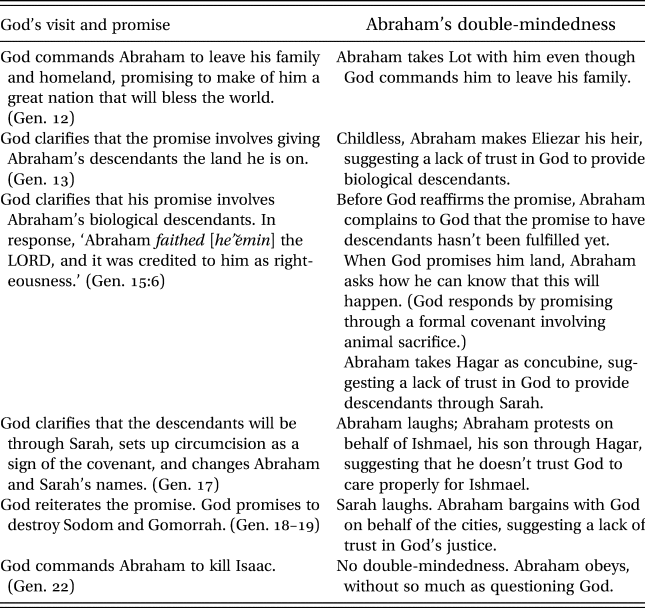
Kvanvig (Reference Kvanvig, Bergmann and Brower2016; Reference Kvanvig2018) and Eleonore Stump (Reference Stump2012) offer competing interpretations of Abraham's faith, amenable to the Loyalty-Only and Trust-Only views. Stump argues that Abraham was the ‘father of faith’ in virtue of his exemplary trust in God's goodness (Stump (Reference Stump2012), 259) and consequent reliability to keep promises. She takes the Abraham narrative to involve a character arc in which Abraham learns to trust in God's goodness and reliability, gradually becoming the father of faith. As she points out, the Abraham narrative is punctuated by a series of visitations by God in which God makes promises to Abraham (or clarifies promises previously made), and in almost every case, Abraham reacts to these encounters by manifesting some distrust, ‘hedging his bets’ on God's promises. (See Table 1 for some central cases.)
Examples of Abraham's ‘double-mindedness’ from Stump (Reference Stump2012)

On Stump's reading, Abraham's experiences of interacting with God over the course of his life give him more and more reason to trust God to fulfil his promises and to act justly. Consequently, Abraham's trust in God's goodness becomes heroically strong by the time of his defining test of faith, the binding of Isaac.
Criticizing Stump's Trust-Only interpretation, Kvanvig contends that faithfulness, rather than trust, is at the heart of Abraham's faith. According to Kvanvig, Stump's interpretation misses the key point that, despite Abraham's doublemindedness, faith was already present from the beginning of Abraham's story. His obedience to God in leaving Hebron already manifested the exemplary faith for which he would be famous.
According to Kvanvig, trust in God is not sufficient to account for Abraham's exemplary faith. In support of this claim, Kvanvig criticizes Stump for not adequately recognizing the importance of God's command to Abraham's faith in the binding of Isaac:
A reservation we should have about Stump's account is that it makes the divine command ancillary to the point of the story. God's command generates a test for Abraham, but the central factors at work in her account relegate the significance of the command to secondary status. The accomplishment of displayed faith, on her account, could have been present even without the command. As far as I can tell, her account of Abraham's faith leaves open the possibility that such faith could have been expressed even if Abraham had decided on his own to sacrifice Isaac, perhaps vowing to sacrifice Isaac on the model of Jephthah, and then displaying the same degree of belief in God's goodness as she attributes to Abraham in the actual story. (Kvanvig (Reference Kvanvig2018), 29)
Kvanvig here criticizes Stump for failing to answer adequately a question that she claims her account handles well: why does Abraham deserve the title ‘the father of faith’ rather than Jephthah, who actually followed through on a child-sacrifice? (Jephthah's sacrifice of his daughter came as a result of an oath he made to God that if God granted him victory over the Ammonites then he would kill the first person to come into his house.) According to Stump, what distinguishes Abraham from Jephthah is his trust in God's goodness and God's faithfulness to fulfil covenant promises. But Kvanvig suggests that Abraham would not have deserved the title of father of faith if he had intended to sacrifice Isaac for the same reason as Jephthah, even if we stipulate that his intention was accompanied by full confidence in the goodness of God. The crucial difference, according to Kvanvig, is that Abraham's intention to kill was in response to a direct command of God.
What has characterized Abraham from the beginning in his relationship with God is constant here: when God says go, Abraham goes; when God says do, Abraham does. It is the following, the obedience, that is the heart of the faith of Abraham, not some imputed story about motives and beliefs that are somehow both ideal and out-of-character in the most difficult following of all. It is, in a word, a rendering of Abraham's faith in terms of his faithfulness that is crucial to the story. (Kvanvig (Reference Kvanvig2018), 30–31)
We agree with Kvanvig that Abraham would not have deserved the title ‘father of faith’ or have been an exemplary person of Judaeo-Christian faith if he had merely trusted in God's goodness without manifesting loyalty in response to God's commands. A high degree of trust in someone is compatible with treating them with great disloyalty, as illustrated by the case of the unrepentantly unfaithful husband who continues to trust his wife to be faithful. Likewise, if Abraham had decided to sacrifice Isaac as an act of disloyalty, such an act might yet have manifested a high degree of trust in God. One can imagine a state of affairs in which, perversely, his trust in God's unconditional promise to make of him a great nation reinforces a heinous decision to kill Isaac; he might think that God will somehow, eventually, set things right. It is counterintuitive, however, to suppose that in such a scenario Abraham is a person of strong Judaeo-Christian faith.
This criticism is related to old objections to Trust-Only accounts of Christian faith, arguably dating back to the New Testament, to the effect that Trust-Only accounts would warrant sinning boldly that grace may abound. They are reasons why many, in thinking about what it is to be a person of Judaeo-Christian faith, have included in their account a disposition to obey God, or a first- or second-order desire to obey God.Footnote 14 It seems counterintuitive to count as a person of exemplary, great, mature, or devout Judaeo-Christian faith someone whose overall stance toward God is characterized by disloyalty.
We've endorsed Kvanvig's claim that trust is not sufficient for Judaeo-Christian faith. Kvanvig defends a Loyalty-Only view of Abraham's faith, and he thus challenges not just the sufficiency of trust for faith but also whether trust is necessary. The narrative, he contends, includes few details about Abraham's psychology, leaving it at best unclear whether his obedience involved trust in God's goodness. In fact, according to Kvanvig, the Abraham narrative is consistent with thinking that throughout his life Abraham was a person with ‘trust issues’, who found it difficult or impossible to trust. People with trust issues can still have a robust affective faith of the sort Abraham exhibits, which requires only that one remain loyal or faithful to God. Kvanvig says,
The divine demands on Abraham are extensive and significant. His faith is deep and secure, expressed even under the most trying circumstances, and the exemplary character of that faith isn't threatened at all by the supposition that it involves a significant degree of failure of trust. (Kvanvig (Reference Kvanvig2018), 35)
Thus, in Kvanvig's view, trust is not necessary for faith, not even the exemplary faith of Abraham. Abraham had faith in leaving Hebron despite his doublemindedness, and despite arguably lacking trust either in God outright or in God keeping the promise to make of him a great nation. The worry Kvanvig raises here is a challenge to any theory of Judaeo-Christian faith that includes an element of trust, including our own Trust-Loyalty view.
It is worth noting, though, that there is also a prima facie challenge here for a Loyalty-Only theorist. Kvanvig comes close to committing himself to the claim that unquestioning loyalty is required in order to count as a person of faith. And yet, although it is true that Abraham goes when God says to go to Hebron, he doesn't follow God's command to leave all of his kin. The doublemindedness he shows in bringing Lot, the part of the family that could carry on his line if God doesn't come through by providing a direct heir, casts doubt on his unquestioning loyalty as much as his trust.
In spite of these needed qualifications, what seems true about the strength of Abraham's faith is that in obeying God's command to leave his kin in Hebron and go to Canaan, Abraham trusts God enough to leave most of his family, but not enough to leave Lot. He is also loyal enough to do these things as well, without displaying unqualified loyalty. We'll develop an account that is sensitive to these kinds of qualifications in the final section.
Is loyalty enough?
Note a crucial difference between Kvanvig and Stump's readings of the narrative. Kvanvig endorses the following two interpretive theses about Abraham's faith:
-
Constant Strength of Faith: The strength of Abraham's faith is relatively stable throughout the narrative.
-
Constant Virtue of Faith: Abraham had the virtue of faith throughout the narrative.
Stump, on the other hand, views Abraham as growing into faith in fits and starts, but eventually – by the time of the binding of Isaac – developing a faith that is heroic in both strength and virtue.
These do not exhaust the interpretative options, and we will argue for an alternative that endorses the Constant Virtue but not the Constant Strength thesis. In support of the Constant Virtue of Faith thesis, interpreters (including the author of Hebrews) typically praise Abraham's faith in leaving Hebron at the beginning of his relationship with God (Genesis 12), and God commends Abraham's faith in the middle of the narrative (Genesis 15:6). So, even though the binding of Isaac is undoubtedly the climactic story of faith in the narrative, there is considerable interpretative plausibility to Kvanvig's claim that Abraham exhibited a virtue of faith that was relatively constant at least from the time he left his homeland for Canaan (in Genesis 12).
Having an admirable or virtuous faith, though, need not mean that faith is ideally psychologically strong. In an Aristotelian framework, having a virtue is a matter of having a character trait in the right manner, to the right degree, etc. given one's circumstances. One can be a person of faith on the kind of Trust-Loyalty view we defend in ways that do not simply involve maximal strength in the dimensions of trust and loyalty.
Against the Constant Strength of Faith thesis, there is considerable plausibility to Stump's claim that the Abraham narrative presents Abraham's faith as growing or strengthening over time, culminating in the faith he manifested in the binding of Isaac. Although it is true, as Kvanvig notes, that the narrative contains few explicit descriptions of Abraham's psychology, a narrative doesn't have to explicitly describe the psychology of its protagonist in order to present a compelling psychological portrait (witness the writings of Ernest Hemingway). Including trust as a dimension in which faith can be strong, we will argue, has two main advantages.
First, we note an interpretative reason internal to the Abraham narrative for thinking that Abraham's faith partly consisted in his trust in God to fulfil covenant promises. Genesis 15, a key passage that commends Abraham's faith, also connects his faith fairly explicitly to his trust in God's promises. At the beginning of the visitation from God described there, Abraham complains to God that he is still heirless: the promise to make of him a great nation has not been fulfilled. God responds by promising that Abraham's descendants will be as numerous as the stars he sees in the sky. This promise is immediately followed by the crucial verse 15:6, ‘Abraham faithed [he’ĕmin] the LORD, and it was credited to him as righteousness.’
Proponents of the various views could make a case for translating he’ĕmin as ‘believed’, ‘trusted’, or ‘was faithful/loyal to’, each of which fall within the semantic range of the Hebrew term. However, the hiphil verb conjugation foregrounds the trust side of the register (Healey (Reference Healey and Freedman1992), 745), and the narrative context strongly suggests that it is Abraham's trust in God's promise rather than Abraham's loyalty or obedience to God that is primarily in view. Genesis 15:6 is immediately preceded by God's promise, and not by any command of God, so the passage is an important exception to Kvanvig's point that the narrative typically presents Abraham's faith as a response to God's command. Further support for the trust interpretation of Genesis 15:6 comes from the continuation of the passage when, the next day, God formalizes the promise with a covenant ceremony that involves walking among sacrificed animals (the significance being that breaking the promise merits death). Notably, Abraham is neither commanded to do anything nor asked to promise anything in the ceremony. It is God alone who walks – symbolically, in the form of fire and smoke – among the sacrificed animals. The desired effect of the formal ritual seems to be to give Abraham further reason to trust God to keep this unconditional promise (see Stump (Reference Stump2012), 270–272).
Second, postulating an increase in Abraham's trust in God is especially crucial, we will argue, in order to explain the strikingly different responses to God Abraham makes in bargaining for Sodom and Gomorrah and in the binding of Isaac. In the Sodom and Gomorrah episode (Genesis 18:16–33), Abraham stands before the Lord, challenging God's investigation of wickedness in Sodom and Gomorrah. ‘Will you sweep away the righteous with the wicked?’, Abraham asks. Interestingly, God is willing to bargain, agreeing to spare the whole city if there are fifty righteous people. And then forty-five . . . forty . . . thirty . . . twenty . . . ten . . . and a deal is agreed upon. In bargaining for Sodom and Gomorrah, Abraham challenges God in a manner similar to, if less extreme than, Job's protests of God's apparently unjust treatment of him. However, as Stump notes, Abraham's response to God's command to kill Isaac stands in stark contrast to Job's protests:
Job attacks God himself and demands redress when he thinks the God whom he loved and served has unjustly overwhelmed him with catastrophe. Job demands God's reasons for his suffering; he calls God to account for the injustice of what has happened to him. In circumstances such as these, a great soul will be defiant, not fearful.
But what is Abraham's reaction? It is neither collapse nor revolt. As dramatic as God's command is in the narrative, there is equal drama in Abraham's reaction. He is simply silent. He says nothing to God, or to anyone else either. He simply prepares to obey. (Stump (Reference Stump2012), 295)
Consider this question prompted by the text: in the face of God's command to sacrifice Isaac, why didn't Abraham challenge God, as Job did, or at least respond with a pointed question or two, as he had done earlier on behalf of Sodom and Gomorrah? This descriptive psychological question also has a normative counterpart: shouldn't he have done so?
Satisfying answers to these questions seem to us to require including trust as a component of faith. While we have agreed with Kvanvig that Abraham's loyal obedience in light of God's commands is an essential part of his response of faith, it is implausible to see Abraham's faith as virtuous in the culminating event of his life, the binding of his own son in loyalty to God, apart from his unquestioning loyalty functioning in combination with a high degree of justifiable trust. Stump is right to interpret Abraham's faith as developing and maturing in the dimension of trust over time. In the next section, we explain what virtuous faith looks like on our Trust-Loyalty model and, with this in view, we will argue both that high trust is needed in order to see Abraham's binding of Isaac as virtuous and that Abraham's earlier dealings with God are, in their own way, also readily understandable as virtuous expressions of faith.
Thus, while the sort of trust and loyalty involved in virtuous expressions of Judaeo-Christian faith may need to be qualified in significant ways that stand in need of exploration, neither loyalty nor trust are by themselves sufficient for Judaeo-Christian faith.
The Trust-Loyalty view
Faith and covenant
We'll introduce the Trust-Loyalty account in connection with the idea of covenant, berîṯ, which is crucial for understanding the function and value of faith in the Abraham story. (Although we focus on the concept of covenant inherited from the Ancient Near East here, many of the points that we make about the function of trust and loyalty in the context of covenantal relations also apply to relationships more generally, including at least some forms of friendship, where parties typically have less formalized normative expectations for each other, whether explicit or implicit.) A covenant is a formal agreement around which a relationship is structured – a mutual contract, bound by promises (e.g. to perform or refrain from performing actions), that sets up obligations and expectations by which the relationship will be regulated. Party A promises B that A will do x, y, and z, perhaps conditional on B's fulfilling B's own covenantal obligations.
The promises made in a covenant set up what it is for each party to be faithful to the other within the context of the relationship. In a conditional covenant, at least some promises are such that breaking them nulls the covenant and releases the other party from their obligations. The relationship's flourishing depends on each of the parties being able to trust that the other will keep their covenantal promises, and on each maintaining a commitment or intention to keep his or her promises.
Note in this connection a difference between faithfulness and loyalty in the context of an explicitly defined covenantal relationship. A key part of what makes the keeping of wedding vows an instance of being faithful to a spouse is the fact that the promises are accepted and reciprocated. Someone who made similar promises without their being accepted and reciprocated would be a stalker, not a spouse. Although such a person might count as being loyal to the other, in ways that mirror loyalty in a marriage, and might even count as remaining faithful to their promises, their loyalty does not count as being faithful to the other person. A similar point seems to hold in cases in which a conditional covenant has irrevocably ended.
Though they are similar to contracts, covenants involve solemn vows undertaken with more seriousness and permanence. They also have a more open-ended, relational character, which ordinary contracts typically lack: promises made in covenant relationships typically go well beyond those involved in ordinary contractual relationships. In the case of the covenant of marriage (which the Christian tradition uses extensively as an analogue of the relationship God desires to have with people) each party typically promises to love or ‘be for’ the other's good. Making such promises adds a level of commitment on top of the pre-covenant relationship. A couple may already have obligations towards each other in virtue of friendship or as romantic partners. But entering into a covenant with each other adds further obligations in virtue of the promises made, giving each party a special set of obligations owed to the other in particular.
In some covenant relationships – for example, between teachers and disciples, generals and soldiers, and rulers and those they govern – the covenantal expectations of loyalty are less symmetrical than in marriage (see Morgan (Reference Morgan2015), 120). In these relationships, allegiance is the type of loyalty expected to be shown towards those in authority. Often, such relationships are structured around a common purpose or set of ideals to which both parties also owe allegiance. U.S. presidential advisers, for example, serve at the pleasure of the president but also take an oath to uphold and defend the U.S. Constitution, to which both parties have a higher loyalty.
The covenant between God and Abraham is a key theme in the Abraham narrative, which sometimes emphasizes Abraham's trust in God's promises and sometimes his faithful obedience in keeping his own covenant promises to God. Indeed, we will argue that, in the context of covenant relationships, loyalty and trust are intertwined psychologically and normatively in such a way that it makes sense to think of being a person of faith in terms of their combination.
Trust-Loyalty faith as a social virtue
We propose that virtuous faith will involve different manifestations of loyalty and trust, being appropriate at different times and in different strengths, according to the agent's evidence and circumstances. Seen as a virtue, loyalty and trust working together in appropriate combination contribute to the good of flourishing interpersonal relationships that are not too easily abandoned in times of trial.
Consider some cases of human relationships under strain, when one party seems to be abandoning or violating shared ideals or norms: a married person who discovers evidence that a spouse has had an affair; a student whose teacher uses unorthodox pedagogical methods that seem pointless; a public official serving a president who seems to be violating constitutional norms; or a soldier whose leader gives a command that seems to have no strategic merit.
Here are four different ways that the married person, student, official, or soldier might respond to the apparent conflict between the person's actions and shared ideals.
First, they might protest at the violation and use this as grounds for ending the relationship. The spouse might cite the infidelity as grounds for divorce. The soldier or public official might resign in protest. Call this the resign in protest response.
Second, they might exhibit a response maintaining high-trust and unquestioning loyalty in unflinching subordination, while explaining away the conflict as merely apparent. Thus, the soldier or student might obey the commander's orders or the teacher's unorthodox instructions, trusting that those in authority are warranted in ways that they are not well positioned to understand. Similarly, the married person might defer to their partner, dismissing the apparent evidence as misleading and trusting their spouse that no infidelity has occurred. Call this the see no conflict response. Below we will argue that Abraham's binding of Isaac involves a justified example of this response.
Third, they might adopt an adjusted ideals response, abandoning or adjusting the shared ideals to fit the actions of the person. For example, the married person might come to believe that there is nothing wrong with sex outside marriage. The public official might hold that whatever the leader does is acceptable precisely because they did it.
A fourth distinct kind of response involves protesting in faith. Without explaining away the apparent violation or using it as grounds for breaking the relationship, one might aim at remaining loyal to the person by calling them back to shared ideals. In the final section, we will argue that Abraham's calling God to accountability in the Sodom and Gomorrah scene involves this sort of response.
These different responses suggest several ways in which trust and loyalty, though conceptually distinct, are normatively and causally intertwined in the context of covenantal relationships, in ways that bear on which of the above responses is appropriate given the situation.Footnote 15 First, one's reasons for trusting others can, in turn, provide reasons for or against being loyal. Whether one's covenant promises are binding, in the context of a conditional covenant, depends on the other's continued faithfulness in keeping covenant promises. Thus, to the extent that you have good reason to trust the other to be faithful to keep covenantal promises, you have reason to think that you will be on the hook for your own promises and should remain faithful to keeping them. Conversely, strong reasons to distrust can cancel one's obligations to remain loyal. For example, if one has overwhelmingly compelling reasons to think that a teacher is untrustworthy qua teacher (because they are incompetent or don't even try to help the student learn), then one is no longer justified in remaining loyal to the teacher qua teacher. If the teacher deviates far enough, one might even have an obligation to stop being loyal to them qua teacher, ending the student–teacher relationship with them. Reasons to distrust someone can justify the option of resigning in protest.
Second, assuming that reasons to distrust are not so strong as to demand the resigning in protest response, reasons for or against continuing to trust someone can affect the strength and character of the loyalty that is normatively appropriate within a covenant relationship. In the context of strong reasons to trust a leader, spouse, or teacher – for example, a long history in which the other has consistently proven trustworthy – one may be justified in performing acts of unquestioning allegiance or loyalty in response to requests or commands that seem in tension with the other's trustworthy character, as when a student persists in doing exercises assigned by a teacher with unorthodox pedagogical methods, or a soldier loyally follows a command that seems on its face to have no strategic value. One might be justified in trusting the person in authority to have some justifying reason one does not understand. In short, strong reasons for trust can justify the see no conflict option.
However, in contexts in which strong reasons for trust are absent, the appropriate kind of loyalty or allegiance will not be of an unquestioning sort; in such cases, loyalty might properly be expressed in faithful protest, calling the other back to shared ideals without abandoning the covenant relationship. Thus, the public official serving a president who seems to be violating constitutional norms might aim to remain loyal to the office of the presidency by challenging the president to return to the constitutional ideals they share. The spouse might respond to infidelity by calling the other to repent and return to faithfulness.
Abraham's Akedah faith and the see no conflict response
With these four responses in view, we can say more about what it would take to see Abraham's faith as virtuous in the binding of Isaac passage. On this occasion, Abraham neither protests at nor questions God's command, so his response must be either the see no conflict or the adjusted values response. In the context of the narrative, only the first option plausibly explains and justifies Abraham's unquestioning obedience. In the world of the story, the best explanation of his unquestioning obedience is that by this time in his life he has extraordinarily good epistemic reasons for trusting God. We agree with Stump's explanation, namely that Abraham's response is virtuous because of the lessons he has learned about God's trustworthiness over a lifetime of relating to God. His unquestioning loyalty is distinguished by a trust that somehow, despite strong appearances to the contrary, there is no conflict between God's command and his essential goodness or his ability to keep his covenant promise. Miracles such as Isaac's birth, in fulfilment of promises that seemed impossible on their face, had taught him to answer ‘no’ to the pointed question God had earlier asked in response to Sarah's doubt: ‘Is there anything too difficult for the Lord?’ (Genesis 18:14).Footnote 16 Abraham's is the high-trust loyalty of a soldier who loyally obeys a command that seems to have no strategic value, trusting that the commanding officer is better positioned to see its merit, or the student who persists in an exercise that seems pointless, trusting that the teacher has a pedagogical goal in mind that the student does not currently understand.
The alternative is to interpret Abraham's response along the lines of the adjusted values response. Perhaps Abraham exhibited an unquestioning loyalty of the sort displayed by someone who views whatever their leader commands as thereby acceptable because they commanded it. Or perhaps he was willing to adjust or ignore his own idea of what is good out of unquestioning loyalty to God.
We see two main problems for this alternative. First, it is out of keeping with Abraham's earlier bargaining for Sodom and Gomorrah. The narrative does not depict Abraham's questioning God as inappropriate, given their relationship at the time. This makes Abraham's change of attitude both out of character and unjustifiable. While nothing in the narrative supports a change in Abraham's attitude towards whether it is acceptable sometimes to question God, the narrative does suggest that by the time of the binding of Isaac he had considerably more evidence of God's faithfulness and justice.
Second, given the specific command of God in the binding of Isaac passage, an interpretation on which Abraham's trust in God is strong seems required for Abraham's loyal obedience to count as fidelity or faithfulness to God. As we noted above, in a conditional covenant relationship the covenantal promises determine which behaviours constitute remaining faithful, and some promises are so central that failing to keep them dissolves the covenant and cancels the other party's obligations to keep their promises. Let us return to the example of a married person who believes that a spouse has violated wedding vows. Remaining loyal to the spouse might count as remaining faithful if one has some trust in the spouse to return to keeping covenantal promises (although in this case protesting in faith and calling the other to return to shared ideals is the type of loyalty that seems appropriate). However, if one believes that a conditional covenant is irreparably broken – after a divorce, for example – then to remain loyal is no longer to show covenantal faithfulness. (Nor does it show covenantal unfaithfulness; the point is that to attribute either is a category mistake when the covenantal relationship ends. Covenantal relationships, by their nature, involve an agreement between two parties.) In Abraham's covenantal relation to God, the fundamental promise of God on which the relationship is based is that God will care for Abraham's descendants with Sarah and make of them a great nation. On its face, God's command to kill Isaac seems to be a command for Abraham to facilitate God in breaking this fundamental promise, ending the covenant that must be intact in order to construe this act of loyalty as an act of fidelity to God. Thus, unless we suppose that Abraham trusted that somehow things were not as they appeared, we cannot make sense of Abraham's loyal and unquestioning obedience as a virtuous act of fidelity to God. In general, unquestioning loyalty is virtuous only when it is based on a high degree of warranted trust.
To sum up our discussion so far: first, we noted a trend in recent biblical scholarship that takes important instances of the ʾĕmûnâ and pistis/fides lexicons to pick out something that encompasses both trust and loyalty. We have offered an account that makes sense of why biblical authors might plausibly have attached such value to it in divine–human relations and of why the Graeco-Roman world more widely might have regarded it as an important social virtue. We can think of a person of virtuous faith as one who is disposed to respond with faith in and faithfulness to another in appropriate circumstances, or breaking faith with others if the circumstances warrant. Trust and loyalty function together dynamically in the context of covenant relations and less formal relationships founded on mutual trust and loyalty. The kinds of responses to others that are appropriate, particularly when relationships are under strain, depends both on the sort of trust that is normatively appropriate and on the sort of loyalty that is normatively appropriate. Since having the virtue of faith, so understood, is valuable, we can also see why it would be important to track trust and loyalty of others in combinations that may not involve the virtue of faith. So, it makes sense that people would have a word (pistis) to characterize the character trait or complex psychological trait possessed by people of faith.
Protesting in faith
Before closing, we consider a final strenuous test that poses a potential challenge for all of the accounts under consideration: can we make sense of the idea that the virtuous response of a person of faith might sometimes manifest in questioning or even protesting against God? You might think that when God is the object of faith, the see no conflict response is the only justifiable response of faith. After all, if God is all powerful, wholly good, and perfectly trustworthy, what sense can be made of virtuous protest? You might think, further, that when God is the object of faith the Trust-Loyalty theorist should simply say that exemplary persons of faith are those who max out in both dimensions, trust and loyalty.
Granted, on the assumption that Abraham is basically right (i.e. that God really exists, is faithful to what has been promised to Abraham, and has in fact issued the commands Abraham thinks that God has), from an objective perspective it would be best for Abraham to maximize his trust and loyalty to God. However, before readers jump too quickly to binding their own Isaacs, let's keep in mind that from a second- or first-person perspective often that isn't what virtue calls for. One's evidential circumstances typically are relevant to the response that is appropriate, and it is from this perspective that we will discuss faith as a virtue.
Abraham's bargaining for Sodom and Gomorrah as protesting in faith
Recall Kvanvig's claim that the exemplary character of Abraham's faith throughout the narrative is not threatened by the supposition that Abraham's trust in God's goodness was weak. We have argued that making sense of the binding of Isaac as an exemplary case of faith requires thinking of it as a case in which Abraham had extraordinary justification for strong trust in God. However, we agree that Abraham's having the virtue of faith is compatible with the idea that his trust in God's goodness was weak at times, such as in the doublemindedness he exhibits in bringing Lot with him when he left Hebron.
In fact, in some episodes of Abraham's story, such as his bargaining with God for Sodom and Gomorrah, the lack of complete trust in God's goodness and lack of unquestioning loyalty that Abraham manifests seem to be entirely appropriate and even admirable. Since Abraham's questioning betrays a diminished trust in God to act justly, one might be inclined to see his response as a lapse in faith. Similarly, one might think that it displays diminished loyalty to God, since the response is not one of unquestioning loyalty that takes whatever God does to be right. And yet, there is a tradition worth accommodating that takes Abraham's bargaining actually to be expressive of a deep and abiding faith in God, a faith that can persist and be appropriate to the situation even when his trust in God to act justly is extremely low and tenuous, and his loyalty is not unquestioning.
As a contemporary exemplar of this ‘protest tradition’ of thinking about faith, consider the model and writings of Holocaust survivor and Nobel Laureate, Elie Wiesel. Despite the horrors he witnessed as a teenager in Auschwitz and Buchenwald, Wiesel claimed that he never abandoned faith in God. In his 1996 memoir, Wiesel explains his faith in God by appealing to the Jewish tradition of protest:
[I]f Nietzsche could cry out to the old man in the forest that God is dead, the Jew in me cannot. I have never renounced my faith in God. I have risen against His injustice, protested His silence and sometimes his absence, but my anger rises up within faith and not outside it. I admit that this is hardly an original position. It is part of Jewish tradition. But in these matters I have never sought originality. On the contrary, I have always aspired to follow in the footsteps of my father and those who went before him. Moreover, the texts cite many occasions when prophets and sages rebelled against the lack of divine interference in human affairs during times of persecution. Abraham, Moses, [and] Jeremiah . . . teach us that it is permissible for a man to accuse God, provided it be done in the name of faith in God. (Wiesel (Reference Wiesel1996), 84)
Unlike Nietzsche, Wiesel doesn't deny that God exists. Instead, acting on the assumption that God does exist, he continues to engage with God, shaking a fist against God's apparent silence and injustice. Examples in the ‘protest tradition’ that Wiesel is citing include Abraham's contending with God for Sodom and Gomorrah, Jacob's wrestling with God, Jeremiah's complaints to God on behalf of justice (while simultaneously confessing that his heart is with God in Jeremiah 12:1–4), Job's refusal of easy answers on why he is suffering, and the Psalmists’ protest against God's apparent absence and silence.Footnote 17
Although Stump's reading of the faith of Abraham takes trust to be fundamental to faith, she makes several points amenable to our Trust-Loyalty understanding of protest in her insightful discussion of Job, an especially clear exemplar of the protest tradition. During his darkest moments, Job expresses serious distrust in God's essential goodness. Although Job remains loyal to God in that he never curses God to his face (as Satan wants him to do), Job angrily and publicly charges God with wrongdoing. As Stump points out, Job's attitude toward God is depicted in the story as appropriate. In rebutting his comforters, who advocated blind trust in God's goodness, Job suggests that even God would approve of his attitude over theirs, and God vindicates this view when he shows up at the end of the story and strongly chastises them: ‘My anger is hot against you because you have not said of me the thing that is right, as my servant Job has’ (Job 42:7).
Making sense of the protest tradition is challenging. The protest, which the tradition sees as rising up within faith, can seem positively incompatible with faith. One option available to Trust-Only or Loyalty-Only theorists is to bite the bullet and to deny that Job, Wiesel, or others are people of faith. The Trust-Only theorist might say that, given the severity of the distrust in God's goodness that Job expresses, we should view Job as someone who abandons his faith (perhaps regaining it at the very end, in the happy-ending postscript). Likewise, the Loyalty-Only theorist might regard his attitude as incompatible with faith, since it is not an instance of unquestioning loyalty. But that comes at a heavy cost. We expect that proponents of either view will find this landing spot uncomfortable and unattractive.
But how can they avoid it? By themselves, the commitments of each view seem to pressure theorists in this direction. Consider proposals that Trust-Only and Loyalty-Only theorists might take as necessary conditions for being a person of Judaeo-Christian faith, in terms of loyalty or trust:
-
Someone is a person of Judaeo-Christian faith only if they trust in God. [Two-place trust]
-
Someone is a person of Judaeo-Christian faith only if they trust God to keep covenantal promises (promises to bless, to save). [Three-place trust]
-
Someone is a person of Judaeo-Christian faith only if they have unquestioning loyalty to God. (When God says ‘Go’, they go.)
Each of these proposals is arguably too strong. Abraham's bargaining with God for Sodom and Gomorrah casts doubt on whether he has outright trust in God and unquestioning loyalty to God. In Job's case, his overall attitude is even farther removed from unquestioning loyalty, and manifests considerable distrust. The protest tradition thus raises a prima facie challenge to any view that takes trust or loyalty to be necessary for faith.
One might think that our Trust-Loyalty view is in double trouble, since it takes being a person of Judaeo-Christian faith to involve dimensions of both trust and loyalty. However, we will argue that in fact the Trust-Loyalty view has resources for understanding the tradition that Trust-Only and Loyalty-Only views lack.
Protesting in faith
What is it to protest ‘in faith’? Three related ideas characterize the idea in interpersonal relationships and seem to fit both Wiesel's view of protesting God in faith and Stump's discussion of Job.
First, protesting in faith requires that the protester not treat the violation as a reason to abandon the covenant relationship. In cases of protesting in faith, the protester remains open to continued relationship, unlike one who takes the resigning in protest option. The angry protest of someone after a divorce who sees no prospect for reconciliation is not a protest in faith.
Note that when Wiesel claims to have retained faith in God, he goes on to say that he has never renounced his faith in God. The salient contrast with having faith is renouncing, betraying, or abandoning it, not distrusting or failing to show unquestioning loyalty.Footnote 18 Protesting against God in faith involves a continued openness to relationship with God. One does not use the apparent violation of trust on God's part as a reason to abandon the relationship. As Stump notes, Job's angry protests against God's treatment of him are compatible with his engaging God in a loving relationship.
In the dialogues with the comforters . . . Job is vehemently indignant against God; but anger and indignation are one way to continue holding on to a relationship of love. A wife whose husband is furious at her is still very much in relationship with him. The distance indicated by cursing a person to his face requires something colder and harder than anger. (Stump (Reference Stump2012), 217)
Second, as we mentioned earlier, one who protests in faith must exhibit a kind of loyalty to the person (not just to the shared ideals), although not of an unquestioning sort. The point of protesting in faith is to call the other party back to shared ideals as a way of being loyal to them. For example, a presidential adviser can remain loyal to the president by calling them back to constitutional ideals. In this, protesting in faith contrasts with resigning in protest (where one chooses loyalty to the shared ideals over loyalty to the person without remaining open to the relationship); with the adjusted ideals response (where one chooses loyalty to the person over the shared ideals); and with the see no conflict response (where there is no protest).
Likewise, in protesting against God in faith one aims at remaining loyal to God by remaining loyal to God's ideals. Protesting against God in faith is a bit more difficult to make sense of since, given God's essential goodness, it is difficult to see conceptual space between God's actions and higher ideals. In this connection, Stump distinguishes between being loyal to the office of God and being loyal to the person of God. She acknowledges that Job did not exhibit a loyalty to God of the sort that would endorse as good whatever God does. His is not the loyalty of those who are prepared to label as good whatever a leader should say or do. Nevertheless, she argues that Job manifests loyalty to God by remaining loyal to the goodness of God. Stump says,
In denouncing the comforters’ willingness to kowtow to God, Job takes his stand with the goodness of God, rather than with the office of God as ruler of the universe. Without losing his personal commitment to the person of God, Job refuses to accept what God does just because it is God who does it. If, per impossibile, divine power and divine goodness were to be opposed, then in the way in which he reacts to his suffering Job is in effect choosing to be on the side of goodness rather than on the side of power, even if the side of power should be God's side. In this choice, Job is as fervently on God's side as it is possible to be. . . . And so, by being angry at God and by insisting on goodness over power, even in God's case, Job in fact draws closer to God. (Stump (Reference Stump2012), 217–218)
The criticism of God that is involved in protesting within faith is that God has not been true to his own ideals. As Wiesel says he learned from his teachers: ‘Only the Jew knows that he may oppose God as long as he does so in defense of His creation’ (Wiesel et al. (Reference Wiesel, McAfee Brown and Fox1995), 6). By remaining true to God's cause and to God's creation, one remains loyal to God, despite the protest.
The Loyalty-Only theorist might appeal to this distinction as an answer to the prima facie worry, abandoning the claim that faith requires unquestioning loyalty. But there are some normative waters to be navigated here: whether this kind of loyalty is appropriate depends on the extent to which trust is justified. In order for it to be appropriate to take the protesting in faith rather than see no conflict response, trust must be not overwhelmingly justified. In order for it to be appropriate to protest in faith rather than resign in protest some trust must be justified. This brings us to our third point.
Third, virtuous protest in faith requires some trust in the other party, though not trust of an unqualified sort. The very idea of protesting in faith suggests that your trust in the person is not of an unqualified sort. Genuine unqualified trust that they have not violated the shared ideals lands you in the see no conflict response; protest certainly wouldn't be called for in that case.
Protests of a more peripheral sort do not serve as a challenge to plausible two-place or three-place accounts of faith in terms of outright trust, since lacking trust in someone to perform certain kinds of actions is compatible with having significant outright two-place or three-place trust in them. For example, protest that implies a complete lack of trust in a spouse to do the dishes or to be on time for an appointment is compatible with a strong two-place trust in the other, and compatible with trust in them to keep their wedding vows.
However, in more extreme cases of protesting in faith the overall relationship might be characterized by a lack of two-place trust or even by outright three-place distrust of someone to come through for you in respects that are central to your relationship with them. For example, past infidelities might cause you to lose trust in a partner's current capacity to keep fundamental promises on which the relationship depends. Virtuously protesting such infidelities within faith is still possible in such extreme circumstances, though it seems to require at least trust in the partner to return to the relationship or to become again the sort of person who can properly be trusted (e.g. to come to see the error of his ways, repent, and become again the sort of person who is worthy of two-place trust).Footnote 19
There are two very different sorts of trust that the protester might retain and we submit that, unless the protester has at least the minimal sort of trust involved in one or the other of these two kinds of trust, then they won't count as a person of faith.
First, the protester might take the other party to have violated the covenant but trust in them to return to it someday. Indeed, part of the point of such protests is to hold them accountable and call on them to return to the shared ideals. Plausibly, a protester won't count as a person of Judaeo-Christian faith if they think that God has violated the covenant but there is no sense in which they trust in God to return to it someday. Making sense of protesting against God in faith in this way presents some further, theological complications that do not arise in the case of protesting against human persons in faith. Some won't see that as sufficient for orthodox faith. It is the route taken by process theologians, but it is harder to reconcile with the idea that God is necessarily good. If we suppose that God is necessarily good, it does not seem coherent to suppose that God has transgressed but can still be trusted to return to being faithful. Can we make sense of the strenuous protest of Job and Wiesel while maintaining a high view of the divine attributes?
Second, the protester might trust the other party to some degree that, despite appearances, the covenant has not in fact been violated. You might have some trust in a spouse's testimony that, in spite of your lying eyes, they have in fact been faithful. Similarly, you might retain some trust in God's goodness in such a way that, despite appearances, you trust that God is not in fact in violation of the covenant, even though you cannot see how. On this theologically more orthodox option, someone who protests in faith must have at least a minimal trust in God's essential goodness, which perhaps consists in hoping-against-hope that God may yet have some justifying reason for the actions being protested. What's needed here is trust enough not to abandon the covenant relationship, but not enough to stop protesting. (Otherwise the See No Conflict response would be appropriate.) In order to allow room for the most extreme cases, this hope should not be conceived as strong enough to make it seem inappropriate to the protester to express strongly worded complaints. Job and others in the protest tradition do not trust in God's goodness enough to stop protesting, and if we consider whether their overall stance towards God is one of trust in God's goodness, the answer seems to be ‘no’. It is compatible with these claims, however, that Job and other protestors trust in God's goodness enough to risk continuing a covenant relationship with God, enough to refrain from cursing God, and enough to continue to ask, as Wiesel did, why God would allow horrendous suffering.
Our version of the Trust-Loyalty view thus seems to deliver the correct result: someone who remains loyal to God and has trust of either the first or second kind might plausibly be described as a person of faith. What's even more clear, however, is that someone who so thoroughly distrusts God and so does not trust God even in these minimal ways or anything like these ways, is not rightly regarded as a person of faith no matter how loyal they are. It is not plausible to describe someone who protests against God, in the absence of either the first or the second sort of trust, as a person of faith. Indeed, one lesson that you might take from the Job narrative is that even if God has reasons that ultimately vindicate God's actions, God might actually prefer a response of protesting in faith given one's epistemic situation. As might a parent who is pleased with her child's response to a morally puzzling command, God endorses Job's response in contrast to the responses endorsed by Job's friends.
Some readers may be tempted to dismiss the protest tradition, as a way of sidestepping the complexities that it raises for theorizing about faith. How central is it, really, to the Christian tradition? We think that it is not easily dismissed. Even those who are sceptical that the protest of Job or Wiesel manifests faith should note that more ordinary Christian practices are arguably along the same continuum as protest, if not as extreme. Consider, for example, the practice of petitionary prayer, in which one petitions God for justice to be done. In the Christian tradition, these prayers are asserted as requests that God make good on His promise that His kingdom will come. Implicit in such requests, though, is the idea that without the request God might not act in these just ways. The petitioner seems open to the following questions: Why are you asking God for justice? Do you think that God is not just? Would God not act in a just way even without your prayers?
On this point, consider the way a thoroughgoing Trust-Only interpretation threatens to undercut the stated purpose of the Parable of the Widow and the Unjust Judge: to teach the need for persistent prayer. If the point of the story were simply that God is to be trusted, this might undermine any reason we have to ‘cry to him day and night’ for justice, almost as much as would the belief that God is unjust. The motivation becomes apparent if we add shades of a protest reading, according to which we are encouraged to emulate some of the widow's chutzpah in our prayer life. Were one to look for faith on earth, on this reading, one thing to look for would be people who aim to ‘wear out’ God with cries for justice.Footnote 20
The Trust-Only theorist might respond by claiming that petitionary prayer is really for our moral development and is not causally efficacious. On this view, God wants us to petition because God wants to develop in us the practice of being attentive to the needs of others and to places where justice needs to increase. God would act in perfectly good and just ways with or without us, but God wants us to ask as a way to teach us these things. Notice, though, that even this account of petitionary prayer invokes the idea that God wants us to interact and engage with God in a way that involves requests, acting as if these could have a causal impact, and thus as if God might otherwise not act. So, even on this view there is a mode of interaction that God desires that seems to manifest low trust.
Conclusion
We have argued that the broad response to God commended in scripture – ‘Judaeo-Christian faith’, the complex property had by a ‘person of Judaeo-Christian faith’ – includes dimensions of both trust in and loyalty to God.
One of the claims we have made about this response is axiological: the distinctive goods made available in relationships (whether human–divine or human–human relationships) characterized by both trust and loyalty are sufficiently important to make them worth picking out in combination. The two components, though distinct, are interconnected causally and normatively in ways that are conducive to flourishing covenantal relations. They function together to contribute to something of recognizable social and eudaemonic value: flourishing covenant relationships that are not too easily abandoned and are resilient in times of trial.
Second, the valuable response is a good candidate for ‘faith’, in the sense of what people of Jewish or Christian faith have or are encouraged to aspire to, anchored in scriptural understanding of ʾĕmûnâ and pistis. In particular, the Trust-Loyalty view provides a promising account of the faith of exemplars. It accounts for the perseverant combination of trust and loyalty embodied in Abraham's engagement in a covenantal relationship with God. It also illuminates the highly resilient relationships evident in the protest tradition, through circumstances where moral and evidential circumstances call for manifestations of faith that involve neither an unquestioning loyalty nor a high degree of trust. Though different aspects are emphasized or brought more clearly into the foreground in various contexts, the response of faith that God is said to desire of humans is characterized by both trust and loyalty in appropriate combination. Paradigmatically flourishing relationships of the kind we have in view are such that each party has faith in and is faithful to the other. Attitudes of trust and loyalty are each arguably indispensable to flourishing in such relationships. They are two sides of a coin, but there is a single coin, a quality very much worth having and reflecting upon.Footnote 21