Introduction
In the aftermath of the Nanjing Massacre, one way in which Wang Jingwei's Reorganized National Government (RNG) (1940–45) sought to impose social order was to implement a corporatist labour strategy. Inspired by European fascist theory and building on the pre-war Nationalist-Government labour legislation, corporatism sought to prevent union autonomy, stifle class-based sentiment, and undermine the pursuit of class interests, whether on the part of capitalists or of workers. It also strived to ensure government control and loyalty to the state, and promote production.Footnote 1 Corporatism, as Elizabeth Perry explains, was adopted by the Nationalists during the Nanjing decade (1927–37) to avoid class conflict while promoting economic development. In theory, the state would reorganize society along hierarchical lines whereby organizations and interest groups would be licensed by the state. Leaders of these organizations would be supported by the state in exchange for a commitment to social order and keeping their interests and aspirations in line with state mandates.Footnote 2
The key organ of the Wang regime that implemented corporatist labour practices was the Social Movement Guidance Committee (Shehui yundong zhidao weiyuanhui or Sheyunhui for short). Together with the Relief Aid Committee (Zhenwu weiyuanhui), the Sheyunhui was formed in August 1941 upon the dissolution of the Ministry of Social Affairs and was administered directly by the Wang government's Executive Yuan. The importance attached to the organization is indicated by its leadership. The spymaster Ding Mocun (in his capacity as former minister of social affairs) was its first director. By October 1941, vice president of the Executive Yuan, Zhou Fohai, took over the top position,Footnote 3 but Ding remained on the executive board with two other prominent cabinet ministers, Li Shengwu and Mei Siping. As its title and guiding principles suggest, the Sheyunhui propounded a statist approach towards social movements: ‘The purpose of the Committee is to promote social movements and offer guidance and supervision over people's organizations and the training of mass organizations.’Footnote 4 The Sheyunhui's reach was extensive; each province and city under the collaborationist regime established branch committees that guided, organized and trained mass groups (labour, women, farmers, merchants, and youth), and social movements. In January 1943, the Social Movement Guidance Committee merged with the Relief Committee to form the Social Welfare Ministry, directed again by Ding Mocun. The reasons for this merger are unclear, but the Sheyunhui's social-welfare measures in both city and countryside were always an important part of its mission.Footnote 5 Based on an analysis of over 50 labour–capital disputes mediated by the Sheyunhui in Nanjing, one can speculate that the Wang regime sought to reign in social movements for fear that they prompted social disorder by revealing workers’ profound mistrust of authority figures. Still, the arbitration process continued despite having deleted the term ‘social movement’ from the ministry's title.
The cases involved essential handicraft industries—basic foodstuffs, shoes, candles, and joss sticks used for lighting and funeral rites. Strategic industries in Nanjing, such as electric-power and chemical plants, remained under Japanese military control and did not fall under the Sheyunhui's jurisdiction. Thus, political questions about collaboration remain muted in the documentary record of the Sheyunhui.Footnote 6 The Wang regime's intervention in labour disputes involving the handicraft sector were independent of any Japanese oversight—a lack of oversight common to other occupied urban centres in the Lower Yangzi regionFootnote 7 and conforming to Japan's New China Policy (dui Hua xin zhengce) that was issued by Japan's Imperial Conference on 21 December 1941. Predicated on the RNG's declaration of war against the United States of America and Britain, Japan ceded greater autonomy and self-governance to the Wang regime. The foreign settlements would be returned; the central government in Nanjing would exercise more direct control over its local governments; and, by 1943, Japan ceded partial control over material resources to the Wang regime.Footnote 8 But it is wrong to minimize Japanese influence over the RNG's economic policy and their control over resources. The constant tug of war over resources, especially rice and grains, between the Wang regime and the Japanese military was at the heart of food scarcity and inflation, which, in turn, fuelled the labour disputes.
Chinese historians of post-Massacre Nanjing have underscored the imposition of Japanese colonial-style rule on the city. This view, confirmed by foreign witnesses, holds true for the 1938–39 years, but is less accurate for the period of the Wang regime. Contrary to much of the Chinese historiography on occupied Nanjing, which emphasizes either repression of civilians through social controls or pockets of resistance in occupied central China, the arbitration cases show that state authorities readily granted trade unions’ economic demands for higher wages.Footnote 9 The state encouraged a ‘labour movement’ and provided workers with a modicum of agency while pressuring commercial associations to accept worker demands. In response to inflation and to preserve their breadwinner status, male artisans actively participated in these corporatist strategies. Workers’ agency did not reflect an endorsement of Wang Jingwei's regime, but represented a tacit form of consent as a means of survival.
Military occupation and social controls
Chinese historians’ emphasis on a paradigm of social controls and colonial subjugation is based in part on the extensive military command structure and sizeable presence of Japanese troops in Nanjing after the Massacre. Formed from the merger of the Japanese Northern China Area Army and the Central China Expeditionary Army, the General Headquarters of the Chinese Expeditionary Army was established in September 1939. Located at the former site of the Nationalist Government's Ministry of Foreign Affairs, a four-story T-shaped reinforced concrete structure, with 5,000 square metres of space, housed all the offices of four sections and three departments.Footnote 10 The General HQ oversaw Japan's military operations in China and became a symbolic and literal overlord to all Chinese governments established in wartime Nanjing. During negotiations to ‘restore the capital’ to Nanjing, Wang Jingwei repeatedly requested that the Japanese military remove their headquarters from Nanjing. Wang feared that, with its presence in the city, the public would not have confidence in his government's sovereignty.Footnote 11 Wang's entreaties were rebuffed. The headquarters remained in Nanjing throughout the war. Japan proved slightly more accommodating when it came to reducing the number of troops in the city, but this was really more dependent on the pressing manpower shortages and strategic decisions. From June 1938 to June 1943, Japan's 15th Division (renamed the Nanjing Defense Command, Nanjing fangwei silingbu) administered Nanjing, Zhenjiang, Changzhou, and the railroad line between Wuhu and Nanjing. After being transferred to fight in Southeast Asia, the unit was replaced by Japan's 61st Division, which remained in Nanjing until February 1945, when it left for Shanghai.Footnote 12
It is unclear how many Japanese soldiers were stationed in Nanjing after Wang Jingwei established the RNG on 30 March 1940. Many troops of the 15th Division surrounded the periphery of the city, controlling access to the city and to the airport. The Japanese military relied on collaborationist Chinese forces (Ren Yuandao's First Front Army deployed throughout the Lower Yangzi and the three Guards Divisions, about 10,000 men based in Nanjing) to maintain social order in the city. Despite a reduced presence, Jing Shenghong argues that the Japanese military imposed colonial-style rule over Nanjing: ‘The Japanese authorities’ long term military occupation of Nanjing relied on their bayonets to establish colonial rule and order, on the periodic vigilance and readiness to suppress the Chinese residents’ resistance, on the surveillance of the puppet regime's activities, and on military oversight over production and everyday life.’Footnote 13
Jing Shenghong relies chiefly on Western missionary accounts of the city in the aftermath of the Nanjing Massacre to underscore how Japanese soldiers intimidated the local population. Throughout the spring of 1938 and extending to 13 December, the first anniversary of Nanjing's capture, Japanese planes bombed the neighbouring counties of Luhe and Jiangpu, at the first sign of any resistance. According to Minnie Vautrin, the dean of Ginling College for Women, the bombing raids sent a clear signal to Nanjing residents to comply with Japanese authorities.Footnote 14 The most visible reminders of Japan's military occupation were the checkpoints set up at each of the city gates. Controls on the urban population were first implemented on 22 December 1937 when the Japanese army's military police ordered that all civilian passports, referred to as ‘peaceful’ or ‘good resident’ permits (anju zheng, liangmin zheng) be issued to all residents and refugees in the city. By late February 1938, some 172,000 city residents had been registered.Footnote 15 Although the order forcing all residents to show their permits at the city gates was rescinded by 25 February 1938, searches continued at Nanjing's busiest checkpoints—the Zhongshan and Yijiang Gates. Chinese residents found most humiliating the forced opening of coffins for inspection despite having the required certificates and the harassment of women. In his diary excerpt of 12 April 1939, Albert N. Steward recounts the following tragic episode relayed by his Chinese teacher:
A young Chinese woman was passing the guard of Japanese soldiers at the city gate with a cigarette in her mouth. They claimed this to be an insult, stripped off her clothing and tied her hands behind her back with her belt and sent her down the street. After reaching home she committed suicide.Footnote 16
Months after the Massacre, there continued to be sporadic incidents of brutality against Chinese civilians. Vautrin's diary entry of 11 May 1939 notes that four Japanese soldiers killed a rickshaw puller for unknown reasons and that a carriage driver was badly beaten by a soldier driving a truck full of wounded soldiers because the carriage driver ‘did not get out of the way quickly enough’. Another Chinese worker employed in a Japanese shop was suspected of petty theft, brought to the garrison, and electrocuted before dying in the hospital.Footnote 17
Military occupation and economic controls
Intimidation went hand in hand with the Japanese military's domination over people's livelihood, either through the destruction of Nanjing's economy or the imposition of economic controls and expropriation of resources. The wartime impact felt even more brutal because it followed a period of rapid economic and demographic growth. The population's annual rate of growth averaged almost 10 per cent during the 1927–37 years and, by 1935, the population had surpassed the 1-million mark.Footnote 18 As the Nationalist Government's capital, Nanjing had received an infusion of investment from both the public and private sectors, domestic and foreign sources, leading to a wave of industrialization and commercialization. Between 1927 and 1934, some 567 factories were established. According to an industrial survey sponsored by the National Resources Commission, by mid-decade, 9,853 workers were employed in 722 factories, including 219 printing shops, 200 silk-weaving factories, 105 cotton-weaving factories, 66 iron foundries, 50 coal-briquette plants, 50 rice mills, 14 soap factories, nine tile factories, three flour mills, two cokeries, two egg factories, and one glass factory.Footnote 19 Several large-scale and advanced mechanical, chemical, and electrical plants were also established, including, in 1937, the Yongli Chemical Plant—the largest chemical factory in Asia at the time. By the mid-1930s, Nanjing held two of the country's largest companies—the China Cement Plant and the Jiangnan Cement Plant—producing a combined 275,000 tons per year. By 1937, 20 mechanized brick-and-tile factories were producing one-fifth of China's total output. Nanjing also held the largest and most modern food-processing centre in the country.Footnote 20
By the spring of 1938, the population had been decimated and many of Nanjing's factories lay in ruins. Bombing raids that began in late September and continued through the autumn of 1937, as well as artillery fire, destroyed the largest brick-and-tile factory (Jinling), the Datong and Yangzi flour plants, and the two largest papermaking plants (Zhongguo and Zhonghua). Nanjing's famed silk looms retained only one-fifth of their pre-war production capacity. The Yongli Chemical Plant was partially destroyed,Footnote 21 as was the Xiaguan electrical power plant, where damage reduced output to one-quarter of the pre-war capacity of 30 million watts. After the Japanese occupation, the city's total output was 50 million watts—most of it restricted for the military and government's use. The strict limits on electricity use by civilians, businesses, and factories had severe repercussions on industrial recovery. Based on one estimate, only 7.3 per cent of industries and commercial enterprises were in operation compared to the pre-war years.Footnote 22 This figure may be from the late 1930s, as it does not acknowledge the limited economic recovery under the Wang Jingwei regime, but it accurately reflects the destruction in the immediate aftermath of the Massacre. According to an internal document of the Nanjing Self-Government Committee dated 13 March 1938:
The number of unemployed workers has reached staggering proportions in the city, along its periphery and by the northern shore of the [Yangzi] River. Moreover, with hundreds of industries coming to a halt so many without a livelihood have simply resigned themselves to death; increasingly those without an occupation loiter and join packs of thieves.Footnote 23
Minnie Vautrin's account is similar. She notes the desperation among Nanjing residents forced outside the city gates to cut grass for winter fuel and to glean beans. Other residents were reduced to dismantling abandoned buildings and private residences, stripping the wood, tiles, and bricks, and selling them to eke out a living.Footnote 24
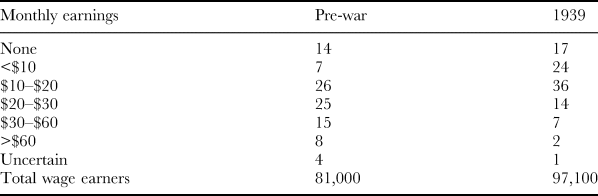
There was widespread destitution in Nanjing, reported as the condition of 44 per cent of the city's population in 1939.Footnote 25 By early 1939, there was an exodus of the affluent and the highly skilled, and a shift in jobs in production exacerbated ‘the despairing struggle of peddlers and to the overflowing reservoir of unskilled labour’.Footnote 26 The large number of family stalls and the excessive numbers of peddlers had decreased average daily earnings in the trade group from $1.54 in 1939 to $0.49. Incomes in manufacturing, domestic work, and shops all saw daily rates reduced to half of pre-war earnings. A comparison of pre-war (1937) and 1939 monthly incomes for wage earners indicates the sharp rise in low-paying jobs (by 1939, some 77 per cent earned less than $20 per month) and the decline in middle- and better-paying jobs among the remnant and refugee population, most of whom had never experienced prosperity (Table 1).Footnote 27
Comparison of pre-war and 1939 income groups (percentage)

Source: M. Searle Bates; Nanking International Relief Committee, The Nanking Population: Employment, Earnings and Expenditures: A Survey (Shanghai: Mercury Press, 1939), 14.
Following the Massacre, the Japanese took several measures to restore commercial activities and people's livelihoods. The first priority was to restore electricity and water. To this end, by March 1938, 200 people were assigned to the electric-lighting sector, 100 to supply water. During the first half of the year, the Japanese military hired up to 30,000 labourers to build roads and airfields. (Historian Ma Junya claims, without offering proof, that tens of thousands of labourers were executed after finishing the public-work projects so that military intelligence would not be divulged.Footnote 28) Peddlers and petty capitalists were allowed to retail food.Footnote 29 In terms of industrial development, the Japanese began to exercise military administration (junshi guanli) and military controls (junshi tongzhi) over strategic industries. Troops occupied the former Nationalist-controlled Capital Electric Plant, incorporated it under the Central China Hydroelectric Company, and transferred 32 Mantetsu (South Manchuria Railway) technical and administrative staff to oversee operations. Although much of the Jinling Arsenal had been relocated to Chongqing before military conflict engulfed Nanjing, remaining machinery was used by the General Headquarters of the Chinese Expeditionary Army for weapons repair.Footnote 30 Japanese troops occupied and reorganized the Yongli Ammonium Sulfate Factory under joint Sino–Japanese administration. After the outbreak of the Pacific War, several hundred tons of sulphur-production equipment was shipped to a Kyushu munitions plant.Footnote 31 The China Cement Plant was put under military management but leased to Mitsui Products Incorporated. Similarly, the Yangzi Flour Mill was entrusted to the Japan Financial Group, but production was curtailed after the military took the factory's generator and diesel engine. By late 1937, the military operated several smelters and iron mines—sending ore back to Japan and smelting pig iron for the production of hand grenades and artillery shells. These were classic examples of the Japanese strategy of ‘using the war to feed the war’ (yizhan yangzhan). In short, military controls extended over Nanjing's ‘free enterprises’, such as cotton, flour, cigarettes, papermaking, sulphur, cement, and ironmaking. In theory, the military permitted a free market. In practice, it extended control over the large-scale modern enterprises and those that supported munitions.Footnote 32
With the establishment of the RNG, the Japanese military loosened its controls and, by 14 January 1943, announced the termination of military management, allowing Chinese capitalists to assume a greater role in the economy. Nonetheless, ‘cooperative’ production arrangements in the case of the Yangzi Flour Mill and the China Cement Plant allowed Japanese firms to retain control.Footnote 33 According to Industry Minister Mei Siping, as late as May 1943, not even half of the 130 Chinese enterprises occupied by the Japanese military in central China were restored to Chinese ownership.Footnote 34 Calls by both the Japanese military and the Wang regime to boost production and advance recovery had mixed results. One of the unintended consequences of the Pacific War, which led to the Japanese occupation of Shanghai's International Settlement, was the relocation of Chinese businesses to Nanjing. Several industrialists from Wuxi and Shanghai, for instance, moved their textile plants to Nanjing in 1943–44. In 1944, businessmen pooled their resources to establish a papermaking plant in Nanjing.Footnote 35 But Japan's control over scarce resources impeded industrial recovery. Restrictions over iron materials, for instance, led to the shutdown of most privately owned machine factories. A few factories continued to operate in the southern district of Nanjing, producing small farm tools from their allotment of 25 tons of materials per year. But the markets had shrivelled up and they struggled to remain in business.Footnote 36 Despite the establishment of a fuel-management bureau to regulate the sale of kindling and the demand for coal through rationing to civilians and industries, constant shortages blocked industrial production and sent fuel prices soaring. Scarcity of resources exacerbated by heightened demand by the Japanese military contributed to inflation and urban immiseration, the root causes of labour disputes.
Inflation and its effects on the Nanjing working class
All of the labour–capital disputes were attributed to inflation and the struggles of workers to maintain their livelihoods. The saying ‘upsurge in the cost of living’ became a stock phrase used by most unions pressing for mediation in response to widespread food shortages and the sharp rise in commodity prices. By March 1941, Ding Mocun ordered district halls (gongsuo) to conduct cost-of-living surveys for 20 worker households. The statistics were to be reported to the local press and the municipal government with the intention of ‘improving workers’ livelihood and preventing labour disputes that are easily provoked by the surge in prices’.Footnote 37 The number of families surveyed is too small to be statistically significant, but the survey results indicate that the war had led to a marked deterioration in workers’ standard of living. One survey conducted between 1936 and July 1941 comparing the cost of living in ten households showed increased precarity. Whereas in 1936 workers earned more than they spent (monthly intake of 33.3 yuan and consumption of 28 yuan), by 1941, monthly income was 111 yuan while expenses had risen to 201 yuan.Footnote 38 The chief driver behind increasing costs was the soaring price of food. In 1936, workers spent 54 per cent of their expenditures on food items (rice, grains, vegetables, and salt). By 1941, that proportion had escalated to 71 per cent. To compensate, workers decreased their consumption of miscellaneous items (clothing, shoes, cigarettes, bathing, haircuts).
Two others surveys, each of 20 worker households conducted over a ten-day period in May 1941 and July 1942, tell a similar story. The May 1941 survey indicates that the average daily wage (2.975 yuan) fell just short of average daily expenditures (2.985 yuan). By contrast, workers’ income in the July 1942 survey lagged behind expenditures. On average, workers earned 82 yuan while their household expenditures averaged 117 yuan per month. In both years, workers spent about 75 per cent of their money on food.Footnote 39
The disproportionate amount spent on food was caused by wartime shortages. In the aftermath of the Battle of Nanjing and the Massacre, agricultural production in Nanjing's surrounding counties was severely disrupted. In their March 1938 survey of six counties surrounding Nanjing, observers from the International Relief Committee forecast that ‘It would be difficult to recover in a decade all the [farm property] that had been destroyed in less than a month’.Footnote 40 And one Japanese observer described the devastation to Nanjing's rural periphery as a barren wasteland: ‘Most plow oxen have been slaughtered, the farmers lack seed, most agricultural tools have been destroyed or damaged, and there is no means to bring in silkworm eggs. The farmers are in crisis.’Footnote 41 Moreover, military conflict had created a severe labour shortage. Approximately one person out of every seven farm households had been killed and some 84 per cent of deaths were men under the age of 45. Of the remaining population in the six rural counties, approximately 133,000 people had left their homes and not returned.Footnote 42 By 1938, as one historian describes, ‘The decrease in manpower and draught animals caused a missed season for production and tillage, the fields were not cultivated, and agricultural production dramatically decreased whereby Nanjing's peripheral counties barely met 40 percent of pre-war output of rice and other major crops’.Footnote 43 Those farmers who did return home discovered that their property and crops had been destroyed and ‘were forced to return to the city to beg in the streets’.Footnote 44
The disruption of agricultural production in 1938–39 clearly caused shortages, but the ensuing inflationary trends were also triggered by competing demands for rice by Japan, its military, the Wang regime, and urban residents. As Japan's role in the war expanded, approximately 1 million farm labourers were conscripted, leading to a severe reduction in domestic grain production. In 1939, Korea suffered drought and, by 1940, rice production in Japan, Korea, and Taiwan had diminished by 9 million dan (piculs)—the equivalent of 60 kilograms per unit dan. To prevent food riots, Japan augmented its food policies and introduced rice rationing in the six main cities in April 1941.Footnote 45 It also looked to import rice from Anhui, Zhejiang, and Jiangsu (the latter province produced 11 per cent of China's total grain output from 1931 to 1937). In 1939, for instance, 2 million dan of rice were shipped from Jiangsu and Zhejiang to Japan.Footnote 46 By 1941, the occupation army for central China was ordered to become self-sufficient,Footnote 47 even though it had already requisitioned grains for two years from the rich rice-producing area of the Lower Yangzi Delta. There was also competing pressure of the Japanese consulate and Wang Jingwei himself, whose collaborationist government wanted more autonomy over economic resources including food to maintain popular support. These competing pressures led to a variety of arrangements between the Japanese military and the Wang regime over the control of grain resources.
In exchange for guaranteeing Japanese troops a steady supply of rice, Wang Jingwei was promised a relaxation of Japanese authority over rice and grain. The RNG's new found authority was manifest in the establishment on 2 November 1940 of the Grain Management Committee (Liangshi guanli weiyuanhui), under the supervision of the Executive Yuan.Footnote 48 The committee imported Saigon rice and supplied it for below the market price to Nanjing residents. One thousand dan of rice were to be distributed daily to designated shops and sold at a ‘fair price’. With continued rice shortages, Nanjing in July 1942 began rationing based on household registration (jihu shouliang). Once households registered and presented identification, they could purchase low-priced rice allotments every ten days from their local baojia heads. Starting on 16 August, the city sold rice to residents on the basis of coupons—a system referred to as hukou mi.Footnote 49 In addition, different sectors of society gained access to low-priced rice. The quantity of rice varied according to one's profession and preference was given to pillars of the state—the police, officials, and civil servants.Footnote 50 Rationing of rice was extended to workers employed in strategic industries, but it seems unlikely that artisans were accorded rationing privileges.
The amount of rationed rice was meagre to start with and diminished over time. According to government estimates in June 1940, one picul of rice per month could feed seven people—a figure ‘below what Western missionaries had estimated as average consumption of one picul for a family of five’: ‘The 1942 rice rationing cut the monthly amount even farther to 45,000 piculs for a population of about 500,000 (rationing for government and military personnel was already in effect and was not included in these estimates) or one picul for every eleven people each month’.Footnote 51 Disruptions to Nanjing's rice supply in the last two years of the war led to further reductions in the ration allotment.
Rice shortages, competition between the military and civilian population for rice and resources, and farmers’ resistance to selling rice at artificially low prices drastically cut the rice supply in Nanjing and prices soared. As part of the New China Policy and the RNG's implementation of a ‘controlled economy’, by October 1943 a newly established Rice Control Committee (Miliang tongzhi weiyuanhui or mitonghui) was charged with purchasing rice from designated districts at below-market prices. Jia designated areas—some 15 counties in southern Jiangsu and Zhejiang—allowed Japanese merchants to purchase rice, whereas Yi designated areas in southern Anhui, Wuhu, and the Nanjing periphery were set aside for Chinese merchants. But, in practice, Japanese merchants accounted for two-thirds of all sales and encroached on Chinese designated areas.Footnote 52 That these purchases were distributed to Japanese troops also meant a reduction in the supply of rice to Chinese urban residents. By 1944, the Rice Control Committee (RCC) failed to purchase even half of its projected 539,000 tons of rice. Nevertheless, as Zhang Genfu suggests, the RCC maintained its original plan of allotting 259,000 tons to the Japanese military and the RNG's security forces, which barely left a fraction for residents of Shanghai and Nanjing.Footnote 53 The reluctance of farmers to sell grains at artificially low prices prompted a July 1944 regulation that allowed the Japanese military to use force to assist the RCC to purchase grain.Footnote 54 A vicious cycle ensued of decreased production, coerced purchases and requisitions, shortages, and inflation. In his study of the politics of rice in wartime Shanghai, Christian Henriot blames the controlled economy for having ‘paralyzed economic activities’: ‘Its concrete effect on foodstuffs was to discourage peasants from producing staple foods and to drive even the reduced produce that remained out of the market.’Footnote 55
Workers coped with this immiseration by using a number of strategies, including, in order of frequency, taking family ‘loans’, peddling, relying on relief, using pawn shops, and renting property.Footnote 56
Above all, women's wage work became an important supplement in working-class households. The surveys on workers’ cost of living assumed that the adult male of the household was the sole income earner, yet increased participation among women in Nanjing's labour market during the war points to the weakness of this assumption. According to Bates, only 1,800 women were gainfully employed before the war compared to 20,000 women working for wages at the start of 1939.Footnote 57 Excluding service work, there was a dramatic increase in the percentage of women in the total labour force. In June 1934, that figure was 16 per cent, by June 1936 it had risen to 20 per cent, and in June 1940 reached 37 per cent.Footnote 58 According to Japanese surveys, by June 1940, women had retained their dominance in the service sector, but they now constituted between one-third to one-half of all workers in farming, mining, industry, and private work.Footnote 59
Initially, women's greater participation in the workforce was due to the sharp drop in the numbers of young men because of death, labour compulsion, conscription, or the avoidance of compulsion.Footnote 60 The Nanjing Massacre devastated Nanjing's population, which plummeted by about 72 per cent between the summer of 1937 and the spring of 1938. The population stabilized at over 600,000 by 1940 and rose incrementally over the course of the war, but the gender discrepancy never returned to the lopsided ratios typical of the pre-war era. The male-to-female ratio of 1.53 in 1935 plummeted to 1.1 in 1938 before rebounding slightly to 1.25 in 1940, which then remained steady throughout the war.Footnote 61 As a consequence of the male-labour shortage, women entered the workforce to supplement household income. With wages already dwindling for men, the wage rates paid to women were a pittance. In 1939, the average daily earnings for all employed women was $0.18—about a third of the average daily wage income ($0.56) for men.Footnote 62
Judging from the union-membership lists of artisans involved in labour–capital conciliation cases, women were excluded from most handicraft trades. Artisanal union members were all middle-aged men with years of work experience. A partial list of 59 of the construction-industry union's founding members indicates an average age of 42.Footnote 63 Founding members of the candle and joss-stick trade union were even older. The average age of 51 artisans was 47, with an average tenure of 25 years.Footnote 64 One of the union reports on a worker dispute indicates the feeling of shame that the print workers felt in not being able to support their dependants and wives. We do not know the frequency with which artisans’ wives participated in the labour market, but one can suggest that, for older artisans, economic insecurity combined with the frustration of not being able to meet traditional social obligations to their family spawned grievances. These were powerful motivations for participation in the labour-conciliation process.
Ideological origins of labour–capital conciliation and its legislation
Although the labour–capital conciliation process was an innovation used by the Wang Jingwei government to promote social stability and to bolster its own legitimacy, the ideological origins undergirding such labour legislation was rooted in corporatism shared by the Nationalist Government, which took fascist models from abroad for inspiration. Under the Wang Jingwei–Jiang Jieshi coalition government (January 1932–December 1935), the Wang group led by Industry Minister Chen Gongbo, in tandem with Finance Minister Song Ziwen, established corporatist institutions and implemented joint state–private economic reforms to promote autarky and economic nationalism.Footnote 65 By means of the National Economic Council (NEC) and its subsidiary organization, the Cotton Control Commission (CCC), the Wang group instituted a relatively equal partnership between the state and Jiangnan industrialists and bankers. This was typical of what Gregory Kasza describes as rightist patterns of corporatist policies, ‘in which both officials and big business gained influence’.Footnote 66 The CCC attempted to improve domestic production of raw cotton and develop a domestic market in the hinterland while rationalizing industrial production and management in the Shanghai cotton mills.Footnote 67 Ultimately, these reforms were abandoned as Chiang Kai-shek pursued a more totalitarian model of corporatism favouring nationalization of heavy industries geared towards military production. To the degree that she explores how corporatism affected labour, Zanasi reveals that the CCC's attitude was marked by conservatism and a fear that labour action would impede productivist and autarkic goals.Footnote 68
Italy was the model of choice for the Nationalists. Chen Gongbo, who became a central leader of the Wang regime, developed a close rapport with Galeazzo Ciano, the Italian consul in Shanghai between 1930 and 1933, and son-in-law to Benito Mussolini. These ties facilitated a steady stream of fascist advisers to counsel the NEC on economic policy.Footnote 69 And it was Ciano, with the backing of Mussolini, who set up a course in fascist corporate law at the Suzhou-based Comparative Law School of China.Footnote 70 In 1933, in his first lecture presented to law students and faculty, visiting professor Dr G. Costantini articulated the ideas of the corporative state and discussed the salience of corporative law to resolve contentious class relations. Costantini stressed the need for a strong autonomous state to transform syndicalism and ‘place it at the service of the state’. Once unions were brought into the orbit of the state by means of intermediary control organs, that is, corporatives, the state could more readily arbitrate labour–capital disputes:
The controversies between the employers and the workers no longer require to have recourse to the extreme method of the strike and lock-out, both always dangerous, politically and economically, to the national life; but failing the accord between the representatives of both sides, they find in the State the supreme judge and the most impartial arbitrator.Footnote 71
Laudatory references to Italy continued under the Wang Jingwei regime and popularized the myth that fascist corporatism constituted an alternative to capitalism and socialism. The NRG's Ministry of Social Affairs published articles in its bulletin outlining Italy's social-welfare legislation. The official Central Daily highlighted how the Fascist Party in Italy had raised wages to mark the twentieth anniversary of the March on Rome.Footnote 72 Conversely, news about the Allied enemies described strike waves in the United States of America, Great Britain, and the Soviet Union.Footnote 73
David Barrett has argued that there are continuities between the Nationalist Government during the Nanjing decade and the Wang Jingwei collaborationist regime. His observation that Wang ‘sought no break with the ideological direction and practical policies of the pre-1937 Nationalist Government of Chiang Kai-shek’ applies equally well to the Wang regime's labour legislation.Footnote 74 The labour–capital conciliation and arbitration laws implemented by the RNG originated during the late 1920s when the Nationalist Government came to power riding a wave of labour strikes. The first labour law to promote arbitration (仲裁 zhongcai) was the Regulations on Labour Arbitration passed by the Guangzhou Nationalist Government on 16 August 1926. Responding to the internecine conflict between more conservative artisans and radical seamen unions, the use of arbitration aimed squarely at resolving disputes among workers: ‘Worker disputes must be resolved by means of the arbitration committee. At no time, should either side assemble crowds or carry weapons to feud or behave in any way that violates police law or threatens the public order.’Footnote 75 Foreshadowing all subsequent labour laws, the Nationalist Government acted as the final arbiter if one or both parties did not accept arbitration. In legislation passed by the Guangdong provincial authorities on 5 January 1927, all industrial and commercial disputes in strategic industries—weaponry, finance, transport, and public utilities—would be resolved through arbitration committees. In contrast to restrictive labour laws enacted during the Nanjing decade, these formative laws provided a modicum of protection for labour rights. Shop owners and factory managers were prohibited from hiring scabs or thugs during labour strikes. Workers would be compensated during strikes. Merchants were not to form rival unions.Footnote 76
During the summer of 1927, Nanjing also established arbitration committees, whose central mission was to ‘resolve disputes and conflict between labour and capitalists’. The arbitration regulations were issued on 9 August 1927 almost four months after the Nationalist Government declared Nanjing its political capital, thus bearing the state's imprimatur over the arbitration process. Arbitration-committee membership, for instance, was stacked in favour of party-state representatives. The general trade union and commercial association would each have two representatives. The Nationalist Party, city government, and general political branch (zong zhengzhibu) would have a combined team of seven representatives. Committee rulings if not followed by the parties in dispute would be enforced by the government. In other respects, the committee sought to present itself as a neutral arbiter. Committee regulations protected capitalist property during strikes. But they also prevented owners from hiring outside workers, and mandated that workers receive wages during a strike and severance pay in case of a shop or factory closure.Footnote 77
First issued 9 June 1928 with subsequent amendments, the Regulations on Labour Dispute Settlement (Laozi zhengyi chuli fa) (henceforth ‘Regulations’) prohibited strikes and lockdowns before and during the process of conciliation (調解 tiaojie) and/or arbitration. In tandem with the Labour Union Law of 1929, the Regulations became the bedrock of subsequent Nationalist-Government labour and industrial legislation. The Labour Union Law recognized the union as the force to maintain and improve the livelihood of workers. But there was a regressive side, too, prohibiting the formation of unions at the national level and requiring that all unions register with official supervisory organs. The encouragement of sectoral unions, the registration of all union members with the state, and even the mission statement of the Union Law would resurface among the bylaws of trade unions formed under the Wang Jingwei regime. Likewise, the Regulations were adopted almost verbatim by Wang Jingwei's government when they reissued them on 26 April 1941.Footnote 78 There was a key difference between the two versions. The elevated role of the Ministry of Social Affairs, based on a 1933 revision of the Regulations, replaced the Ministry of Industry in overseeing conciliation and arbitration. According to the journalist Israel Epstein: ‘The Ministry of Social Affairs and corresponding local organs, which had already exercised supreme authority over the formation and functioning of trade unions and soon came to appoint their secretaries from among their own officials, thus came to have a decisive voice in conciliation and arbitration procedure as well.’Footnote 79
In the pre-war era, Chiang Kai-shek's Nationalist regime implemented the Regulations most extensively in Shanghai outside the International Settlement. But, even here, administrative fiat commonly ended disputes and the trade unions were often manipulated by gang influence. During the Anti-Japanese War, the Chongqing-based Guomindang reissued the regulations, but they remained underutilized. Officials from the Ministry of Social Affairs often bypassed the conciliation and arbitration boards, and relied on the National General Mobilization Act. Epstein notes that cities under Nationalist wartime control, such as Guilin, had established a Labour Disputes Arbitration Board (representatives from the GMD, the municipality, the district court, labour, and capital), but processed only five cases during 1943, the majority in the handicraft sector. The absence of the terms ‘conciliation’ and ‘arbitration’ from the official China Handbook's chapter on industry and labour indicates that the process had fallen out of favour.Footnote 80
According to the Regulations, any disputes over the conditions of employment that involved 15 or more workers necessitated using the law. Following a formal request by one or both parties (employers and employees), a conciliation committee was convened. The conciliation committee comprised five to seven representatives—two each from labour and capital, and one to three from the administrative authority, namely the Ministry of Social Affairs. Rulings by the conciliation committee were considered contractually binding. If there was no resolution, the case would go to arbitration. The arbitration committee included a representative of the Ministry of Social Affairs, who served as committee chair; a representative of the subsidiary Social Movement Guidance Committee; one representative of the local law court; and one representative from both labour and capital with no direct involvement in the case. Every two years, the Ministry of Social Affairs would direct unions and commercial associations to appoint 24 to 48 representatives to serve on arbitration committees.
Both conciliation and arbitration committees used the same procedures for handling disputes. The parties involved in the dispute would submit a conciliation application to the supervising administration with the following details: name of parties, vocation, commercial or factory address, name of organization, and place of work; the number of workers involved in the dispute; and the main points in dispute. Once the application was received, the committee would take up to a week surveying the worksite and the nature of the dispute. The committee was enjoined to reach a decision within two days of completing the survey unless unusual circumstances caused delay. Once conciliation was achieved, both parties would sign a report that was sent to the Ministry of Social Affairs. If conciliation failed, the two parties applied for arbitration by providing the same information as that provided to the conciliation committee in addition to explaining why conciliation had failed. Following their own investigation of the dispute, the arbitration committee would reach a decision based on a majority vote. The decision was contractually binding on both parties.
Both processes were buttressed by rules and penalties that upheld social order and made it illegal for workers to call a strike or damage the employer's property. No work stoppages or strikes were to be held during a dispute or during the conciliation or arbitration process. This prohibition extended to industries and workers not directly involved in the labour dispute. No worker was to seal off the factory or shop; damage shop or factory goods, tools and equipment; or coerce others to strike. Anyone found in violation was to be fined by up to 200 yuan and was subject to the penal code.
Promoting corporatism and the labour movement through unionization
In keeping with the tenets of corporatism, the occupation regimes in Nanjing began organizing all the city workers into a general trade union. Under the Reformed Government (1938–40), the Yangzi General Labour Union was formed by merging the Nanjing Municipal Commercial Federation (Nanjing tebieshi geye gonghui lianhehui) with the Nanjing Municipal Labour Association (Nanjing tebieshi laogong xiehui). Once the Wang regime was established, the Ministry of Social Affairs convened a meeting on 6 May 1940, where all the trade-union representatives launched the Nanjing Municipal Labour Union Preparatory Commission (Nanjing tebieshi gonghui choubei weiyuanhui). Insufficient membership and budget constraints prevented the union from fully forming and, on 15 September 1941, the Commission stopped its activities. Within days, the Nanjing Labour Regulated Committee (Nanjing tebieshi gonghui zhengli weiyuanhui) took shape. Yet, by 19 April 1943, Nanjing's Ministry of Social Welfare shut it down on the grounds that the Regulated Committee had made ‘minimal progress’.Footnote 81
Rather than supporting trade-union federations that cut across industrial sectors and could potentially wield great influence, the Wang regime preferred to organize each sector. Each of the handicraft industries—candle and joss sticks, leather, and cotton stitched shoes, Western-style military uniforms, pickled vegetables, jewellery, sugar and canned food, construction, printing, papermaking, satin weaving, and tinfoil—were mandated to form commercial associations (公会) and trade unions (职业工会). The construction (水木) union was the exception with its 1800 members, but other unions had far fewer members—ranging between 186 members in the sauce and pickle trade, some 288 tailors in the Western-style militar-uniform trade, and 445 printers.Footnote 82 Judging from their charters, the unions aligned with corporatism and prevented workers from organizing themselves along class lines and pursuing class interests. Convening both commercial associations and trade unions to resolve disputes was meant to harmonize and deepen their bonds of amity. Increasing production and loyalty to the state were also intended consequences of unionization.
Overt political references were not evident in union charters, but exhortations of anti-communism and respect for the state and one's trade can be found; the construction union-membership card was emblazoned with the slogan: ‘Peace, Reconstruction, Anti-Communism, Good-Neighborliness.’ Union members were asked to observe six conditions, among them: ‘Do not violate the existing government's political platform, policies and decrees. Do not inflict damage on this trade's business or reputation.’Footnote 83
From a worker's perspective, the chief goal of the unions was to safeguard their livelihood. Most unions obliged by preventing employers from hiring non-union members. The bureaucratic nature of these dispute cases renders opaque workers’ own views, but one catches glimpses of their motivations. For instance, in a Social Movement Guidance Committee report advocating the establishment of the shoemakers’ union, one of its founding members, Fu Chunyun, was said to have once joined the Yangzi General Labour Union, now considered illegitimate by the Wang regime. The author of the report, Shen Jianping, a Sheyunhui official, accused the Yangzi Union of having recruited members through intimidation and cheating. Nonetheless, he deemed Fu's motives as pure, saying he joined the Yangzi Union because it held out the promise of being able to buy cheap rice, ‘because he had heard the (Yangzi Union) organization had a large budget of 100,000 yuan set aside to buy below market priced rice’.Footnote 84 Likewise, when Shen filled out an investigative form for his superiors at the Sheyunhui, he described Fu as a worker with ‘pure thought’, indicating that he deemed economic motivations to be apolitical.Footnote 85
Shen Jianping advocated establishing the new union on the basis of promoting workers’ welfare and national unity:
This industry in the past was extremely fragmented and lacked organization. Any time they encountered oppression they couldn't alleviate their suffering and focus on working hard for the nation. In order to unite this industry, including cobblers making leather and stitched shoes, and in respect of the law, we request that this Committee authorize the union so that the workers can try their best for the nation. Their motives are pure.Footnote 86
Here, too, one sees continuities between the Wang regime's ideology and that of the pre-1937 Nationalists. In keeping with the Three People's Principles, the union promoted class conciliation as a pillar of national economic development. Shen concludes his report with the statement: ‘I believe we should permit this organization as it will help the labour movement.’Footnote 87 The statement reflected the statist approach of the Wang and Nationalist regimes towards social movements.
Strikes and labour disputes: putting conciliation into practice
Especially when compared to Shanghai, the relatively few disputes and strikes that arose in Nanjing under the Wang Jingwei regime give the impression that the system of labour mediation was effective.Footnote 88 The 52 labour-dispute cases (劳资争议案件) that I have seen at the Nanjing Municipal Archives occurred between May 1941 and May 1945 but were concentrated in 1942 when Zhou Fohai directed the Sheyunhui.Footnote 89 The cases involved various handicrafts—papermaking, straw hats, sauce and pickles, flower mats, tinfoil, dyeing, laundry, cakes, sugar and canned food, jewellery, rice husking, and satin weaving. More than three cases occurred in construction, Western-style military uniforms, and printing. Candle and joss-stick makers and cobblers were by far the most contentious of the various trades with a dozen cases each. Heightened demand for candles given constant fuel and electricity shortages and the escalating prices for coal and oil would have given candle makers more leverage to pursue wage increases and this may explain the frequency of these cases.Footnote 90
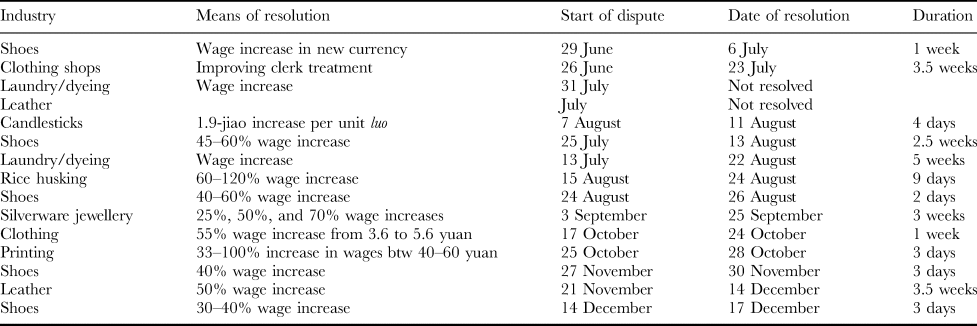
From both labour and the state's perspective, the relatively quick resolution of cases was one of the benefits of applying the law. Monthly statistical reports compiled by the Sheyunhui for the second half of 1942 indicate the number of cases, the means of conciliation, and their duration. As Table 2 indicates, half the cases took one week or less to resolve, often only three days, whereas the other six cases averaged slightly over three weeks to resolve.
Resolution of worker–employer disputes, 1942

Sources: 7–10, 12 yuefen chuli laozi jiufen tongjibiao. Nanjing Municipal Archives (NMA) 10020030315(00)0019, pp. 99–100; NMA 10020030510(00)0020, pp. 108–109; NMA 10020030510(00)0022, pp. 123–124, 131–132; NMA 10020030510(00)0023, pp. 140–141.
Labour unions often accused employers of using delaying tactics rather than conceding higher wages. Appealing to the state put pressure on the commercial associations to comply and come to a resolution, which favoured unions. The state for its part could prevent disputes from spiralling into slowdowns and strikes.
Both Ding Mocun and Zhou Fohai standardized the process of case settlement by creating specific forms detailing worker–employer disputes.Footnote 91 The case report (laozi anjian chuli baogaobiao) noted the cause and date of the origins of the dispute, the names of the representatives for the union and the commercial association along with the Sheyunhui officials, and the process and means of resolution. Once conciliation was achieved, the document often concluded with the stock phrase ‘resolved to both parties’ mutual satisfaction’ (shuangfang yuanman). This presentation of the routinization of reconciliation gave the impression that the process was efficient and devoid of acrimony.
Beyond this façade of harmonious relations, however, there was a great deal of mistrust. In fact, it permeates the reports received by the Sheyunhui from the commercial associations, the unions, and its own officials. Union leaders and workers were frustrated with a lack of regular wage increases given the rapid rise in prices. The employees were also disgruntled by payment in the steadily depreciated ‘old’ fabi currency—a currency banned by government order. Between March and June of 1942, the ratio of Central Reserve Bank (CRB) notes to fabi had plummeted from 1:1 to 1:2.Footnote 92 Whereas merchants could charge CRB for their products and maintain profits, workers continued to receive deflated fabi notes. As a result, by the spring and summer of 1942, workers were demanding to be paid with the new reserve currency (xin chubi 新储币).
Union leaders, too, struggled to earn the trust of the rank and file. A unique document that reveals rifts between workers and their union leadership as well as workers’ mistrust of their employer is a petition written by the publication-and-printing-union members to the Ministry of Social Welfare. Of note is the rhetoric employed by the printers in their appeal. They express a view of the state as a neutral and just arbiter that can help the workers to meet their familial responsibilities:
We respectfully submit:
This union is indebted to the supervising administration's resolution of last year's dispute between labour and capital over wage increases. But now that already more than six months have elapsed we have no recourse to the surging prices, which recently have increased several times yet again. Our monthly income is inadequate to support our children. We can no longer endure. From a husband's perspective, we cannot take care of our wives and raise our children. No amount of words can explain our suffering. The entire body [of workers] has requested that the employers raise wages, but already a month has passed without any response. Moreover, the employers have bribed one of this union's board members and its chairman. A situation like this is immoral and reflects their oppressive policy towards labour ….
Prostrating ourselves we beseech the responsible institution to sympathize with us and to convene representatives of labour and capital to reach conciliation.
This publishing industrial union respectfully submits to the Social Welfare Ministry in the hope that it will not delay and will quickly reach a resolution.Footnote 93
For their part, the owners relied on stereotypes of workers and their union representatives. Commercial associations complained that union leaders lacked moral standing and that workers, being ignorant and impulsive, were too easily manipulated. Owners made use of these images to gain leverage in negotiations as in the case of a tinfoil-industry dispute. After workers slowed down production to demand better treatment, the commercial association berated the union leaders as ‘abominable’: ‘They don't have proper work or family, lack proper residence (xingtong liulang), and rely on their union position for their livelihood. With these types of leaders representing the masses, it is unavoidable that they will violate the country's laws.’Footnote 94 The commercial association went on to defend its actions, indicating that it had raised wages several times in the past to everyone's satisfaction. Anticipating that the Sheyunhui was about to convene a conciliation meeting and had already signalled a wage hike, the commercial association had no qualms about denigrating its opposition.
Given this general level of mistrust, it is not surprising that labour action often punctuated the process of conciliation despite prohibitions against strikes and slowdowns, and heavy fines for violators. In several cases, the strikes or slowdowns were initiated by workers acting independently from union leadership and served as either a rebuke or a pressure campaign against the commercial association and the government. After a month of stalled negotiations between the laundry-and-dye-labour union and their employers over the workers’ demand that wage increases be issued in the new currency, the entire shop stopped working. The pressure tactic was effective. Within a day, Minguo ribao reported that Sheyunhui delegates had reconciled labour and capital, and the two parties had reached full agreement.Footnote 95
In one case involving candle makers, the union sent a letter to the owners asking for a prompt reply to workers’ earlier demand for a wage hike. Without waiting for a response or for the union to petition the Sheyunhui, rank-and-file workers initiated a slowdown on 17 August 1941. Despite efforts by the Committee representatives to get workers back to work while conciliation negotiations proceeded, the workers ‘insisted on first negotiating before resuming work’. Work would not resume until 30 August and a final resolution was reached on 11 September.Footnote 96 Four years later, after the candle makers’ union had begun conciliation meetings with the commercial association, the workers held a slowdown on their own initiative. The Social Welfare Department promptly issued a rebuke of their wildcat: ‘This is a warning for those who disobey union leaders without bearing any responsibility or cost.’Footnote 97 It is not known, however, how this case was resolved.
Unions used a number of strategies to pressure the state and protect workers’ interests. In a petition written on 23 September 1942 to the Sheyunhui, the union leader Yong Daoxian reproached the print owners for illegally dismissing workers during the conciliation process and for disparaging workers. Yong warned that owners’ statements, such as ‘we can ignore [worker demands] or delay’, might prompt autonomous labour actions: ‘We sincerely hope the authorities within the month can sign a contract in order for us to support the agreement, to support the labour movement and avoid further disputes.’Footnote 98 The tactic of threatening that labour would act in a way the union leaders could not control was frequently used. In a letter written to the Sheyunhui on 29 November 1942, the cobbler's union leader expressed his dismay that attempts to convene a meeting with shop owners had failed to materialize. He accused the capitalists of using delaying tactics in response to the cobblers’ demand for a 150-per-cent wage increase. He alluded to the ‘several dozen workers asserting that if the matter wasn't resolved they would stop work or have a slowdown’ and entreated the Social Movement Guidance Committee to intercede: ‘Your Committee seeks to restore the bonds between labour and capital in order to prevent further labour unrest. I'm taking the liberty to request that your committee inspect and evaluate. I hope the matter can be mediated soon, and earnestly await your reply.’Footnote 99
The union's entreaties and threats motivated the Sheyunhui to call for separate meetings on 3 and 4 December with the trade union and the shop owners. The union demanded that the piece rate be increased. Workers typically made 20 pairs of leather shoes per month. One pair brought in roughly one yuan if they were provided room and board, three yuan if not, and 2.5–2.6 yuan per pair of shoes if they received only a food stipend. Contractual workers received a minimum of 20 to 30 yuan and a maximum of 50 yuan per month. Employers countered that the workers were being ‘completely unreasonable’. The owners had already consented to a wage increase of three to five jiao per pair of shoes in April and again on 1 November, only 20 days prior.Footnote 100 A subsequent meeting on 6 December with the union led to the workers’ compromise offer—they would lower their demand for a wage increase from 200 to 150 per cent. The owners countered with their customary three to five jiao per pair—a 20-per-cent increase. Without sufficient progress, the cobblers called for a strike on 8 December. Passions heated up when a cobbler, Tao Wanrong, sought to finish an order for a pair of shoes, thus defying strike orders. When a union section leader and five workers saw Tao at work, they began to argue with him and the shop owner, who maintained that he had not tried to force Tao to work. A brawl broke out and Tao and the shop owner were injured, and a door and window in the shop were damaged.Footnote 101 A resolution was finally achieved by 20 December. The use of force prompted the shop owners to make more concessions. Piecework rates were increased by between 33 and 60 per cent, depending on whether cobblers received room and board.Footnote 102
Silversmiths and goldsmiths also resorted to direct action to accelerate compromise. In a case that began on 3 May 1942, workers in two jewellery shops went on strike for better ‘treatment’ (daiyu)—a term signifying wages, benefits, and social status. The strike led to a quick resolution overseen by the Sheyunhui. The artisans would be paid in new ‘reserve’ currency, which amounted to a 20-per-cent raise. In return, the jewellery workers on 4 May signed an agreement with employers pledging henceforth not to ‘arbitrarily strike or use coercive methods’.Footnote 103 By 18 August, however, the silver-and-jewellery trade union issued a 16-point demand for raises, profit-sharing, the provision of tools, preferential hiring for union members, and the abolition of night work.Footnote 104 To accentuate this final demand, several of the shop artisans stopped working the night shifts. The employers dug in their heels, countering that they had always been solicitous of workers’ needs, noting that they had provided workers with a monthly supplement in January and conceded issuing new currency in May. Why, they asked, were only five shops (half of those that employed artisans) involved in the labour dispute while the other shop workers ‘continued to work in peace’? The shop owners conjectured that ‘some people have infiltrated and fanned the flames of unrest’.Footnote 105
A final accord, overseen by the Sheyunhui, was reached 25 September. The trade union won several significant, if partial, gains. No concessions were granted on the question of profit-sharing. Nor was night work abolished. But the silversmiths gained better pay, including a 70-per-cent wage increase for working nights. The demand that room and board should be distributed equally among salespeople and shop workers was also accepted. In addition, union members would receive preferential hiring and could not be arbitrarily dismissed. And there were other concessions. Instead of being provided with tools by their employers, silversmiths would get a 15-yuan monthly stipend for tools, and wages and rice stipends would be raised by 65 per cent rather than 80 per cent. Finally, the workday would last 8.5 hours—30 minutes more than the artisans had wanted.Footnote 106
Even after the Sheyunhui was disbanded in 1943, government mediation continued and so did labour's threats to take direct action. In a report written to the Department of Economics, the director general of the shoe commercial association reported on 16 August 1944 that he had received a letter from the union demanding a 100-per-cent wage increase and that workers had begun to strike. In a meeting with the union, the commercial association agreed to a 30- to 40-per-cent wage increase, but labour was ‘determined not to retreat from its strike and to use its muscle to coerce us’.Footnote 107 The director thus appealed to the Department of Economics to intervene. After an official presided over a meeting on 23 August, both parties reached conciliation and the union gained a 60-per-cent wage hike.Footnote 108
Similar pressure was applied by tailors against the Clothing Commercial Association. On 2 April 1944, tailors began a strike, disregarding an attempt by the union to reach a wage settlement with the commercial association. Over 200 workers broke equipment and tools in protest that their wages were only one-third to one-half of those earned in the construction trade. The commercial association described the tailors as an elemental force: ‘Their momentum surged and we had no choice but to raise wages (a daily minimum of 60 yuan). We reached an agreement to mutual satisfaction within three days. They have now scattered far and wide. Although a minority has resumed work, most workers still have not resumed work.’Footnote 109 In his letter to the Nanjing Department of Economics, Xu Rongda, the commercial-association leader, requested permission to raise the piecework rate by 90 per cent and to increase the materials fee by 20 per cent ‘so that we can restore peace to several hundred shops in this trade’.Footnote 110 After his explanation that government price controls on silk and cotton clothing had harmed the shops’ bottom line, one can infer that Xu sought not only to quell labour unrest, but also to nudge the state to loosen its price-cap regulations.
If labour and, to a lesser extent, commercial associations used the threat of strikes or slowdowns to pursue their interests, the Sheyunhui was not above using strong-arm tactics against unions to maintain order. In response to a strike called by the leather-shoe union on 1 August 1942, the Social Movement Guidance Committee assembled union leaders to persuade them to resume work. Not achieving any results, the Sheyunhui detained three workers and, by 13 August, a resolution was on the table that increased wages by 40 per cent.Footnote 111
By and large, because of the state's keen interest in maintaining social order, the resolution of labour disputes seems to have favoured workers over employers. Settlements resulted in a wage increase that, based on the available evidence, forced employers to pay more than had they initially offered.
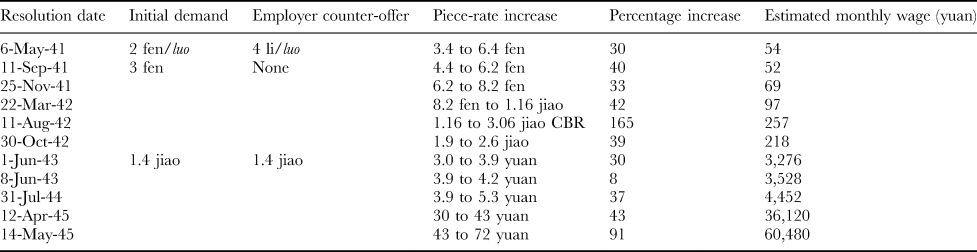
Table 3 documents the wage increases following labour disputes in the candle-making industry. Occasionally, workers received other forms of remuneration besides their pay per unit of production. The September 1941 resolution, for instance, doubled workers’ tea stipend from one to two yuan (a pot of hot water cost one yuan) and increased the wine stipend from 0.4 to one jiao (ten jiao equals one yuan). Workers also received an end-of-the-year bonus equivalent to two months’ wages in January 1943.Footnote 112 Generally, workers were paid by the piece based on the number of baskets (luo) that they produced per day and wage hikes focused on the price per luo. In a forum convened by the Sheyunhui, workers calculated that they could produce 30 luo per day, whereas employers estimated production of between 30 and 40 luo per day. Workers calculated that they worked 20 days per month, whereas owners calculated 24 days of wages per month.
Resolution of labour–employer disputes in the candle-making industry

Note: Piece work was based on the unit of luo 籮, a basket of candles. A li is 0,001 yuan, a fen is 0.01 yuan, and a jiao is 0.1 yuan. Central Bank Reserve (CBR) notes replaced the fabi notes in the spring of 1942. I calculate estimated monthly wages on the basis of 35 luo produced per day, 24 days per month. Sources: Nanjing Municipal Archives (NMA) 10020030238(00)0006; 10020030189(00)0005, pp. 64–65; NMA 10020030189(00)0005, p. 72; NMA 10020030510(00)0022, pp. 123–124; NMA 10020030178(00)0002, p. 23; NMA 10020030178(00)0001, p. 2; NMA 10020030320(00)0003, p. 11; NMA 10020030178(00)0002.
Did wage increases keep up with the rate of inflation? Ideally, one would compare the cost-of-living index with the wage increases, but only monthly figures for January 1943 through May 1945 are available. From workers’ own testimony, wage hikes failed to keep pace with hyperinflation. In responding to Sheyunhui officials’ questions regarding the cost of living in 1941, union officials responded: ‘Even though the employers provide room and board, with the exorbitantly high cost of living the wages received are truly insufficient for a family's livelihood.’Footnote 113 The following year, this testimony was echoed by press accounts revealing that prices of all goods had spiked during April and May 1942, thus ‘threatening workers’ livelihood’. Despite significant wage increases in June and reversion to the new currency, prices increased in July, which led workers to ‘once again experience difficulty maintaining their livelihood’.Footnote 114 In the publishing industry, negotiations between printers and employers had led to a 60-per-cent wage increase in January 1942 but, by March, the union appealed to employers’ sense of rectitude in light of inflation: ‘The original wages were raised 60 per cent, but three months have passed and prices escalate daily making people's livelihoods even more difficult to maintain …. We hope that the employers will try to understand workers’ suffering.’Footnote 115 In his May 1945 petition letter to the Social Welfare Department, the union leader explained that
the prices for firewood, rice, oil, salt and other daily goods are soaring and have doubled, so that original wages can't maintain our livelihood. Request this department and the commercial association to accede to the union's demand to double wages and to supplement the cost of living so that we can work in peace.Footnote 116
That month, workers gained a 91-per-cent rate increase—one of the highest rate increases that they had ever received during wartime, but it still was not enough to keep up with the doubling of prices.
The leather-shoe industry, also prone to labour disputes, reveals similar patterns despite incomplete data. The cobblers’ union demanded piece-rate increases of 150 per cent in December 1941 and 1942, and a 100-per-cent raise in August of 1944. The employers countered with offers of 20 to 40 per cent. Settlements mediated by the Sheyunhui increased piece rates in December 1941 by 70 to 80 per cent, in August 1942 by 60 per cent, in November 1942 by 40 per cent, in December 1942 by 30 to 40 per cent, and in August 1944 by 60 per cent.Footnote 117 These different rates in the same month were premised on particular divisions of labour and whether the cobbler also received a food stipend. Cobblers working with machinery (yangji) received higher wages than cobblers stitching men's shoes (dafan), who in turn received higher wages than cobblers stitching women's shoes (xiaofan). Work on soles earned more than work on the shoes’ uppers. Workers receiving meals received the lowest piece rate per pair of shoes, while cobblers receiving a food stipend received higher rates but lower than those who prepared food themselves. Available data for monthly income in December 1942 indicate that most cobblers making 20 pairs of shoes a month earned between 106 to 135 yuan—a meagre amount but, with the food allowance, enough for subsistence.Footnote 118
Conclusion
The labour disputes mediated by the Sheyunhui indicate that this sector of Nanjing's society and economy was administered autonomously by the Wang Jingwei regime. Perhaps because the Japanese presence was only felt indirectly through the military's impact on resources and food, workers had more leeway to voice their economic demands and utilized the corporatist system to maintain their livelihoods. Neither of the two paradigms—social controls and resistance—employed by Chinese historians adequately explains the artisan's struggles nor the gains achieved through arbitration. The Nationalist labour legislation that undergird the Wang regime's approach to settling labour disputes imposed its own set of social controls on labour, but workers flaunted the rules by threatening or carrying out short-term strikes and slowdowns to force owners to the bargaining table. The model of political resistance, namely anti-Japanese resistance, also does not seem applicable. Machinists employed in strategic large-scale factories like the Three Routes One Section (Sanlu yi chang) Machine Plant and the Puzhen Machine Plant purposely held slowdowns or made faulty repairs so that transport machinery would break down for the Japanese. They tellingly voiced their opposition with jingles such as ‘loaf on the job, muddle along, and don't work yourself to the bone for the Japanese’ (磨洋工,混饭吃,不给日本人卖命). These acts of passive resistance against Japanese colonialism rarely occurred in the handicraft sector.Footnote 119
Likewise, available documentation falls silent on whether the Communist Party made any inroads during the war into the handicraft sector. Historians indicate that the Communist underground strategy involved organizing students and workers in strategic industries such as transport and machinery. By July 1942, the Second Division of the Communist New Fourth Army had established links with Nanjing railroad workers employed at the Xiaguan station of the Central China Railways Company (Huazhong tiedao gongsi) where they encouraged acts of sabotage against the Japanese and collaborationist rule.Footnote 120 In contrast, artisans’ direct action was meant to pressure the state and owners to make concessions, but not to subvert the system. One could argue in fact that, by participating in the conciliation process and producing everyday goods, artisans were supporting the collaborationist regime and thus indirectly sustaining the Japanese occupation. Union-leadership participation in the arbitration process suggests a form of ‘neutral collaboration’—a conformist attitude dictated by self-interest lacking identification with the occupying power's ideology.Footnote 121
Following the defeat of Japan and once the Nationalists had regained Nanjing, leaders of the Wang Jingwei regime were put on trial for treason. All of the executive-board-committee members and directors of the Sheyunhui were sentenced to death or imprisonment as hanjian, traitors to China. Most likely, it was their prominent positions in the collaborationist regime rather than their participation in the Sheyunhui per se that sealed the verdict. In fact, as part of his defence, Ding Mocun argued that his work at the Social Welfare Ministry—establishing poor people's hospitals, schools, and factories, and providing rice, clothing, and coffins—had alleviated the suffering of Nanjing residents and had helped the War of Resistance: ‘The accused's welfare enterprises were carried out on the orders of the Central Government [the Nationalist Government] to safeguard the nation's vitality so that the people in the occupied zone could assist the Central Government when it mounted the counteroffensive.’Footnote 122 Ding's plea fell on deaf ears and he was executed in July 1947. Mei Siping, who served as governor of Zhejiang, minister of business, and then minister of the interior, while on the executive board of the Sheyunhui, was executed in September 1946. Li Shengwu, a fellow executive-board member and minister of education, was sentenced to 15 years in prison. Zhou Fohai was sentenced to death before having his sentence commuted to life imprisonment in 1947. Suffering from poor health, Zhou died in prison several months later. It remains unclear whether lower-level officials in the Sheyunhui and the subsequent Ministry of Social Welfare were punished or whether leaders of the commercial associations and trade unions were tainted by their involvement in the wartime conciliation process.
By 1946, a nationwide labour movement had emerged. In response, Chiang Kai-shek's Nationalist Government sought to control the movement by sponsoring unions, by imposing automatic wage adjustments pegged to the monthly fluctuation of cost-of-living indexes, and, once more, in July 1947, by banning strikes.Footnote 123 If there were recourse to conciliation and arbitration committees to address wage disputes fuelled by the hyperinflation crisis, it is very likely that Nanjing's system of mediation, however flawed, re-emerged as a model despite its past link to collaboration.