Introduction
Both ultimate arguments concerning associations between early life care and fitness Reference Belsky, Steinberg and Draper1 , as well as proximate neuroscientific thinking regarding the interplay between emotion and cognition Reference Cahill and Alkire2 , suggest that the link between caregiving and cognitive functioning is likely dependent upon the real-world significance of the stimuli for individuals within specific environments. However, the bulk of current research incorporates non-social affectively neutral stimuli. Thus, it may not be surprising that sensitive caregiving and related constructs are generally found to predict “better” child cognitive outcomes in domains such as cognitive flexibility, inhibitory control, and working memory Reference Bernier, Carlson and Whipple3,Reference Matte-Gagne, Bernier, Sirois, Lalonde and Hertz4 . Still, while reliance upon neutral stimuli is useful for tightly controlled experiments that shed light on discrete cognitive processes, this approach cannot, on its own, yield a full picture of the impact of early life care upon neurocognitive development. In the real-world, children also need to exercise cognitive abilities in the face of emotional interpersonal situations. Here, we consider whether the relation between maternal sensitive caregiving and cognitive performance varies according to the socioemotional (SE) nature of the task at hand.
Why SE context may shape cognitive functioning and enhance fitness
Both Main and Belsky have advanced arguments suggesting that early life sensitive caregiving confers information about the reasonable likelihood an individual will encounter supportive relationships in the concurrent Reference Main, Immelman, Barlow, Petrinovitch and Main5 and/or future Reference Belsky, Steinberg and Draper1 environment, and that this information will influence the way personality, behavior and schemas for interpersonal relationships develop (for discussions concerning predictive adaptation also see Reference Gluckman, Hanson and Spencer6–Reference Ellis, Boyce, Belsky, Bakermans-Kranenburg and van IJzendoorn8 ). Such arguments suggest an impact of caregiving and personality/schema development on fitness, either indirectly (by increasing survival to reproductive age) or directly (by influencing mating and reproductive behavior). Still, sensitivity may not only serve as a correlate and/or predictor of social conditions.
Cameron and colleagues Reference Cameron, Champagne, Parent, Fish, Ozaki-Kuroda and Meaney9 have suggested that the nature of maternal care is influenced by the quality of the prevailing environment. In this manner, maternal sensitivity may also be a reliable signal of environmental conditions distal to relationships, per se. That is, sensitivity may also be expected to predict general aspects of offspring cognitive and emotional functioning, beyond those most closely linked to social relationships, also needed to enhance evolutionary fitness. First, across cultures, lower levels of maternal sensitivity are consistently linked to lower socioeconomic status (SES) Reference Mesman, van IJzendoorn and Bakermans-Kranenburg10 , a construct similar to rank and status in other species Reference Sapolsky11 . For example, low rank has been associated with restrictive behaviors in primates Reference Suomi and Shaver12 and limited access to resources necessary for nest building with behaviors such as rough handling in rodents Reference Perry, Finegood and Braren13 . Second, it is unlikely that sensitivity simply distinguishes optimal from extremely adverse conditions; rather, it may provide a continuum for most human experience. Unlike behavior such as abuse or maltreatment, low sensitivity, and/or subtly frightening/anomalous maternal care is notably common. In fact, low levels of maternal sensitivity and/or subtly frightening/anomalous care predict an “insecure” pattern of responding to maternal separation distress, estimated to occur in roughly 50% of mother–child relationships worldwide Reference De Wolff and van IJzendoorn14,Reference Madigan, Bakermans-Kranenburg, van IJzendoorn, Moran, Pederson and Benoit15 .
Although interventions aimed to enhance sensitivity often result in “positive” child behavioral and cognitive outcomes Reference Klein Velderman, Bakermans-Kranenburg, Juffer, Van, Mangelsdorf and Zevalkink16–Reference Bakermans-Kranenburg, van IJzendoorn, Pijlman, Mesman and Juffer21 , comparatively lower quality environments have been found associated with “better” outcomes in cognitive skills likely important for navigating more adverse conditions. For example, in rats, forms of care associated with low status and/or environmental harshness predict better memory for threatening stimuli Reference Bagot, van Hasselt, Champagne, Meaney, Krugers and Joels22 – arguably an important skill for a young animal living in a difficult environment without extensive parental support. Similarly, rat pups who have experienced early maternal separation and/or exogenous corticosteroids show a prolonged retention of fear-related memories Reference Callaghan and Richardson23 . Accordingly, lower levels of sensitivity relate to less extinction of fear during preschool Reference Tsotsi, Borelli and Binte Abdulla24 as well as developmentally advanced memory patterns Reference Rifkin-Graboi, Quan and Richmond25 in humans. Such abilities may be important when navigating relatively adverse environments, perhaps especially when maternal support is comparatively unavailable.
There is also evidence for the potentially adaptive effects of increased stress reactivity that comes closer to the interests of Child and Adolescent Psychiatry. The research of Farrington and Tremblay Reference Farrington, Gallagher, Morley, St Ledger and West26,Reference Kerr, Tremblay, Pagani and Vitaro27 on young males growing-up in a low SES, high crime urban environments provides an excellent illustration of the potential advantages of increased emotional stress reactivity. In both studies, males that most successfully avoid the pitfalls associated with such a “criminogenic” environment are shy and somewhat timid; behavioral inhibition can be a protective factor. Under such adverse conditions, a parental rearing style that favors the development of a greater level of stress reactivity to threat could be viewed as adaptive. Indeed, drawing on ideas concerning conditional adaptation, there is a growing literature concerning how adversity may promote “hidden talents,” or skills necessary to navigate harsh environments, in relevant domains such as memory, attentional shifting, and reward, which may be especially apparent during stressful or uncertain current contexts Reference Ellis, Abrams, Masten, Sternberg, Tottenham and Frankenhuis28 .
Physiological and attentional mechanisms through which context may shape cognitive functioning
At a proximate level, electrophysiological and looking paradigm research suggest processes through which caregiving may interact with concurrent experience to cognitive functioning in a manner consistent with “in the moment” needs, though such work examines constructs beyond sensitive–insensitive care. In keeping with the idea that the identification of angry faces may be of special import to children who have experienced abusive care, maltreatment has been reported to specifically associate with enhanced attentional allocation to angry faces ( Reference Pollak, Klorman, Thatcher and Cicchetti29 , but see Reference Shackman, Shackman and Pollak30 for findings suggesting effects are specific to known caregivers). Moreover, unlike children who have not experienced abuse, maltreated children show greater electrophysiological indices of attention towards all facial expressions when asked to attend to angry faces than they do when asked to attend to happy faces. This finding suggests that the presence of angry stimuli may enhance overall attentional processing Reference Pollak, Cicchetti, Klorman and Brumaghim31 . Given links between enhanced arousal/attention and improved memory consolidation and performance Reference Cahill and Alkire2 , such findings may also suggest that exposure to caregiving adversity enhances memory performance for aversive SE stimuli or at least alleviates expectable between group differences.
SE stimuli may also be expected to alter relations between caregiving adversity and cognitive flexibility or shifting. Abused children show neural signs of attentional disengagement when distracting angry auditory maternal stimuli are encountered during facial expression tasks Reference Shackman, Shackman and Pollak30 . Furthermore, in a normative sample, attachment insecurity and disorganization were associated with the ability to disengage from fearful faces during a looking paradigm Reference Peltola, Forssman, Puura, van IJzendoorn and Leppänen32 . Thus, evidence suggests that caregiving adversity may influence how children shift away and towards SE stimuli. By extension, the inclusion of SE stimuli in cognitive shifting tasks may be expected to alter the manner in which caregiving adversity influences task performance.
Furthermore, those who have experienced comparatively adverse caregiving may attempt to maintain internal regulation by defensively excluding threatening information Reference Peltola, Forssman, Puura, van IJzendoorn and Leppänen32,Reference Zeijlmans van Emmichoven, van IJzendoorn, de Ruiter and Brosschot33 . Therefore, it is also possible that negative past experience may affect the degree of inhibitory processing needed during inhibitory control tasks. Inhibitory control tasks, also sometimes referred to as “delay of gratification” tasks, are often considered to represent two conflicting impulses: the normal tendency to reach for a desired object and the immediate rule to refrain from reaching. If, in addition to being comprised of a reward, the object also includes an informational threat, the object’s overall perceived positive value will likely decrease. With a decrease in perceived value, inhibitory control may become less important in preventing reaching behavior.
The current study
Here, we examine maternal sensitivity in relation to children’s associative or relational memory, cognitive flexibility, and inhibitory control tasks. We specifically focus on these three domains for a combination of reasons. With regard to cognitive flexibility and inhibitory control/delay, there is a gap in the existent literature. That is, while past pediatric work has examined these skills in relation to caregiving Reference Bernier, Carlson, Deschenes and Matte-Gagne34,Reference Merz, Landry, Montroy and Williams35 , it has not considered stimuli context. However, concurrent experience may moderate associations with executive functioning, as well as associations between experience and memory performance Reference Ellis, Abrams, Masten, Sternberg, Tottenham and Frankenhuis28 . For example, when adults experienced unpredictable early environments they exhibited better attentional shifting during concurrent stress. Reference Mittal, Griskevicius, Simpson, Sung and Young36 Second, stimuli-dependent performance on relational memory, cognitive flexibility, and inhibitory control tasks is likely influenced by variation in earlier occurring cognitive-emotional processes such as arousal and/or attention, which may be influenced by the amygdala Reference Phelps and LeDoux37 . The amygdala has been implicated in studies of parent–child relationships, caregiving, and/or early life adversity Reference Buss, Davis, Shahbaba, Pruessner, Head and Sandman38–Reference Thijssen, Muetzel and Bakermans-Kranenburg42 , as have regions related to memory Reference Lee, Poh and Wen43–Reference Luby, Belden, Harms, Tillman and Barch46 and executive functioning Reference Thijssen, Muetzel and Bakermans-Kranenburg42,Reference Moutsiana, Fearon and Murray47,Reference Narita, Takei and Suda48 .
Each cognitive construct was tested twice, with one version of the test using SE stimuli and the other non-socioemotional (NSE) stimuli. SE stimuli involved facial expressions (happy and angry) while NSE stimuli involved desserts (ice cream and cake).
In keeping with past research, we anticipated that maternal sensitivity would positively predict cognitive functioning Reference Bernier, Carlson and Whipple3,Reference Matte-Gagne, Bernier, Sirois, Lalonde and Hertz4,Reference Bernier, Carlson, Deschenes and Matte-Gagne34,Reference Merz, Landry and Zucker49 when NSE stimuli were used. However, we expected a different set of relations in the SE conditions. Specifically, we expected that insensitivity would enhance arousal when viewing SE stimuli and so lead to better memory in the SE condition. We also expected that maternal sensitivity would impact the executive functioning (i.e., cognitive flexibility and inhibitory control) tasks.
In our cognitive flexibility tasks, we always asked children to switch from a rule asking them to sort stimuli according to their color to a rule asking them to sort stimuli according to their type (e.g., happy versus angry cartoon (SE); ice cream versus cake (NSE)). Therefore, we expected that prior experience with insensitive care might “boost” switching performance during the SE (as compared to NSE) version because children exposed to less sensitive care might show greater initial allocations of attention to SE, versus NSE, stimuli. In other words, such children may have found it easier to switch to the “type” rule during the SE condition, simply because the SE properties of the stimuli were especially salient for them.
With regard to inhibitory control, we were not certain about the manner in which performance would likely be affected. On the one hand, the SE aspect could increase attentional requirements, leaving less executive functioning capacity available for inhibition; on the other hand, the SE aspect could have decreased the stimuli’s appetitive value, leading to less need for inhibitory control.
Finally, in an exploratory capacity, we consider the role of gender upon relations between early life care and cognitive functioning during SE and NSE tasks. Gender may be important to consider for a variety of reasons. First, it may predict the pace of development amongst neural structures like the hippocampus and amygdala, important to emotion and memory Reference Lee, Poh and Wen43 , and so could potentially impact the degree to which other sources of influences upon cognitive functioning can be detected at this stage of life. Second, gender is related to children’s emotion perception, with girls outperforming boys Reference McClure50 . As such girls could be expected to find the SE tasks easier than boys and so be less likely to be influenced by additional factors but could also be more likely to notice the SE aspects of the stimuli, and so be more likely to be influenced by them. Finally, gender may moderate maternal sensitivity’s influence upon developmental shifts in connectivity between the amygdala and prefrontal cortex Reference Thijssen, Muetzel and Bakermans-Kranenburg42 . Amygdala-medial prefrontal circuitry is important to fear learning and emotion regulation Reference Kim, Loucks and Palmer51 , and so in this manner, may impact the extent to which emotional stimuli are attended to and/or retained.
Methods
Participants and study design
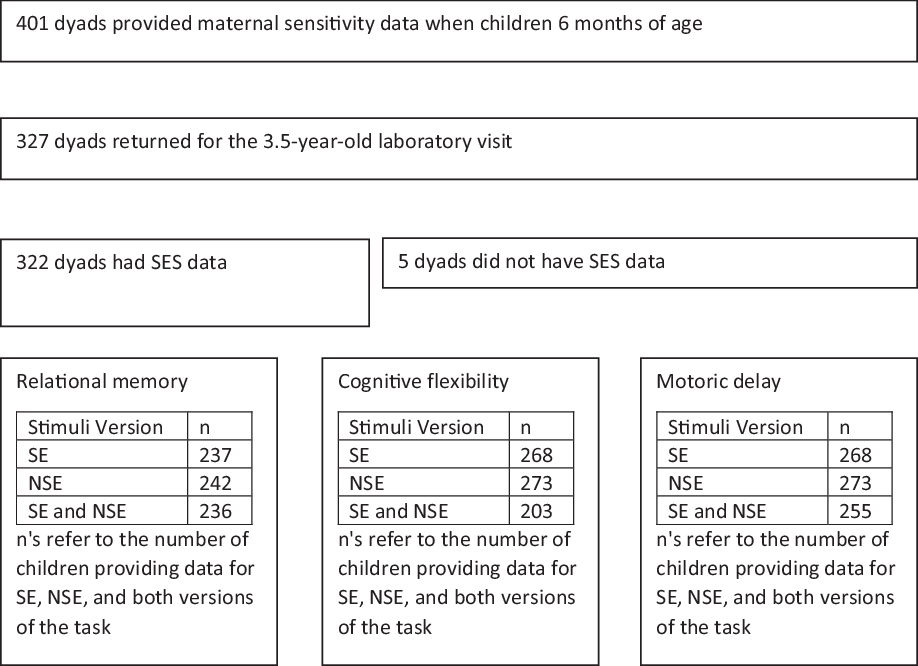
Participants were mothers and singleton-born children taking part in the prospective birth cohort, Growing Up in Singapore Towards Healthy Outcomes (GUSTO). Participants previously took part in a mother–infant observational session when infants were 6 months of age. Of the 401 GUSTO cases for whom 6-month maternal sensitivity data were available, 82% (n = 327, 47% female) returned for a follow-up visit when children were an average of 3 years to 5 months old (M days since birth = 1257.76 (roughly 3.53 years), SD days since birth = 28.25, see Fig. 1). At the time of initial recruitment into the larger pregnancy cohort, the average age of these mothers was respectively 30.86 (SD = 5.29). At that time, 36.7% had university degrees or higher, 57.5% had attended some secondary school or had an intermediate qualification (e.g., GCE A levels, ITE/NCE), and 5% had only attended primary school. Consistent with the recruitment strategy for the larger cohort study Reference Soh, Tint and Gluckman52 , these 327 mothers primarily identified as ethnic Chinese (52%), ethnic Malay (30%), or ethnic Indian (16.2%). Tasks were administered by trained research assistants in the child’s preferred language(s) (e.g., English, Mandarin, Tamil, or Bahasa Melayu).
Study participants. A graphic depiction of how cohort study participants were chosen for inclusion into the current sample.

Maternal sensitivity
When infants were 6 months of age, mothers were asked to “interact or play” with their children without toys or books for 5 min and then in the presence of toys and books for 10 min. Previous work suggests that asking parents to engage without toys may heighten the stress within the observational situation Reference Madigan, Moran and Pederson53 . This laboratory-based video-record was subsequently coded by one of three southeast Asian research staff according to the mini-Maternal Behavior Q Sort (MBQS) 25 Item for Video Data Reference Moran54,Reference Moran, Pederson and Bento55 . This system is comprised of 25 descriptors of potential parenting behavior that address constructs such as attentiveness, responsiveness, facilitation of autonomy, synchrony and attunement, acceptance of positive and negative emotions, and the extent to which responses are developmentally appropriate. Coders are instructed to place the cards into one of five piles ranging in most-like to least-like the observed interaction. Each pile must contain five cards. A middle rating can be given when a descriptor is either “somewhat” like the observation or irrelevant to the observation. As a rule of thumb, coders consider how likely they would be to use any given description when talking to another person about what they observed. Scores for the 25 items are then correlated with scores that were assigned by the system’s developers for each card during a hypothetical prototypically sensitive interaction. Therefore, an interaction that receives a “1” means that it was perfectly correlated with the ideally sensitive interaction, and one that receives a “−1” means that it was very dissimilar to such an interaction. Coder training as well as the system itself has been previously described Reference Heng, Quan and Sim56 . Reliability was assessed in the larger GUSTO sample (n = 401) between the first two coders across 59 cases (roughly 15% of the larger sample), and between Coder Three and Coder One and Coder Two, respectively, across 35 and 31 tapes. The Absolute Intraclass Correlation Coefficient Single Measures across coders equaled 0.720 and was 0.861 between the two coders (i.e., Coders One and Two) who assessed the majority of the cases.
Cognitive testing at 42 months
The 3.5 years follow-up was roughly 3 h long and included cognitive testing relevant to the current paper, as well as other cognitive and behavioral paradigms that did not include both SE and NSE conditions (see Supplement One: S1 Overview of 3.5-Year-Old Testing). Within the current paper’s complete case sample, the mean age at 3.5 follow-up was 3.45 years (range = 3.18–3.8 years, SD = 28.25 d).
Relational memory
The relational memory task consisted of three blocks: Memory 1, Memory 2, and Inference. Memory blocks were counterbalanced for SE and NSE stimuli (see Supplement Two: S2 Relational Binding Task Figure). The third block was used to assess children’s ability to form inferences and is not relevant to the current research as it combines information from both SE and NSE conditions.
Memory blocks began with a practice component to familiarize children with the experiment, and then proceeded to “Encoding” followed by “Retrieval.” During Encoding, children were shown 10 unique slides with centrally positioned cartoon animals. On the bottom left and right of each animal slide, two smaller images were placed. Within both the SE and NSE blocks, the same 10 animals were used. In the SE condition, the smaller right/left images were of a female child displaying a happy (e.g., on the left) and angry (e.g., on the right) expression (NIMH-chEFs picture set Reference Egger, Pine and Nelson57 ). In the NSE condition, the images were pictures of ice cream or cake that were as perceptually similar as possible with regard to colors and toppings. Children were told that the animals only liked to make friends with happy people (SE condition)/eat ice cream (NSE condition) and were asked to press a button on the left or right of a keyboard below that indicated which happy girl was the animal’s friend (SE condition)/food the animal liked (NSE condition). Slides progressed after the child pressed the button indicating the happy girl/ice cream. After responding to all 10 unique animal-SE/NSE encoding slides, the 10 encoding trials were repeated a second time. Immediately following the encoding portion, children were told that a naughty pirate had chased away all the friends (SE condition) or taken all the animal’s ice cream (NSE condition) and children were asked to help the animal get its friends/ice cream back. They were then shown five retrieval slides. Each retrieval slide had one of the happy (SE)/ice cream (NSE) stimuli positioned in the center with a picture of the previously linked animal towards the bottom (e.g., left) and an animal that had previously been shown alongside a different central image on the other side (e.g., right). Within the 5 retrieval slides then, only 5 of the previously viewed 10 happy girls/ice creams were centrally displayed. All of the 10 previously viewed animals were displayed in the retrieval slides, but only 5 of the animals were displayed on the same slide as the happy girl/ice cream with which they had previously been presented. Children were asked to identify which animal went with which happy girl/ice cream. Memory scores on both the SE and NSE versions ranged from 0 to 5, with 5 indicating the best performance.
Cognitive flexibility
Cognitive flexibility was examined using counterbalanced SE and NSE versions of a Dimensional Card Sorting Task Reference Zelazo58 . A detailed description Reference Goh, Yang and Tsotsi59 has been reported elsewhere. In brief, each version of the DCCS had two blocks. In the first block, preschoolers were asked to sort six cards into boxes according to the color of the picture on the cards. In the second block, preschoolers were asked to sort the six cards according to the type of picture. The boxes had line drawings attached to them. In the SE condition, the line drawings were of a happy or angry cartoon emoticon/person; within the NSE condition, the line drawings were of either an ice cream or piece of cake. The color of the line drawings was different. The sorting cards contained the same images as those attached to the boxes but were drawn in the opposite color (e.g., if the happy face on the box was drawn in blue, then the happy face cards the child received were drawn in red).
Consistent with the protocol for this task Reference Zelazo58 , children who answered more than one pre-switch trial incorrectly were dropped, to ensure variation in performance in the “post-switch” phases truly reflected flexibility and not, for example, difficulties attending to or comprehending more basic aspects of the task. Of the remaining children, those who correctly responded to at least five out of six post-switch trials were grouped as “Pass,” while all other toddlers were grouped as “Fail.”
The SE and NSE blocks were counterbalanced. To protect against interference from one DCCS block to the next, children took part in a separate memory encoding task between SE and NSE DCCS blocks.
Inhibitory control
The procedures used in this task have been previously reported Reference Tsotsi, Broekman and Sim60 . Briefly, we used SE and NSE counterbalanced versions of an inhibitory control task. Both versions consisted of four delay trials. Children were asked to place their hands on a mat and wait for a bell to be rung before retrieving a reward. These instructions were reinforced at the start of each trial. Beyond the mat, the experimenter placed a reward under a glass jar (i.e., SE reward: colorful emoticon stickers; NSE reward: colorful chocolates, or cereals in the case of allergy/objections to sugar). Experimenters waited a specified period of time after the start of each trial to lift the bell (Phase 1) and then to press the bell (Phase 2). After retrieval, children were allowed to (SE condition) place the sticker on a sticker template or (NSE condition) eat the candy. Thus, both conditions included a potentially rewarding physical action.
The experiment was video-recorded and scored by one of three independent raters according to the protocol created by Kochanska and colleagues Reference Kochanska, Murray and Harlan61 . Child behavior was scored per trial on a scale from 1 to 9, with 9 indicating the highest inhibitory control. Scores from 1 to 7 reflected how long the child was able to delay (e.g., 1 – child ate candy within Phase 1 of the trial; 2 – child ate candy within Phase 2 of the trial; 3 – child touched candy within Phase 1 of the trial; 4 – child touched candy within phase 2 of the trial; 5 – child touched jar within Phase 1 of the trial, etc.), and additional points were given if a child was able to keep their hands on the mat during one (1 point) or both (2 points) of the trial’s phases. An average score across all four trials was calculated per task version.
Demographics
Demographics were collected when mothers were 26 weeks pregnant. Both maternal education and household income were converted into five-point scales, and these moderately-to-strongly correlated variables were averaged to create a composite SES score as per Reference Heng, Quan and Sim56 . In addition, when infants were 6 months of age mothers completed an interviewer-administered questionnaire to determine the proportion of the child’s waking hours spent with the mother. Past research indicates the importance of considering the amount of predominately awake-time the infant has spent with his/her mother (“maternal exposure”) as a potential moderator leading to “dose–response” types of effects in infancy and early toddlerhood Reference Rifkin-Graboi, Quan and Richmond25,Reference Wen, Soe and Sim62 .
Statistical approach
Primary analyses (gender aggregated data)
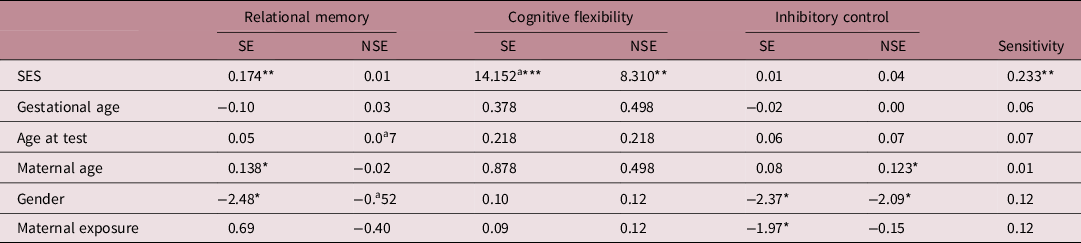
To balance concerns about power and third variable effects, we examined SES, child gender, maternal exposure, child age at test, and gestational age in relation to both task outcomes and maternal sensitivity (see Table 1). As SES was the only variable significantly related to sensitivity as well as some of the cognitive outcomes, only this variable was included as a covariate in subsequent analyses.
Associations with potential covariates

Values for associations between relational memory/motoric delay/sensitivity and SES, gestational age, age at test, and maternal age reflect Pearson r’s. Values for associations between gender and relational memory, delay, and sensitivity reflect t’s from independent t tests (male = 1, female = 2). Relations between maternal exposure reflect t’s from independent t tests (less than 50% = −1, more than 50% = 1). Values for relations between cognitive flexibility and SES, gestational age, age at test, and maternal age reflect Wald’s from logistic regressions. Values for associations between cognitive flexibility and gender and maternal exposure reflect the chi-square statistic. Analyses examining relational memory for NSE included 243 children in all cases except maternal exposure (n = 240) and SES (n = 242). Analyses examining relational memory for SE included 239 children in all cases, except maternal exposure and SES, both of which included 237 children. Analyses examining the cognitive flexibility with NSE used 232 cases, except when considering maternal exposure (n = 214) and SES (n = 227). Analyses examining cognitive flexibility with SE stimuli used 239 cases except when considering maternal exposure (n = 221) and SES (n = 234). Analyses examining delay to NSE stimuli used 273 cases, except when considering maternal exposure (n = 252) and SES (n = 268). Analyses examining delay to SE stimuli used 277 cases except when considering maternal exposure (n = 255) and SES (n = 273).
*P ≤ 0.05; **P ≤ 0.01; ***P ≤ 0.001.
For each type of task (i.e., relational memory, cognitive flexibility, and inhibitory control) we began by only including data from dyads in which children completed both versions (see Supplement Two: S2 Relational Binding Task Figure and Supplement Three: S3 Table of Descriptives for Included (Complete Case) and Excluded Participants). This step was taken to facilitate the interpretation of any SE versus NSE differences and ensure that any such differences could not be attributable to differences in SE versus NSE sample properties. For DCCS analyses, children who did not pass pre-switch were considered to have missing DCCS data. In addition, three dyads lacking SES data were excluded.
Using available data, three structural equation path models were specified in Mplus v 7.4. Each model examined the contribution of maternal sensitivity to performance on SE and NSE conditions, one model per type of task. A Wald test was used to examine if the contribution of maternal sensitivity significantly differed between SE and SE conditions. Moreover, as these are two related conditions of the same task, a correlation was specified to represent their non-independent relation. A maximum likelihood estimator robust to non-normality, which is appropriate for continuous outcomes (MLR Reference Field64 ) was utilized for relational memory and motoric delay tasks. The weighted least squares mean variance estimator with a probit link, appropriate for binary outcomes (WLSMV Reference Field64 ), was utilized for the cognitive flexibility task.
Exploratory analyses examining gender
To examine gender’s role, multi-group structural equation models were utilized to examine differences in the relation of sensitivity to performance on tasks in two ways. In keeping with the research questions and above approach, we were primarily interested in the difference in the strength of associations between the SE and NSE conditions within each gender (e.g., SE versus NSE amongst boys). In addition, we also compared performance of boys versus girls within each condition (e.g., boys in SE versus girls in SE).
Supplementary analyses accounting for missing data
In recognition of statistical approaches accounting for missing data, within Supplement Four we provide a re-analysis of the data with two frequently used techniques: multiple imputation (MI) and full information maximum likelihood (FIML). Please see “Supplement Four: S4 Missing Data: Plan, Results, and Discussion” for the methods and results used in these approaches and an accompanying discussion.
Within the main body of the text, all results refer to those obtained in the complete case analyses.
Results
The number of cases per cognitive task type is subsequently reported by individual task (see Fig. 1 and Table 2). With regard to the number of children with data for more than one type of task: 161 children provided data for all tasks; 15 for relational memory and DCCS tasks; 26 for delay and DCCS tasks; and 51 for relational memory and delay tasks. See Supplement Three: S3 Table of Descriptives for participant characteristics and maternal sensitivity mean values by task
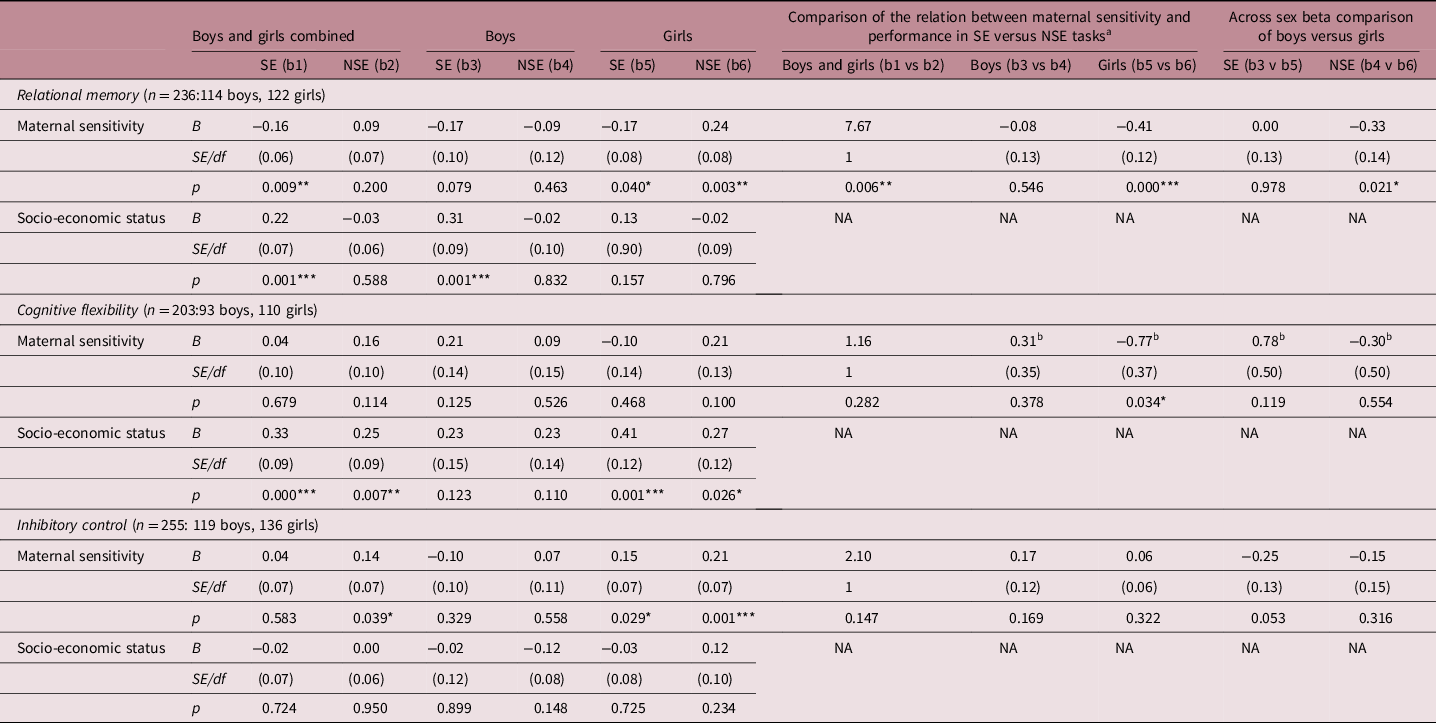
Standardized beta coefficients of maternal sensitivity on SE and NSE tasks with comparisons across conditions and gender
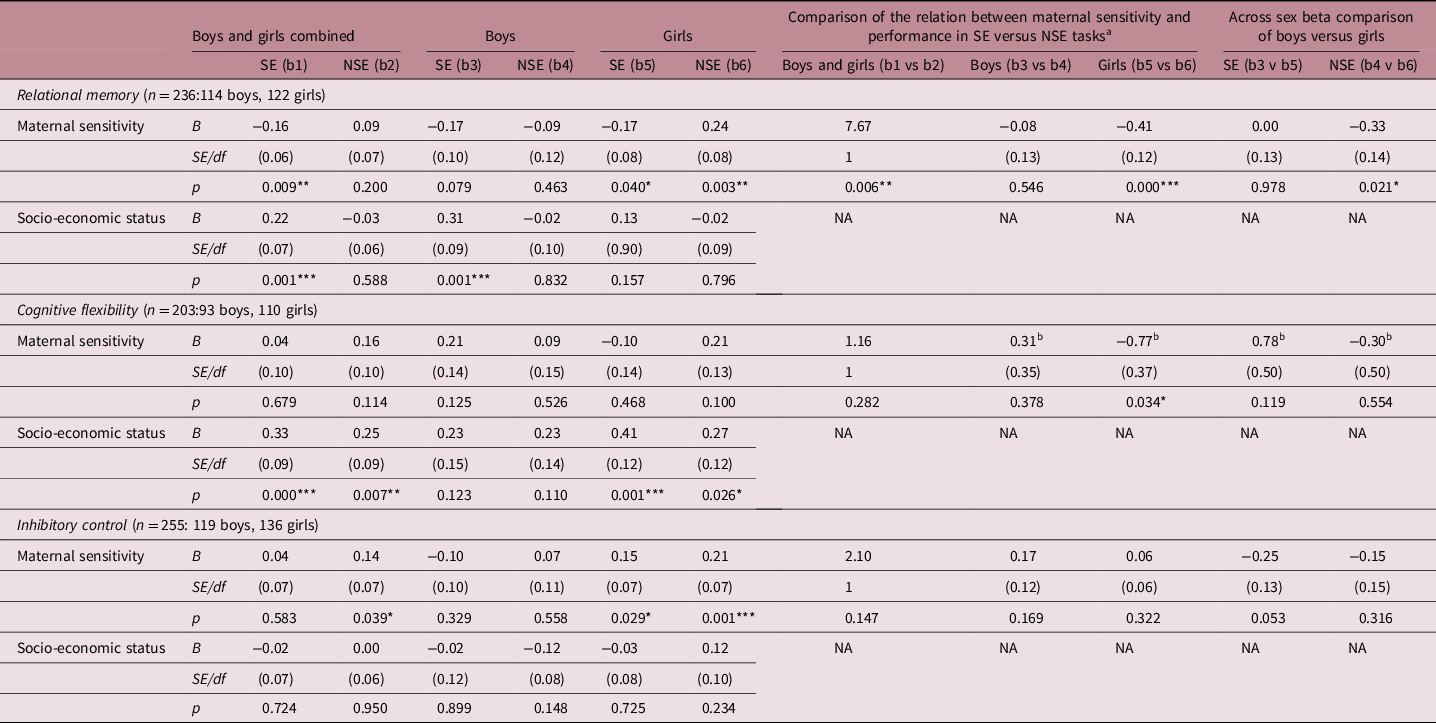
a Comparison of the relations between maternal sensitivity and performance in the SE versus NSE tasks for the gender aggregated sample was conducted with a Wald test. Comparisons of these relationships within the group of boys and within the group of girls were performed by examining the difference in the betas.
b Manual standardization with SDx/SDy is not applicable to categorical outcomes. Hence, unstandardized betas are reported here.
*P ≤ 0.05; **P ≤ 0.01; ***P ≤ 0.001.
Relational memory
Gender aggregated data
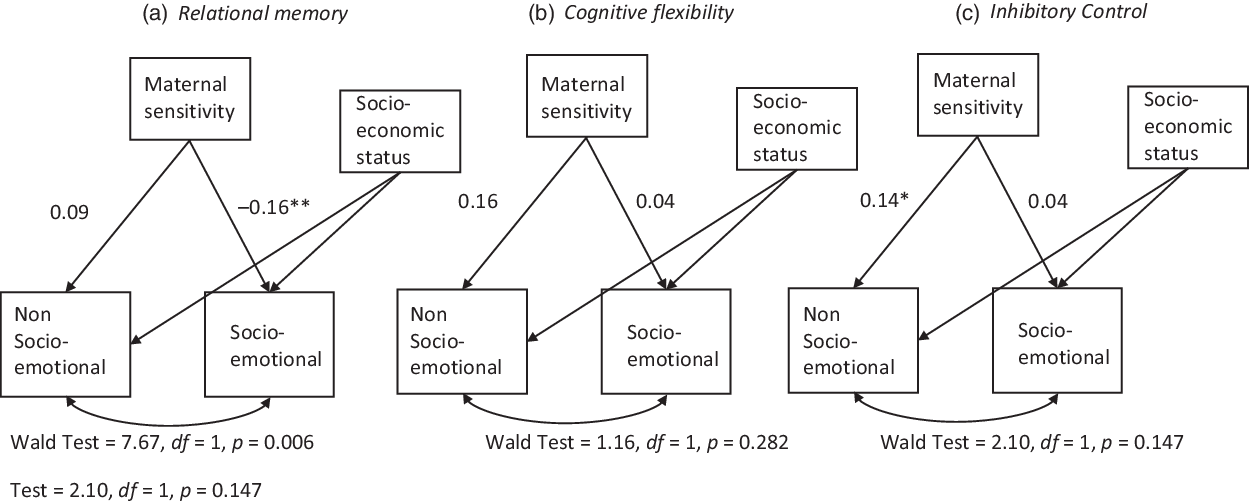
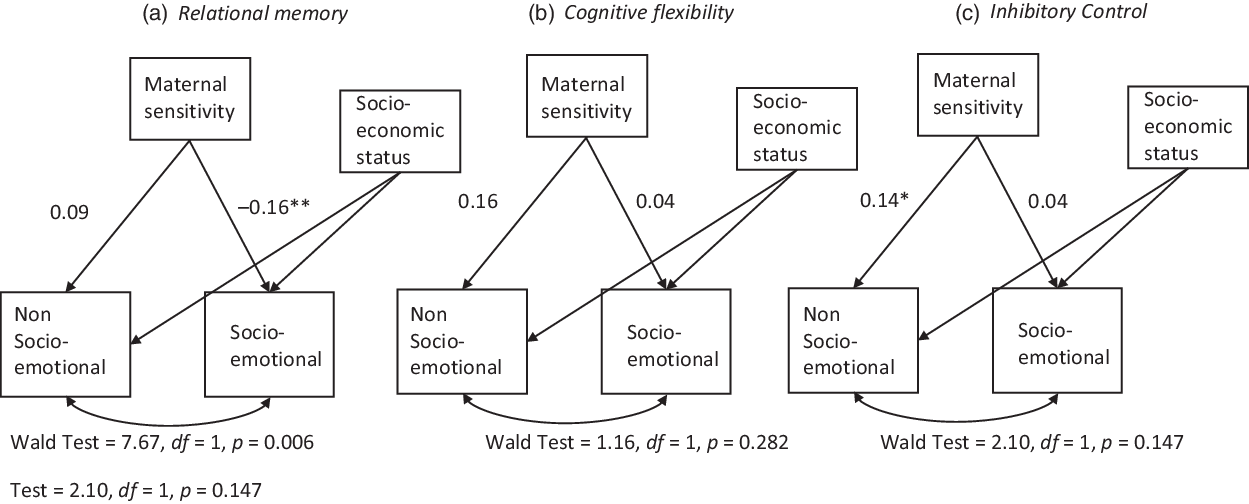
Two-hundred thirty-six children (114 males, 122 females) provided relational memory data with average SE and NSE scores of, respectively, 2.67 (SD = 1.0) and 2.93 (SD = 1.02). As a group, children performed significantly better on the NSE version of the task (t(235) = −2.91, P = 0.004). As shown in Fig. 2, sensitivity negatively predicted SE performance (B = −0.16, SE = 0.06, P = 0.009) but not NSE performance (B = 0.09, SE = 0.07, P = 0.200), after adjustment for SES (see Supplement Five: S5 Figure Sensitivity and Relational Memory Scatterplot). Moreover, sensitivity predicted performance on these two conditions differentially (Wald test = 7.67, df = 1, P = 0.006). No case had a cook’s distance >1 nor had a standardized residual greater than 3 SD, suggesting no undue influence on beta estimates Reference Muthén and Muthén63 .
Structural equation path models concerning maternal sensitivity, SES, and SE and NSE versions of cognitive tasks.
*P < 0.05; **P < 0.01. Structural equation path model with standardized betas for paths from maternal sensitivity to NSE and SE conditions for (a) relational memory, (b) cognitive flexibility, and (c) inhibitory control. Other standardized betas omitted for clarity but available in Supplement Four: S4 Multiple Imputed Analytic Plan, Results, and Discussion.
Gender disaggregated data
Amongst boys, maternal sensitivity did not significantly relate to SE performance (B = −0.17, SE = 0.10, P = 0.079) or NSE performance (B = −0.09, SE = 0.12, P = 0.463), and the difference in effects was not significant (B difference = −0.08, SE = 0.13, P = 0.546). However, amongst girls, higher levels of maternal sensitivity significantly predicted worse performance on the SE version (B = −0.17, SE = 0.08, P = 0.04) and better performance on the NSE condition (B = 0.24, SE = 0.08, P = 0.003). In addition, the difference in relations between maternal sensitivity and SE versus NSE performance in girls was significant (B difference = −0.41, SE = 0.12, P = 0.000). Not surprisingly, then, the relation between maternal sensitivity and SE performance was not statistically different across girls and boys (B difference = 0.00, SE = 0.13, P = 0.978), but the relation between maternal sensitivity and NSE performance was (B difference = −0.33, SE = 0.14, P = 0.021).
Cognitive flexibility
Gender aggregated data
Two-hundred three children (93 males, 110 females) passed pre-switch and provided cognitive flexibility data. The number of children who passed post-switch was nearly identical across the SE and NSE versions of the task. In the NSE condition, 50 passed and 153 failed the post-switch. Likewise, in the NSE condition, 52 passed and 151 failed the post-switch condition. As shown in Fig. 2A, sensitivity did not predict either SE or NSE performance (B = 0.04, SE = 0.10, P = 0.679; B = 0.16, SE = 0.10, P = 0.114), after adjustment for SES. The Wald test was non-significant, indicating that the contribution of sensitivity to both conditions did not differ (Wald test = 1.16, df = 1, P = 0.282). Although standardized residuals are not available in Mplus, no case had a cook’s distance >1, suggesting no undue influence on beta estimates.
Gender disaggregated data
Similar to the combined analysis, amongst boys there were no significant relations between sensitivity and SE (B = 0.21, SE = 0.14, P = 0.125) nor NSE (B = 0.09, SE = 0.15, P = 0.526) performance, nor was the difference in the betas associated with these relations significant (B = 0.31, SE = 0.35, P = 0.378). Likewise, in girls there was no significant relation between sensitivity and performance on the SE (B = −0.10, SE = 0.14, P = 0.468) or NSE (B = 0.21, SE = 0.13, P = 0.100) conditions. However, amongst girls the difference in the effect sizes between maternal sensitivity’s relation to SE stimuli and its relation to NSE stimuli did significantly vary (B difference = −0.77, SE = 0.37, P = 0.034) in the hypothesized direction. Neither the relations between maternal sensitivity and performance in the SE (B difference = 0.78, SE = 0.50, P = 0.119) nor NSE (B difference = −0.30, SE = 0.50, P = 0.554) conditions significantly differed between girls and boys.
Inhibitory control
Gender aggregated data
Two-hundred fifty-five (119 male, 136 female) participated in the inhibitory control task with average SE and NSE scores, respectively, of M = 7.88 (SD = 1.28) and M = 7.98 (SD = 1.21). As a group, children’s behavior did not significantly differ across the two task conditions, t(254) = −1.45, P = 0.149. As shown in Fig. 2C, sensitivity did not predict the SE condition (B = 0.04, SE = 0.07, P = 0.583), but did predict the NSE condition (B = 0.14, SE = 0.07, P = 0.039), after adjustment for SES (see Appendix Six: S6 Figure Inhibitory Control Scatterplots). However, the prediction of sensitivity to each condition did not differ from one another (Wald test = 2.10, df = 1, P = 0.147). No case had a cook’s distance >1, suggesting no undue influence on the beta estimate.
However, nine cases had standardized residuals greater than 3 standard deviations, resulting in a heteroskedastic distribution of errors, which can reduce the reliability of P-values. Heteroskedasticity could not be resolved by removing these nine cases, as doing so simply resulted in six additional cases above 3 standard deviations in standardized residuals. This is likely due to the non-normal distribution of motoric delay tasks (see Supplement Three: S3 Table of Descriptives), which is accounted for in MPLUS, which utilizes a robust estimator that is designed to correct for this feature Reference Field64 .
Gender disaggregated data
Amongst boys, there were no significant differences in relations between maternal sensitivity and SE (B = −0.10, SE = 0.10, P = 0.329) or NSE (B = 0.07, SE = 0.11, P = 0.558) performance, nor was the difference in the effect sizes significant (B difference = 0.17, SE = 0.12, P = 0.169). Amongst girls, however, maternal sensitivity predicted better performance on both the SE (B = 0.15, SE = 0.07, P = 0.29) and NSE conditions (B = 0.21, SE = 0.07, P = 0.001), and the difference was not significantly different (B difference = 0.06, SE = 0.06, P = 0.322). The differences in the relations between maternal sensitivity and performance on the SE (B difference = −0.25, SE = 0.13, P = 0.053) and NSE tasks (B difference = −0.15, SE = 0.15, P = 0.316) did not significantly differ between boys and girls.
Discussion
Prior work’s findings that lower levels of maternal sensitivity, and relatedly insecure attachment, predict decreased executive functioning Reference Bernier, Carlson and Whipple3,Reference Matte-Gagne, Bernier, Sirois, Lalonde and Hertz4,Reference Bernier, Carlson, Deschenes and Matte-Gagne34,Reference Bernier, Beauchamp, Carlson and Lalonde65 are consistent with the idea that environmental adversity leads to enhanced stress hormones that, over time, impair frontolimbic circuitry influencing functions, such as memory, cognitive flexibility, and inhibitory control Reference McEwen, Nasca and Gray66 . However, work considering the adaptive significance of cognitive functioning Reference Rifkin-Graboi, Quan and Richmond25,Reference Ellis, Abrams, Masten, Sternberg, Tottenham and Frankenhuis28,Reference Frankenhuis and de Weerth67,Reference Frankenhuis, Panchanathan and Nettle68 implies that there are circumstances in which caregiving adversity may predict “better” cognitive functioning.
We investigated whether the relation between sensitivity and cognitive functioning would vary depending on contextual aspects of the stimuli. Within our complete case analyses examining data from both boys and girls, we found lower maternal sensitive caregiving in infancy predictive of better relational memory to SE stimuli, but not NSE stimuli in preschoolers. Because, as a group, children performed more poorly on the SE than NSE version of the task, we cannot rule out the possibility that it is easier to detect effects of sensitivity in difficult, as opposed to less difficult, memory tasks. Still, these findings also fit within an adaptation framework. As children exposed to less sensitive care may be more likely to encounter future difficult relationships, and less likely to turn to supportive caregivers for help, prioritizing SE versus NSE cues may be beneficial. Mechanistically, if children exposed to higher levels of insensitive care found the SE stimuli to be more salient, they may not only have encoded such items more deeply, they may also have been comparatively more likely to exhibit enhanced levels of noradrenaline, which could then influence memory performance Reference Cahill and Alkire2 .
In addition, as expected, we observed sensitivity predictive of the degree of difference between memory for the SE and NSE stimuli. However, in the combined sample of girls and boys we did not observe a significant relation between sensitivity and memory for the NSE stimuli. In some ways, this is in contrast to past work suggesting that stressful experiences should negatively impact memory. Work with children points to relations between lower SES and worse memory performance Reference Noble, McCandliss and Farah69 , and work with adults likewise often points to relations between chronic stress and impaired memory performance Reference McEwen, Nasca and Gray66 . Still, relations between early life maltreatment and memory functioning are complex and may suggest that the age Reference Dunn, Busso and Raffeld70 and consistency Reference Qiu, Rifkin-Graboi and Chen71 of exposure moderate relations. Moreover, the timing of assessment may also play a role, and the ideal time to identify differences may not be uniform across genders, as relevant brain structures may develop at different rates Reference Krogsrud, Tamnes and Fjell72–Reference Uematsu, Matsui and Tanaka74 , but see Reference Tamnes, Bos, van de Kamp, Peters and Crone75 . Indeed, here we observed significant relations between more adverse experience, in the form of insensitive maternal care, and worse performance during the NSE condition, but better performance in the SE condition amongst girls, but not boys. In addition, in order to prioritize circuitry important to avoiding danger, adverse early life caregiving experiences may lead to accelerated memory development. Given the non-linear pace of hippocampal development, initially such acceleration may lead to adversity associating with enhanced memory, the effects may then become difficult to detect during periods of relative plateau, and eventually relations may invert Reference Rifkin-Graboi, Quan and Richmond25,Reference Rifkin-Graboi, Kong and Sim76 . Indeed, some Reference Bernier, Dégeilh, Leblanc, Daneault, Bailey and Beauchamp44,Reference Rao, Betancourt and Giannetta45,Reference Rifkin-Graboi, Kong and Sim76 investigations concerning caregiving and neurodevelopment point to an association between less sensitive care and enhanced early life hippocampal development. In addition, other work points to associations between less sensitive care and accelerated development, specifically in females Reference Thijssen, Muetzel and Bakermans-Kranenburg42 . However, to our knowledge, no work examines caregiver sensitivity and/or child attachment in relation to memory for NSE stimuli across the lifespan. Additional studies examining these relations, as well as relations with SE stimuli are warranted, especially given adult findings linking secure attachment to better memory for negatively valanced words Reference Zeijlmans van Emmichoven, van IJzendoorn, de Ruiter and Brosschot33 .
Beyond the observed relations between sensitivity and memory performance, we also found some evidence that the SE quality of a reward may influence sensitivity’s relation to inhibitory control. Prior research has investigated associations between maternal sensitivity (or similar constructs) and performance on delay-task batteries Reference Merz, Landry, Montroy and Williams35,Reference Kochanska, Murray and Harlan61,Reference Pauli-Pott, Schloß and Becker77,Reference Merz, Landry and Zucker49 . These batteries have included a snack-delay task, but have also examined delay in response to approaching gifts and toys, alone and/or in the presence of a familiar experimenter and/or a novel stranger. Similar to the current findings, the overall impression from such work is that sensitive caregiving does positively predict children’s delay behavior (but for nil results see Reference Bernier, Carlson, Deschenes and Matte-Gagne34 ). However, in addition to sensitive caregiving, other aspects of caregiving may also play a role Reference Merz, Landry and Zucker49 . Here, we examined maternal sensitivity during free-play in a laboratory environment. Though mothers may have felt some stress during the no-toys portion Reference Madigan, Moran and Pederson53 , we did not include any procedures to specifically enhance stress in infants (e.g., separation, the introduction of novelty, or maternal disengagement). Past work indicates that maternal sensitivity in infant distress versus non-distress contexts may differentially impact outcomes, and that the latter may be more closely tied to demographic factors such as SES Reference Leerkes, Weaver and O’Brien78 . Likewise, harshness and unpredictability may differentially impact cognition, suggesting that it is too simplistic to consider “good” and “bad” experience Reference Mittal, Griskevicius, Simpson, Sung and Young36 . As such, future research may wish to further decompose aspects of maternal sensitivity (e.g., predictability, harshness, comforting behavior, and facilitation of autonomy).
In addition, developmental stage may play a role in the relation between caregiving and cognitive functioning. For example, both Merz and colleagues Reference Merz, Landry, Montroy and Williams35 and Pauli-Pott and colleagues Reference Pauli-Pott, Schloß and Becker77 find constructs similar to the sensitivity variable we have examined here predictive of increased growth in delay performance across time, but not delay performance at the youngest age tested. Likewise, the age of exposure to insensitive-sensitive care may impact outcomes Reference Merz, Landry, Montroy and Williams35 , and future work should examine these relations at older ages when a larger proportion of children is likely to pass the task.
In the current work, we did not observe a significant relation between sensitivity and delay performance to SE stimuli in the sample as a whole, perhaps suggesting that children exposed to less sensitive care did not find the SE stimuli appetitive. This idea is in keeping with work suggesting the defensive exclusion of emotional information amongst insecure adults Reference Zeijlmans van Emmichoven, van IJzendoorn, de Ruiter and Brosschot33 as well as children in insecure attachment relationships Reference Main, Kaplan and Cassidy79,Reference Kirsh and Cassidy80 . Nevertheless, as sensitivity did not predict a significant difference between responses to SE and NSE stimuli, and because, amongst girls sensitivity predicted better performance in both versions of the task, this interpretation should be treated with caution.
Unlike the other cognitive processes, regardless of stimuli type, we did not observe significant relations between sensitivity and cognitive flexibility in the sample as a whole, or when data were disaggregated according to gender. This is in contrast from the majority of past observational studies examining sensitivity and NSE cognitive flexibility Reference Bernier, Carlson and Whipple3,Reference Matte-Gagne, Bernier, Sirois, Lalonde and Hertz4,Reference Bernier, Carlson, Deschenes and Matte-Gagne34 , as well as implications from sensitivity-focused intervention research Reference Lewis-Morrarty, Dozier, Bernard, Terracciano and Moore17,Reference Lind, Lee Raby, Caron, Roben and Dozier19 . It is possible that these nil findings are particular to our procedures (e.g., consistently asking children to first sort by concept and then by color, using line drawings rather than pictures, etc.). However, the nil findings are not unheard of, and indeed whilst Merz and colleagues Reference Merz, Landry, Montroy and Williams35 observed relations between parental responsiveness and growth in cognitive conflict abilities over time amongst 534 preschoolers, significant associations were not observed at all study time points. Moreover, consistent with other investigations we did see positive associations between cognitive flexibility and parental SES Reference Bernier, Carlson, Deschenes and Matte-Gagne34 , suggesting that our task was able to identify individual differences. Finally, in further support of the task’s ability to detect differences, though we did not observe significant relations between sensitivity and NSE performance in either gender, amongst girls, the degree of association between sensitivity and SE versus NSE performance did significantly vary in a way consistent with hypotheses, with the beta for the relation between sensitivity and NSE performance (B = 0.21, P = 0.10) in the same direction of that found in other research.
To our knowledge, this study represents the first prospective examination of observed maternal sensitivity when infants were 6 months of age and subsequent preschool cognitive functioning roughly 3 years later on three different types of tests, each containing SE and NSE stimuli. In addition, future work should also continue to use both complete case and missing data techniques for analysis (see Supplement 4), to better understand the phenomena and to help determine best statistical practices; as revealed in Supplement Four, while our complete case and FIML approaches yielded similar effects, the MI approach did not reveal relations between maternal sensitivity and relational memory. These techniques are able to utilize information from children who were present at 6 months testing but not 42 months, guarding against bias which may arise from complete case analyses which drop by 36.4%–49.4% of cases due to missing data. Furthermore, future work should expand on these findings by comparing responses to stimuli that vary in both SE versus NSE dimensions as well as appetitive versus aversive quality, and may also wish to include a larger variety of emotions. Future work should also examine relations between specific aspects of insensitive care and cognitive functioning. Mittal and colleagues Reference Mittal, Griskevicius, Simpson, Sung and Young36 hypothesized that when individuals expect unpredictable environments, it is to their benefit to frequently update new information (and so exhibit high cognitive flexibility). Accordingly, they found that unpredictability during childhood was associated with comparatively good flexibility at university age, specifically when concurrent feelings of unpredictability were invoked, with no effects when people were tested in neutral conditions. Their work, then, additionally demonstrates the importance of concurrent testing environments Reference Mittal, Griskevicius, Simpson, Sung and Young36 .
Understanding the interplay between caregiving, cognitive/executive functioning, and SE cues is not simply of theoretical importance. A better appreciation of the manner in which these variables interact may also have practical value. Frankenhuis and colleagues suggest such knowledge may lead to better designed educational and workplace policies, eliminating stigma, and decreasing publication biases Reference Frankenhuis and Nettle81 . Likewise, if replicated, the results of the current paper may suggest that SE information could be used alongside teaching and intervention materials to enhance the learning of new skills and/or limit temptations to approach rewards. More broadly, additional research considering the potential adaptive significance of sequelae to caregiving adversity may ultimately lead to the creation of learning materials that limit disparities at the start of preschool, and so provide more equal educational opportunities for all students. In turn, this may perhaps enhance the likelihood that, at school age, those exposed to caregiving adversity are more likely to find meaningful positive relationships, which are a known source of resilience for the development of change in cognitive affective strategies and relationships Reference Williford, Carter, Pianta, Cassidy and Shave82 .
Acknowledgements
The GUSTO study group includes Allan Sheppard, Amutha Chinnadurai, Anne Eng Neo Goh, Anne Rifkin-Graboi, Anqi Qiu, Arijit Biswas, Bee Wah Lee, Birit F.P. Broekman, Boon Long Quah, Borys Shuter, Chai Kiat Chng, Cheryl Ngo, Choon Looi Bong, Christiani Jeyakumar Henry, Cornelia Yin Ing Chee, Yam Thiam Daniel Goh, Doris Fok, Fabian Yap, George Seow Heong Yeo, Helen Chen, Hugo P S van Bever, Iliana Magiati, Inez Bik Yun Wong, Ivy Yee-Man Lau, Jeevesh Kapur, Jenny L. Richmond, Jerry Kok Yen Chan, Joanna D. Holbrook, Joshua J. Gooley, Keith M. Godfrey, Kenneth Kwek, Kok Hian Tan, Krishnamoorthy Niduvaje, Leher Singh, Lin Su, Lourdes Mary Daniel, Lynette Pei-Chi Shek, Marielle V. Fortier, Mark Hanson, Mary Foong-Fong Chong, Mary Rauff, Mei Chien Chua, Michael Meaney, Mya Thway Tint, Neerja Karnani, Ngee Lek, Oon Hoe Teoh, P. C. Wong, Peter D. Gluckman, Pratibha Agarwal, Rob M. van Dam, Salome A. Rebello, Seang-Mei Saw, Shang Chee Chong, Shirong Cai, Shu-E Soh, Sok Bee Lim, Chin-Ying Stephen Hsu, Victor Samuel Rajadurai, Walter Stunkel, Wee Meng Han, Wei Pang, Yap-Seng Chong, Yin Bun Cheung, Yiong Huak Chan, and Yung Seng Lee.
Financial support
This research is supported by the Singapore National Research Foundation under its Translational and Clinical Research (TCR) Flagship Programme and administered by the Singapore Ministry of Health’s National Medical Research Council (NMRC), Singapore (NMRC/TCR/004-NUS/2008; NMRC/TCR/012-NUHS/2014). Additional funding is provided by the Singapore Institute for Clinical Sciences, Agency for Science Technology and Research (A*STAR), Singapore, Biomedical Research Council (BMRC) Strategic Positioning Fund (SPF) (Grant ID: SPF2013/002) as well as the NMRC (NMRC/CBRG/0039/2013), and the Young Investigator Award at the Singapore Institute for Clinical Sciences (SICS/YIG/2013/002).
Conflicts of interest
Although no authors have a direct conflict of interest regarding the topic of the current manuscript, Yap-Seng Chong has received reimbursement for speaking at conferences sponsored by companies selling nutritional products. He is also part of an academic consortium that has received research funding from Abbott Nutrition, Nestle, and Danone.
Ethical standards
Approval from National Health Care Group Domain Specific Review Board (D/09/021 and 2014/00414) and SingHealth Centralized Institutional Review Board (2009/280/D) was obtained, with informed written consent from each participant.
Supplementary material
To view supplementary material for this article, please visit https://doi.org/10.1017/S2040174420001348