Several factors shaped ancient Maya flintknappers’ raw material choices, including material properties and abundance, and socioeconomic or political restrictions. In terms of the former, archaeologists have long recognized that raw material choices are driven by material properties. Generally, flintknappers preferentially work materials such as fine-grained cherts when making bifaces. More rarely, bifaces were fashioned from coarse-grained material that may not fracture as predictably (i.e., Nami Reference Nami2015). In areas in which flintknappers had access to a variety of raw materials, we can consider factors contributing to raw material selection.
In the Maya Lowlands, the primary stone materials available were chert, limestone, and obsidian; limestone is the most naturally abundant but has the least documented evidence of use. Historically, limestone has been considered a less-desirable raw material for flaked-tool production because its physical properties do not result in predictable conchoidal fractures, which are found in brittle, elastic, and homogeneous materials (Andrefsky Reference Andrefsky2005; Whittaker Reference Whittaker1994).
Our research at Buenavista del Cayo, Belize (hereafter Buenavista) has caused us to rethink assumptions about raw material preferences for limestone. At Buenavista, we recovered 42 limestone bifaces and evidence for limestone biface production in the site's marketplace (Cap Reference Cap2015a). These data suggest limestone bifaces were distributed through marketplaces and they were more common than previously thought.
Limestone Tools in the Maya Lowlands
Limestone tools are most often reported from chert-poor regions with locally available limestone. Within the southern Maya Lowlands, chert's uneven distribution results in localized chert-poor regions with relatively high percentages of limestone artifacts (Andrieu and Roche Reference Andrieu, Roche, Barrientos, Canuto and Bustamante2015; Rivero Torres Reference Rivero Torres1987). In the chert-poor north coast region of the northern Maya Lowlands, archaeologists have noted the presence of limestone bifaces and debitage (Dahlin et al. Reference Dahlin, Bastamow, Beach, Hruby, Hutson, Mazeau, Hruby, Braswell and Mazariegos2011; Hearth and Fedick Reference Hearth, Fedick, Hruby, Braswell and Mazariegos2011). The low reported frequency of flaked limestone artifacts may be due to limestone's friability and its propensity to weather, which complicate its identification (Braswell Reference Braswell1998; Dahlin et al. Reference Dahlin, Bastamow, Beach, Hruby, Hutson, Mazeau, Hruby, Braswell and Mazariegos2011; Hearth and Fedick Reference Hearth, Fedick, Hruby, Braswell and Mazariegos2011).
Limestone use is not restricted to chert-poor regions. In the upper Belize River valley (UBRV), chert occurs ubiquitously, if irregularly (Horowitz Reference Horowitz2017; VandenBosch Reference VandenBosch1999; Yaeger Reference Yaeger2000), whereas limestone tools and flakes are found throughout the region (Supplemental Table 1). Most of the reported limestone tools are general utility bifaces (GUBs): large, chunky bifaces with rounded ends (Kidder Reference Kidder1947). Limestone GUBs have been found in households (Braswell Reference Braswell1998; Peuramaki-Brown Reference Peuramaki-Brown2012; Yaeger Reference Yaeger2000), agricultural terraces (Wyatt Reference Wyatt2008), and chert quarries (Horowitz Reference Horowitz2017; VandenBosch Reference VandenBosch1999). Limestone debitage from flaked-stone tool production has also been reported but with little information about its quantity or characteristics (Supplemental Table 1).
The Buenavista sample provides an opportunity to begin systematic examinations of limestone biface production. We discovered evidence for limestone biface production early in our research at Buenavista, heightening our awareness of its potential presence.
Buenavista
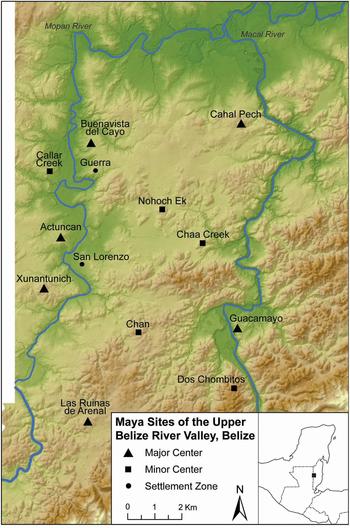
Buenavista, located on the east bank of the Mopan River in the UBRV (Figure 1), was a major political center during the Early Classic and the early Late Classic periods (AD 300–700), with occupation extending from the Middle Preclassic (950–300 BC) through the Terminal Classic period (AD 780–1000; Ball and Taschek Reference Ball, Tashchek and Garber2004; LeCount and Yaeger Reference LeCount, Yaeger, LeCount and Yaeger2010; Peuramaki-Brown Reference Peuramaki-Brown2012). This sample derives from investigations by the Mopan Valley Archaeological Project (MVAP) that, under the direction of Jason Yaeger, has worked at and around Buenavista since 2005. MVAP investigations of relevance include excavations in the monumental core (Cap Reference Cap2015a), survey and excavations of surrounding settlement zones (Eli Reference Eli2014, Reference Eli2015; Peuramaki-Brown Reference Peuramaki-Brown2012), and excavations of the minor center of Callar Creek (Kurnick Reference Kurnick2013) and Callar Creek Quarry (Horowitz Reference Horowitz2017).
Location of Buenavista.

Limestone Acquisition
The UBRV bedrock consists of Cretaceous and Tertiary period limestone beds and alluvial deposits containing limestone and chert cobbles. Cretaceous beds consist of dolomite and crystalline limestone. Tertiary beds consist of soft limestone, chert, marl, and gypsum (Smith Reference Smith1998). Although a survey of limestone outcrops has not been conducted, the ancient Maya used both hard and soft limestone, suggesting their accessibility. The latter were preferred for masonry (Braswell Reference Braswell1998; Keller Reference Keller2006), whereas the former were more suitable for knapping.
Limestone Biface Production and Exchange
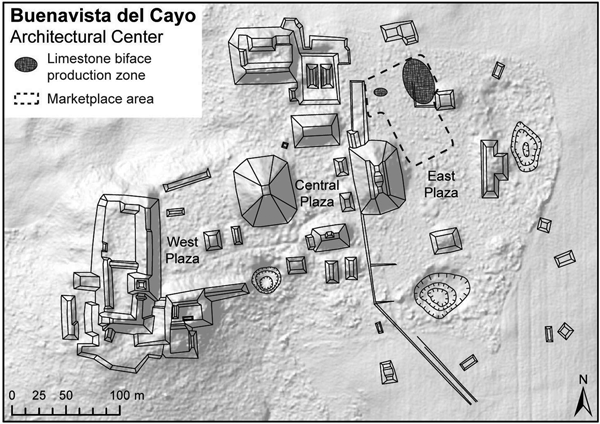
Excavations in Buenavista's Late Classic marketplace (Cap Reference Cap2015a) recovered evidence of limestone biface production, the largest reported concentration of limestone debitage in the UBRV (Supplemental Table 1), and the first time limestone tool production has been identified in a marketplace. Limestone bifaces were produced in two areas (Figure 2): the western and eastern zones, with maximum limestone densities of 644 and 58,062 debitage/m3, respectively (Cap Reference Cap2015a:253; Heindel Reference Heindel2010:Tables 10–13).
Limestone debitage concentrations in Buenavista's marketplace.

Whole and broken flakes were analyzed to determine production mechanisms and products. All flakes in the eastern zone and 87% of the flakes in the western zone are thinning flakes. No limestone bifaces were recovered, but the sample is consistent with end-stage biface production (Cap Reference Cap2015a).
Limestone Bifaces
Excavations and pedestrian survey at Buenavista have thus far recovered 42 limestone bifaces contemporaneous with the site's marketplaceFootnote 1, Footnote 2. Thirty-four were recovered from 19 households (Eli Reference Eli2014, Reference Eli2015; Peuramaki-Brown Reference Peuramaki-Brown2012), 6 from a community structure (Peuramaki-Brown Reference Peuramaki-Brown2012), and 15 from the site's West Plaza (Cap Reference Cap and Yaeger2015b). Of those recovered from households, 19 were recovered in excavations in Buenavista's South Settlement Zone (Peuramaki-Brown Reference Peuramaki-Brown2012) and 15 during surface collections in plowed fields in the settlement zones east and north of Buenavista (Eli Reference Eli2014, Reference Eli2015).
Biface analyses focused on metric, qualitative, and indexical analyses. Metric analyses provide information on size and form. Qualitative analyses examined completeness, breakage patterns, and use-wear. Breakage pattern analysis characterizes the nature and timing of breakage. We focused on impact fractures, caused when a biface strikes a hard surface; and bending fractures, caused by production errors and impact (Andrefsky Reference Andrefsky2005; Whittaker Reference Whittaker1994:165). Macroscopic use-wear was assessed with the naked eye. Use-wear provides information on tool function and confirmation of breakage through use. Finally, the width/thickness (W/T) and Johnson thinning index (JTI; Johnson Reference Johnson1981), a ratio of biface surface area to mass, were calculated for whole bifaces to examine biface reduction and form.
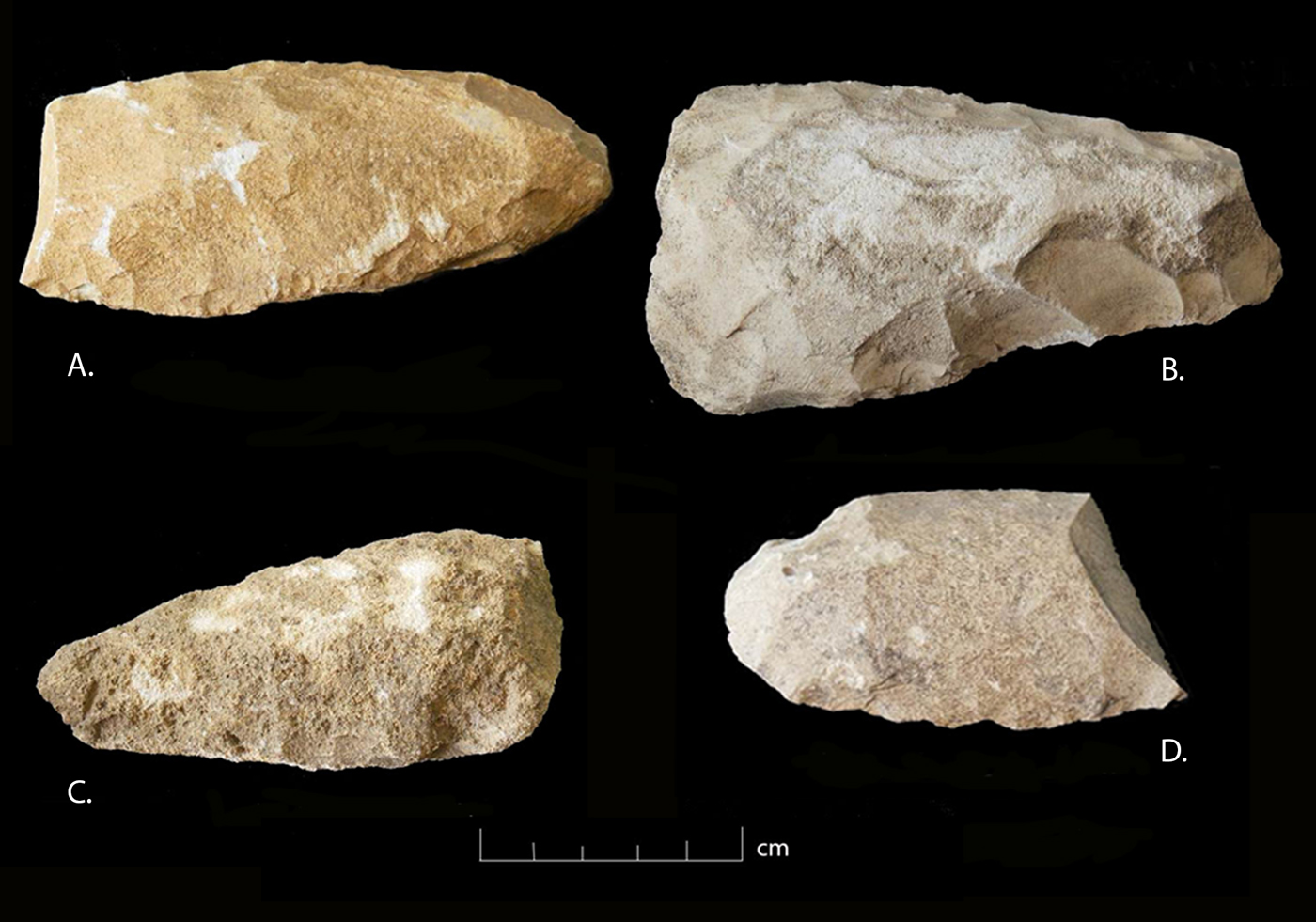
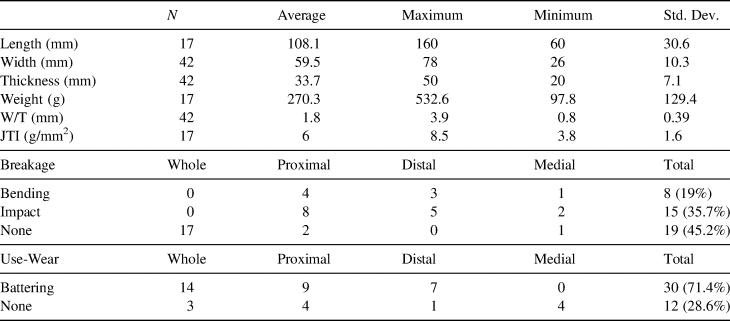
The limestone bifaces are large, thick GUBs (Table 1; Figure 3). Twenty-eight bifaces were broken, of which 15 had impact fractures or impact-induced bending fractures, indicative of use-related breakage (Table 1). The fractures were visually similar (Figure 3), suggesting a similar cause. Macroscopic use-wear, predominately battering, was observed on the lateral margins of whole and broken bifaces, either from use or retouch for hafting (Table 1, Figure 3).
Limestone bifaces from Buenavista. A: Whole biface with flake removal; B, C: Whole biface; D: Biface with impact fracture.

Biface Metrics, Breakage Patterns, and Macroscopic Use-Wear.

The bifaces had a high W/T ratio and low JTI (Table 1). These values illustrate that the limestone bifaces were finished but not thinned as is typical with biface production, although GUBs are thick. Thus, biface thickness was an intentional result of the production process.
Discussion
Evidence for limestone biface production and exchange in the Buenavista marketplace suggests that these tools were desired by householders, as they were incorporated into the site's marketplace exchange network. These findings also demonstrate that limestone was suitable/desirable for biface production.
The Buenavista limestone bifaces have use-wear and breakage patterns that indicate they were struck against hard materials. Comparisons with experimental quarrying, digging, and chopping found that thicker bifaces break less often than thinner ones (Clark and Woods Reference Clark, Woods and Shott2014), bifaces accumulate feather and step fractures on lateral margins, and bending fractures predominate (Lewenstein Reference Lewenstein1987); these are all characteristics of this sample.
Given these patterns, we suggest the Buenavista limestone bifaces were likely used for heavy-duty tasks such as quarrying, chopping, and hoeing because the archaeological wear-patterns mimic those from experimental studies. Future experiments will be important for accessing these interpretations. Nevertheless, the presence of limestone bifaces and debitage in a chert-rich area indicates that for the ancient Maya these tools had utility and that the raw material quality did not dissuade knappers from using limestone to produce tools.
Acknowledgements
The Belize Institute of Archaeology granted permission for this research. Thanks to the Mopan Valley Archaeological Project/Mopan Valley Preclassic Project; Pablo, Hector, and Celina Guerra; and the Juan Family. Funding provided by: National Science Foundation (BSC#0810984), Social Sciences and Humanities Research Council of Canada, Frankino Foundation, Choquette Family Foundation, University of Calgary, University of Wisconsin-Madison, and University of Texas at San Antonio. Diego Matadamas edited the Spanish abstract. Comments by Tatsuya Murakami and three anonymous reviewers improved the manuscript. Thanks to Geoffrey Braswell and María Gutiérrez for their editorial assistance.
Data Availability Statement
Discussed materials are housed in the MVAP laboratory with permission from the Institute of Archaeology.
Supplemental Materials
For supplementary material accompanying this paper, visit https://doi.org/10.1017/laq.2018.72
Supplemental Table 1. Table presenting data on the quantity of limestone bifaces and debitage in the Upper Belize River Valley.