This article explores how wartime stress and the health of recruits while in the service affected their subsequent wealth accumulations. The patterns and determinants of wealth accumulation have been one of the central issues in American economic history. Various human capital attributes such as age, literacy, race, length of residence, and nativity, have been employed as determinants of savings. It has been established by these studies that the age profile of wealth was inverse-U shaped, that the duration of residence in America or in a particular locality was positively related with the magnitude of wealth, and that the size and pattern of wealth accumulation differed by ethnicity.1
Soltow, Men and Wealth; Kearl and Pope, “Choices”; Pope, “Households”; Galenson and Pope, “Mobility”; Galenson, “Economic Opportunity”; and Ferrie, Yankeys.
To my knowledge, however, the effect of health, a potentially important element of wealth mobility, has not been explored. By considering this important dimension of human capital, the present study will broaden our under-standing of wealth accumulation.
By examining the experiences in the past, this article also contributes to the current research regarding the association between health and economic status. There is increasing evidence of a strong association between many measures of economic status, including income and wealth, and a variety of health outcomes, such as mortality, morbidity, and self-reported health.2
Ettner, “New Evidence”; McDonough et al., “Income Dynamics”; McClellan, “Health Events”; Attanasio et al., “Differential Mortality”; and Meara, “Health.”
According to the head of household's 1984 self-reported general health status, for instance, those in excellent health in 1984 were 74 percent wealthier than respondents in fair or poor health.
3 Nutritional status (indicated by height, BMI, and caloric in-take) are also closely correlated with wages in many developing countries.
4 Deolaliker, “Health and Nutrition”; Berhman and Deolaliker, “Agricultural Wages”; and Strauss and Thomas, “Health.”
The direction of causality, however, remains a matter of debate. Medical scientists are often convinced that variation in socioeconomic status produces health disparities, whereas economists tend to emphasize the influence of health on wealth.
5 Recent studies have attempted to measure the magnitude of wealth depletion caused by poor health and to explain the cause of lower savings among the sick. Smith, “Healthy Bodies,” reports that the mean wealth reduction caused by new severe health problems is about 7 percent of household wealth. This study also suggests that the major causes of wealth depletion include a decline in labor supply that reduces income, downward revisions in life expectancy that allow spending of precautionary savings, and the reduced likelihood of leaving large inheritances.
Studies on the impact of poor health on wealth accumulation are subject to several empirical difficulties. First, because current health is in part influenced by past economic status, and because economic conditions at different ages are to an extent correlated, there is a potential endogeneity problem. Analyzing changes in wealth based on a panel dataset mitigates but does not entirely eliminate the problem. Second, in order to measure the pure health effect on wealth accumulation, it is desirable to see how unanticipated changes in health affect savings, be-cause if people anticipate that their health will deteriorate, they can save prior to the onset of illness to take care of this contingency. For this reason, some studies use the onset of new chronic conditions as a predictor of savings. But, whereas new onsets may provide the best chance of identifying health shocks, not all new onsets come as a surprise.6
A number of studies have attempted to deal with this problem, employing various instruments. Ettner, “New Evidence,” used the state unemployment rate, work experience, parental education, and spousal characteristics as instruments for an individual's income. She found that the effect of income on health remains significant and even increases after instrumenting. Meer, Miller, and Rosen, “Health-Wealth Nexus,” used the size of inheritance as an instrument for wealth. They found that the originally small but significant effect of wealth on health became statistically insignificant if instrumental variable estimation was applied.
The Union Army data used in this study have several advantages over the modern datasets commonly used for studying the impact of health on economic status, such as the Health and Retirement Survey (HRS) and the Asset and Health Dynamics of the Oldest Old Survey (AHEAD). First, we are able to mitigate the potential endogeneity problem by looking at the behaviors of people in the past. In the mid-nineteenth century, there were few effective medical or health care ser-vices to be purchased. The most important link between economic status and health was the quality of nutrition and housing. There was less residential segregation by social class, and both the rich and the poor were exposed to a similar ecological environment. Furthermore, there was no medical insurance in the nineteenth century. Thus, we have fewer factors to mask the true saving effect of poor health in the past.7
The results of studies on the effects of socioeconomic status on health in the past are mixed. Steckel, “Health and Mortality,” found that socioeconomic class differences in mortality among women and children in mid-nineteenth-century America were small based on a sample of families matched to the 1850 and 1860 censuses. Preston and Haines, Fatal Years, also reported that the influences of economic factors on child mortality at the end of the nineteenth century were relatively weak. Preston et al., “Effects,” suggested that the link between wealth and health became stronger over the twentieth century. In contrast, Ferrie, “Rich,” found that socioeconomic status, especially wealth, was an important force shaping the mortality rates experienced by Americans in the middle of nineteenth century, based on a sample of the mortality schedules of the 1850 and 1860 censuses. Lee, “Prior Exposure,” found that wealth had a significant positive effect on the health of Union Army recruits while in the service.
Second, military medical records enable us to isolate unanticipated changes in health. All recruits who passed the medical examination were presumably in relatively good health at the time of enlistment. Illnesses and injuries while in the service were purely unanticipated events at enlistment. These features of the data provide an ideal setting in which we can analyze the influence of health on economic mobility. Finally, the Union Army data allow a rare opportunity to examine the association between health and economic mobility at relatively young ages. Studies based on today's data are largely concerned with individuals at middle and older ages, in part because there are relatively small variations in health among the young. But due to the extremely varied wartime experiences of the recruits, the Union Army data allow us to observe substantial disparities in health at younger ages.
This study is related to several other important issues in various fields, such as the economic effects of Post Traumatic Stress Disorder (PTSD) and the economic costs of the Civil War. Measuring wartime stress and following up on its subsequent effects on health and mortality is an important issue in medical and epidemiological studies.8
Archibald and Tuddenham, “Persistent Stress”; Beebe, “Prisoners”; Berg and Richlin, “Pows I-IV”; Dent et al., “Post-War Mortality”; Goulston et al., “Morbidity”; Hearst, Newman, and Hulley, “Delayed Effects”; Lund et al., “Combat Exposure”; Nefzger “Prisoners”; Smith et al., “Hepatitis”; Spaulding, “Pueblo Incidence”; Sutker et al., “Cognitive Deficit”; and Ursano, “Prisoner.”
As stress is not directly observable, previous studies have developed an index to proxy the severity of wartime experiences. As will be addressed, the measures of combat exposure available from the Union Army service records are much wider in range and more detailed in characterization than those that have been employed in previous studies. For instance, company-level variables, such as the casualty rate of a particular company, can be constructed from the data. The richness of these data makes possible an improved measure of wartime stress. Although there is a voluminous literature on the effect of veteran status on measures of economic performance, little is known about how the extent of wartime stress or particular wartime events affected later economic mobility.
9 DeTray, “Veteran Status”; Berger and Hirsch, “Civilian Earnings”; and Angrist, “Earnings.”
My study will fill this gap in the literature.
Finally, this study will significantly alter our understanding of the economic costs of the Civil War. Where previous studies have mainly focused on the damages during the war itself, my analysis of the Union Army data takes into account, in the estimation of human and physical losses, the persistent effects of military service on the economic mobility of Union Army veterans after the war.10
For a previous study, see Goldin and Lewis, “Economic Cost.”
In addition, where previous studies only paid attention to the aggregate impact of the war, this study provides new micro-evidence on how the costs of the war were allocated across different populations and the mechanisms by which such allocations were made.
DATA
This study is based on a sample of the several primary data sources that were collected and linked as part of the project titled “Early Indicators of Later Work Levels, Disease, and Death” (hereafter, the EI project) jointly sponsored by the National Bureau of Economic Research, the National Institutes of Health, the Center for Population Economics at the University of Chicago, and Brigham Young University. The original population from which the sample used in this study was drawn is composed of 28,546 recruits who enlisted in the states of Connecticut, Delaware, Illinois, Iowa, Kansas, Kentucky, Maine, Maryland, Massachusetts, Michigan, Minnesota, Missouri, New Hampshire, New York, Ohio, Pennsylvania, Vermont, West Virginia, and the District of Columbia. These recruits have been linked to various data sources, such as military service records, pension records, and records from the 1850, 1860, 1900, and 1910 censuses.11
See Fogel, “New Sources,” Public Use Tape … Medical Records, Public Use Tape … Census Records, and Public Use Tape … Surgeon's Certificates; and Wimmer, “Reflections,” for more detailed explanations of the EI Project and data produced from the project. The data sets collected and linked as part of this project can be obtained from the web site of the Center for Population Economics (http://www.cpe.uchicago.edu).
The service records contain very detailed descriptions of the diseases or wounds that the recruits suffered during their military service. As soon as a recruit was too ill to report for duty, his condition was noted in morning reports. If his condition required medical attention, it was recorded in the regimental surgeon's report. If he was hospitalized, the diagnosis of the disease was described in the case history together with the ultimate outcome, such as return to service, discharge for disabilities, or death.12
U.S. Surgeon General's Office, History.
Information on disease and wounds, which was used in measuring the health of recruits, was gathered from these sources. Military service records also provide information on the demographic and socioeconomic characteristics of recruits prior to enlistment, including age, occupation, place of birth, and height; and military career, including rank, military duty, company, regiment, change in military status, dates of enlistment and discharge, and so on. Variables on occupation prior to military service, nativity, age, year of enlistment, and death rates of each company that were used as either measures or determinants of economic mobility or indexes of wartime stress come from these records.
For the purpose of examining the patterns of economic mobility shortly after the Civil War, 4,397 recruits were located in, and linked to, the manuscript schedules of the 1870 population census. The recruits selected for the search met the following criteria: First, they were known to be alive when the 1870 census was enumerated, or information on their death dates was not available. Second, they enlisted in a state or district for which an index of the 1870 census is available, such as the District of Columbia, Delaware, Iowa, Kansas, Maine, Minnesota, Missouri, Ohio, and West Virginia. This second criterion for the sample selection is employed to reduce the costs of data collection.13
Now that a national index for the 1870 census is available, this linkage procedure could be improved.
The information contained in pension and military records that had been already linked to the sample of recruits were utilized in locating the selected recruits in the manuscript census. As a result of the linkage process, 1,863 veterans (42.4 percent of those who were searched) were successfully linked to the 1870 census. Of these veterans, 1,097 men (58.8 percent) were connected to the 1860 census.
Census records provide additional information on socioeconomic structure and on household structure prior to and shortly after the military service of recruits. These contain information on age, occupation, place of birth, personal and real estate wealth, place of residence, and literacy for other household members as well as the recruits. Among the variables required for this study, wealth and place of residence at the town level prior to enlistment are found only in the 1860 census. There-fore, I limit the sample to the 1,097 recruits who were linked to both the 1860 and 1870 censuses whenever wealth or town of residence is concerned.
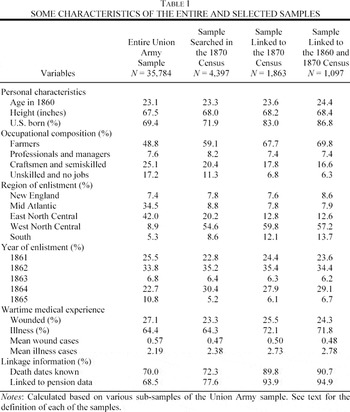
As can be expected from the nature of the linkage process, the sample linked to the 1870 census is a severely restricted subset of the entire Un-ion Army sample. Table 1 compares some key characteristics of recruits between the entire and selected samples. A comparison of the first and second columns of the table shows that the sample of 4,397 persons who were searched in the 1870 census is much different from the entire sample in terms of geographical and occupational compositions. In particular, recruits from the West North Central region (55 percent) are heavily overrepresented in the sample searched in the 1870 census. On the other hand, recruits from the Mid Atlantic and East North Central regions account for, respectively, 9 percent and 20 percent of the sub-sample, much lower than their original shares (35 percent and 42 per-cent, respectively). The percentage of farmers and tenants (59 percent) is also much higher for the sample searched in the 1870 census than the entire sample (49 percent), primarily due to the overrepresentation of the recruits from the Mid West and the lower rate of migration of farmers. Other characteristics are generally similar between the two samples.
Additional sample selections occurred in the course of linking the sample of 4,397 men to the 1870 census. The second and third columns of Table 1 present the differences between the search sample and the subsample linked to the 1870 census. In addition, a logistic regression was conducted to examine the correlates of probability of successful linkage to the 1870 census, using the variables included in Table 1. The most powerful predictor of a successful linkage is whether a recruit is linked to pension records. Recruits who were linked to pension records were nearly four times as likely to be found in the 1870 census as those who were not connected to pension data. Because pension records pro-vide useful information, especially on place of residence, which helps to locate and identify persons in manuscript schedules of censuses, this is an anticipated pattern of sample selection. Persons whose death dates are known are twice as likely to be linked to the 1870 census as those whose death dates are unknown, even after controlling for the status of linkage with pension records, the primary source of death dates. This result suggests that some recruits whose death dates are unknown may have been dead by 1870, and, therefore, were not at risk to be found in the 1870 census. Also, recruits who were found in the 1870 census were more likely to be U.S.-born, to be farmers, to reside in either the West North Central region or the South, and to have wartime medical experiences than those not linked to the 1870 census.14
The overrepresentation of the U.S.-born and greater disease cases among the recruits who were linked to the 1870 census can be explained in part by their higher linkage rate to pension records. Immigrants were less likely to be found in pension records because many foreigners who died during the early postwar years had no eligible dependents or were used behind the front and so were less likely to incur war-related disabilities (Fogel, “New Sources”). Army veterans with health problems originating from military service were more likely to apply for and receive pensions because early pension laws required such conditions. Therefore, it is not surprising that recruits who were connected to census records present more severe medical experiences while in the service.
Because the information from pension records was used in locating the veterans in the 1870 census, the sample used here is subject to additional bias problems. Recruits who were entered on the pension rolls early (that is, those who were severely injured or sick while in the service) could be more likely to be linked to the 1870 census, owing to the information on place of residence around 1870. On the other hand, the majority of veterans were entered on the pension rolls after 1890, when the eligibility condition for pensions was relaxed.15
For the evolution of the Union Army pension laws, see Costa, Evolution; and Glasson, Pensions.
Therefore, both the very sick (who began to receive pensions early) and the very healthy (who received pensions late) could be overrepresented in the present sample. If this is the case, the effect of wartime experiences on wealth accumulation, estimated in what follows, could be biased upward, because two extreme cases are compared.
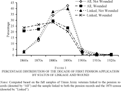
As an indirect test to see if veterans who were entered on the pension rolls early and those who were entered late are overrepresented in the sample linked to the 1870 census, I compare the percentage distribution of the timing of the first pension application for veterans who were wounded while in the service and those who were not between the full sample searched and the selected sample linked to the 1870 census. Because only those who had war-related health problems were eligible for Union Army pensions prior to 1890, the timing of a veteran's pension application is a rough measure of the severity of wounds he suffered while in the service. If the potential bias explained above were serious, the wounded veterans in the linked sample should have applied for pensions much earlier than those not wounded, compared to those in the entire sample. The result shown in Figure 1 is that the pattern of the difference in the timing of pension applications between injured veterans and those not wounded was similar for the full sample and the linked sample. Consequently, the potential bias problem does not seem too serious.
PERCENTAGE DISTRIBUTION OF THE DECADE OF FIRST PENSION APPLICATION BY STATUS OF LINKAGE AND WOUND
To summarize, my sample is a biased sample that overrepresents the native and agricultural population in the Mid West. Therefore, the ex-tent and the patterns of wealth accumulation between 1860 and 1870 found in this study may not reflect the general experience of the Union Army at large, let alone the entire northern population. However, it is not likely that the present sample produces a serious bias in the relation-ship between wartime medical experiences and wealth accumulation, which is the main focus of this study. In spite of the potential selection bias, therefore, a careful use of the sample provides a rare opportunity to examine the effects of various health problems while in the service and the extent of wartime stress on wealth accumulation in the nineteenth century.
MEASURING HEALTH
Military service during the Civil War seriously damaged the health of recruits who survived the war. A quarter of the recruits were injured, and nearly three-quarters of the veterans suffered various illnesses at least once while in the service (Table 2). Wartime illnesses were mainly caused by infectious diseases, although some chronic conditions such as rheumatism and hernia were also prevalent. Diarrhea was the most common disease in the army camp, contracted by 30 percent of the recruits in the sample, followed by malaria (19 percent), respiratory infections such as pneumonia and bronchitis (7 percent), measles (6 percent), and typhoid (4 percent). The unusually high rates of disease contraction were due to the peculiar nature of the army camp, in which a large number of men from heterogeneous socioeconomic and ecological backgrounds were confined in an extremely unhealthy environment.
Many of the recruits who contracted infectious diseases while in the service, if they survived, probably recovered from the illnesses rather quickly, even before they were discharged from their service. However, the damage caused by those acute diseases may have had persistent influences on their later health. Studies have found that infectious diseases affect the odds of suffering chronic conditions such as heart, respiratory, and musculoskeletal disorders at older ages.16
Elo and Preston, “Effects”; and Costa, “Understanding.”
I use dummy variables indicating whether a veteran experienced a particular type of wound or disease as well as wounds and illnesses in general as a measure of health. The particular wartime events considered here include five types of wound by location and ten diseases that were most common among Union Army recruits: typhoid, smallpox, measles, diarrhea, respiratory infections, malaria, tuberculosis, rheumatism, syphilis, and hernia.
Visible medical experiences are not the only indicators of the extent of health damages suffered by veterans who fought in a bloody war. The intimate violence involved in war, such as being exposed to heavy combat, witnessing friends and comrades die, and watching the enemy before or after killing them, could provide survivors with serious war trauma. It has been reported that Post-Traumatic Stress Disorder (PTSD) was widespread and severe among the veterans who served in Vietnam and the Civil War.17
There is a large body of research linking war trauma with various mental and physical health outcomes. Epidemiologists studying PTSD in contemporary veterans reported that suffering wartime events such as being wounded in combat, fired upon in combat, stationed in a combat zone, and being captured by the enemy had persistent and statistically significant effects on the later mortality and morbidity of veterans who fought in World War II, the Korean War, and the Vietnam War.
18 Archibald and Tuddenham, “Persistent Stress”; Beebe, “Prisoners”; Berg and Richlin, “Pows I-IV”; Dent et al., “Post-War Mortality”; Goulston et al., “Morbidity”; Hearst, Newman, and Hulley, “Delayed Effects”; Lund et al., “Combat Exposure”; Nefzger “Prisoners”; Smith et al., “Hepatitis”; Spaulding, “Pueblo Incidence”; Sutker et al., “Cognitive Deficit”; and Ursano, “Prisoner.”
Based on a sample of Union Army veterans, Dora Costa found that imprisonment by the enemy, being wounded, and being discharged for injury or illness significantly increased the risk that veterans who survived to 1890 would die between the ages of 55 and 77.
19 As stress is not directly observable, it is necessary to develop an index to proxy the severity of wartime experiences. A company-level variable, such as the percentage of death from wounds in the recruit's company, is a good index of wartime stress because it incorporates several different aspects that contribute to stress. Residents of a town were often recruited to the same company, sent to the same battle ground, and fought side by side. Consequently, all individuals in a particular company were exposed to a similar level of stress. In particular, the company mortality from wounds provides a measure of common exposure to combat of recruits who served in the same company.20
A typical company was composed of about one hundred men. In the entire Union Army sample, 23 percent of the recruits served in more than one company. For these recruits, the mortality of their first company was used to construct the wartime stress variables.
The degree of wartime stress undergone by recruits, measured by the company mortality from wounds, greatly varied across different companies. Twenty-two percent of the recruits in the sample served in companies where not a single person was killed in action. In contrast, nearly 11 percent of the recruits fought in a company in which more than 10 percent of enlisted men died from wounds. Some recruits in the former category belonged to militia units formed exclusively from men of their locality and never saw battle. Many of them were recruited (and released) before the major battles or after Lee's surrender, and thus escaped not only the stress of combat but even a substantial threat of exposure to combat.
21 These 22 percent of recruits are clearly distinct from others in terms of the pro-portion of recruits who suffered from illnesses while in the service (46 percent compared to 72 percent for the entire sample) and the average rate of company mortality from illness (5.3 percent in contrast to 10 percent for the entire sample).
22 See Table 7. Although the wartime experiences of those 22 percent of recruits were apparently more favorable than those of the rest of the recruits, the relationship between the company mortality rate from wounds and other company casualty rates, such as mortality from illness and discharge because of wounds or illness, does not appear to be linear. This suggests that recruits who were exposed to bloody combat, regardless of how often, were subject to a higher level of stress than those who did not experience any serious battle. In this sense, recruits who served in companies with no deaths from injury may be used as a control group where the effect of participation in the Civil War on economic mobility is examined.
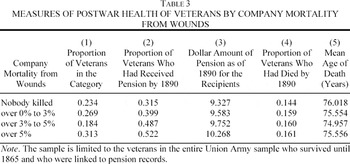
The company mortality of Union Army recruits was closely linked to their postservice health status. Analyzing the Surgeon's physical examination data, Judith Pizarro, Roxane C. Silver, and Joann Prause recently found that the company death rate significantly increased the probability of suffering various chronic diseases such as cardiac, gastrointestinal, and nervous conditions when they were examined by surgeons to receive Union Army pensions.23
Pizarro, Silver, and Prause, “War Experiences.”
presents several additional measures of health of the veterans in the entire Union Army sample who survived the war, according to the four categories of the company mortality from wounds: zero, 3 percent or less, 3 percent to 5 percent, and more than 5 percent. The results reported in columns 2 and 3 show that the company mortality was positively related to the proportion of veterans who had received pensions by 1890 and the average amount of pension given to the recipients in 1890. Given that the very sick were entered on the pension rolls earlier and received a larger pension, these results indicate that the veterans who served in a company that lost a large fraction of servicemen during the war were less healthy than those who fought in a low-mortality company. The results for the probability of dying by 1890 and the longevity reported in columns 4 and 5 of
Table 3 suggest the company mortality from wounds had a weak positive relationship with postservice mortality. Based on these results, I use the four dummy variables representing particular rates of death from wounds (denoted as
Co. Wound Mortality 1 through 4 in
Table 4 and elsewhere) as an index of wartime stress.
In addition to the variables on wartime experiences I add variables on height at the time of enlistment as an indicator of the nutritional status of recruits. Because it is inappropriate to compare the height of a recruit at a growing age with those who had already gained their final stature, it is desirable to use an age-standardized measure of height. Accordingly, I construct five dummy variables on height (Height 1 to Height 5), each of which represents a quintile of the height distribution for a particular age. For age 18, for example, recruits with heights from 64.5 inches to 67 inches were classified as the fourth quintile; for age 19, recruits whose heights were 65 inches to 66.25 inches were included in the same category. The height distribution by age was obtained from the entire Union Army sample of about 35,000. To all recruits 23 and older, a single height distribution was applied, assuming that height after age 23 remained unchanged.
WARTIME STRESS, HEALTH, AND WEALTH ACCUMULATION
The accumulation of wealth of a person between two points in time can be modeled as being determined by the initial stock of human capital (such as health, ability, skills, and so on), individual choice (such as occupational shift, geographical movement, and family formation), change in the prices of the assets held, and luck.24
Kearl and Pope, “Choices.”
The adverse influences of wartime events are expected to have affected the size of wealth accumulation of the Union Army veterans via two different paths: by directly impairing their health, and by altering individual choices.
25 Though not taken up in this article, I have examined how the combat exposure, wounds, and illnesses recruits experienced while in the service affected their subsequent occupational mobility through 1870 using the same data. I used three different measures of occupational mobility. First, I used the probability of not being gainfully employed in 1870 to see if poor health prohibited veterans from labor force participation. Second, I employed the probability that persons employed in unskilled occupations at the time of enlistment moved up to farming, skilled, or white-collar occupations by 1870. Finally, I used the rate of change in the estimated occupational income scores. I found that that greater combat exposure, measured by the company mortality from wounds, reduced occupational mobility.
The adverse effects of wartime stress and medical events on geographical movement and family formation by 1870 do not appear to be strong.
26 No significant effect of geographical mobility and family formation may be due to the fact that the linked sample used here underrepresents the recruits who migrated and those who newly formed a family after the war.
The empirical analyses given in this section estimate the direct effects of wartime events while in the service on wealth accumulation between 1860 and 1870, after controlling for occupational changes, geographical migration, and number of children, as well as other personal characteristics. The results do not change much if the variables on choice are excluded, which implies that the effect of health on wealth accumulation is largely direct.
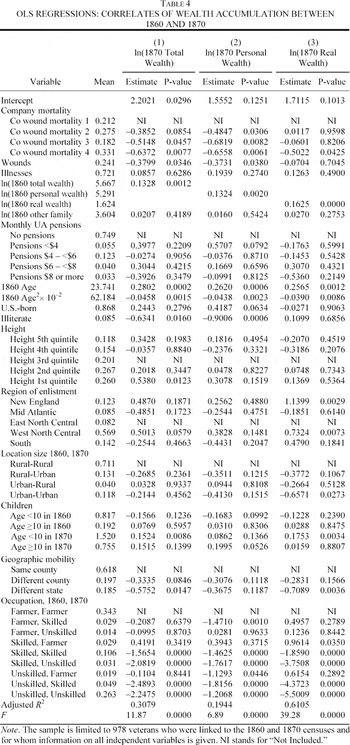
Table 4 presents the results of baseline regressions that examine the effects of combat exposure measured by the company mortality from wounds, wounds, and illnesses on wealth accumulation between 1860 and 1870. Exploiting the fact that both the 1860 and 1870 censuses re-port personal and real estate wealth separately, three different measures of wealth, namely, logarithms of total, personal, and real wealth, are used in the analysis.27
For recruits who possessed no wealth, the log of wealth was given as zero.
In addition to the variables representing the health of recruits while in the service, the following control variables are included. First, to control for the initial wealth, the logarithms of the 1860 total, personal, and real wealth are included. In addition, the logarithm of the 1860 wealth held by other family members is added to consider the additions of wealth from inheritance or gift. I also employed dummy variables on the amount of Union Army pension as of 1870.
28 According to the 1862 General Law for the military pensions, privates received a maximum of $8 per month for being totally disabled. For any degree of disability less than total, veterans received a disability rating represented in fractional form, x/8, where the numerator (x) represented a degree of disability less than total ($8). It also represented the amount in dollars that the veteran was to receive monthly for his disability. For example, a veteran who lost a finger in the war was rated “2/8 totally disabled” by the examination board and granted $2 for his pension (Fogel, Medical Records, pp. 323–24). In the sample used in the analysis, only a few pensioners received $2 or less in 1870. Accordingly, I classified the pension amount into five categories: no pensions, less than $4, $4 to less than $6, $6 to less than $8, and $8 or more.
Pension benefits could contribute to more rapid wealth accumulation. However, because the size of pension circa 1870 depended on the severity of war-related disabilities, the amount of pension benefits may not be positively associated with the magnitude of wealth accumulation, if the impacts of poor health, not fully captured by the health measures included in this study, are considered. As indexes pertaining to the initial stock of human capital, I employ variables on 1860 age, place of birth, ability to read and write, and height. I also include variables on the region of residence at the time of enlistment and the size of town of residence as of 1860 and 1870 to control for the potential variations in the conditions of labor and property markets.
As controls for the choice of veterans, the following variables are included. First, the number of children younger than age ten and those ten and older for 1860 and 1870 is included to consider the effects of family size and structure. Presence of older children would have a positive effect on wealth accumulation by providing additional family labor. On the other hand, a large number of younger children could impede wealth accumulation owing to more expenditures on children.29
It should be noted that in the analysis of wealth accumulation, variables on occupational shift, geographical movement, and the number of children are subject to a potential endogeneity problem. That is, for example, a wealthier person would be able to support more children, and spare a fund for relocation. I do not attempt to address this issue here, because it is difficult to find an instrumental variable to cure this problem, and the main concern of this study is to examine the effects of wartime events on wealth accumulation.
In addition, dummy variables on geographical mobility (same county, moved to a different county within the same state, and moved to a different state) are added to capture the effect of migration on wealth. The effect of geographical migration on wealth accumulation is ambiguous, even though it is more likely that its net effect is negative at least in the short-term given the large cost associated with relocation. Finally, dummy variables for occupational changes are included to account for the effect of occupational change on wealth accumulation.
30 The identification of farmers at the time of enlistment is subject to errors; therefore, the extent of occupational mobility suggested here could be biased to some extent. For recruits who were linked to the 1860 census, the direction of bias is unclear. It is assumed in the foregoing method that persons who had real estate wealth in 1860 continued to possess wealth at the time of enlistment, which may not be true. This tends to overstate the proportion of farmers, and understate the degree of occupational mobility, because some cases of switching from tenant farmer to farmer will be counted as no change in occupation. On the other hand, persons who owned no real estate wealth are assumed to remain landless by the time of enlistment. Because some of these persons moved up to being self-employed farmers, this assumption will lead to an underestimation of the proportion of farmers at the time of enlistment, and to an overstatement of the extent of occupational mobility. It is unknown which type of bias is greater. For recruits who were not linked to the 1860 census, it is likely that the extent of occupational mobility suggested here is subject to a downward bias. It is implicitly assumed that farmers who possessed real wealth at the time of enlistment continued to do so by 1870, and those lacking a farm when entering the army also continued to do so by 1870. Given that the direction of occupational mobility is upward on average, the previous assumption will overstate the share of self-employed farmers at the time of enlistment, and thus understate the extent of mobility from tenant farmers to self-employed farmers.
Because better occupations pay more on average, it is expected that the extent of occupational mobility is positively associated with wealth. If the cost of training required for a job switch is too large, however, it is possible that occupational change diminished the size of wealth accumulation, at least in the short-term.
The results suggest that combat exposure and wounds while in the service had strong negative effects on the total 1870 wealth, after controlling for the total 1860 wealth and other personal characteristics. On the other hand, illnesses in general had no significant effect on wealth accumulation. The effects of wartime events are generally stronger for personal wealth than for real wealth. For personal wealth, the effect of the company mortality from wounds largely reflects the difference between the veterans who served in a company with no single person killed in action and the rest who served in a company sent on more dangerous missions. For real wealth, only those who served in the category of highest-mortality companies had statistically significant disadvantages. The significant effect of wounds on wealth is found only for personal wealth; its effect on real wealth is negative, too, but statistically insignificant.31
The particularly strong effect of health on personal wealth is largely due to the occupational difference that will be discussed in what follows. The impacts of wounds and exposure to combat on wealth were especially powerful for unskilled workers for whom personal wealth was the major form of savings.
The effect of 1860 other family wealth is small and statistically in-significant for all three specifications, indicating that the influence of inheritance or gift was probably unimportant. The effect of pension was statistically insignificant in general, except that veterans who received less than four dollars per month accumulated significantly more personal wealth than did nonpensioners. As noted previously, it is likely that the disadvantages of pensioners due to their poor health offset the effect of additional incomes from pensions. The coefficients on age and age squared show an inverse-U shaped age-wealth profile, as found in other studies on wealth accumulation.32
Wealth peaked at age 31 for total wealth, 30 for personal wealth, and 33 for real wealth.
The total wealth of natives was not significantly different from that of immigrants, controlling for other personal characteristics. Illiteracy greatly hampered wealth accumulation, especially personal wealth. The result for height weakly supports the findings of previous studies suggesting that superior nutritional status is associated with greater productivity.
33 Deolaliker, “Health and Nutrition”; Berhman and Deolaliker, “Agricultural Wages”; and Strauss and Thomas, “Health.”
That is, taller persons, who belonged to the top quintile, had significant advantages in total wealth accumulation. As for the regional differences, veterans who lived in the West North Central and New England at the time of enlistment acquired significantly more real wealth than did others. The result for the size of location suggests that the magnitude of wealth accumulation, real wealth in particular, was significantly smaller for those who resided in urban areas in 1870 than the rest of the veterans.
The number of children younger than age ten in 1860 had a negative effect on both types of wealth as of 1870, although it misses statistical significance by a small margin. It probably reflects the influence of the costs required to raise children. In contrast, the number of children younger than age ten in 1870 had a strong positive effect on total and real wealth. This relationship could be explained in terms of a wealth effect in choosing the number of children. The presence of children age ten and older had a positive effect on wealth accumulation, but it is statistically significant only for personal wealth. Geographical mobility was associated with a decrease in wealth accumulation. Long-distance migration, indicated by moving across a state border, had a much greater negative effect on wealth than a shorter move to a different county within the same state, especially for real estate wealth.
The results for dummy variables for occupational change between 1860 and 1870 suggest that veterans who were farmers either in 1860 or 1870 were wealthier in 1870 than those who never became farmers. Secondly, veterans who were skilled workers in both 1860 and 1870 were wealthier than those who were unskilled workers either in 1860 and 1870. I also used another measure of occupational mobility, namely, the rate of change in the estimated occupational income scores.34
This score was estimated by Ferrie, Yankeys, based on a regression with the natural log of real estate wealth as the dependent variable and age, age squared, and age cubed, controls for region of residence and size of location, along with dummy variables for 157 occupation titles, as regressors. The coefficients on the occupational dummies, evaluated at age 30, were taken to represent differences in income within three broad occupational classes: white-collar, skilled, and unskilled. These dummies were adjusted, taking into account the skill premia found by Goldin and Margo, “Wages.” See Ferrie, Yankeys, appendix D, for the detailed method of imputation and data on imputed income scores. The occupation at enlistment as of 1870 was coded into the three-digit occupation codes for the 1950 census (U.S. Bureau of Census, Alphabetical Index; Ruggles and Sobek, Samples), and matched to the occupational income scores.
The result of the alternative regression, not reported here, shows a strong positive effect of occupational mobility on 1870 wealth. If the variable on occupational mobility is omitted from the regression, the size of the coefficients on company mortality slightly increases.
35 The percentage change in the three dummy variables on the company mortality was 45 percent for the lower-mortality companies (Co wound mortality 2) and 17 percent for the next category (Co wound mortality). The coefficient for highest-mortality companies (Co wound mortality 4) remained unchanged.
It suggests that the degree of combat exposure had a negative indirect effect on wealth accumulation through occupational mobility, but such an effect is relatively small. On the other hand, the coefficient for wounds diminishes a bit if variables on occupational change are omitted. It implies that occupational switch helped wounded veterans overcome their disadvantages to some extent.
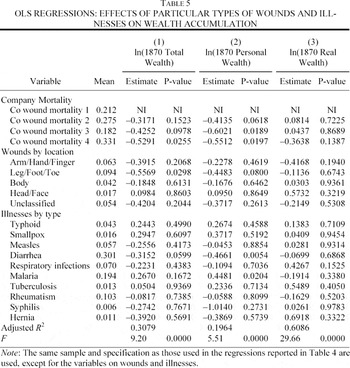
Table 5 reports the results of regressions employing more detailed classifications of wounds and illnesses. Regression coefficients for all other control variables are excluded from the table but included in the regressions. The results for these variables are similar to the results reported in Table 4. Among wounds on various body parts, injuries to a leg or foot had the most powerful negative effect on wealth accumulation. As in the case of illnesses in general, specific diseases had no significant effects on wealth accumulation. The only exception is diarrhea, which exerted a strong negative effect on total and personal wealth accumulations.
The size of the regression coefficients given in Tables 4 and 5 may not be perfectly accurate given that the sample used in this study is relatively small in size and not representative of the Union Army at large. Nevertheless, the results strongly suggest that the loss of wealth caused by exposure to combat and wounds while in the service could be substantial. Applying the estimated regression coefficients reported in Table 4, a rough estimate of the decrease in wealth accumulation caused by each wartime event, evaluated at the mean total 1870 wealth ($2,052), can be provided as follows: First, men who served in a company that lost more than 5 percent of its men due to injury would accumulate $1,085, only 53 percent of the amount acquired by men enlisted in a company with zero mortality from wounds.36
The log of the mean total wealth as of 1870 was 7.6266. Assuming persons in the control group (men who served in companies with no persons killed by injury) possessed the same amount of total wealth, the mean total wealth of veterans who served in a company with the mortality from wounds greater than 5 percent is calculated as 7.6266 – 0.6372 = 6.9894, which is $1,085.
Second, veterans who were wounded while in the service would have acquired $1,403, only two-thirds of the mean wealth for the entire sample used in the analysis.
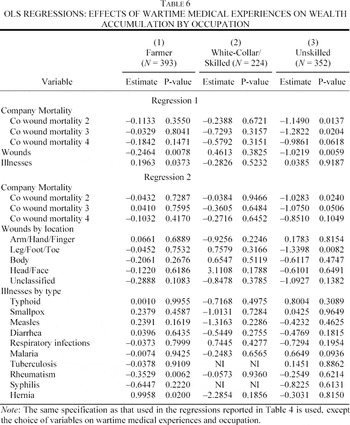
Table 6 presents a summary of the results of regressions conducted separately for three occupational categories, namely, farmers, white-collar and skilled workers, and unskilled workers.37
It would be useful to divide the nonfarm occupations into white-collar and blue-collar occupations. There are too few white-collar workers in the sample (less than 70) to conduct the regression analysis separately for white-collar workers.
The results suggest that the impact of poor health on wealth accumulation was quite different for men in different occupations. The wealth losses caused by wartime medical and military experiences were more severe for veterans who were unskilled workers at the time of enlistment. The magnitudes of the negative effects of wounds and the company mortality from wounds are much larger than the effects found in the entire sample. In contrast, the wealth accumulations of white-collar and skilled workers between 1860 and 1870 were not affected significantly by wounds or combat exposure while in the service. For farmers, wartime wounds had a relatively small effect on wealth accumulations. Furthermore, wartime illnesses in general increased the size of 1870 wealth for farmers. The particularly strong impacts of wartime events found for the unskilled, for whom personal wealth was the major form of savings, explains why health affected personal wealth more significantly in the results for the entire sample. The type of wounds or illnesses that affected wealth accumulation also differed by occupation. For unskilled workers, the effect of leg and foot injuries was particularly strong. For white-collar and skilled workers, on the other hand, wounds to an arm or hand had a strong impact on wealth accumulation, although it misses statistical significance by a relatively small margin. For farmers, unclassified wounds caused the largest damage.
A possible explanation for the occupational differences in the impact of health on wealth accumulations is the difference in the type of human capital required for each job. It is likely that wartime wounds and com-bat exposure damaged the physical attributes of veterans' human capital such as functional abilities and physical strength rather than their skills or knowledge. Therefore, the economic impacts of wartime medical experiences should be greater for persons employed in manual jobs than those engaged in occupations that require nonphysical human capital.
Another hypothesis is that farmers, white-collar workers, and the skilled had advantages over unskilled workers in coping with physical damages because they were more likely to be self-employed and to initially possess wealth. Thanks to the greater job flexibility allowed by self-employment, it would be easier for them to adjust the type and intensity of work according to their health conditions.38
Older farmers in the past postponed the timing of retirement by adjusting the amount and intensity of their work in accordance with changes in their health and economic needs (Pedersen, “Evaluation”). This flexibility of farming was one reason why the labor force participation rate of older males in the late nineteenth and early twentieth centuries was higher for farmers than for nonfarmers (Lee, “Sectoral Shift”).
Farmers, for example, would be able to adjust the amount of work by modifying acreage or crop mix. Also, they could utilize the services of family members or hire farm laborers. It is not likely that unskilled laborers had such options.
INSTRUMENTAL VARIABLE ESTIMATIONS FOR THE EFFECTS OF DISEASES
The absence of the link between wartime diseases and wealth accumulation suggests that infectious diseases, once cured, had no persistent effects on later economic mobility of the veterans. However, this explanation, plausible as it may be, is not consistent with previous studies that found strong and persistent effects of infectious diseases on later health.39
Elo and Preston, “Effects”; and Costa, “Understanding.”
I will suggest an alternative explanation, arguing that the weak relationship between wartime diseases and wealth accumulation was due to an endogeneity problem, resulting from the link between the health of recruits prior to enlistment and their medical experiences while in the service. I will also show that many infectious diseases as well as illnesses in general turn out to have strong negative impacts on savings if the endogeneity problem is eliminated by using instrumental variable estimations.
Measurement of health based on wartime medical experiences requires an attention to omitted variables pertaining to the recruit's health status prior to enlistment. Simple models using variables on wartime traumatic events such as injury and illness as indexes of health assume that the probability of being wounded or contracting disease was unrelated to individual characteristics of the recruits. But the probability of being wounded or contracting disease was by no means equal for all recruits. It was determined in part by factors that we might consider exogenous, such as the battle experience of the company in which a recruit served. It was also determined by factors that reflect individual characteristics, some observable and some not. For example, taller and more robust men were more likely to be placed near the front lines where wounds were more likely. Men who were ill in hospital were not at risk for battle wounds. If individual-specific determinants of the probability of being wounded are also determinants of subsequent health, the estimated effect of the stress of being wounded will be biased.
This potential association between individual characteristics and war-time events is clearly seen in the results of the regressions that analyze the effects of recruits' personal characteristics on their medical experiences while in the service.40
See Lee, “Health and Wealth,” table 3 for the results of these regressions.
Former farmers and residents in rural areas, who were healthier on average prior to enlistment thanks to greater isolation from other people, were more susceptible to disease and were more likely to die from the diseases they contracted than were nonfarmers and urban dwellers.
41 Lee, “Health and Wealth,” also found that recruits from a county with a higher child death rate were less likely to contract disease than those from a low-mortality county.
Native recruits were subject to a greater risk of illness than were foreigners, who had had more chances of exposure to infectious disease in the course of immigration. The different degrees of immunity against pathogens is probably the most important link between the extent of exposure to disease prior to enlistment and health while in service. That is, survivors of unhealthy environments developed better immunity to some of the infectious diseases that were rampant in the army.
42 Lee, “Socioeconomic Background” and “Prior Exposure.”
The probabilities of being wounded and of dying from a wound while in the service were not so strongly affected by individual characteristics as were the odds of contracting and dying from diseases. However, taller recruits were significantly more likely to be killed by injury while in the service.
43 Military position, such as rank, duty, and company, was another important determinant of the extent of risk in military service. For instance, men who were assigned noninfantry duty or who held a higher rank were less likely to die while in the service than, respectively, infantrymen and privates. Assignment of military positions was, again, strongly affected by age, height, occupation, place of residence, household wealth, and nativity (Lee, “Health and Wealth,” table 3). For example, nonfarmers and natives were significantly more likely to be appointed to a higher rank, and to be assigned to noninfantry duty than were, respectively, farmers and foreigners. Also, the chances of being assigned a higher rank were greater for taller or wealthier recruits than for shorter or poorer persons. This relationship is explained by a match between the quality and type of skills recruits obtained prior to enlistment and the requirements for particular military positions (Lee, “Selective Assignment”). That is, higher-rank positions in the Union Army tended to be filled by individuals with better human capital attributes that would be useful for making a good officer. A military duty requiring particular skills was more likely to be given to a person possessing similar skills thanks to his occupation prior to enlistment.
In general, stressful wartime events such as wounds and illnesses are positively correlated with superior health and productivity prior to enlistment, which, again, would be positively associated with wealth accumulation after military service. Therefore, simple models using the variables on wartime events as stress measures would induce a down-ward bias in estimating the effect of wartime experiences on subsequent savings. The most straightforward solution to this problem is to employ instrumental variable regression. Specific wartime events undergone by individuals can be modeled as functions of exogenous variables which are correlated with the extent of wartime stress, but not with un-observable individual characteristics that affect economic mobility. Then the predicted probability of the event, rather than the actual events, could be used to construct indexes of wartime stress.
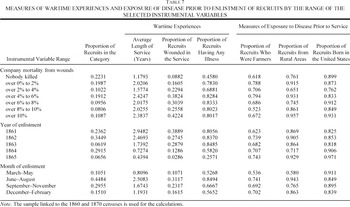
It is difficult to find perfectly legitimate instrumental variables from the available data, as is the case for most studies on the link between health and wealth. Nevertheless, I managed to select three reasonable, if not perfect, instrumental variables, namely, the company mortality from wounds, the year of enlistment, and the month of enlistment. Table 7 provides several key variables representing wartime experiences and the extent of exposure to disease prior to enlistment, according to the range of each of these instrumental variables. For the purpose of the present analysis, a legitimate instrumental variable should be correlated with the severity of wartime experiences, and uncorrelated with the degree of prior exposure to disease.
Company mortality from wounds is a measure of common wartime stress that a company's men were exposed to from enlistment to discharge. Consequently, this variable is positively correlated with the probabilities of being wounded and of having illnesses while in the service, as indicated by Table 7. On the other hand, there is no a priori reason to believe that recruits from healthier environments were more likely to be enlisted into companies that were sent to more dangerous military missions. Indeed, Table 7 shows a very weak correlation between company mortality from wounds and the measures of exposure to disease prior to enlistment.44
Regression analyses also suggest that the company mortality from wounds was only weakly correlated with individual characteristics (Lee, “Health and Wealth,” table 3). Natives and nonfarmers living in rural areas tended to serve in companies with a higher injury-caused mortality compared to, respectively, foreigners and farmers. However, the average difference in the company mortality between natives and immigrants and between nonfarmers dwelling in rural areas and farmers were small (1 percent and 0.3 percent respectively). It is unclear why native farmers were more likely to be enlisted in higher-risk companies than nonfarm immigrants. A possible explanation is that they were (or were viewed as) more loyal to the Union in comparison with nonnatives from cities (Lee, “Selective Assignment”). Many foreigners in the North were lukewarm or hostile to the entire war effort, especially those who perceived it as an unnecessary crusade to free slaves (Murdock, “Fight”; Vinovskis, “Civil War”). Those who participated in draft resistance or evasion during the Civil War were often characterized as lower-class immigrants, living in cities and allied with Democratic politicians (Lavine, “Draft”). A commanding officer, when sending a unit to a dangerous mission, would have chosen a company composed of more reliable recruits to reduce the risk of desertion.
The severity of wartime experiences of recruits heavily depended upon the year of enlistment. As presented in Table 7, the earlier a person entered the army the greater the probabilities of being wounded and of suffering from illnesses. This is mainly due to the fact that earlier enlistees served longer on average as the war lasted long enough for them to finish their three-year term. In addition, the difficulties of military missions and the disease environment changed year to year. On the other hand, again, the correlation between the year of enlistment and the measures of exposure to disease prior to enlistment was weak.
The chances of contracting diseases and being wounded while in the service also differed remarkably by the month of enlistment. The wartime casualty rate was particularly severe among recruits who enlisted in the summer. In contrast, recruits who joined the army in the spring or winter fared relatively well. Again, the difference in the average length of service is a major explanation for the seasonal disparity in the casualty rates. Summer enlistees served the longest term (two and a half years), whereas those who enlisted in the spring served the shortest (less than ten months). This is because most recruits who enrolled in the Union Army in 1861 enlisted shortly after Lincoln's call for 42,000 three-year army volunteers on 3 May, and Congress' authorization of another one million three-year volunteers in June.45
McPherson, Battle, chapter 10.
Another explanation, especially for the high rate of illness among those who enlisted in June through August, is the particularly strong influences of infectious diseases in summer. It is documented in the medical histories of the Civil War that the earlier seasoning period in the army was most critical for the survival of recruits. During this period enlistees with limited prior development of immunity were exposed to a pool of infectious diseases in the army.
46 Therefore, it would be more dangerous to be first confined to the unhealthy army environment in summer when various infectious diseases were rampant. Unlike the other two instrumental variables, the month of enlistment shows a relatively strong correlation with the measures of prior exposure to disease. In particular, recruits from rural areas were more likely to enlist in summer. For this reason, it is anticipated that using this variable as an instrument will not correct fully the downward bias in the estimation of the effect of health on wealth.
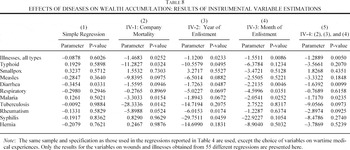
For conducting instrumental variable regressions, I first estimate the probabilities of particular wartime events predicted by four sets of instrumental variables, including polynomials of the company mortality from wounds, dummy variables for the year and month of enlistment, and the combination of the three instruments. The predicted probability of each event is used as an index of insults to health while in service, corrected for the potential bias arising from omitted variables. The predicted probabilities of wartime events are highly correlated with each other. This is not too surprising because these variables are all estimated based on the same set of instrumental variables. Since the results of regression analyses that include these variables together as independent variables exhibit symptoms of multicollinearity, I examine the effect of each wartime event one at a time. Table 8 reports the regression coefficients for the variables for all types of illnesses and ten wartime diseases, estimated from 55 regressions. The results for other variables, omitted from the table, are generally similar to those reported in Table 4.
The results show that illnesses while in service had strong negative effects on wealth accumulations if instrumental estimations are used. Although the magnitudes of coefficients and the degree of significance vary depending on the choice of instrumental variable, all four sets of instruments provide considerably consistent results. The coefficients on illnesses in general are all statistically significant, with their magnitudes ranging from −1.55 to −1.12. The results for specific diseases are less robust, but still exhibit a considerable regularity in terms of statistical significance and relative size, especially for more common diseases such as diarrhea (contracted by 30 percent), malaria (19 percent), and rheumatism (10 percent). For instance, the coefficients for diarrhea are all significant for the four specifications, with their sizes ranging from −2.21 to −1.55. Similarly, the coefficients for malaria are all significant, with their magnitudes ranging from −3.30 to −1.72. Other specific diseases whose impacts on wealth accumulation were significant for two or more specifications include typhoid, measles, respiratory infections, tuberculosis, and rheumatism. As anticipated above, the results based on using the month of enlistment as the instrumental variable provide much weaker effects of wartime diseases on wealth accumulation.
Since the instrumental variables used in this study may not be perfect, the magnitudes of the estimated regression coefficients are not reliable. Nevertheless, the evidence provided here strongly suggests that contraction of infectious diseases had a negative impact on wealth accumulations in the nineteenth century, in the absence of the endogeneity problem explained above.
CONCLUSIONS AND FURTHER IMPLICATIONS
My study has explored how the wartime stress and health of Union Army recruits while in service affected their wealth accumulation through 1870, based on a sample of men successfully linked to military records and the manuscript schedules of the 1860 and 1870 censuses. Veterans who served in a company that underwent more dangerous military missions acquired much less wealth, especially personal wealth, than those enlisted into a company with a lower casualty rate. Wounds while in service also had a strong negative effect on wealth accumulation. In contrast, simple dummy variables for illnesses in general as well as ten particular diseases had no significant effects on wealth accumulation. If instrumental variable estimation is employed, however, illnesses while in service turned out to have greatly diminished wealth accumulation. A few particular diseases, especially diarrhea and malaria, also had strong negative impacts on wealth accumulation. The influences of wartime medical and military experiences were particularly strong for unskilled workers compared to farmers and skilled workers.
The results of this study suggest that health was a powerful determinant of economic mobility in the nineteenth century. It is particularly revealing that infectious diseases such as diarrhea, and malaria exerted strong influences on wealth accumulation. It is well documented that infectious diseases affect the probability of suffering chronic conditions such as heart, respiratory, and musculoskeletal disorder at middle or older ages.47
Elo and Preston, “Effects”; and Costa, “Understanding.”
The present study adds to this literature that the adverse influences of infectious diseases could come out at relatively young ages in the form of reduced productivity. Also the results provided here suggest that the decline in the prevalence rate of various infectious diseases would have brought a large saving of economic costs arising from poor health.
This paper also suggests that the direct economic costs of the Civil War were much greater than has previously been thought. Goldin and Lewis estimated that the dollar amount of human losses arising from deaths and wounds was $1.3 billion for Union soldiers and $945 million for Confederate troops, accounting for 37 percent and 28 percent of the total direct costs of the Civil War for the North and the South, respectively.48
Goldin and Lewis, “Economic Cost.” These costs include $955 million for 360,000 Union soldiers killed, $365 million for 275,175 Union soldiers wounded, $684 million for 258,000 Confederate troops killed, and $261 million for 197,000 Confederate troops wounded.
The present study has shown that various diseases and expo-sure to combat while in service, as well as wartime wounds, seriously impeded wealth accumulations of veterans. This implies that Goldin and Lewis's estimate probably understates the entire direct costs of the Civil War because the economic losses due to degraded health of the recruits who survived the war without being wounded are not considered.
A rough estimate of the wealth losses of Union Army veterans who survived the war can be given as follows. Suppose that the recruits who served in a company in which no one was killed by injury while in service were similar to those who did not join the army in terms of the size of wealth accumulation. The underlying assumption is that these 20 percent of recruits were not damaged by military service at all. The regression coefficient on the dummy variable of the company mortality from wounds (–0.55) suggests that individuals who served in the army during the war accumulated $868 less by 1870 than those who did not join the army. The present value of wealth losses caused by participating in the war as of 1861 in 1861 dollars is about $408, if the discount rate is assumed to be 6 percent.49
The choice of the discount rate of 6 percent comes from Goldin and Lewis, “Economic Cost.” The consumer price index used for converting 1870 dollars into 1861 dollars is 27 for 1861 and 38 for 1870 (U.S. Bureau of the Census, Statistics, E135). The present value of the losses evaluated in 1861 was calculated by discounting the estimated value by 1/(1.06).9
If this estimate is regarded as a per capita loss for about 1.8 million Union Army recruits who survived the war, the total economic losses caused by wartime damages to health for the North is $734 million, more than twice as large as the $365 million, cost of wartime wounds estimated by Goldin and Lewis.
50 This amount is probably a lower-bound estimate of the economic costs of health problems caused by the war for the following reasons. First, it only considers the wealth losses through 1870. If the adverse economic impacts of wartime experiences lasted longer, their lifetime costs would have been even larger. Second, the economic performances of veterans who served in a company with no deaths from wounds were presumably not as good as those who did not serve in the army, as assumed above, because they also were exposed to diseases and wartime stress to some extent.
I have benefited from the helpful comments and suggestions of Jeremy Atack, Dora Costa, Joseph Ferrie, Robert Fogel, Mathew Kahn, Gavin Wright, two anonymous referees, and participants in the 2003 NBER Early Indicators of Later Work Levels, Disease and Death and Cohort Studies Group Joint Meeting, the 46th National History Meeting, and seminars at Seogang and Seoul National Universities. I thank Janet Bassett and her research team for their assisting in the collection and linkage of the 1870 manuscript census, J. Kim and S. Lee for their research assistance, Susan Jones for her editorial assistance, and Joon Y. Park for his encouragement and personal support through the Institute of Economic Research at Seoul National University. This study is supported by National Institute on Aging, the National Institutes of Health (P01 AG10120), and the Brain Korea 21 Project in 2004.