Introduction
Platypus cylindrus, the oak pinhole borer, is the most common ambrosia beetle of the Platypodinae in Southern Europe and its distribution extends to all Eurasian and Mediterranean areas, including North Africa (Balachowsky et al., Reference Balachowsky, Chevalier, Cuillé, Grison, Hoffmann, Jourdheuil, Labeyrie, Remaudière, Steffan, Touzeau, Vilardebo and Balachowsky1963; Villemant & Fraval, Reference Villemant and Fraval1993; Sousa & Inácio, Reference Sousa, Inácio, Lieutier and Ghaioule2005; Belhoucine et al., Reference Belhoucine, Bouhraoua, Dahane and Pujade-Villar2011a ). This insect used to be regarded as a secondary pest since its attacks were generally limited to dead or weakened hosts namely Castanea, Fagus and Quercus trees (Seabra, Reference Seabra1939; Baker, Reference Baker1963; Sousa et al., Reference Sousa, Debouzie and Pereira1995). However, since the 1980s severe infestations were observed in apparently healthy cork oak stands in Portugal (Ferreira & Ferreira, Reference Ferreira and Ferreira1989; Sousa & Débouzie, Reference Sousa and Débouzie2002; Inácio et al., Reference Inácio, Henriques, Lima and Sousa2012a ), Morocco (Villemant & Fraval, Reference Villemant and Fraval1993; Sousa et al., Reference Sousa, Inacio, El Antry, Bakry and Kadiri2005) and Algeria (Belhoucine et al., Reference Belhoucine, Bouhraoua, Dahane and Pujade-Villar2011a ), leading to widespread tree dead. Conversely, in Tunisia the beetle continues to have a secondary pest status and its attacks are only observed on dead or weakened trees (Bellahirech et al., Reference Bellahirech, Inácio, Bonifácio, Nóbrega, Sousa and Ben Jamâa2014). Adult flight and foraging period of P. cylindrus occurs during the warm season and the insect affects trees of all ages, especially those recently decorked. The attacks are located in the trunk and branches of larger diameter (Sousa & Débouzie, Reference Sousa and Débouzie2002). In the heartwood, an extensive system of galleries at different plans, with surrounding wood staining brown can be noticed when symptomatic trees are cut down (Inácio, Reference Inácio2011). Platypus cylindrus is an ambrosia beetle since its larvae and adults feed mainly upon fungi lining the galleries in the host, the ambrosia fungi. Etymologically, the designation ‘ambrosia’ is derived from Greek mythology, meaning ‘food of the gods’ (Baker, Reference Baker1963; Batra, Reference Batra1963; Beaver, Reference Beaver, Wilding, Collins, Hammond and Webber1989). Ambrosia beetles transport the fungal spores inside specialized structures of storage and dissemination called mycangia (Baker, Reference Baker1963; Cassier et al., Reference Cassier, Lévieux, Morelet and Rougon1996; Inácio et al., Reference Inácio, Henriques and Sousa2011). The morphology of the mycangia and their localization on the body are different, depending on species and sex. In P. cylindrus, mycangia are located on the dorsal median surface of the prothorax being more developed in females than in males (Sousa & Inácio, Reference Sousa, Inácio, Lieutier and Ghaioule2005; Inácio et al., Reference Inácio, Henriques and Sousa2011; Belhoucine et al., Reference Belhoucine, Bouhraoua, Harrak, VIñolas, Equihua-Martinez, Valdez-Carrasco and Juli Pulade-Villar2013), females hence being capable to transport and inoculate large amounts of fungal propagules. The mutual network of beetle galleries and ambrosia fungi disrupts the movement of water within the tree and rapidly kills it (Inácio et al., Reference Inácio, Henriques and Sousa2011).
Raffaelea montetyi is the most important symbiotic fungus of P. cylindrus taking into consideration the frequency of isolation (Belhoucine et al., Reference Belhoucine, Bouhraoua, Meijer, Houbraken, Harrak, Samson, Equihua-Martinez and Pujade-Villar2011b ; Reference Belhoucine, Bouhraoua, Harrak and Samson2012; Inácio et al., Reference Inácio, Henriques, Nóbrega, Marcelino, Sousa, Oliveira, Matos, Saibo, Miguel and Gil2012b ) and its pathogenic effect towards cork oak (Inácio et al., Reference Inácio, Henriques, Lima and Sousa2012a ). Besides this, a new species of Raffaelea closely related to Raffaelea canadensis, and a new Ophiostoma s.l species were consistently retrieved from P. cylindrus mycangia and insect galleries in the tree (Inácio et al., Reference Inácio, Henriques, Nóbrega, Marcelino, Sousa, Oliveira, Matos, Saibo, Miguel and Gil2012b ). All these fungi (Ophiostomatales) are associated with wood discoloration and wilt symptoms, hence being considered as declining agents. They are transported and vectored by P. cylindrus during adult flight and directly inoculated in the host tree while foraging (Inácio et al., Reference Inácio, Henriques, Nóbrega, Marcelino, Sousa, Oliveira, Matos, Saibo, Miguel and Gil2012b ). Worldwide, other species of Raffaelea were reported causing oak wilt (Kubono & Ito, Reference Kubono and Ito2002; Murata et al., Reference Murata, Yamada and Ito2005) and tree death (Fraedrich et al., Reference Fraedrich, Harrington, Rabaglia, Ulyshen, Mayfield, Hanula, Eickwort and Miller2008; Kim et al., Reference Kim, Choi, Seo and Shin2009; Harrington et al., Reference Harrington, Aghayeva and Fraedrich2010).
According to Sousa et al. (Reference Sousa, Debouzie and Pereira1995), P. cylindrus can be considered as part of a succession of biotic agents involved in the process of cork oak decline. Disturbances in the soil (acidification, reduced levels of calcium and potassium and high concentration of aluminium and zinc) might favour the decay of cork oak stands, creating good conditions for the settlement of the species (Sousa & Débouzie, Reference Sousa and Débouzie2002). Climatic factors, including successive years of drought and heat, as excess of water causing suffocation of the roots, are factors favourable to attacks of P. cylindrus. Its presence is also triggered by inappropriate management practices as severe pruning and debarking and injuries to the tree. Moreover, the permanence in the stand of infested or diseased trees, and wood obtained from pruning, provides new foci for insect dispersal (Sousa & Inácio, Reference Sousa, Inácio, Lieutier and Ghaioule2005).
Considering the different behaviour of P. cylindrus in Portuguese and Tunisian cork oak stands, we address two relevant research questions pertaining to the evolution and management of cork oak stands: (i) if morphological and genetic differentiation between populations of Portugal and Tunisia exist; (ii) if these differences have influence in the insect behaviour and consequently in its role on cork oak decline, or if other variables may be considered to explain the opposite insect behaviour in the two countries. In order to answer these questions, morphological and molecular analyses of the different populations were made. Given the role of mycangia in pathogens spread, their microstructure was examined and compared for morphological differentiation. Genetic relationships among populations from different geographic locations were analysed by means of internal simple sequence repeat polymerase chain reaction (ISSR-PCR) markers and using the region of mitochondrial cytochrome oxidase subunit I gene (COI). Both molecular markers have been widely used in genetic variability, population structure and phylogeny studies for different insect orders (Borba et al., Reference Borba, Garcia, Kovaleski, Oliveira, Zimmer, Castelo Branco and Malone2005, Taylor et al., Reference Taylor, Downie and Paterson2011, Velonà et al., Reference Velonà, Luchetti, Ghesini, Marini and Mantovani2011). The high degree of polymorphism of the ISSR-PCR markers, which are rapid and efficiently sensitive, allows the successful differentiation between closely related individuals (Zietkiewicz et al., Reference Zietkiewicz, Rafalski and Labuda1994).
The high rates of nucleotide substitution in the mitochondrial COI gene have been used to evaluate genetically heterogeneous populations within a given species and it is frequently used to profile organisms due to the availability of universal primers for this gene and a great range of phylogenetic signal (Folmer et al., Reference Folmer, Black, Hoeh, Lutz and Vrijenhoek1994; Simon et al., Reference Simon, Frati, Beckenbach, Crespi, Liu and Flook1994; Hebert et al., Reference Hebert, Cywinska, Ball and DeWaard2003). These advantages allow for the discrimination not only of closely related species, but also phylogeographic groups within a single species.
The main objectives of the study were to assess morphological and genetic features of P. cylindrus in relation to geographic location and behavioural differences, aiming to clarify the possible relationship of these parameters with tree decline. To our best knowledge, this is an innovative approach on the study of P. cylindrus behaviour, seeing the opposite phytosanitary conditions of Portuguese and Tunisian cork oak stands.
Materials and methods
Study sites and sampling of insects
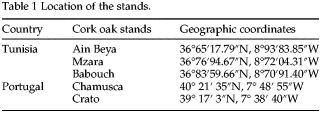
Insects were sampled during 2012 at five cork oak stands in Tunisia and Portugal (Table 1).
Location of the stands.

One symptomatic tree was randomly sampled per each stand, cut and sectioned into three logs with 50 cm high, after the cork debarking (in September, October). The logs were installed in the laboratory and insects were captured when emerged, into three small fabric traps per log, attached with silicone at the entrance holes of P. cylindrus.
Morphological characterization
From each country, 100 insects (50 males and 50 females) were observed under a stereomicroscope to separate males from females. Their mycangia were extracted and mounted on microscope slides in clear lactophenol following Inácio et al. (Reference Inácio, Henriques and Sousa2011) protocols, and the number of pits counted.
For scanning electron microscopy (SEM), 10 specimens of P. cylindrus from each country (5 males, 5 females), previously ultrasound cleaned, were sputter coated with gold palladium (98:2) following Inácio et al. (Reference Inácio, Henriques and Sousa2011) protocols, and examined using a JEOL 35 SEM (JEOL Inc., Massachusetts, USA).
Data analysis
Morphological data was analyzed with one-way variance analysis tests (ANOVA) to compare between sex and countries, and assumptions were tested for homogeneity of variances using Leven test. Least Square Difference (LSD) means comparison was used to establish homogeneous groups (Statistica 6.0 software package, Tulsa, USA).
Molecular characterization
DNA extraction
Prior to DNA extraction, a subset of adult individuals (male and female) were rinsed in ethanol (70%) for 30 s and rinsed in distilled water to remove exogenous material. From each specimen, the legs were removed, crushed in liquid nitrogen using a micro-pestle and incubated at 56 °C overnight in lysis buffer and 100 μg ml−1 proteinase K. After incubation, total genomic DNA extraction was performed using the DNeasy Blood & Tissue Kit (Qiagen, Hilden, Germany) following the manufacturer's instructions. DNA quantity and purity were checked using a NanoDrop 2000 UV-Vis Spectrophotometer (Thermo Fisher Scientific, Massachusetts, USA).
COI amplification
Amplification of the COI region was done using one set of primers: forward primer LCO1490 (5′GGTCAACAAATCATAAAGATATTGG3′) (Folmer et al., Reference Folmer, Black, Hoeh, Lutz and Vrijenhoek1994) and reverse primer TL2-N-3014 (5′TCCAATGCACTAATCTGCCATATTA3′) (Simon et al., Reference Simon, Frati, Beckenbach, Crespi, Liu and Flook1994). Amplification reactions were performed in a final reaction volume of 25 μl containing 1 μl (100 ng) of template DNA, 0.4 μM of each primer and 1× PCR Master Mix buffer, which included 1.5 mM MgCl2 and 0.2 mM of each dNTP. Thermal cycling conditions were as follows: denaturation temperature of 94 °C for 2 min, an annealing temperature of 50 °C for 1 min and an elongation temperature of 72 °C for 1 min for a total of 35 cycles, followed by a final extension for 10 min at 72 °C.
Amplified products were loaded onto a 1.2% agarose gel containing 0.5 μg ml−1 ethidium bromide and 0.5× Tris-borate-EDTA (TBE) running buffer and electrophoresed at 5 V cm−1. Amplifications were visualized using the VersaDoc Gel Imaging System (Bio-Rad, USA) and were considered successful when a band of the expected size was observed. PCR products were cleaned using GeneJET PCR Purification Kit (Fermentas, Germany) according to the manufacturer's protocol. Amplicons were sequenced in each direction at STABVida Sequencing Laboratory (Lisbon, Portugal) on a DNA analyzer ABI PRISM 3730xl (Applied Biosystems). P. cylindrus’ sequences were first investigated by a blastx search against the non- redundant nucleotide database in GenBank. FinchTV Version 1.4.0 (Geospiza Inc.) and BioEdit v7.2.0 (Hall, Reference Hall2007) programs were used for analyzing and editing the DNA sequences. Consensus sequences were compiled into a single file (Fasta format) and were aligned using Clustal W (Thompson et al., Reference Thompson, Higgins and Gibson1994). The nucleotide alignments were subsequently exported to the MEGA version 6 (Tamura et al., Reference Tamura, Stecher, Peterson, Filipski and Kumar2013) for genetic distances and phylogenetic analyses. Genetic distances were calculated using the Tamura-3-parameter model by a bootstrap procedure (1000 replicates). Phylogenetic tree was constructed using Maximum Likelihood and Neighbour-Joining (NJ) algorithm with Tamura 3-parameter model. Inter- and intraspecific-genetic distances were calculated using the Tamura-3-parameter model in the MEGA program including both transition and transversion substitutions.
Three species of the Platypus genus (Platypus jansoni, Platypus magnus and Platypus geminates) were used in the phylogenetic analyses as outgroup. The sequences were selected from the GenBank database and their access numbers were plotted in phylogenetic trees.
ISSR-PCR amplification
ISSR-PCR fingerprinting profiles were generated using a set of four primers that produced a high polymorphism and showed the best reproducibility and repeatability of amplification. The primers were di- and tri-nucleotide microsatellite motifs anchored with a stretch of degenerate nucleotides at 3′end: (GTG)3, (GGA)7, (AG)8YT and (TG)8RT.
PCR reactions were carried out using the DreamTaq PCR Master Mix (2×) (Thermo Scientific, Vilnius, Lithuania) in a Biometra TGradient thermocycler (Biometra, Göttingen, Germany). Each reaction was performed in a final volume of 25 μl containing 1 μl (100 ng) of template DNA, 0.4 μM of each primer and 1× Dream Taq PCR Master Mix buffer, which included 1.5 mM MgCl2 and 0.2 mM of each dNTP. Thermal cycling conditions were as follows: denaturation temperature of 94 °C for 2 min, an annealing temperature of 53 °C for 1 min and an elongation temperature of 72 °C for 1 min for a total of 40 cycles, followed by a final extension for 10 min at 72 °C. PCR analysis of each DNA was performed in duplicate. Negative control reactions were performed in the absence of genomic DNA. Amplified products were loaded onto a 2% agarose gel containing 0.5 μg ml−1 ethidium bromide and 0.5× TBE running buffer and electrophoresed at 5 V cm−1. The DNA fragments were visualized using the VersaDoc Gel Imaging System (Bio-Rad, USA). For data analysis, each band with a different electrophoretic mobility was assigned a position number and a mark of 1 or 0 based on the presence or absence of the band. Only reproducible bands were considered for analysis. Bands common to all isolates were excluded from the analysis. The individuals were clustered on the basis of their profiles in a dendrogram constructed with Numerical Taxonomy and Multivariate Analysis System (NTSYSpc-Version 2.02) using DICE coefficient and the NJ method. In addition to NJ cluster analysis, Unweighted Pair-Group Method (UPGMA) was performed on the same data sets.
Results
Morphological characterization
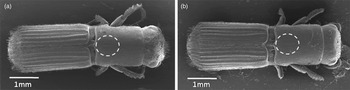
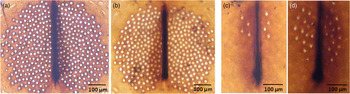
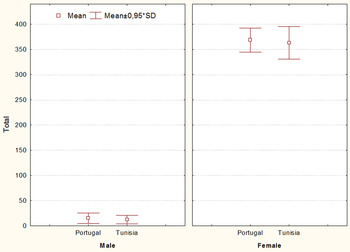
Microscopic observation of mycangia confirmed the presence of several ovoid structures in both sexes of the insects of both countries (figs 1 and 2). Spheroid cavity counting show that mycangia are more developed in females than in males, also for both countries, respectively [F (98.1) = 5.034; P < 0.0001; F (98.1) = 8.343; P < 0.0001]. No statistically significant differences between Tunisian and Portuguese populations were found for males (F (98.1) = 1.47; P = 0.2269) and females (F (98.1) = 0.85; P = 0.3589) (fig. 3). These results are valid since the ANOVA assumptions were fulfilled.
Scanning electron micrographs of male Platypus cylindrus from: (a) Portugal; (b) Tunisia; localization of mycangia is signalled with white circle.

Light microscope photos of Platypus cylindrus mycangia of Tunisian and Portuguese adults showing multiple spheroid cavities: (a) Tunisian female; (b) Portuguese female; (c) Tunisian male; (d) Portuguese male.

Comparison between number of mycangial pits of females and males of Platypus cylindrus in Portugal and Tunisia. Letters over Standard deviation bars refer to ANOVA LSD homogenous groups.

COI gene sequences
The amplified bands of approximately 1.5 Kb were sequenced and analyzed. High-quality DNA chromatograms, without ambiguities of bases were observed in all COI sequences. Thus, PCR products were not cloned. The resulting sequences have a total length of 1418 bp and were submitted to NCBI GenBank database (http://www.ncbi.nlm.nih.gov/genbank/) under accession numbers from KP297968 to KP297974.
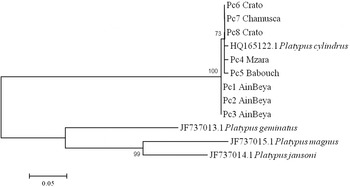
The alignment of COI sequences showed high percentage of identical sites (99%) indicating a very low variation in nucleotide composition, with no insertions or deletions but only substitutions. Phylogenetic tree based on COI sequences was obtained and evolutionary distances among 9 sequences of P. cylindrus, including one of the reference sequence and other 3 sequences of other species of the same genus, were designed (fig. 4).
Molecular phylogenetic tree of COI sequences of Platypus cylindrus. The evolutionary history was inferred by using the Maximum Likelihood method based on the Tamura 3-parameter model. The percentage of replicate trees in which species clustered together in the bootstrap procedure (1000 replicates) is shown next to the branches. The analysis involved 12 nucleotide sequences. There were a total of 728 positions in the final dataset. Evolutionary analyses were conducted in MEGA6.

The phylogram revealed one main group with bootstrap value of 100% including all individuals of P. cylindrus species. The phylogenetic analysis also showed that the main group could be divided into three subgroups, one including all individuals from Portugal, another including individuals from Mzara and Babouch and the third group included only the individuals from Ain Beya. The sequence divergence ranged from 0 to 1% within all individuals.
ISSR-PCR analysis
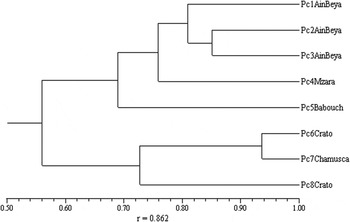
Based on the ISSR-PCR profiles, distinct banding patterns between 0.2 and 2.0 kb were obtained for the four primers, resulting in a total of 39 scorable and different band positions. One consensus dendrogram was obtained from the analysis of the profiles generated by the four primers (fig. 5).
ISSR-PCR analysis of Platypus cylindrus. Consensus dendrogram with the primers (GTG)3, (GGA)7, (AG)8YT and (TG)8RT performed in NTSYSpc2 using DICE's correlation coefficient and UPGMA.

The grouping analysis (UPGMA) at the level of 56% genetic similarities separated the individuals into two large groups. The first group comprised P. cylindrus individuals from Tunisia whereas the second consisted of those from Portugal. This analysis allows a coherent clustering of the individuals according to the geographical location.
Discussion
Morphological traits
No significant differences were found between the number of mycangial pits of adult P. cylindrus, both females and males, from Portugal and Tunisia although, as obtained by others (Cassier et al., Reference Cassier, Lévieux, Morelet and Rougon1996; Sousa et al., Reference Sousa, Inacio, El Antry, Bakry and Kadiri2005; Inácio et al., Reference Inácio, Henriques and Sousa2011; Belhoucine et al., Reference Belhoucine, Bouhraoua, Harrak, VIñolas, Equihua-Martinez, Valdez-Carrasco and Juli Pulade-Villar2013), females harbour more pits in each mycangia than males. Considering their known importance as specialized structures for storage and transportation of symbiotic fungi (Batra, Reference Batra1963; Berryman et al., Reference Berryman, Raffa, Millstein and Stenseth1989), the morphological similarity of insects’ mycangia from both countries may correspond to a similar potential of fungal dispersion and inoculation. Since the symbiotic fungi serve both for offspring nourishment and to overcome tree defences as wood pathogens, the amount of fungal propagules will be decisive in the host tree colonization. Moreover, the mycobiota associated with P. cylindrus in Portuguese and Tunisian cork oak stands was found to be similar even if the diverse genera were isolated in different proportions in the two regions. Ophiostomatales were identified as the main symbiotic fungi of P. cylindrus in both countries, confirming the stability of this association and the key role of mycangial vectorization (Inácio et al., Reference Inácio, Henriques, Nóbrega, Marcelino, Sousa, Oliveira, Matos, Saibo, Miguel and Gil2012b ; Bellahirech et al., Reference Bellahirech, Inácio, Bonifácio, Nóbrega, Sousa and Ben Jamâa2014). These results contradict the hypothesis that the possible morphological differences in the mycangia, particularly in the number of pits, would explain the different aggressiveness of insects in the two countries.
Molecular approach
COI analysis
In various insect groups, nucleotide sequence information of several mitochondrial DNA gene regions has been used for evaluating phylogenetic relationships either among closely related species or genetically heterogeneous populations of a single species because these regions show sufficiently high rates of nucleotide substitution (Ito et al., Reference Ito, Nishikawa, Shimada, Ogawa, Minamiya, Tomoda, Nakahira, Kodama, Fukuda and Arakawa2011). From these gene regions, COI in particular has been most frequently used in phylogenetic analyses (Smith, Reference Smith2005). In this context, the present work is an innovative study on P. cylindrus populations of Portugal and Tunisia where the nucleotide sequence of COI region of the individuals was determined and a 1420 base pair alignment was obtained. The differences among the investigated COI sequences obtained from P. cylindrus deriving from both countries were not significant. As stated by Ptaszyńska et al. (Reference Ptaszyńska, Łętowski, Gnat and Małek2012), the genetic diversity within or between populations in comparison with that which occurs among species is usually very low and the level of divergence was independent of the specimen locality, i.e., the similarity among all populations could not be related to geographical origins. Other authors show that the phylogeography of the pest population is clearly related to the history of its host (Burban et al., Reference Burban, Petit, Carcreff and Jactel1999).
In our study, the 1420 nt long COI gene fragments indicated a sequence similarity of 99% among populations. From these results we may conclude that the polymorphisms in the COI region are very low and conserved among populations.
ISSR-PCR analysis
Based on the different banding patterns observed for the four primers, a dendrogram was obtained showing that the Tunisian and Portugal populations are grouped in two separated clusters with a percentage of similarity of ca. 56%. The results obtained herein contribute to the knowledge of the genetic variation of P. cylindrus and its correlation with the geographic locations, but the possible relationship with the host decline was not answered. In fact, as stated by others (Ploetz et al., Reference Ploetz, Hulcr, Wingfield and De Beer2013), when ambrosia beetles infestations are associated with tree decline, a wide range of interactions is evident. Many parameters related to the population dynamics of the insects, the sanitary condition of the host plant and management strategies should be analyzed. Cork harvesting is a forestry practice specific to this Mediterranean evergreen oak which is a strain factor for the tree, particularly because it is performed during the most stressful time of the year when daily temperature increases, and also because stripped oaks become more vulnerable to pathogens and environmental hazards such as wildfires (Oliveira & Costa, Reference Oliveira and Costa2012). In Portugal, the coefficient of debarking is higher than in Tunisia (Pereira & Tomé, Reference Pereira, Tomé, Burley, Evans and Youngquist2004; Chaar et al., Reference Chaar, Stiti, Montero, Khaldi and Zapata-Blanco2009). Moreover, climate change could also have a determinant effect in insect behaviour, especially the extreme temperatures and the lack of precipitation during late spring and summer in Portugal, contrasting with the milder conditions in the Tunisian cork oak forests where the climate is humid with a temperate winter.
Available information is still scarce to explain differences in the aggressiveness of P. cylindrus’ populations and their effect on cork oak decline. To gain further insight into a relationship between phylogenetic and pest status traits of P. cylindrus, additional sequences and specimens from other regions of Portugal and Tunisia, and even from other countries, must be brought into a multigene phylogenetic analysis. Furthermore, a set of parameters need to be considered such as the abiotic and biotic effects that can increase beetle attacks, aiming the forest management for the control of the oak pinhole borer and the vectoring of pathogenic fungi in cork oak stands.
Supplementary Material
The supplementary material for this article can be found at http://www.journals.cambridge.org/BER
ACKNOWLEDGEMENTS
The authors would like to thank the financial support of the National Research Institute of Rural Engineering, Water and Forests (INRGREF) of Tunisia and National Agronomy Institute of Tunisia (INAT). Authors are also grateful to the support of INIAV technical staff of Forestry Research Unit in Portugal.