

The Holocene colonisation histories of remote islands—those lying more than 250km from continental shores—provide comparative insight into prehistoric voyaging capabilities and motives between the three oceans, and, in this respect, the Indian Ocean appears different. Long-distance seafaring was established there over 4000 years ago (McGrail Reference McGrail2001: 251), but of the remote island groups—namely the Seychelles, Chagos, Mascarenes, Cocos, Christmas, Maldives, Comores and Madagascar—only the last three were colonised prior to 650 BP (Anderson et al. Reference Anderson, Camens, Clark, Haberle and Seetah2018: 30–38). By that time, nearly all the remote Pacific and Atlantic islands in the tropical and temperate zones had been occupied, if not always continuously. If Indian Ocean voyaging was aligned primarily to monsoon trade-routes around the continental perimeter rather than to the exploration of remote island colonising opportunities (Anderson et al. Reference Anderson, Camens, Clark, Haberle and Seetah2018: 49–53)—as historical evidence largely confirms—then the initial habitation of Madagascar was probably a relatively late occurrence. Until recently, cultural evidence suggested just that.
Earlier archaeological research in Madagascar relied upon dates based on material culture and on radiocarbon, indicating human activity no earlier than c. 1400 BP (Radimilahy & Crossland Reference Radimilahy and Crossland2015: 502), a finding consistent with Malagasy traditions, historical linguistics and most genomic histories (Anderson Reference Anderson and Ludden2018; Anderson et al. Reference Anderson, Camens, Clark, Haberle and Seetah2018: 38–39). Colonisation occurred at the same time in the Comores, and on Pemba Island near the African mainland, perhaps reflecting either nascent East African maritime mobility that preceded the rise of Swahili maritimity or local collaboration with foreign shipping (Fleisher et al. Reference Fleisher, Lane, Laviolette, Horton, Pollard, Morales, Vernet, Christie and Wynne-Jones2015).
In contrast to the cultural evidence, however, palaeoenvironmental approaches have suggested anthropogenic landscape changes in Madagascar dating to as early as 2500 BP (Burney et al. Reference Burney, Burney, Godfrey, Jungers, Goodman, Wright and Jull2004). Furthermore, putatively cut-marked megafaunal bones have been radiocarbon dated to 2000–2500 BP, with one estimate at 3810±35 BP (Gommery et al. Reference Gommery, Ramanivosoa, Faure, Guérin, Kerloc'h, Sénégas and Randrianantenaina2011). In 2013, the chronological discrepancy between the archaeological evidence and the palaeoenvironmental inference was extinguished—definitively it seemed—by publication of an occupational chronology for the Lakaton'i Anja rockshelter near the northern tip of Madagascar, extending back to 4380±400 BP (Dewar et al. Reference Dewar, Radimilahy, Wright, Jacobs, Kelly and Berna2013). With few reservations, archaeologists have accepted this alignment of archaeological and environmental habitation chronologies around a mid Holocene date (e.g. Douglass & Zinke Reference Douglass and Zinke2015: 272–73; Radimilahy & Crossland Reference Radimilahy and Crossland2015: 500; Crowther et al. Reference Crowther, Lucas, Helm, Horton, Shipton, Wright, Walshaw, Pawlowicz, Radimilahy, Douka, Picornell-Gelabert, Fuller and Boivin2016: 6635; Ekblom et al. Reference Ekblom, Lane, Radimilahy, Rakotoarisoa, Sinclair, Virah-Sawmy and Campbell2016: 201–10; Douglass Reference Douglass2017: 338). That age has also been adopted by some palaeoecologists (e.g. Crowley et al. Reference Crowley, Godfrey, Bankoff, Perry, Culleton, Kennett, Sutherland, Samonds and Burney2017; Muldoon et al. Reference Muldoon, Godfrey, Crowley and Simons2017; Salmona et al. Reference Salmona, Heller, Quéméré and Chikhi2017), and it has been worked into biogeographical conjecture that giant tortoises were dispersed to Indian Ocean islands by mid Holocene Austronesian navigators (e.g. Wilmé et al. Reference Wilmé, Waeber and Ganzhorn2017). More widely, the Lakaton'i Anja results have been viewed as congruent with emerging arguments for extensive Indian Ocean voyaging by the fourth millennium BP, including to Madagascar from East Africa and Southeast Asia by at least 2500 BP (e.g. Blench Reference Blench, Anderson, Barrett and Boyle2010; Fuller et al. Reference Fuller, Boivin, Hoogervorst and Allaby2010).
In recent counter arguments, the notion of tortoise dispersal has been dismissed and the African origins of Madagascan pig, dog and chicken—the standard domesticates dispersed by Austronesians—offer no support for any early transoceanic voyaging from Southeast Asia (Cheke et al. Reference Cheke, Pedrono, Bour, Anderson, Griffiths, Iverson, Hume and Walsh2017; Herrera et al. Reference Herrera, Thomson, Wadley, Piper, Sulandari, Dharmayanthi, Kraitsek, Gongora and Austin2017). Anderson et al. (Reference Anderson, Camens, Clark, Haberle and Seetah2018: 40–43) show that damage to Madagascan megafaunal bones is almost wholly taphonomic with no necessary connection to associated radiocarbon dates. Furthermore, no perimortem activity is demonstrated in a recent claim of Early Holocene butchery of Aepyornis (elephant bird) remains (Hansford et al. Reference Hansford, Wright, Rasoamiaramanana, Perez, Godfrey, Errikson, Thompson and Turvey2018). Sequences of anthropogenic landscape change are now inferred to have occurred after 2000 BP (Virah-Sawmy et al. Reference Virah-Sawmy, Willis and Gillson2010; Crowley et al. Reference Crowley, Godfrey, Bankoff, Perry, Culleton, Kennett, Sutherland, Samonds and Burney2017), and thus imply an earlier absence of people in Madagascar (Anderson Reference Anderson and Ludden2018). Combined, these arguments question the mid Holocene human habitation of Madagascar. This article debates the Lakaton'i Anja chronology on which an early colonisation date critically depends.
The optically stimulated luminescence (OSL) hypothesis of site chronology
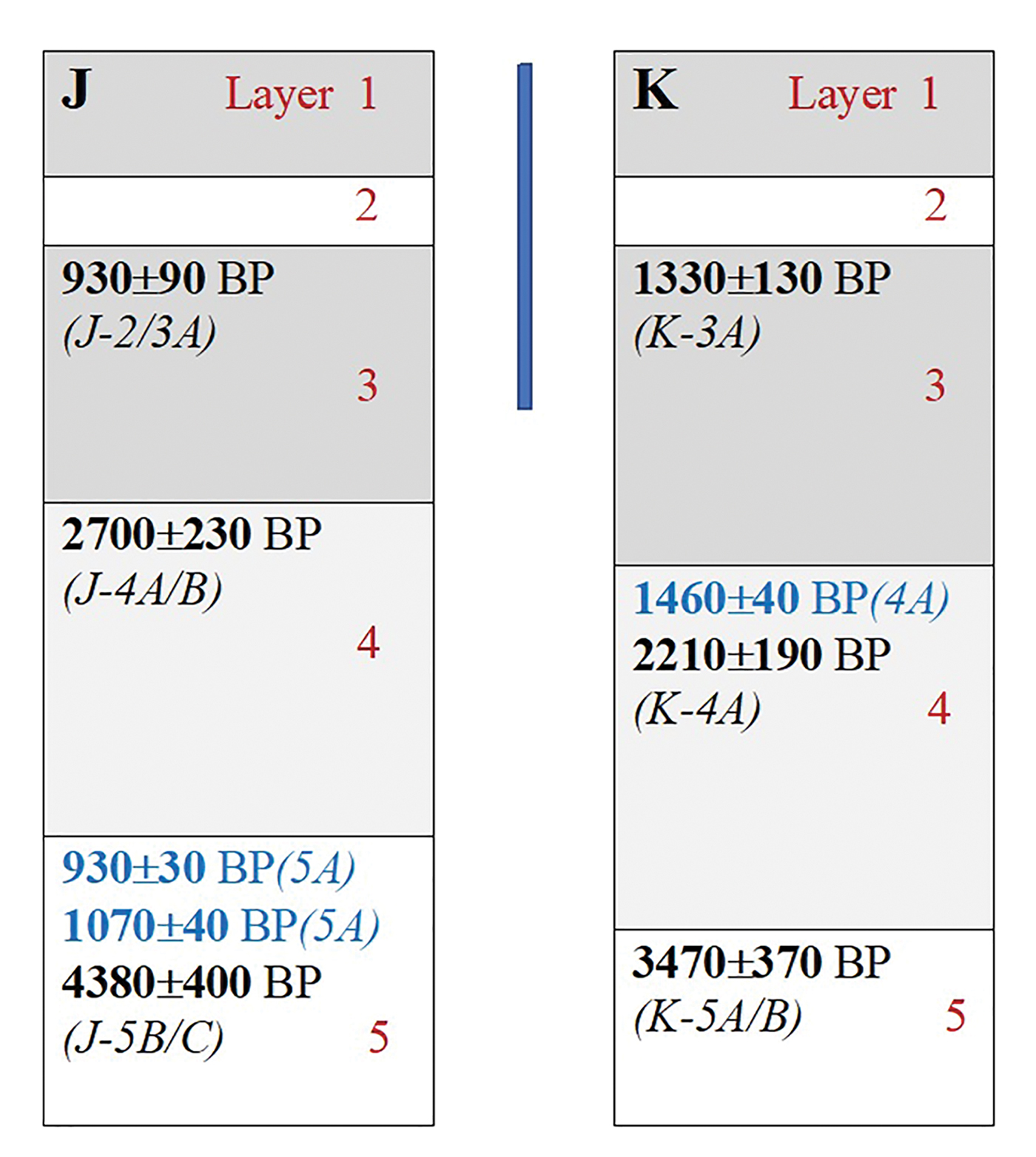
The mid Holocene chronology proposed by Dewar et al. (Reference Dewar, Radimilahy, Wright, Jacobs, Kelly and Berna2013) derives primarily from two 1m2 test-pits (Figure 1: units J–K) at the Lakaton'i Anja rockshelter. These yielded abundant cultural material from layers 1 and 3, which were separated by layer 2, a thin silt deposit. There were scattered patches of cultural material in layer 4, but only occasional cultural fragments in layer 5. Dewar et al. (2013: SI 4) argue that the stratigraphy represents a series of phases of sparse occupation, followed by more intensive habitation. Three AMS radiocarbon dates (Figure 1) suggest that the entire stratigraphy is relatively late, but Dewar et al. (Reference Dewar, Radimilahy, Wright, Jacobs, Kelly and Berna2013) preferred instead to use the six ages (Figure 1) estimated from OSL.
Stratigraphic sampling levels in excavation units J and K at Lakaton'i Anja; the blue bar = 0.2m; OSL sample designations and results are in black, and radiocarbon determinations (details in Dewar et al. Reference Dewar, Radimilahy, Wright, Jacobs, Kelly and Berna2013: 12587) in blue.

OSL uses laser stimulation of sedimentary quartz grains to produce ultraviolet emissions, the decay rate of which is proportional to elapsed time since exposure of the sample to natural light. The single-aliquot regeneration method of OSL (Jacobs & Roberts Reference Jacobs and Roberts2007) was used at Lakaton'i Anja because evidence of termite disturbance required each grain be measured individually in order to distinguish the original or ‘host’ sediments of each stratigraphic unit from those that might have been introduced by termites. Dewar et al. (Reference Dewar, Radimilahy, Wright, Jacobs, Kelly and Berna2013) subjected six samples to OSL (Figure 1). Results indicated occupation extending back to c. 4400 BP.
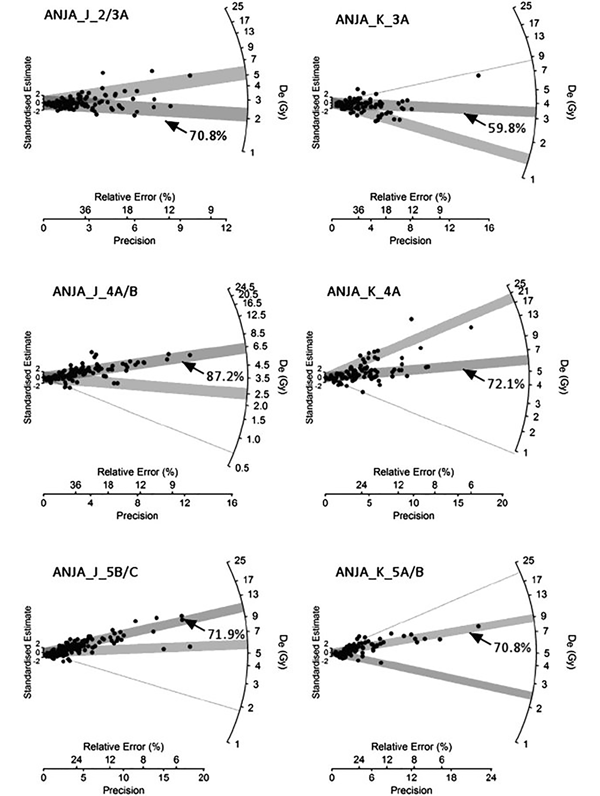
The data points (‘equivalent dose values’, or De) for each sample lay mainly in the inner, less precise, area of the radial plots (Figure 2) and were suggested to be “spread too widely to fall within any single band width” (Dewar et al. Reference Dewar, Radimilahy, Wright, Jacobs, Kelly and Berna2013: SI 7). In fact, the De estimates of all six samples are scattered, or ‘over-dispersed’ (OD) at values from 41 per cent to 72 per cent. This is well beyond the expected level of OD = 5 per cent determined by laboratory measurement of a test sample. Dewar et al. (2013: SI 7) concluded that “the range of OD values from the cave at Lakaton'i Anja suggests significant contamination” and noted that each sample appeared to consist of several discrete De distributions. Such coarse-grained mixing of sediments with significantly different ages indicates episodic mixing events, rather than soil-forming processes (Dewar et al. Reference Dewar, Radimilahy, Wright, Jacobs, Kelly and Berna2013: SI 7). In considering the cause of this mixing, Dewar et al. (2013: SI 7) note that “during excavation of the sediments, there was evidence for termite burrows, and it is likely that the sample tubes may have penetrated some of the termite burrows” (Dewar et al. Reference Dewar, Radimilahy, Wright, Jacobs, Kelly and Berna2013: SI 7). Nevertheless,
from an archaeological standpoint, the most important feature to note is that the vast majority of grains in each sample belong to a single D e population […] It is highly likely, therefore, that the artifacts excavated from these layers are contemporaneous with these grains—which form the bulk of the deposit—and were not incorporated at a later date […] thus, accurate ages can be estimated for the associated artifacts from the host single-grain D e populations (Dewar et al. Reference Dewar, Radimilahy, Wright, Jacobs, Kelly and Berna2013: SI 7).
Radial plots of single-grain De values for the six Lakaton'i Anja samples measured, showing the percentage of grains thought to represent host sediments (Figure S3; Dewar et al. Reference Dewar, Radimilahy, Wright, Jacobs, Kelly and Berna2013).

The OSL hypothesis, therefore, is that despite contamination of the samples by temporally different populations of sediment grains, the Lakaton'i Anja cultural material was associated exclusively with the dominant, or host sediment, grain population in each case. The OSL ages of these populations thus date the enclosed cultural material. Dewar et al. (Reference Dewar, Radimilahy, Wright, Jacobs, Kelly and Berna2013: SI 7) argue that the much younger radiocarbon dates for the lower layers indicate “disturbances in the excavated sediments and the downward percolation of charcoal [by termite activity] from the upper levels into the underlying levels”. Charcoal “would be a source of moisture” for termites (Dewar et al. Reference Dewar, Radimilahy, Wright, Jacobs, Kelly and Berna2013: SI 7). This curious assertion is undocumented.
The bioturbation hypothesis of site chronology
Any evidence of disturbance weakens the argument that OSL dates on a sedimentary unit must also apply to the cultural material located within it; the greater the disturbance, the weaker the argument. OSL dating offers no practical means of determining whether cultural items from a particular layer are associated with the sediment taken as the original or host deposit, or with another sediment population of different age in the same layer, such as sediment introduced by bioturbation. In fact, which sediment population represents the original deposit within a layer can only be determined by its numerical dominance of measured grains. In a sample where intrusive sediments were dominant, those would be regarded incorrectly as the original host sediments.
Significant stratigraphic disturbance by bioturbation is apparent at Lakaton'i Anja. Termites had excavated tunnels from the surface to underground chambers. Madagascar is also home to insectivorous mammals, such as mole tenrecs (Oryzorictes), which live in subterranean burrows. Layers 4 and 5, in particular, were described as being “penetrated by large later termite burrows” (Dewar et al. Reference Dewar, Radimilahy, Wright, Jacobs, Kelly and Berna2013: 12585), and it was thought that, in these layers, there might have been “other burrows now completely consolidated, which have moved material downwards” (Dewar et al. Reference Dewar, Radimilahy, Wright, Jacobs, Kelly and Berna2013: SI 5). That is to say, bioturbation could have been substantially more extensive than was observed during excavation.
The extent of the disturbance at Lakaton'i Anja can be estimated by the proportion of measured quartz grains in minor De populations—those that did not belong to the host sediments. The lowest proportion is approximately 13 per cent for sample ANJA K 4A/B. It is 28–40 per cent for the other five samples (Dewar et al. Reference Dewar, Radimilahy, Wright, Jacobs, Kelly and Berna2013: tab. S6). Thus, approximately one-third of the sediment in most samples originated from somewhere else and at a different time than the sediment in the host population. Such extensive disturbance contradicts Dewar et al.’s (2013: SI 7) assertion that the “vast majority” of grains in each sample belong to a single De population.
The non-host sediments at Lakaton'i Anja are generally more recent than the host population, indicating their downward displacement. Dewar et al. (Reference Dewar and Wright2013: SI 7) calculated that the minor De population grains in layer ANJA K3/A (40.2 per cent of the total measured sample) would provide an age of c. 600 BP, which is less than half of the 1330 BP estimate provided for the host sediment in the same layer. Inspection of De values for minor components in the other samples (Dewar et al. Reference Dewar, Radimilahy, Wright, Jacobs, Kelly and Berna2013: fig. S3) suggests ages of c. 1400 BP or younger for samples ANJA J4A/B and ANJA K 5A/B (c. 2700 and 3470 BP for host sediments, respectively) and a somewhat younger age (perhaps <2000 BP) for ANJA J5B/C than c. 4380 BP for host sediments. Although some grains in ANJA J2/3A and ANJA K4A are older than the host population, the overall pattern is of later disturbance, in which cultural material could have been moved downward.
If charcoal was intrusive in layers 4 and 5, then bone, shell, flaked stone and other cultural material could have been as well. Irrespective of whether termites carried charcoal downward deliberately, their burrows provided conduits for the relocation of material by gravity. The small size of the faunal remains and stone flakes—the latter being “less than 2cm in length” (Dewar et al. Reference Dewar, Radimilahy, Wright, Jacobs, Kelly and Berna2013: 12585)—made them easily susceptible to vertical movement. Indeed, some artefacts otherwise associated with habitation deposits in the upper layers were found in lower layers. Dewar et al. (Reference Dewar, Radimilahy, Wright, Jacobs, Kelly and Berna2013: 12587, SI 8) record sherds of local pottery carried below layer 2 via termite burrows, a chlorite-schist vessel sherd dating to after 1000 BP in layer 3B, and a dark glass bead dating to after 1250 BP (probably 950–700 BP, according to Dewar et al. Reference Dewar, Radimilahy, Wright, Jacobs, Kelly and Berna2013: SI 9) in layer 5. These examples demonstrate that disturbance extended throughout the entire stratigraphic sequence.
The bioturbation hypothesis could be falsified by showing that archaeological remains in the lower layers were distinct from those above. The main material used in tool manufacture found in all layers at Lakaton'i Anja is locally sourced chert; it occurs slightly more frequently in layers 1 and 5 (Dewar et al. Reference Dewar, Radimilahy, Wright, Jacobs, Kelly and Berna2013: tab. S2). Dewar et al.’s (2013: 12586) argument that fine red chert was found exclusively in layers 4 and 5 is contradicted by the presence of red chert in layer 3 (Dewar et al. Reference Dewar, Radimilahy, Wright, Jacobs, Kelly and Berna2013: SI 5). Quartz crystal was said to be found “predominantly from layers 4 and 5” (Dewar et al. Reference Dewar, Radimilahy, Wright, Jacobs, Kelly and Berna2013: SI 5), implying that it also occurred in upper layers. The stratigraphic distribution of scarce items may be unrepresentative as a result of limited excavation, which comprised only 2m2 of the 70m2 floor area, but the extant data do not support suggestions of temporal change in material sources.
Older occupation at Lakaton'i Anja could also be inferred if stone technology in the lower layers represented a tradition that disappeared before deposition of the upper layers. Analysis of the flake tools—primarily from layers 4 and 5—suggested to the excavators the presence of several retouched blades and crescentic and trapezoidal forms “similar to those from Ambohiposa” (Dewar et al. Reference Dewar, Radimilahy, Wright, Jacobs, Kelly and Berna2013: SI 5), another Madagascan rockshelter site and the only other one to reveal a flaked tool industry. At Ambohiposa, however, such flakes were rejected as typologically defined ‘blades’, ‘crescents’ and ‘trapezes’ by Dewar et al. (Reference Dewar, Radimilahy, Wright, Jacobs, Kelly and Berna2013: SI 2–3), who emphasised that “backed microblades, retouched points, or multiply notched tools that would be convincing to all stone tool specialists are not present”. Dewar et al. (Reference Dewar, Radimilahy, Wright, Jacobs, Kelly and Berna2013: 12583–84) offered an appropriately cautious appraisal of the evidence, focusing on showing that “this is a stone tool industry created by people” (Dewar et al. Reference Dewar, Radimilahy, Wright, Jacobs, Kelly and Berna2013: SI 5). They suggest that the Madagascan industry was literally but not typologically microlithic; while resemblances exist with other forager lithic assemblages around the rim of the Indian Ocean (except in Southeast Asia), there are no specific links with types seen in the mainland East African Later Stone Age microlith traditions.
Although recent linkage of the Madagascan evidence to mainland Later Stone Age industries has been advanced speculatively, a “lack of formal types” (Ekblom et al. Reference Ekblom, Lane, Radimilahy, Rakotoarisoa, Sinclair, Virah-Sawmy and Campbell2016: 201) provides little evidence upon which to hang an empirical case—and none is made. Even if there was a microlithic industry of East African Later Stone Age type in Madagascar, then a demonstrated association of Later Stone Age lithics with ceramics dating c. 1500–1000 BP at Ukunji Cave on Mafia Island, and radiocarbon dates of earlier than 1100 BP on assemblages in the lowest layer at Ambohiposa (Dewar et al. Reference Dewar, Radimilahy, Wright, Jacobs, Kelly and Berna2013: 12585), do not support an inference of mid Holocene antiquity at Lakaton'i Anja.
Conclusions
OSL dating of the dominant quartz grains by layer at the Lakaton'i Anja rockshelter provide a plausible chronology of the natural sedimentary history of the site. The substantial evidence for bioturbation at the site, however, challenges the OSL dating of sparse cultural materials in layers 4 and 5, which the excavators assumed to be enclosed by host sediments, rather than associated with sedimentary components introduced by later bioturbation. It is argued here that all of the archaeological material in the lower layers could have been introduced—as some certainly was—through extensive later bioturbation. This activity is signalled in the 13–40 per cent of non-host grains in the OSL samples, in the high rates of OD in the OSL results, and in evidence that non-host sediments appear generally younger (<600–1400 BP) than the host sediments (2700–4380 BP).
The proposition that all classes of material are liable to downward movement by bioturbation at Lakaton'i Anja provides a simple explanation for the stratigraphic distribution of cultural material. This contrasts with a scenario in which the flaked stone and midden components in the lower layers were part of the original deposition, while the charcoal was later moved into coincidental association with these earlier materials by termites seeking water. To their credit, Dewar et al. (Reference Dewar, Radimilahy, Wright, Jacobs, Kelly and Berna2013: SI 7) recognised the uncertainties in this case by observing that “no systematic study has ever been conducted to explicitly determine the effect of termite burrows on sediment movement and OSL dating, and this would be a worthwhile study to do”.
The alternative radiocarbon chronology for Lakaton'i Anja comprises three recent determinations (Figure 1), plus six others from excavations carried out around 1986, for which few details—other than median ages—have been published (Dewar & Rakotovololona Reference Dewar and Rakotovololona1992; Dewar & Wright Reference Dewar and Wright1993). The nine radiocarbon dates are on charcoal and range from 900–1700 BP, with all but one date being later than 1500 BP. As the samples were unidentified to taxa, they may have contained old wood, and must therefore be regarded as providing maximum ages. While they could provide an approximate estimate of the actual age of the stratigraphy at Lakaton'i Anja, confirmation of this would require more radiocarbon dating on samples of manifestly short-lived material.
The chronology of Lakaton'i Anja requires further investigation using OSL and radiocarbon dating. Until that happens, it seems unwise to accept an archaeological hypothesis of mid Holocene habitation in Madagascar, or to develop related propositions of long-distance maritime migration at the outset of offshore seafaring in the western Indian Ocean.
Acknowledgements
This critique was presented at the Indian Ocean Workshop at Stanford University in 2014. My thanks to Krish Seetah and also to Geoffrey Clark and Simon Haberle for comments.