Unnecessary and inappropriate antimicrobial use is widespread in hospitals.Reference Hecker, Aron, Patel, Lehmann and Donskey1 Antimicrobial stewardship programs can safely decrease antimicrobial use and improve appropriateness.Reference Davey, Brown and Charani2 Stewardship activities have generally focused on empiric therapy using restriction and/or preauthorizations or have intervened when high-risk or inappropriate agents are used via audit and feedback. Although these strategies have been successful, they require stewardship resources in the form of personnel who provide antibiotic approvals or review cases. The requirement for time and expertise limits implementation, particularly in smaller facilities that often lack dedicated personnel. In larger facilities, even if resources are available, they are not generally able to influence all antimicrobial use and they focus only on specific agents or clinical situations. Thus, many patients who receive antimicrobials do not have the benefit of antimicrobial stewardship interventions.
The Centers for Disease Control and Prevention (CDC) has advocated for the implementation of antimicrobial “time-outs” (ATOs) as a broad strategy to improve antimicrobial use without personnel investment.3 An ATO typically involves revisiting antimicrobial therapy after initiation, with reassessment of therapy in light of clinical and microbiologic data and a decision to either continue, adjust, or discontinue. Potential questions to address during an ATO may include the following: (1) Are antibiotics needed? (2) If so, what agent, dose, and route? (3) Can the agent be narrowed to target the pathogen? And (4) how long should antibiotics be continued? The advantage of ATOs is that they make the bedside clinician the stewardship agent, thus also training them in improved antibiotic use. Additionally, an ATO can theoretically be implemented without additional resources, personnel, expertise, or outside input.
Unfortunately, literature describing the ideal mechanism and timing for an ATO, the impact of an ATO on prescribing, and how to optimize ATOs using clinical workflow is lacking. Although ATOs make inherent sense, data showing their efficacy regarding changing antimicrobial use or improving care are limited.Reference Lee, Frenette, Jayaraman, Green and Pilote4–Reference Richardson, Neuner and Athans6 Many questions exist regarding how to effectively implement ATOs, who should initiate an ATO, and whether ATOs improve antimicrobial use. To evaluate these questions, we performed a cluster-randomized trial of ATOs on inpatient medical teams using team-based pharmacists to prompt antimicrobial review.
Methods
Setting and population
We sought to measure the impact of a team-based, pharmacist-led ATO by randomizing 6 academic inpatient medical teams (5 internal medicine team and 1 family medicine team) to ATO implementation (ATO) or usual care (UC) at a 624-bed tertiary-care center. The study was conducted from November 1, 2014, to February 28, 2015, and it included all patients who were receiving antimicrobials and were admitted or transferred to one of the teams. We excluded patients for whom medicine was not the primary team, and we excluded all days spent in the intensive care unit (ICU) from our analysis. Medical teams included an attending physician, 2–4 residents, and a team-based pharmacist. (Resident and attending physicians changed at least monthly.)
An antimicrobial stewardship program (ASP) team consisting of a full-time infectious disease (ID) pharmacist and an ID-trained medical director was active, and numerous interventions were ongoing simultaneously (eg, clinical guidelines, electronic order sets, rapid blood culture diagnostics, procalcitonin use, extensive use of audit and feedback). ASP activities did not change during the study, and study teams were not excluded from the ASP intervention.
The institution utilizes a team-based pharmacy model in which a pharmacist makes rounds with a medical team on business days, providing input on medication-related issues. Pharmacists were typically assigned to the same team over the course of the study. Pharmacist staffing was controlled so those utilizing ATOs did not serve on UC teams (and vice versa) until phase B. No resident or faculty overlap occurred between the ATO teams and the UC teams during phase A.
Intervention
We developed an ATO process for implementation by the team-based pharmacists as part of their usual discussion during rounds. The ATO focused on several aspects: appropriate use of empiric therapy, particularly broad-spectrum antimicrobials; adjusting therapy based on culture data; antimicrobial dosing; and therapy duration. The ASP team developed algorithms to assist pharmacists in regimen evaluation by categorizing each regimen as empiric, definitive, or prophylactic therapy and then asking a series of questions (Supplemental Fig. 1 online).
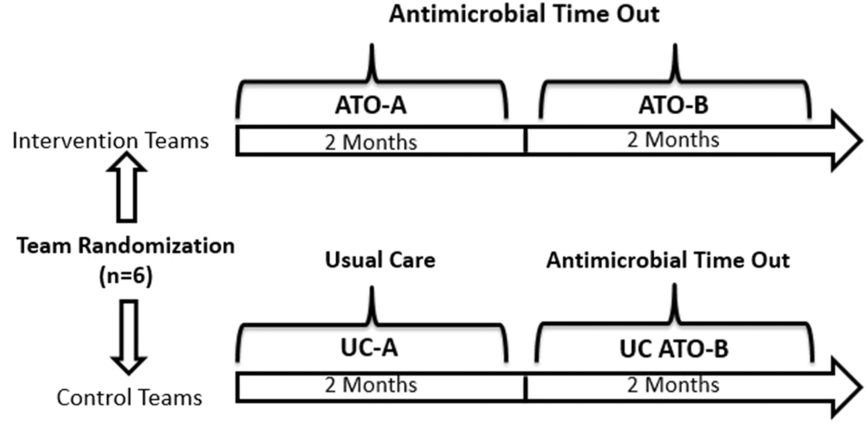
During phase A, the 6 teams were randomized by random-number generation to implement the time-out (ATO-A) or to continue usual care (UC-A) for 2 months. In phase B, the UC team pharmacists were trained in the ATO process and implemented it (UC ATO-B) while ATO use continued in the other group (ATO-B) (Fig. 1). ASP personnel provided education on appropriate antibiotic use to all team clinicians and pharmacists at study initiation and monthly as new clinicians rotated on (ie, 30-minute, in-person, didactic sessions). ASP personnel (T.V. and K.R.) trained 11 pharmacists at ATO initiation (phases A and B) via a 1-hour, in-person, didactic session focusing on algorithm use and ATO documentation, with a brief follow-up session 2 weeks later. Our goal was ATO integration into daily care discussion, and pharmacists were encouraged to use the algorithms to develop antimicrobial recommendations during prerounds and then to introduce the issues identified during rounds. Algorithm use on rounds was not required nor were ATOs if antibiotic issues had already been addressed as part of usual care. Pharmacists were to target ATOs at the following times: 48–72 hours after antibiotic initiation or within 24 hours of a patient transferring out of the ICU (early ATOs) and roughly 48 hours after the initial time-out if still the patient was still on antimicrobials (late ATOs). Additional ATOs could be performed (subsequent ATOs). Compliance with an ATO was determined by pharmacist ATO documentation in the EHR using the iVent function.
Study design.

Definitions
Patients admitted or transferred to any of the 6 medical teams were included unless medicine was not the primary service. Patients treated with <48 hours of antibiotics or who died within 48 hours of starting antibiotics were excluded. Days in the ICU were excluded from both census and antibiotic measurements because they could not be influenced by ATOs. The primary outcome was antibiotic use measured as days of therapy (DOT) per 1,000 patient days (DOT/1,000 PD). We also collected demographics, infection site, DOT of specific antimicrobials, duration of IV therapy, length of stay, comorbidity index, ID consultation, in-hospital mortality, C. difficile incidence, 30-day readmission, and need for transfer to the ICU. Antibiotic adverse events measured included documentation of allergic reaction, prolonged QT interval, and renal dysfunction (ie, RIFLE criteria).Reference Bellomo, Ronco, Kellum, Mehta and Palevsky7 The following ATO data were collected: compliance with the early and late ATO documentation, type of therapy (empiric, definitive, or prophylactic), and specific intervention performed.
Statistical analysis
Statistics were displayed for the 4 groups separately. Mean, standard deviation, median, minimum and maximum were used for continuous data, and counts and percentages were used for categorical data. Analysis of variance (ANOVA) was used to compare the mean age between groups. The Kruskal-Wallis test was used to compare the median length of stay (LOS), Charlson comorbidity index, and outcomes that involved days (ie, days of therapy, etc). The Fisher exact test was used to evaluate the association of categorical data with group status. Comparison of rates of days of therapy between the groups was performed using negative binomial regression. Generalized estimating equations (GEEs) were used to compare rates while accounting for the correlation among patients with >1 hospitalization. P < .05 was considered statistically significant. Power calculation showed that 450 admissions evaluated for inclusion in each group of teams had an 80% power to detect a difference of 15% in antibiotic use between the groups.
Results
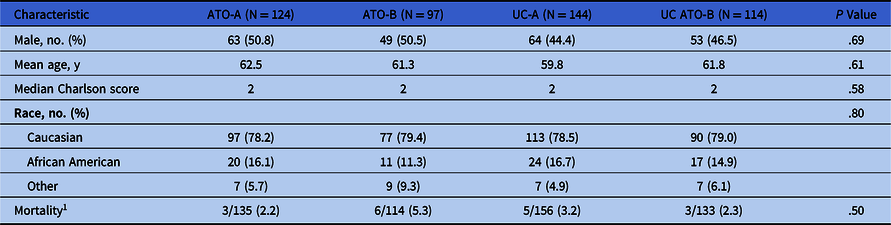
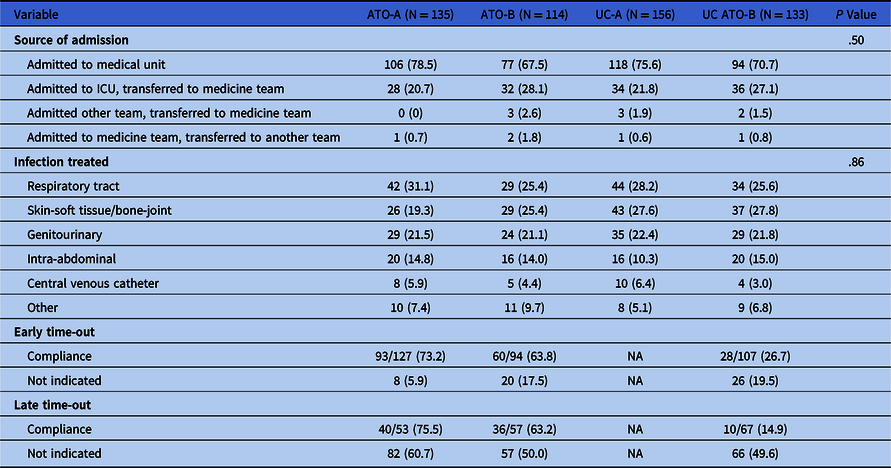
In total, 268 patients (124 in ATO-A and in 144 UC-A) with 291 admissions were included in phase A (1,093 total admissions evaluated), and 211 patients (91 in ATO-B and 114 in UC ATO-B) with 247 admissions were included in phase B (1,095 total admissions evaluated). Most patients were admitted only once: 429 patients were admitted once, 42 were admitted twice, 7 were admitted 3 times, and 1 patient was admitted 4 times. Demographic data are listed in Table 1. We detected no significant differences in age (median, 62 years), sex (52.2% female), comorbidity (median Charlson comorbidity score, 2), race (78.7% white), or hospital mortality (3.2%). Most patients were admitted directly to a medical unit, but >20% of each group had been transferred from an ICU (Table 2). The most common infections were respiratory tract, skin and soft tissue, and genitourinary infections; we detected no differences in infection type between groups (P = .86).
Demographics Data (First Admission Only)

Note. ATO, antibiotic time out; ATO-A, pharmacist-led ATO group in phase A; ATO-B, pharmacist-led ATO group in which ATOs were continued in phase B; UC-A, usual care group in phase A (control); UC ATO-B, usual care group in which ATOs were initiated in phase B.
1 Mortality data for all admissions.
Admission and Infection Source
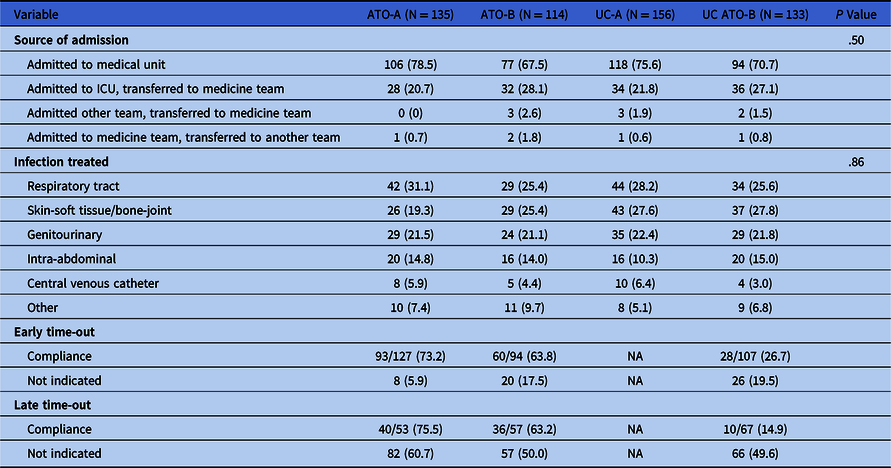
Note. ATO, antibiotic time out; ATO-A, pharmacist-led ATO group in phase A; ATO-B, pharmacist-led ATO group in which ATOs were continued in phase B; UC-A, usual care group in phase A (control); UC ATO-B, usual care group in which ATOs were initiated in phase B; ICU, intensive care unit.
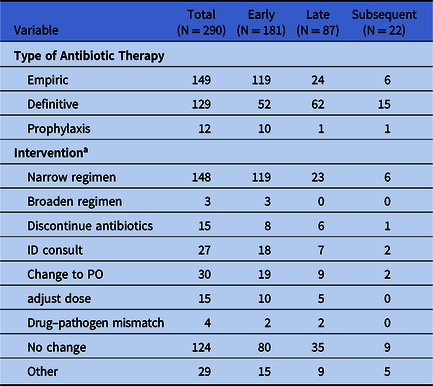
In total, 290 ATOs were documented during the study: 181 early ATOs, 87 late ATOs, and 22 subsequent ATOs. Time-out compliance is described in Table 2. Early ATO compliance was 73.2% in phase A (ATO-A) and declined to 63.8% in phase B (ATO-B), with similar trends in late ATO compliance (ie, ATO-A 75.5% and ATO-B 63.2%). Early ATOs were not indicated in 13.6% of admissions due to ID consultation 96% of the time. In phase B, when the ATOs were implemented in the UC group (UC ATO-B), 27% compliance was observed, which was much lower than that in the ATO groups (early compliance 27% and late compliance 14.9%). Late ATOs were indicated much less frequently than early ATOs, primarily due to ID consultation and patient discharge (Supplemental Table 1 online). The most common ATO intervention was the recommendation for narrow therapy, followed by change to oral (PO) and recommendation for an ID consultation (Table 3). The rate of interventions documented by a team-based pharmacist who staffed at least 14 days (N = 11) varied, ranging from 1.5 interventions per day to 0.3 interventions per day. The mean number of interventions per day staffed was 0.9. We detected a significant difference between the ATO groups (ATO-A and -B) and the UC ATO-B group in interventions per day (1.27 vs 0.51; P < .0001). Additionally, the number of interventions per day by ATO group pharmacists decreased between phase A and phase B (1.53 vs 1.04; P = .0002).
Time-Out Information

Note. ATO, antibiotic time out; ATO-A, pharmacist-led ATO group in phase A; ATO-B, pharmacist-led ATO group in which ATOs were continued in phase B; UC-A, usual care group in phase A (control); UC ATO-B, usual care group in which ATOs were initiated in phase B; ID, infectious disease; PO, oral.
a Could select >1 intervention.
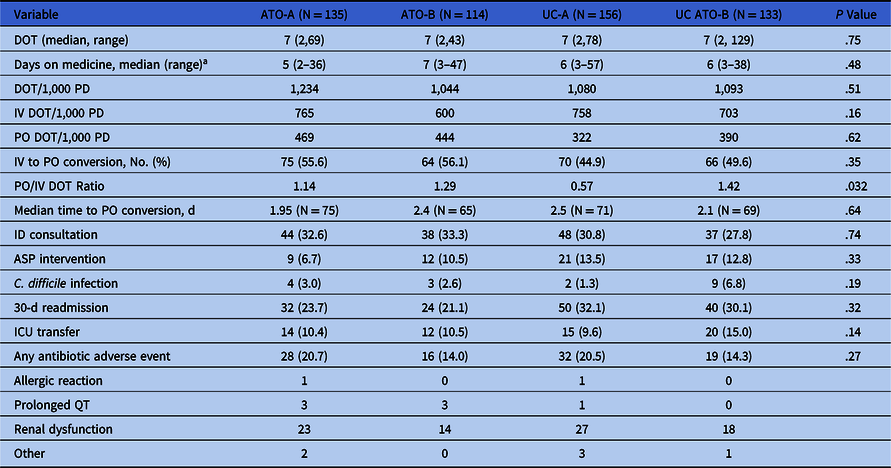
Antibiotic use was not significantly different between the UC group and any of the ATO groups (Table 4). This was true for both overall IV and PO antibiotics, although the proportion of PO antibiotics was much higher in the ATO group (P = .032). The rate of IV to PO conversion while an inpatient was not meaningfully higher in the ATO groups than the UC group (55.8% vs 44.9%; P = .35), and this rate improved only marginally when ATOs were introduced into the UC group in phase B (44.9% vs 49.6%). Median time to PO conversion was not improved. We detected no differences in antibiotic adverse events, C. difficile infection, ID consultation, or readmission at 30 days. There was no difference in the use of vancomycin, linezolid, piperacillin-tazobactam, cefepime, ertapenem, meropenem, or ceftriaxone between the 4 groups (Supplemental Table 2 online). Overall, levofloxacin use was unchanged, but IV levofloxacin decreased significantly in the UC group when ATOs were introduced (49 vs 20 DOT/1,000 PD; P = .022). Oral levofloxacin use did not differ between the groups.
Clinical Outcomes

Note. ASP, antimicrobial stewardship program; DOT, days of therapy; IV, intravenous; PO, oral; ATO, antibiotic time out; ATO-A, pharmacist-led ATO group in phase A; ATO-B, pharmacist-led ATO group in which ATOs were continued in phase B; UC-A, usual care group in phase A (control); UC ATO-B, usual care group in which ATOs were initiated in phase B; ID, infectious disease; PD, patient days; ICU, intensive care unit.
a Excludes ICU days.
Discussion
We demonstrated that implementation of an ATO was feasible and practical, but its impact on antibiotic use was minimal. As indicated by an e-mail survey, the ATO process was well accepted by both pharmacists, who felt empowered to engage in antibiotic discussions, and team members, who appreciated pharmacist input. We chose to use team-based pharmacists to perform ATOs because the same 1–2 pharmacists are typically assigned to a medical team, so they develop a rapport with team. Additionally, while physicians rotated monthly, team pharmacists provided a stable core group of personnel who were facile with EHR use and documentation. Finally, we chose to make the activity team-based and not to provide ASP team involvement to determine whether the addition of ATOs to our current activities provided benefit.
ATO compliance initially was high, but it was less well adopted in the UC group. Moreover, 6 pharmacists served the UC teams, and only 1 documented >1 ATO per day staffed, with 3 pharmacists documenting <0.4 ATOs per day. In comparison, only 1 of the initial 6 ATO pharmacists documented <1 ATO per day. The reason for this disparity is unclear because the education and support provided to pharmacists in both groups was identical. Individual pharmacist comfort and engagement in stewardship may have varied, as may have the team’s attending physician’s interest in addressing antibiotic issues.
The preferred timing of ATOs is unknown. Ideally, they occur whenever clinical or microbiologic data become available to allow adjustments in antibiotic use. Our data suggest that the first 72 hours or immediately after ICU transfer were the most fruitful times for antibiotic regimen review. A significant opportunity for intervention may have been missed by targeting the 48–72-hour window. Much clinical and microbiologic data return before this time, allowing regimen adjustment that may benefit from an ATO. Late ATOs exhibit lower yields because many patients had already been discharged or a definitive antibiotic plan had already been created. No recommendation for change was the second most common intervention overall and the most common in the late ATO category. This finding suggests that antimicrobial plans later in the course of care are not generally amenable to a time-out performed by a team member, although they may still benefit from outside intervention by stewardship experts.
We did not detect a difference in overall antibiotic use or in specific antibiotic use with the implementation of ATOs. Intravenous antibiotic DOT days decreased relative to oral DOT with ATO implementation in the UC group, driven primarily by decreased intravenous (IV) levofloxacin use. Pharmacist-directed IV to PO switch interventions have previously been shown to be effective, and early transition to PO was one of the ATO targets.Reference Dunn, O’Reilly, Silke, Rogers and Bergin8,Reference Kuti, Le, Nightingale, Nicolau and Quintiliani9
There are a number of possible explanations for why the ATOs did not measurably alter antibiotic use. First, our measure of DOT may have been too blunt to detect a difference. Previous studies of stewardship interventions that focused on de-escalation have detected changes that were statistically significant but were generally performed <24 hours after the order.Reference Banerjee, Teng and Cunningham10,Reference Beganovic, Costello and Wieczorkiewicz11 Such a change would be difficult to detect using DOT. Measuring time to most narrow-spectrum appropriate therapy or time to first de-escalation may better reflect the impact of the intervention, but these metrics are more challenging to measure. The duration of our study may also have impacted the outcome. Possibly, over a longer period, antibiotic use changes may have been greater, but our study was of relatively short duration due to its cluster-randomized design and the need to avoid group contamination. Our hospital has an active ASP focusing on audit and feedback for many years, and clinicians are generally aggressive with antimicrobial de-escalation. This factor may have decreased the influence of the ATOs on antibiotic use as well.
Another reason for a lack of impact may have been the time points chosen (as noted previously). Our program does not utilize preauthorization to alter empiric choices, and the ATO may be have had more impact if it had been performed earlier or as part of a daily patient checklist. Daily checklists have been effective at decreasing antibiotic use in the ICU and at improving targeted antimicrobial use.Reference Weiss, Moazed and Mcevoy12 A subsequent study compared an electronic checklist to face-to-face prompting and found that face-to-face prompting significantly decreased antibiotic use compared to the paper format.Reference Weiss, Dibardino, Rho, Sung, Collander and Wunderink13 Interestingly, an ATO using a paper checklist on hospital days 3–5 showed no impact on antibiotic use.Reference Thom, Tamma and Harris5
Scheduling and personnel issues may have impacted our study. The ATOs were not performed on weekends or holidays, reducing opportunities by ~30%. Such issues are common for ASPs because weekend staffing is uncommon. In a recent single-center study, the impact of not performing weekend antibiotic reviews on restricted antimicrobials resulted in an additional 3.8 days compared to those that were reviewed during the week.Reference Freeman, Eschenauer and Patel14 Pharmacist variability in expertise and experience may have influenced our results. To attempt to mitigate this factor, we provided identical training to all pharmacists regarding antibiotic use in common infections and met with them at study initiation and 2 weeks into both periods A and B. No direct observations of ATOs were performed, nor was active monitoring and feedback of ATO use or documentation performed. Addressing these issues may have improved ATO utilization, but we were seeking to determine whether an ATO process without direct stewardship intervention and active support could be successful. Our use of team-based pharmacists limits the applicability of our intervention to only those sites that use a similar team model. Pharmacists generally are ideally positioned to intervene to improve antibiotic use, but the role and effectiveness of non-ID pharmacists who are not supported by ID-trained experts is poorly defined.
Our finding that ATOs do not impact antibiotic use is not isolated. Multicenter implementation of a prescriber-driven ATO using a paper form filled out on hospital days 3–5 decreased “inappropriate” antibiotic prescribing from 45% to 31% but did not change any other antibiotic use measure.Reference Thom, Tamma and Harris5 Two studies utilized electronic notifications to prompt ATOs. Graber et al required users to enter a structured clinical note if vancomycin or piperacillin-tazobactam were continued for >3 days.Reference Graber, Jones and Glassman15 Vancomycin early discontinuation was more common after the ATO implementation, but piperacillin-tazobactam use was unchanged. Another center created an interruptive alert appearing after 72 hours for patients on empiric antibiotics with no defined duration.Reference Richardson, Neuner and Athans6 The alert fired nearly 33,000 times for 6,138 patients. Antibiotics were discontinued or de-escalated in 21% of patients in the 6 hours after the alert fired, although no clear link between the alert and de-escalation could be determined, nor were these researchers able to compare antibiotic use to the prealert period, and overall antibiotic remained unchanged.
Although ATOs make inherent sense, the current literature suggests that their impact is limited. Notably, all studies of ATOs cited (other than the ICU checklists) were conducted at centers with active ASPs, and adding ATOs to an active ASP may yield minimal benefit. An ATO may be beneficial when an active ASP is absent or the program lacks ID expertise, although ATOs have not been studied in these situations. ATOs will benefit from better tools and training of those performing the activity. Nonetheless, asking clinicians with variable ID experience and expertise to self-police antibiotic use through an ATO may not be successful. Greater benefit may come from expanding access to stewardship and ID experts through the use of audit and feedback and “handshake stewardship,” which have been shown to provide meaningful improvements in antibiotic use.Reference Anderson, Watson and Moehring16,Reference Hurst, Child, Pearce, Palmer, Todd and Parker17 The downside to these interventions is that they require time and the availability of experts.
In summary, implementation of a pharmacist-led ATO was feasible and well accepted but did not change overall antibiotic use or impact patient outcomes. ATOs may promote increased use of PO antibiotics, but more effective strategies for self-stewardship are needed.
Supplementary material
To view supplementary material for this article, please visit https://doi.org/10.1017/ice.2020.347
Acknowledgments
Financial support
This work was supported by an investigator-initiated grant from Merck.
Conflicts of interest
T.C.V. reports research grants from Merck. All other authors report no conflicts of interest relevant to this article.