I. INTRODUCTION
Distinctive structure-property accord has instigated research for newer synthesis routes of hyperbranched polymers (HBPs), a novel class of dendritic macromolecules. Their hallmark architectural attribute is a highly branched structure with a large number of peripheral functional groups responsible for their excellent flow and processing properties.Reference Kim1–Reference Gao and Yan4 The structure of the repeating unit, the nature of their end groups, the degree of branching (DB), and the molar mass dictate their final properties. In this context, it is pertinent to mention that HBPs with s-triazine moiety in their structure have many advantages in practical field of applications.Reference Mahapatra and Karak5 These include high thermostability, flame retardancy, rigidity and good electronic properties, and so on. Moreover, s-triazine containing cyanuric chloride is a low-cost commercially available product with applications attested in various sectors including textiles, plastics, and rubber industries. Thus, synthesis of a new HBP with s-triazine unit from cyanuric chloride is an interesting proposition to develop materials with desirable advanced properties.
Again, epoxy resins are a class of versatile thermosetting polymers because of their high strength, low creep, very low cure shrinkage, excellent resistance to corrosion, good adhesion to many substrates, and appropriate electrical properties. These attributes make them applicable in different industries (e.g., electronics, aeronautics, or astronautics) as protective coatings, fiber-reinforced plastics, adhesives, binder for composites, etc.Reference Selvaraj, Maruthan, Palraj and Venkatachari6–Reference Fu, Shi, Yuan, Zhong, Zhang, Chen and Wu9 However, the existing epoxy resins have inherent brittle character that inhibits their further proliferation into various advanced industrial applications including active surface coatings.Reference Bouer10 Hence, the synthesis of a new epoxy resin or modification of existing epoxy resins to improve the various performance properties has been the subject of intense investigation throughout the world.Reference Mustata and Bicu11–Reference Zhang and Jia13
Thus, the synthesis of hyperbranched epoxy resin with s-triazine unit is expected to be an interesting area of research as it may result lower viscosity, higher solubility, higher thermostability, better adhesive strength, and cross-linking due to presence of large numbers of functional end groups compared to its conventional linear analog. Hence, this novel epoxy resin might be used in high performance surface coating applications. Although there are enough reports on synthetic approaches of the conventional epoxy resins, both from petroleum and renewable resource,Reference Zhang and Jia13–Reference Ishida, Yokomachi, Seino, Hayakawa and Kakimoto16 the report on hyperbranched epoxy is really rare.
An attempt, therefore, was made to synthesize a thermostable s-triazine-based hyperbranched epoxy resin by a simple polycondensation technique using a hyperbranched core unit. The synthesized resin was characterized with various analytical and spectroscopic analyses such as measurements of solubility, solution viscosity, hydroxyl value, epoxy equivalent, and spectral studies of Fourier transform infrared (FTIR) spectroscopy, 1H nuclear magnetic resonance (NMR) spectroscopy, 13C NMR spectroscopy, etc. Further, performance characteristics like gloss, impact strength, scratch hardness, adhesion, chemical resistance, and thermostability of the cured resin were also evaluated to judge the suitability of the resin for advanced surface coating applications.
II. EXPERIMENTAL
A. Materials
Toluene, tetrahydrofuran (THF) and dichloromethane (DCM) (Merck, Mumbai, India) were used after distillation and stored with molecular sieves. Epichlorohydrin (EPC, Merck, India) and poly(amido amine) (HY 840, Ciba-Geigy, Mumbai, India) were used as received. Bisphenol-A (S.D Fine Chemicals, Mumbai, India) was used after recrystallization from toluene. Hyperbranched polyether polyol (HBPO) was prepared as reported earlierReference Karak, Roy and Voit17 and used as an s-triazine-based hyperbranched core unit. Other chemicals like sodium hydroxide (NaOH), pyridine, acetic anhydride, cetyl-trimethyl ammonium bromide (CTAB, phase transfer catalyst), and methanol were obtained from Merck, India, and used as received.
B. Synthesis
1. Preparation of hyperbranched polyol
The hyperbranched polyether polyol with s-triazine unit was prepared as reported earlier.Reference Karak, Roy and Voit17 Briefly, an aqueous solution (150 mL of distilled water) of 4.95 g (0.124 mol) NaOH, 5.4 g butane diol (0.06 mol), and 0.0036 mol phase transfer catalyst (6 mol% with respect to diol) were mixed with 7.38 g (0.04 mol) cyanuric chloride in organic solvent (100 mL DCM). The mixture was stirred continuously at 1–2 °C for 2 h, 14–15 °C for 2 h, and 15–16 °C for 5 h. Finally, 5.4 g of butane diol was added in excess, and the reaction was continued for another 2 h. The product was purified by precipitation technique.
2. Synthesis of hyperbranched epoxy resin
Hyperbranched polyether polyol (HBPO, 20 wt% of total mass of diol compound) and bisphenol-A were taken in a three neck round-bottom flask fitted with a condenser and thermometer in a calculated amount of epichlorohydrin (1:1.5 mol ratio of hydroxyl group to epichlorohydrin) at room temperature under stirring condition. On complete dissolution of HBP and bisphenol-A, the system was placed on a preheated oil bath at (54 ± 1) °C. To this reaction mixture, 5 N aqueous solution of NaOH was added dropwise for 1 h under stirring condition at constant temperature. After complete addition of NaOH solution, the reaction mixture was continued for 3 h at the aforementioned conditions. On completion of the reaction, the product obtained was dissolved in chloroform and filtered to remove the salt formed. The filtrate was then washed with 15% brine solution followed by washing with distilled water for 3–4 times. The washed product was dried under reduced pressure at 40 °C. The final product obtained was a sticky transparent mass with 59% yield.
The reaction parameters for this polycondensation reaction were optimized with respect to concentration of base, reaction temperature, and time for the reaction by changing only one of these parameters while all others were kept constant. The yield, solution viscosity, and epoxy equivalent were measured in each case to examine the optimum condition for the reaction. An interfacial polymerization was also tried to synthesize the hyperbranched epoxy resin by using CTAB as phase transfer catalyst at room temperature. But the results found were not fruitful in this case and thus further studies were not carried out.
3. Curing of epoxy resin
Poly(amido amine) was used as the curing agent to harden the hyperbranched epoxy resin. An amount of 50 phr (parts per hundred of resin) of the curing agent was mixed with hyperbranched epoxy resin along with a little amount of THF (to facilitate mixing) by mechanical stirring for 20 min. Then the mixture was cast on glass slides. The films were then degassed under vacuum at room temperature to ensure complete removal of the volatiles. The cast films were cured at 120 °C for a specified period of time followed by postcuring at 150 °C for 30 min in a muffle furnace to determine the touch free time (minimum time when no impression appears on touching the film) and hard dry time of the film. Similarly, the films were also cast on mild steel plates (150 × 50 × 1.6 mm3), tin plates (150 × 50 × 0.4 mm3), and glass plates (75 × 25 × 1.75 mm3) for impact resistance, gloss, and chemical resistance tests, respectively. The average dry thickness of the films was 40–45 μm as measured by pen tester (Sheen Instrument Ltd., Surrey, UK) in all the cases.
4. Instrumentation techniques
FTIR spectra of the resin were recorded on a Nicolet (Ramsey, MN) Impact 410 FTIR spectrophotometer using KBr pellet. 1H NMR and 13C NMR spectra of the epoxy resin were recorded on a JNM-ECS FTNMR (400 MHz, JEOL, Tokyo, Japan) spectrometer using tetramethylsilane as an internal standard and CDCl3 as the solvent. Thermal study was conducted by differential scanning calorimetry, DSC (DSC-60, Shimadzu, Tokyo, Japan) and thermogravimetric analysis (Shimadzu TG50, Toyko, Japan) at a heating rate of 10 °C·min−1 under nitrogen flow rate of 30 mL·min−1. Impact strength and gloss of the cured film were determined by falling weight impact tester (S.C Dey & Co, Kolkata, India) and gloss meter at an angle of 60° (Model No. 160, Sheen Instrument Ltd.), respectively. The crosscut adhesion test was performed by the standard ASTM D3359-97 method, which was done on coated aluminium strips (150 × 50 × 0.68 mm3) after treatment with chromic-sulfuric acid followed by washing with distilled water.Reference Bhuniya and Maiti18 Scratch hardness test was carried out by scratch hardness tester (Model No. 705/1, Sheen Instrument Ltd., Surrey, UK) as per ASTM D5178. The chemical resistance test was performed by immersing the samples in different chemical media and by observing the weight changes for specified period of time. The swelling test was carried out by immersing the weighted amount (W d) of cured film in dimethylformamide (DMF) for required period of time. After equilibrium (48 h), the weight of the swollen film (W s) was measured. Then the swelling value was calculated by using the following formulae.

The solubility of the resin was observed in different solvents at room temperature, using 0.01 g sample in 1.0 mL solvent. The solution viscosity was measured with 0.5% solution of the resin using Ubbelohde suspended level viscometer at (31 ± 0.5) °C. The epoxy equivalent and hydroxyl value of the synthesized resin was determined by the standard pyridinium chloride and acetylation method, respectively.Reference Motawie, Sherif, Badr, Amer and Shehat19
III. RESULTS AND DISCUSSION
A. Synthesis
The synthesis of hyperbranched epoxy resin in this study was carried out by a simple polycondensation technique under mild reaction conditions. However, there are reports on end group modification of HBPs,Reference Ishida, Yokomachi, Seino, Hayakawa and Kakimoto16, Reference Zhang, Jia and Zhou20, Reference Coessens, Pyun, Miller, Gaynor and Matyjaszewski21 proton transfer polymerization,Reference Gong and Fre’chet22, Reference Emrick, Chang and Fre’chet23 etc. for synthesis of epoxy resin by using complex reaction scheme, toxic organic solvents, high energy, and time-consuming processes. So, keeping these issues in mind, here a simple, cost-effective, and efficient technique has been utilized to synthesize the hyperbranched epoxy resin.
At first, an attempt had been made to synthesize the hyperbranched epoxy by interfacial polycondensation technique at room temperature. The indication of occurrence of the reaction was confirmed by FTIR analysis where an epoxy ring stretching at 910 cm−1 was observed (not shown). But, unfortunately, the 1H NMR and 13C NMR analyses revealed ill-defined product. The poor yield and low viscosity with high epoxy equivalent of the product may be due to the fact that under the used reaction conditions the polymerization is not favorable. Further, there is a difficulty in the separation of the phase transfer catalyst (CTAB) from the sticky mass, and trace amounts of the phase transfer catalyst retain even after several washings and reprecipitations. Thus, this process was not utilized further. Hence, the hyperbranched epoxy resin in the present study was synthesized by adopting a low-temperature bulk polycondensation technique. In this process, hyperbranched polyol, bisphenol-A, and epichlorohydrin formed a homogeneous single phase system in the reaction medium. In this polycondensation reaction, initially epichlorohydrin reacts with the hydroxyl group of bisphenol-A as the acidity of the aromatic hydroxyl is higher than the aliphatic one. However, after complete consumption of bisphenol-A, the epichlorohydrin as well as the diglycidyl ether epoxy reacts with some of the hydroxyl groups of hyperbranched polyol. These reactions result in the desired hyperbranched epoxy resin as shown in Scheme 1. The variation of the reaction conditions indicated that the optimum reaction conditions were 5 N aqueous base, temperature of (54 ± 1) °C, and duration of 3 h as shown in Table I. The increase or decrease of these parameters resulted in lower yield, viscosity, and higher epoxy equivalent value of the resulting epoxy resin. A longer reaction time than 3h was found not to increase the yield as well as the viscosity. It has also been observed that at higher temperature than (54 ± 1) °C of the reaction and at higher concentration of the base than 5 N resulted yellow coloration of the product. This may be due to the harsh reaction condition, which facilitates the other side reactions. The percent yield is almost comparable under the reaction conditions from 5 to 15 N of NaOH. The low viscosity at 15 N NaOH may be due to the unfavorable reactions conditions, which prevent the formation of high molecular weight as in other two cases. The variation of yield and viscosity can be explained in the same way for the other cases, e.g., increase of reaction time. In this case, the yield is the highest for 5 h of reaction time, which is the best condition for the polymerization to obtain the low viscosity. This also helps in processing of the resin.
Optimization conditions and corresponding yield, epoxy equivalent and viscosity of hyperbranched epoxy resin synthesized by polycondensation and interfacial technique.

a The result obtained from interfacial technique.
B. Characterization
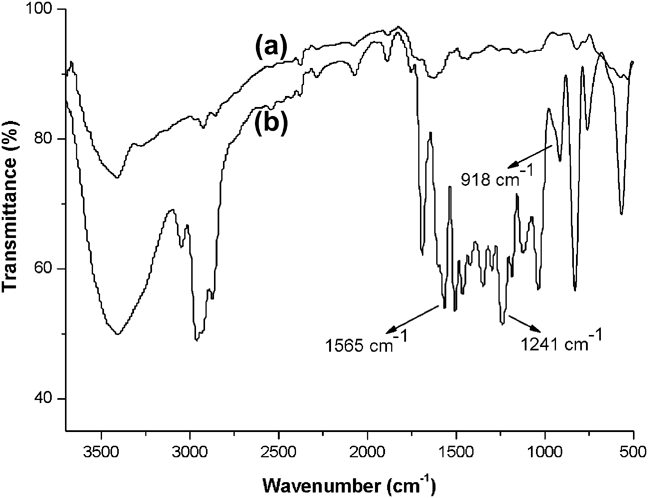
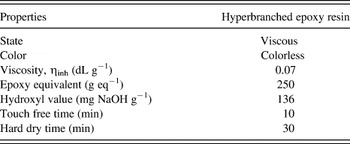
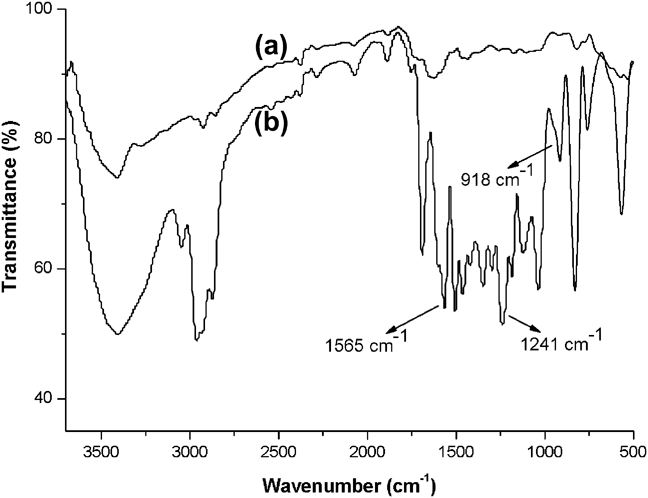
The synthesized epoxy resin was characterized by analytical techniques like measurements of solubility, dilute solution viscosity, epoxy equivalent and hydroxyl value, etc. (Table II). The epoxy resin was found to be soluble in polar solvents like THF, acetone, DCM, 1,4-dioxane, dimethylacetamide, DMF, dimethyl sulfoxide, etc. These may be due to polar nature of the epoxy resin, which results from the presence of large numbers of epoxy and hydroxyl groups in the structure. The low viscosity (Table II) is not only due to low molecular weight of the resin but also result from compact globular hyperbranched structure with large numbers of end groups. Unfortunately, the determination of molecular weight by gel permeation chromatography (GPC) was not possible as the material strongly absorbed by the column material, so it was not possible to get any result. That is why inherent viscosity was given in each case (Table I). The presence of oxirane ring as indicated by epoxy equivalent value of the resin (Table II) confirmed the formation of epoxy resin. This hydroxyl value (Table II) may be due the presence of hydroxyl groups in the hyperbranched core unit and also opening of a few epoxy groups on chain extension of the resin as shown in Scheme 1. This result indicates that all the hydroxyl groups of the core unit are not utilized for the reaction with epichlorohydrin. However, besides the presence of unreacted hydroxyl groups in the resin, the shelf-life was found to be more than six months. The behavior of the resin remained unchanged even after more than six months (the solubility was found to be same as original resin). Thus, the resin has a sufficient long self-life time as required for many applications. FTIR spectrum of the synthesized epoxy (Fig. 1) indicates the presence of –OH stretching absorption band at around 3400 cm−1 and bands at 2950–2850 cm−1 appeared for the aliphatic –CH stretching vibrations. An absorption band at 918 cm−1 is due to the bending vibration of epoxy group, which indicates the occurrence of the reaction and formation of epoxy group.Reference Das and Karak14 The bands at 1507 cm−1 is due to the stretching frequency of phenyl group, and the bands at 1565, 1346, and 750 cm−1 are due to the triazine ring. The C=N bond of the triazine moiety appeared at 1422 cm−1 in the IR spectrum of the resin. The bands at 1241 and 831 cm−1 appeared for stretching vibration of aromatic ether and out-of-plane –CH bending vibrations of benzene ring, respectively. The FTIR spectrum of the cured hyperbranched epoxy revealed the occurrence of curing reaction and formation of three-dimensional (3D) cross-linked network structure as shown in Fig. 1. The absence of epoxy ring stretching band at 918 cm−1 and decrease in the –OH stretching band intensity along with overlapping of –NH band of poly(amido amine) confirm the reaction between hyperbranched epoxy and poly(amido amine) curing agent at the specified curing conditions forming rigid 3D network structure.
Fourier transform infrared spectra of (a) cured hyperbranched epoxy and (b) hyperbranched epoxy resin.
Synthesis of hyperbranched epoxy resin.

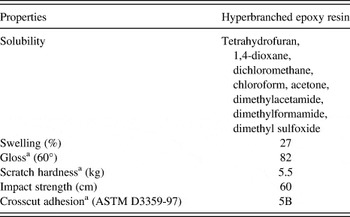
Physical properties of the hyperbranched epoxy resin.

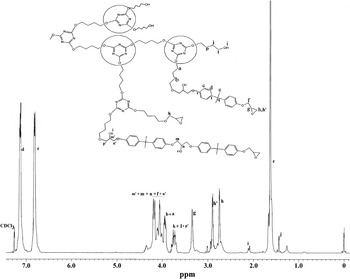
The structure of the hyperbranched epoxy resin has further been supported by NMR spectral analyses. 1H NMR spectrum of the synthesized epoxy (Fig. 2) is little complicated due to the overlapping of many peaks in the δ = 3.0–4.1 ppm region.Reference Pascu, Garcia-Valls and Giamberini24 The peaks at δ = 1.24 (m) and 1.62 (s) ppm are due to the methylene and –CH3 protons, respectively. The δ values at 2.7–2.9 ppm and 3.3 ppm are due to the –CH2– and –CH– protons of oxirane ring, respectively.Reference Emrick, Chang and Fre’chet23, Reference Emrick, Chang, Fréchet, Woods and Baccei25 The chemical shift values at δ = 3.5–3.7 ppm and 4.0–4.1 ppm are due to the different chemical environment methylene protons as shown in Fig. 2. The peaks appeared at δ = 6.7–7.1 ppm are for aromatic protons.
1H nuclear magnetic resonance (NMR) spectrum of hyperbranched epoxy resin.

The structural perfection of the HBPs is usually characterized by the determination of their DB, which can be determined by using Frechet’s equation as follows.Reference Emrick, Chang, Fréchet, Woods and Baccei25

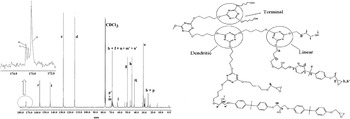
where D, T, and L refer to the number of dendritic, terminal, and linear units in the structure of the resin, respectively. DB was calculated from 13C NMR spectroscopy (Fig. 3) by comparing the integration of the peaks for the respective units in the resin. The value of DB for the resin was found to be nearly 0.57. This value indicates that the resin exhibits a highly branched structure as the value is 0 for linear and 1 for dendrimer. As the value approaches near to 1 from 0, the number of branches increases, and at 0.5 the structure is said to be ideal hyperbranched structure. So the synthesized hyperbranched epoxy resin has near to ideal hyperbranched structure.
13C NMR spectrum of hyperbranched epoxy resin.

The 13C NMR spectrum further supports the hyperbranched structure of the synthesized resins. All the excepted peaks were observed in 13C NMR spectrum. The peak values at δ = 25.0–29.0 ppm are due the different methylene –CH2– carbons (Fig. 3). The peak at δ = 31.1 ppm is due to the –CH3 carbon, while the chemical shift values at δ = 41.8, 45.0, and 50.0 ppm are due to the aliphatic tertiary carbon, –CH2–, and –CH– carbons of oxirane ring, respectively. The peaks at δ = 62.5 and 68.8 ppm are due to the methylene carbons directly attached to electronegative oxygen atom (Fig. 3). The peaks at δ = 114.0–127.8 ppm and 143.0–156.0 ppm appeared for the carbons of benzene ring. Three peaks at δ = 173.0–173.3 ppm are due to the symmetrically substituted, disubstituted, and monosubstituted polyol core, which can be considered as dendritic, linear, and terminal units, respectively (Fig. 3).
C. Properties
1. Curing study
During homogenization of the mixture of the resin with hardener, high vacuum was used to remove the volatiles which otherwise would have detrimental effect on the ultimate performance of the cured resin. The cross-linking of the epoxy resin with poly(amido amine) hardener is a nucleophilic addition reaction. In this reaction, amine groups of the hardener react with the strained epoxy (oxirane ring) groups of the resin and thereby forming chemical covalent linkages between the resin and hardener chain molecules under the used conditions. The driving force of this curing reaction is the release of strain energy of the oxirane ring. The hydroxyl groups (generated during cross-linking reaction or preformed) of the epoxy resin can also take part in curing reaction by reacting with epoxy groups of the other chains in the presence of base poly(amido amine). Thus, the role of poly(amido amine) hardener is multifold.Reference Das and Karak14 It acts as a cross-linker, as a base as well as it imparts plasticization effect to the epoxy resin, and thereby improves the flexibility of the cured film.
2. Coating performance of the hyperbranched epoxy resin
The synthesized hyperbranched epoxy resin appeared as colorless, odorless, sticky, and transparent mass. From the solubility studies, it has been observed that the hyperbranched epoxy resin is soluble in most of the common organic polar solvents (Table III). This may be due to the characteristic hyperbranched structure and the presence of polar –OH and terminal epoxy end groups in the structure. Adhesion studies indicate that the synthesized epoxy thermoset has a good adhesion character with the used substrates. This may be due the presence of large number of polar hydroxyl, epoxy, and ether groups which create strong secondary interactions with the treated aluminium surface. The high gloss value is due to the smooth and uniform surface of the cured resin (Table III), and this result is one of the noticeable achievements in this study. The cured epoxy resin is found to have good scratch hardness resistance which may be due to the presence of rigid aromatic, heterocyclic moieties and good cross-linking density as indicated by swelling test (Table III). The moderate impact strength of the cured resin indicates the presence of flexible ether linkages and aliphatic moieties present in the resin. These results indicate that this resin might be utilized for surface coating application.
Coating performance of the hyperbranched epoxy resin.

a The values are the mean of five tests.
3. Thermal properties
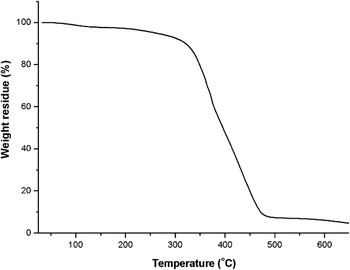
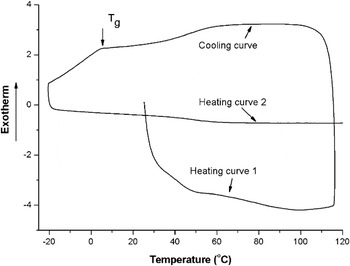
The initial decomposition temperature and 50% decomposition temperature of the cured hyperbranched epoxy were found to be 270 and 395 °C, respectively (Fig. 4). The formation of 6 wt% of weight residue at 600 °C was also observed. This high thermostability is due to the presence of thermostable heterocyclic triazine moiety, rigid aromatic moiety, and better cross-linking of the resin. The initial 3–4% weight loss is due to loss of moisture and/or trapped solvent (Fig. 4). Then, the rapid degradation (Fig. 4) may be because of the presence of linear aliphatic moieties, structural defects in the hyperbranched epoxy resin. DSC study of the cured hyperbranched epoxy showed a glass transition temperature (T g) of about 5 °C (Fig. 5). However, no other transition peaks were observed under the investigated temperature range, which indicates absence of any crystalline phase in the resin and the material is amorphous in nature.
Thermogravimetric analysis thermogram of hyperbranched epoxy resin.

Differential scanning calorimetry thermogram of cured hyperbranched epoxy.

4. Chemical resistance
The chemical resistance of the hyperbranched epoxy resin was studied in various chemical media. The cured coated resin on glass plate of 6 × 1 × 0.2 cm3 size was kept in 250 mL beakers containing 150 mL of different media. The media used were distilled water, aqueous NaOH solution (pH 7.4), 10% aqueous NaOH (w/v) solution, and aqueous hydrochloric acid solution (pH 6.8). The plates were kept for 20 days at room temperature, and changes of masses were determined gravimetrically. The weight losses of the cured samples are shown in Table IV. The chemical resistance test in various media (Table IV) showed that the epoxy thermoset is highly stable and almost negligible change in the weight was observed. This may be due to the presence of aromatic, heterocyclic moieties and good cross-linking density (low swelling value, Table III) of the cured resin. Further, gel fraction of the cured hyperbranched epoxy was determined by soxhlet extraction technique using THF as the solvent to verify the solvent resistance of the cured resin. The gel fraction was found to be 0.973, indicating sufficient solvent resistance characteristic of the cured hyperbranched epoxy.
Weight changes (%) of the cured films under different chemical media.

IV. CONCLUSIONS
From the present investigation, it can be concluded that a hyperbranched epoxy resin is synthesized by a simple low-temperature bulk polycondensation technique. The synthesized epoxy resin is successfully characterized by FTIR, 1H NMR, and 13C NMR spectroscopic studies. The solubility behavior indicates that the hyperbranched epoxy resin is highly soluble in most of the common organic polar solvents; thus, it can be processed without any difficulty. Performance characteristics like impact strength, gloss, scratch hardness, adhesion, thermostability, and chemical resistance showed that the synthesized epoxy resin can be potentially used as an active surface coating materials for various applications.
ACKNOWLEDGMENTS
One of the authors, Buddhadeb Roy expresses his sincere gratitude to University Grant Commission (UGC), Delhi (India), for the financial assistance as Rajib Gandhi National Fellowship (RGNF). The author also thanks Central Instrumentation Facility, Tezpur University, India, for help in analysis and testing of the samples. The authors express their sincere thanks for departmental financial assistance to the SAP (UGC) New Delhi, India, through grant No. F.3-30/2009 (SAP-11) and Fund for Improvement of Science & Technology Infrastructure (FIST) program 2009, DST New Delhi, India, through grant No. SR/FST/CSI-203/209/1.