According to standard comparativist views, death is bad in so far as it deprives someone of goods she would otherwise have had. In The Ethics of Killing, Jeff McMahan argues against such views and in favour of a gradualist account according to which how bad it is to die is a function of both the future goods of which the decedent is deprived and her cognitive development when she dies. Comparativists and gradualists therefore disagree about how bad it is to die at different ages. In this article I examine two prominent criticisms of gradualism and show that both misconstrue McMahan. I develop a related criticism that seems to show that a gradualist cannot coherently relate morbidity and mortality. This criticism also fails, but has an instructive implication for how policy-makers setting priorities for health care investments should regard choices between life-saving interventions and interventions against non-fatal diseases in the very young.
INTRODUCTION: WHAT MAKES DEATH BAD?
It is widely believed that death can be bad for the person who dies. One common explanation adopts a comparativist view: death is bad in so far as it deprives someone of goods that she would otherwise have had.Footnote 1 In The Ethics of Killing, Jeff McMahan argues against this comparativist account of the badness of death and in favour of a gradualist account.Footnote 2 According to McMahan, how bad it is to die is a function of both the future goods of which the decedent is deprived and the degree of psychological unity she has with the future self who would have experienced those goods. The cognitive requirements for psychological unity mean that very young children are generally not as psychologically unified with their future selves as are older children or adults. This implies that it is usually not as bad for a very young child to die as it is for an older child or a young adult.
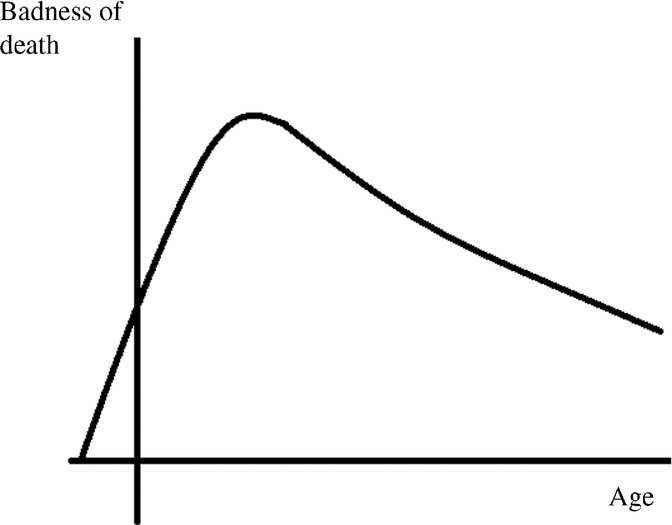
The question of how the badness of death is related to age and cognitive development is of more than just theoretical interest. A comparativist view is built into the current designs of summary measures of population health, such as quality-adjusted life years (QALYs) and disability-adjusted life years (DALYs). These measures are supposed to give a common currency for comparing different health states, including death, to help policy-makers choose between different ways to spend money on health care and research.Footnote 3 If we accept a comparativist account of the badness of death, then the younger one is, the worse one's death and, all else being equal, the greater priority preventing that death should receive. If we adopt a gradualist account, such as McMahan’s, then the worst death will occur somewhere later in childhood or early adulthood. All else being equal, preventing the deaths of very young children and older adults should get lower priority on such a view.Footnote 4
Many people find implausible the comparativist implication that the death of a newborn is worse for her than the death of a young adult is for him.Footnote 5 They think, by contrast, that it is worse for the young adult to die, even though he therefore misses out on less valuable life than does the newborn. The ability to capture and explain our intuitions about the relative importance of death at different ages makes gradualist accounts like McMahan's appealing. However, McMahan's account has recently been criticized on the grounds that it is unsupported by the intuitions he cites and incoherent in its normative implications. These criticisms would, if compelling, give us reason to reject any gradualist account of the badness of death. In this article I examine two prominent criticisms – from Ben Bradley and John Broome – and show that both misconstrue McMahan's view. I then develop a further, related criticism that seems to show that a gradualist account cannot relate morbidity and mortality in a coherent way. This criticism also fails, but it has an instructive implication for how policy-makers setting priorities for health care investments should regard their choices between life-saving interventions and interventions to prevent or treat non-fatal diseases.
THE TIME-RELATIVE INTERESTS ACCOUNT
According to McMahan, two factors affect how bad it is to die. One is the value of the future goods of which death deprives its victim. In this respect, he agrees with the comparativist. The other is the extent to which those future goods are important for the decedent at the time when she is deprived of them. This factor varies with cognitive features of the decedent. McMahan argues that a person has reason to care about herself over time in so far as the earlier and later versions of herself are linked by relations of prudential unity. These relations are not simple personal identity – it is not because I will later be the same person that it matters to me now what will happen to me later – but are instead given by the degree of psychological unity that holds between earlier and later stages of a person. According to McMahan:
The degree of psychological unity within a life between times t1 and t2 is a function of the proportion of the mental life that is sustained over that period [e.g. constant beliefs or dispositions], the richness or density of that mental life, and the degree of internal reference among the various earlier and later mental states.Footnote 6
Why is psychological unity important? Imagine a creature with almost no psychological unity. It has experiences (including pleasure and pain), but does not remember the past and cannot conceive of the future. It is not self-conscious and so cannot conceive of itself as an enduring entity. It does not have personality traits, nor beliefs or desires. For such a creature, it is hard to see why it would matter to it if it were to die and another similar creature were to come into existence. That is, it has little or nothing of what is required for egoistical concern. Suppose that this creature will eventually become a self-conscious, psychologically consistent being with a memory and future-directed goals. At that point, it will have much stronger reasons to care about itself over time. But it does not yet have those reasons. And the fact that it will one day have them does not yet ground egoistic concern for its future self.
Foetuses and newborns lack self-awareness, do not have a conception of the past and future, do not have ongoing projects, and so forth. These characteristics, which are the ones constitutive of psychological unity, develop over time and may not be fully present until late childhood or adolescence. The reasons that children have to care about their future selves therefore also develop gradually over time, so that as they get older, they have more reason to care, and so the loss of future life becomes more important for them. McMahan writes:
Intuitively, it is the vast psychological distance that there would have been between the infant and itself later as a person that explains our sense that the death is a less serious misfortune than the death of an older child or adult – despite the greater magnitude of the good it loses. And the infant is unaware of itself, unaware that it has a future; it therefore has no future-directed mental states: no desires or intentions for its future. Because its mental life is so limited, there would be very few continuities of character or belief between itself now and itself as a person . . . It is, in short, almost completely severed psychologically from itself as it would have been in the future . . . It is almost as if the future it loses might just as well have belonged to someone else.Footnote 7
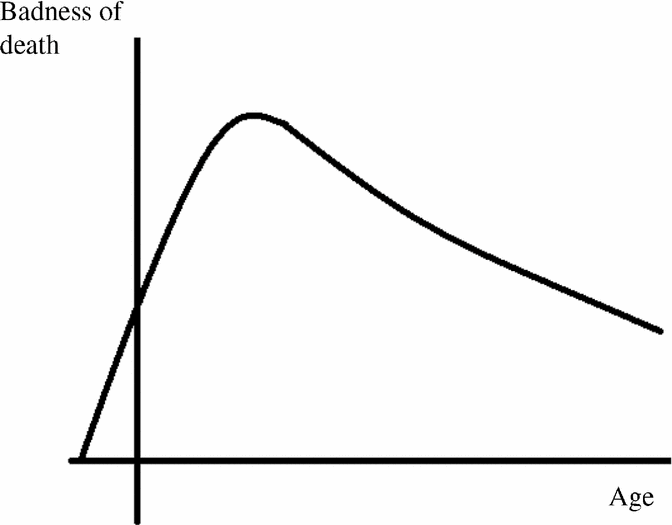
If McMahan is correct, then how bad it is for a human to die will normally vary with age in the manner depicted in figure 1. Once a foetus is sentient its death will start to matter for its own sake.Footnote 8 The badness of death will then increase as its psychological connections with itself in the future increase and then gradually taper off as the diminishing amount of future life lost as a result of death outweighs any further cognitive advances.
Gradualist accounts of the badness of death
ALTERNATIVE GRADUALIST ACCOUNTS
McMahan's specific view about psychological unity and prudential value is not the only view that implies that how bad it is to die varies with cognitive development in this way. A number of philosophers have developed accounts of interests that have similar implications. In this section I illustrate this point with reference to two such accounts – from Peter Singer and Joel Feinberg – that have been developed by philosophers looking for a theoretically grounded account of interests that can do work in applied ethics. For those who are sceptical of McMahan's view about the basis for prudential concern, but still want to preserve the common intuitive judgement that it is not as bad for an infant to miss out on future life as it is for a young adult, such accounts provide an alternative justification for gradualism about the badness of death. However, the gradualism they entail, since it is structurally similar to McMahan’s, is similarly vulnerable to the objections I canvass in the later sections of this article. Whichever route to gradualism one adopts, I argue, one must face the objections head on.
First, although Peter Singer accepts that a being can matter as soon as it is capable of experiencing pleasure and pain, he believes that self-conscious rational beings have further interests in satisfying their preferences. He argues:
For preference utilitarians, taking the life of a person will normally be worse than taking the life of some other being, since persons are highly future-oriented in their preferences. To kill a person is therefore, normally, to violate not just one, but a wide range of the most central and significant preferences a being can have. Very often, it will make nonsense of everything that the victim has been trying to do in the past days, months, or even years.Footnote 9
If, as seems plausible, the degree to which people are future-oriented in their preferences develops gradually, as children begin to see themselves as distinct individuals who exist over time, it will follow that the extent to which their preferences can be set back by death will develop gradually, as well.
According to Joel Feinberg, our interests include welfare interests – in physical health, the absence of pain, economic sufficiency, and so forth – and focal aims – such as writing a book, acquiring political power, and raising a family. The former are necessary for the latter, but, in general, Feinberg considers them instrumental to the achievement of focal aims, which are the things that are really important.Footnote 10 If we take a hierarchical view of interests like this, how bad it is to have one's interests set back (for example, by death) will depend on what sorts of interests one is capable of having. Very young children, who cannot have focal aims, will not have so great a setback of their interests as a result of dying as will adults.
Finally, McMahan himself identifies a number of characteristics that ground interests in one's future and that normally develop gradually during childhood. These include: the existence of narrative structure in the life of the person who dies, which can be stymied in an adult whose life has started to take form, but not in an infant whose life does not yet have a structure; the investment that older persons may have made in their futures; and the projects and preferences people have that may go unsatisfied.Footnote 11 This suggests that even in the absence of the time-relative interests account he would have the resources to defend some type of gradualist view.
It is worth noting that on all these views, the majority of the capacities needed to have substantial interests in one's future will be present in quite young children. By the age of five, for example, a child who develops normally understands the past, present and future, has permanent memories, can distinguish fantasy from reality (and tell both true and fantastical stories), can form close friendships, may have interests that last for the rest of her life (such as music and sports), may be afraid of death, and can feel guilt, pride and empathy.Footnote 12 Of course, there is variation, and there will be a great deal of development from this point, especially in abstract and moral thinking, emotional control and realistic expectations about the world, but in terms of psychological unity and on any of these views of what interests make death bad for the decedent, it seems to me that five-year-olds have what it takes. If we deny that, we will have to endorse some rather implausible, elitist views about what sort of intellectual development or sophisticated projects are needed in order for someone's interests in her future to matter.Footnote 13
The view that one's interests in one's future develop gradually in young children is implied by several accounts of interests that have been developed by philosophers looking to use them to resolve problems in applied ethics. These accounts imply that how bad it is to die increases gradually over time as the capacities that underlie these interests develop. Assuming, as seems plausible, that the harm of death is also a function of what one loses through dying, they therefore support a gradualist account according to which how bad it is to die normally varies with age following a function similar to that represented in figure 1.Footnote 14 Such an account is also supported by many people's intuitive judgements about which deaths are worst. In the sections that follow, I consider two objections to gradualist accounts that, though directed against McMahan, in fact constitute objections to any such account.
BRADLEY’S DEFENCE OF THE LIFE COMPARATIVE ACCOUNT
In a recent article and subsequent book, Ben Bradley argues that McMahan's ‘primary’ argument against the comparativist account of the badness of death fails.Footnote 15 Were Bradley correct, then one of the most important reasons for rejecting a comparativist account of the badness of death would not apply.
The comparativist account of the badness of death is derived from a more general account of the value of any event for an individual, which McMahan calls the Life Comparative Account (LCA).Footnote 16 Bradley states it as follows:
LCA: The overall value of an event for an individual = the value for that individual of her entire actual life, minus the value for her of the life she would have had if the event had not occurred.Footnote 17
As noted above, according to the Life Comparative Account, all else being equal, the younger one dies, the worse one's death is, since the more valuable life one misses out on. This implies that it is worse to die as a young adult than as an old one, which seems correct. However, it also implies that the death of a newborn is worse for him than the death of a young adult is for her. Indeed, according to the Life Comparative Account, the very worst time to die is immediately after conception, since that is the point at which the victim misses out on the most.Footnote 18 Even people who are unsure about the newborn case will surely agree that an early miscarriage is not as bad for the miscarried foetus as the death of an infant is for the infant. As McMahan argues:
Consider first that most people believe that we begin to exist at conception. They therefore believe that the death even of an embryo prior to implantation is the death of one of us. Yet on a conservative estimate, two of every three products of human conception die of natural causes prior to birth. If we thought that the death of a fetus or infant was as serious a misfortune as the death of an older child or adult, we would have to think of the vast number of spontaneous abortions that occur as a continuing tragedy of major proportions. We would surely mobilize ourselves, as a society, to lower the prenatal death rate. Yet the level of social spending on the prevention of spontaneous abortion remains exceedingly low – lower by far than the social investment in the search for a cure for diseases, such as AIDS, that result in far fewer deaths. The explanation for this is that we simply do not regard the death of an embryo [or] fetus as a serious misfortune, even though most of us believe that the victim is one of us.Footnote 19
He later comments:
If identity were what matters [rather than psychological unity, which comes in degrees], the worst death, involving the most significant loss, would be the death of an individual immediately after the beginning of his existence. But the loss that would have occurred if that individual had simply been prevented from beginning to exist would not have been significant at all. This is hard to believe. It suggests that it is profoundly important to prevent the existence of an individual who would die within seconds of beginning to exist.Footnote 20
On the basis of the latter passage, Bradley reconstructs what he takes to be McMahan's primary argument against the Life Comparative Account:
P1. If LCA is true, then death is extremely bad for its victim at the earliest stage of life.
P2. Failing to come into existence is not bad for a person.
P3. If P2, and if death is extremely bad for its victim at the earliest stage of life, then it is extremely important to prevent someone from coming into existence if he would otherwise die just after coming into existence.
P4. It is not extremely important to prevent someone from coming into existence if he would otherwise die just after coming into existence.
C. Therefore, LCA is not true.Footnote 21
Bradley's most compelling criticisms of this argument target P3.Footnote 22 He says: ‘P3 is true only if it is always important to prevent great harms, and it seems clear to me that it is not.’Footnote 23 Why not? Bradley offers two argumentative strategies. The first, I will argue, requires controversial premises. The second, as Bradley notes, does not.
First, Bradley suggests we could distinguish between how much someone is harmed and how much the harm matters morally. Bradley suggests two reasons why someone might think that although the death of a foetus or infant harms it more than the death of an adult harms her, nevertheless the harm does not matter as much morally.
One reason appeals to a notion of desert: ‘Perhaps a harm matters more morally when it is suffered by someone who deserved to be benefited than when suffered by someone who didn't deserve any benefits.’Footnote 24 However, it is implausible that this can explain the phenomena that motivate McMahan's argument. We would not only have to believe that desert is relevant to how much harm matters, and to believe that adults (in general) deserve benefits but foetuses do not, we would also have to believe that desert made so much of a difference that the spontaneous abortion of a foetus mattered very little, even though it would harm the foetus more than a young adult is harmed when she dies.
Alternatively, Bradley suggests that:
We might say that certain individuals have moral status, while others lack it, and that harms matter morally only when suffered by a being with moral status or, perhaps, that moral status comes in degrees and that harms matter more when suffered by individuals with greater moral status.Footnote 25
Thus, on this view, although the vast number of spontaneous abortions would be ‘a continuing tragedy of major proportions’ for the foetuses, it would not be a tragedy that we have strong moral reasons to prevent. However, this view is likely to be hard to defend, too. One reason for this is that we usually reason in the other direction: from how bad a harm would be for an individual to how morally bad it would be for that harm to occur, and finally to how strong our moral reasons are to prevent it.Footnote 26 Claims to the contrary – such as claims that the suffering of non-human animals matters less than the identical suffering of humans – therefore tend to be controversial. A second reason is that in the cases to which McMahan and Bradley appeal, it does not seem that we are judging that miscarried foetuses are experiencing a harm of immense proportions, but one that we do not have reason to care about. Rather, the intuitive judgement is that we do not have reason to care about it because the harm is not that great.Footnote 27
Bradley raises these first two objections only in passing, so it is not clear how far he endorses them.Footnote 28 Both rely on controversial premises. It therefore does not seem like a great cost to a supporter of a gradualist account to deny them. However, Bradley's central criticism of McMahan does not depend on controversial premises. It relies on rejecting ‘a principle that nobody should accept’.Footnote 29
Assume, following the comparativist account, that the harm of death lies in what death deprives its victim of. A foetus that will die almost immediately upon coming into existence is deprived by that death of a normal human lifespan, which is a great harm. Suppose that we could prevent this harm by preventing the foetus from coming into existence. Is it important that we do this? It is not. We cannot give the foetus the goods of which death deprives him: depending on our choice he will either never exist or he will come into existence and then die almost immediately. Allowing him to come into existence does not, therefore, mean that we are depriving him of the goods of living a normal human life. Thus, if he will die almost immediately anyway, it is no better to prevent a foetus from coming into existence than to allow him to come into existence, even though doing so prevents a great harm.
Bradley suggests an analogy, which may clarify this point. Suppose I cure you of an otherwise deadly disease. You then live ten more years before dying from an unrelated cause. This death deprives you of ten further years of life. My cure may be said to be an ‘indirect cause’ of your later death.Footnote 30 But you do not thereby have a complaint against me that I deprived you of a decade of life. This is because you would not have had those last years whether or not I saved you from the disease.
Bradley is therefore correct that philosophers of all persuasions should deny that it is always important to prevent great harms. It is not important for an agent to prevent a great harm in at least some cases in which she cannot thereby help the person who would be harmed to obtain the goods of which the harm would deprive him. It follows that Bradley is right that P3 is false. In contrast to his other objections, in order to accept this we do not have to have particular (and controversial) views about desert or moral status. So McMahan is indeed mistaken that ‘LCA suggests that it is profoundly important to prevent the existence of an individual who would die within seconds of beginning to exist.’Footnote 31
However, Bradley's response to McMahan's overall case against LCA is only compelling if the only options available with regard to spontaneous abortion are (1) to prevent someone from coming into existence or (2) to allow her to come into existence only to die almost immediately. If those are our only options, then whatever we do, we do not deprive the foetus of valuable future life. These are not the only options. Another is to look for ways to prevent the spontaneous abortion so that the foetus continues to develop. If we could now take measures to prevent spontaneous abortions that would allow the foetus to develop and potentially live a normal human lifespan, then we could prevent a very substantial loss of future life. If LCA is true, then failing to do so would be to allow these foetuses to experience very serious harms. We would have powerful moral reasons to prevent these harms.
Of course, there are many spontaneous foetal deaths that we cannot currently prevent. However, we could fund research to try to prevent them. Again, if we know that there will be many spontaneous abortions in the future, and we know that medical research has a reasonable prospect of preventing some of them, then not supporting that research is depriving some of these foetuses of valuable future lives. But we do not think that finding new ways to prevent early miscarriage is as important as preventing or curing other fatal conditions. Moreover, it is plausible that we care about early miscarriage primarily for the sake of the prospective parents, not that of the foetus. Public support for funding to research how to prevent spontaneous abortions is nowhere close to the level it would be if people really thought that the natural deaths of foetuses were as bad as the natural deaths of other people.Footnote 32 That suggests, as McMahan argues in the first quotation above, that most people do not really hold this view, even if most people believe that we begin to exist at conception.Footnote 33
The best version of McMahan's argument therefore takes as its starting point the low priority that is generally given to preventing spontaneous abortions in comparison to other life-saving treatments. It does not rest on intuitions about the relative importance of dying immediately after coming into existence versus not existing at all. If we really thought that the death of a foetus was as bad for it as the death of a young adult is for her, then we would favour investing much more in the prevention of spontaneous abortion. The fact that we do not implies that we do not think that the death of a foetus is that bad. But the comparativist account of the badness of death implies that the death of an early foetus is the worst death of all.
BROOME AND THE INCOHERENCE OF THE TIME-RELATIVE INTERESTS ACCOUNT
John Broome argues that McMahan's time-relative interest account is incoherent. He notes that an account of how bad it is to die may sometimes tell us how we should act. He then considers the case of a doctor who must choose between saving a newborn baby and a young adult. McMahan's time-relative interest account can explain why we might judge that the doctor should save the adult.Footnote 34 (This will be true of any gradualist account which holds that one's interest in future life develops during childhood.) Broome then illustrates the purported incoherence with the following variant on the example:
Suppose the doctor has a different choice. As before, one of her patients is a new-born baby and another is a young adult. But in this example, neither is threatened with immediate death. Instead, each has a disease that will kill her in thirty years’ time unless it is treated now. (In the intervening period she will live in good health.) The doctor has the resources to treat one of her patients, thereby saving that person's life in thirty years’ time, but she cannot treat both. Which should she treat?Footnote 35
If we consider who currently has a greater interest in having her life saved, it is clear that the doctor should prefer the adult. The infant currently has very little interest in her future life, whereas the adult has a great deal of interest in his. But in thirty years’ time, when the death will actually happen, the situation will be reversed. It will be worse for the person who was the baby and is now a thirty-year-old adult to die, than for the older adult who has significantly less of a natural lifespan left to live. From the perspective of when the death will occur, it will be worse for the person who is currently a baby. Broome concludes:
According to [McMahan’s] relativist teleology, if the doctor now acts to save the adult, in thirty years’ time she should reverse that decision if she can. At that time, if she can, she should try to save the person who is now the baby, rather than the one who is now the adult. Yet now she should arrange for the opposite to happen. That is incoherent.Footnote 36
The incoherence arises only if there is no principled way to decide at what point in time we should evaluate the badness of an event like death. However, there is such a way. How bad it is for someone to die, according to gradualist accounts, depends on how the person is related to herself in the future at the time that she dies, which is partly a function of the individual's cognitive development at the time that she dies.Footnote 37 That is true independently of when the event occurs that eventually causes her death. In Broome's example, if no other considerations are morally relevant, the doctor should save the person who is now the baby since her death if untreated will be worse for her than that of the person who is now an adult. The extent to which she is currently related to the person who will experience this death is irrelevant.Footnote 38
MORBIDITY VERSUS MORTALITY: AN APPARENT PARADOX
What should we say about morbidity? Should the disvalue of acquiring an illness or disability be evaluated in the same way as dying? It is possible that it is worse to be ill at some ages than at others. For example, it might often be worse to be ill as an adult because adults are more likely to have projects that can be frustrated by a period of illness. Alternatively, it might be worse in some respects to be ill as a child. A child may not understand what it means to be ill or realize that she will recover. However, how bad it is to be deprived of future goods by illness is not related to characteristics of the person at the time she acquires the illness, in the same way that how bad it is to be deprived of future goods by death is related to her characteristics when she dies. Instead, how bad it is for someone to be ill should be evaluated in terms of the setbacks to her interests at each time that the illness affects her interests. To find out how bad acquiring the disease is for her, we then need to aggregate the disvalue at each of these times.Footnote 39 Thus, something like a comparativist view of illness is correct. Morbidity is not like mortality.
This leads to results that may seem paradoxical when we attempt to compare the value of the health gains from interventions that save lives and interventions that avert morbidity. Imagine that we have the option to prevent a newborn child's death, but at the cost of leaving her with a permanent disability. Life with the disability is worth living. For simplicity, let us talk in terms of DALYs, where one DALY represents the disvalue to the individual of losing one year of healthy life. Stipulate that a full, healthy life lasts 80 years. However, according to the gradualist account, because of the weak relationship between the newborn and her future self, when calculating the disvalue of her death, we should discount her loss, let us say by using a multiplier of 0.25.Footnote 40 Her death is then associated with 20 DALYs. Suppose that the disability has a disability weight of 0.5, so that a year lived with the disability is considered equivalent to 6 months of healthy life. Then a lifetime lived with this disability will be associated with 40 DALYs. It will be twice as bad to have a lifetime of disability as to die. In other words, it appears to be worse overall for the individual that she acquire the disability than that she should die as an infant. However, ex hypothesi, living with the disability is not as bad as dying. So, at no point is it better for the individual that she dies than that she continues living with the disability. This implication might seem paradoxical.Footnote 41
The paradox here is only apparent, however. It arises through playing on two different points of view: the point of view of the infant at the time the choice is made and the point of view (or, better, points of view) of the infant over her life if she lives. This is the wrong comparison to make. In cases where a choice will determine whether or not someone continues to exist, we should consider that person's interests in her future at the point in time about which the choice is being made. If a choice is being made about whether to save someone from death at age two, at the cost of a life with a disability, then what matters is how she will be related to her future life when she is two. In the example described, we should take the individual's point of view about whether the future she is weakly unified with that involves the disability is preferable to death. In the example I gave, from the point of view of the patient, we should discount the value of her future life with the disability in the same way as we do with her death. It will then be associated with 10 DALYs (80 × 0.5 × 0.25) and, correctly, imply that preventing her death is better for her than preventing her disability by letting her die.
McMahan considers an analogous objection, which only involves choosing between deaths. Consider the following case:
The Choice between Deaths. A day-old infant will die unless the doctor saves him. Although the infant can be saved, the condition that threatens his life cannot be cured and will certainly cause his death later around the age of thirty-five.Footnote 42
McMahan notes that although it is clearly better for the infant that he be saved, if the time-relative interests account is correct, the doctor thereby ensures that his eventual death is worse for him than if he had been left to die. Nevertheless, McMahan agrees that the doctor should save him. He explains:
It is true that the infant's time-relative interest in continuing to live is weak and that the time-relative interest in continuing to live that it will later have if it lives to be thirty-five will be strong. Nevertheless, its present time-relative interest, however weak, favors life and opposes death. If the doctor saves the infant, he will have done what is in its best time-relative interest now. And the infant will never have a later time-relative interest that would have been better served by allowing it to die. If, however, he allows the infant to die now, he will have frustrated the only time-relative interests it will ever have . . .Footnote 43
Again, the correct way to evaluate the relevant costs and benefits of treating an infant is to consider the interests that the infant has in its future at the time that the choice will lead to him living or dying. McMahan's resolution of the choice between deaths parallels my resolution of the comparison between death and lifetime morbidity.
A SURPRISING IMPLICATION
It is possible to hold a gradualist view of the badness of death and a comparativist view of the badness of morbidity without paradox. A careful interpretation of gradualist accounts suggests that they imply, correctly, that it is always better for someone that she have more worthwhile life than that she die. However, when we turn to cases that involve choices between different people, the difference between the way that death and morbidity are evaluated has some interesting implications. Consider the following case:
Lives or sight. A hospital has limited supplies of a drug used to treat a serious illness of newborn infants. The illness either kills its victims quickly or causes permanent blindness. Which effect it will have in any case can be determined by a simple blood test. The same dose is required to bring those who will otherwise die to a state of perfect health as to cure those who will otherwise be blind to a state of perfect health.
Suppose that blindness has a disability weight of 0.5, so that a year of living while blind is considered equally valuable to an individual as 6 months of perfect health. Suppose, further, that the administrators of the hospital are convinced that a gradualist account of the badness of death is correct. They judge again that the loss of future life for a newborn is only a quarter as bad for that newborn as the loss of future life is for an older child or adult. Then, when the administrators come to decide whether to use their limited supplies of the drug to prevent death or prevent blindness they should reason as follows. For those who will otherwise become blind, their continued existence is not in question. Providing one of them with the drug will avert 40 DALYs. For those who will otherwise die, their continued existence is at issue. We must therefore evaluate how bad it would be not to receive the medication in working out how much to value the lifetime in perfect health that we save. At the young age, when the medication would have its effect, dying discounts the loss of future life by a multiplier of 0.25. Providing someone who will otherwise die with the drug will therefore avert only 20 DALYs. All else being equal, if we can either save a newborn (who will live no matter what we do) from blindness or another newborn from death, the value of saving the person from blindness is twice as great. This is true even though it is twice as bad to die as to be blind.Footnote 44
For some, this implication may seem to revive the paradox that was put to bed in the previous section. However, while the implication that the total value of treating blindness is greater in this case than preventing death might be surprising, I consider it a welcome implication of gradualist accounts. After all, if we really think that some deaths are worse than others, and we think that it is possible to compare the badness of death and disability, such that it can sometimes be reasonable to trade off more time for better health, then there are inevitably going to be cases in which more good can be done by improving the health of someone who would live anyway than by saving someone else's life. This is just one interesting example of that phenomenon.
CONCLUSIONS
McMahan's time-relative interests account of the badness of death is one of a family of gradualist accounts. These accounts all imply that how bad it is to lose out on future life is a function of characteristics that vary with an individual's cognitive development. Since cognitive development varies with age, normally it is not as bad for very young children to lose out on future life as it is for older children and adults. How bad it is to die is then a function of two factors: one's degree of cognitive development and how much valuable future life one misses out on through dying.
The most prominent objections that have been raised to McMahan would equally constitute objections to other gradualist accounts. I have argued that they fail. The badness of morbidity cannot usually be evaluated according to how someone is now (at the point of decision about treatment or prevention) related to her future self at the time she will suffer the loss in health-related welfare. It must instead be evaluated at the times that the illness sets back the sufferer's interests. This gives rise to another potential objection to gradualist accounts of the badness of death, since it implies that sometimes it is more important to prevent morbidity than to prevent mortality, even when it would be better for the person to experience the ill health than to die. Intrapersonally, I have argued that this rests on a mistake about the perspective from which we should evaluate a decision about saving someone's life. Interpersonally, however, it is sometimes true that we produce better outcomes by treating one person's sickness than saving another's life. This is a consequence that should be embraced by anyone who accepts that some deaths are worse than others and that the badness of death can be compared to the badness of ill health.Footnote 45