On 6 December 1920, the Czech artistic group Devětsil announced its formation in Prague.Footnote 1 Proclaiming an absolute break with the artistic practices of the past, Devětsil's spokesmen declared the group's project to be “not a proposal for modern art, but a plan for a new life and a new organization of the world.”Footnote 2 Pointedly attacking the principle of aesthetic autonomy, or art for art's sake, they wrote that they would no longer speak of art in terms of “space, composition, coloration, dynamism, verse and rhyme”—that is, according to traditional formal categories—“but rather in terms of humanity and of life.”Footnote 3 Later, they simply said, “Art = Life.”Footnote 4 In this way, they maintained that they had “liquidated art in the historical sense.”Footnote 5
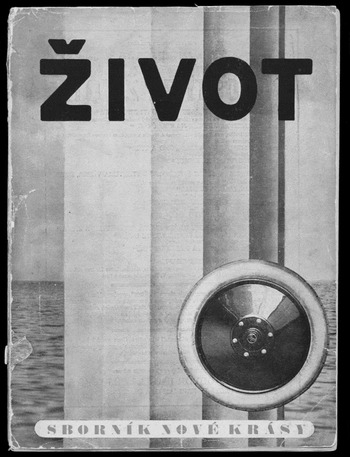
With declarations such as these, avant-garde artistic groups rocked the cultural scene of post-World War I Europe. The radical claim to abolish the autonomy of art and fuse art with life is usually associated with movements such as Dadaism, surrealism, or Futurism in their German, French, and Italian incarnations, but the same goals were shared by dozens of other artistic constellations across the European continent. Prague was a lesser-known center of avant-garde art than Berlin, Paris, or Florence, to be sure, but its artistic scene was no less shaken by the reverberations of the avant-garde explosion (Fig. 1).Footnote 6 The projects of these diverse groups, active mainly in the 1920s and 1930s, assumed a great variety of forms, but the ambition to “liquidate art” was common to all. It almost always involved the abolition of the distinction between objects of art and objects of use and the discovery of aesthetic value in the most unlikely of places. It meant elevating the utilitarian products of modern industrial civilization (crankshafts, gears, ball bearings—whatever, really) to the status of art. It meant eliminating the distinction between high art and low, celebrating kitsch and popular culture, erasing the line between the art of museums and galleries and that of the street corner and beer hall. It has often been said that the effort to efface the boundary between art and life first reached its logical conclusion when in 1917 Marcel Duchamp hung a urinal on a gallery wall in New York and asked that it be appreciated as art.Footnote 7
Jaromír Krejcar, Karel Teige, Bedřich Feuerstein, Josef Šíma, cover design for Život 2 (1922), one of Devětsil's art journals. The title, Život, means simply “life,” exemplifying the group's attempt to abolish the boundaries between art and life. (Research Library, the Getty Research Institute, Los Angeles, California.)

Since that time too critics and observers everywhere struggled to make sense of this radical new phenomenon. Some, predictably, decried it as a travesty and an abomination, as a betrayal of art's eternal verities and principles. Other, more sympathetic observers saw in it not just a new kind of art, but a new approach to the world, heralding the wholesale transformation of life. Everyone who reckoned with it was forced to confront basic questions about art and its place in modern society. Did the experiments of the avant-garde qualify as “art” despite protestations to the contrary? Or did they in fact signal the end of art? Did the rupture of the boundaries of art portend the world's transformation? Or did it spell the dissipation of whatever power art once possessed?
This essay concerns itself with the efforts of one early and little-known observer of the avant-garde, the Czech writer Karel Čapek (1890–1938), to grapple with these questions. A novelist, playwright, and prolific essayist, Čapek was a central figure in the pre-World War I modernist movement in the Czech landsFootnote 8 and an active participant in the heated cultural debates of the 1920s and 1930s, including those concerning the emergence of avant-garde groups such as Devětsil. Drawing on a conceptual vocabulary familiar to him, Čapek interpreted Devětsil's project in a highly unique way: in terms derived largely from the French vitalist philosopher Henri Bergson (1859–1941). He understood the avant-garde assault on art and attempt to efface the boundaries between art and life according to Bergson's notion of the élan vital, the all-pervading impulse to life that strives to free itself from all constraints. In this view, art was a constraint on life that needed to be smashed, and this, thought Čapek, was precisely what Devětsil and other avant-garde groups endeavored to do. It was a project that worried him greatly, especially in the aftermath of World War I. Drawing on the work of the German social philosopher Georg Simmel (1858–1918), Čapek argued that the attempt to free life from all constraints and live life “in itself” was impossible. All life, he said, must necessarily be embodied in form and so less than completely free; this was the only way to preserve its value and meaning. The dream of the union of art and life not only damaged art but also devalued individual life. The problem with the project of the avant-garde was that it was unethical.
The distinctiveness of Čapek's understanding of the avant-garde becomes more clear when contrasted with the most influential interpretation of the movement, that of the German literary critic Peter Bürger.Footnote 9 In his 1974 study, Theory of the Avant-Garde, Bürger argued that at its core the avant-garde impulse was an attempt to negate the autonomy of art as it emerged in late nineteenth-century bourgeois society and to close the yawning gap that had emerged between the spheres of art and life. Whereas in premodern times, he contended, art had been harmoniously integrated into social life on the basis of its religious or courtly function, in modern, bourgeois society art grew increasingly disconnected from and irrelevant to the practices of a rationalized everyday life until it became so distant that it came to occupy its own separate, self-sufficient aesthetic sphere.
This disconnection of art from the practices of day-to-day life culminated in the movement known as aestheticism or art for art's sake, wherein art's separateness from life became the content of the work of art itself. Avant-garde artists of the early twentieth century were, according to Bürger, rebelling against the autonomous status of art in modern society, against art as an “institution” alienated from everyday life. It was this critique of art's social function that distinguished the avant-garde: “The European avant-garde movements can be defined as an attack on the status of art in bourgeois society. What is negated is not an earlier form of art (a style) but art as an institution that is unassociated with the life praxis of men.”Footnote 10 And yet the negation of the autonomy of art was not merely an attempt to destroy art as an institution. Rather, avant-garde artists were seeking the sublation of art in the Hegelian sense; that is, its overcoming but preservation in a changed form. Put more simply, by transferring art to the praxis of life, they were seeking to remake life from a basis in art.
Besides offering a lucid account of this complex phenomenon, Bürger's theory also provided a compelling explanation of the ultimate failure of the avant-garde project. If through the negation of art's autonomy avant-garde artists intended to effect a radical transformation of life, then their efforts were profoundly contradictory, he maintained, because art's autonomy was the necessary condition of a critical understanding of reality. In bourgeois society, where the principle of competition pervades all spheres, art, due to its separation from life, becomes a refuge for values such as humanity, joy, truth, and solidarity, and ensures their preservation. Art's autonomy thus provides a perspective from which to imagine a different and better future. Negating art's autonomy also negates art's critical distance from and perspective on society; it makes art part of the society it wishes to transcend.Footnote 11
But Bürger went further than this, casting doubt on the very possibility of a genuine reconciliation between art and life under prevailing social and political circumstances. According to him, a false reconciliation was clearly evident in the products of the culture industry. Pulp fiction and commodity aesthetics, for example, do represent a breakdown of the boundaries between art and life, but the result is not emancipatory. On the contrary, art is made to serve commerce, leaving the world untransformed. “In late capitalist society,” he wrote, “intentions of the historical avant-garde are being realized but the result has been a disvalue.”Footnote 12 Under these conditions, Bürger questioned the wisdom of the avant-garde project as a whole: “Given the experience of the false sublation of autonomy, one will need to ask whether a sublation of the autonomy status can be desirable at all, whether the distance between art and the praxis of life is not requisite for that free space within which alternatives to what exists become conceivable.”Footnote 13 He concluded, in other words, that art's autonomy needed to be maintained for the sake of the possibility of real social change.
Bürger's Theory of the Avant-Garde owes a significant debt to the critical-theory tradition, especially to the work of Theodor Adorno, Walter Benjamin, Jürgen Habermas, and Herbert Marcuse, from whom he derives many of his key concepts. Like them, his theoretical premises are mainly Marxian, and they shape his interpretation of the avant-garde in distinct ways. As Andreas Huyssen has pointed out, Bürger's
use of the Marxian categories of criticism and self-criticism implies that the negation and sublation (Aufhebung) of bourgeois “institution art” is bound to the transformation of bourgeois society itself. Since such a transformation did not take place, the avantgarde's attempt to integrate art and life almost had to fail.Footnote 14
Looked at this way, the central problem of the avant-garde has less to do with its intentions than with its timing and methods; it sought to attain via culture what was only attainable through social revolution, and it did so at the wrong moment. Bürger never claims that the longed-for reconciliation between art and life is impossible, only that it is false, that it does not genuinely occur. Under different conditions, a genuine reconciliation might be possible. Bürger thereby shifts the weight of the avant-garde's failure from culture to social and economic life, and in doing so he preserves the possibility of reconciliation. In this sense, despite his stinging critique, Bürger endorses the goals of the avant-garde while disputing its timing and methods. Like Adorno, he aspires to the condition of “reconciled life,” of which the avant-garde provided a vivid, if failed, glimpse.Footnote 15
Bürger's approach has unquestionably been fruitful and his Theory has deservedly become a central reference point for discussions about the meaning of the avant-garde. But as with all perspectives, it obscures as well as clarifies, and different approaches, such as that of Čapek, reveal dimensions of the project that Bürger's does not. Čapek's ideas about the avant-garde revolt do not amount to a fully worked-out theory like that of Bürger. Rather, his views are scattered throughout his essays and woven into his plays and novels, requiring more interpretation. Still, the general direction of his thought is clear and so too are the points of convergence and divergence with Bürger's much more comprehensive theory. Like Bürger, Čapek questioned the wisdom and feasibility of the avant-garde project and defended the autonomy of art. But his central concern was not, as with Bürger, the problem of the false elimination of the distance between art and life. Rather, he was worried about the prospect of success. Bergson's philosophy gave him the means to envision a successful merger of art and life, he did not like what he saw. Simmel provided the tools to diagnose the error.
* * *
Karel Čapek is not a writer who is widely known today, but in the 1920s and 1930s he was very popular not only in Czechoslovakia but also across Europe and in the United States. His plays were produced almost immediately in Berlin, London, and New York, and his novels were quickly translated into the major languages of the world. Along with Jaroslav Hašek, author of The Good Soldier Schweik, the celebrated satire of life in the Austro-Hungarian Army during the First World War, he was one of the few Czech writers to achieve an international reputation in the interwar years. Nominated twice for the Nobel Prize in literature in the 1930s, he was denied it in part because of his outspoken antifascism and the desire of the Nobel Committee not to offend Germany. His best-known works include the 1920 play R.U.R. (Rossum's Universal Robots), a futuristic drama about the revolt of human-like labor machines in which he introduced the word “robot,”Footnote 16 and his 1936 novel War with the Newts, an apocalyptic satire of Europe in the age of communist and fascist dictatorship. He is also well known for his translation of an anthology of modern French poetry and for his highly readable biography of Tomáš Masaryk, Czechoslovakia's first president. Despite the accessibility of his style, Čapek was one of the most philosophically oriented writers of his generation. He earned a degree in philosophy from the university in Prague and studied briefly at the University of Berlin and at the Sorbonne in Paris. He wrote his dissertation on aesthetics and published a short book on pragmatism in 1918. After contemplating an academic career, he chose instead the life of a journalist and creative writer.
Čapek's best-known works suggest little about his involvement in high cultural affairs, but he was in fact one of the leading figures of the modernist movement in the Czech lands in the years before World War I. He belonged to the generation of artists who engineered the break with naturalistic representation and championed the turn to expressionism, Futurism, and cubism, making a name for himself as one of his generation's most vocal and articulate spokesmen. In 1911, at a time when the cubist style was still largely unknown in Europe, he joined with a small number of artists to found the Skupina výtvarných umělců, a group dedicated to the defense and promotion of the new art. Along with his older brother Josef (who became one of the most famous Czech cubist painters), he helped bring major exhibits of cubist art to Prague, including one in 1914 that may have been the largest such exhibition to date anywhere in the world.Footnote 17 Čapek wrote extensively about cubism, Futurism, and expressionism, and polemicized with the detractors of modern art; he translated the poetry of Guillame Apollinaire, F. T. Marinetti, Blaise Cendrars, and many others into Czech; he corresponded with modernist artists throughout Europe. He was, in short, one of the most energetic and determined advocates of cultural modernism in the Czech lands in the years before 1914.
In the post-World War I period, he was similarly involved in the great cultural debates of the day, including those concerning the advent of avant-garde art. But unlike in the 1910s, he no longer found himself on the leading edge of cultural developments. In the 1920s that role was claimed by a younger generation of artists organized into groups such as Devětsil, and they positioned themselves resolutely against the prewar modernist movement, creating the conditions for a sharp generational conflict. Although these two generations of modernist artists shared many assumptions, in the 1920s they arrived at very different destinations aesthetically and politically. Whereas most members of the younger generation turned to communism, Čapek and many of his peers inclined towards a progressive liberalism or reform socialism and enthusiastically supported Masaryk and the new state of Czechoslovakia. While the artists of Čapek's generation, like the those of the post-World War I avant-garde, had striven to break down the exclusivity of the aesthetic sphere and bring art into closer contact with the life of the age, when in the early 1920s Devětsil's spokesmen declared the equivalence of art and life and that the purpose of art was not art itself but the revolutionary transformation of the world, Čapek and other members of his generation balked. Now, they fiercely defended art's autonomy. Art merged with life, they warned, would not revolutionize life or restore wholeness to the world, but only deliver art into politics, negate it by means of technological rationality, or render it meaningless as kitsch. They rejected in its entirety the notion that life could be made more whole or free by shattering the cultural forms that contained it. They argued instead that life could only be approached through the mediation of form and that it was precisely the limits on life that gave it its meaning and value. The attempt to burst the boundaries of art and reunify it with life itself was therefore not an act of liberation but of destruction.
* * *
Čapek's critique of the avant-garde was formulated in the context of the clash with Devětsil, which began soon after the group's organization in 1920. A few words about Devětsil are necessary here.Footnote 18 The group was, without a doubt, interwar Czechoslovakia's most important avant-garde formation. It was well organized and active from its founding to its dissolution in 1931 and had many major talents attached to it, including that of its tireless spokesman, Karel Teige (1900–51). Like most such groups, it was subject to frequent programmatic shifts. It began with an adamant rejection of “technical civilization” and the machine aesthetic celebrated by the cubists and Futurists only to embrace these shortly thereafter as embodying the characteristic forms of modern life. It moved through a large number of phases and isms, the most important of which were proletarian art, constructivism, and poetism. Devětsil had a long-standing romance with the mechanical arts: with film, photography, and typography. Its creative experiments with collage, photomontage, and the graphic manipulation of text are among its most notable legacies. At the same time, its members made significant contributions in the more traditional fields of architecture, painting, and poetry.
This programmatic and aesthetic diversity make it difficult to make generalizations about Devětsil, but there were some constants. One was communism. Nearly all of Devětsil's members joined the Communist Party in the 1920s or were close sympathizers. Much of Devětsil's art was tendentious; that is, it was meant to be political even when it lacked explicit ideological content. The group's spokesmen did not acknowledge a substantive distinction between politics and art. Teige put it most succinctly when he said that Devětsil's “young authors are communists and they try to infuse this new worldview into their work.”Footnote 19 The affair with communism began to sour, however, in 1929, with the Stalinization of the Czechoslovak Communist Party and the defections and expulsions that followed.Footnote 20 For many, though not all, it came to an end in the 1930s with the Soviet turn to socialist realism and the staging of the show trials. For most of a decade, however, communism was inseparable from the Czech avant-garde.
Another constant was the attempt to overcome the autonomy of the aesthetic sphere. Devětsil's original artistic program was conceived as a rejection of artistic formalism. To Teige, “formal art” was nothing other than art for art's sake, art that was concerned only with its own internal problems and developments, art for which the life of the age in which it was produced was more or less irrelevant. The new art was meant to be “content art.” It was art that concerned itself not merely with abstract and esoteric formal questions but rather, as cited above, with “humanity and life.”Footnote 21 In Teige's imagination, the new “content art” was akin to primitive art. A term of approbation to him, primitivism was pre-art, the art of native peoples, art by untrained artists, children's art, gothic art, folk art, and so on. This was art that had never existed just for art's sake, as an autonomous realm to satisfy the unsatisfactory in bourgeois life. This was art that never existed independently as art, that had never been separated from the life of those who produced it. It was art that was the direct expression of life itself, art at one with life.Footnote 22
In 1922, Teige began to outline a new and more radical program, constructivism, which explicitly called for the negation of art.Footnote 23 The premise of constructivism was the machine character of modern life. Because the modern age was an era of science and technology that found its ultimate expression in the machine, Teige reasoned that everything—all forms of life—would have to submit to the rational, utilitarian, and efficient rule of the machine. From this perspective, he preached the liquidation of the arts. He imagined a world in which technology supplanted art and engineers replaced artists as the stewards of beauty.Footnote 24 In constructivism, the reunion of art and life meant that the mundane products of machine civilization would be elevated to the status of art while traditional artistic forms would simply disappear. In one of its many provocative gestures, Devětsil upheld the lowly ball bearing as the ultimate symbol of modern beauty.Footnote 25
Sensing perhaps the limits on creativity imposed by constructivism, in 1923–4 Teige introduced another concept, poetism, that would balance its constraints. Rather than eliminating art by collapsing it into technology, poetism conceived the fusion of art and life differently, as art's infinite expansion. Poetism was meant to be the condition of life experienced as art, of life literally become a poem. “Poetism,” Teige explained in his 1924 manifesto, “is an art of life, an art of living and enjoying, it must become, eventually, a natural part of everyday life.”Footnote 26 Poetism's cocreator, the writer Vítězslav Nezval, characterized it as a method of “apprehending the world as a poem.”Footnote 27 It was a means of realizing the freedoms of the unbounded aesthetic imagination in everyday life. To Teige, poetism was also a glimpse of what he believed life would be like in the near future; that is, after the revolution. Art as an institution embodying a separate mode of human experience would no longer be necessary because “all realities would be ultraviolet.”Footnote 28 That is, life itself would be art.
* * *
Soon after Devětsil's organization, Teige proclaimed an insurmountable conflict between the artistic generations separated by World War I. To him, the war was an emphatic “dividing line between two worlds.”Footnote 29 On one side of the war's divide stood the old world of Euro-Atlantic civilization, of liberalism, capitalism, and individualism. On the other side was the new world, still being born, of socialism, peace, harmony, and “wholeness.” The war demonstrated the absolute moral and spiritual bankruptcy of the prewar world; it was the suicide of a corrupt and irremediable civilization and nothing in it was worthy of salvation.Footnote 30 The relationship of the artistic generations straddling this divide could therefore only be one of “radical opposition.”Footnote 31
Yet at the beginning of the 1920s the differences in the practices of the two generations—their paintings, poetry, and architectural proposals—were more theoretical than actual. Members of the older generation, Josef Čapek and Václav Nebeský, favorably reviewed Devětsil's first group show in the spring of 1922 in part because they felt that its painters continued in the prewar modernist tradition.Footnote 32 A number of Devětsil's young painters and architects premiered their work at exhibitions organized by their older peers and continued to show with them even after relations became severely strained.Footnote 33 In addition, before they founded their own journals, members of Devětsil published their critical writings almost exclusively in magazines associated with the prewar generation. It was only there that they found any sympathy at all in an artistic scene that continued to be dominated by the naturalistic and impressionistic schools of the nineteenth century.
Indeed, the two generations shared many presuppositions about art and its place in the modern world. Like Devětsil, the artists of Čapek's generation deplored the alienation of art from society characteristic of modern times. They, too, longed for a unified culture in which the distance between art and life would be bridged. In the prewar period, they had repeatedly called for the narrowing of this gap and for an art that was “alive.” They, too, admired primitivism for its proximity to life—and reminded the younger generation that they had in fact introduced them to it.Footnote 34
Like the postwar avant-garde, furthermore, the writers and artists of Čapek's generation looked to modern life and to the technological innovations of industrial society for new forms of beauty. In the years before the First World War, Čapek celebrated poetry that “speaks of crowds, of great feats of engineering and progress, of the new tension-filled reality created by humanity.” The new poets’ raw material, he believed, was “the huge reality of the physical and social world.” “With naive joy the poet comes to know the new, powerful contents of the modern century—cities, machines, progress, and the immense collectivity of mankind,” he declared.Footnote 35 Stanislav K. Neumann, one of the most talented figures of the prewar generation, was even more explicit. “We want an art,” he explained, “that is strong and vigorous, which is and always was the celebration of its age in its most humble forms.”Footnote 36 The “humble forms” of modern life that Neumann most often chose to highlight were its new technological realities. “Our new poems,” he wrote, “will be called The Oceanliner, The Monoplane, The Aqueduct, The Tunnel, The Viaduct . . . and they won't be any worse than those named Salome or The Crucified.” He continued, “Whereas the preceding symbolist generation wanted so much nuance and ethereal music, we are totally satisfied if readers hear in our poems the rhythm of box cars, the hum of crankshafts, and the rattle of cogwheels.”Footnote 37
The continuities between this project and that of the postwar avant-garde should be clear: both aimed to “return art to life,” to narrow the gap between the sphere of art and everyday life. These similarities, however, mask significant differences in the aspirations of the two generations. In the first of his articles as the spokesman of Devětsil, Teige asserted that the young generation's goals had less to do with the creation of new artistic forms than with the revolutionary transformation of the world.Footnote 38 In a short response to one of his earliest essays, Čapek objected by simply defending the autonomy of art: what was relevant to art was not the order of the world, but the order of art. Even if the world had changed, he cautioned, the formal criteria of art had not.Footnote 39 The art historian and critic Nebeský responded to Teige's claims more systematically in an article entitled “Artistic Defeatism.”Footnote 40
Nebeský charged the young generation with having lost faith in the independent status of art and characterized Teige's aims as “carrying art outside of art.”Footnote 41 He compared Teige's proposals to wartime defeatism of an aesthetic sort, referring to the demand frequently voiced during World War I for a return to national and folk art. Nebeský saw in this demand, as in Devětsil's program, a form of artistic defeatism in that it asked art to conform to criteria other than those internal to art itself. “The painter's task is no longer to paint well, but to build a new world,” he wrote, summarizing Teige's position. “This is an example of postwar artistic defeatism.”Footnote 42 Building a new world, constructing a new social order, thought Nebeský, was a political project, not an artistic one. To make the purpose of art politics, he believed, could only have a deleterious effect on art. Nebeský argued in this article and elsewhere against any politicization of art, whether from the left or the right.Footnote 43
With Devětsil's turn to constructivism in 1922, Nebeský expanded his critique of the group's challenge to the autonomy of art. In an article entitled “Art Dethroned,” Nebeský praised the group, on the one hand, for broadening the definition of art and for discovering so many “new beauties” in the industrial products of modern civilization, much as his own generation had done.Footnote 44 On the other hand, he worried that in Devětsil's theory and practice, the specific content of art was getting dispersed. He wrote,
The mere conjoining of literature and journalism, architecture and engineering, theater and the cinema, the chamber orchestra and the jazz band, the painting and the magazine illustration or political cartoon is not sufficient to show exactly what perspective art brings to bear on these new realities.Footnote 45
He asked if art, continuing down this road, could remain art at all.
It was an appropriate question. Teige was at this time confidently predicting the demise of all traditional artistic forms. He valued the photograph, collage, and poster over the painting and considered the work of architects easily substituted by that of engineers and even of laymen. Teige was convinced that anyone, including himself, could be an architect. In the process, he produced—in the judgment of some of Devětsil's own architects—some very mediocre architectural proposals, but succeeded very well in alienating a number of the group's members.Footnote 46 Devětsil was, after all, a group of artists. If art was dead, what was its purpose? The irony of Teige's most extreme proposals for the negation of art is that they touched off a protest within the avant-garde itself which led to the defense of the very categories it claimed to be destroying.Footnote 47
Nebeský's objections to Devětsil's program, however, concerned not only the dispersal of the contents of art. His graver worry was that by breaking open art's containers, the group was inviting them to be filled by precisely that which was most inimical to art: the rationalized contents of the economic sphere. Following Marx, Teige reasoned that the character of the age was determined by its dominant means of production.Footnote 48 Since the dominant means of production of the modern age was mechanical production, art, to be of its age, had necessarily to be based on mechanical production. Nebeský, who also insisted that art be of its age, argued that Teige had misunderstood the productive demands that the age imposed on art. For him, modern production was characterized above all by differentiation and specialization. Its only demand therefore was that “mechanical production be as mechanical as possible and artistic production as artistic as possible.”Footnote 49
To mechanize art, Nebeský feared, was to mechanize human beings, to turn people, as it were, into robots. To him, the autonomy of art signified the fundamental mystery and irrationality of life, the irreducibility of life to any one particular form. It was the free space from which the individual negotiated and gave creative resolution to the multiplicity of external forces that impinged on him. To mechanize art was to claim that modern life had just one form and that it was wholly determining. “As long as truth was one,” he wrote in another article, “as it was, for example, in the Middle Ages, art too could express on its own the whole of the truth.”Footnote 50 But in modern times, he went on to explain, truth had become fragmented and specialized, and its unified expression was no longer possible. Nebeský acknowledged that something had been lost as the gap between art and everyday life yawned wider. But he could not accept that the gap could be closed by simply collapsing art into another of life's spheres. Rather, he worried that art and its freedoms would disappear without the unity of life thereby being restored.
* * *
To Čapek, the young generation's desire to dissolve the barriers between art and life reminded him of important aspects of his own generation's program in the years before World War I. One of the key slogans of the prewar modernist movement had been “Long Live Life!” (“At’ Žije Život!”). Cribbed from an article on the philosopher Henri Bergson, one of the most influential thinkers of the day, “Long Live Life!” was a call to liberate life from all constraints and limits, to free it from all the outdated forms and conventions that shackled it and made it ossify.Footnote 51 At the center of Bergson's theory was an all-pervading impulse to life, the élan vital, which, if properly grasped, could liberate mankind from the positivistic and mechanistic culture of the day and lead him to overcome, perhaps, even death. Arguing that mechanistic, scientific reasoning necessarily falsified mankind's true experience of the world because it could not grasp life in its fluidity, uniqueness, and variability, but only in lifeless, ready-made categories, Bergson provided the philosophical basis for the prewar generation's revolt against naturalism.Footnote 52 Through Bergson the yoke of inherited, ossified, artistic conventions was lifted from their shoulders. His philosophy licensed imagination, invention, and experimentation, and promised to reconnect art to the sources of “life itself.”
In the years after World War I, however, Čapek turned sharply away from Bergson's vitalism, and his critique of it formed the basis of his resistance to the program of the postwar avant-garde. When in 1920 Neumann published a collection of his prewar essays on modern art in a volume entitled Long Live Life!,Footnote 53 Čapek, in a review of the book, emphatically distanced himself from his former friend and collaborator:
Long Live Life! Before the war . . . these words seemed completely natural; today, after such a massacre and practically on the deathbed of civilization, they sound very strange. Long Live Life then meant: long live strength, speed and noise, long live size and exuberance, long live crowds, long live technology, long live the dynamism of the boundless externalization, multiplication, and materialization of life, which are the gifts of the present day. At the time, we were drunk on the roar of unbound energies. Today, instead of listening, we make noise in order to break the silence frozen above the ruins.Footnote 54
And yet Neumann's book, Čapek felt sure, laid out an aesthetic program that was being pursued by part of the rising young generation. Just weeks before the publication of his review, Devětsil was organized. It seems clear that Čapek had its young poets in mind. To him, they were perpetuating in a new and even more militant form the most perilous aspects of the prewar program. Čapek explained,
When today I read so many books of young poetry, roaring, agitated, full of revolutionary optimism and the celebration of the “strong, red life,” I cannot escape the feeling that we treat this surplus of life like a bunch of loose bills burning a hole in our pockets. No matter which way you say it, life is devalued.Footnote 55
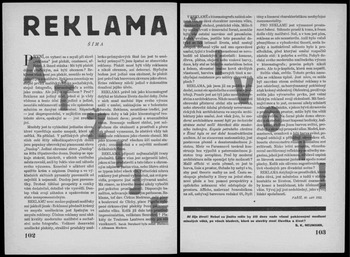
“Believe me,” he warned, “the shrill cry for life is the forsaking of humanity.”Footnote 56 What Čapek sensed only vaguely in 1920 was made explicit two years later when the avant-garde adopted the slogan “Long Live Life!” as its own (see Fig. 2.)
If Karel Čapek interpreted the project of the postwar avant-garde in the Bergsonian terms of the prewar modernist movement, its artists gave him reason to do so. This article from Život 2 (1922) directly and dramatically references S. K. Neumann and the prewar slogan “At’ Žije Život!” (“Long Live Life!”). (Research Library, the Getty Research Institute, Los Angeles, California.)

Six months before he published his review of Neumann's book, Čapek wrote an extended series of essays on Bergson.Footnote 57 The occasion was the publication of the Czech translation of Bergson's Creative Evolution, one of the philosopher's most important and widely read works. Čapek used the opportunity not only to review Bergson's book, but also to evaluate what he came to believe were the deleterious practical consequences of vitalism as a philosophy.
In Creative Evolution (1908) Bergson theorized a fundamental conflict between life, the essence of which was motion and change, and matter—that is, the material, static form in which life was necessarily embodied in the world. Life constantly strove to liberate itself from its material incarceration, and it did so through an evolutionary process, whereby it became embodied in ever higher, more self-directed forms. Animal life was higher than plant life since animals enjoy a freer, more active form of existence than do plants, which are merely passive. But it was human life that represented the most advanced form of life, because human life was characterized by consciousness and an active will; that is, by the capacity for self-direction and self-determination. The history of life was therefore the history of the attempt to organize matter such that it would become the instrument of life's liberation. Human consciousness had become this instrument; consciousness was life in its purest and freest form. In a state of mind Bergson called “supraconsciousness”—consciousness directed at itself—life encountered no material obstacles. Such heightened moments of experience were moments when individual consciousness merged with universal consciousness, or, to put it another way, when individual, embodied life reconnected with the universal life force itself, the élan vital. The dissolution of individual consciousness into this universal consciousness was the condition of life's freedom. It was the condition of life in complete harmony with the world, and this was life's goal. Human beings, by bringing consciousness into the world, were the instruments of life's liberation, but they were not the goal. Human life was simply the means to a greater end. In the aftermath of the war, this treatment of human life, thought Čapek, was where Bergson and, implicitly, he too had gone wrong.Footnote 58
Čapek turned away from his prewar program because he felt that life, understood in Bergson's terms as an impulse prior to, and more excellent, powerful, and durable than, individual lives, had led to the most comprehensive devaluation of individual life in history. During the war, life had become a disposable quantity and human beings mere things. Life conceived as a vital principle, as a quality independent of and external to its embodied form, was the turning away from humanity. “Bergson undertook the first major attempt to found a philosophy exclusively on the basis of life,” explained Čapek, “but by grounding it in a biological conception, on the basis of a generalized vitality, he necessarily ended by not being just to mankind.”Footnote 59 Life, concluded Čapek, must always be limited by and valued as individual life. Only in this way could it preserve its value and meaning. Only in this way could an ethics be possible.Footnote 60
In the same set of essays Čapek took issue with Bergson's aesthetic theory. Whereas the aim of art, Bergson seemed to suggest, was the inner experience of life itself, life in its purest, freest, least material form, Čapek objected that art was the attempt to give form to that experience, to realize it in the external, material world. In materializing this experience, art necessarily “turned its back on life”; it could never capture life's true fluidity and wholeness; it necessarily acted as a constraint on life.Footnote 61 But without the constraints that art placed on life, there was only formless experience, without order or meaning. Thus Čapek could paradoxically conclude, “For the sake of life itself, it pays to renounce life.”Footnote 62 This same reasoning informed Čapek's critique of the postwar avant-garde's efforts to fuse art and life. When its representatives proclaimed the death of art and its collapse into life itself, Čapek recoiled. For him, the death of art was not the revolutionary transformation of the world but rather the forsaking of mankind and of meaning.
* * *
In 1922, in the midst of the debate with Devětsil over the abolition of art, Čapek wrote his play The Makropulos Case. Better known as an opera by the composer Leoš Janáček (1854–1928), The Makropulos Case has at first glance little to do with the questions raised by the debate and has not usually been interpreted as such. Yet a close reading reveals that it grapples with intimately related issues.
On the surface, The Makropulos Case concerns itself with a highly unusual subject: the perils of life that is too long. When it was first staged, critics assumed that the play was a response to George Bernard Shaw's Back to Methuselah, which premiered several months before The Makropulos Case and which also takes up the question of longevity. Though Čapek strenuously denied any connection,Footnote 63 the similarities are striking. But while Shaw believed that an increased lifespan would create the conditions for continual self-improvement and ultimately for social and moral progress, Čapek imagined a very different scenario. For him, eternal life meant life without expectation and desire, a perpetual march into a future indistinguishable from the past. It was life without stable identity, life without attachments, life without faith, belief, or love. Without death, even the void could offer no meaning. In short, it was life devoid of meaning—a living death.
The plot of Čapek's play is without doubt original. Emilia Marty, an opera singer on an engagement in Prague, embroils herself in a century-old legal dispute between two aristocratic families. On the brink of resolving the case, Marty offers new evidence that may alter its outcome. She has a mysteriously precise and personal knowledge of the arcana of the case as well as of the actors involved, some of whom have been dead for decades. She is also fabulously beautiful and sings like a siren. Despite a long career, neither her beauty nor her voice seems dulled by time, and men are drawn to her with a desire bordering on insanity. Gradually, it becomes clear that Marty's interest in the legal case is more than casual. Her aim is to secure some ancient documents held by one of the families, and she is willing to get them by any means necessary: by theft, by violence, or, as it turns out, in exchange for the courtesies of the flesh.
In the end, the secrets of Marty's art, agelessness, and acumen are exposed. Her true name is Elina Makropulos and she is the daughter of the court physician and alchemist of Rudolf II, the emperor who ruled from Prague more than three centuries earlier. Her father had prepared a formula for the aging emperor to prolong his life by three hundred years. Before ingesting it, the cautious emperor first had it tested on the doctor's own daughter. When she fell into a coma, he threw the doctor in prison. But the formula worked, and she has lived to the healthy age of 337. Now, the formula is wearing off, and she has returned to Prague for a second dose.
Despite her age and experience, Emilia Marty hardly resembles Shaw's ideal. On the contrary, she is lonely, passionless, and dissolute. She can form no stable relationships because she outlives all her peers and lovers. She has no stable identity because she cannot live as the same person for more than the length of an average lifetime. She appears in Prague as Emilia Marty, but she has also been known as Ellian MacGregor, Eugenia Montez, Ekaterina Myshkina, Elsa Mueller, and others. Without emotional attachments and without the possibility of personal coherence, she lives in a shadowy world in which actions have little consequence and the lives of others are less than fully real. With their frightening impermanence, the people that surround her are merely disposable. There is no progress here, only isolation and cruelty. But beyond Marty's contempt, there is also envy of the fullness and purposefulness of others’ fleeting lives. “You are so near to everything!” she exclaims in the play's climactic scene. “For you, everything has meaning. For you, everything has value because you live through so little . . . You believe in everything: in love, in yourselves, in virtue, in progress, in humanity, and in I don't know what else.”Footnote 64 In the end, Marty tries to give away the formula but no one will take it.
When The Makropulos Case opened in Prague, it received mixed reviews, but when Janáček, the innovative composer of Jenůfa and Káťa Kabanová, saw the play it captured his imagination at once. He later said, “It gripped me. You know it's terrible, the emotion of an individual who will never meet her end. A true misery. She does not want anything, does not wait for anything. It had to be made into a work.”Footnote 65 Čapek, however, had doubts about the play's suitability as an opera and suggested instead that Janáček simply take the idea of extremely long life, which he noted was hardly his exclusive literary property, and build around it a structure better suited to opera.Footnote 66 But Janáček persisted and eventually an agreement was reached. When the opera premiered in 1926 in Brno it was immediately hailed a great success. Even Čapek, who had been so skeptical about the prospects of his work as an opera, was pleased. “He did it a hundred times better than I could ever have even imagined,” he reportedly said.Footnote 67 In its incarnation as an opera, The Makropulos Case may ironically be one of Čapek's most enduring creations.
Like Janáček, many of the play's later interpreters locate its greatest appeal in the paradoxes of extremely long life, the fact that immortality turns out to be less a blessing than a curse. Because it revolves around a scientific formula for longevity, some have understood the play as one of Čapek's warnings of the dangers of scientific and technological hubris.Footnote 68 While such an interpretation is consistent with other themes of his work, there is little evidence to support it in this case. Čapek never indicated any concern that medical science was making such strides that a cautionary tale about the perils of longevity might be necessary. Moreover, in his correspondence with Janáček, he claimed no proprietary stake in the idea of very long life. Longevity was clearly not the only thing he had in mind when he wrote The Makropulos Case.
A more likely meaning of Emilia Marty's long life is the persistence of old forms of life, old ways of living, in a context that renders them unsustainable. Issues of class—the decline of the old aristocracy and the rise of the bourgeoisie—play a vivid role in The Makropulos Case but hardly ever get the kind of attention they deserve. When the play opens, Vítek, a legal assistant and representative of the new bourgeoisie, is excoriating the old aristocracy. He launches into a speech by the great French revolutionary figure, Danton:
Citizens of France! Why do you continue to tolerate these old and privileged nobles, spoiled by the King of France, people of rank who possess nothing of nature, nor intelligence, but boast only of their tyranny! This small band of courtiers and heirs, these holders of our land, of the power and the law . . .Footnote 69
It should not be forgotten that Čapek wrote the play shortly after the end of three centuries (i.e. the length of Emilia Marty's life) of Habsburg rule in Bohemia and during the first years of republican government in Czechoslovakia. He was also writing about this transition.
But if Emilia Marty's long life is nothing else it is a metaphor for the prewar modernist slogan “Long Live Life!” Like many of the artists inspired by Bergson in the years before World War I, she represents the ambition to liberate life from all constraints and bonds, to allow it to exist in its freest and purest state. She represents a vision of life that (at least potentially) has no limits, that is absolutely boundless and free. She flouts all social norms and conventions. She is not constrained in the least by the considerations of traditional moral or social behavior. Not only is she depicted as rude and willful, deceitful and manipulative, there are also numerous intimations of her homosexuality as well as of her interest in and experiences with incest, sadism, and prostitution.
The young avant-garde around Devětsil, Čapek believed, was pursuing a similar program. Its intention, so often repeated by its spokesmen, was to overthrow all the formal conventions of the past, not in the name of new art, but in the name of “life.” Emilia Marty embodies precisely the seductive synthesis of art and life. The perfection of her art is that it is not really art at all, but rather life itself. Her voice is simply the voice of life, of the universal life force, of the élan vital, in Bergsonian terms. But while Marty carries with her the promise of unrestricted freedom, of unparalleled contentment, and of sublime pleasure, she never delivers. On the contrary, wherever she goes, she breeds destruction. She and her art bring with them not freedom and happiness, but rather madness, suicide, and murderous rage. One of her lovers goes crazy, another takes his own life, and a third wants to kill her. An art of life, in Čapek's view, is indeed not art at all; it is chaos and death.
The Makropulos Case is in large part an advancement of Čapek's critique of the Bergsonian elements of his own prewar program, which he believed the postwar avant-garde was perpetuating. Part of the appeal of Bergson's vision of life, he thought, was that it provided no space for death. Bergson had imagined life as a vital principle inherent in all things but greater than any particular form. If all life existed along a vital continuum, then death was not in fact life's negation but rather its transformation into a new and different form. “Bergson left out one thing from his picture of life: death,” wrote Čapek pointedly in his postwar essays on the philosopher.Footnote 70 This is the proposition he was testing in The Makropulos Case—and which he found profoundly lacking.
Life without limits, without even the limit of death, was not freedom but a kind of death because it was life without meaning. Marty's life is not happy and fulfilled but empty and debased because it has no purpose. Life without limits, moreover, left no room for ethics. Marty's gravest failing is not moral—the violation of accepted standards of decency—but ethical: she treats other people badly. She treats everyone around her like a disposable object, as a means to her own ends. Individuals are simply the instruments of her limitless life, not ends in themselves. In its attempt, via revolution, to unify art and life and restore “wholeness” to the world, the avant-garde, Čapek believed, did the same: it treated individual life not as an end in itself but as a means to a greater end.
“Not the intellect but rather death cuts off a human being from the flow of life,” wrote Čapek as a corrective to Bergson's view of life. “A human being is an individual because he dies individually.”Footnote 71The Makropulos Case is, above all, an argument for the necessity of acknowledging that life is not unlimited and that its most important limit is individual life. It is, in short, an argument for the restoration of death to life and, as such, paradoxically, for the restoration of respect for the individual and for individual life, which Čapek believed the avant-garde, like Bergson, sorely neglected.
* * *
Two days after he finished writing The Makropulos Case, Čapek began to work on a new project, the novel Krakatit.Footnote 72 Although completely different in form and subject, Krakatit is an elaboration of many of the themes he had begun to explore in The Makropulos Case. It is once again a critique of the vitalism of Henri Bergson, inspired, I argue, by the work of Georg Simmel, and a warning to the postwar avant-garde. While The Makropulos Case inquired in general terms into the problem of a conception of life with no constraints or limits, Krakatit specifically examined the meaning and consequences of life without form, of life that had burst the boundaries of form.
In his essays on avant-garde art, Teige often complained that Čapek and his peers were obsessed with the invention of new artistic forms to the detriment of life. Whereas the older generation, he said, had choked off life in the stranglehold of form, the avant-garde, in its most radical endeavors, aimed to free life from the constraints of form as such, to live life according to the unbounded aesthetic imagination, as if it were a work of art. Krakatit explores what a liberation from the constraints of form similar to that imagined by Teige might in fact entail. To Čapek, the result was neither freedom nor revolutionary transformation but merely destruction.
The premise of Krakatit is the invention of a new kind of explosive that disintegrates the bonds that give matter form, violently releasing huge amounts of energy. Called “krakatit” after the Indonesian volcano Krakatoa that erupted in 1883 with tremendous destructive force, it works on a principle similar to that of a nuclear explosion.Footnote 73 But in Čapek's imagination, not just unstable, fissionable material but everything that gives form to life—both materially and intellectually—is a latent explosive. As the novel's protagonist, a chemical engineer named Prokop, explains: “Every material is in fact an explosive. Water . . . water is an explosive. The feathers in a feather bed are also an explosive.” But he also comments, mysteriously, “Every thought is a kind of explosion in the brain,” and then adds, “Life, you know, is an explosive.”Footnote 74
While Čapek's conception of krakatit clearly owes a debt to modern physics, the germ of the idea was more likely derived from Bergson. In his review of Creative Evolution, Čapek summarized in the following way Bergson's description of the mechanism by which plants store the sun's energy and then release it to the animals which eat them: “They are like explosive material, only waiting for a spark to liberate their pent-up energy.”Footnote 75 Life, he went on to say, advanced “explosively” as it became embodied in ever higher, freer forms.Footnote 76 Years later, Čapek once again described Bergson's philosophy in explosive terms, characterizing it as “fireworks.”Footnote 77 Only in the context of Bergson's vitalism, not modern physics, does Prokop's cryptic statement, “Life . . . is an explosive,” make any sense.
Čapek's warning in Krakatit that life, explosively freed from the confines of form, was not liberation but destruction may have been inspired by Simmel's influential 1918 critique of vitalism. In his essay “The Conflict in Modern Culture,” Simmel argued that in modern times a fundamental shift in the history of culture had taken place.Footnote 78 The life of every society or civilization, he explained, had always been embodied in particular cultural forms giving it content and order (as art, religion, science, law, and so on), and the history of culture had always been understood as the succession of these forms (for example, changes in artistic styles). But there was a deep conflict at the heart of culture. Even though the forms of cultural existence arose from the life experience of a particular group of people, the same forms also constrained their experience by giving it a fixity it did not possess. Cultural forms could never share, in Simmel's words, the “restless rhythm of life, its ascent and descent, its constant renewal, its incessant divisions, and reunifications.”Footnote 79 In the modern age, this conflict inherent to all of cultural life had become explicit. In modern times, many no longer strove for the creation of new cultural forms to embody life but sought instead to make life manifest in its own immediacy, without the mediation or constraint of form. “At present, we are experiencing,” wrote Simmel, “a new phase of the old struggle—no longer a struggle of a contemporary form filled with life, against an old, lifeless one, but a struggle of life against form as such, against the principle of form.”Footnote 80
Yet such a struggle was profoundly contradictory because life must always, without exception, be embodied in form. Life, Simmel asserted, “can enter reality only in the form of its antithesis, that is, only in the form of form.”Footnote 81 It was this fundamental conflict that modern culture, with its vast variety of philosophical, artistic, and quasi-religious movements united in pursuit of “life itself,” had starkly revealed:
Life wishes to obtain something which it cannot reach. It desires to transcend all forms and to appear in its naked immediacy. Yet the processes of thinking, wishing, and forming can only substitute one form for another. They can never replace the form as such by life which as such transcends the form. All these attacks against the forms of our culture, which align against them the forces of life “in itself,” embody the deepest internal contradictions of the spirit. Although this chronic conflict between form and life has become acute in many historical epochs, none but ours has revealed it so clearly as its basic theme.Footnote 82
Simmel resolved this impossible contradiction by suggesting that formlessness might be the appropriate form of contemporary life. Whether this conclusion was satisfactory or not, his fundamental insight remained unchanged: life must necessarily be embodied in form; it could only enter reality in the form of form. The “absolute peace” of life at one with itself would remain “an eternal secret to us.”Footnote 83
While there is no definitive evidence that Čapek had Simmel's essay in mind when he conceived Krakatit, he always referred to the philosopher as one of the key influences on his thinking and he had written about him enthusiastically in the years before World War I.Footnote 84 Most suggestive of a link between Simmel and Krakatit, however, is an essay Čapek wrote just before composing his novel. Shortly after he began to plan it in the summer of 1922 (he started to actually write in October of that year), he made a three-week trip to the Tatra mountains in Slovakia.Footnote 85 In September, he wrote about that trip in a newspaper column.
Entitled simply “Forms,” the article described his visit to a tiny mountain village where he observed a Sunday Mass.Footnote 86 He was fascinated by the persistence of age-old customs and traditions and by the way in which the villagers seemed fully and effortlessly to inhabit them, as if they were an extension of their very beings. What the villagers possessed and what moderns lacked, he thought, was form. “Primitive life,” he commented, “is distinct from modern, civilized life mainly in that the latter is formless and chaotic whereas primitive life is completely imbued with ritualistic forms.” “I'm recounting all of this,” he continued, “because our life, our modern, urban, and cosmopolitan life, has in all and everything one characteristic: the dissolution, disintegration, and dissipation of all life forms.”Footnote 87 Čapek betrayed in this essay considerable nostalgia for the world of the tiny Slovak mountain village, longing for the strong sense of social solidarity that such a place and way of life seemed to offer. The modern world, in contrast, seemed “sterile” to him. But he knew at the same time that the universe of that village was lost to people like himself and could not be recovered. Spurred by Simmel or not, it was with these thoughts in mind that he sat down to write Krakatit.
Organized around the invention of an explosive that destroys all form, the novel is nothing other than the story of the “dissolution, disintegration, and dissipation of all life forms.” Its protagonist, Prokop, is the very embodiment of this tendency towards dissolution: he is literally falling apart. When the novel opens, Prokop is stumbling through the streets of Prague after having his finger blown off in his laboratory. A few chapters later, he loses a second digit to another laboratory accident. Further on, he severely fractures his leg after falling off a horse. In still another scene, Prokop packs his clothing with explosives, threatening to become a kind of suicide bomber, thus flirting with complete bodily disintegration. And Prokop's dissolution is not just physical but psychical as well. He spends a significant portion of the novel in a feverish delirium. Čapek devotes lengthy passages to his vivid and disturbing dreams and hallucinations. Prokop is the mirror image of his own explosive.
Unquestionably one of Čapek's most interestingly drawn characters, Prokop is both volatile and steady, explosive and integral. A highly creative person, he is an artist among scientists. Channeling his creativity entirely into the invention of ever more destructive explosives, the epitome of his labors is krakatit. He is at once immensely proud of his creation, taking almost perverse pleasure in its destructive power, and at the same time tortured by the thoughts of the horrors it might cause. A wounded veteran of a major war (unspecified, but clearly World War I), Prokop knows firsthand the meaning of modern warfare. In the course of the novel, the reader learns that he was nearly killed in an artillery barrage. He is tormented by recurring nightmares of the battlefield. A number of his schoolmates, the reader is informed, perished in the war. He belongs, without a doubt, to Čapek's generation. Like Čapek himself, he is drawn to the notion of shattering all constraints on life, but, having lived through war, he is wary of the consequences. This tension animates the whole of the novel until Prokop's renunciation of krakatit in its final pages.
If Prokop is torn by the possibilities that krakatit represents, other characters are less worried about the consequences of its use. One such figure is Prokop's fellow chemist, Tomeš, a possible stand-in for Teige. After Tomeš steals the formula for krakatit,Footnote 88 Prokop seeks to find him and stop him before he can manufacture it and put it to use. Prokop eventually catches up with Tomeš, but his protégé cannot be dissuaded from its production. Tomeš initially has some difficulty with the formula, but once he masters it, he accidentally unleashes a monstrous explosion that kills him and many others, realizing Prokop's worst fears. Tomeš (Teige?), in other words, fulfills a project originally conceived by Prokop (Čapek?), with disastrous consequences. Hence Prokop's quest to stop him.
One of the most interesting aspects of Krakatit is Čapek's exploration of the political ramifications of the attempt to free life from the constraints of form. This section of the book ought to be understood as a direct commentary on the political programs of the various revolutionary movements in the 1920s, including that of the postwar avant-garde. Towards the end of Krakatit, Prokop gets entangled in a vague international conspiracy committed to the overthrow of the entire social, political, and economic order but otherwise utterly uncertain of its program. Combining elements of communism, anarchism, and fascism, the group has obtained a few ounces of krakatit, which it worships like a sacred object. Its members await the arrival of Prokop to their headquarters as if he were a messiah, in the expectation that he will bring meaning and direction to their struggle. Prokop, however, has no gift for the role of charismatic leader. He receives advice from a particularly sinister figure, Comrade Daimon, the man who has shepherded him into the group's fold. Daimon recommends a program of “direct action,” the content or goals of which are totally irrelevant. He instructs Prokop to treat the group's members as human fodder, as material to be used for his own purposes, whatever they may be. “After the first successes, they'll follow you like sheep,” he says, adding, “especially if you eliminate from the leadership a few others, who I'll point out to you.”Footnote 89
If Daimon's advice to Prokop recalls the burgeoning fascist movements of the 1920s, it is no accident. Čapek wrote this section of the novel in the summer of 1923 after spending nearly two months in Italy that spring.Footnote 90 Mussolini had only just taken charge of the Italian state in October 1922, making Čapek an early observer of fascism in power. As if to emphasize this connection, the encounter with the group takes place while Prokop is en route to Italy. It is not clear whether the group is in fact based in Italy, but that detail may have been left deliberately ambiguous. It was not fascism as such that Čapek was exploring in Krakatit, but rather certain of its impulses that it seemed to share with other revolutionary movements.
The specific way in which Daimon interprets the power of krakatit, however, most closely resembles, albeit in extreme form, one of Teige's iterations of the collapse of art and life—poetism—wherein life itself becomes a work of art. To Daimon, krakatit represents the power to transcend all constraints and limits on the self, to dissolve the boundaries between the self and the world, and to remake the world on the basis of one's imagination alone. “At this moment,” Daimon tells Prokop, “there's only one great power in the world and that's you yourself.”Footnote 91 He muses, “Your thoughts will be orders; your dreams historic revolutions.”Footnote 92 He encourages Prokop to respect no boundaries or constraints and to spurn those who would have him do so: “No Genghis Khan or Napoleon will tell you what to do or where your limits are . . . Don't let anybody near you who would set you any boundaries or give you direction.”Footnote 93 “Do you want to annihilate the world?” he asks. “So be it. Do you want to make it happy by forcing upon it eternal peace, God, a new order, revolution, or whatever else? Why not?”Footnote 94 To Daimon, the transcendence of all limits and the violation of all boundaries is the very purpose of krakatit itself. “The power that does not overflow its old boundaries,” he asserts, “is wasted.”Footnote 95
Needless to say, in Čapek's reckoning krakatit does not transform the world into a work of art. Applied to politics, he saw krakatit as a formula for dictatorship, for the violent imposition of one person's will onto the rest of society. For that person, there may be unlimited freedom, but for the rest there is compulsion and slavery; they are merely the instruments of the other's will. In the end, krakatit is exactly what Prokop designed it to be: an explosive and therefore a recipe for destruction. The chief lesson of the novel is that when the forms of life are shattered, nothing remains. There is no emancipatory effect, only a void.
* * *
Čapek's approach to the avant-garde does not represent a systematic theory like that of Bürger. The value of his perspective, however, does not lie in its comprehensiveness but rather in its unique understanding of the movement, providing insights that Bürger's theory does not. Interpreting the avant-garde project in Bergsonian terms, Čapek believed that the effort to collapse the boundaries between art and life amounted to an attempt to liberate life from all constraints and give it the mobility and freedom that the imagination itself possesses. Devětsil's appropriation of the slogan “Long Live Life!” and Teige's claim to live life like a poem, in accordance with the aesthetic imagination alone, seems to sanction this interpretation.
Despite the differences in their approaches, there are notable similarities in Čapek's and Bürger's assessments of the avant-garde. Like Bürger, Čapek saw the core of the project as the attempt to negate the autonomy of art and close the gap between art and life that had opened up in modern times. Similarly, Čapek recognized that the avant-garde aimed not so much to destroy art as to transform life by infusing it with the imaginative possibilities of art. Finally, both Čapek and Bürger cast doubt upon the wisdom of the avant-garde project and defend the autonomy of art.
But whereas for Bürger the central problem of the project was the false reconciliation of art and life, Čapek worried about the prospect of success. To him, the union of art and life heralded not a utopia of harmony and wholeness but rather a world without meaning or ethics, a cold and empty place where human beings were instruments of life rather than ends in themselves. In the aftermath of World War I, moreover, Čapek became convinced that life conceived as a state of pure freedom, unconstrained by any material or physical limits, amounted to the devaluation of human life. Imagined in this way, life necessarily stood apart from individual, embodied life; human beings served the goal of life's freedom rather than being its measure and rule. In its theory as well as in its revolutionary goals, Čapek worried that the avant-garde treated individual life much as Bergson had, not as an end in itself, but as a means to a loftier condition of freedom. The dream of the union of art and life was, in short, unethical.
Drawing on the work of Simmel, Čapek sought to show that an undifferentiated realm of life was simply not attainable and that its pursuit was not an act of liberation but of destruction. Life could never be completely free from the cultural forms that constrained it. Rather, it must always be limited in order to retain its value and meaning. It could only enter reality, as Simmel suggested, in the “form of form.” By accepting the necessity of form and with it the boundaries between art and life, Čapek accepted that the full unity of the world would never be reestablished. There would never be a final relaxation, a final release from the tension of the contradiction between life and the forms in which it was embodied. Art's autonomy was a vivid marker of this tension, but it also provided the free space necessary for the imagination of new forms for life, better suited to mankind's needs. As Bürger suggested, art needed to retain its autonomy in order to preserve “that free space within which alternatives to what exists become conceivable.”Footnote 96 But, for Čapek, unlike Bürger, there would be no final reconciliation, only an endless succession of new and different life forms. Indeed, this is the story of modern art, which the avant-garde, despite its claims, did not bring to a close.
The debate between the members of Devětsil and the artists of Čapek's generation was most heated in the years from 1920 to 1924, but it continued through the 1920s and into the 1930s. In 1928, poking fun at a slogan of the avant-garde, Josef Čapek summarized his generation's attitude towards art and its autonomy: “‘The art of tomorrow will no longer be art.’ Too bad, but maybe the art of the day after tomorrow will once again be.”Footnote 97