INTRODUCTION
Current understanding of the taxonomy of the family Tritoniidae (Odhner, Reference Odhner1963; Marcus, Reference Marcus1983; Pola & Gosliner, Reference Pola and Gosliner2010) includes the following valid genera: Tritonia Cuvier, 1798, Tritoniopsis Eliot, 1905, Tritoniella Eliot, 1907, Marionia Vayssière, 1877, Marioniopsis Odhner, 1934, Marianina Pruvot-Fol, 1931, Paratritonia Baba, 1949, and Tochuina Odhner, Reference Odhner1963. The taxonomy of Tritoniidae is considered problematic despite the revisions of Odhner (Reference Odhner1936, Reference Odhner1963), mainly because the descriptions of most species lack information on the internal anatomy, such as the jaws or stomach plates (Smith & Gosliner, Reference Smith and Gosliner2003), and some animals do not fit appropriately into any of the currently recognized genera (Willan, Reference Willan1988; Schrödl, Reference Schrödl2003).
The species of the family Tritoniidae presently recorded for the western Atlantic are: Tritonia bayeri Marcus, 1967, Tritonia challengeriana Bergh, 1884, Tritonia hamnerorum Gosliner & Ghiselin, Reference Gosliner and Ghiselin1987, Tritonia odhneri Marcus, 1959, Tritonia plebeia Johnston, 1828, Tritonia vorax (Odhner, 1926), Tritonia wellsi Marcus, Reference Marcus1961, Tritoniella belli Elliot, 1907, Tritoniopsis frydis Marcus, 1970, Marionia cucullata (Couthouy, 1852), Marionia limceana Silva, Meirelles & Matthews-Cascon, Reference Silva, Meirelles and Matthews-Cascon2013, and Marionia tedi Marcus, Reference Marcus1983. Only T. wellsi, T. odhneri, M. cucullata and M. limceana have been recorded from Brazil (Silva et al., Reference Silva, Meirelles and Matthews-Cascon2013).
In this paper we describe a new species of nudibranch belonging to the genus Tritonia Cuvier, 1798.
MATERIALS AND METHODS
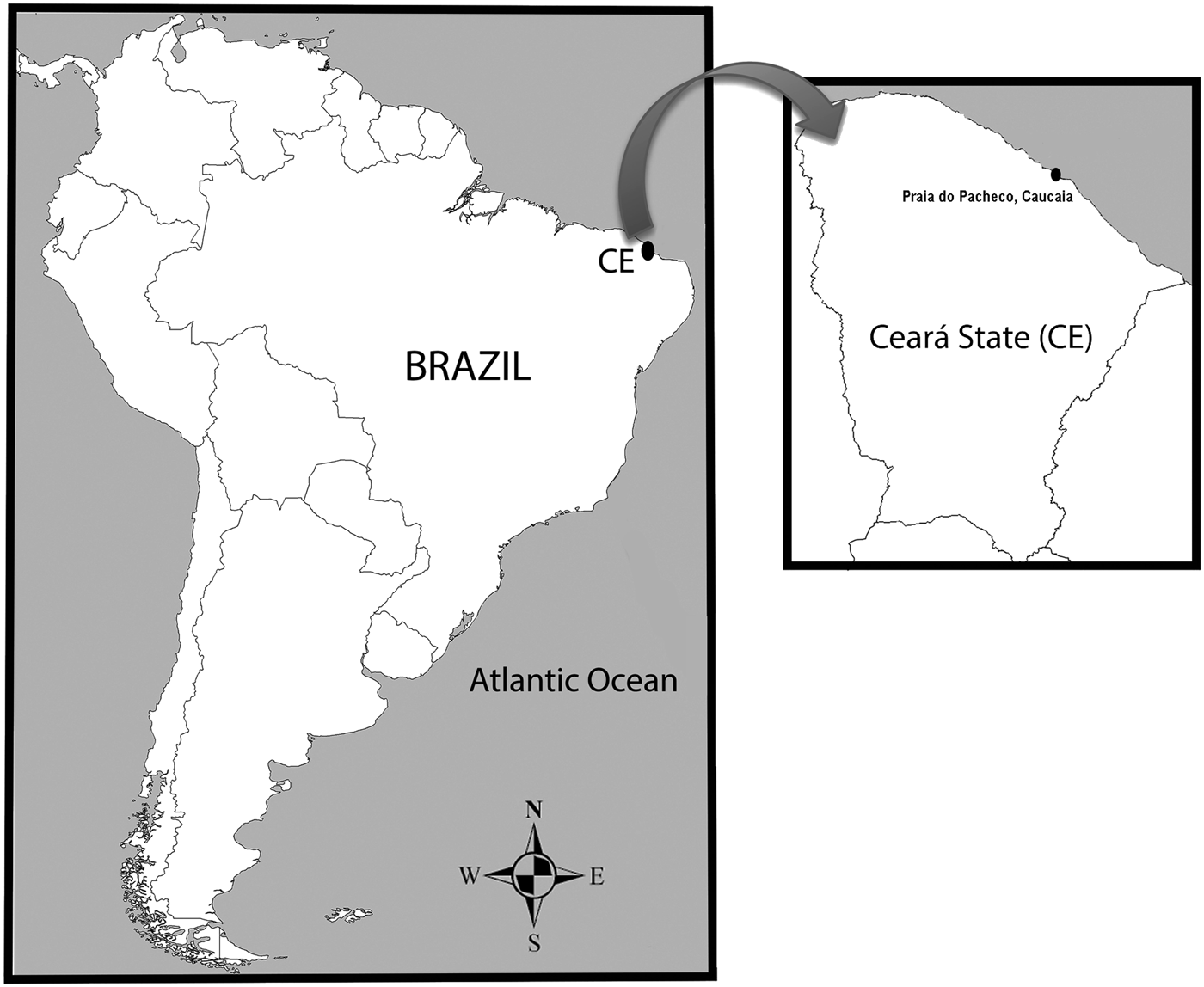
The animals were collected by hand during a spring tide at the Praia do Pacheco, Caucaia (03°41′S 38°38′W), State of Ceará (Figure 1). The samples were taken to the Laboratory of Marine Invertebrates of the Universidade Federal do Ceará, where they were photographed with a Nikon 4500 digital camera coupled to a stereoscopic microscope, and measured with calipers of 0.1 mm precision. The animals were anaesthetized in a saturated solution of seawater (salinity 35) + fresh water (1:1) + magnesium chloride for 2 h and fixed in 70% ethanol. Some animals were dissected from the right side of the body. The internal organs were observed and photographed under an optical microscope, and compared with the data in the literature. The radula and jaw were extracted and treated with potassium hydroxide (KOH) to remove residual tissue. The radula was examined in a Jeol scanning electron microscope at the Laboratório de Microscopia Eletrônica de Varredura do Departamento de Invertebrados do Museu Nacional. All collected material was incorporated into the ‘Professor Henry Ramos Matthews—series B’ Malacological Collection of the Universidade Federal do Ceará (CMPHRM-B) and the Museu de Zoologia da Universidade de São Paulo (MZUSP).
Tritonia khaleesi, sp. nov., distribution map.

SYSTEMATICS
Infraclass OPISTHOBRANCHIA
Order NUDIBRANCHIA Cuvier, 1817
Infraorder DENDRONOTIDA Odhner, 1934
Family TRITONIIDAE Lamarck, 1804
Genus Tritonia Cuvier, 1797
Tritonia khaleesi, sp. nov.
(Figures 2–7)
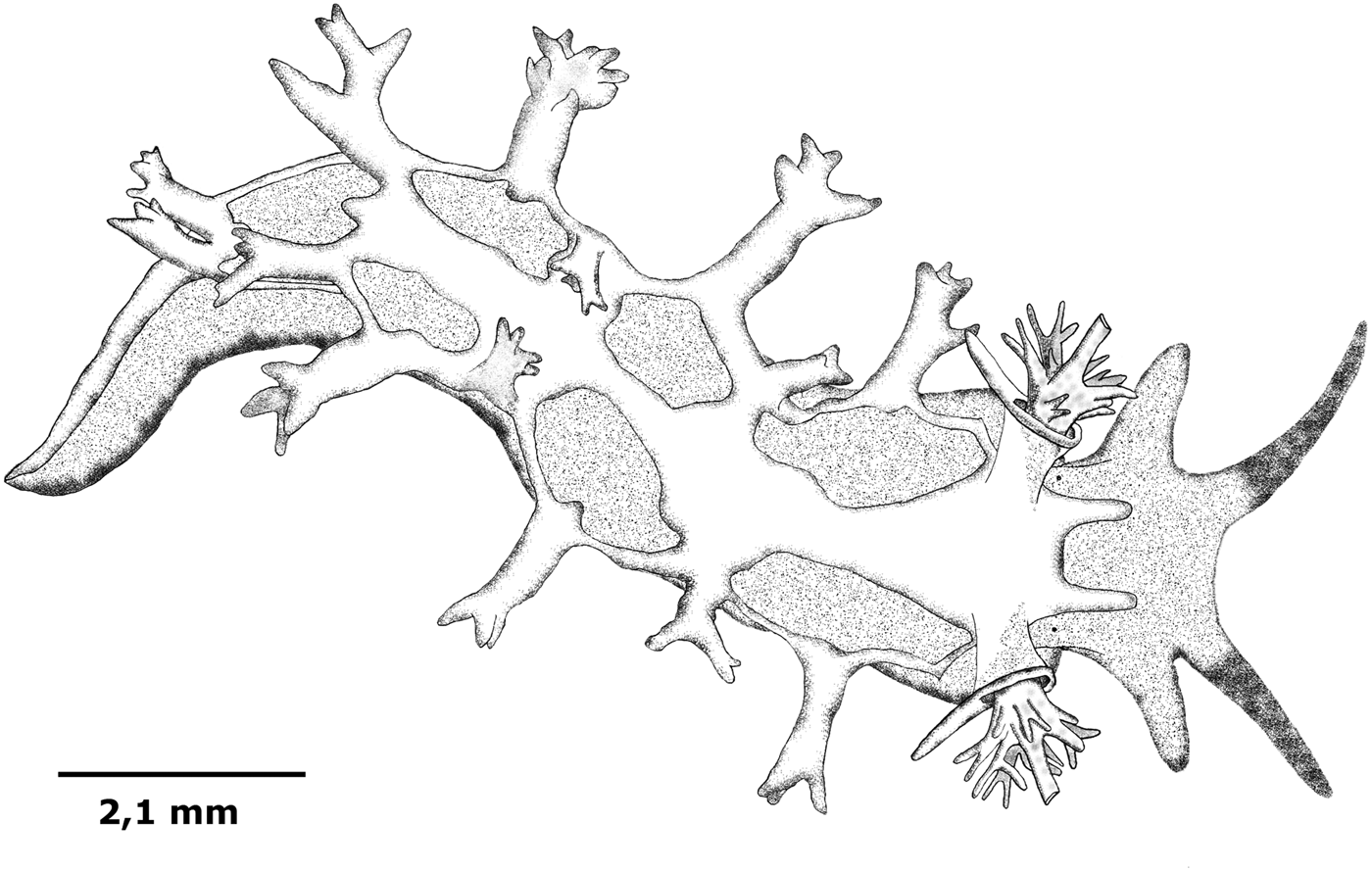
Tritonia khaleesi, sp. nov., holotype CMPHRM 3763B, line drawing. Mature adult.
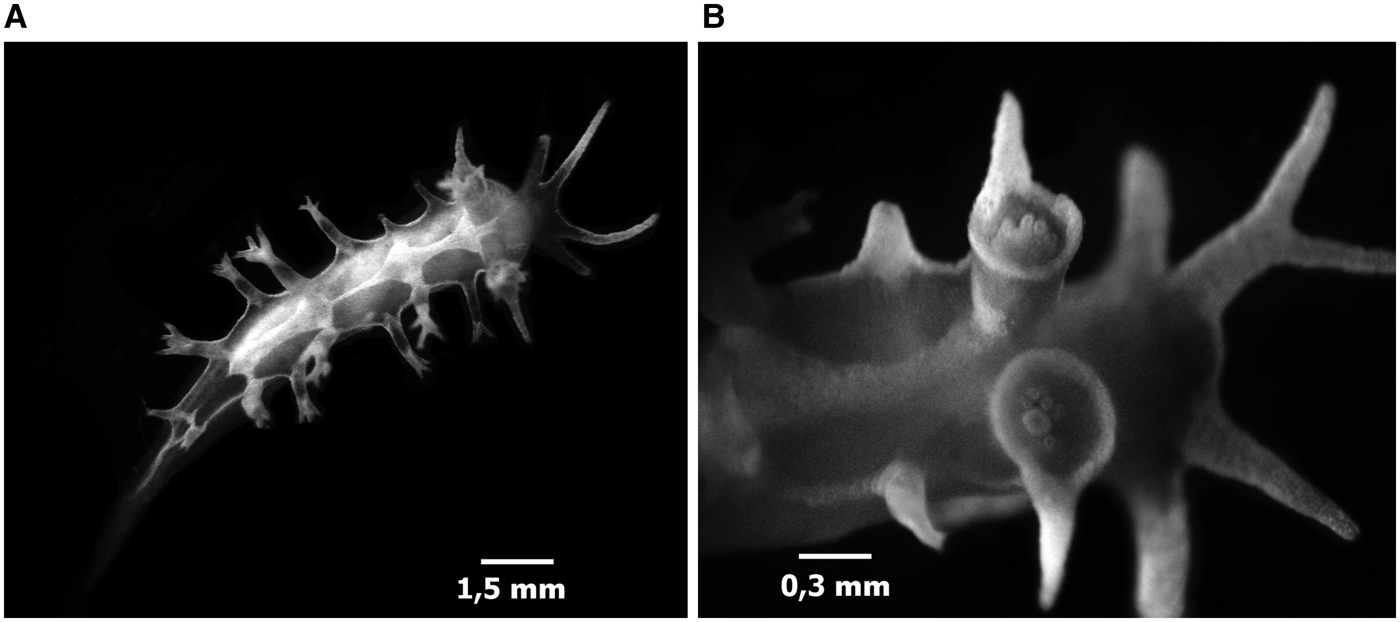
Tritonia khaleesi, sp. nov., digital photographs. (A) Holotype CMPHRM 3763B, 12 mm in length; (B) paratype CMPHRM 3759B, rhinophoral sheath possessing a long fleshy extension and retracted rhinophoral club; bifurcated veil appendage.
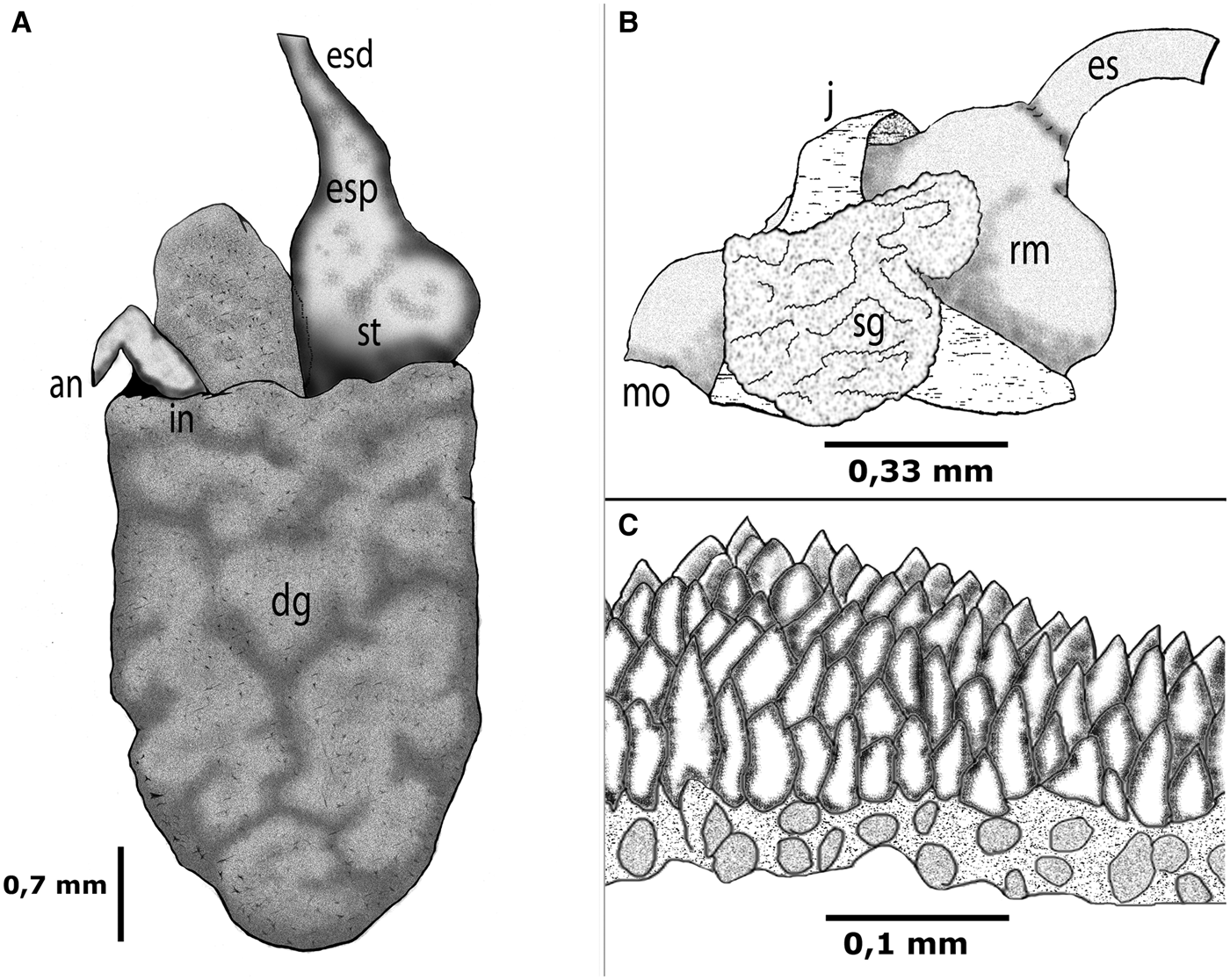
Tritonia khaleesi, sp. nov. Drawing from paratype CMPHRM 3757B: (A) digestive system (ventral view): an, anus; dg, anterior digestive; esd, distal oesophagus; esp, proximal oesophagus; in, intestine; st, stomach; (B) head (lateral view): es, oesophagus; j, jaw; sg, salivary glands; rm, radular mass; mo, mouth opening; (C) denticle rows from masticatory border of the jaws.
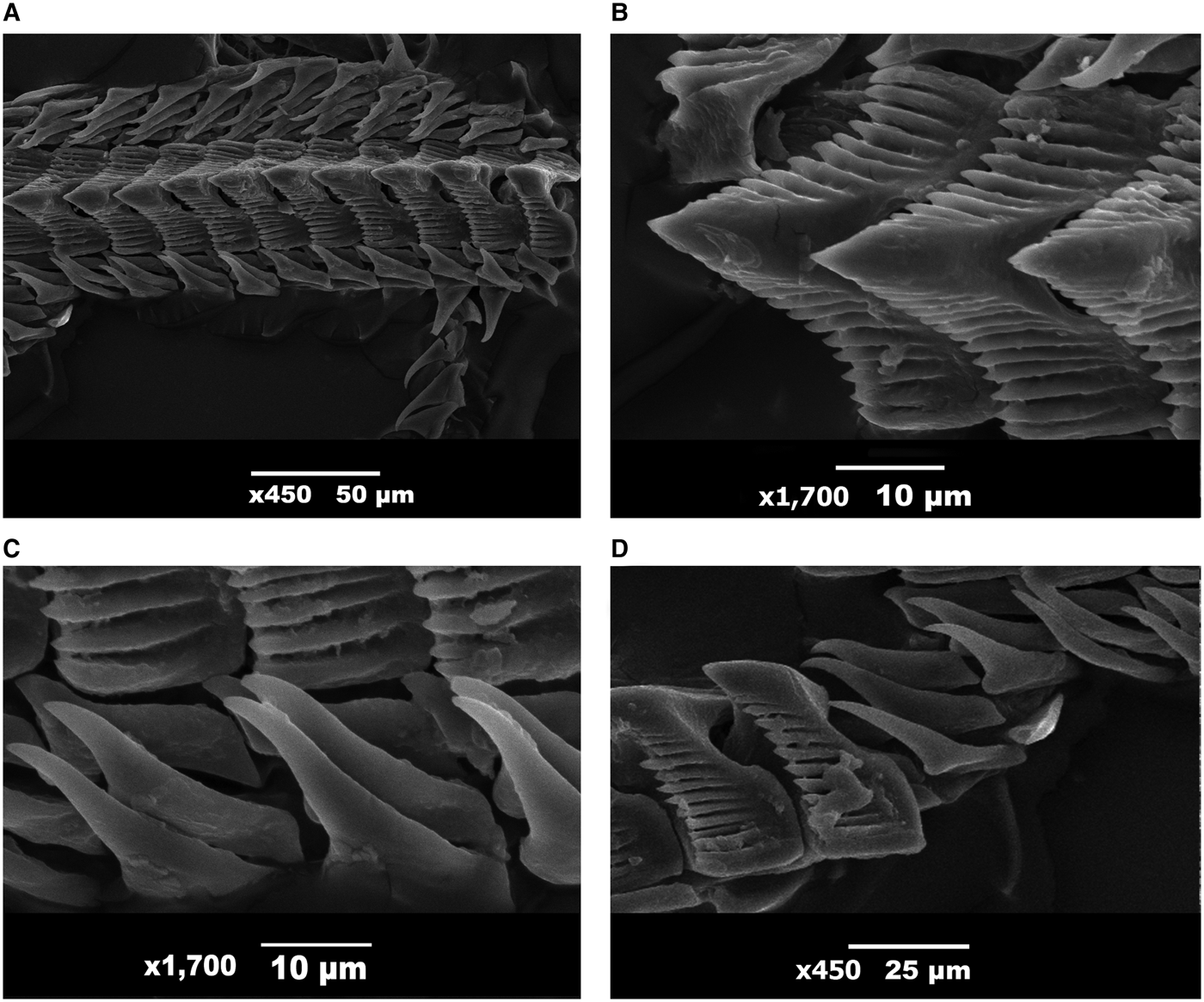
Tritonia khaleesi, sp. nov. scanning electron micrographs of radula of paratype CMPHRM 3757B: (A) overview of radula; (B) rachidian teeth; (C) first lateral and outer laterals; (D) rachidian teeth, lateral view.
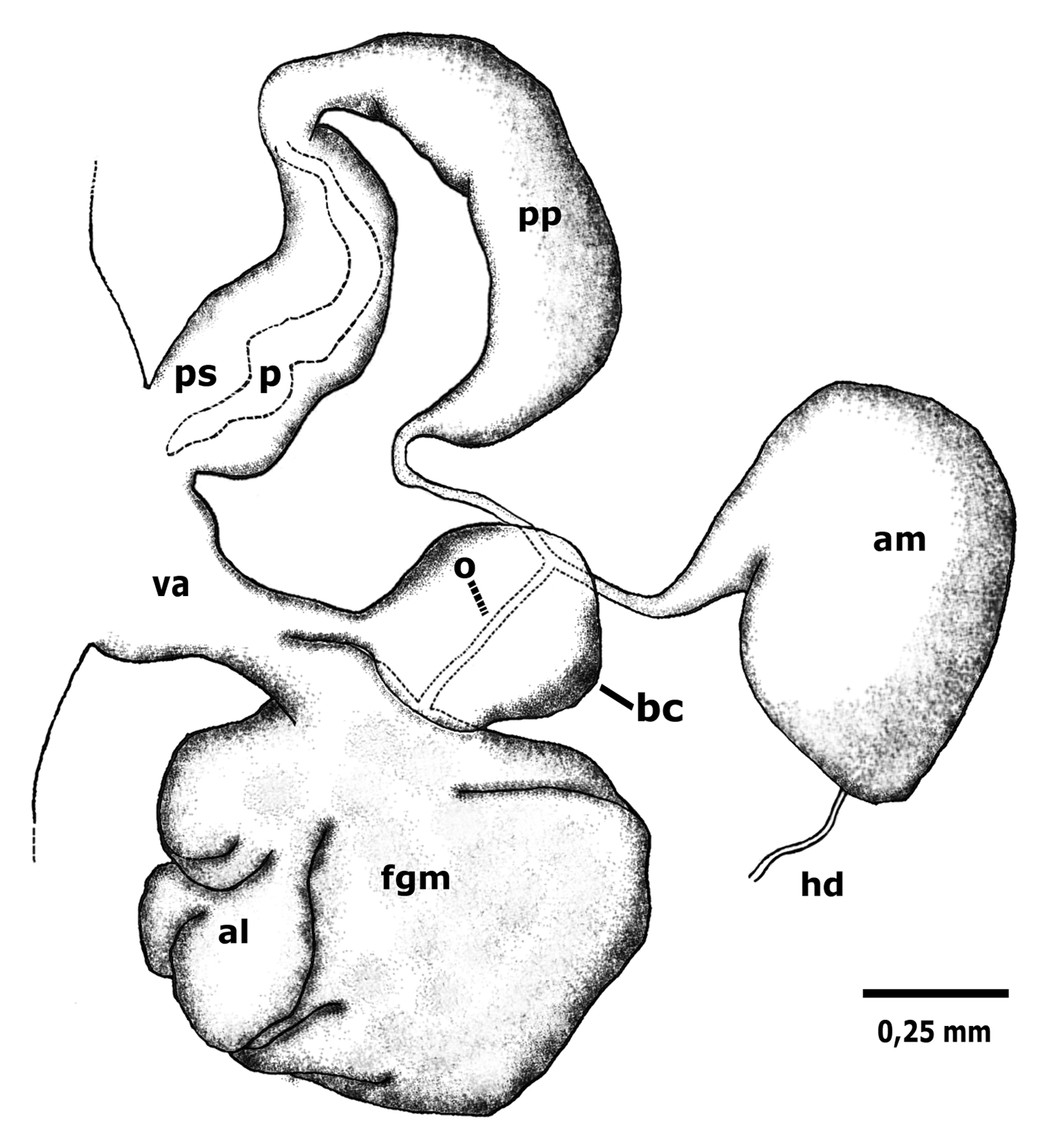
Tritonia khaleesi, sp. nov. Drawing from paratype CMPHRM 3757B. Reproductive system: al, albumin gland; am, ampulla; bc, bursa copulatrix; fgm, female gland mass; hd, hermaphroditic duct; o, oviduct; p, penis; ps, penial sac; pp, prostatic part; va, vaginal atrium. Dorsal view.
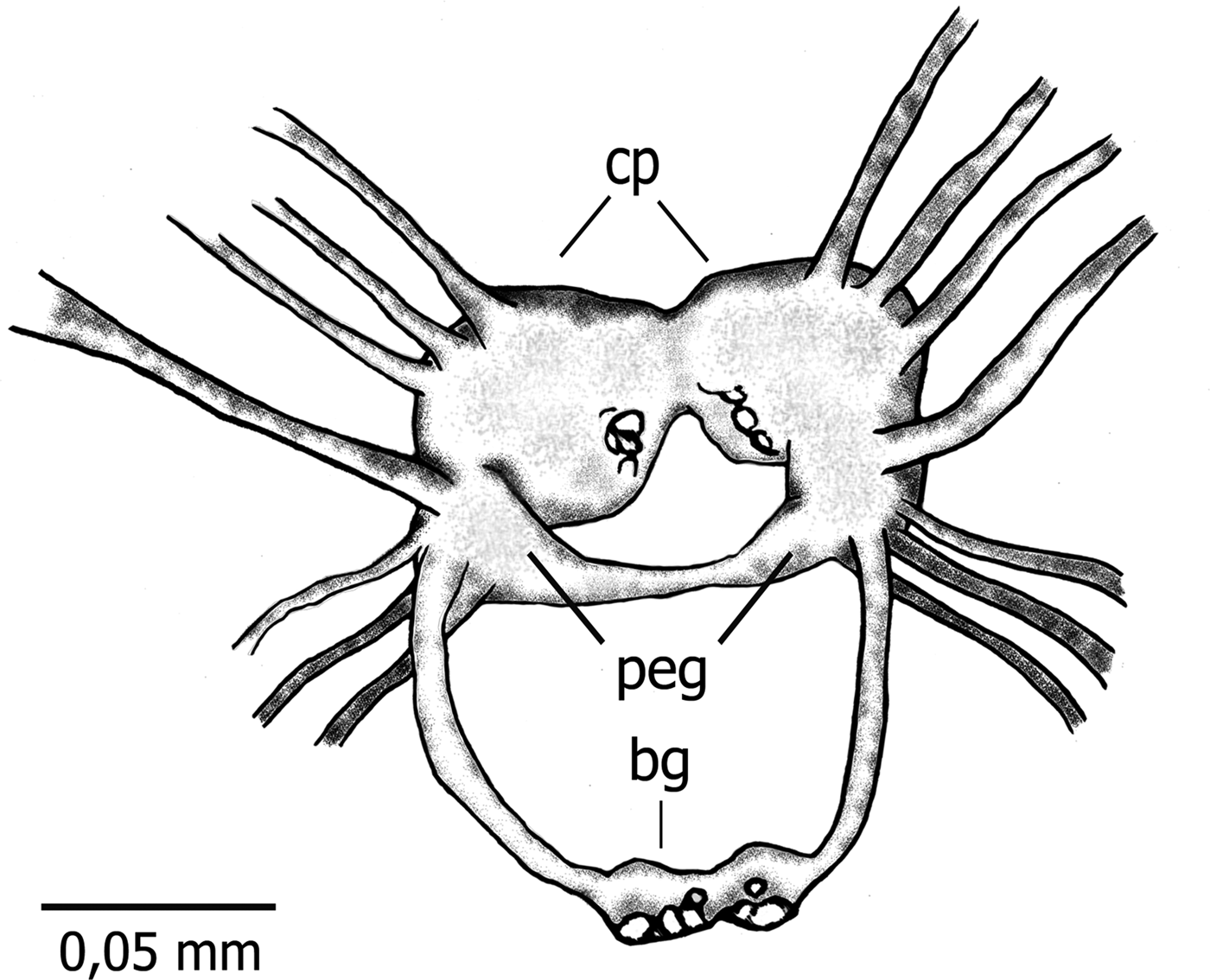
Tritonia khaleesi sp. nov. Drawing from paratype CMPHRM 3757B. Central nervous system: cp, cerebropleural; peg, pedal ganglia; bg, buccal ganglia.
TYPE MATERIAL
Holotype: CMPHRM 3763B, 12 mm long, March 2011, coll. F. Vasconcelos S., 1.0 m depth, dissected. Paratypes: CMPHRM 3757B, 15 mm long, May 2012, coll. F. Vasconcelos S., type locality, 1.0 m depth, dissected. CMPHRM 3758B, 7 mm long, August 2010, coll. F. Vasconcelos S., type locality, 1.2 m depth, dissected. CMPHRM 3759B, 8 mm long, August 2010, coll. F. Vasconcelos S., type locality, 1.2 m depth, dissected. MZUSP 113165, 8 mm long, July 2012, coll. F. Vasconcelos S., type locality, 1.2 m depth, not dissected.
TYPE LOCALITY
Praia de Pacheco, Caucaia, State of Ceará, north-eastern coast of Brazil (04°02′S 38°11′W).
GEOGRAPHICAL AND BATHYMETRIC DISTROBUTION
Tritonia khaleesi is reported only from the north-eastern Brazilian coast, on the Praia do Pacheco, Ceará. So far the species is known only from the intertidal zone.
ETYMOLOGY
The name, proposed as a noun in apposition, refers to the title ‘Khaleesi’, meaning ‘Queen’, of the main character Daenerys, from the book series A Song of Ice and Fire by the American author George R.R. Martin. The character is described as being short and having long white hair, features that resemble the white band on the notum of Tritonia khaleesi. The book series was recently adapted for the television series A Game of Thrones.
DIAGNOSIS
Tritoniidae with four velar appendages; slender white body; notum covered with one white band running from rhinophores to tail; rhinophoral sheath with fleshy extension; digestive glands fused; absence of stomach plates; seven pairs of gills; jaw with 10–14 rows of denticles on inner lips; unicuspid rachidian tooth.
DESCRIPTION
External anatomy: the holotype specimen (Figure 2) was 12 mm long when alive. The animal has a slender whitish body. The notum is covered by a broad white band (Figure 3A) extending from between the eyes and veil to the tail. This white band involves the rhinophores, ascending the rhinophore sheaths and branching to involve the 2nd, 4th and 6th gills. The transparent ventral region reveals the orange-colored digestive glands surrounded by the white ovotestis.
The veil is rounded and contains four digitiform appendages in most specimens; one paratype has a bifurcated appendage (Figure 3B). The innermost anterior appendages, i.e. the oral tentacles, are largest, with similar coloration to the white band of the notum. The rhinophoral sheath is chalice-shaped and semitransparent, possessing a long fleshy extension on the outer side. The retractable rhinophoral club has five bipinnate plumes. Most specimens have seven gills on either side, but some specimens have eight on one side and seven on the other. The gills are long and have similar coloration to the white band of notum. The gills divide into two main branches. Each main branch divides into two or three smaller branches, although some gills do not branch. The foot is linear, narrow and semi-transparent. The anterior end of the foot has a rounded margin. The anus is located between the 3rd and 4th gills on the right side, while the genital opening is under the 2nd gill. The mouth is located ventrally and anterior to the foot, between the lips. The renal pore is anterior to the anus.
Digestive system (Figure 4): the lips are in a prone position, connecting the tube to the mouth opening. The jaw is concave, narrow, amber-colored, with 10–14 rows of denticles. Two salivary glands are positioned next to the pharynx. Inside the pharynx is the radular mass, where the radula is inserted, connecting to the esophagus in the dorsal region of the buccal mass. The radula (Figure 5) of the paratype measured 1 mm, across the curve. The radular formula is 32 × 2–5.1.1.1.2–5 teeth. The rachidian teeth are unicuspid, each with 11–12 denticles. The first lateral teeth are stout, differing from the remaining lateral teeth which have long sharp cusps. The oesophagus extends from the buccal mass until the connection to the stomach. The stomach is ‘U’-shaped, with the digestive gland opening into its middle region. The stomach and intestine do not form a loop around the digestive gland. No stomach plates or girdles were found in the stomach. The typhlosole was found in the intestine and passes through it to the anus. The short intestine exits the stomach and narrows toward the anus. The digestive gland is orange-colored and large, occupying one third of the total length of the animal.
Reproductive system (Figure 6): the reproductive system is androdiaulic. The ovotestis covers most of the surface of the digestive gland, appearing white against the orange-coloured digestive gland. The hermaphroditic duct connects the ovotestis to the ampulla. The ampulla is large and oval; its outlet bifurcates into the oviduct and vas deferens. The slender vas deferens passes into the prostatic part. The prostatic part is long, bulky and thick, becoming the penial sac, where lies the flagelliform penis. The globular spermatheca is smaller than the ampulla and connected to the vagina through a narrow duct. The female gland mass connects to the vagina. The small, nodular and yellow albumen gland is easily discernible inside the female gland mass, together with a folded membrane gland. The penial sac and vagina open to the exterior in a common chamber located below the 2nd gill.
Nervous system (Figure 7): cerebral and pleural ganglia (cerebropleurals) are completely fused and directly connected to the pedal ganglia. The pair of pedal ganglia are connected by the circum-oesophageal nerve ring. A pair of buccal ganglia were found on the ventral oesophagus, completely fused and linked to the pedal ganglia by connectives. The cerebropleurals and the buccal ganglia have easily distinguishable giant nerve cells.
DISCUSSION
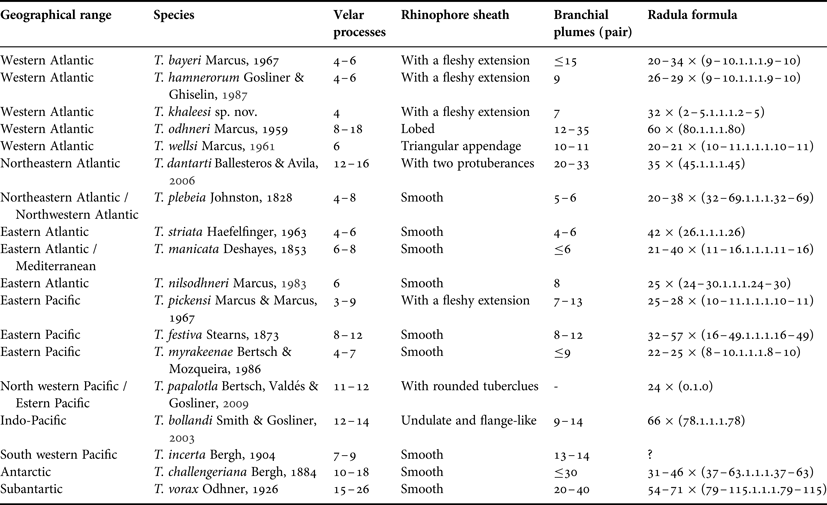
The separation of genera within the Tritoniidae is still problematic 50 yr after the last revision by Odhner (Reference Odhner1963). Past species descriptions based mainly on the external anatomy, as well as intense controversy regarding the characters used by different investigators to separate genera are part of the problem. We have combined the available data in an updated table of some species of Tritonia and our proposed species (Table 1).
Comparison of some species of the genus Tritonia Cuvier, 1797. Data compiled from Marcus (Reference Marcus1961), Gosliner & Ghiselin (Reference Gosliner and Ghiselin1987), Wägele (Reference Wägele1995), Smith & Gosliner (Reference Smith and Gosliner2003), Behrens & Hermosillo (Reference Behrens and Hermosillo2005), Ballesteros & Avila (Reference Ballesteros and Avila2006) and Bertsch et al. (Reference Bertsch, Valdés and Gosliner2009).
The species described here does not have the digestive gland divided and lacks stomach plates, and therefore the genera Marionia, Marioniopsis, Paratritonia and Tritoniella were discarded (Odhner, Reference Odhner1963; Marcus, Reference Marcus1983). The radula of this species does not resemble those of the two remaining possible genera, Tritonia and Tritoniopsis. Species of Tritonia have a tricuspid rachidian tooth and a differentiated first lateral tooth, whereas species of Tritoniopsis have a unicuspid rachidian tooth and the first lateral teeth do not differ from the others (Marcus, Reference Marcus1983). Our species has characteristics of both genera: a unicuspid rachidian tooth, and the first lateral teeth are different from the rest, so we cannot assign this taxon to a genus based only on the radula. We decided to assign our species to Tritonia based on the number of gills, the fleshy extension on the outer side of the rhinophoral sheath, and the number of veil appendages.
Externally, T. khaleesi is very similar to the original illustration of Tritonia pickensi Marcus & Marcus, 1967. The two species are slender, whitish, have the notum covered by a broad white band extending from between the eyes to the tail, and the rhinophoral sheath has a fleshy appendage on the outer side. Tritonia khaleesi can be distinguished from T. pickensi by the number of gills (7–13 in T. pickensi and 7 in T. khaleesi), the number of velar appendages (3–9 in T. pickensi and 4 in T. khaleesi), and the rachidian tooth (tricuspid in T. pickensi and unicuspid in T. khaleesi). Also, Tritonia pickensi is reported from the Pacific coast of Mexico, and T. khaleesi has been found only in a small area on the Atlantic coast of north-east Brazil.
Tritonia khaleesi is easily distinguished from other tritoniids known from the Atlantic by the notum. Tritonia wellsi was described with a smooth notum except for a small webbed region between the 10th and 11th gills, but some researchers have reported specimens with opaque white dots (Valdés et al., Reference Valdés, Hamann, Behrens and DuPont2006). Tritonia bayeri has a network of white lines on the notum and T. hamnerorum has longitudinal white lines on the notum, but only T. khaleesi has the notum covered by a single broad white band extending from between the eyes to the tail. Also, T. hamnerorum, T. bayeri, T. wellsi and T. khaleesi are the only tritoniids that are known to possess a fleshy extension on the rhinophoral sheath, together with T. pickensi from the Pacific.
The typical rachidian tooth of Tritonia is tricuspid, but a few species depart from this standard feature. Tritonia papalotla Bertsch, Valdés & Gosliner, Reference Bertsch, Valdés and Gosliner2009 possesses a single pectinate rachidian tooth and a unique diet, feeding on zoanthid anthozoans rather than on gorgonians or soft corals. Tritonia khaleesi is the only known member of Tritonia that possesses a unicuspid rachidian tooth as an adult. This suggests a unique diet, although it was not possible to observe the species feeding.
ACKNOWLEDGEMENTS
We thank Ana Karla and Yan Torres for their assistance in the sampling, Sulla Sulani for her help with the scanning electron microscope, and Carlo Magenta for his help with the material incorporated into MZUSP.