

I. Introduction
International courts regularly cite each other, even though no formal doctrine of precedent exists in international law. For instance, the regional human rights courts refer to each other’s case law, partly as a tool to build legitimacy (Sandholtz and Feldman Reference Sandholtz, Feldman, Brysk and Stohl2019). This study aims to show that judicial dialogue among the regional human rights courts and the Human Rights Committee (HRC) contributes to the construction of a rights-based global constitutionalism. The human rights courts see themselves as both embedded in and contributing to a global human rights legal system. Cross-citation among the human rights courts advances the construction of rights-based global constitutionalism by providing a basic degree of coordinationFootnote 1 among the regional courts and the HRC. Although the jurisprudence of the human rights courts necessarily responds to human rights problems and political contexts in their respective regions, the sharing of case law means some fundamental norms and principles are shared across regions. In this sense, judicial dialogue among the courts contributes to strengthening the international rule of law.
The following section builds on theories of global constitutionalism, two core elements of which are a normative structure (rules) and an institutional structure to interpret and apply the rules. I will argue that the web of international and regional human rights treaties constitutes the normative structure of global constitutionalism; however, the central argument of this study is that the regional human rights courts and the HRC are constructing – in a rudimentary, decentralized form – the institutional component of global rights-based constitutionalism. The next section provides the empirical support for this argument, documenting the network of cross-citations among the regional human rights courts and from the regional courts to the HRC.
A brief clarification of the term ‘global’ in this context is in order. I argue that the network of human rights courts is building the emergent institutional dimension of a global constitutionalism, but significant parts of the world – including Asia and the Middle East – do not participate in regional human rights courts; nevertheless, the term ‘global’ still applies. First, informal coordination among the human rights courts and the HRC is creating shared interpretations of universal human rights norms and principles. Those interpretations establish baselines, or focal points, that can guide actors in parts of the world that are not covered by a regional human rights court, as they seek to invoke, assert or apply international human rights norms. Second, though no regional human rights court has jurisdiction in the countries of Asia and the Middle East, the HRC possesses a global mandate. It is not a court, and its conclusions and general comments are not legally binding; however, it is an authoritative interpreter of the International Covenant on Civil and Political Rights (ICCPR), which is now global, given that it has virtually universal ratification and many of its human rights norms have clearly achieved the status of customary international law. The HRC thus offers a central point of reference for the interpretation and application of global human rights norms for activists, advocates, civil society organizations and domestic judiciaries – even in states outside the jurisdiction of one of the regional human rights courts. With the HRC, the regional courts are building an emergent decentralized institutional structure for global rights-based constitutionalism.
II. Modern constitutionalism
Though diverse approaches to the idea of ‘global constitutionalism’exist, they all assert that certain international law principles and norms serve functions at the global level akin to (although not identical to) the role played by constitutions in domestic legal orders. With some exceptions, political scientists have paid little attention to the scholarly work on global constitutionalism, perhaps assuming it is an exercise in legal theory. This study begins from the contrary premise: that a properly specified conception of global constitutionalism permits a more complete and coherent assessment of empirical patterns of exchange among the regional courts and the HRC.
The discussion here is not about constitutions, if by ‘constitution’ we mean a document, established by a constituent act, that creates the institutions of government, defines their powers and establishes rules for the production, interpretation and enforcement of additional laws. Rather, the argument is about constitutional orders – that is, systems of law and their associated institutions that perform functions that are ‘constitutional’. I argue that the international human rights regime, comprising national, regional and international layers, is such a constitutional order.
Traditional conceptions of constitutionalism have been shaped by the domestic model, in which constitutions – grounded in the democratic will of a people – establish the institutions of the state and allocate powers to those institutions. The traditional version, however, can accommodate democratic repression – that is, the possibility (and the historical reality) that the will of the majority can support evils like apartheid and genocide. Modern constitutions, especially since World War II, thus build not just on the will of a people but on the freedoms and rights of each person. The laws and policies – and all official deeds – enacted under the constitution must conform to higher-order norms that protect the freedom and dignity of each person by establishing rights. Rights thus place limits on the powers of all public officials. Kumm’s theory of cosmopolitan constitutionalism foregrounds human rights: ‘a universal moral requirement that public authorities treat those who are subject to their authority as free and equal persons endowed with human dignity’ (Kumm Reference Kumm, Dunoff and Trachtman2009: 303). Gardbaum advances a similar argument: that constitutional law is no longer just ‘law containing one or more metarules for the organization and ordering of political authority’; rather, it defines a ‘legal system for the protecting of fundamental rights’ (Gardbaum Reference Gardbaum, Dunoff and Trachtman2009: 238). Gardbaum (Reference Gardbaum, Dunoff and Trachtman2009: 238) also notes that this kind of constitutionalism ‘is no longer in practice, and so cannot be conceptualized as, limited to the national’. Stone Sweet (Reference Stone Sweet2013: 493) similarly holds that the core of any modern constitutional order consists of a set of peremptory norms and ‘other substantive fundamental rights’, as well as ‘standards of procedural due process, and access to justice’. For Stone Sweet and Ryan (Reference Stone Sweet and Ryan2018), modern constitutionalism informs both national and some international legal orders.
Modern constitutionalism is thus cosmopolitan and pluralist. It is cosmopolitan in that it is not grounded in the sovereign state or its people, but in universal rights norms and principles (Kumm Reference Kumm, Dunoff and Trachtman2009; Stone Sweet and Ryan Reference Stone Sweet and Ryan2018); it is pluralist because it necessarily recognizes that separate constitutional orders coexist and interact. Multiple legal orders – domestic, regional and international – possess an ‘autonomous claim to legitimacy’ and authority (Stone Sweet Reference Stone Sweet2013: 493). An archetypal example of constitutional pluralism is the European Union (EU). With the doctrines of the supremacy and direct effect of EU law, coupled with judicial review by the European Court of Justice (ECJ), the EU became a constitutional system (Weiler Reference Weiler1991, Reference Weiler1999; MacCormick Reference MacCormick1999; Stone Sweet Reference Stone Sweet2004). Walker distils the essence of constitutional pluralism in the EU:
Constitutional pluralism, by contrast, recognises that the European order inaugurated by the Treaty of Rome has developed beyond the traditional confines of inter-national law and now makes its own independent constitutional claims, and that these claims exist alongside the continuing claims of states.
(Walker Reference Walker2002, 337; see also Walker Reference Walker2003)The European system of rights protection is likewise an example of constitutional pluralism, in which national courts and the European Court of Human Rights (ECtHR) engage in ‘constitutional dialogues’ to manage the interdependence of domestic and regional protection of rights and to promote ‘doctrinal coherence’ (Stone Sweet and Ryan Reference Stone Sweet and Ryan2018: Ch. 3). Gardbaum (Reference Gardbaum2008: 760) regards both the EU and the European human rights regime as constitutionalized systems. Kumm (Reference Kumm, Dunoff and Trachtman2009: 273) argues that constitutional pluralism captures the contemporary ‘relationship between national and international law’ better than traditional conceptions of monism and dualism.
III. Global constitutionalism and human rights norms
A system of constitutional justice – at any level – incorporates two key elements: a ‘charter of fundamental rights’ and ‘a mode of constitutional review to protect those rights’ (Stone Sweet Reference Stone Sweet, Rosenfeld and Sajó2012: 816; Stone Sweet and Palmer Reference Stone Sweet and Palmer2017: 394). Constitutional rights create ‘justiciable obligations’ on the part of public officials to respect rights, which in turn requires a judicial mechanism to review official acts for their compatibility with those obligations. Courts empowered to exercise rights-based review act as ‘trustees’ of the constitutional system (Stone Sweet and Palmer Reference Stone Sweet and Palmer2017: 379).Footnote 2 This new constitutionalism took root in Europe after World War II, and by the 1990s had ‘diffused globally’ (Stone Sweet Reference Stone Sweet2000; Stone Sweet Reference Stone Sweet, Rosenfeld and Sajó2012: 816).
In this sense, constitutionalism is visible in an interconnected system linking national, regional and international orders. The normative dimension is largely in place, embedded in national constitutions, the regional human rights conventions and the network of international human rights treaties. These three sources of norms (constitutions, regional conventions, international treaties) contain overlapping, broadly similar lists of rights. In this section, I describe these relatively well-established components of global constitutionalism. In the following section, I advance the claim that the final piece – an international system of judicial rights review – exists in rudimentary, decentralized form in the network of regional human rights courts and the HRC.
The international level
International human rights norms provide the normative structure of global constitutionalism. The argument here builds on important insights advanced by Gardbaum and others. Gardbaum (Reference Gardbaum, Dunoff and Trachtman2009: 255) views the international human rights system as a stage ‘in the historical development of the idea of constitutionalism’. In the age of ‘global constitutionalism’, ‘legal limits [on state power] are now imposed by international law and may also be interpreted and applied by – or in the shadow of – international rather than domestic state actors’ (2009: 255). International human rights law thus reinforces one of the core purposes of modern constitutionalism: to set limits on ‘what governments can lawfully do to people within their jurisdictions’ (Gardbaum Reference Gardbaum, Dunoff and Trachtman2009: 237). In that sense, international human rights law and national constitutional rights are functionally similar: they both set boundaries for the exercise of state authority.
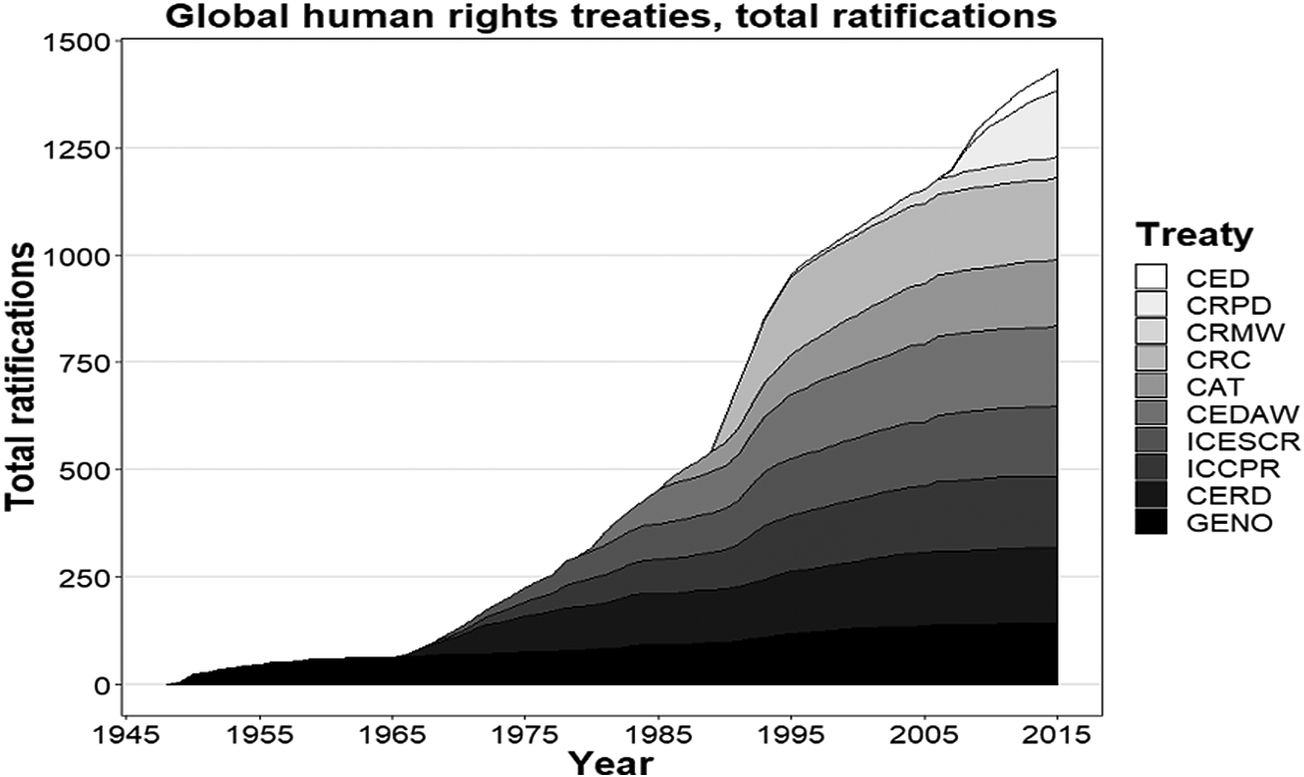
The story of the emergence and expansion of the international human rights regime is well known. The UN General Assembly approved the Universal Declaration of Human Rights (UDHR) in 1948, enumerating a list of civil, political and due process rights. The Genocide Convention was signed the same year. Proponents of the UDHR had hoped that it would quickly be transformed into a comprehensive treaty, but the treaty-making process turned out to be a protracted one. The two covenants – the International Covenant on Civil and Political Rights (ICCPR) and the International Covenant on Economic, Social, and Cultural Rights (ICESCR) – were signed in 1966, as was the Convention on the Elimination of All Forms of Racial Discrimination (CERD), but they did not enter into effect until 1976. Subsequent treaties for the most part affirmed Covenant rights, elaborated rights and obligations with greater specificity (torture, disappearances), or applied them to special populations (such as women, children, persons with disabilities and migrant workers). Figure 1 depicts the growth of the human rights regime in terms of the number of treaties and the total number of state ratifications.
Growth of the human regime – treaties and state ratifications

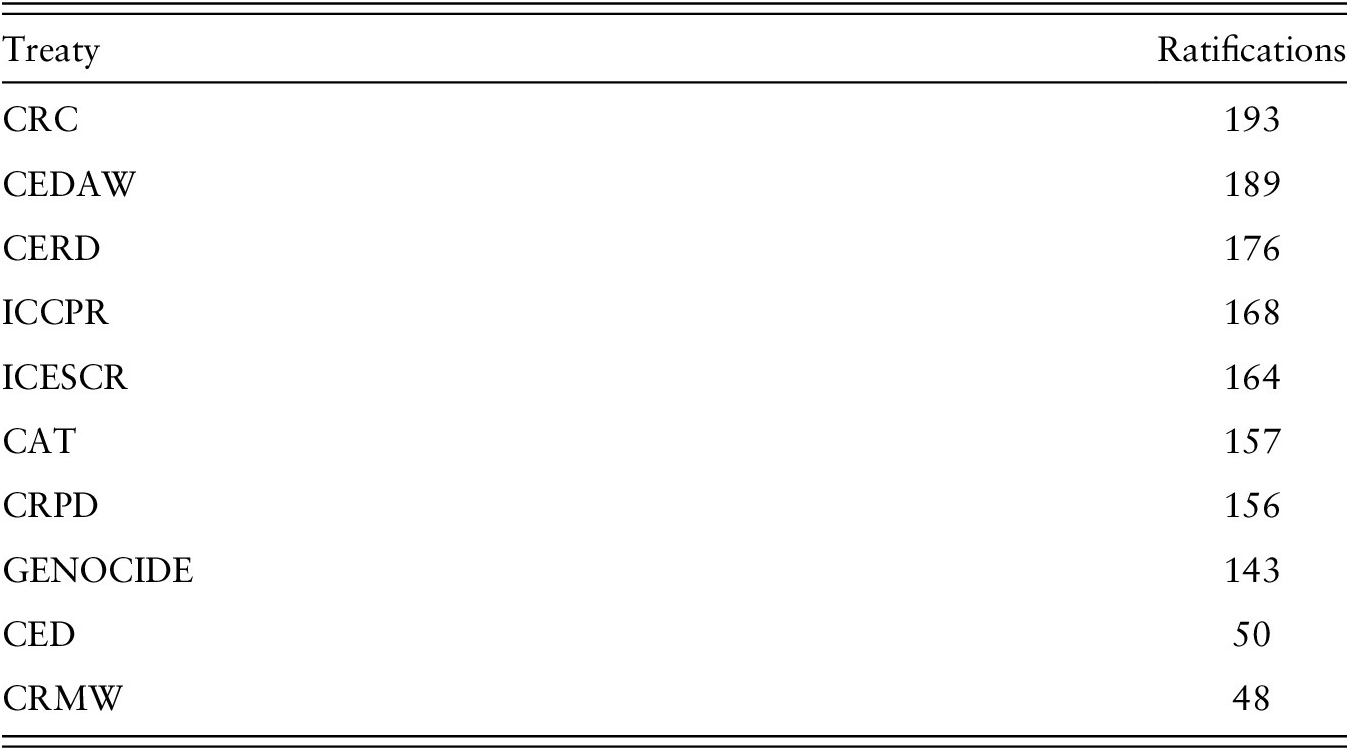
As Table 1 shows, some of the core human rights treaties have achieved virtually universal state participation and others, including the two Covenants, have reached very high levels of ratification or accession (87 per cent of states for the ICCPR and 85 per cent for the ICESCR).
Total ratifications of human rights treaties, 2015

Note: ‘Ratification’ includes accession and succession. Total UN membership in 2015 was 193 states. Some entities that are not UN member states are registered as parties to some of the treaties. For example, both the Holy See and the State of Palestine are listed as parties to the Convention on the Rights of the Child (CRC).
The international level is generally seen to be lacking the second component of modern constitutionalism: a judicial mechanism for rights review. Gardbaum recognizes the ‘tremendous growth’ in the number of national courts exercising the power of rights review, but also notes that ‘international human rights courts with similar powers remain the exception rather than the rule, especially at the global level’ (Gardbaum Reference Gardbaum2008: 751).
The regional level
Regional human rights regimes developed in parallel with the global human rights system.
The European system
The member states of the newly created Council of Europe adopted the European Convention on Human Rights (ECHR) in November 1950. The Convention provided for the creation of a European Court of Human Rights (ECtHR), which held its first session in 1959. The Court was dramatically transformed by an additional protocol in 1998, which abolished the European Commission of Human Rights (that previously held the sole power of referral to the ECtHR), established the compulsory jurisdiction of the Court, and created the right of individual petition. Through 2016, the ECtHR issued more than 18,000 judgments. Its jurisprudence has been progressive (Cichowski Reference Cichowski2007; Stone Sweet and Ryan Reference Stone Sweet and Ryan2018), in that it treats the Convention as a ‘living instrument’ (Letsas Reference Letsas, Føllesdal, Peters and Ulfstein2013)Footnote 3 and has been willing to announce higher standards of rights protection when it deems that a European consensus on a higher standard has emerged (and sometimes when a consensus has not yet developed).
Although the Court’s judgments are, in formal terms, directed at the state that is the subject of a petition, they are widely seen as signaling how the Court will rule in future cases, and therefore as indicating that its case law applies to all 47 member states. In fact, there is evidence that member states view the Court’s jurisprudence as having these erga omnes effects (Helfer and Voeten Reference Helfer and Voeten2014). The European Convention and the case law of the ECtHR have broadly been incorporated into domestic legal systems in Europe (Keller and Stone Sweet Reference Keller and Stone Sweet2008) and the rate of compliance with ECtHR judgments is – again, generally speaking – high (Baluarte and De Vos Reference Baluarte and De Vos2010; Hawkins and Jacoby Reference Hawkins and Jacoby2010; Hillebrecht Reference Hillebrecht2014). The Court has referred to the European Convention as ‘a constitutional document’,Footnote 4 and some scholars view the Court as a constitutional court for Europe (Gardbaum Reference Gardbaum2008: 760; Greer Reference Greer2006: 173; Stone Sweet and Ryan Reference Stone Sweet and Ryan2018).
The inter-American system
The member states of the Organization of American States adopted the American Convention on Human Rights (ACHR) in 1969, although the Convention did not receive the requisite number of ratifications and enter into force until 1978. The ACHR built on the 1948 American Declaration of the Rights and Duties of Man, which was the world’s first general international human rights document. The Convention provided for the creation of the Inter-American Court of Human Rights (IACtHR), which held its first session in June 1979. Cases reach the IACtHR through a two-step process in which petitions go first to the Inter-American Commission on Human Rights, which – once the petition is deemed admissible – seeks to bring the petitioners and the respondent state to a ‘friendly settlement.’ If that effort is not successful, the Commission refers the case to the Court.Footnote 5 The IACtHR is the authoritative interpreter of the American Convention. Through 2016, the IACtHR had issued 212 judgments on the merits.
Though its caseload amounts to a minute fraction of the ECtHR’s, the Inter-American Court has developed a dynamic jurisprudence and has sought to establish itself as the apex of a legal system for applying the American Convention. The Court’s most assertive effort along these lines is its doctrine of ‘conventionality control,’Footnote 6 under which domestic courts are required to review domestic legal acts for their conformity with the American Convention.Footnote 7 Furthermore, domestic courts should ‘take into account not only the treaty, but also the interpretation thereof made by the Inter-American Court.’Footnote 8 In a subsequent judgment, the IACtHR extended the doctrine by requiring that all state officials at all levels (not just judges) exercise conventionality control over all legal acts.Footnote 9 The similarity to domestic constitutional review is clear. Indeed, Dulitzky concludes that the IACtHR, with the doctrine of conventionality control, has sought to establish the ACHR ‘as an inter-American constitution’ and itself as ‘an inter-American constitutional court’ (Dulitzky Reference Dulitzky2015b: 64). That the IACtHR has not fully succeeded in establishing itself as a regional constitutional court is evidenced by the resistance it has encountered from some domestic courts (Contesse, Reference Contesse2019; Huneeus Reference Huneeus2011).Footnote 10 Compliance with IACtHR judgments is patchy and generally lower than is the case for the ECtHR (Baluarte and De Vos Reference Baluarte and De Vos2010; Hawkins and Jacoby Reference Hawkins and Jacoby2010; Hillebrecht Reference Hillebrecht2014). Nevertheless, its role as the final arbiter of higher-order human rights norms and its capacity to judge the compatibility of state actions vis-à-vis Convention rights indicate that a form of regional constitutionalism is being constructed in the Americas.
The African system
The African Court on Human and Peoples’ Rights (ACtHPR) has only recently begun to function and is still developing its jurisprudence and establishing its authority. The African Charter on Human and Peoples’ Rights (the ‘Banjul Charter’) was adopted by the member states of the Organization of African Unity (now the African Union) in 1981 and entered into effect in 1986. The African Court on Human and Peoples’ Rights was established by a protocol to the African Charter, adopted in 1998 and entering into force in 2004. The ACtHPR issued its first judgment on the merits in 2013. As of the end of 2018, it had issued 26 judgments on the merits, finding violations of the African Charter in 23 of those. It is therefore too early to draw conclusions about the Court’s jurisprudence or the extent of state compliance with its rulings. Formally at least, the ACtHPR has a constitutional role in the African Union, with the authority to review state acts for their compatibility with the African Charter and other international human rights instruments.
Human rights law: The national level
International and regional human rights norms have been incorporated into national legal systems in multiple ways, including via a constitution, legislation and judicial interpretation. Incorporation of international rights in domestic constitutions has become the global norm. The new constitutionalism emerged in Europe in the 1950s and featured three core elements: ‘1) an entrenched, written constitution, 2) a charter of fundamental rights, and 3) a mode of constitutional judicial review to protect those rights’ (Stone Sweet Reference Stone Sweet, Rosenfeld and Sajó2012: 816). By the 1990s, this model ‘had diffused globally’ (Reference Stone Sweet, Rosenfeld and Sajó2012: 816). Indeed, as Law and Versteeg (Reference Law and Versteeg2011: 1194) demonstrate, ‘it has become standard practice for constitutions to include explicit rights provisions’. Further, the nature of rights provisions displays clear trends: ‘a tendency to guarantee an increasing number of rights; the spread of judicial review; and the existence of generic rights that can reliably be found in the vast majority of constitutions’ (Reference Law and Versteeg2011: 1194). Stone Sweet (Reference Stone Sweet, Rosenfeld and Sajó2012: 816, n. 812) finds that all 106 constitutions established since 1985 have included a charter of rights and 101 have included a judicial rights review mechanism.
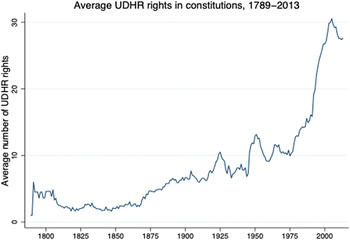
International human rights law has had a demonstrable effect on the domestic constitutionalization of rights. In fact, it is possible to trace domestic constitutional rights to the UDHR, the first international (as opposed to regional) document to enumerate a comprehensive list of basic rights. Elkins, Ginsburg and Simmons (Reference Elkins, Ginsburg and Simmons2013) show the influence of the UDHR on constitutional rights in several ways. For instance, the similarity between new constitutions and the UDHR is greater after 1948 than before.Footnote 11 In addition, the average percentage of UDHR rights included in constitutions rises dramatically after 1948. Finally, analysing constitutions written after 1948 and a total of 73 rights, they find that UDHR rights are more than one and a half times as likely as non-UDHR rights (that is, rights not appearing in the UDHR) to be included in constitutions (Elkins, Ginsburg and Simmons Reference Elkins, Ginsburg and Simmons2013: 77, 79, 80). Beck, Meyer et al. (Reference Beck, Meyer, Hosoki and Drori2017) report similar findings. The average number of UDHR rights included in national constitutions rises from about fifteen in 1900, to 20 in 1948, to about 35 in 2013. They explain the rise in terms of the influence of world society: the larger the number of global human rights treaties in existence at the time of a constitution’s initial adoption, and the more of those treaties a country has signed, the larger the number of UDHR rights that will be included in the constitution (Beck, Meyer et al. Reference Beck, Meyer, Hosoki and Drori2017: 10). Sloss and Sandholtz, employing a different coding of 68 UDHR rights, show that the number of UDHR rights included in national constitutions rises dramatically after 1948 (see Figure 2). The average number of UDHR rights in constitutions in 1947 was 11.5; by 2005 it had reached a peak of 30.6 (Sloss and Sandholtz Reference Sloss and Sandholtz2019). Finally, Versteeg (Reference Versteeg2015) demonstrates that the international and regional human rights treaties served as a template for constitutional rights provisions.
Number of UDHR rights included in national constitutions

States can also ‘constitutionalize’ international human rights norms without formally writing them into the constitution, through legislation and judicial decisions. This has occurred in Europe (Keller and Stone Sweet Reference Keller and Stone Sweet2008) and Latin America (Góngora Mera Reference Góngora Mera2011). In Africa, the experience is varied, but with the same overall trend. Viljoen (Reference Viljoen2012: Ch. 12) shows that international human rights law (with a particular focus on the African Charter) becomes incorporated into domestic law via the constitution, legislative incorporation and judicial interpretation.
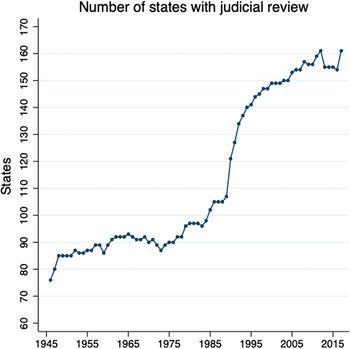
Finally, just as the normative substance of global constitutionalism has been broadly diffused in national legal orders, the institutional component – courts empowered to exercise constitutional rights review – has also spread transnationally. The dominant institutional form is the constitutional court, which holds authority to review official acts for their compliance with a rights-based constitution (Stone Sweet Reference Stone Sweet, Rosenfeld and Sajó2012; Stone Sweet and Palmer 2018: 389, 394). The Varieties of Democracy Project has constructed cross-national, cross-temporal data that includes an indicator of judicial review. A country is coded in a given year as having judicial review if ‘any court in the judiciary [has] the legal authority to invalidate governmental policies (e.g. statutes, regulations, decrees, administrative actions) on the grounds that they violate a constitutional provision’ (Coppedge et al. Reference Coppedge2018a; Coppedge et al. Reference Coppedge2018b: 152). The V-Dem definition of judicial review thus corresponds with the concept advanced in work on the new constitutionalism. Figure 3 shows the number of countries each year that are classified as having judicial review. The number of countries with judicial review shows a strong upward trend, with a particularly striking acceleration in the 1980s and 1990s (an era of constitution writing and revision after the end of the Cold War). By 2018 judicial review had spread to the vast majority of states in the world – more than 160.
Number of countries classified as having judicial review

This section has described a global constitutionalism of human rights, which consists of interlocking normative structures at three levels – international, regional and national – and associated institutions for rights review at two levels – regional and national. The global system is cosmopolitan in that it is grounded not in sovereign statehood or the will of a specific people, but rather in universal rights. It is pluralist because it embraces multiple legal orders, each with autonomous claims to legitimacy. The next section addresses the apparently missing piece: international rights review.
IV. An institutional framework for global rights review
I argue in this section that an emergent, rudimentary institutional framework for rights review does exist at the international level. It is pluralist in the sense that it is a network of multiple judicial and quasi-judicial bodies, each with its own basis of legitimacy and authority. The network consists of the three regional human rights courts – European, Inter-American and African – plus the UN Human Rights Committee. Two potential objections immediately present themselves. First, the regional human rights courts have no binding jurisdiction outside their respective regional conventions and the countries that have ratified them. They are not authoritative interpreters of the global human rights treaties. Second, the HRC is not a court, so its General Comments and its ‘views’ on individual petitions are not binding on anybody.
The responses are straightforward. First, the regional human rights courts see themselves as integral parts of a larger global system of human rights law. They regularly invoke the global treaties and treaty bodies as guides to interpreting the regional human rights treaties. Outside those regions, the interpretations of the regional human rights courts are relevant considerations in determining the content of the global treaties, much as the interpretations of domestic courts are relevant in determining treaty obligations.Footnote 12 Second, the HRC is an authoritative interpreter of the ICCPR. The regional courts cite the HRC not because it holds some sort of superior authority. Though the HRC does not issue binding judgments, it is the body charged with interpreting the ICCPR, one of the foundational international human rights treaties. In other words, the HRC serves as a central reference point for the regional courts as they participate in the development of international human rights jurisprudence.
In this section, I provide evidence to support the claim that the regional human rights courts and the HRC together form a global institutional framework for rights review. These bodies are linked by judicial dialogue through cross-citations. I acknowledge two limitations at the outset. First, important regions of the world do not participate directly in the loose institutional structure of global rights review. Asia and the Middle East region lack regional human rights courts; states in those regions are not under the binding jurisdiction of any supranational human rights court. Still, the jurisprudence of the regional courts and the HRC is available to activists, advocates and courts in those regions, to support the expansion of rights. Second, the analysis here sets aside the domestic dimension. Domestic courts are the ‘front line’ when it comes to applying human rights law and holding state officials accountable for violations. Judicial dialogue clearly occurs – to a greater or lesser extent – between national courts in Africa, Europe and Latin America and their respective regional courts; however, the central goal of this study is to assess the degree to which jurisprudential exchange among bodies with supranational jurisdiction is constructing an emergent global infrastructure for rights review. That is, this study addresses the degree to which the normative structure of global constitutionalism is, or may be, complemented by an international institutional structure.
Precedent, external citations and the quest for legitimacy
Courts face a permanent crisis of legitimacy because the loser in any dispute may be inclined to reject the court’s decision as biased, political or arbitrary (Shapiro Reference Shapiro1981: Ch. 1). One of the most important tools for defusing the ongoing crisis of legitimacy is giving reasons, which means explaining why the court’s decision was not biased or arbitrary but was required by the law (Carter and Burke Reference Carter and Burke2016: 8). A court’s citations to case law are a crucial part of its giving reasons, and thus of its legitimation strategy. My premise is that the regional courts cite each other and the HRC partly to enhance their legitimacy (Sandholtz and Feldman Reference Sandholtz, Feldman, Brysk and Stohl2019). This is not an argument that external citations are more important for building legitimacy than citations to a court’s own precedents. Certainly a court’s own case law is fundamental to demonstrating that the court is consistent, treating like cases alike. External citations can play a supplementary role, adding to the perceived legitimacy of the court and its decisions. External citations can enhance legitimacy with internal constituencies (national governments, legislatures, courts, activists, advocates and the public) by showing: (1) that the court’s reasons are sound; (2) that the court’s interpretation of the law is consistent with common practice in other jurisdictions; and (3) that a different court would decide the case in the same way. In other words, the regional human rights courts cite each other’s judgments not as binding authority but rather as persuasive authority.
The regional courts in a global system
I argue that the regional human rights courts cite each other and the HRC for a second reason: they want to be seen as active participants in the construction of the global human rights regime. They want to influence, and to be seen as influencing, other courts and the broader international regime.
International judges care about their reputation and status among their international peers. As Voeten notes, one motive for external citations is ‘influencing other courts’. Judges who do not cite externally are less likely to be cited themselves (Voeten Reference Voeten2010: 550). External citations, then, target not just internal constituencies but also international ones. They signal to other international courts that the citing court is attuned to international jurisprudential currents and desires to participate in their development.
The regional human rights courts clearly see themselves as integrated into a larger global human rights system. This self-conception is important because it underpins the courts’ invocation of global human rights treaties, and because it both explains and legitimizes their references to the HRC. That is, if the HRC is an authoritative interpreter (even if not the authoritative interpreter) of one of the pillar treaties of the global human rights system, then it is appropriate for the regional courts to draw on the HRC for interpretive guidance.
The ECtHR explicitly places the European Convention and its own jurisprudence in the broader context of international human rights law. As the Court stated in Hassan v United Kingdom, ‘As the Court has observed on many occasions, the Convention cannot be interpreted in a vacuum and should so far as possible be interpreted in harmony with other rules of international law of which it forms part.’Footnote 13 The Court routinely cites international human rights treaties and the interpretations of the human rights treaty bodies as it interprets the European Convention on Human Rights.
Similarly, the Inter-American Court recognizes that the American Convention on Human Rights and the Inter-American human rights system are embedded in the larger system of international human rights law (Neuman Reference Neuman2008, 112). As one of the Court’s influential presidents, Judge Antônio Augusto Cançado Trindade (Reference Cançado Trindade2004: 29) put it, ‘the regional systems of protection operate in the framework of the universality of human rights’. The Court itself repeatedly places the American Convention and the Inter-American Human Rights System within the context of the global human rights regime. A word search of all IACtHR merits judgments in English found the phrase ‘international human rights law’ used 474 times in 119 judgments, the phrase ‘international human rights standards’ 31 times in 20 judgments and ‘international human rights system’ six times in five judgments. In these references, the Court regularly affirms that regional human rights law is embedded in a broader system of international human rights law. In its first advisory opinion, for example, the IACtHR declared:
The nature of the subject matter itself, however, militates against a strict distinction between universalism and regionalism. Mankind’s universality and the universality of the rights and freedoms which are entitled to protection form the core of all international protective systems. In this context, it would be improper to make distinctions based on the regional or non-regional character of the international obligations assumed by States, and thus deny the existence of the common core of basic human rights standards.Footnote 14
Moreover, both the preamble to the American Convention and Article 29 of the Convention place the regional treaty in an international context. Article 29 decrees that, ‘No provision of the Convention may be interpreted as … restricting the enjoyment or exercise of any right or freedom recognized … by virtue of another convention to which one of the said states is a party.’Footnote 15 In Ituango Massacres v Colombia the IACtHR declares that, ‘The corpus juris of international human rights law comprises a set of international instruments of varied content and juridical effects (treaties, conventions, resolutions and declarations) … This Court, therefore, must adopt the proper approach to consider this question in the context of the evolution of the fundamental rights of the individual in contemporary international law.’Footnote 16 Such examples could easily be multiplied. In addition, the IACtHR routinely cites international human rights treaties, the interpretations of the human rights treaty bodies and international soft law sources (Neuman Reference Neuman2008, 109–10).
Like the ECtHR and the IACtHR, the African Court sees itself as part of a larger international human rights system. Indeed, the Protocol establishing the African Court on Human and Peoples’ Rights, under ‘Sources of Law’, declares, ‘The Court shall apply the provisions of the Charter and any other relevant human rights instruments ratified by the States concerned.’Footnote 17 The African Court also routinely cites international human rights treaties and treaty bodies, as well as the other regional human rights courts.
The web of judicial exchange
The regional courts cite each other frequently, with the African and Inter-American courts doing so more than the ECtHR. All three regularly refer to the Human Rights Committee, which plays a distinct role in this web of judicial exchange. Its 18 members are independent experts who are elected in their personal capacity to four-year terms, with the possibility of re-election. The HRC announces its interpretations of the Covenant through three main mechanisms: (1) ‘concluding observations’ on the reports regularly submitted by member states; (2) ‘adoption of views’ in response to complaints submitted by states or (far more commonly) by individuals, alleging violations of the ICCPR by a state party; and (3) ‘general comments’, which the Committee offers on its own initiative as interpretations of the covenant with regard to specific themes or topics. The data reported below include references by the three regional courts to all three types of HRC communications. The data do not include citations by the HRC to the regional courts. The HRC does cite the jurisprudence of the regional courts, but it appears to do so only to delineate the procedural history of the case – that is, when the complaint before it has been the subject of a regional court proceeding. The HRC does not cite the regional courts as persuasive authority when explaining its reasons. Keller and Grover (Reference Keller, Grover, Keller and Ulfstein2012: 157) note that, ‘In respect of regional human rights regimes (e.g. European Court of Human Rights), the [Human Rights] Committee is understandably reluctant to rely on their jurisprudence, as many states parties may not have submitted to these regimes.’ Conte and Burchill (2016: 16) state more categorically that the HRC does not cite the regional courts: ‘The Committee has also eschewed the assistance of the jurisprudence of other international human rights bodies in interpreting the ICCPR.’ The regional human rights courts are not obligated to consult HRC communications, but they do.
For the regional courts, the data reported below include only final judgments on the merits; they exclude separate opinions, rulings on admissibility and advisory opinions. Because my purpose is to analyse the role of cross-regional citations in the development of human rights jurisprudence, the focus on merits judgments is appropriate.
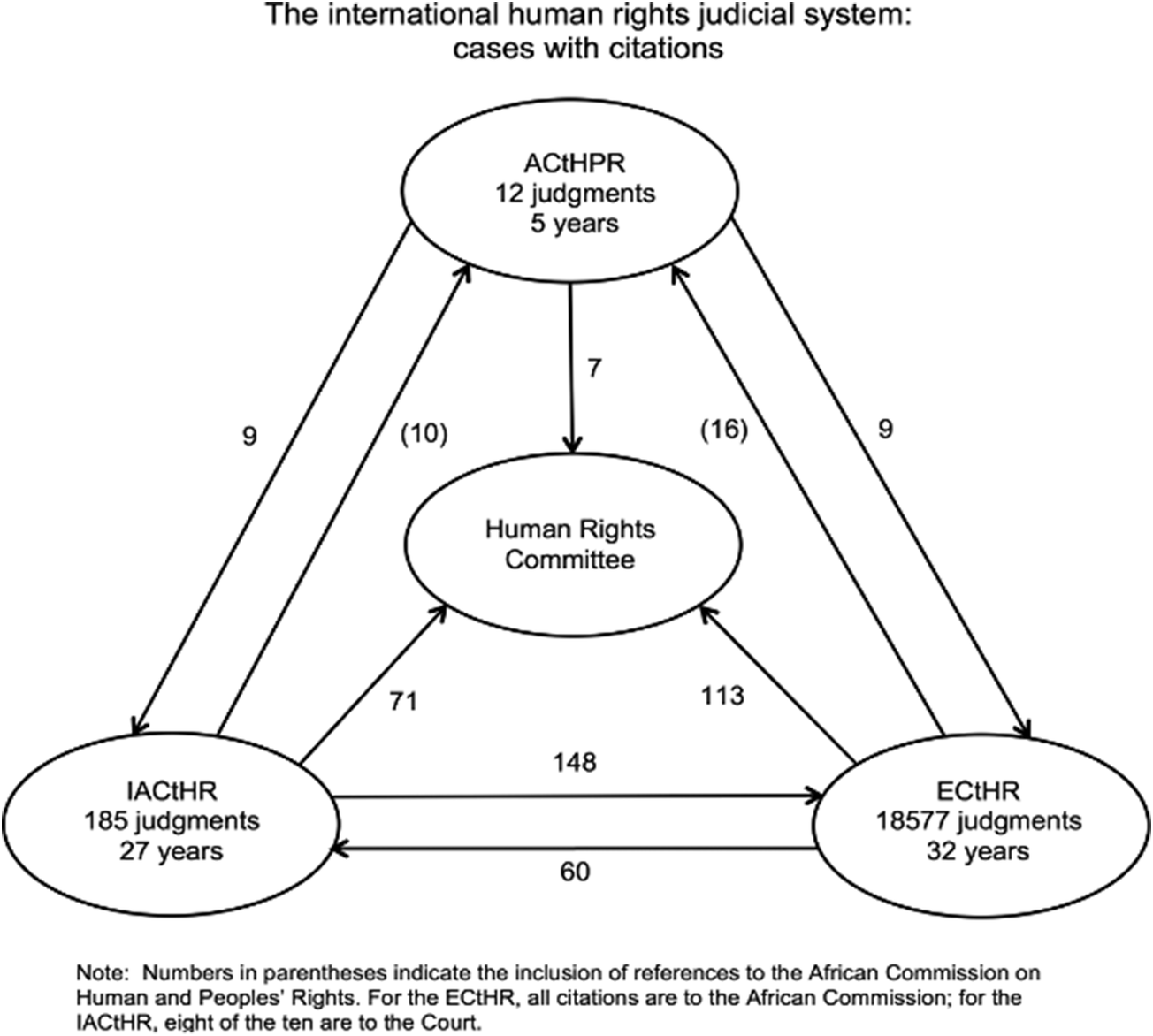
Figure 4 depicts the web of cross-citations in graphic form. The numbers beside the arrows indicate the number of cases in which a citation occurs; the arrows point to the cited body. These data are cumulative, covering the human rights courts from their first judgment through 2015.
The web of cross-citations

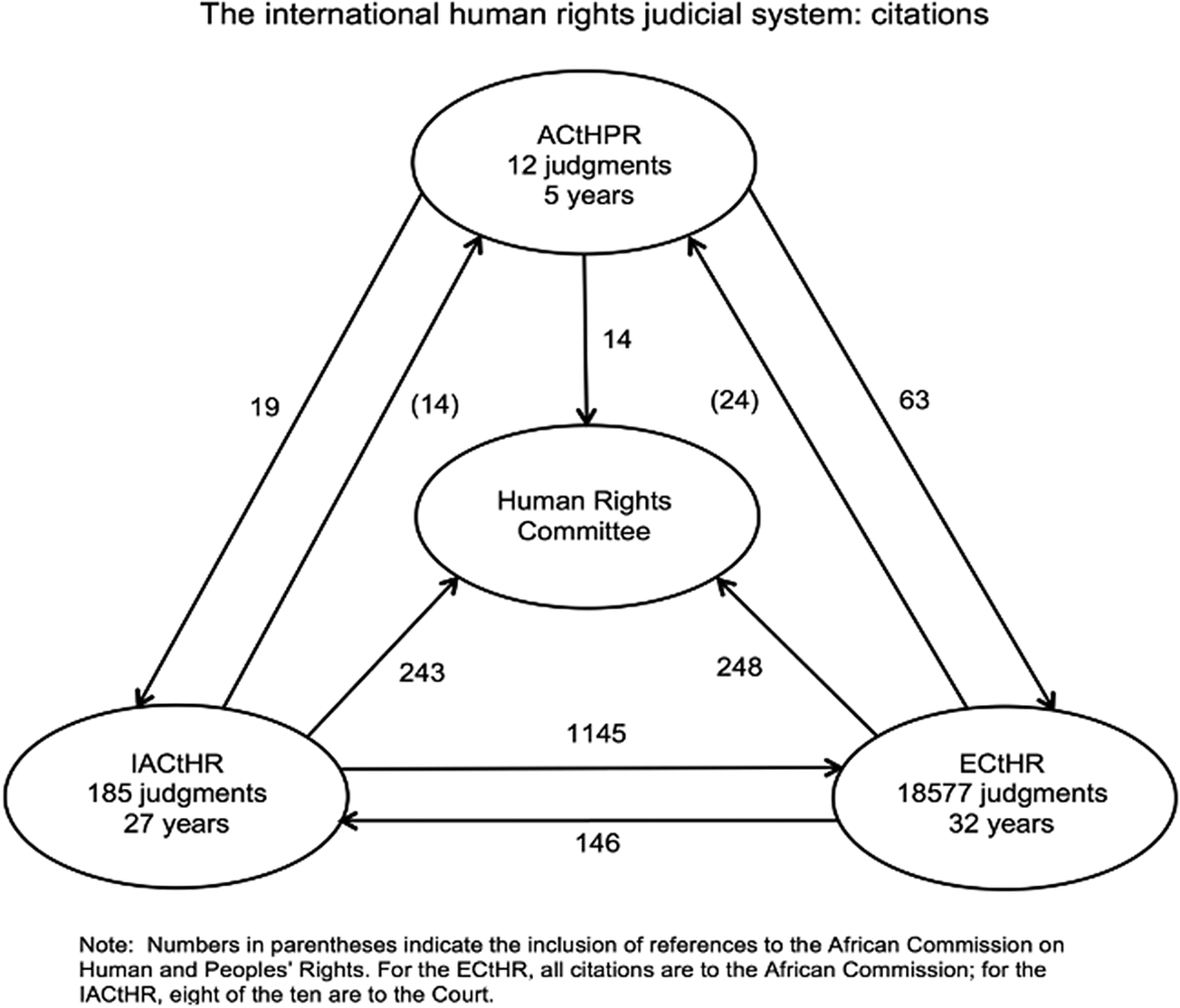
Figure 5 shows the number of unique citations among the courts and the HRC, excluding duplications.Footnote 18 That is, in preparing the data described in Figure 5, I dropped citations within each judgment that referred to the same external decision. Clear differences among the regional courts are apparent. The newer human rights courts – the ACtHPR and the IACtHR – cite externally at a much higher rate than the ECtHR. In fact, the IACtHR has cited the ECtHR in 75 per cent of its merits judgments and the HRC in 36 per cent. The ACtHPR has cited the other two regional courts in 75 per cent of its judgments and the HRC in 58 per cent.
The number of unique citations

That the ECtHR cites externally less often makes sense, given that by the time the other two courts were producing judgments, the ECtHR already had a large and well-developed case law of its own. For instance, by 1988 – the year the IACtHR issued its first judgment on the merits – the ECtHR had already issued 180 judgments. When the IACtHR reached 100 merits judgments (2008), the ECtHR had more than 10,000. The ACtHPR issued its first judgment on the merits in 2013, and by the end of 2015 it had produced only 12 merits judgments, by which time the ECtHR had accumulated more than 18,000 merits judgments. In other words, the ECtHR had fewer reasons or less need to cite the other two regional courts (Sandholtz and Feldman Reference Sandholtz, Feldman, Brysk and Stohl2019). Still, the ECtHR has cited both of its peer bodies.
The citations to the African system require some clarification. The African human rights system (like the Inter-American system) includes two bodies: a commission and a court. The African Commission is much older than the court, having been created by the 1981 African Charter on Human and Peoples’ Rights and having initiated operations in 1987. It can receive petitions from African Union member states, from organizations and from individuals. If the Commission finds that a violation of the African Charter has occurred, it can recommend measures for a friendly settlement. It can also refer cases to the African Court. Although the case law of the African Court is still sparse, the African Commission has built a body of jurisprudence, having issued a total of 97 decisions on the merits through 2018. The data reported in the figures include ECtHR and IACtHR citations to the African Commission because omitting references to its decisions would create the misleading impression that the ECtHR and the IACtHR have paid no attention to their African counterparts.Footnote 19
The network in practice: Illustrations
It would be impossible to analyse in a single article the substance and character of the jurisprudential exchange among the regional courts and the HRC. Some broad observations, with illustrative examples, may nevertheless be useful.
The ACtHPR
As noted above, because the ACtHPR is relatively new, it has not yet developed a large body of case law. With only 12 judgments on the merits through 2015, it is hard to generalize about the Court’s pattern of external citations, except to point out that it cites externally in all but one of the 12 judgments.Footnote 20 Not surprisingly, the ACtHPR routinely draws on the jurisprudence of its sister regional courts and on the HRC to lend support to its reasoning. It cites them on substantive norms, on due process norms, and on principles of interpretation. This statement appears to capture the ACtHPR’s attitude toward external precedent: ‘The Court is fortified in its reasoning by the decisions of the African Commission, the United Nations Human Rights Committee, the European Court of Human Rights and the Inter-American Court of Human Rights, which are courts of similar jurisdiction.’Footnote 21
In Lohé Issa Konaté v Burkina Faso, for example, the Court refers to the ECtHR, the IACtHR and the HRC on the inappropriate use of criminal sanctions in defamation cases.Footnote 22 In a case involving procedural due process, the Court refers to case law from both of the other regional courts and the HRC in interpreting the obligation of the state to ensure those accused of criminal offences have access to effective legal assistance.Footnote 23 The ACtHPR has also adopted proportionality analysis as the most suitable method for determining the permissibility of state restrictions on qualified rights. In laying out the elements of proportionality analysis, the Court quotes from the ECtHR (Handyside v United Kingdom, Gillow v United Kingdom and other cases) and the IACtHR (Baena Ricardo et al v Panama).Footnote 24
The ECtHR
In the late 1990s, many of the ECtHR’s cites to the IACtHR dealt with physical integrity rights, an area in which the ECtHR did not have a large body of precedent but the IACtHR did. For instance, the ECtHR first cited the IACtHR for its jurisprudence with regard to forced disappearances. It also referred to IACtHR cases with respect to corporal punishment to extract confessions and to capital punishment (Sandholtz and Feldman Reference Sandholtz, Feldman, Brysk and Stohl2019). The ECtHR has occasionally cited the African Commission – for example, on the positive duty of the state to protect from violence lawyers representing accused persons.Footnote 25 It cited the African Commission on the point that ‘unremunerated work is tantamount to a violation of the right to respect for the dignity inherent in the human being’.Footnote 26
The ECtHR cites the HRC more than it does the other regional courts. For example, the ECtHR cited a General Comment of the HRC in support of the point that states could not invoke states of emergency as justification for violating peremptory norms of international law, including the ‘fundamental principles of fair trial, including the presumption of innocence’.Footnote 27 On a due process norm, the ECtHR cited the HRC to the effect that the accused should have access to legal assistance at all stages of the proceedings, including police questioning.Footnote 28
The IACtHR
The Inter-American Court has cited the ECtHR across a wide range of topics, which is not surprising since it cites the European Court in three-quarters of its judgments. One important example deals with the positive obligation of states to ensure respect for convention rights. In the Cotton Fields case, the IACtHR cited judgments of the ECtHR in support of its finding of state responsibility for violations committed by private actors, and for its determination that the failure to prevent violence against women was part of a generalized pattern that amounted to discrimination against women.Footnote 29 The IACtHR has also invoked ECtHR rulings to deal with newly arising rights issues – for example, involving sexual orientation and in vitro fertilization (Sandholtz and Feldman Reference Sandholtz, Feldman, Brysk and Stohl2019). Indeed, the IACtHR cites the ECtHR and the HRC in support of some of its most important contributions to the development of international human rights law.
The IACtHR cites the African Commission and the African Court far less frequently, but it has done so in cases involving media rights and freedom of expression,Footnote 30 the rights of indigenous peoples to the natural resources on their traditional landsFootnote 31 and in several of its landmark amnesty cases, among other topics.Footnote 32
The Inter-American Court has developed innovative jurisprudence in a number of areas, and in doing so has repeatedly drawn connections to the case law of the other regional courts and the HRC. For instance, beginning with its earliest decisions, the IACtHR has advanced the principle that states are under an obligation to investigate, prosecute and punish serious violations of human rights. The Court has noted that both the ECtHR and the HRC have adopted similar views.Footnote 33 In one of its key amnesty cases, the IACtHR cited the HRC on the ‘prohibition of amnesties that prevent the investigation and punishment of those who commit serious human rights crimes’.Footnote 34 The IACtHR has also emphasized the right to the truth – that is, to the truth about the fate of victims of rights violations. The Court has cited both the ECtHR and the HRC in establishing that right.Footnote 35 In the area of procedural rights, the IACtHR referred to both the HRC and the African Commission in support of its finding that even in cases involving the expulsion or deportation of foreigners, states must follow minimum standards of due process.Footnote 36
V. Conclusion
The three regional courts make reference to each other’s case law and to the jurisprudence of the Human Rights Committee. These cross-citations serve as an informal, decentralized coordinating device. Of course, the human rights courts offer their own nuances and innovations; however, the practice of cross-citation enables them to advance similar interpretations of basic international human rights norms and principles. That the HRC serves as a common point of reference enhances the degree of coordination across the regional courts. This coordination has produced common approaches to substantive rights, like access to justice as a human right and the right to the truth. It has also generated shared methods of interpretation, notably proportionality analysis as a means of determining when governments are justified in impinging on qualified rights (Stone Sweet and Mathews Reference Stone Sweet and Mathews2019: Ch. 6).
Global rights-based constitutionalism requires two main components: an overarching normative structure and an institutional means for interpreting and applying international human rights norms. The normative structure exists in the interlocking bodies of human rights law at the national, regional and international levels. I have argued that the regional human rights courts and the HRC are constructing, in a decentralized and practice-driven way, an emergent institutional framework for applying and interpreting human rights norms. These trans-judicial dialogues create a degree of coherence among distinct human rights systems, each with its own political context and basis of authority. Of course, coordination will not be complete and divergences will remain, given the differing challenges and demands placed on the regional systems. By the same token, because the network is decentralized and informal, it remains open to new potential entrants, should regional institutions develop in parts of the world where they do not yet exist. The jurisprudence being developed by this international network is accessible to activists, advocates and judges at the national and sub-national levels. To the extent that international judicial dialogue serves as an informal mechanism for sharing the interpretation and development of human rights norms, it contributes to the development of global constitutionalism.
Acknowledgements
The author is grateful to members of the PluriCourts Centre at the University of Oslo, the Berlin Potsdam Research Group ‘The International Rule of Law – Rise or Decline?’ and two anonymous reviewers for constructive suggestions on earlier versions of this article. The author thanks the Berlin Potsdam Research Group for providing a congenial setting in which to complete the study.