Health service utilization increases across the life course, including the late life course years (Reference Nie, Wang, Tracy, Moineddin and Upshur17). With the aging of the baby boom generation, this increased utilization has profound implications for healthcare planning and policy. Utilization rates for diagnostic imaging (i.e., CT and MRI scanning) have been rising dramatically—and more rapidly relative to other health services. In Ontario, Canada, between 1993 and 1994 and between 2003 and 2004, the number of CT and MRI scans increased by 300 percent and 600 percent, respectively (Reference Laupacis, Keller, Przybysz, Tu, Pinfold, McColgan and Laupacis12). There is a need to understand, at a population level, the drivers of this rapidly increasing utilization and to develop measures to assess utilization trends and clinical outcomes.
Canada has fewer CT and MRI scanners than most developed countries (3). There is growing concern—among patients and providers alike—that Ontarians do not have sufficient access to these technologies (Reference Laupacis, Przybysz, Keller, Tu, Pinfold, McColgan and Laupacis14;19). Given these concerns, it is important to determine whether disparities exist in access to these technologies in the outpatient setting (i.e., exclusion of diagnostic imaging in the hospital setting). Previous studies have documented inequalities on the basis of age, gender, physician gender, and socioeconomic status (Reference Borkhoff, Hawker and Kreder2;Reference Glazier, Tepper, Agha, Moineddin, Jaakkimainen, Upshur, Klein-Geltink, Leong, Maaten, Schultz and Wang9;Reference Kung, Tsai, Yaung and Liao11;Reference Rosen, Davis and Lesky22).
Few published peer-reviewed studies have examined utilization of diagnostic imaging across the late life course. Thus, the aim of this study is to investigate utilization patterns of outpatient diagnostic imaging services (X-ray, CT, and MRI) for those aged 65 years and older.
METHODS
Study Design and Sample
We conducted a population-based retrospective cohort study to examine the pattern of diagnostic imaging service utilization over a 1-year period (April 1, 2005, to March 31, 2006). All Ontario residents aged 65+ who were eligible for provincial health insurance and made at least one claim during the study period were included in the analysis. Services provided to patients without valid OHIP (Ontario Health Insurance Plan) numbers and/or out-of-province patients were excluded from the analysis, as were patients who died during the study period. Patient healthcare numbers were used to identify age and sex from the RPDB (Ontario Registered Persons Database). The total sample comprises approximately 1.6 million residents.
Data Sources and Variables
Two administrative data sources were used to conduct the analysis: (i) OHIP database and (ii) RPDB database.
The OHIP claims database covers all claims made by fee-for-service physicians, community-based laboratories, and imaging facilities funded by the Ontario Ministry of Health and Long-Term Care. Fee codes were used to identify diagnostic X-rays, CT scans, and MRI scans (limited to one scan per patient per day).
For each service, the distribution of total claims was determined for the study group during the 1-year study period. We categorized patients into three user groups: non-users, moderate-users, and high-users. Non-users were defined as those patients who did not received the particular service; moderate-users were defined as those patients who received the particular service on a single occasion; and high-users were defined as those patients who received the particular service on two or more occasions during the study period.
For each person in the study cohort, SES quintiles were calculated by using a person's postal code, available in the RPDB (Reference Krieger10;Reference Mustard, Derksen, Berthelot and Wolfson16;Reference Roos and Mustard21;Reference Vrbova, Mamdani, Moineddin, Jaakimainen and Upshur24) Statistics Canada has estimated neighborhood level socioeconomic gradients (based on income). Each adult's postal code was linked to the Statistics Canada SES quintile gradient, with quintile 1 (Q1) having the lowest income, and quintile 5 (Q5) having the highest.
Analysis
Claims were grouped by sex and by 5-year age intervals. Descriptive statistics such as mean and standard deviation were used for tabulating number of CT/MRI scans and X-rays taken for males and females by age groups. Comparing mean number of tests and proportion of users shows how age and gender affect diagnostic utilization in the older population. Poisson regression was used to compare the number of visits between males and females. Goodness-of-fit was accessed by using the deviance. All analyses were done using SAS software version 9.1. All test statistics were two-sided. p values of .01 or less were considered statistically significant.
RESULTS
Diagnostic Imaging Service Utilization by Age and Gender
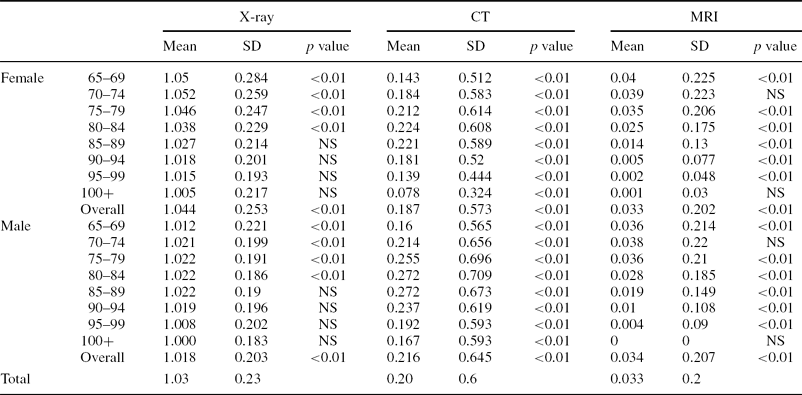
As indicated in Table 1, X-ray was the most used diagnostic imaging service during the 1-year study period with an overall mean of 1.03 X-rays per person (SD = 0.23). Females received significantly more X-rays than males (p < .01). This gender difference was statistically significant from the 65–69 age group to the 80–84, but disappeared in the oldest age groups. Overall utilization patterns increased with age to the 70–74 age group, and declined with each age group.
Utilization of Diagnostic Imaging among Seniors by Age and Gender, Ontario, 2005–06

With respect to CT services, the overall mean number of scans per person during the 1-year study period was 0.22 (SD = 0.6). On average, males received significantly more CT scans than females (p < .01). The gender difference was statistically significant across all age groups. CT scans for both females and males increased with advancing age, peaking in the 80–84 age group, followed by a decline thereafter.
The mean number of MRI scans during the 1-year study period was 0.033 (SD = 0.2). Females received significantly more scans in the 65–69 age group, but from the age of 75 on, males averaged significantly more utilization. MRI scans peaked in the 70–74 age group and decreased with advancing age.
Non/Moderate/High Use of Diagnostic Imaging Services
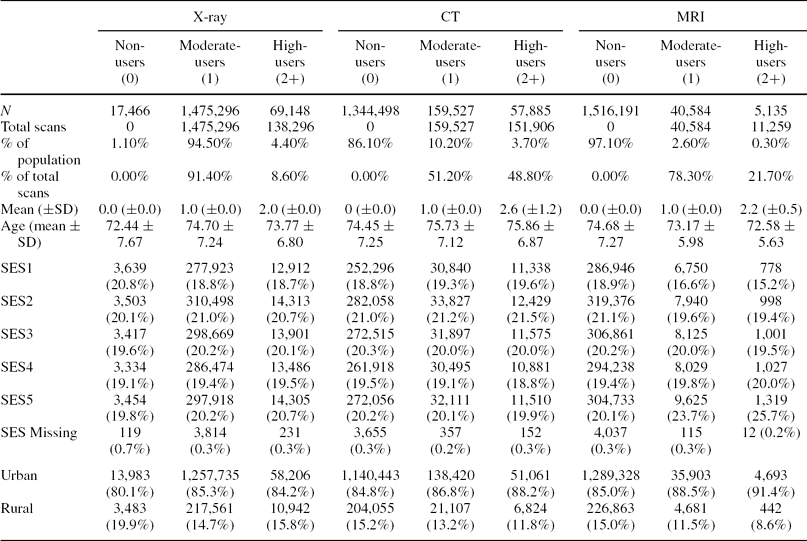
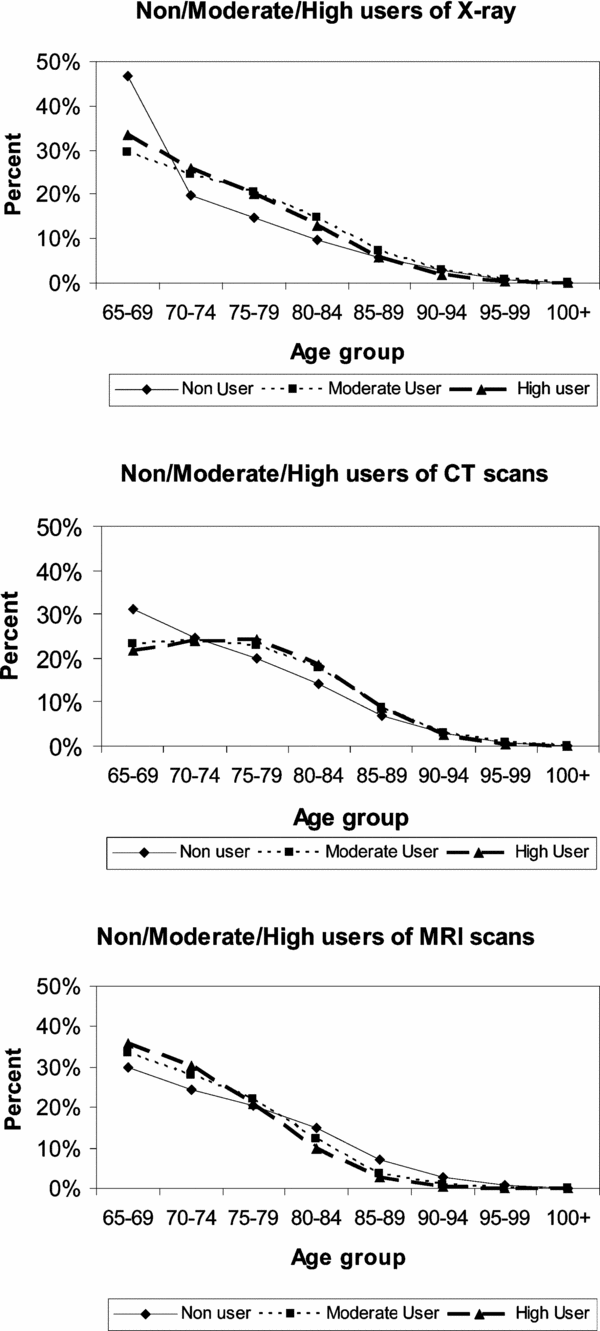
Table 2 and Figure 1 present patterns of utilization for non-, moderate-, and high-users of diagnostic imaging services. For X-ray services, 4.4 percent of the total population accounted for 8.3 percent of all X-rays taken. The average age on service date was 74.6 years for X-rays (73.8 for high-users, 74.7 for medium-users and 72.4 for non-users). High-users of X-rays were largely female (Table 3).
Patterns of Diagnostic Imaging Utilization among Seniors, Ontario, 2005–06

Patterns of utilization for non/moderate/high-users of diagnostic imaging services by age group.

Utilization of Diagnostic Imaging among Seniors by Gender, Ontario, 2005–06

With regard to CT, the vast majority of the population (86.1 percent) did not receive CT services during the study period. A very small proportion of patients (3.7 percent) accounted for nearly half (48.8 percent) of all scans performed during the study year. The average age on service date was 74.6 years for CT scans (75.9 for high-users, 75.7 for moderate-users, and 74.5 for non-users). High-users of CT scans were more likely to be male.
Finally, for MRI services, most of the population (97.1 percent) did not receive a scan. As with CT scans, a very small proportion of patients (0.3 percent) accounted for a significant share (21.7 percent) of the total scans performed. The average age on service date was 74.6 years for MRI scans (72.6 for high-users, 73.2 for medium-users, and 74.7 for non-users) (Table 2). There was no gender difference among high-users of MRI.
Impact of SES on Utilization of Diagnostic Imaging Services
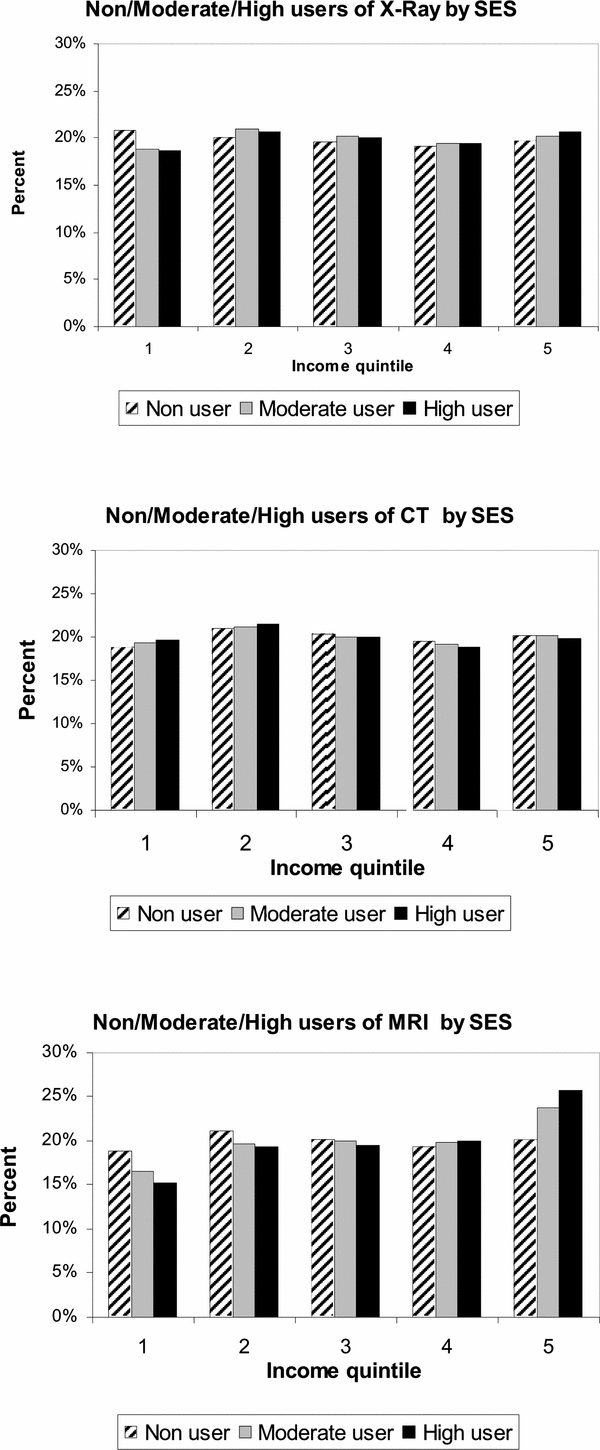
The percentage of patients from the five income quintiles differed significantly for each service, as well as among non-, moderate-, and high-users (Table 2, Figure 2). The rate ratio of SES 1 to SES 5 (Table 4) shows that for MRI, there is a SES gradient from non-users to high-users; that there are more non-users with the lowest SES, and more high-users have the highest SES. No differences were observed for X-ray and CT.
Patterns of utilization for non/moderate/high-users of diagnostic imaging services by SES.

Utilization of Diagnostic Imaging among Seniors by SES Quintile, Ontario, 2005–06

DISCUSSION
Utilization of diagnostic imaging services among Ontarians aged 65+ is markedly higher than for their younger counterparts (Reference Laupacis, Przybysz, Keller, Tu, Pinfold, McColgan and Laupacis14). Utilization of diagnostic imaging followed an inverted U-pattern: increasing with advancing age, peaking in the 80–84 age group for CT scans and the 70–74 age group for MRI and X-rays, and then declining in the later years. There is also a small proportion of the older population who account for the large majority of diagnostic imaging. Finally, we report an SES-based disparity for MRI utilization in which high-users were more likely to have a high SES.
Our data indicate that a small proportion of patients accounts for a disproportionate share of total utilization of diagnostic imaging services. High-users of diagnostic imagining were more likely to be female for CT scans and male for X-rays. This is consistent with previous studies of overall healthcare utilization, total outpatient expenditures, and hospital admissions (Reference Demers4;Reference Freeborn, Pope, Mullooly and McFarland7;Reference Reid, Evans and Barer20). Our results also showed higher utilization of MRI scans by people of higher socioeconomic status. Similar results have been shown in the rest of Canada and in other countries around the world (Reference Demeter, Reed, Lix, MacWilliam and Leslie5;Reference Lysdahl and Børretzen15;Reference You, Alter and Iron25). The report Access to Health Services in Ontario reported that in 2004/05 individuals living in the poorest neighborhoods were 33 percent less likely to receive an MRI scan than those living in the wealthiest neighborhoods (Reference Laupacis, Przybysz, Keller, Tu, Pinfold, McColgan and Laupacis14). Similarly, it has been shown that Manitobans living in poorer neighborhoods had fewer diagnostic imaging tests than those living in wealthier neighborhoods (Reference Demeter, Reed, Lix, MacWilliam and Leslie5). Using population-level data, the authors found that rates of use of a wide variety of diagnostic imaging procedures were strikingly higher (often more than twofold) in the highest income groups, irrespective of age or level of morbidity. These data are limited, however, by the classification of all those aged 65 and above as one homogenous group.
Individuals living in neighborhoods of lower SES are generally in poorer health than those living in wealthy neighborhoods (Reference Glazier, Tepper, Agha, Moineddin, Jaakkimainen, Upshur, Klein-Geltink, Leong, Maaten, Schultz and Wang9). It is thus surprising that MRI scanning is higher for those living in wealthier neighborhoods. Systematic differences in healthcare delivery cannot be accounted for by medical need alone, and lower rates of utilization could reflect unmet needs in certain populations. It is unclear what factors other than healthcare needs drive MRI utilization (Reference Frohlich, Fransoo and Roos8;Reference Laupacis, Keller, Przybysz, Tu, Pinfold, McColgan and Laupacis12;Reference Laupacis, Przybysz, Keller, Tu, Pinfold, McColgan and Laupacis14). Higher SES has been demonstrated to be a significant predictor of angiography use after acute myocardial infarction in Canada (Reference Alter, Naylor, Austin, Chan and Tu1). People in higher SES groups may be more likely to have a regular family physician, to be better educated about sophisticated imaging technologies, more assertive healthcare consumers, and to have better access to specialists who would refer them for imaging studies.
Furthermore, our results show that men account for a disproportionate share of high-users of CT scans. Gender disparities have been found previously for other services. For example, among patients aged 50 years and older, women appear less likely than men to be admitted to an ICU and less likely than men to receive selected life-supporting treatments (Reference Fowler, Sabur and Li6). It has also been shown that physicians are more likely to recommend total knee arthroplasty for male patients than for female patients, with referral rates for men nearly 22 times higher (Reference Borkhoff, Hawker and Kreder2). Where differences should arise, it is likely that patient, provider, and system factors are at play (Reference Laupacis and Evans13;Reference Noseworthy18;Reference Stein23).
To the best of our knowledge, this is the first study to investigate variability in diagnostic imaging services utilization across the late life course. Our analysis is based on a large population sample with reliable database linkages at the individual level, yet it is important to note several limitations with our study. Individuals without a valid health card number were not included in our analysis because they could not be identified in the RPDB. The OHIP database includes only fee-for-service claims; therefore, physicians and patients enrolled in alternative payment plans were not captured, nor were utilization events within other significant sectors of the Ontario healthcare system (e.g., chronic care/long-term care, home care, physiotherapy, etc.). Exclusion of these services leads to an underestimation of overall utilization of services.
POLICY IMPLICATIONS
Population aging will lead to increased demand for diagnostic imaging. The present findings have significant implications for health policy and planning. Utilization of diagnostic imaging followed an inverted U-pattern across the late life course, peaking in 70–84 age range. This pattern suggests that there will be a planning need to accommodate the aging baby-boom population as it approaches this age bracket. With respect to gender, our data indicate that females receive significantly more X-rays than males, while males receive significantly more CT and MRI scans. Given that similar gender patterns have been found for other health services, further research is required to inform policy directives to address these apparent discrepancies.
Finally, despite access to universal health care in Canada, we found significant evidence of SES-based disparities in utilization of MRI services, in that higher SES was associated with higher MRI utilization. If health care is to be fully accessible, there may be a need for programs to target underserved populations to reduce remediable inequities. While patient-level decisions regarding the use of diagnostic imaging are rightfully determined on the basis of clinical factors, such as severity of condition and prognosis, we would argue that meso- and macro-level allocation decisions should also be based on the ethical principles of equity and fairness, especially in an environment of limited healthcare resources.
CONTACT INFORMATION
Li Wang, MD, MSc (li.wang@sunnybrook.ca), Research Associate, Jason X. Nie, BSc (jason.nie@sunnybrook.ca), Research Assistant, C. Shawn Tracy, MSc (shawn.tracy@sunnybrook.ca), Research Associate, Primary Care Research Unit, Sunnybrook HSC, 2075 Bayview Avenue E354, Toronto, Ontario M4N 3M5, Canada Rahim Moineddin, PhD (rahim.moineddin@utoronto.ca), Associate Professor, Department of Family and Community Medicine and Public Health Sciences, University of Toronto, 263 McCaul Street, Toronto, Ontario M5T 2W7, Canada; Institute for Clinical Evaluative Sciences, Sunnybrook Health Sciences Centre, 2075 Bayview Avenue E354, Toronto, Ontario M4N 3M5, Canada
Ross E. G. Upshur, MD, MA, MSc (ross.upshur@sunnybrook.ca), Associate Professor, Department of Family and Community Medicine and Public Health Sciences, University of Toronto, 263 McCaul Street, Toronto, Ontario M5T 2W7, Canada; Director, Primary Care Research Unit, Sunnybrook Health Sciences Centre, 2075 Bayview Avenue E354, Toronto, Ontario M4N 3M5, Canada