Introduction
Cannabis is one of the most frequently used illicit drugs in the world (UN Office on Drugs and Crime, 2010). Young people are using it at an earlier age (Smith & Flatley, Reference Smith and Flatley2011), to the extent that it is replacing cigarette smoking as the most common substance used by them (Moss et al. Reference Moss, Chen and Yi2013). Based on evidence from observational studies, cannabis use has been linked to a number of effects on cognition and behaviour (Ranganathan & D'Souza, Reference Ranganathan and D'Souza2006; Solowij & Pesa, Reference Solowij and Pesa2010), with memory being one of the most robustly replicated cognitive functions which has been reported to be impaired following chronic (non-acute) cannabis use (Grant et al. Reference Grant, Gonzales, Carey, Natarajan and Wolfson2003; Fletcher & Honey, Reference Fletcher and Honey2006; Solowij & Battisti, Reference Solowij and Battisti2008; Solowij & Pesa, Reference Solowij and Pesa2010; Schoeler & Bhattacharyya, Reference Schoeler and Bhattacharyya2013). Meta-analyses of observational studies comparing cannabis-using subjects with non-using subjects have reported small (Grant et al. Reference Grant, Gonzales, Carey, Natarajan and Wolfson2003) to medium-sized effects (Schreiner & Dunn, Reference Schreiner and Dunn2012) of cannabis on verbal memory performance, consistent with evidence that regular cannabis use affects the structure (Matochik et al. Reference Matochik, Eldreth, Cadet and Bolla2005; Yucel et al. Reference Yucel, Solowij, Respondek, Whittle, Fornito, Pantelis and Lubman2008) and function (Kanayama et al. Reference Kanayama, Rogowska, Pope, Gruber and Yurgelun-Todd2004; Sneider et al. Reference Sneider, Pope, Silveri, Simpson, Gruber and Yurgelun-Todd2008) of brain regions involved in memory processing. As discussed by Solowij & Battisti (Reference Solowij and Battisti2008), accumulating evidence suggests that the magnitude and persistence of cognitive impairment associated with cannabis use depends on various parameters such as age of onset (Pope et al. Reference Pope, Gruber, Hudson, Cohane, Huestis and Yurgelun-Todd2003; Gruber et al. Reference Gruber, Sagar, Dahlgren, Racine and Lukas2012), dose (Bolla et al. Reference Bolla, Brown, Eldreth, Tate and Cadet2002), frequency (Jager et al. Reference Jager, Kahn, Van Den Brink, Van Ree and Ramsey2006; Tait et al. Reference Tait, Mackinnon and Christensen2011), and duration of cannabis use (Meier et al. Reference Meier, Caspi, Ambler, Harrington, Houts, Keefe, McDonald, Ward, Poulton and Moffitt2012) as well as the period of abstinence from cannabis (Pope et al. Reference Pope, Gruber, Hudson, Huestis and Yurgelun-Todd2001) at the time of testing, all of them interacting with each other to predict the degree of impairment (Wagner et al. Reference Wagner, Becker, Gouzoulis-Mayfrank and Daumann2010).
Δ-9-Tetrahydrocannabinol (THC), the main psychoactive ingredient of cannabis, is thought to be responsible for the adverse effects of cannabis on cognition. Experimental studies involving acute challenge with THC have reported that cannabis can impair short-term (Morrison et al. Reference Morrison, Zois, McKeown, Lee, Holt, Powell, Kapur and Murray2009; Englund et al. Reference Englund, Morrison, Nottage, Hague, Kane, Bonaccorso, Stone, Reichenberg, Brenneisen and Holt2013) and long-term memory function (Curran et al. Reference Curran, Brignell, Fletcher, Middleton and Henry2002; D'Souza et al. Reference D'Souza, Perry, MacDougall, Ammerman, Cooper, Wu, Braley, Gueorguieva and Krystal2004) and alter the neural substrates underlying learning and memory (Bhattacharyya et al. Reference Bhattacharyya, Fusar-Poli, Borgwardt, Martin-Santos, Nosarti, O'Carroll, Allen, Seal, Fletcher, Crippa, Giampietro, Mechelli, Atakan and McGuire2009, Reference Bhattacharyya, Atakan, Martin-Santos, Crippa, Kambeitz, Prata, Williams, Brammer, Collier and McGuire2012) in healthy subjects, for which reason THC administration has also been proposed as a strategy to model and study schizophrenia pathophysiology (Fletcher & Honey, Reference Fletcher and Honey2006).
Among individuals suffering from a psychotic disorder, co-morbid substance use disorders including cannabis use are higher than in the general population (Koskinen et al. Reference Koskinen, Löhönen, Koponen, Isohanni and Miettunen2010). Cannabis use is also associated with an increased risk of relapse (Linszen et al. Reference Linszen, Dingemans, Nugter, Van der Does, Scholte and Lenior1997), and of violence and criminal activity (Miles et al. Reference Miles, Johnson, Amponsah-Afuwape, Finch, Leese and Thornicroft2003) in patients with psychosis. Although experimental acute challenge studies suggest that acute impairments in memory induced by THC are greater in those with a psychotic disorder (D'Souza et al. Reference D'Souza, Abi-Saab, Madonick, Forselius-Bielen, Doersch, Braley, Gueorguieva, Cooper and Krystal2005) than healthy controls, evidence from naturalistic studies in patients with psychosis have not been as straightforward. Epidemiological studies and meta-analyses investigating the non-acute effects of cannabis use in patient samples have either reported better performance in different domains of memory such as working memory (Jockers-Scherubl et al. Reference Jockers-Scherubl, Wolf, Radzei, Schlattmann, Rentzsch, Gomez-Carrillo de Castro and Kuhl2007; Løberg et al. Reference Løberg, Hugdahl and Jørgensen2008; Rabin et al. Reference Rabin, Zakzanis and George2011) and verbal learning (Schnell et al. Reference Schnell, Koethe, Daumann and Gouzoulis-Mayfrank2009; Leeson et al. Reference Leeson, Harrison, Ron, Barnes and Joyce2012) or no significant difference between cannabis-using and non-using patients (Korver et al. Reference Korver, Nieman, Becker, van de Fliert, Dingemans, de Haan, Spiering, Schmitz and Linszen2010; Donoghue et al. Reference Donoghue, Mazzoncini, Hart, Zanelli, Morgan, Dazzan, Morgan, Murray, Jones and Doody2012; Bahorik et al. Reference Bahorik, Newhill and Eack2013).
The evidence summarized above suggests that the same drug, which is known to be a risk factor for psychosis and is associated with memory impairment in healthy users, appears to have an association with better memory performance in users with a psychotic disorder. In light of these paradoxical trends in the non-acute effects of cannabis use on memory in healthy users v. those with psychosis, especially when this is contrasted with experimental evidence of the acute effects in these two groups (D'Souza et al. Reference D'Souza, Abi-Saab, Madonick, Forselius-Bielen, Doersch, Braley, Gueorguieva, Cooper and Krystal2005), the objective of the present study was to systematically summarize the non-acute effects (based on observational studies) of cannabis use on memory function both in those with and without a psychotic disorder. Elucidating this is important to advance current understanding of the association between cannabis use and psychosis and determinants of this association, which in turn may help devise intervention strategies. To our knowledge, no study has as yet carried out a systematic quantitative synthesis of the literature employing meta-analytic techniques in both healthy and psychotic users regarding the long-term effects of cannabis use on the different subdomains within memory function, defined as a multidimensional construct.
We employed a meta-analytic approach to statistically integrate the results from multiple individual studies. In the present analysis we have focused on non-acute effects, thus including both residual and chronic effects. We employed an inclusive definition in order to have the power to detect the effect of cannabis use in both healthy and psychotic users. Hence, all studies comparing cannabis users with non-users were included, independent of the time of abstinence from cannabis/results from urine tests. However, to address the issue of residual effects, we examined the effect of abstinence by carrying out moderation analysis (described below). This allowed us to address the following questions:
-
(i) Does the non-acute effect of cannabis on memory function differ significantly between healthy individuals and those with a psychotic disorder?
-
(ii) Is there a domain-specific effect of cannabis on memory?
-
(iii) Are there particular demographic and individual differences between healthy cannabis users and cannabis-using patients with psychosis that may be related to the differential effects of cannabis use on memory in these two groups of cannabis users?
-
(iv) Does the magnitude of the effect of cannabis use on memory depend on certain cannabis use characteristics such as frequency, duration, age of onset of use and duration of abstinence at the time of testing?
Method
Search strategy and selection criteria
Following recommended guidelines (Higgins & Green, Reference Higgins and Green2008; Beller et al. Reference Beller, Glasziou, Altman, Hopewell, Bastian, Chalmers, Gøtzsche, Lasserson and Tovey2013), a systematic search strategy was used to identify all relevant studies. The MEDLINE database was searched for English language studies using a combination of search terms describing the outcome of interest (neuropsych*, cognit*, memory, learning, recall) and cannabis use (marijuana/marihuana, cannabis, THC, cannabinol, cannabidiol), with the final search conducted on 27 June 2014. Following further bibliography searches of previously published reviews and meta-analyses (Gonzalez et al. Reference Gonzalez, Carey and Grant2002; Grant et al. Reference Grant, Gonzales, Carey, Natarajan and Wolfson2003; Potvin et al. Reference Potvin, Joyal, Pelletier and Stip2008; Rabin et al. Reference Rabin, Zakzanis and George2011; Donoghue & Doody, Reference Donoghue and Doody2012; Schreiner & Dunn, Reference Schreiner and Dunn2012; Yücel et al. Reference Yücel, Bora, Lubman, Solowij, Brewer, Cotton, Conus, Takagi, Fornito and Wood2012), studies were selected if they met the inclusion criteria (for a flowchart, see Supplementary Fig. S1).
Recorded variables
Memory was considered as a multidimensional construct (Kambeitz et al. Reference Kambeitz, Bhattacharyya, Kambeitz-Ilankovic, Valli, Collier and McGuire2012), including 11 distinct memory dimensions, classified based on temporal characteristics (i.e. from short-term memory to long-term memory) or based on its content (i.e. verbal or visual memory) (Pezdek & Evans, Reference Pezdek and Evans1979) (see Supplementary Fig. S1 and Supplementary Table S1). As a common metric for the estimate of effect size, Cohen's d or the standardized mean difference (SMD) between the means of cannabis users v. non-users was estimated for each neuropsychological test that measured an aspect of memory functioning. This was followed by sensitivity analysis in a more homogeneous group (Kambeitz et al. Reference Kambeitz, Bhattacharyya, Kambeitz-Ilankovic, Valli, Collier and McGuire2012) that involved computing the effect-size estimate using the same approach as above, but including only the data from studies that employed the same memory test (see Supplementary Appendix S1). Demographic and clinical characteristics [pre-morbid intelligence quotient (IQ), depression, anxiety and level of global functioning] were compared using another set of SMDs estimated from data for those measures reported as means and standard deviations (see Supplementary Table S2).
Following established guidelines, subgroup and meta-regression analyses were carried out for duration, frequency, age of onset and abstinence from cannabis use as well as for cigarette and alcohol use and year of publication (for classification criteria, see Supplementary Appendix S1).
Analysis
Analyses were conducted with the metaphor package (Viechtbauer, Reference Viechtbauer2010) in R, using random-effects models (Lane et al. Reference Lane, Cherek, Lieving and Tcheremissine2005) that assume that the SMDs vary from study to study (Borenstein et al. Reference Borenstein, Hedges, Higgins and Rothstein2011) (for details, see Supplementary Appendix S1). Cohen's d for memory outcome was estimated according to established guidelines (Higgins & Green, Reference Higgins and Green2008). In a second set of random-effects models, SMDs for demographic and clinical variables in cannabis users v. non-users were estimated. Missing data, potential publication bias and heterogeneity assessment were considered following recommended procedures. To investigate sources of heterogeneity, the influence of continuous moderator variables, including the SMDs estimated for demographic and clinical variables, on Cohen's d for memory was tested using mixed-effect models (Viechtbauer, Reference Viechtbauer2010).
Results
After excluding irrelevant studies or those that did not satisfy our criteria, a final sample of n = 88 studies (number of domain-specific substudies k = 303), comprising 7697 healthy subjects and 3261 subjects with a psychotic disorder was included (see Supplementary Fig. S1 and Supplementary Table S3).
Random-effects models: effect of cannabis on memory function in cannabis users with and without a psychotic disorder
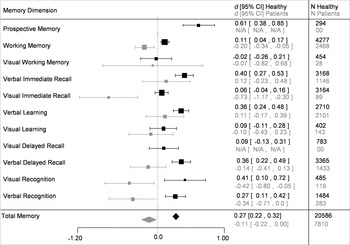
Cannabis use significantly impaired global memory (d = 0.27, p < 0.0001; Fig. 1) in healthy cannabis users relative to non-users. Conversely, in patients with psychosis, cannabis use was associated with better performance in these tasks, with a modest effect size (d = −0.11, p = 0.05). Substantial overall heterogeneities (I 2 = 72%, see Supplementary Table S4) indicated that moderators are likely to have influenced the effect of cannabis use on memory (Song et al. Reference Song, Sheldon, Sutton, Abrams and Jones2001). Moderator analysis indicated that the effect-size estimates were significantly different (p < 0.0001) between the two diagnostic groups (patient v. healthy).
Random-effects models for global memory and different memory dimensions in healthy subjects (■) and patients ( ). Effect-size estimate Cohen's d indicates differences in memory outcome between non-users and cannabis users, with larger estimates reflecting worse performance in cannabis users. N is the number of subjects per memory dimension, including cannabis users plus non-users. CI, Confidence interval.

In the healthy sample, most of the memory dimensions were significantly impaired by cannabis use, with the most pronounced impairments being observed for prospective memory. Within the patient sample, cannabis users had either no impairments or performed significantly better in several assessed memory dimensions (working memory, visual immediate recall, visual recognition, verbal recognition) (Fig. 1). Moderator analysis indicated that the effect-size estimates were significantly different (p < 0.001) between the different memory dimensions within the healthy sample, but not in the patients (p = 0.15). Dimension-specific effects in healthy individuals were not related to the size of sample examined for each dimension (Supplementary Table S5). Funnel plots (Supplementary Fig. S2) and Egger's test indicated that publication bias was present within the healthy sample (p < 0.005) but not the patient sample (p = 0.34) for global memory. The corrected model revealed an effect-size estimate of Cohen's d = 0.18 (p < 0.0001). Supplementary Table S6 details the test results for publication bias for global memory and each memory dimension separately.
Sensitivity analysis to address the issue of heterogeneity in the measures employed resulted in an even larger-sized, statistically significant effect of cannabis use on immediate recall (d = 0.52, p < 0.0001) and verbal learning (d = 0.52, p < 0.0001) in the healthy sample by including only studies that employed the Rey Auditory Verbal Learning Test (RAVLT) (see Supplementary Table S7). Results with the RAVLT in the patient sample were similar (immediate recall: d = −0.10; verbal learning: d = −0.05) to the larger inclusive sample.
Mixed-effects models: test of moderators
Clinical moderators of effects of cannabis action
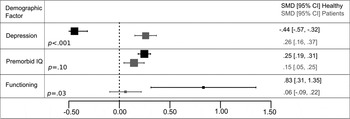
Meta-regression (Supplementary Table S8) suggested a significant moderating effect of SMDs (SMDs between cannabis users and non-users) estimated for level of functioning, pre-morbid IQ and level of depression, implicating a more pronounced effect on global memory in those cannabis-using subjects with a lower level of functioning and pre-morbid IQ, as well as higher levels of depression relative to non-using controls. We then examined the extent to which these factors may have contributed to the different patterns of effect of cannabis in healthy and patient groups, by comparing the SMDs estimated for each moderator variable per study between the two diagnostic groups (healthy v. patients). As shown in Fig. 2, healthy cannabis users showed higher levels of depression when compared with non-users (SMD = −0.44, p < 0.0001), while in the patient sample cannabis users had lower levels of depression than non-users (SMD = 0.27, p < 0.0001). Healthy cannabis users were characterized by lower levels of functioning when compared with healthy non-users (SMD = 0.83, p = 0.002), whilst no such effect was present in the patient sample (SMD = 0.06, p = 0.43).
Differences in standardized mean difference (SMD) for clinical factors between healthy subjects (■) and patients ( ). SMDs in clinical parameters [depression scores, pre-morbid intelligence quotient (IQ) and functioning scores] are shown between non-users and cannabis users, with larger SMDs reflecting lower scores (lower depression levels, lower pre-morbid IQ, lower functioning) in cannabis users. The p value is the estimated significance level for the categorical moderator (healthy v. patients) in mixed-effects models for SMD in depression scores, pre-morbid IQ and functioning scores between non-users and cannabis users. CI, Confidence interval.

Effect of age
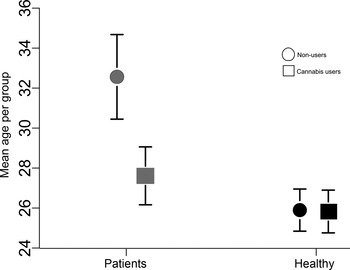
Meta-regression showed that age at the time of performance of memory tasks significantly moderated the adverse effects of cannabis use on memory (slope coefficient of −0.20, p < 0.0001). This effect was such that the younger the cannabis user compared with the non-user at the time of cognitive testing, the smaller was the magnitude of the adverse effect of cannabis use on memory function. While cannabis users in the healthy sample appeared to be matched in terms of their mean age to the non-users (25.6 years v. 25.6 years, t = 0.30, p = 0.76), the cannabis-using patients were on average 5 years younger than the non-using patients (mean = 32.5 years v. 27.6 years, t = 9.08, p < 0.0001) (see Fig. 3).
Mean differences in age between groups. There were significant differences in mean age between cannabis users and non-users in patients (p < 0.0001) but not the healthy sample (p = 0.76).

Effect of cannabis use characteristics
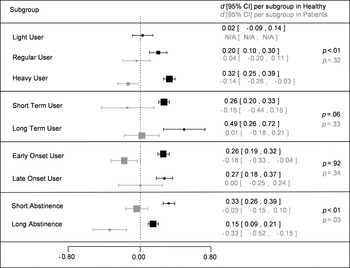
Categorical moderator analysis revealed that those cannabis users in the healthy and patient groups abstaining from the substance for 10 days or more before performing memory tasks did better in memory tests when compared with those who had abstained for less than 10 days (Fig. 4). In the healthy sample, significantly greater memory impairments were present in heavy users when compared with moderate or light users, while the frequency of cannabis use was not a significant moderator in the patient sample. There was a trend toward a dose–response relationship (p = 0.06) between the duration of cannabis use and effect on memory, such that larger effect sizes were reported in long-term healthy cannabis users compared with short-term users. Age of onset of cannabis use did not appear to moderate the adverse effects of cannabis in both groups.
Categorical moderator analysis based on cannabis use patterns in healthy subjects (■) and patients ( ). Effect-size estimate Cohen's d indicates differences in memory outcome between non-users and cannabis users, with larger estimates reflecting worse performance in cannabis users. The p value is the estimated significance level for each categorical moderator (i.e. frequency of use, duration of use, onset of use, abstinence from cannabis) in moderator analysis. ‘Light user’ indicates less than four times/month or less than 10 joints/month; ‘regular user’ indicates between four and 20 times/month or between 10 and 25 joints/month; ‘heavy user’ indicates diagnosis of cannabis dependence or more than 20 times/month or more than 30 joints/month; ‘short term user’ indicates cannabis use less than 2500 days of use; ‘long term user’ indicates more than 5000 days of use; ‘early onset user’ indicates cannabis use before the age of 17 years; ‘late onset user’ indicates cannabis use after the age of 17 years; ‘short abstinence’ indicates less than 10 days of abstinence; ‘long abstinence’ indicates more than 10 days of abstinence; CI, confidence interval; N/A, not applicable.

Effect of difference in co-morbid alcohol and nicotine use
Subgroup analysis suggested that differences in alcohol and nicotine use patterns did not significantly (p < 0.05) moderate the effects of cannabis on memory function (see Supplementary Fig. S3).
Effect of year of publication
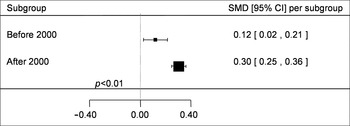
In the healthy sample, there was a significant effect of date of publication on the effect of cannabis on memory, i.e. studies that were published before 2000 reported a significant but small effect size of d = 0.12, whereas studies published after 2000 reported a significant moderate effect size of d = 0.31, which were significantly different in comparison (p = 0.01; see Fig. 5). This comparison could not be carried out in the patient sample, considering that all of the studies in patients were published after 2000 (see Supplementary Table S3).
Categorical moderator analysis: year of publication. Standardized mean differences (SMDs) are shown in memory outcome between non-users and cannabis users in the healthy sample, with larger SMDs reflecting worse performance in cannabis users. The p value is the estimated significance level for the categorical moderator year of publication (before 2000 v. after 2000). ‘Before 2000’ indicates studies published before the year 2000; ‘after 2000’ indicates studies published after the year 2000. CI, Confidence interval.

Discussion
Results presented here suggest that cannabis use has a robust but modest adverse effect on global memory function as well as its multiple component dimensions in healthy cannabis users, with the precise magnitude of the effect depending on the specific dimension of memory tested. This replicates the results of previous reviews (Solowij & Battisti, Reference Solowij and Battisti2008) and meta-analyses that reported small impairments in memory in healthy cannabis users, with effect sizes ranging from d = 0.16 to d = 0.32 (Grant et al. Reference Grant, Gonzales, Carey, Natarajan and Wolfson2003; Schreiner & Dunn, Reference Schreiner and Dunn2012). Furthermore, our results implicate selective effects of cannabis on aspects of memory in healthy users, with the largest effect sizes reported for prospective (d = 0.61) and retrospective memory with both verbal (e.g. verbal learning, immediate and delayed recall) and visual content (e.g. visual recognition). In practical terms, these results suggest that the effects of cannabis use are more likely to be expressed in impairments in day-to-day activities that require the ability to remember to carry out the intended task at some point of time in the future (e.g. meeting a friend or taking medication) or problems in recalling events from the past (e.g. recalling past conversations). The effects on rather longer-term memory functions may also reflect the high density of CB1 receptors, the main target of cannabinoids, in brain structures critically involved in longer-term memory processes such as the hippocampus, basal ganglia and cerebellum (Herkenham et al. Reference Herkenham, Lynn, Little, Johnson, Melvin, De Costa and Rice1990; Eichenbaum, Reference Eichenbaum1993; Packard & Knowlton, Reference Packard and Knowlton2002), with cannabinoids preventing hippocampal long-term potentiation, a potential substrate for memory (for a review, see Iversen, Reference Iversen2003) through a downstream effect on a number of neuromodulator/ neurotransmitter systems (Pertwee, Reference Pertwee2008). Strikingly, the results indicate better overall memory performance in cannabis-using patients when compared with non-users (d = −0.11), particularly for the domains of visual immediate recall (d = −0.73), verbal recognition (d = −0.34) and visual recognition (d = −0.41), which is in line with earlier meta-analytical findings of either a lack of adverse effect of cannabis on cognitive abilities in patients with a psychotic disorder (Løberg & Hugdahl, Reference Løberg and Hugdahl2009; Yücel et al. Reference Yücel, Bora, Lubman, Solowij, Brewer, Cotton, Conus, Takagi, Fornito and Wood2012) or association with better attention and psychomotor speed (Donoghue & Doody, Reference Donoghue and Doody2012), reasoning, problem-solving and visual memory (Potvin et al. Reference Potvin, Joyal, Pelletier and Stip2008) and neurological soft signs (Ruiz-Veguilla et al. Reference Ruiz-Veguilla, Callado and Ferrin2012). A recent meta-analysis also reported that psychotic patients with unspecified co-morbid substance use disorder performed significantly better in tests measuring verbal learning and memory (d = −0.26) than those without (Donoghue & Doody, Reference Donoghue and Doody2012). Better verbal memory function related to substance use has also been reported in a subsequent study comprising a sample of first-episode psychosis for verbal memory function (Lutgens et al. Reference Lutgens, Lepage, Iyer and Malla2014), while no effect of polydrug use was present on working memory in schizophrenia patients (Wojtalik & Barch, Reference Wojtalik and Barch2014). Similarly, no adverse effects of cocaine on verbal learning and memory were present in patient samples (Donoghue & Doody, Reference Donoghue and Doody2012). In summary, cannabis appears to have differential effects on memory in users with and without a psychotic disorder, a phenomenon that has also been referred to as the paradox effect of the dually diagnosed (Penk et al. Reference Penk, Flannery, Irvin, Geller, Fisher and Hanson2000; Moreno-Granados et al. Reference Moreno-Granados, Ferrín, Salcedo-Marín and Ruiz-Veguilla2014).
Meta-regression indicated that several factors such as lower levels of depression, higher levels of functioning and a younger age at the time of cognitive assessment may have attenuated the adverse effects of cannabis on memory, whilst other factors such as years of education, level of anxiety, co-morbid nicotine and alcohol use did not appear to moderate the effects of cannabis. First, on comparing the healthy and patient groups, cannabis-using patients appeared to be less depressed than the non-users, while an opposite pattern was evident in the healthy sample. This may suggest that co-morbid depressive symptoms may partly account for the apparent opposite effects of cannabis use on memory function in healthy users v. those with a psychotic disorder. In fact, depressive symptoms have been associated with impairments in cognitive function in healthy subjects, including episodic and semantic memory, as well as executive function (McDermott & Ebmeier, Reference McDermott and Ebmeier2009), and have also been linked to impairments in recall and recognition memory in schizophrenia patients (Burt et al. Reference Burt, Zembar and Niederehe1995).
Second, age differences between cannabis users and non-users may have significantly moderated the effect of cannabis use on memory. Adverse effects of cannabis on memory seemed to increase with increasing age differences between cannabis users and non-user (i.e. the older the cannabis user in comparison with the non-user, the larger the impairing effect of cannabis on memory), consistent with a previous meta-analysis reporting an association between older age and a stronger detrimental effect of cannabis use on global cognition, as well as on working memory and processing speed in patients with a psychotic disorder (Potvin et al. Reference Potvin, Joyal, Pelletier and Stip2008). This may in fact be an effect of age-related worsening of memory performance (Vakil & Blachstein, Reference Vakil and Blachstein1997; Benedict et al. Reference Benedict, Schretlen, Groninger and Brandt1998), unrelated to the effect of cannabis exposure or the duration of exposure to cannabis. In the studies included in the present meta-analysis, healthy cannabis users and non-users did not differ in their average age, implicating that age was not a confounding factor in this group. However, in the studies that investigated patients with psychosis, cannabis-using patients were on average 5 years younger than the non-users (see Fig. 3). Performance in verbal memory tests are sensitive to changes in age of testing within the age ranges of participants reported in these studies (Hulicka, Reference Hulicka1966), with younger age being associated with better performance in the Hopkins Verbal Learning Test (Benedict et al. Reference Benedict, Schretlen, Groninger and Brandt1998) as well as in learning and recall measures from the RAVLT (Vakil & Blachstein, Reference Vakil and Blachstein1997). This may partly explain the better memory performance in cannabis-using patients relative to non-users.
A further explanation for the paradoxical findings in patients lies in the fact that many patients with schizophrenia are thought to have a neurodevelopmental disorder (Murray & Lewis, Reference Murray and Lewis1987) while drug abuse may provide an alternative pathway to developing psychosis (Murray et al. Reference Murray, Paparelli, Morrison, Marconi and Di Forti2013). Such a view would suggest that cannabis-using patients with psychosis may represent a subgroup with less neurodevelopmental pathology (Yücel et al. Reference Yücel, Bora, Lubman, Solowij, Brewer, Cotton, Conus, Takagi, Fornito and Wood2012; Ferraro et al. Reference Ferraro, Russo, O'Connor, Wiffen, Falcone, Sideli, Gardner-Sood, Stilo, Trotta, Dazzan, Mondelli, Taylor, Friedman, Sallis, La Cascia, La Barbera, David, Reichenberg, Murray and Di Forti2013) and less neurocognitive impairment than non-using patients in the first place. Perhaps, another explanation that does not pitch the neurodevelopmental pathway and drug abuse as alternative pathways to psychosis may be that cannabis-using patients with psychosis have better neurocognitive function to begin with. This idea is further supported by reports of absence of impaired cognition in association with use of a number of psychoactive substances (alcohol, cannabis, hallucinogens, cocaine, stimulants) in those with psychosis (Pencer & Addington, Reference Pencer and Addington2003; Potvin et al. Reference Potvin, Joyal, Pelletier and Stip2008) and evidence that substance-using schizophrenia patients were characterized by better social functioning and fewer negative symptoms when compared with non-users (Salyers & Mueser, Reference Salyers and Mueser2001; Carey et al. Reference Carey, Carey and Simons2003).
Duration of abstinence from cannabis had a significant effect on memory function in both groups, such that the longer the duration of abstinence from cannabis, the smaller was the size of impairment observed, suggesting perhaps that worse memory performance associated with cannabis use may be largely but not completely reversible. These results are consistent with studies in healthy users reporting smaller effects of cannabis on memory in former users when compared with those who had never used (Fried et al. Reference Fried, Watkinson and Gray2005) and reversible effects of cannabis on short-term memory function following abstinence in humans (Pope et al. Reference Pope, Gruber, Hudson, Huestis and Yurgelun-Todd2001; Tait et al. Reference Tait, Mackinnon and Christensen2011) and animals (Nakamura et al. Reference Nakamura, Da Silva, Concilio, Adrian Wilkinson and Masur1991). Frequency of cannabis use also appeared to moderate the effects on memory in healthy individuals but not in patients consistent with evidence that the effects of cannabis are likely to depend on dose (Curran et al. Reference Curran, Brignell, Fletcher, Middleton and Henry2002) and frequency of use (Fried et al. Reference Fried, Watkinson and Gray2005). The evidence is less clear in this regard in patients with psychosis, with abstinence being associated with better performance in some (Rabin et al. Reference Rabin, Zakzanis, Daskalakis and George2012) but not all studies (Bugra et al. Reference Bugra, Studerus, Rapp, Tamagni, Aston, Borgwardt and Riecher-Rössler2013). Similarly, an association between cognitive performance and duration and frequency of cannabis use was found in some studies including patients with psychosis (Wobrock et al. Reference Wobrock, Falkai, Schneider-Axmann, Hasan, Galderisi, Davidson, Kahn, Derks, Boter and Rybakowski2013), whilst others failed to show a correlation between duration of cannabis exposure and age at first cannabis use (Cunha et al. Reference Cunha, Rosa, Ayres, Duran, Santos, Scazufca, Menezes, dos Santos, Murray, Crippa, Busatto and Schaufelberger2013).
An interesting trend in our analysis was the doubling of the effect on memory in healthy cannabis users reported in studies published after 2000 relative to those in the previous period (see Fig. 5). More speculatively, this may be related to the changing potency of cannabis that is used recreationally (Bowman & Pihl, Reference Bowman and Pihl1973; Soueif, Reference Soueif1976). In contrast to old-fashioned herbal cannabis and resin consumed in the 1970s and 1980s, for example comprising about 3–4% THC (Poulsen & Sutherland, Reference Poulsen and Sutherland2000), THC content in currently available herbal cannabis has increased to about 8%, and ‘skunk’ or sinsemilla is increasingly dominating the market in the UK and other European countries, a more potent variant containing about 16% THC (Hardwick & King, Reference Hardwick and King2008). However, in this context we cannot rule out the possibility that some of the between-study variation arose owing to changes in the quality of research conducted, i.e. that greater methodological rigor was introduced by studies published after 2000.
Certain limitations are to be considered when interpreting the results of the present meta-analysis. First, a causal relationship between cannabis use and memory impairments cannot be inferred given the cross-sectional nature of the studies. Methodological heterogeneity of studies included is another important caveat inherent to the meta-analytic approach. In particular for the present meta-analysis, an obvious limitation is related to the use of different cognitive tests administered to measure the same memory dimension. Combining the results of different cognitive tests meta-analytically is an approach that has been employed before (Kambeitz et al. Reference Kambeitz, Bhattacharyya, Kambeitz-Ilankovic, Valli, Collier and McGuire2012) and sensitivity analysis indicates that this is unlikely to be an issue (see Supplementary Table S7). Conclusions regarding the impact of depression and differences in functioning between the patients v. healthy samples and cannabis user v. non-user comparison groups are of limited generalizability, given the diversity of measures administered to measure level of functioning, depression and pre-morbid IQ (see Supplementary Table S2). Furthermore, they have been administered by raters with different backgrounds (e.g. clinically trained v. non-trained researchers v. self-ratings by subjects) in different contexts (e.g. psychiatric services v. research facilities). Another important limitation relates to heterogeneity in the criteria used to define the user v. non-user subgroups in the studies (see Supplementary Table S9). This was less of a problem in studies involving healthy individuals, with only one study defining non-users as those who did not use cannabis in the previous year (Wadsworth et al. Reference Wadsworth, Moss, Simpson and Smith2006) and one defining non-users as those who were not diagnosed with cannabis use disorder at the assessment (Smith et al. Reference Smith, Cobia, Wang, Alpert, Cronenwett, Goldman, Mamah, Barch, Breiter and Csernansky2014), whilst the remaining studies defined non-users as those who never used cannabis in their life or never used the substance regularly. Caution is also warranted in interpreting the present data regarding the moderating effects of cannabis use patterns such as abstinence, frequency, duration and age of onset of use, as they were mainly based on self-reports and hence represent only crude approximations of actual exposures. Effects of these moderators were investigated independently, rather than within multifactorial prediction models, which was not possible in this meta-analysis as only a few studies reported data on all parameters of cannabis use. However, this limits the interpretation of these results, given that these moderators interact with each other to influence memory (Wagner et al. Reference Wagner, Becker, Gouzoulis-Mayfrank and Daumann2010) and the results may be susceptible to bias considering that only a subset of studies was available for moderator analysis (see Supplementary Table S10). It is also worth noting that various factors may underlie motivation to use cannabis among patients with psychosis, including using it as a form of self-medication. Consistent with this idea, it may be possible that some patients may have used cannabis to treat their pre-existing cognitive deficits. However, this aspect was not addressed in the present paper as the focus of this meta-analysis was not to investigate the reasons as to why patients with psychosis use cannabis, but to estimate the magnitude of the effects of cannabis on memory, irrespective of the reasons for its use. Generalizability of the results may also be limited to Europe, North America and Australia, as only a few studies came from Asia or Africa.
Conclusions
These results confirm that regular cannabis use impairs memory function across a range of different memory domains, at least in healthy individuals. A similar adverse effect was not observed in patients with psychosis, which may reflect the possibility that cannabis users among patients with psychosis comprise a less depressed, less developmentally impaired, and younger subgroup in comparison with non-using patients. Duration of abstinence from cannabis appeared to reduce the effects on memory in both healthy individuals and patients with a psychotic disorder, underlining the importance of harm-reduction strategies. Our findings highlight a need for future studies employing longitudinal design in adequately matched participant groups on potential confounding factors, to definitively establish the effects of regular use of the world's most widely used illicit drug on memory function.
Supplementary material
For supplementary material accompanying this paper visit http://dx.doi.org/10.1017/S0033291715001646
Acknowledgements
S.B. has received support from the National Institute of Health Research (NIHR), UK (NIHR Clinician Scientist Award; NIHR CS-11-001) and the UK Medical Research Council (MR/J012149/1) as well as from the NIHR Mental Health Biomedical Research Centre at South London and Maudsley NHS Foundation Trust and King's College London.
We would like to acknowledge Professor Stefan Leucht who commented on an earlier draft of the paper. We thank all the authors of the included studies, especially Ruud van Winkel, M.D., M.Sc., Ph.D. and Carissa Coulston, M.Sc., Ph.D. for kindly sharing their unpublished data for inclusion in this meta-analysis.
Declaration of Interest
None.