Introduction
Children and adolescents who enter the child welfare system, whether through foster care, kinship care (placement with relatives) or residential institution care, are at higher risk of suffering from a mental disorder (Burns et al. Reference Burns, Phillips, Wagner, Barth, Kolko, Campbell and Landsverk2004; Rushton & Minnis, Reference Rushton, Minnis, Rutter, Bishop, Pine, Scott, Stevenson, Taylor and Thapar2008; Tarren-Sweeney, Reference Tarren-Sweeney2008). Recently, it was reported that more than half the children and adolescents who are in public care have some kind of psychopathology (Schmid et al. Reference Schmid, Goldbeck, Nuetzel and Fegert2008; Janssens & Deboutte, Reference Janssens and Deboutte2010), while the prevalence rates of mental health problems could reach up to 70% (Mount, Lister & Bennun, Reference Mount, Lister and Bennun2004). The UK data showed an approximately fivefold prevalence of mental problems in these children and adolescents compared to the general population of the same age (Meltzer, Reference Meltzer2003). The major mental problems include some previously unrecognized psychiatric disorders (McCann et al. Reference McCann, James, Wilson and Dunn1996) or disruptive behavioral and emotional problems (Tarren-Sweeney, Reference Tarren-Sweeney2008). Externalizing problems, such as attention, delinquent and social problems, are more common than internalizing problems, such as anxiety and depression (Sawyer et al. Reference Sawyer, Carbone, Searle and Robinson2007; Rushton & Minnis, Reference Rushton, Minnis, Rutter, Bishop, Pine, Scott, Stevenson, Taylor and Thapar2008; Tarren-Sweeney, Reference Tarren-Sweeney2008). Finally, high rates of suicide attempts are also present (Sawyer et al. Reference Sawyer, Carbone, Searle and Robinson2007).
Children and adolescents who are in the child welfare system have significantly poorer quality of life (QOL) as compared with the general population of the same age (Carbone et al. Reference Carbone, Sawyer, Searle and Robinson2007; Van Damme-Ostapowicz et al. Reference Van Damme-Ostapowicz, Krajewska-Kułak, Wrońska, Szczepański, Kułak, Łukaszuk, Jankowiak, Rolka and Baranowska2007). Although there is evidence showing that children and adolescents in public care have a higher prevalence of mental health problems than children in the general community, the data on its relationships with QOL are scarce. The only study about QOL in children from foster care demonstrated that their mental health problems were associated with impaired daily functioning, and that poorer QOL was partly attributable to their higher prevalence of mental health problems (Carbone et al. Reference Carbone, Sawyer, Searle and Robinson2007). However, the only study about QOL in children residing in institutions, although demonstrating significantly poorer perceptions of QOL compared with those in the general community, did not evaluate relationships between mental health and QOL (Van Damme-Ostapowicz et al. Reference Van Damme-Ostapowicz, Krajewska-Kułak, Wrońska, Szczepański, Kułak, Łukaszuk, Jankowiak, Rolka and Baranowska2007).
Considering that the mental health problems influence QOL negatively in children in foster care and that such influence was not studied in children and adolescent in residential care, the present study was performed with the aim of evaluating the effects of mental health status on QOL in children and adolescents residing in either residential or foster care, aged 8–18 years. Specifically, the effects of anxiety, depressive symptoms and general mental difficulties on QOL were assessed.
Methods
Sampling
The Serbian child welfare system provides permanent, out-of-home care for children and adolescents. The care is provided for children and adolescents whose parents died, whom their parents left or the parents are unknown, and for those whose parents lost their custody for any reason. The total number of children, adolescents and young adults up to 26 years of age in the system at the time of the study was 5831 (Serbian Ministry of Labor and Social Policy, November 2009). It was estimated that about 700 children and adolescents aged 8–18 reside in designated institutions and about 2000 in foster care.
Three major regional childcare centers in Serbia participated in this study (Belgrade, Nis and Krusevac). These centers provide care to 300 children and adolescents, aged 8–18. All of them attend school. Psychologists of the participating centers contacted all children and adolescents, explaining them the purpose and study procedures. Those who accepted to participate and who completed the informed consent were included in the study (for individuals younger than 18 years, the consent was obtained through the institution). The informed consent was also obtained from caregivers of the children and adolescents residing in foster care.
Questionnaires
Pediatric Quality of Life Inventory™ Version 4.0 (PedsQL™)
Quality if life was assessed with the Pediatric Quality of Life Inventory™ Version 4.0 (PedsQL™) (Varni, Seid & Kurtin, Reference Varni, Seid and Kurtin2001). This is a self-report questionnaire with 23, 5-point-scaled items assessing QOL in the following dimensions: physical functioning, emotional functioning, social functioning and school functioning. Items are reverse scored and linearly transformed to a 0–100 scale, where higher scores indicate better QOL. The physical health score (eight items) is the same as the physical functioning scale and the psychosocial health score (15 items) is the sum of the items divided by the number of items answered in the emotional, social and school functioning scales. The total score is the sum of all the items over the number of items answered on all the scales. Internal consistency was 0.91 the total score and 0.72–0.83 for the scales in the present study.
Screen for child anxiety-related emotional disorders (SCARED)
Anxiety symptoms were identified using the SCARED questionnaire (Birmaher et al. Reference Birmaher, Brent, Chiappetta, Bridge, Monga and Baugher1999). This questionnaire contains 41 items that can be assigned to panic/somatic, generalized anxiety, separation anxiety, social phobia and school phobia. Each item is scored on a 3-point scale, with higher scores indicating larger problems. The sum of all items presents the total SCARED score (possible range: 0–123). In the study, we used only the total score and a cut-off score of 25 indicating the presence of an unspecific anxiety disorder (Birmaher et al. Reference Birmaher, Brent, Chiappetta, Bridge, Monga and Baugher1999). Internal consistency was 0.9 of the total score in the present study.
Short mood and feeling questionnaire (SMFQ)
Depressive symptoms were identified using the SMFQ (Angold et al. Reference Angold, Costello, Messer, Pickles, Winder and Silver1995). The SMFQ is a self-report questionnaire with 13 items, each has a 3-point scale, that assess the core depressive symptoms in children and adolescents. The sum of all items presents the total SMFQ score (possible range: 0–26), with higher scores indicating larger depressive problems. A cut-off score of eight was used to determine present depressive symptoms (Angold et al. Reference Angold, Costello, Messer, Pickles, Winder and Silver1995). Internal consistency was 0.87 in the present study.
Strengths and difficulties questionnaire (SDQ)
To assess general mental health problems/difficulties, the SDQ was administered (Goodman, Reference Goodman1997). The SDQ possesses 25 items encompassing the following dimensions: emotional and conduct problems, hyperactivity/inattention, peer relationship problems and prosocial behavior. Each item is scored on a 3-point scale, with higher scores indicating larger difficulties. Items of the first four problem areas are summed up to generate a total difficulties score (possible range: 0–40). We used the total SDQ score and cut-off points were defined classifying the test results into normal (0–15), borderline (16–19) and abnormal (20–40) (Goodman, Reference Goodman1997). Internal consistency was 0.76.
Statistical analysis
Descriptive data were calculated for all questionnaires’ scores (means and standard deviations), while independent samples t tests were used to compare them. Pearson's chi-square test was used to test the differences between the groups. Percentages of mental health problems were calculated based on the cut-off points of the SCARED, SMQ and SDQ. Effect sizes (d) were quoted according to Cohen (Reference Cohen1988) for estimated differences between positive screening on the measures and the PedsQL score. Effect sizes from 0.2 to 0.5 were designated as small, those between 0.51 and 0.8 were considered moderate and those over 0.81 large. Finally, a stepwise linear regression was performed to test the effects of independent variables of interest, anxiety (SCARED), depressive symptoms (SMFQ) and general mental difficulties (SDQ) on QOL (PedsQL).
Ethics
The Ethics Committee of the Clinic for Neurology and Psychiatry for Children and Youth Belgrade approved the study. The proper authorities of the participating centers also approved the study.
Results
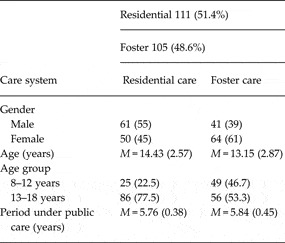
The overall response rate was 72%. Twenty-five percent of all contacted children and adolescents refused to participate, while 3% (10) returned inappropriately completed questionnaires. The sample included 216 participants (Table 1). The total amount of missing data from the questionnaires was 0.2% and the missing items were replaced according to the suggested rules for each questionnaire.
General demographic characteristics of the sample (N = 216)

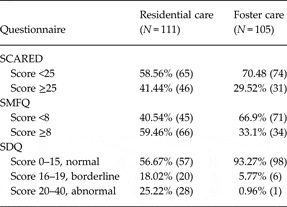
The SCARED, SMFQ and SDQ mean scores for the entire group were 21.3 (11.97), 7.65 (7.65) and 11.34 (6.63), respectively. These scores were significantly higher for children and adolescents from residential care than for those from foster care (Table 2). Based on the cut-off values of the questionnaires, 35.65% of the participants had significant anxiety, 49.3% depressive symptoms and 13.48% abnormal behavior/difficulties. These problems were more prevalent in children and adolescents from residential care (Table 3).
Mean (standard deviation) of the SCARED, SMFQ and SDQ scores of the sample (N = 216)

Distribution of the subjects based on the cut-off scores of the questionnaires (N = 216)

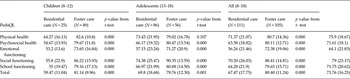
The mean value of the PedsQL total was 73.76 (16.25) and ranged 64.1–79 for the scales’ scores (Table 4). There was no statistically significant difference between the children and adolescent's scores (independent samples t test, p = 0.97), that were 73.82 (14.55) and 73.73 (17.13), respectfully. The PedsQL scores of the children from residential care were significantly lower than those of the children from foster care (Table 4). Except for the PedsQL Physical Health, the adolescent's scores were also significantly lower for those living in residential care. However, both groups perceived overall psychosocial health lower than physical, especially emotional functioning.
PedsQL scores of the sample (N = 216)

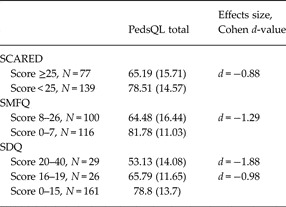
The PedsQL scores were significantly lower in children and adolescents with substantial SCARED (≥25), SMFQ (≥8) and SDQ score (Table 5). The magnitude of the impacts of mental health problems on QOL ranged from −0.88 to −1.88 (large effect) in the total score.
PedsQL scores in the groups with mental health problems identified by the cut-off values of the SCARED, SMFQ and SDQ scores

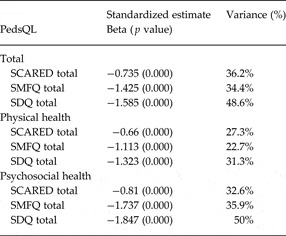
Finally, the linear regression model was conducted to analyze the prediction of the PedsQL scores from the SCARED, SMFQ and SDQ. The model tested was corrected for age and gender. All three scores accounted for significant variations in the PedsQL, but the SDQ produced the greatest independent variance among them (Table 6).
Associations between the PedsQL scores and the SCARED, SMFQ and SDQ score corrected for age and gender (N = 216)

Discussion
This is the first study to our knowledge that evaluated the effects of mental heath on QOL in children and adolescents residing in residential and foster care. The results indicate that there are strong negative effects of anxiety and depression symptoms and general mental difficulties on everyday living in the studied population.
The children and adolescents included in this study showed significant levels of mental health problems. About 36% had positive scores on screening for unspecific anxiety disorders and as high as 50% for depressive symptoms. Abnormal behaviors or general mental difficulties were reported by about 13% of the participants. These problems were more prevalent in children and adolescents in residential than in the foster care.
Analyzing the general characteristics of QOL in these children and adolescents it was observed that there were no significant differences between the children and adolescent's perceptions of QOL. However, children from residential care perceived their QOL significantly lower than those from foster care did. Except for the physical health, adolescent residing in residential care also perceived their QOL significantly lower. Nevertheless, both groups estimated their overall psycho-social health to be lower than the physical, particularly in the sphere of the emotional functioning. These findings correspond to findings from the previous study that showed significantly poorer psychological than physical QOL domains (Carbone et al. Reference Carbone, Sawyer, Searle and Robinson2007).
The following was observed analyzing the PedsQL with SCARED, SMFQ and SDQ scores: first, there was an inverse correlation between the self-assessment of mental heath and QOL indicating that the presence of greater mental health problems correlates with poorer QOL. Overall, general mental difficulties were more significantly correlated with poorer QOL than the presence of anxiety or depressive symptoms only. Second, QOL was significantly lower in children and adolescents who were positively screened for psychopathology, whether it was an anxiety, depression or general psychopathology. The presence of either of these mental health problems has a larger impact on QOL than its absence. Third, the SCARED, SMFQ and SDQ score account for significant variations in the PedsQL scores. The levels of present anxiety symptoms produced variations in 36% of the QOL score, depressive symptoms in 34% and general mental health in even 48.6%. The mental health accounts for the most variations in the perceptions of psychological health and the QOL of children and adolescents from residential care.
In total, these findings imply that the QOL of children and adolescents living in residential and foster care is associated with their mental health status. The QOL is adversely affected with the presence of mental health problems implying that higher levels of mental health problems are related to poorer QOL. Stronger relationship was observed between general mental health and QOL, while the higher levels of anxiety or depressive symptoms had less influence, although the relationship was still statistically significant. The above results correspond to the previous reporting that QOL was significantly poorer in children with mental health problems residing in home-based foster care (Carbone et al. Reference Carbone, Sawyer, Searle and Robinson2007). Finally, the results of our study proved the notion that children's mental health is associated with most of the aspects of their daily functioning and that the poor QOL is associated with mental health (Sawyer et al. Reference Sawyer, Whaites, Rey, Hazell, Graetz and Baghurst2002; Bastiaansen et al. Reference Bastiaansen, Koot, Ferdinand and Verhulst2004; Bastiaansen, Koot & Ferdinand, Reference Bastiaansen, Koot and Ferdinand2005; Rajmil et al. Reference Rajmil, Palacio-Vieira, Herdman, Lopez-Aguila, Villalonga-Olives, Valderas, Espallargues and Alonso2009).
In terms of the limitations of the study, using only the questionnaires and not the structured psychological interview for mental health assessment may result in a clinical mismatch between the two. In addition, the cross-sectional design of the study is a major limitation because it was not possible to determine whether mental health had a direct effect on QOL, whether QOL influenced mental health or whether the relationship was bi-directional. Further limitation is not evaluating the effects of the presence of two mental problems, for example, anxiety and depression or depressions and behavioral problems, because the measures used are only for screening purposes and there are no data supporting that they could be combined to produce more sensitive and specific findings in the presence of some comorbidity. Last, it is possible to report selection bias, whereas the selected subjects from the participating centers could differ from those residing in other centers.
Being aware of the limitations of the study, our future work will be directed toward longitudinal assessments of this population coming from multiple sources that evaluate this relationship. Of particular importance will be studying the effects of transference from home to residential care and/or foster care and the effects of different interventions to improve mental health and QOL of these children and adolescents, as well as to evaluate different models of QOL and mental health/psychopathology in this population. Finally, the most important is that all these assessments agree with the recognized directions and needs in the mental health care of children and adolescents in Serbia (Pejovic Milovancevic et al. Reference Pejovic Milovancevic, Popovic Deusic, Lecic Tosevski and Draganic Gajic2009).
In summary, mental health status accounts for significant variations in the QOL of children and adolescents residing in residential and foster care. Mental health problems, anxiety, depressive symptoms or general mental difficulties, have strong negative effects on QOL. In spite of its limitations, the study provided for much needed mental health data in this vulnerable population.
Acknowledgements
The authors would like to thank all children, adolescents and their caregivers who accepted to participate in the study. Many thanks to Dobrila Grujić (Foser care center for children and youth Belgrade), Zoran Milačić (Residential care for infants, children and youth Belgrade), Violeta Blagojevic (Foster and residential care for children Nis), coordinators and psychologists from the participating care centers. Additionally, we would like to thank the questionnaires’ developers who granted permission to use them. Finally, we are thankful to two reviewers whose comments led to significant improvements of the article.
Declaration of Interest
None.