Introduction
Cochlear implantation is now the standard of care for treating severe to profound hearing loss. As implantation criteria expand and our global population ages, the treatment rate and number of elderly implantees are rapidly increasing. The prevalence of age-related hearing loss is high: more than half of the population aged over 60 years suffers from hearing loss,Reference Agrawal, Platz and Niparko 1 , Reference Lin, Niparko and Ferrucci 2 which is severe or profound in 1 per cent.Reference Lin, Yaffe, Xia, Xue, Harris and Purchase-Helzner 3 The latter group are thus potential candidates for cochlear implantation. Hearing loss in the elderly was found to be associated with social isolation and an increased risk of cognitive impairment.Reference Lin 4 – Reference Lin, Metter, O'Brien, Resnick, Zonderman and Ferrucci 8
Data on the functional outcome of cochlear implants in elderly patients is contradictory: some studies demonstrate outcomes comparable to those of younger patients,Reference Shin, Fraysse, Deguine, Valès, Laborde and Bouccara 9 – Reference Park, Shipp, Chen, Nedzelski and Lin 15 while others demonstrate poorer results in the elderly.Reference Mahmoud and Ruckenstein 16 – Reference Roberts, Lin, Herrmann and Lee 21 However, these studies were all retrospective, used short-term data and different criteria for defining elderly patients (age between 60 and 80 years), and used a variety of devices, coding strategies, and soundfield tests.
Regardless of the audiometric outcome in elderly vs younger patients, it is well accepted that elderly patients benefit significantly from implantation in terms of satisfaction and quality of life.Reference Shin, Fraysse, Deguine, Valès, Laborde and Bouccara 9 , Reference Park, Shipp, Chen, Nedzelski and Lin 15 , Reference Vermeire, Brokx, Wuyts, Cochet, Hofkens and Van de Heyning 17 , Reference Kelsall, Shallop and Burnelli 22 – Reference Orabi, Mawman, Al-Zoubi, Saeed and Ramsden 25
There are limited long-term data on the effect of ageing on audiometric outcomes in cochlear implantees. Long-term function may be affected by neurodegenerative processes and reduced neural plasticity in elderly patients. Spitzer et al. evaluated 23 cochlear implantees aged over 60 years, and demonstrated overall stability of functional outcome over time (average follow up, 8.4 years; range, 1.5–13.8 years).Reference Spitzer, Cellum and Bosworth 26 However, longitudinal performance was highly variable: for long-term speech recognition for monosyllabic words, 17 per cent of patients decreased by more than 20 per cent, while 26 per cent improved by more than 20 per cent.
Ruffin et al. demonstrated that elderly patients had a poorer audiometric performance after cochlear implantation.Reference Ruffin, Tyler, Witt, Dunn, Gantz and Rubinstein 27 However, this tended to stabilise at 24 months post-implantation, and there was no increased risk of long-term deterioration during a mean follow-up period of 93 months. Similarly, Dillon et al. followed 14 patients aged over 65 years and found that their audiometric performance stabilised between 5 and 10 years post-implantation.Reference Dillon, Buss, Adunka, King, Pillsbury and Adunka 28
Choi et al. showed that older age at implantation is associated with increased rates of discontinuing regular cochlear implant use over a mean follow up of 5.2 years.Reference Choi, Contrera, Betz, Blake, Niparko and Lin 29 The most commonly reported reasons for discontinuation were poor hearing benefit (45 per cent), pain or discomfort (23 per cent), and not needing to hear on a daily basis (23 per cent).
This study aimed to evaluate the stability of cochlear implantation outcome over time in elderly patients compared with younger adults.
Materials and methods
A total of 798 patients received implants in our centre between 1989 and 2008. A retrospective chart review was performed for all adult patients with a minimum follow up of five years (n = 87). Inclusion criteria were pre-operative bilateral severe to profound hearing loss with word discrimination scores of less than 50 per cent and Hearing in Noise Test (‘HINT’) scores (60 dBA at 1 m under quiet conditions) available at one and five or more years after implantation.
Collected data included age at implantation, sex, pure tone averages (PTAs; of 0.5, 1 and 2 kHz) for both implanted and contralateral ears, aetiology of deafness, side of implantation, make and model of the cochlear implant, and previous hearing aid use. Test score stability was calculated as the difference between scores at one year and at the last follow up (i.e. the score at last follow up minus the score at one year), with positive values signifying hearing improvement and negative values signifying deterioration in outcome during follow up.
Short Form 36 (‘SF-36’) Health Survey questionnaires were used to compare physical and mental health scores before implantation and one year after implantation. Pre- and post-implantation scores were available for 76 and 72 patients, respectively. In all, 60 patients with both pre- and post-implantation questionnaire scores were included in the analysis.
Ethical standards
All procedures complied with the ethical standards of the relevant national and institutional guidelines on human experimentation (Sunnybrook Health Sciences Centre Research Ethics Board) and with the Helsinki Declaration of 1975, as revised in 2008.
Statistical analyses
Hearing in Noise Test scores at one year and the last follow up were compared with the age at implantation using Spearman's correlation testing. Patients were stratified into three age groups: 60 years and younger, 61–70 years, and 71 years and older. Demographic data were compared between age groups using the Kruskal–Wallis test for independent samples. A second analysis compared data from patients aged 60 years and under and those aged 71 years and above using the Mann–Whitney U test. The distribution of categorical variables was compared between these groups using the chi-square and Fisher's exact tests. Averages of pre- and post-operative Short Form 36 scores were calculated for all three age groups, and score improvement was analysed using paired Student's t-tests. A p value of greater than 0.05 was considered statistically significant. All statistical analyses were performed using IBM SPSS statistics software version 21 (Armonk, New York, USA).
Results
Patients
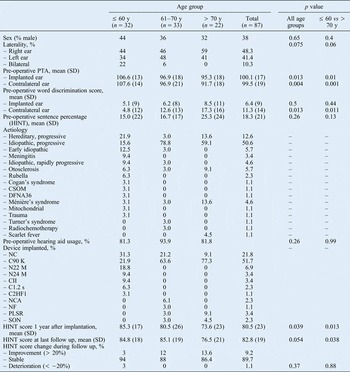
Patient demographic data are summarised in Table I. A total of 87 patients were followed up for 5 years or more (mean, 6.8 years). At the time of implantation, 32 patients were aged 60 years or younger, 33 were aged between 61 and 70 years, and 22 were older than 70 years. Fifty-four patients were women (62 per cent), and 75 (86 per cent) used hearing aids prior to implantation. The right ear was implanted in 48 per cent of patients, and the left in 41 per cent; 9 patients (10 per cent) underwent sequential bilateral implantation. None of the bilateral implantees was aged over 70 years at implantation (age range, 42–68 years).
Demographic data and outcomes stratified by age group

Y = years; PTA = pure tone average; SD = standard deviation; HINT = Hearing in Noise Test; CSOM = chronic suppurative otitis media; DFNA36 = autosomal dominant deafness-36; NC = Nucleus Contour; C90 K = Advanced Bionics 90k 1j; N22 M = Nucleus 22; N24 M = Nucleus 24; CII = Advanced Bionics c2; C 1.2 s = Advanced Bionics 1.2 standard; C2HF1 = Advanced Bionics HiFocus 1; NCA = Nucleus Contour Advance; NF = Nucleus Freedom; PLSR = Med El Pulsar; SON = Med El Sonata
Mean pre-operative PTAs were 107 dB HL for patients aged 60 years and younger, 97 dB HL for those aged 61–70 years, and 95 dB HL for those aged over 70 years for the implanted ear and 108 dB HL, 97 dB HL, and 92 dB HL, respectively, for the non-implanted ear. PTAs were significantly lower in patients aged 60 years and younger. The mean pre-operative percentages of correctly repeated sentences were higher in elderly patients (25.3 vs 16 per cent), but the difference was not statistically significant.
The most common aetiology for hearing loss in patients older than 70 years was progressive idiopathic loss (59 per cent), followed by hereditary progressive loss, Ménière's disease and otosclerosis. There was a similar proportion of pre-implantation hearing aid use in all age groups.
Functional outcomes at one year after implantation and the last follow up
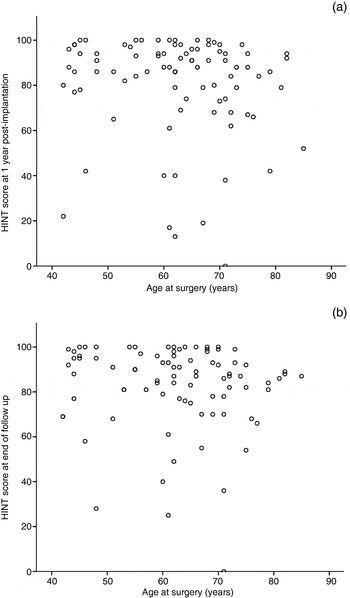
Hearing in Noise Test scores at one year after implantation were 85.3 per cent for patients aged under 60 years (range, 22–100 per cent), 80.5 per cent for those aged 61–70 years (range, 13–100 per cent) and 73.6 per cent for those aged over 70 years (range, 0–98 per cent; p = 0.039). Spearman's correlation analysis between age at implantation as a continuous variable and hearing score at one year after implantation showed a non-significant trend toward a better outcome for younger patients (r = −0.18, p = 0.096). Figure 1a shows the association between age and hearing scores at one year after implantation.
Scatterplots showing the distribution of audiometric outcome (Hearing in Noise Test under quiet conditions) at (a) one year and (b) the last follow up by age at implantation.

Hearing scores at the last documented follow-up appointment were 84.8 per cent for patients aged under 60 years (range, 28–100 per cent), 85.1 per cent for those aged 61–70 years (range, 25–100 per cent) and 76.5 per cent for those aged over 70 years (range, 0–99 years; p = 0.054), Spearman's correlation analysis between age at implantation and hearing score at the last follow up showed no statistically significant relationship (r = −0.16. p = 0.140). Figure 1b shows the association between age and hearing scores at the last follow up.
Stability of outcome during follow up
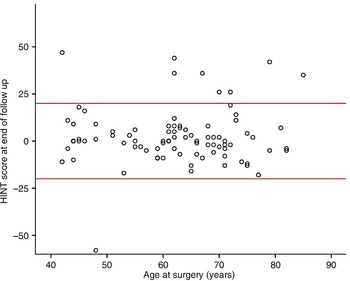
Outcome stability was calculated by subtracting hearing scores at one year after implantation from those at the last follow up. Using a 20 per cent change in hearing scores as the cutoff to indicate clinical significance (as suggested by Spitzer and colleaguesReference Spitzer, Cellum and Bosworth 26 ), the vast majority of patients in all age groups had a stable outcome (Fig. 2). Interestingly, 13.6 per cent of elderly patients improved by more than 20 per cent and none deteriorated during this time period. There were no significant differences in hearing score change during follow up among age groups (p = 0.37).
Scatterplot showing the distribution of changes in Hearing in Noise Test score during follow up by age at implantation. The red lines define stable results, i.e. a change of less than 20 per cent from the Hearing in Noise Test score at one year.

Short Form 36 Health Survey results
A total of 60 patients completed Short Form 36 questionnaires both prior to and 1 year after implantation: 22 were aged under 60 years, 21 were aged between 61 and 70 years, and 17 were aged 71 years or over.
Health survey scores are presented in Table II. Similar to younger patients, cochlear implantation in those older than 70 years was associated with significant improvements in the ‘Social Functioning’, ‘Emotional Role Functioning’ and ‘Mental Health’ categories. In contrast to younger patients, elderly patients also perceived their ‘Physical Role Functioning’ performance to be significantly improved, with pre- and post-operative scores of 60 and 88.3, respectively.
SF-36 Pre- and post-implantation scores per domain for the three age groups

*P value < 0.05. SF-36 = Short Form 36 health Survey; pre = pre-implantation; post = post-implantation
Discussion
Cochlear implantation improves communication skills and quality of life in the elderly. Functional outcome after cochlear implantation largely depends on neural plasticity, which may be compromised in this age group. In this study, we demonstrated that cochlear implantation improves the quality of life to a similar degree in both patients older than 70 years and younger patients. Functional outcomes at one year after implantation and at the last follow up were significantly better in younger patients, although differences in hearing scores were less than 15 per cent. There are concerns that neurodegeneration in elderly patients may affect outcome stability over a period of years. However, this study found that hearing scores were very stable over a follow up period of 6.8 years in all age groups. Specifically, none of the 22 elderly patients had a drop in hearing scores of more than 20 per cent.
The functional outcomes of cochlear implantees were previously reported to be similar or poorer in elderly patients compared with younger patients.Reference Shin, Fraysse, Deguine, Valès, Laborde and Bouccara 9 – Reference Roberts, Lin, Herrmann and Lee 21 Differences in outcome may be attributed to ageing and decreased memory function rather than to cochlear implant function. In a comparison of 14 older and 12 younger patients with normal hearing, Meister et al. demonstrated that younger patients performed better with a background masker.Reference Meister, Schreitmüller, Grugel, Beutner, Walger and Meister 30 Working memory function was the only significant predictor of this difference. Similarly, Zekveld et al. and Anderson Gosselin and Gagné demonstrated that older patients expend more listening effort to recognise speech in a noisy background.Reference Anderson and Gagné 31 , Reference Zekveld, Kramer and Festen 32 Goŕdon-Salant and Fitzgibbons showed that age and hearing impairment are independent risk factors for diminished speech recognition in elderly listeners.Reference Goŕdon-Salant and Fitzgibbons 33 Carlson et al. made a similar observation: older cochlear implantees had lower scores in the AzBio Sentence Test, while scores for other post-operative speech recognition tests were similar in both age groups.Reference Carlson, Breen, Gifford, Driscoll, Neff and Beatty 14 The authors considered this to be a consequence of the higher memory and executive demands of the AzBio Sentence Test. In the present study, the Hearing in Noise Test performed under quiet conditions was the main outcome measure. There is some concern about the sensitivity of this test because of its ceiling effect, and more challenging tests are also commonly used, such as AzBio and CNC sentence tests. However, many of our patients were recruited during an earlier period when the Hearing in Noise Test performed under quiet conditions was the standard pre- and post-implantation objective measurement of outcome. Furthermore, such testing may be better when applied across such a wide age range because it is less confounded by differences in memory function.
-
• Cochlear implantation is beneficial to elderly patients
-
• It significantly improves audiological measures and quality of life
-
• Cochlear implant outcomes are stable for all age groups, including the elderly
Cochlear implantation is an expensive intervention and many cost–utility studies have been undertaken over the years to evaluate multiple age groups including infants, adolescents, young adults and the elderly. Concerns have been raised that the benefit does not outweigh the cost of cochlear implantation in the elderly population. However, the performance stability over years in this study indicates that cost–benefit ratios should be re-evaluated. Furthermore, outcomes were stable during follow up for all age groups, and none of the elderly patients experienced a decline of more than 20 per cent in hearing scores. Spearman's correlation testing between age as a continuous variable and hearing test stability demonstrated a similar result. This is an important finding because the rates of age-related hearing loss in the general population rise from 25 per cent in the sixth decade to 52 per cent in the seventh.Reference Yamasoba, Lin, Someya, Kashio, Sakamoto and Kondo 34 Factors suggested to be associated with age-related hearing loss include diabetic and atherosclerotic changes, noise exposure, ototoxicity, and oxidative stress leading to mitochondrial dysfunction, cochlear degeneration and cochlear nucleus atrophy,Reference Yamasoba, Lin, Someya, Kashio, Sakamoto and Kondo 34 as well as changes affecting higher processes in the auditory pathway such as age-related central auditory processing deficits, decreased learning and communication potential, and diminished rehabilitation potential.Reference Carlson, Breen, Gifford, Driscoll, Neff and Beatty 14 The most common type of hearing loss in elderly patients in this study was progressive idiopathic hearing loss, which is consistent with age-related hearing loss. The outcome function in this population was stable despite the progressive nature of this type of hearing loss and presumed associated degenerative changes in the peripheral and central auditory pathways.
All patients in this study had a minimum follow up of 5 years, with an average follow up of 6.8 years. Ruffin et al. and Dillon et al. demonstrated that cochlear implant outcome is stable between 5 and 10 years after implantation.Reference Ruffin, Tyler, Witt, Dunn, Gantz and Rubinstein 27 , Reference Dillon, Buss, Adunka, King, Pillsbury and Adunka 28
This study had several limitations. It was retrospective and groups were limited in size. Cognitive function, which is probably associated with functional outcomes, was not assessed. In addition, patients who may have been lost to follow up were not considered.
Conclusion
Cochlear implantation in patients aged older than 70 years is associated with a significantly improved quality of life. Cochlear implant function as measured by Hearing in Noise Test scores was marginally poorer in elderly than in younger patients, but was stable over time.