Since the call for the recruitment of more multiculturally diverse counselling students (e.g., speak with an accent, older, of colour) in the Association for Counselor Education and Supervision conference in 1988 (Walz, Gazda, & Shertzer, Reference Walz, Gazda and Shertzer1991), the number of international counselling students (ICSs) has increased in the United States (U.S.; Haktanir, Reference Haktanir2018; Reid & Dixon, Reference Reid and Dixon2012). ICSs studying in the U.S. come from various countries in which the counselling profession is at different developmental stages, such as similar to that of the U.S., or where counselling is not recognised as a profession. ICSs diversify the class environment and may help foster their domestic classmates’ multicultural competencies (Ng & Smith, Reference Ng and Smith2009) at various levels (e.g., attitudes and beliefs, knowledge). Additionally, ICSs can have a pivotal role in creating a unified definition of counselling around the world by spreading their knowledge and experience should they return to their country of origin.
With the increasing number of ICSs studying in the U.S. (Karaman & Watson, Reference Karaman and Watson2017), the experiences of ICSs studying there are well-documented (e.g., Nayar-Bhalerao, Reference Nayar-Bhalerao2013; Ng & Smith, Reference Ng and Smith2012). ICSs have reported academic, personal and cultural challenges, such as issues related to adaptation to and understanding of American culture, language competency, and social inclusion (Nayar-Bhalerao, Reference Nayar-Bhalerao2013; Nilsson & Anderson, Reference Nilsson and Anderson2004). Considering the significance of language competency and cultural understanding in the counselling process, several researchers have examined the relationship between ICSs’ acculturation levels, which comprises both language competency and understanding and practising the mainstream culture, and the extent to which they feel comfortable in providing effective counselling services to clients (e.g., Li, Lu, Bernstein, & Bang, Reference Li, Lu, Bernstein and Bang2018; Ng & Smith, Reference Ng and Smith2012; Nilsson & Anderson, Reference Nilsson and Anderson2004). The findings of these studies are inconsistent as some researchers have suggested that overall acculturation is related to the extent to which individuals believe they can carry out counselling services effectively (Haktanir, Reference Haktanir2018; Nilsson & Anderson, Reference Nilsson and Anderson2004) while others have noted a nonsignificant relationship (Li et al., Reference Li, Lu, Bernstein and Bang2018; Ng & Smith, Reference Ng and Smith2012).
Counselling self-efficacy (CSE) is conceptualised in the literature as the concept of feeling comfortable with one’s skills while providing counselling services (e.g., Larson & Daniels, Reference Larson and Daniels1998). Counselling self-efficacy, in general, has been found to be positively associated with clinical experience (Haktanir, Reference Haktanir2018; Watson, Reference Watson1992), counselling-related coursework (Al-Darmaki, Reference Al-Darmaki2004; Meyer, Reference Meyer2015), and counsellor performance (Hanson, Reference Hanson2006), while clinical experience and counselling-related coursework together explain more than 30% of the variance in CSE scores. Additionally, CSE has been found to be negatively correlated with anxiety (Larson & Daniels, Reference Larson and Daniels1998; Tsai, Reference Tsai2015). Although studies focusing on CSE generally did not examine ICSs and domestic counselling students (DCSs) separately, several studies have focused on CSE among ICSs. However, there is a lack of studies exploring CSE among domestic students. Both domestic and international counselling students report anxiety about seeing clients (Al-Darmaki, Reference Al-Darmaki2004; Tsai, Reference Tsai2015), yet it is unclear to date how these groups’ CSE compares. Although it is portrayed in the literature that ICSs experience more stressors than DCSs that may be detrimental to the development of CSE (e.g., language proficiency issues, cultural understanding), there is a lack of research comparing the two groups (i.e., ICSs and DCSs) in terms of their levels of CSE.
Moreover, the Council for Accreditation of Counselling and Related Educational Programs (CACREP) is an accreditation body for master’s- and doctoral-level counselling programs in the U.S. and across the world. To obtain CACREP-accreditation, counselling programs must meet certain requirements, such as full-time faculty-to-student ratio, number of credit hours and courses offered. Accordingly, the CACREP proposed accreditation standards and current 2016 standards are being used. The purpose of these standards is to safeguard equitable education by standardisation across programs (Wilcoxon, Reference Wilcoxon1990). However, it is unclear whether the CACREP standards (2016) are developed with ICSs in mind and can address these students’ training needs. Additionally, little has been investigated regarding whether the pedagogical approach employed in counselling programs in the U.S. is as effective for ICSs as it is for DCSs. Although CSE is a perception and not equivalent to counselling competency, counsellors reporting higher CSE tend to provide a higher quality of services to their clients (Hanson, Reference Hanson2006; Jaafer, Mohamed, Bakar, & Tarmizi, Reference Jaafar, Mohamed, Bakar and Tarmizi2009). In fact, Bernard and Goodyear (2008) suggested promoting CSE of students to be one of the major goals of counselling programs. Additionally, researchers asserted CSE to be a key outcome measure in the evaluation of counsellor education (Goreczny, Hamilton, Lubinski, & Pasquinelli, Reference Goreczny, Hamilton, Lubinski and Pasquinelli2015). Consequently, a deeper understanding of CSE of students may help counselling programs to evaluate their work in preparing successful future counsellors. Sending out counsellors to the workforce who are competent and confident in their skills is not only a desired outcome of counselling programs, but also an ethical necessity for a counselling faculty. If counsellors in training who do not feel confident in their counselling skills join the workforce, then they may be less likely to be of help to clients, which can raise an ethical and gatekeeping issue.
To this end, the main purpose of this study is to compare the CSE of DCSs and ICS after controlling for clinical experience and counselling-related coursework. Since it is documented in the literature that counselling students who acquire more counselling experience and take more counselling-related classes generally report higher levels of CSE (e.g., Haktanir, Reference Haktanir2018; Watson, Reference Watson1992), these two variables are accounted for in the analysis. Furthermore, this study examines the role of clinical experience and graduate-level, counselling-related coursework in explaining CSE for DCSs and ICSs separately, and compares the two regression models to ascertain whether they differ in explaining CSE. Finally, this study investigates whether participants’ CSE scores vary across participants’ degree level (i.e., master’s level, doctoral level) or specialty area (e.g., School Counselling, Counsellor Education).
With these purposes in mind, this study will address the following research questions:
-
1. Is there a significant difference between counselling self-efficacy of ICSs and DCSs after controlling for advancement in counselling program, as indicated by the amount of clinical experience and counselling-related coursework?
-
2. Are clinical experience and amount of counselling training significant predictors of CSE for ICSs and DCSs separately?
-
3. Do the regression models for DCSs and ICSs differ significantly?
-
4. Are there significant differences in CSE scores across specialty areas and degree levels?
Method
Participants
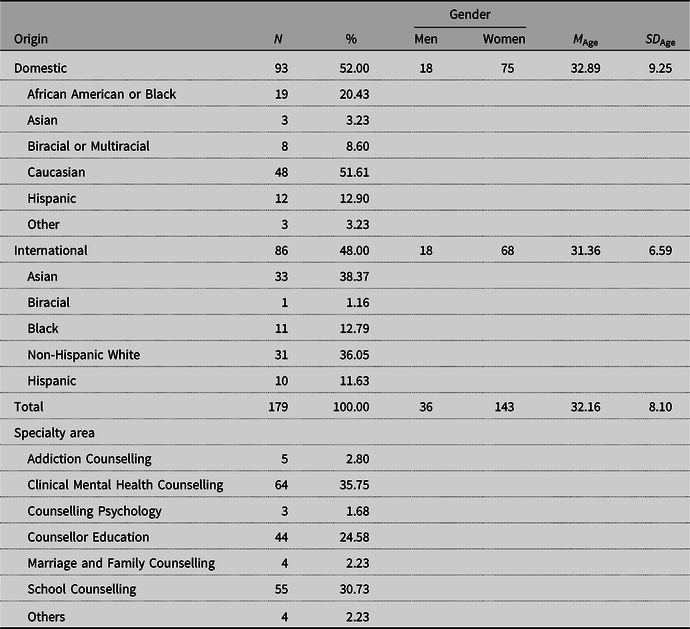
International counselling students (ICSs) Please check that the hierarchy of section headings is set correctly.enrolled in U.S. institutions were recruited as a part of a dissertation study, and the researcher collected data separately from DCSs for the current study. An ICS was described as a counselling student who was born and raised outside of the U.S., regardless of their citizenship status. One hundred and twenty-three DCSs (i.e., American students enrolled in counselling programs in the U.S.) and 114 ICSs were recruited. Any cases with excessive missing data points or violating test assumption(s) were removed. Consequently, the researcher ran the analysis with a total of 179 participants, of whom 93 were DCSs (52%) and 86 were ICSs (48%). The mean age for DCSs was 32.89 (SD = 9.25) while it was 31.36 for ICSs (SD = 6.59), yielding an average of 32.16 (SD = 8.10) for the entire group. Overall, both groups appeared to be rather similar in the gender composition, with each group including 18 men, and 75 and 68 women in the DCS group and in the ICS groups respectively. Of the participants, 20.10% (n = 36) were men and 79.90% (n = 143) were women.
Just over half of DCSs (n = 48; 51.61%) identified as Caucasian or non-Hispanic White, 19 identified as Black or African American (20.43%), 12 identified as Hispanic (14.90%), 8 identified as either biracial or multiracial (8.60%), 3 identified as Asian American (3.23%), and 3 identified as Other (3.23%). Approximately 75% of ICSs identified as either Asian (n = 33; 38.37%) or non-Hispanic White (n = 31; 36.05 %), 11 identified as Black (12.79%), 10 identified as Hispanic (11.63%), and 1 identified as biracial (1.16%). When participants’ specialty areas were examined, participants reported to be in one of the seven specialty areas: Addiction Counselling (n = 5), Clinical Mental Health Counselling (n = 64), Counselling Psychology (n = 3), Counsellor Education (n = 44), Marriage and Family Counselling (n = 4), School Counselling (n = 55), and others (n = 4); see Table 1 for participant characteristics.
Essential participant characteristics

Instruments
Demographic questionnaire
Participants completed a demographic questionnaire that contained items related to age, gender, ethnicity, accreditation status of the participant’s program, participant’s specialty area, the number of counselling-related credits participant had completed, and clinical (counselling) experience in hours.
Counsellor Activity Self-Efficacy Scales
The Counsellor Activity Self-Efficacy Scale (CASES) was developed by Lent, Hill, and Hoffman, (Reference Lent, Hill and Hoffman2003) to measure the degree to which counsellors believe they possess basic counselling skills and can help clients with specific issues in the near future (i.e., over the next week). The CASES is comprised of three subscales: (a) basic counselling skills, (b) session management skills, and (c) helping clients with certain issues (e.g., depressed, extremely anxious, suicidal). This scale has 41 items, each ranging from 0 (no confidence) to 9 (complete confidence), with higher total scores reflecting higher counselling self-efficacy. Sample items include ‘How confident are you that you could repeat or rephrase what the client has said, in a way that is succinct, concrete, and clear?’, ‘How confident are you that you know what to do or say next after your client talks?’ and ‘How confident are you that you could work effectively with a client who is clinically depressed?’ The CASES showed with excellent overall Cronbach’s alpha value, .97, with subscales ranging from .79 to .92 (Lent et al., Reference Lent, Hill and Hoffman2003). Furthermore, the scale demonstrated high correlation (r = .76) with the Counselling Self-Estimate Inventory (COSE; Larson et al., Reference Larson, Suzuki, Gillespie, Potenza, Bechtel and Toulouse1992), indicative of strong convergent validity. In the sample of the current study, an overall Cronbach’s alpha value of .98 for CASES, and .93, .97 and .96 for the basic counselling skills subscale, session management skills subscale and specific counselling topics subscale respectively were found.
Procedures
After receiving Institutional Review Board (IRB) approval, the researcher disseminated the study survey to DCSs and ICSs enrolled in U.S. institutions. The recruitment procedures for the groups were different. To collect data from domestic students, the study link was shared through a counselling list-serv (CESNET-L). Additionally, counsellor educators working in different departments across the U.S. were contacted to share the study information with their domestic students. Due to the limited number of ICSs studying in the U.S., a snowball sampling method was employed to collect data from the ICSs. The researcher contacted ICSs among a circle of acquaintances through email and invited them to participate in the study and share study information with other ICSs. Additionally, 20 counsellor educators across the U.S. were invited to share the study information with their ICSs, if any existed. Moreover, the researcher recruited ICSs through counselling conferences. Due to the inability to acquire the precise number of potential participants intended for recruitment, no response rate was calculated (Granello & Wheaton, Reference Granello and Wheaton2004).
Data screening and analysis
Power analysis
The researcher conducted an a priori G*Power analysis to ascertain the minimum number of participants required to detect a medium effect size given an alpha level of .05 and power of .80. For the analysis of covariance (ANCOVA) test (with two groups), a minimum of 158 participants were required to detect a significant difference if a medium effect size existed (f = .25), while a minimum of 68 participants were required to detect a medium effect size (f 2 = .15) for the multiple regression analysis. Finally, a minimum number of 216 participants were required to find a significant difference, when present, for the analysis of variance (ANOVA) test (with seven groups). Given that 179 participants were recruited in the present study, it can be inferred that this study demonstrated sufficient power for the ANCOVA and multiple regression tests, yet lacked statistical power for the ANOVA test.
Preliminary analysis
Prior to carrying out the primary analysis, data were inspected, the ratio of missing values to all values was calculated (less than .002), and missing values were replaced with the series mean function in SPSS. Then the researcher tested the assumptions for the ANCOVA and multiple regression analysis, including independence of observations, normality, homoscedasticity, homogeneity of variance, normality, linearity and homogeneity of regression slopes, and noncollinearity of predictor variables (Field, Reference Field2013; Tabachnick & Fidell, Reference Tabachnick and Fidell2015). Six cases were removed due to a high influential effect on the regression line. Clinical experience violated the assumption of homoscedasticity; thus, it was transformed using the log10 function in SPSS. After removing the high influential data points and transforming the data, homoscedasticity was met (i.e., no more funnelling z graph).
Results
Research question 1
The first research question explored whether or not a significant difference existed after controlling for participants’ advancement (as measured by the amount of clinical experience and counselling-related coursework), results of which can be seen in Table 2. The researcher analysed the data using SPSS (Version 22) and conducted an ANCOVA to test whether there was a statistically significant difference between DCSs and ICSs’ counselling self-efficacy after adjusting for how advanced the students were in their program. To determine students’ advancement in the program, the researcher utilised their clinical experience (CE) and counselling-related coursework (CRC), as more advanced counselling students would accumulate more clinical hours and take more counselling-related courses. Using principle component analysis, these two variables (i.e., CE and CRC) were combined and reduced to one factor, which was then used as the covariate. After adjusting for advancement in a counselling program (i.e., clinical experience and counselling-related coursework), there was no statistically significant difference in CSE scores between DCSs and ICSs, F(1, 176) = 2.48, p = .12, partial η2 = .02.
ANCOVA analysis results

Note: ANCOVA, analysis of covariance; SS, Type III sum of squares.
Research question 2
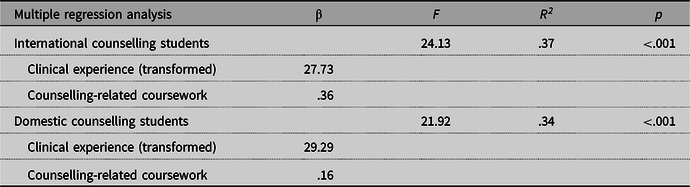
The second question was related to whether or not clinical experience and amount of counselling training significantly explained the variance in CSE scores. A multiple regression analysis was conducted to predict CSE from CE and CRC among DCSs and ICSs separately. The multiple regression model for the DCSs was statistically significantly, F(2, 91) = 21.92, p < .001, R 2 = .34. A multiple regression analysis for the ICSs also revealed a statistically significant model, F(2, 83) = 24.13, p < .001, R 2 = .37, both suggesting a large effect size (Field, Reference Field2013); see Table 3. In other words, CE and CRC accounted for 34% and 37% of the variance in CSE scores among DCSs and ICSs respectively. For the DCS group, while the clinical experience uniquely accounted for 24% of the variation in CSE scores, the amount of CRC uniquely explained approximately 1% of the variation in the CSE scores. For the ICS group, clinical experience uniquely explained 12% of the variance in CSE scores while the amount of CRC uniquely explained approximately 3% of the variance in CSE scores. Consequently, the remaining 9% for the DCSs and 22% for ICSs were the shared variance between CE and CRC.
Multiple regression analysis results for ICSs and DCSs

Note: Dependent = Counselling self-efficacy
Research question 3
The third question was about whether or not the regression models for DCSs and ICSs varied significantly. The researcher conducted a Fisher’s z transformation to compare correlation coefficients associated with the two regression models (i.e., multiple regression analysis models). A comparison of the regression models for DCSs and ICSs suggested no significant difference, Fisher z = .27, p > .05, as the z score was below the cutoff score of 1.98.
Research question 4
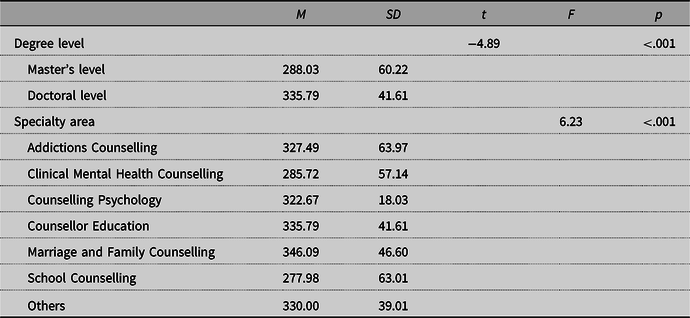
The fourth research question focused on whether or not CSE scores varied across the participants’ specialty area (e.g., school counselling, mental health counselling) and degree levels (e.g., master’s level and doctoral level). The researcher examined whether CSE scores differed across participants’ degree level and specialty areas. An independent-samples t test was carried out to determine whether significant differences existed in CSE between doctoral-level students and master’s-level students. Doctoral-level students (M = 335.79, SD = 41.61) reported significantly higher CSE than master’s-level students (M = 288.03, SD = 60.22), t(177) = −4.89, p < .001. When the same analysis was conducted for each group separately, similar differences were detected in domestic students group, t(91) = −3.49, p = .001, and international students group, t(84) = −3.31, p = .001; see Table 4.
Degree level and specialty area comparison results

A one-way ANOVA was run to determine whether the CSE level was different for different counselling specialty areas. CSE scores were statistically significantly different among specialty areas, F(6,172) = 6.23, p < .001. Tukey post hoc analysis showed that CSE scores of counsellor education students significantly differed from those of school counselling and clinical mental health counselling students (p < .001), yet no differences between master’s-level specialty areas were statistically significant; see Table 4 for more details.
Discussion
Counselling self-efficacy (CSE) refers to the degree to which counsellors and counsellors-in-training believe they can effectively counsel clients in the near future. Due to the association between CSE and the quality of services provided to the clients (see Hanson, Reference Hanson2006), CSE can provide counsellor educators with the data to evaluate the effectiveness of the counselling training provided and to determine whether a student is ready for providing counselling services, which can be used in the gatekeeping process as well. Though CSE has been studied in numerous studies, researchers have paid scant attention to the examination of CSE for international and domestic counselling students separately. This study compared the CSE scores of ICSs and DCSs, investigated the degree to which CSE scores are regressed on clinical experience (CE) and counselling-related coursework (CRC) for each group, and whether CSE scores varied across specialty areas as well as between degree levels (i.e., master’s level, doctoral level).
Although more stressors for ICSs have been documented in the literature that may potentially interfere with the development of CSE (e.g., language-related issues), when the two groups’ CSE scores were compared, no significant differences were detected in this study. In fact, ICSs’ unadjusted average CSE score was slightly above that of DCSs. However, it is noteworthy that the ICS group included three times as many doctoral students as the DCS group. As addressed in research question 4, doctoral students reported significantly higher CSE scores than their master’s-level peers. Therefore, the difference in CSE scores between ICSs and DCSs might be explained by the disproportionate distribution of the groups in terms of degree level.
Another question sought in this study was the extent to which the amount of clinical experience (CE) and counselling-related coursework (CRC) explained the amount of regression in CSE scores. The current study found that CE and CRC jointly explained a significant proportion of the variation in CSE scores for both groups. This finding is consistent with those of other studies in the literature (e.g., Al-Darmaki, Reference Al-Darmaki2004; Watson, Reference Watson1992). It can therefore be suggested that as counselling students advance in their degree program (i.e., more CE and CRC), their CSE scores are inclined to increase. When the unique contributions of CE and CRC were examined, CE explained a much higher variance in the CSE scores for both groups. Although CE may simply have higher correlation with CSE than that of CRC, another possible explanation for such a large difference might be explained by the possibility that participants reported all credit hours they completed in their counselling studies, rather than just reporting those credits specifically related to counselling. In other words, participants might have included credit hours related to noncore or nonspecialty-specific courses, such as research methods.
Finally, this study examined whether CSE scores varied across degree level and specialty areas. The findings of this study accord with other studies (e.g., Larson et al., Reference Larson, Suzuki, Gillespie, Potenza, Bechtel and Toulouse1992; Ng & Smith, Reference Ng and Smith2012), which suggested that doctoral-level students reported significantly higher CSE scores than those of master’s level students. Consistent with this finding, doctoral students reported higher CSE scores than school counselling and mental health counselling students while no significant differences between any master’s-level specialty area pairs were detected. These differences may be explained by the fact that doctoral-level students continue accumulating clinical hours and enrolling in more counselling-related courses, which are reported to be associated with CSE in this study as well as in the literature.
Implications for the profession, counsellor educators, and counselling students
Implications for the profession
The study suggested that ICSs and DCSs reported similar CSE scores. Based on these findings, it appears that ICSs and DCSs benefit from their counselling training approximately equally well. One interpretation of the similar CSE scores can be that the 2016 CACREP standards and the pedagogical approach utilised in counselling programs are as effective for DCSs as ICSs. Consequently, any future updates in the standards should also take ICSs into consideration and uphold their comfort level in their counselling skills.
Additionally, this study’s findings may be connected to the pivotal role of accreditation in the counselling profession. Though it is difficulty to directly link this study’s findings to the role of CACREP, many counselling professionals acknowledge the importance of standardisation among counselling programs across a given country (e.g., Wilcoxon, Reference Wilcoxon1990). To ensure equitable education for counselling students from different backgrounds, the CACREP can be a model for the counselling profession in countries other than the U.S. in the development process of their national accreditation body.
Implications for students
Another finding of this study is that CE and CRC significantly explained CSE scores of both ICSs and DCSs in a similar manner. Given these relationships, counselling students lacking confidence in rendering effective counselling services to clients can take as much CRC as possible before enrolling in a practicum course. The findings of this study also revealed that doctoral-level counselling students reported significantly higher CSE scores than those of school counselling and clinical mental health counselling students. With this in mind, master’s-level graduates in these fields might consider pursuing a doctorate in counselling, not only to improve their research skills but also to increase their comfort level in providing higher quality counselling services to clients.
Implications for counsellor educators
Additionally, considering the relationship between CE and CSE, counsellor educators can incorporate more experiential activities to allow students have more counselling-like experiences. Furthermore, existing counselling student organisations (e.g., Chi Sigma Iota) or new counselling student organisations can hold counselling experience meetings where students can conduct mock counselling sessions under the supervision of faculty advisors. Additionally, school counselling students’ self-efficacy may be fostered by incorporating more group counselling activities, equipping students with skills for working with resistant clients, as well as teaching assessments that school counsellors use with students (Kozan, Reference Kozan2020).
Limitations and recommendations for future studies
There are a number of limitations of the current study that need to be addressed. First, CSE is a belief, thus it refers to how individuals perceive themselves to be effective in providing effective services to clients. Though researchers suggest that counsellors with higher CSE provide better counselling services, it is important to remember that CSE is not counselling competency. Second, although the researcher intended to compare the CSE scores of students in CACREP-accredited counselling programs and non-CACREP-accredited counselling programs, only three participants reported enrollment in an APA-accredited program, 11 students indicated that they were unsure of the accreditation status of their program, while the remaining students reported to be enrolled in a CACREP-accredited program (n = 165). Consequently, comparing the CSE scores of students in CACREP-accredited programs to non-CACREP-accredited programs was not feasible. Future studies could intentionally recruit participants from non-CACREP-accredited programs to ascertain whether a difference exist between the two groups. Third, according to the 2018 annual report of CACREP, total student enrollment in counselling programs has reached 53,000. The last CACREP annual report demonstrating the demographic composition of the enrolled students (2016 CACREP Annual Report, 2017) indicated that at least 459 international students were enrolled in counselling programs. Although the ICS sample appeared to be more representative than the DCS sample, in comparison to the total number of counselling students, the sample size of this study represents only a small percentage of all counselling students. Experiences of other counselling students might be different, and therefore, future researchers may wish to conduct replication studies with a larger sample size. Fourth, the analysis lacked power for an ANOVA, with seven variables (specialty areas). It is also important that addiction counselling, family and couples counselling, counselling psychology, and other counselling programs were underrepresented (3 ≤ n ≤ 5). Therefore, these specialty areas were statistically underpowered and future studies could recruit more heterogeneous groups. Fifth, the researcher did not acquire any information regarding participants’ bachelor’s degree (i.e., undergraduate degree). This, in fact, may be an important variable in understanding participants’ CSE. For example, unlike the U.S., several countries (e.g., Turkey) provide counselling degrees at the bachelor’s-degree level. In the U.S., master’s-level counselling students can have virtually any type of bachelor’s degree (engineering, political sciences, psychology). Therefore, future studies could obtain information from participants regarding their educational backgrounds. Finally, the researcher conducted only cross-sectional analyses; thus, no causal effect can be inferred from the results. Future researchers could conduct longitudinal studies to examine the development of CSE over semesters to examine the relationship between CSE, CE and CRC.
Conclusion
A deeper understanding of CSE is important for ethical practice, gatekeeping and program evaluation. This study revealed that ICSs and DCSs reported similar CSE scores after controlling for CE and CRC and that doctoral students reported higher CSE scores than those of school counselling and mental health counselling students. This study highlighted that counselling program curriculum is effective for both ICSs and DCSs and that CE and CRC play pivotal role in CSE development among counselling students.
Conflict of interest
None.