Introduction
In Table 1 of their paper, Vondrák & Kocourková (Reference Vondrák and Kocourková2008) enumerated 56 known lichenicolous species of Opegrapha s. lat., and more recently in their world checklist of lichenicolous fungi Diederich et al. (Reference Diederich, Lawrey and Ertz2018) listed 71 species. Since then, O. physciae has been described on Physcia sorediosa (Vain.) Lynge from the Philippines (Joshi Reference Joshi2019). A small number of species have been transferred out of Opegrapha: O. physciaria (Nyl.) D. Hawksw. & Coppins has been moved to the resurrected monotypic genus Phacothecium Trevis. as P. varium (Tul.) Trevis. by Hafellner (Reference Hafellner2009), and in the same paper the genus Phacographa Hafellner was introduced for O. glaucomaria (Nyl.) Källsten ex Hafellner (type species), O. zwackhii (A. Massal. ex Zwackh) Källsten ex Hafellner and the newly described Phacographa protoparmeliae Hafellner.
The generic and higher systematic placement of lichenicolous species of Opegrapha s. lat. awaits further phylogenetic studies; however, some at least (including those in Phacographa) may be referable to the Lecanographaceae, and not to the Opegraphaceae or Roccellaceae (Frisch et al. Reference Frisch, Thor, Ertz and Grube2014).
During our general lichenological studies we have encountered several, hitherto undescribed species referable to the genus Opegrapha s. lat. Many of these are represented by individual or poorly developed specimens. However, we have now gathered sufficient material of four taxa to merit their formal description or recognition here. Specimens of two of these species have previously been subsumed under O. rupestris Pers. or O. parasitica s. lat. On morphological grounds, it would seem that none of these new species belong to either Phacographa or Phacothecium as treated by Hafellner (Reference Hafellner2009).
Materials and Methods
The study is based chiefly on material collected by the first author in Scotland and Ireland and housed in the collections of the Royal Botanic Garden, Edinburgh (E); other material was seen from JACA, K(M), KW, NMW and the private herbaria of Paul Diederich, Javier Etayo, Mark Powell and Neil Sanderson. Anatomical and morphological observations were undertaken using light microscopy, with thin hand-cut sections mounted in water and/or 10% KOH, with water mounts being used for measurements unless otherwise stated. K/I refers to reactions in Lugol's iodine solution (1% I2) following pretreatment with 10% KOH. Macro images were captured using a Canon EOS 600D camera attached to a Leica MZ6 dissecting microscope, and micrographs were obtained using a Canon EOS 1300D camera attached to an Olympus BH-2 microscope equipped with Nomarski DIC optics.
The Species on Arthoniaceae
Although there are no previously described species of Opegrapha s. lat. from Arthonia s. lat., there is one species described on foliicolous Cryptothecia (Arthoniaceae) by Matzer (Reference Matzer1996): O. cryptotheciae R. Sant. ex Matzer & R. Sant. We describe here a further two species from Arthonia s. lat., one from the type species of Arthonia Ach. (A. radiata) and the other from the type species of the recently resurrected Coniocarpon DC. (C. cinnabarinum DC.).
Opegrapha arthoniicola Coppins & S. Y. Kondr. sp. nov.
Index Fungorum No.: IF 558014
A lichenicolous fungus, parasitic on thalli of Arthonia radiata (Pers.) Ach. but showing few, if any, signs of damage; similar to O. sawyeriana Coppins (this paper), but with larger and more clustered ascomata and without a dark brown base to the exciple.
Type: Scotland, Westerness (V.C. 97), Morvern, N of Glenmorven Cottage, coastal hazelwood, grid NM56.52, on Arthonia radiata on Corylus bark, 16 June 1992, B. J. Coppins et al. 22429 (E—holotype; GZU—isotype).
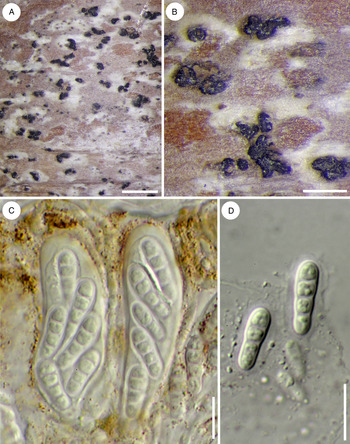
Opegrapha arthoniicola (Coppins 24999). A, colony on thallus of Arthonia radiata. B, detail of ascomatal clusters. C, asci and ascospores mounted in KOH, surrounded by minute brown granules from the epithecium. D, ascospores mounted in KOH, showing the gelatinous perispore. Scales: A = 1 mm; B = 0.5 mm; C & D = 10 μm. In colour online.

Ascomata developing below, and bursting through the host thalli, later becoming superficial, in scattered clusters 0.7–1.0 mm across, each containing up to seven ascomata. Individual ascomata black, not pruinose, lirellate, (0.14–)0.3–0.8(–1) mm long, (0.9–)0.1–0.14(–0.2) mm wide and 0.07–0.1 mm tall in section, usually 1–2-furcate, straight or curved; disc slit-like or eventually gaping. Exciple well developed only laterally, ±spreading outwards below, (9–)19–29(–33) μm thick, dark brown to blackish brown, K± tinged faintly olivaceous, with a paler inner layer 4.8–6.7 μm thick, consisting of rounded cells 3–4.8 μm diam.; basal exciple not developed. Hymenium colourless at the base, (54–)61–67 μm tall, I+ blue then reddish brown in places, K/I+ blue; epithecium very thick, (14.4–)20–24 μm thick, olivaceous owing to external minute brown granules, K± becoming more olivaceous blackish. Subhymenium indistinctly yellowish, K−, 6.5–10(–12.0) μm tall. Paraphyses sparingly branched, 1.4–1.9 μm diam. (in KOH) with slightly swollen tips 2.3–3.4 μm diam. with abundant external minute brown granules. Asci shortly cylindrical-clavate, (34–)38.5–44 × 10–12.5 μm, with a minute K/I+ blue ring around the top of the ocular chamber, (4–)6(–8)-spored. Ascospores long remaining hyaline, (1–)3-septate, the upper two cells usually broader than the lower cells, (10.5)12.5–14.5 × 3.4–4.2(–4.8) μm; perispore thin, often indistinct; old spores sometimes becoming brown owing to presence of brown granules in the perispore.
Pycnidia not seen.
Etymology
The species epithet is derived from the genus of the host lichen to which it appears restricted.
Ecology and distribution
To our knowledge this species is restricted to thalli of Arthonia radiata, although host specificity has not been extensively researched in this genus. Despite the wide and often abundant occurrence of its host, Opegrapha arthoniicola so far appears to be confined to western Britain and Ireland, with most finds being from western Scotland. It should be sought elsewhere, especially in SW England, Norway and the Iberian Peninsula.
Interestingly, the host species is found on a wide range of broad-leaved trees and shrubs but to date the parasite-host pair of O. arthoniicola and A. radiata has been confined to Corylus. The same is true for Pertusaria leioplaca DC. and its parasite O. pertusariicola Coppins & P. James (Coppins & James Reference Coppins and James1979).
Remarks
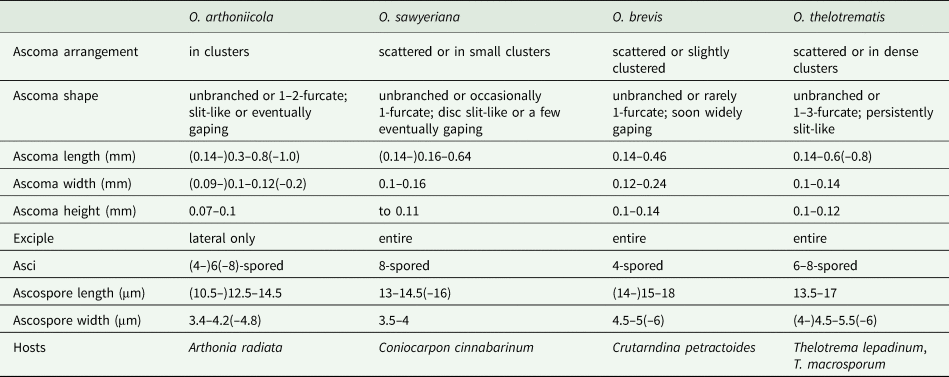
Opegrapha arthoniicola has some similarities to O. sawyeriana, a species on the related host lichen Coniocarpon cinnabarinum (see below). The two are mostly alike in anatomical terms, but O. sawyeriana differs in forming distinct brown-grey (necrotic) patches on the host thallus, the ascomata are smaller and scattered rather than clustered, and in section it has a thin, dark brown base to the exciple.
Owing to its 3-septate ascospores, O. arthoniicola closely resembles O. brevis Coppins and O. thelotrematis Coppins (Coppins Reference Coppins1987), both parasitic on genera of Graphidaceae (Crutarndina and Thelotrema, respectively) and from similar habitats. It differs by its much smaller and narrower ascospores, as well as by some characters of the ascomata and the lichen hosts (see Table 1).
Distinguishing characters of Opegrapha arthoniicola, O. sawyeriana, O. brevis and O. thelotrematis.

Arthonia radiata is also host to two pyrenocarpous fungi, Muellerella polyspora Hepp ex Müll. Arg. and Stigmidium arthoniae (Arnold) Hafellner.
Additional specimens examined (all on Arthonia radiata on Corylus)
Ireland: V.C. H33, Fermanagh, Crom, Inisherk, park, west side, 23(H)/35.24, alt. 50 m, 1993, B. J. Coppins & A. M. O'Dare, Coppins 15861 (E).—Great Britain: Scotland: V.C. 96, Easterness, W side of Loch Ness, Abriachan Wood (south), NH567.341, alt. 70 m, 2001, B. J. & A. M. Coppins 19965 (E); V.C. 97, Westerness, Sunart SSSI, Allt Torr na Moine, NM5562, alt. 10–50 m, 2009, B. J. Coppins et al. 22778 (E); Moidart, Glenuig, NM670774, 5–30 m, B. J. Coppins et al. 23154 (E); Drimnin Allt Mhungasdail valley hazelwood, NM562.538, alt. 40–50 m, 2009, B. J. Coppins 23159 (E); V.C. 98, Argyll Main, Seil, Ballachuan Hazelwood, NM759.147, alt. 20 m, 1997, B. J. & A. M. Coppins 17426 (E); V.C. 101, Kintyre, 7 km SE of Campbeltown, Balnabraid Glen, NR76.15, alt. 0–80 m, 1994, B. J. Coppins & A. M. O'Dare 16210 (E); V.C. 102, South Ebudes, Islay, 3–4 km from Port Askaig, Baleachdrach, grid. NR42.65, 1992, B. J. Coppins & A. M. O'Dare 15052 (E); V.C. 103, Mid Ebudes, Mull, NW of Lagganulva, NM447.420, alt. 50 m, 2000, B. J. & A. M. Coppins 18989 (E); Ardnacross, NM550.489, alt. c. 10 m, 2000, B. J. & A. M. Coppins 18955 (E); W of Killiemore, alt. c. 30 m, NM48.39, 2015, B. J. Coppins 24999 (K(M)); V.C. 104, North Ebudes, Eigg, Manse Wood, NM482.844, alt. 20 m, 2000, B. J. Coppins 19156 (E); V.C. 105, West Ross, Balmacara, Port Bán, NG78.31, alt. < 25 m, 1992, A. M. Fryday 3384 (E); Dundonnell, S of Dundonnell House, NH115.848, alt. 50 m, 2007, B. J. & A. M. Coppins 22502 (E); Inverpolly, SW side of Loch Buine Móire, NC09.15, alt. 80–90 m, 1999, B. J. & A. M. Coppins 18697 (E). Wales: V.C. 44, Carmarthen, Llandovery, Allt Rhyd y Groes NNR, SN767.478, alt. 170 m, 22 xi 1997, A. M. Coppins s. n. (E); V.C. 48, Merioneth, Nant-y-gwyrddail, SH677.145, alt. 230–270 m, 2014, B. J. Coppins et al. 24420, 24421 (E).
Opegrapha sawyeriana Coppins sp. nov.
Index Fungorum No.: IF 558015
A lichenicolous fungus, parasitic on thalli of Coniocarpon cinnabarinum DC., often arising in small, pale grey necrotic patches; similar to O. arthoniicola Coppins & S. Y. Kondr. (see above) but with ascomata that are usually less clustered and with a brown excipular layer beneath the hymenium.
Type: Ireland, Co. Clare (V.C. H9), The Burren, Slievecarran, Keelhilla and Eagle's Rock Nature Reserve, M329.041, alt. 160 m, on thallus of Coniocarpon cinnabarinum on Corylus, 28 October 2008, B. J. & A. M. Coppins 25762 (E—holotype; K—isotype).
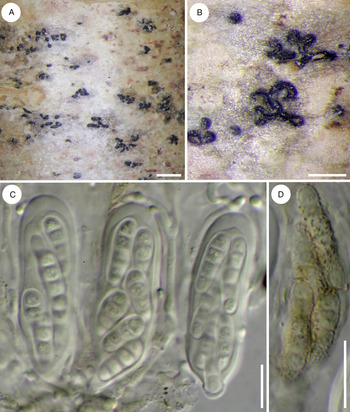
Opegrapha sawyeriana (isotype). A, colony on thallus of Coniocarpon cinnabarinum. B, detail of ascomatal clusters. C, asci and ascospores mounted in KOH. D, overmature ascospores mounted in KOH, showing the brown granules from the degenerating perispore. Scales: A = 1 mm; B = 0.2 mm; C & D = 10 μm. In colour online.

Ascomata developing just below the bark surface, but soon bursting through this and the host thallus and becoming superficial; single or in small groups of 2–4. Individual ascomata lirellate, (0.14–)0.16–0.64 × 0.1–0.16 mm, to 0.11 mm tall, unbranched and straight or curved, or occasionally 1-furcate, black, not pruinose; disc slit-like or sometimes a few eventually gaping. Exciple well developed laterally, ±spreading outwards below, (12–)20–27(–39) μm thick, dark brown to blackish brown, K± faint olivaceous tinge; basal exciple brown (slightly less intensely pigmented than the lateral exciple), 9–15 μm thick. Hymenium colourless or with the upper part dilute brownish, 50–60 μm tall, I+ blue, K/I+ blue; epithecium indistinct. Subhymenium indistinctly yellowish, K−, 5–10 μm tall. Paraphysoids sparingly branched, 1.3–1.7 μm diam. (in KOH), slightly widening above to c. 2.3 μm and sometimes with a few external minute brown granules. Asci shortly cylindrical-clavate, 30–39 × 11–12 μm, with a minute K/I+ blue ring around the top of the ocular chamber, 8-spored. Ascospores long remaining colourless, 3-septate, the upper two cells usually broader than the lower cells, 13–14.5(–16) × 3.5–4 μm; perispore thin, often indistinct; old spores sometimes becoming brown owing to presence of brown granules from the degenerating perispore.
Pycnidia not seen.
Etymology
In honour of John Sawyer (1968–2015), much respected and inspirational CEO of the National Biodiversity Network. John took the first author (BJC) and his wife to a hazelwood close to his family holiday home on the Isle of Mull, where material of this new species was collected. Poignantly, in the evening of that same day, just a few hours after saying goodbye to him, John died from a heart attack.
Ecology and distribution
This species appears to be restricted to thalli of Coniocarpon cinnabarinum and is associated with some degradation of the host tissues (see notes below). It appears to be not uncommon in strongly oceanic areas of south-western England, Scotland and Ireland, and always on branches and twigs of Corylus. The host lichen is common and widespread, and O. sawyeriana might well have a broad distribution in suitable habitat along the European Atlantic seaboard.
Remarks
The species is compared with O. arthoniicola and other species from similar habitats in Table 1. The grey discoloration of the host thallus surrounding the ascomatal clusters is due to a network of dark brown, frequently branched and anastomosing nodular subcuticular hyphae, with possible haustoria present. These might well belong to O. sawyeriana and reflect an at least partially necrotic lifestyle, but they could also be scavenging nutrients from plant tissues that have been disrupted by the host lichen. However, some fruit-bodies of O. sawyeriana seem themselves to be colonized by an unidentified sterile fungus with frequently and irregularly branched hyphae, and the brown mycelium might belong to this species instead.
Additional specimens examined (all on Coniocarpon cinnabarinum on Corylus)
Ireland: V.C. H1, South Kerry, Lickeen Wood, Blackstones Bridge, V707.853, 2015, N. A. Sanderson 2082 (hb. Sanderson); Loch Inchiquin, Uragh Wood, V83.62, 1996, B. J. & A. M. Coppins 25937 (E); V.C. H2, North Kerry, Crohane Wood, W052.796, 2015, N. A. Sanderson 2083 (hb. Sanderson); V.C. H9, Clare, The Burren, Glensleade depression, M2279.01114, alt. 100 m, B. J. & A. M. Coppins 25804 (E); Poulanine, M233.005, alt. 140 m, B. J. & A. M. Coppins 25794 (E); Poulnalour, R299.945, alt. 50 m, 2008, B. J. & A. M. Coppins 25788 (E); V.C. H16, West Galway, Derryclare Wood, L835.498, alt. 10 m, 14 ix 2012, V. J. Giavarini (hb. Powell 4719); V.C. H33, Fermanagh, Marble Arch NNR, northern end, H125.355, 3 vii 1990, A. M. O'Dare s. n. (E); Marble Arch woods, Cladagh Glen, H12.35, alt. c. 90 m, 2010, B. J. & A. M. Coppins 23055 (E); Cladagh River, upper ravine woodland, H119.333, alt. 180 m, 2010, B. J. & A. M. Coppins 23066 (E).—Great Britain: England: V.C. 4, North Devon, Clovelly, The Hobby, in oceanic coastal Quercus-Corylus woodland on top of cliff, SU32266.24298, 2020, N. A. Sanderson 2785 (hb. Sanderson). Scotland: V.C. 98, Argyll Main, Seil, Ballachuan Hazelwood, NM76.14, 25 v 2003, V. J. Giavarini s. n. (E); V.C. 103, Mid Ebudes, Mull, Reudle, Allt Dubhaig, NM36.45, alt. c. 80 m, 2015, B. J. & A. M. Coppins & J. Sawyer [Coppins 24994] (E); Croig, NM407.534, alt. 10 m, 2016, B. J. & A. M. Coppins 25248 (E).
The Species on Verrucariaceae
There are at least seven species of Opegrapha s. lat. parasitic on members of the Verrucariaceae (Diederich et al. Reference Diederich, Lawrey and Ertz2018), including one new species described here (O. hochstetteri), a poorly known species without a modern description (O. opaca) and Opegraphoidea staurothelicola Fink.
In the phylogenetic analyses by Gueidan et al. (Reference Gueidan, Roux and Lutzoni2007, Reference Gueidan, Savić, Thüs, Roux, Keller, Tibell, Prieto, Heiðmarsson, Breuss and Orange2009), the host lichens of the three Opegrapha species described below belong to different lineages: Verrucaria (Bagliettoa) baldensis A. Massal. (parasitized by O. rupestris Pers.) belongs to Bagliettoa A. Massal.; V. hochstetteri Fr. and V. muralis Ach. (parasitized by O. hochstetteri) to the ‘Polyblastia’ group; V. nigrescens Pers. and V. viridula (Schrad.) Ach. (parasitized by O. opaca) to the ‘Endocarpon’ group. Furthermore, the main hosts of O. pulvinata Rehm, viz. Dermatocarpon intestiniforme (Körb.) Hasse and D. miniatum (L.) W. Mann, belong to the ‘Dermatocarpon’ group. The host preference shown by these species therefore provides further evidence in support of the formal recognition of multiple phylogenetic clades within Verrucaria s. lat.
Opegrapha hochstetteri Coppins sp. nov.
Index Fungorum No.: IF 558016
A lichenicolous fungus, parasitic on thalli of Verrucaria hochstetteri Fr. and V. muralis Ach. but showing few if any signs of damage; similar to O. opaca Nyl. but differing principally in the somewhat larger dimensions of the ascospores, asci and hymenium height, and the larger but less tightly compacted ascomatal clusters.
Type: England, North Somerset (V.C. 6), Weston-super-Mare, Brean Down, S-facing slope of limestone peninsula, grid ST28.58, on Verrucaria hochstetteri, 21 March 1986, B. J. Coppins 11243 (E—holotype).
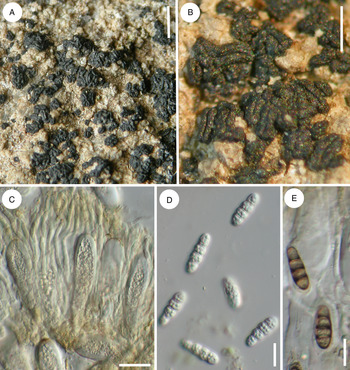
A & B, Opegrapha hochstetteri (holotype). A, several ascomatal clusters (on thallus of Verrucaria hochstetteri). B, close-up view of irregular ascomatal clusters. C–E, on thallus of Verrucaria muralis (Cannon P2885). C, asci and paraphyses, mounted in water. D, mature, colourless ascospores, in water. E, overmature brown ascospores, in water. Scales: A = 1 mm; B = 0.5 mm; C = 20 μm; D & E = 10 μm. In colour online.

Ascomata often forming loose rounded clusters, 0.4–1.2 mm diam. with more irregular clusters to 1.8 × 1.4 mm, and to 0.4 mm high; clusters with 2 to c. 20 ascomata. Individual ascomata usually discernible, black, not pruinose, lirellate, unbranched or shortly 1–2-furcate, mainly not open but sometimes a few open around the centre exposing the non-pruinose disc, 0.2–0.5(–0.7) mm long, (0.1–)0.15–0.2 mm wide and 0.16–0.2 mm tall in section. Exciple well developed, entire, 36–48 μm wide laterally, dark brown to blackish brown, K− or K+ reddish enhancing (never greenish). Hymenium 50–62 μm tall, hyaline, I+ red to reddish brown, K/I+ blue; epithecium well developed, brownish and I+ blue, 19–24 μm tall. Subhymenium 12–28 μm tall, slightly brownish, K−. Paraphyses sparingly branched, 1.4–2 μm diam. (in KOH), with slightly swollen tips to c. 3.5 μm diam., which are covered with abundant minute brown granules. Asci broadly clavate, 48–61 × 16–17 μm, with a K/I+ blue ring around the top of the ocular chamber, (4–)6(–8)-spored. Ascospores long remaining colourless, 3-septate, the upper two or only the cell second from the top somewhat more swollen than the lower cells, (15–)16–19 × (4.7–)5–6 μm whilst colourless, old brown ascospores to 21 μm long and 7 μm diam., usually with a distinct perispore 1–2 μm thick; surface of old spores released from the asci minutely warted (at ×1000), but without brown granules in the perispore.
Pycnidia c. 80 μm diam., immersed in the host thallus, with a dark brown wall, conidiogenous cells elongate-ampulliform, 8–12 × c. 2 μm; conidia aseptate, bacilliform to narrowly ellipsoidal, colourless, 4.3–4.8 × c. 1 μm.
Etymology
The species epithet is derived from that of the host lichen on which it was originally detected.
Ecology and distribution
Found on thalli of Verrucaria hochstetteri and V. muralis on calcareous rock and stonework, mostly on worked stone in graveyards etc. So far known only from southern England and Luxembourg but has surely been overlooked elsewhere, given the hosts’ wide distribution.
Remarks
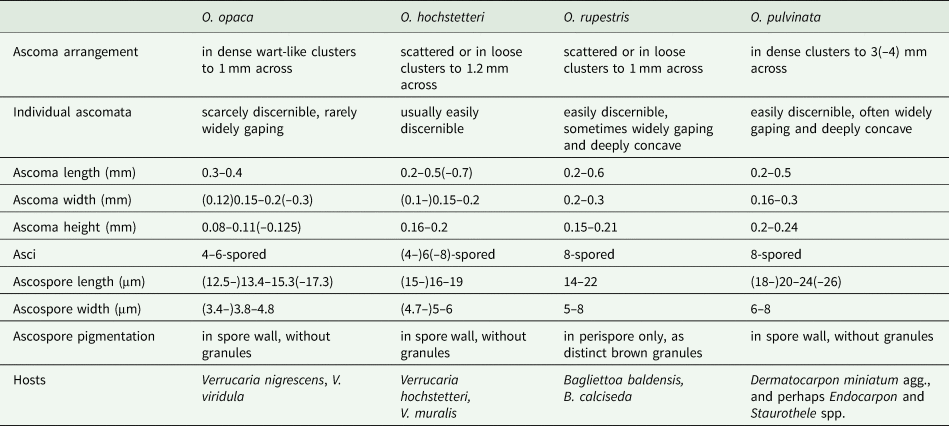
This species is similar to Opegrapha opaca (treated below) but differs principally in the somewhat larger dimensions of the ascospores, asci and hymenium height, and the larger but less tightly compacted ascomatal clusters. The species are compared in Table 2. These differences remain consistent when comparing collections on the respective hosts, Verrucaria hochstetteri and V. nigrescens. All three collections on V. hochstetteri previously filed under O. rupestris in E are referable to O. hochstetteri.
Distinguishing characters of Opegrapha opaca, O. hochstetteri, O. rupestris and O. pulvinata.

Selected additional specimens examined (all on Verrucaria hochstetteri unless otherwise stated)
Great Britain: England: V.C. 8, South Wiltshire, West Grimstead Church, SU211265, alt. 75 m, on mortar on S wall of church, 2016, B. J. Coppins & M. Powell [Coppins 25038] (E); V.C. 9, Dorset, Poxwell, SY75.83, on limestone wall, 1975, H. J. M. Bowen [Coppins 1306] (E); V.C. 13, West Sussex, Edburton Church, on vertical side of table tomb, TQ23.11, alt. 50 m, 20 ix 1973, B. J. Coppins s. n. (E); V.C. 20, Hertfordshire, Chipperfield Church, TL043.015, alt. 140 m, on V. muralis on cement, 2015, M. Powell 3830 (hb. Powell); V.C. 21, Middlesex, Stoke Newington, Abney Park cemetery, TQ334.869, on V. muralis on limestone monument, 2017, P. F. Cannon P2885 (K(M)); V.C. 25, East Suffolk, Sizewell, TM47.64, alt. < 10 m, on V. muralis on concrete tank block, 8 ix 2015, A. Acton (E); V.C. 32, Northamptonshire, Stanwick Lakes, SP965.714, alt. 35 m, on V. muralis on limestone fragment lying on the ground, 2015, M. Powell 3945 (E).—Luxembourg: Gutland: W Larochette, vallon du Manzebaach, UTM KA.91, sur un rocher en grès, dans une forêt, 1983, P. Diederich 5808 (hb. Diederich).
Opegrapha opaca Nyl.
Index Fungorum No.: IF 396560
Bot. Notiser 1853, 161 (1853); type: [France, Hérault, Montpellier] ‘ad monspelium prope Cambouse ad saxa calcarea’, on Verrucaria cf. nigrescens, s. d., W. Nylander (H-NYL 6928—holotype; seen from images provided by JSTOR Global Plants).
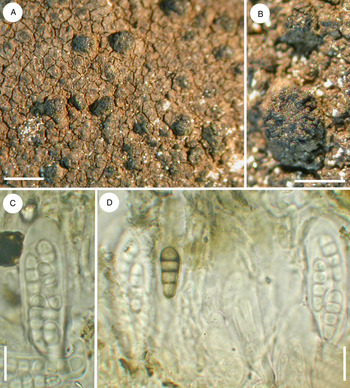
Opegrapha opaca (Coppins 13983). A, several ascomatal clusters (on thallus of Verrucaria nigrescens). B, detail of ascomatal clusters. C & D, asci and ascospores. Scales: A = 1 mm; B = 0.5 mm; C & D = 10 μm. In colour online.

Lichenicolous fungus, parasitic on thalli of Verrucaria nigrescens Pers. and V. viridula (Schrad.) Ach. but showing few if any signs of damage.
Ascomata forming black spots between host thallus areoles and sometimes forming dense wart-like clusters, (0.2–)0.3–0.8(–1.0) mm across and 0.1–0.2 mm high. Individual ascomata often difficult to discern, black, not pruinose, lirellate, unbranched or shortly 1–2-furcate, rather short and broad, mainly ±closed but sometimes widely open, 0.3–0.4 mm long, (0.12–)0.15–0.2(–0.3) mm wide and (80–)95–110(–125) μm tall in section, mainly pressed together in compact rounded wart-like clusters of 2–6, which under a ×10 lens resemble large, rough-walled perithecia. Exciple well developed, entire, 14–30 μm thick laterally, dark brown to blackish brown, K− (never greenish). Hymenium 48–55 μm tall, colourless, I+ red to reddish brown, K/I+ blue; epithecium well developed, brownish and I+ blue quickly red, 19–24 μm tall. Subhymenium 12–15 μm tall, slightly brownish, K−. Paraphyses sparingly branched, 1.4–2 μm diam. (in KOH), with slightly swollen tips to 3.4 μm diam., which are covered with abundant minute brown granules. Asci broadly clavate, 42–50 × (11.5–)12.5–14.5 μm, with a K/I+ blue ring around the top of the ocular chamber, 4–6-spored. Ascospores long remaining colourless, (1–)3-septate, the upper two or only the second cell from the top somewhat more swollen than the lower cells, (12.5–)13.4–15.3(–17.3) × (3.4–)3.8–4.8 μm, old brown ascospores up to 19 μm long and 6 μm diam., sometimes with a thin perispore c. 1 μm thick; old spores released from the asci (or in undehisced, overmature asci) very often with pale brown to brown walls [without brown granules in the perispore].
Pycnidia c. 80 μm diam., immersed, with a dark brown wall, conidiogenous cells elongate-ampulliform, 10–15 × c. 2 μm; conidia aseptate, ellipsoidal, colourless, 3–4 × c. 1 μm.
Ecology and distribution
So far known on calcareous rocks or stonework in W Europe, from Spain, England, Wales, Luxembourg and N France, and further east in Israel. The species is probably more widely occurring in Europe, at least in countries south of the boreal zone. Some of the records (Spain, Israel) are from warm, dry Mediterranean zones where the species is common on very exposed Verrucaria nigrescens. In a subarid park in southern Navarra it was very common and the accompanying lichen biota is described in Etayo (Reference Etayo2008).
Remarks
The original description is short and does not distinguish between the parasite and its host. We have examined the holotype only using images provided by JSTOR Global Plants. It was previously annotated by G. Clauzade and C. Roux in 1971 as ‘Verrucaria cf. nigrescens Pers parasiti par Opegrapha cf. parasitica (Massal). Oliv.’, and in 1987 by Leif Källsten as ‘Opegrapha rupestris Pers.’. We are grateful to Dr Damien Ertz for bringing this specimen to our attention. We had originally intended to describe this species as ‘O. verrucariae’, a name by which it has been informally known for c. 15 years. As no detailed description of O. opaca exists, we provide here a full description as was intended for a new species. This should be compared with notes made during any future examination of the holotype.
Opegrapha opaca differs from O. pulvinata, known from Dermatocarpon miniatum agg. (and supposedly also from Endocarpon pusillum Hedw. and Staurothele ‘catalepta’; Clauzade et al. Reference Clauzade, Roux and Diederich1989; Hafellner Reference Hafellner1994; Puntillo Reference Puntillo1996: 130 & tav. XXVII), as well as from O. rupestris, known from Verrucaria (Bagliettoa) baldensis and its close relatives, mainly by its much smaller ascospores but also other characters, such as size and habitus of ascomatal clusters, development of individual ascomata, number of the ascospores in asci, and host range (Table 2; Pentecost & James Reference Pentecost, James, Smith, Aptroot, Coppins, Fletcher, Gilbert, James and Wolseley2009: 643). From O. rouxiana Nav.-Ros. & Hladun, known from Polyblastia albida Arnold and P. nidulans (Stenh.) Arnold in NE Spain, O. opaca differs by its much smaller ascospores ((21.5–)24.5–30.5 × 8.5–10 μm in O. rouxiana), much bigger and not immersed ascomatal clusters and different hosts (Navarro-Rosinés & Hladun Reference Navarro-Rosinés and Hladun1995).
Opegrapha centrifuga A. Massal., O. monspeliensis Nyl., O. persoonii (Ach.) Ach. and O. saxatilis DC., on the thalli of several endolithic Verrucaria (incl. Bagliettoa) but not V. nigrescens or V. viridula, have generally been considered as synonyms of O. rupestris Pers. (Clauzade et al. Reference Clauzade, Roux and Diederich1989; Hafellner Reference Hafellner1994; Kocourková Reference Kocourková2000; Santesson et al. Reference Santesson, Moberg, Nordin, Tønsberg and Vitikainen2004). Only Diederich & Sérusiaux (Reference Diederich and Sérusiaux2000) recorded O. rupestris on V. nigrescens, but this report refers to O. opaca. Opegrapha parasitica (A. Massal.) Vězda is a parasite of Circinaria species (Aspicilia calcarea agg.) (Hafellner Reference Hafellner1994) although some earlier authors also reported it on Verrucaria (e.g. Vězda Reference Vězda1970), but only prior to the recognized distinction from O. rupestris. It has similarly pigmented ascospores to O. opaca but they are larger, 16–22 × 6–8 μm, and its ascomata do not form dense clusters. Opegrapha insidiens (J. Steiner) S. Y. Kondr. (syn. Leciographa insidens J. Steiner), reported on Verrucaria buschirensis J. Steiner (and other calcicolous genera) from Iran, is probably referable to Opegrapha s. lat., but supposedly has larger asci of 80–107 × 20–24 μm and ascospores of 18–26 × 6–10 μm (Vouaux Reference Vouaux1913); considering the ascospore size, it should be compared with O. rouxiana.
The genus Opegraphoidea was introduced by Fink (in Hedrick Reference Hedrick1933: 311) to accommodate lichenicolous species of Opegrapha. The sole species (and therefore the type), Opegraphoidea staurothelicola Fink, was described from the USA (Ohio) growing on Staurothele umbrina (Wahlenb.) Tuck. (= S. fissa (Taylor) Zwackh.). A small specimen determined as this species by Dr Paul Diederich (on Staurothele diffractella (Nyl.) Tuck., USA, Massachusetts, Berkshire County, Bartholomew's Cobble, Asley Falls, 10 vi 1982, R. C. Harris s. n. (NY, non vid.)) is very close to O. opaca, with ascomatal clusters 0.3–0.5 mm diam. and 3-septate ascospores. It differs from O. opaca in having slightly larger ascospores, 15–18 × 5–6(–7) μm when hyaline, or 16.5–19 × 6.5–7 μm when brown. Old ascospores develop a brown pigment, both in the spore wall and as granules in the perispore, such that these old spores have a distinctly warted surface. It has bacilliform conidia, 3.5–3.8 × c. 1 μm, but a further difference from O. hochstetteri and O. opaca is that the pycnidia are developed in the ascomatal clusters and not in the host thallus. The notes from the Harris collection used in this comparison were kindly supplied by Dr Paul Diederich. The type of Opegraphoidea staurothelicola needs to be compared with this Harris collection to determine if they are indeed conspecific, but there is little doubt that it belongs in Opegrapha in its current, broad circumscription. A further taxon on Staurothele is O. romsiae S. Y. Kondr. & Kudratov (Kondratyuk & Kudratov (Reference Kondratyuk and Kudratov2002), as ‘O. romsae’), described from Tajikistan on Staurothele areolata (Ach.) Lettau. It is said to have ascospores 17–21 × (6–)6.5–7(–9) μm, but should nevertheless also be closely compared to Opegraphoidea staurothelicola.
Selected additional specimens examined (all on Verrucaria nigrescens unless otherwise stated)
Great Britain: England: V.C. 5, South Somerset, Spaxton church, ST225.370, alt. 70 m, on V. viridula at base of church wall, 2015, M. Powell 3843 (hb. Powell); V.C. 6, North Somerset, Weston-super-Mare, Sand Point, ST32.65, alt. c. 30 m, on S-facing low limestone outcrops, 1991, B. J. Coppins 13983 (E); ibid., 1992, B. J. Coppins 15279 (E); Compton Bishop, Rackley Spur, ST395.550, alt. c. 65 m, 2002, B. J. & A. M. Coppins 20639 (E); Compton Bishop, Wavering Down, ST400.558, alt. c. 155 m, 2002, B. J. & A. M. Coppins 20698 (E); V.C. 8, South Wiltshire, East Grimstead church, SU224272, alt. 50 m, on Verrucaria viridula on red-brick kerb, 2016, B. J. Coppins & M. Powell [Coppins 25037] (E); V.C. 15, West Kent, West Peckham church, TQ644.525, on buttress of north wall of church, alt. 75 m, 2005, B. J. Coppins 22123 (E); ibid. on mortar on W wall, B. J. Coppins 22124 (E). Wales: V.C. 45, Pembrokeshire, near Pembroke, Castlemartin, W of Brownslade, SR8999.9762, alt. 25 m, on Verrucaria viridula on limestone in small disused quarry, 2005, A. Orange 15795 (NMW).—France: Moselle: a 300 m à l'est de Montenach, pente sud du Felsberg, IFBL: N9.22.23, sur une paroi verticale ombragée en calcaire coquillier, dans une forêt, on Verrucaria cf. nigrescens, 1999, P. Diederich [13814] & J. Signoret (hb. Diederich).—Luxembourg: Lasauvage, UTM: GQ.08, rocher dans le village, sur un rocher en tuf calcaire, 1999, P. Diederich 13898 (hb. Diederich).—Spain: Zaragoza: gipsic low ridge near Calatayud, on calcareous flagstone, 30T 0610675, 4571400, 730 m, 2002, J. Etayo 20204 (JACA); Quercus rotundifolia wood between Cariñena and Fuendetodos, on calcareous stone, 30T 0661463, 4579131, 740 m, 2003, J. Etayo 20300 (JACA); Belchite, La Lomaza de Belchite, calcareous low ridge, 30T 0691795, 4567499, 560 m, 2003, J. Etayo 20385 (hb. Etayo); Luesia, Torres de Sibirana, on calcareous sandstone, 30T 0662034, 4700058, 790 m, 2004, F. Compaired & J. Etayo 21945 (hb. Etayo); Sª de Mequinenza, near Caspe, embalse de Caspe, 165 m, on calcareous sandstone, 2004, J. Etayo 21471 (hb. Etayo). Navarra: Ablitas, calcareous stone hill, 41°54′50.5″N, 001°33′32.9″W, 366 m, 2005, J. Etayo 22339, 22342 (hb. Etayo); ibid., on stones below Pinus wood, 41°56′22.7″N, 001°34′26.8″W, 385 m, 2005, J. Etayo 22327 (hb. Etayo).—Israel: Mount Carmel, Lower Nahal Oren, ‘Evolution Canyon’ (32°43′N, 34°58′E), north-facing slope, station 7, 120 m, on limestone, 2000, S. Kondratyuk 2001 (KW); Central Coast Plain, 20 km to S of Haifa town, Khirbet Karta Nature Reserve, 5–10 m alt., 2000, S. Kondratyuk 2009 (KW).
Key to species of lichenicolous Opegraphaceae recorded from Great Britain and Ireland
1 On Arthoniaceae (Arthonia, Coniocarpon)2
On Graphidaceae (Crutarndina, Thelotrema)3
On Hymeneliaceae (Ionaspis); ascospores (17.5–)20–24 × 5–7 μm, 3-septate Opegrapha reactiva
On Megasporaceae (Circinaria); ascospores 16–22 × 6–8 μm, 3-septate O. parasitica
On Ochrolechiaceae (Lepra); ascospores 17–26 × 6.5–9 μm, 3-septate O. anomea
On Pertusariaceae (Pertusaria); ascospores 21–28 × 4.5–6 μm, (5–)6-septate O. pertusariicola
On Physciaceae (Physconia); ascospores 18–22 × 5–6 μm, 3-septate O. rotunda
On Sphaerophoraceae (Sphaerophorus); ascospores 19–22 × 5.5–6 μm, 3-septate O. sphaerophoricola
On Teloschistaceae (Xanthoria); ascospores 12–17 × 4–6 μm, 3-septate Phacothecium varium
On Verrucariaceae (Bagliettoa, Dermatocarpon, Verrucaria)4
2(1) Exciple only well developed laterally; ascomata in clusters on thalli of Arthonia radiata, not causing necrosis; ascospores (10.5–)12.5–14.5 × 3.4–4.2(–4.8) μm, 3-septate O. arthoniicola
Exciple with a dark brown basal layer; ascomata scattered on thalli of Coniocarpon cinnabarinum, causing some necrosis; ascospores 13–14.5(–16) × 3.5–4 μm, 3-septate O. sawyeriana
3(1) Asci 4-spored; on Crutarndina petractoides; ascospores (14–)15–18 × 4.5–5(–6) μm, 3-septate O. brevis
Asci 8-spored; on Thelotrema lepadinum and T. macrosporum; ascospores 13.5–17 × (4–)4.5–5.5(–6) μm, 3-septate O. thelotrematis
4(1) On Dermatocarpon miniatum aggr.; asci 8-spored; ascospores 18–26 × 6–8 μm, 3-septate O. pulvinata
On Bagliettoa spp.; asci 8-spored; ascospores 14–22 × 5–8 μm, 3-septate O. rupestris
On Verrucaria hochstetteri and V. muralis; asci mostly 6-spored; ascospores 15–19 × 4.7–6 μm, 3-septateO. hochstetteri
On Verrucaria nigrescens and V. viridula; asci 4–6-spored; ascospores 12.5–17.3 × 3.4–4.8 μm, 3-septate O. opaca
Acknowledgements
We are indebted to Andy Acton, Dr Paul Diederich, Dr Damien Ertz, Alan Orange, Mark Powell and Neil Sanderson for the loan of material and for helpful discussions. SYK is grateful to the Royal Society of London for a grant to work at the Royal Botanic Garden Edinburgh.
Author ORCIDs
Brian Coppins, 0000-0001-9464-0495; Sergey Kondratyuk, 0000-0002-2622-0832; Javier Etayo, 0000-0003-0392-0710; Paul Cannon, 0000-0001-8562-7029.