Introduction
Little doubt exists that the Antarctic toothfish (Dissostichus mawsoni Norman) is an important predator in waters overlying the Ross Sea continental shelf and the southern portion, in general, of the Southern Ocean (Eastman Reference Eastman1993, La Mesa et al. Reference La Mesa, Eastman and Vacchi2004). Among a suite of top-predators that otherwise include mammals and penguins, and assuming its role is equal to that of large, predatory fish in other marine ecosystems (e.g. Schindler et al. Reference Schindler, Essington, Kitchell, Boggs and Hilborn2002, Scheffer et al. Reference Scheffer, Carpenter and De Young2005, Frank et al. Reference Frank, Petrie, Choi and Leggett2005), the toothfish probably exerts an important pressure on structuring the Ross Sea neritic foodweb. It is by far the largest fish predator, showing adaptations in that regard, which contrasts with the remainder of the nototheniids, many of which show adaptations to avoid predation (Eastman Reference Eastman1993: 72–92).
There appears to be uncertainty, however, about the full role of toothfish in the ecosystem, at least judging from comments expressed by the CCAMLR (Convention for the Conservation of Antarctic Marine Living Resources) working group for Ecosystem Monitoring and Management (EMM) at its 2007 and 2008 meetings (SC-CAMLR 2007: paragraphs 5.77–5.79; SC-CAMLR 2008: paragraphs 6.10–6.20). Given that marine food webs are unstructured - big organisms eat small ones until the latter, too, become big - toothfish can also be prey, and that could include even the large fish. Their k-selected life history strategy (Eastman & DeVries Reference Eastman and DeVries1986, Reference Eastman and DeVries2000, Eastman Reference Eastman1993) implies that most juveniles and subadults are probably prey of a wide variety of predators.
In this paper we address this uncertainty pertaining to the role of toothfish as prey of Weddell seals, thinking that much of the problem has to do with the unique characteristics of the Ross Sea neritic ecosystem, where most of what is known about Antarctic toothfish, both as prey of Weddell seals (Leptonychotes weddellii Lesson) and other ecological and physiological aspects of their natural history, has been learned. Southern McMurdo Sound has been the site for intensive marine research for 50 years and, although much is known, much remains to be learned about its workings (Smith et al. Reference Smith, Ainley and Cattaneo-Vietti2007).
A large body of observational evidence indicates that many toothfish are taken annually by Weddell seals and killer whales (Orcinus orca Linn.) during the summer in McMurdo Sound, the southernmost arm of the Ross Sea (see Murphy Reference Murphy1962, Dearborn Reference Dearborn1965, Calhaem & Christoffel Reference Calhaem and Christoffel1969, Thomas et al. Reference Thomas, Leatherwood, Evans, Jehl and Awbrey1981, Davis et al. Reference Davis, Fuiman, Williams, Horning and Hagey1999, Reference Davis, Fuiman, Williams, Collier, Hagey, Kanatous, Kohin and Horning2003, Fuiman et al. Reference Fuiman, Davis and Williams2002, Wu & Mastro Reference Wu and Mastro2004, Kim et al. Reference Kim, Conlan, Malone and Lewis2005, Ainley et al. Reference Ainley, Ballard and Dugger2006a, Ponganis & Stockard Reference Ponganis and Stockard2007). However, work using stable isotopes, fatty acids and scats (Testa et al. Reference Testa, Sinniff, Ross and Winter1985, Castellini et al. Reference Castellini, Davis and Kooyman1992, Burns et al. Reference Burns, Trumble, Castellini and Testa1998, Zhao et al. Reference Zhao, Castellini, Mau and Trumble2004, Krahn et al. Reference Krahn, Pitman, Burrows, Herman and Pearce2008) is considered to have provided evidence that toothfish play much less of a role in top predator diets than direct observations suggest (see CCAMLR EMM minutes). The issue appears to be one of the weight given to indirect evidence from tissue analyses, where time lags play a major role in interpretations, versus the weight given to direct observations where time lags do not exist. It is thought by many that biochemical methods integrate better the contribution of prey in a species’ diet over time. This is often true, but only if the time lags and other contextual information is taken into account.
Background
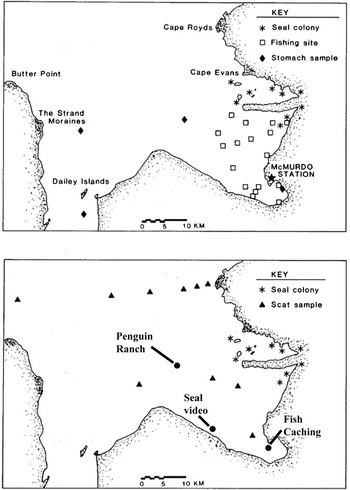
Approximately 2000 breeding seals and appreciable numbers of non-breeders comprise what is considered the eastern McMurdo Sound Weddell seal population (Cameron & Siniff Reference Cameron and Siniff2004). In total for all the McMurdo Sound, the population may number about 4000 individuals (Siniff & Ainley Reference Siniff and Ainley2008) constituting one of the largest concentrations of this species in Antarctica. The breeders congregate at traditional sites around tide cracks near to the shores of Ross Island, the Erebus Ice Tongue, and nearby Delbridge Islands, in the south-eastern corner of the Sound (Fig. 1); smaller breeding concentrations occur at tide cracks along the western side of the Sound. Non-breeding adults are mostly excluded from those colonies owing to the territorial behaviour of adult males and adult females with their pups. These non-breeders congregate at cracks along shore elsewhere as well as at cracks that cross McMurdo Sound, for example, the one that annually exists between Cape Royds, Ross Island, across to Marble Point, Victoria Land (distance ∼50 km; Fig. 1). The breeders are present from early spring (some are even present from the previous winter) through to mid-December (when pups are weaned, and breeding occurs). They then disperse from these pupping and breeding sites, although some remain in the vicinity. In late spring, their numbers are swelled by an influx of immatures and weaners. A favourite haulout then is around the southernmost end of Hut Peninsula, between McMurdo Station and Scott Base where the sea ice meets the Ross Ice Shelf (Smith Reference Smith1965, Stirling Reference Stirling1969). A demographic study has been carried out on this population since about 1963, and currently most of the seals in it are tagged and of known age (Stirling Reference Stirling1969, Testa & Siniff Reference Testa and Siniff1987, Cameron & Siniff Reference Cameron and Siniff2004, Hadley et al. Reference Hadley, Rotella and Garrott2007).
Sites where Testa et al. (Reference Testa, Sinniff, Ross and Winter1985) collected seal scats and fished for toothfish. Also shown are the location of seal colonies, the “Penguin Ranch” (Ponganis & Stockard Reference Ponganis and Stockard2007), the site where video of seals hunting fish was taken during 1997–2000 (Davis et al. Reference Davis, Fuiman, Williams, Collier, Hagey, Kanatous, Kohin and Horning1999), and the site where toothfish caching behaviour was seen (Kim et al. Reference Kim, Conlan, Malone and Lewis2005). In the lower figure, the northernmost line of scat sample sites marks one of the important ice cracks used by non-breeding Weddell seals.
The edge of the McMurdo Sound fast ice, thick enough that an airstrip for military cargo aircraft exists to the south, near McMurdo Station, usually lies just north of Cape Royds during the winter and spring, but by mid-January it breaks back several kilometres, piecemeal, to be well south of the Delbridge Islands. Annually in January, an icebreaker breaks a channel from the edge to McMurdo Station, and killer whales use the channel to reach prey that otherwise would not be accessible (see also Jehl et al. 1980, Thomas et al. Reference Thomas, Leatherwood, Evans, Jehl and Awbrey1981, Andrews et al. Reference Andrews, Pitman and Ballance2008). Soon after the latter intrusion of killer whales, not long after the channel is made, ice conditions and predation pressure appears to force Weddell seals from the mid-sound.
Results
Observational evidence
A key to understanding the importance of toothfish as prey to seals is the experimental study by Testa et al. (Reference Testa, Sinniff, Ross and Winter1985), the report of which in itself is confusing. The main reason for the confusion is that, in spite of ample observational evidence of seals eating toothfish, identifiable remains have rarely been reported in the stomachs or scats of Weddell seals in McMurdo Sound, or elsewhere: 367 stomachs in the Antarctic Peninsula region (Bertram Reference Bertram1940), eight stomachs inspected in the South Shetland Islands (Clarke & Macleod Reference Clarke and MacLeod1982), 44 stomachs inspected from McMurdo Sound (Dearborn Reference Dearborn1965), and numerous scats inspected up to 1985 (Testa et al. Reference Testa, Sinniff, Ross and Winter1985) and subsequently in McMurdo Sound (Castellini et al. Reference Castellini, Davis and Kooyman1992, Burns et al. Reference Burns, Trumble, Castellini and Testa1998) and elsewhere (Plötz Reference Plötz1986). At four locations in East Antarctica, in a study that sorted 905 Weddell seal scat samples collected during 1995–97, one otolith was found (size not specified) of an Antarctic toothfish (Lake et al. 2003).
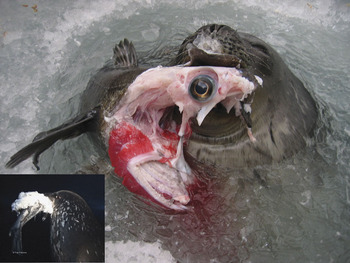
Recently, however, research divers (Kim et al. Reference Kim, Conlan, Malone and Lewis2005) published observations (with accompanying photographs) that the seals eat neither the head, skin nor vertebral column of toothfish, or at least ones > 0.85 m in length (which comprise the majority of toothfish in McMurdo Sound (DeVries et al. Reference DeVries, Ainley and Ballard2008). Here, too, are the observations of R. Davis (personal communication 19 June 2008) who has worked in McMurdo Sound for the past 20 years (see Fig. 2):
A subadult Weddell seal with an Antarctic toothfish 1/3 its size in a research ice hole (photo: Jessica Meir); the seal is removing the skin prior to severing the head from the body. Inset, a Weddell seal skinning and consuming the flesh from the tail of a large toothfish (photo: Rob Robbins). Both photographs taken in McMurdo Sound.
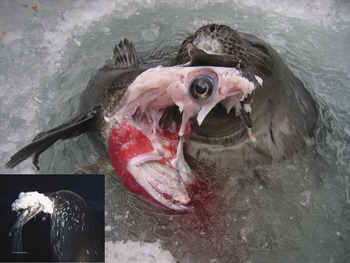
“We’ve observed this [Weddell seals removing the heads of toothfish before consumption] many times over the years when we had a hut over an ice hole. When a seal brings a large toothfish to the surface, it kills it by flinging it vigorously in the air or shaking it underwater until the neck is broken, then, continues until the head breaks off or is shredded. This is the only way the seal can expose the lateral musculature - it cannot or does not attempt to penetrate the skin from the sides. Once the head is off, [the seal] breaks off large chunks of muscle by shaking the carcass vigorously underwater. The skin rolls back as the seal eats its way towards the tail. This process may take several hours, and the seal does not always consume the entire fish. We have seen [this process] by looking down into the water through the ice hole and from the sub-ice chamber. After the head is gone, the carcass floats and may be left under the ice near the hole. I can not tell you how many times I’ve seen this behavior, but it must be at least a dozen.”
This type of observation indicates that finding identifiable hard parts of toothfish, and particularly otololiths and bones of large fish, in a Weddell seal’s stomach or scat is highly unlikely. The otoliths of smaller toothfish (< 40 cm) have been recorded in six Weddell seal stomachs taken in the southern Weddell Sea (Plötz Reference Plötz1986; see also above, in regard to scats). The toothfish caught by research longline in McMurdo Sound range 85–200 cm in length, with the large majority ranging 101–160 cm; bent hooks indicate that even larger fish occur (DeVries et al. Reference DeVries, Ainley and Ballard2008). Large numbers of scats have contained numerous otoliths of the much smaller Antarctic silverfish (Pleuragramma antarcticum Boulenger), and thus otolith degradation owing to digestion is not the issue.
Testa et al. (Reference Testa, Sinniff, Ross and Winter1985) reported a curvilinear relationship between scientific catch rate of toothfish and distance from major seal colonies (r 2 = 0.84). This was based on fishing at 16 sites spread around McMurdo Sound (Fig. 1) using a vertical longline deployed to the bottom, with 15–20 baited hooks. Soak time was 24 hrs. Such a longline operation has led to the catch of 200–500 large toothfish per year from fishing sites that were away from seals (DeVries et al. Reference DeVries, Ainley and Ballard2008). Testa et al. (Reference Testa, Sinniff, Ross and Winter1985) had no information as to the mechanism of the observed fish ‘exclusion’. If foraging was the reason, it would have been contrary to what was commonly known at that time from stomach and scat analysis. Testa et al. speculated that the seals’ activities chased the fish away. In other words, they proposed a form of interference competition.
Additional observational data comes from the experiments of Ponganis & Stockard (Reference Ponganis and Stockard2007). In this case, a large hole (1.3 m across) drilled through the McMurdo Sound fast ice was used to investigate the diving physiology of emperor penguins (Aptenodytes forsteri Gray). The penguins were ‘captive’ as they could not hold their breath long enough to find another air breathing hole farther away, thus to escape. A fence prevented the penguins from walking away. Importantly, the researchers did not feed these birds, as the penguins were allowed to forage at will. Another hole was drilled 15 m away where a sub-ice observation chamber was inserted. From this chamber, penguins and seals using the other hole could be observed beneath the ice. At this location, which became known as “Penguin Ranch” (Fig. 1), these holes were discovered by subadult seals (Fig. 2). These seals can hold their breath up to 82 min depending on type of dive (Castellini et al. Reference Castellini, Davis and Kooyman1992) and, thus, from various sites they can swim the required distance under the fast ice to reach this location. The seals subsequently used the hole, for breathing, for weeks. These researchers were not expressly observing the seals, but in the course of 37 observation days during October–November 2003, on 28 occasions they recorded a seal with a toothfish; in January 2001 they noted 10 seals with a toothfish in 11 days (less rigorous observations of seals with toothfish continued through the 2008 summer; J. Meir, personal communication 2008). These are rates equivalent to those reported by Calhaem & Christoffel (Reference Calhaem and Christoffel1969). Seals were not tagged, but were classified as subadult non-breeders since the site was located several kilometres from the nearest breeding colony. Some were recognizable on a day-to-day basis by spots and scars; one seal took four toothfish in three days. On the basis of Ponganis & Stochard’s observations, these seals were taking on the order of 0.8–1.3 toothfish per day. On some occasions, the seals did not eat the toothfish right away, but rather cached it on the lip of the ice hole (see below).
Kim et al. (Reference Kim, Conlan, Malone and Lewis2005), while studying benthic communities, reported the caching of a toothfish by a Weddell seal on the ocean bottom in one of their study plots. The case can be made that this is not a rare event. In most research divers’ work in McMurdo Sound, areas are avoided where it is likely that Weddell seals would use the holes drilled for diver access. It’s a serious matter, when seals arrive at the same time as divers at the surface of an access hole, since seals are sometimes aggressive and pose some danger for divers. Therefore, benthic researchers are not often in a position to make observations such as these. In this case, the seal “defended” the toothfish carcass upon the researchers’ approach to inspect it, the seal blowing a cloud of bubbles in the divers’ faces. In an unpublished observation made since their publication (S. Kim, personal communication 2008), these researchers encountered a Weddell seal caching a large octopus; and in another such unpublished observation, and only recently coming to light, researchers in January 1962 found three large toothfish cached in an artificially drilled ice hole near Scott Base (G. Kooyman, personal communication 2008, see also Ponganis & Stockard Reference Ponganis and Stockard2007).
Davis et al. (Reference Davis, Fuiman, Williams, Horning and Hagey1999, Reference Davis, Fuiman, Williams, Collier, Hagey, Kanatous, Kohin and Horning2003) placed a small video, with infrared lighting, on the heads of 31 Weddell seals during the course of six spring seasons, 1997–2002. Until 2001, the seals were captured in the breeding colonies and transported to an isolated hole too far away from any other holes/cracks to allow escape (Fig. 1) or territorial interference from other seals. Beginning in 2001, these researchers moved their study to the seal breeding colonies in Erebus Bay (see Fig. 1). In 500 hours of video recording, seals “encountered” 12 adult toothfish and about 1200 silverfish; Davis et al. Reference Davis, Hagey and Horning2004, R. Davis, personal communication 2008). In the study area where bottom depth was ∼575 m, the toothfish were encountered at depths of 12–363 m (in itself a revelation, as toothfish in open water, while found at deep mid-waters are not encountered at such a shallow depth by humans; Eastman Reference Eastman1993). Most were taken > 160 m deep (the Ross Sea toothfish fishery has highest effort at 2000 m depth). Capture rate for either fish species was not disclosed by these researchers, as they were not always absolutely sure of this. Both toothfish and silverfish escaped pursuit; seals apparently pursued, and eventually captured all silverfish they saw but few toothfish (R. Davis & L. Fuiman, personal communication 2008). Why they did not pursue some toothfish is not known but large, powerful fish would probably be able to elude capture thus wasting Weddell seal energy (Fuiman et al. Reference Fuiman, Davis and Williams2002, L. Fuiman, personal communication 2008). In fact, of the 12 toothfish encountered, only one was pursued, though these researchers for an unspecified number of occasions saw these seals, before being instrumented, bring toothfish to the surface of the experimental ice hole (L. Fuiman & R. Davis, personal communication 2008). On some dives, instrumented seals flushed bald notothen (Pagothenia borchgrevinki Boulenger) from cavities full of platelet ice on the underside of the fast ice, by exhaling air into these cavities (n = 6 observations); not all were captured.
Nevertheless, when the observations of Davis et al. (Reference Davis, Hagey and Horning2004) are partitioned by study area, encounter rates with toothfish become consistent with the observations of Testa et al. (Reference Testa, Sinniff, Ross and Winter1985). At the site isolated from seal breeding concentrations, during four years of study, the ratio of toothfish to silverfish encountered by seals was either 1:24 (72 fish-encountering dives, total of 350 fish) or 1:31 (65 fish-encountering dives, 321 fish) depending on dive criteria used in the analysis. After the researchers moved to work near to the seal breeding colonies, where no more toothfish were seen in the videos, overall toothfish to silverfish encounter rate plummeted, the ratio becoming 1:100 (cf. Davis et al. Reference Davis, Hagey and Horning2003, Reference Davis, Fuiman, Williams, Horning and Hagey2004, Fuiman et al. Reference Fuiman, Davis and Williams2002) for the full six years of study.
Biochemical and other evidence
As noted above, extensive collections of scats of Weddell seals in Erebus Bay (Fig 1) were made by Testa et al. (Reference Testa, Sinniff, Ross and Winter1985), Castellini et al. (Reference Castellini, Davis and Kooyman1992) and Burns et al. (Reference Burns, Trumble, Castellini and Testa1998). The scats were collected during October and November. No identifiable remains of toothfish were found, though as noted above many silverfish otoliths were present.
Burns et al. (Reference Burns, Trumble, Castellini and Testa1998) also analysed the stable isotopes of C and N in the blood of 12 adults and 16 yearlings collected at seal colonies. Using blood would reveal trophic information about what these seals ate within the previous 48 h (Tieszen et al. Reference Tieszen, Boutton, Tesdahl and Slade1983, Hobson & Clark Reference Hobson and Clark1992). These researchers also determined isotopes in the muscle of various fish, a procedure that would integrate fish diet over weeks. The blood samples for seals had a δN of 13.1 for adults, and 12.6–13.3 for yearlings, compared to 10.9 for silverfish and 13.5 for toothfish (n = 2; see also Ainley et al. Reference Ainley, Ballard, Barton, Karl, Rau, Ribic and Wilson2003 for silverfish values). The values for toothfish are equivalent to those from a much larger sample taken from the Ross Sea continental slope (Pinkerton et al. Reference Pinkerton, Bury, Hanchet and Thompson2007) where actually the diet is dominated by fish deeper-living than silverfish (Fenaughty et al. Reference Fenaughty, Stevens and Hanchet2003).
The values in McMurdo Sound are consistent with a diet of silverfish for both predators. Had the seals’ values been higher, this would theoretically have reflected the significant consumption of toothfish. Given that these Weddell seals, living in colonies, would not be eating toothfish at this time (including weeks earlier) when the biochemical samples were taken (owing to results of interference competition; see above), but like the toothfish would have been feeding mainly on silverfish (as seen in the seal scats), these biochemical results are to be expected. Values of δN for Weddell seals were equivalent to those determined by Zhao et al. (Reference Zhao, Castellini, Mau and Trumble2004) from the blood of 31 seals taken in pelagic waters of the western Amundsen Sea. The chances that Weddell seals would be eating toothfish in that habitat, ocean depth > 2000 m, are not high. There, silverfish would be the likely prey of the seals, as they were of emperor penguins in that area at that time (Kooyman et al. Reference Kooyman, Siniff, Stirling and Bengtson2004).
Discussion
While biochemical analysis can reveal the trophic level of foraging and even the identity of individual prey in the case of fatty acids, these techniques can not quantify diet composition unless the number of prey are few and represent widely disparate trophic levels. In that case an isotopic mixing model can be constructed with a high degree of credence (Phillips & Koch Reference Phillips and Koch2002). In the case of the Weddell seal considered here, all eating fish within one trophic level of one another (toothfish vs silverfish), use of this procedure is not precise (see diet review in Ainley et al. Reference Ainley, Toniolo, Ballard, Barton, Eastman, Karl, Focardi, Kooyman, Lyver, Olmastroni, Stewart, Testa and Wilson2006b).
How many toothfish are taken by seals during the summer in McMurdo Sound?
It is clear that toothfish are an important prey of Weddell seals during spring and summer in McMurdo Sound, but how many toothfish might seals actually consume? We will consider just non-breeders for the sake of simplicity. About 1000 non-breeders may be present in southern McMurdo Sound during summer (Smith Reference Smith1965). Plötz (Reference Plötz1986) estimated an average wet weight of 12.8 kg of fish in the stomachs of Weddell seals collected in the southern Weddell Sea, and estimated a daily fish intake of 18 kg for a 250 kg seal (a non-breeder judging by mass) during summer. Over a four-month period in McMurdo Sound, non-breeders’ fish take would be 72 tonnes. What would be the composition of that catch?
The non-breeding seals in McMurdo Sound in the spring, in the past, appeared to take about one fairly large toothfish per day of foraging (Fig. 2). These are fish larger than the one weighing 10–20 kg, as pictured in Ponganis & Stockard Reference Ponganis and Stockard2007; see also Fuiman et al. Reference Fuiman, Davis and Williams2002). Weddell seals on numerous occasions have been seen with much larger toothfish, including the one being cached as illustrated in Kim et al. (Reference Kim, Conlan, Malone and Lewis2005). Therefore, many toothfish are caught over the four-month period when seals are concentrated in the area, including late October–March, when about 4000 animals would be foraging here (see summary of seal populations in Siniff & Ainley Reference Siniff and Ainley2008). We will consider just four months, as fishing success indicates that toothfish become hard to catch (at least by humans) by mid-December. Whether that has to do with depletion of the fish by predators, or migration out of the area, remains to be determined (DeVries et al. Reference DeVries, Ainley and Ballard2008). There are McMurdo Sound sightings of Weddell seals with toothfish during January and February at the extreme southern edge of the Sound near Scott Base (see above).
Weddell seals also take many silverfish. Judging from otoliths, and also the video images (Davis et al. Reference Davis, Hagey and Horning1999, Reference Davis, Fuiman, Williams, Collier, Hagey, Kanatous, Kohin and Horning2004, Fuiman et al. Reference Fuiman, Davis and Williams2002), silverfish taken by seals are similar in size to those taken by Adélie penguins (Pygoscelis adeliae Hombron & Jaquinot; Ainley et al. Reference Ainley, Ballard, Barton, Karl, Rau, Ribic and Wilson2003: 20–25 cm, or ∼50 g each: J. Eastman, personal communication 2008). To consume 18 kg of these fish in a day would require catching about 360 individuals (see below), or about equal to one of the subadult toothfish illustrated in Ponganis & Stockard (Reference Ponganis and Stockard2007).
What is the ratio of toothfish to silverfish in a Weddell seal’s diet?
Davis et al. (Reference Davis, Hagey and Horning2004, personal communication 2008), in 500 hrs of video, saw seals encountering 12 toothfish (∼1 m TL, or ∼13.6 kg each; A. DeVries, personal communication 2008) and ∼1200 silverfish. Assuming that seals unfettered by technology caught the majority of toothfish they encountered and all of the silverfish, on a weight basis, the importance to seals of toothfish relative to silverfish is therefore ∼2.7:1. This is not a ‘conservative’ assumption, but how else to explain why unfettered, experimental seals did not pursue toothfish within their “reach”? Since the seals reject the head, vertebral column and skin, i.e. a dress-out rate of 60% (L. Fuiman, personal communication 2008), the weight ratio of consumed fish becomes ∼1.6:1, the benthic invertebrates benefiting and perhaps somewhat dependent upon the toothfish offal (Ainley Reference Ainley2004).
An actual preference for toothfish by Weddell seals based on energetics would be consistent with these ratios, especially as Davis et al. (Reference Davis, Fuiman, Williams, Collier, Hagey, Kanatous, Kohin and Horning1999) saw that Weddell seals could closely approach toothfish or silverfish with little effort. Further, Davis et al. (Reference Davis, Fuiman, Williams, Horning and Hagey2003) logged the seals taking 311 silverfish on 58 dives, or about six fish per dive. In support of that, Castellini et al. (Reference Castellini, Davis and Kooyman1992), on the basis of energetics, proposed that Weddell seals needed to catch two silverfish per dive in order to compensate for diving effort (but not any body weight increase); in general daily foraging by seals comprised 20–30 dives of about 6 min each. Obviously, the best strategy for a Weddell seal is to find a toothfish, of a suitable size for capture, early in their foraging session. The fact also that Weddell seals cache prey items, especially toothfish (see above), a behaviour, as far as we can determine, that has never before been reported in a pinniped but which is common among wolves, large cats, etc (Vanderwall Reference Vanderwall1990), indicates that toothfish are somewhat a special resource. This would indicate that it is cost-effective to guard a toothfish, consuming it as needed, rather than leaving the fish upon satiation and searching for other prey later.
Considering the above ratios and calculations, the 72 tonnes of fish that would be taken by 1000 non-breeding seals in McMurdo Sound over a four-month period would equal about 52 tonnes of toothfish, with the remainder, 20 tonnes, being silverfish; these numbers would be adjusted slightly to account for minor prey items (see Dearborn Reference Dearborn1965) as well as adjustments depending on toothfish availability (see below). How many toothfish would be taken during summer by the breeders, which reach (and then lose) a body mass about 1.5 times a non-breeder, awaits a full season investigation of their foraging but must also be a notable amount. Apparently, the breeders quickly deplete or chase away toothfish in range of seal colonies (see above).
Certainly the catch of toothfish by all seals in McMurdo Sound is on a par with more than one commercial longliner in a typical Ross Sea fishing season (250 tonnes, caught in six weeks by setting 30 000 hooks per day; “Antarctic Encounters”, NZ TV3, April 2007). In addition, the same foraging scenario is more than likely played out among the large numbers of Weddell seals that occur along the Victoria Land coast (see Siniff & Ainley Reference Siniff and Ainley2008; Fig. 3).
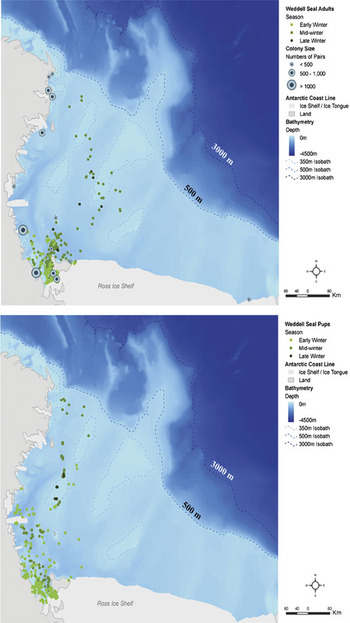
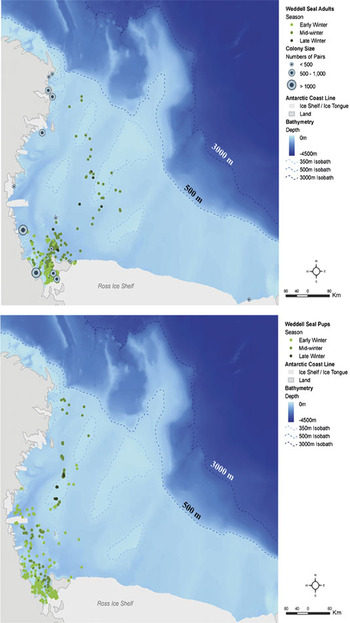
Movements of Weddell seals from breeding sites in McMurdo Sound, as tracked by ARGOS satellites, including both adult females (top panel) and weaned pups (3 to 12 months old; bottom panel) during early (April–May), mid (June–July) and late winter (August–September) following the spring breeding season, 1990–2000 (data sources in Ainley et al. Reference Ainley, Toniolo, Ballard, Barton, Eastman, Karl, Focardi, Kooyman, Lyver, Olmastroni, Stewart, Testa and Wilson2006b). Opaque white circles identify breeding concentrations along Victoria Land. The seals were tagged at the south-easternmost haulout.
One should note in considering the ratios and numbers of fish taken by Weddell seals, as presented here, that toothfish began to decrease noticeably in McMurdo Sound after 2001, six years after the Ross Sea fishery began (DeVries et al. Reference DeVries, Ainley and Ballard2008). Therefore, the seal encounter rate of toothfish was likely to be decreasing during the period when a number of the observations reported herein were made.
Foraging by Weddell seals during the non-breeding season
Once the breeding and moulting season (October–February) is completed, some of the seals from McMurdo Sound disperse north as far as the Ross Sea shelf break, i.e. throughout CCAMLR SSRU 88.1J and 88.1H (see Hanchet & Judd Reference Hanchet and Judd2006; Fig. 3). In addition, there are numerous pupping and breeding colonies along the coast of the western Ross Sea, i.e. at least 10 000–12 000 adults concentrated in numerous discrete locations (Smith Reference Smith1965, Stirling Reference Stirling1969, Siniff & Ainley Reference Siniff and Ainley2008; Fig. 3). These seals, too, as well as their offspring, would forage over the shelf during the non-breeding season. There, they all feed, gaining or regaining the weight and condition lost during lactation, breeding and moult. Readily available food would be critical for gaining the condition needed to successfully reproduce the following spring (see Hadley et al. Reference Hadley, Rotella and Garrott2007), and the bio-energetic advantage of taking toothfish over silverfish would be equally as important at this time of year as during the pupping season. While few studies have been conducted on Weddell seal diet during fall and winter, we can only assume that toothfish and silverfish remain important. Castellini et al. (Reference Castellini, Davis and Kooyman1992) sampled scats at the tiny White Island colony at the extreme southern end of McMurdo Sound over the course of one year, and while silverfish was the main prey item, they did find toothfish flesh within one regurgitation.
Effects on Weddell seals should toothfish become depleted
CCAMLR has proposed a 50% reduction in toothfish biomass in the Ross Sea, with no ecosystem monitoring in place (Pinkerton et al. Reference Pinkerton, Hanchet and Bradford-Grieve2007). What are the implications of this strategy? The Weddell seal is already disappearing from the Antarctic Peninsula region, perhaps due both to disappearance of sea ice and the loss of fish prey (cf. Siniff et al. Reference Siniff, Garrott, Rotella, Fraser and Ainley2008, Ainley & Blight Reference Ainley and Blight2009). It is conceivable that if toothfish became unavailable to the Ross Sea seals then they might switch to eating more silverfish or squid. However, on the basis of energetics, as noted above, it is better for a Weddell seal to capture toothfish compared to making many dives to capture a lot of silverfish. The same is true in regard to squid, which are of much lower caloric value than fish (e.g. Prince & Ricketts Reference Prince and Ricketts1981). There are additional factors to be considered as well before surmising that prey switching is a viable option.
In regard to monitoring Weddell seal populations as a CCAMLR ecosystem management strategy, we know a great deal about their life history, population dynamics and overall behaviours within the wide ecological context of McMurdo Sound and the Ross Sea, because of the long-term studies on the McMurdo Sound population. Of course there is a lot we do not know. However, if we consider the big picture, we can propose how environmental and human interactions might impact the seals’ life history patterns.
In a general sense, Weddell seals have evolved in a relatively stable environment. They return to historical pupping and breeding areas in what is physically and ecologically stable fast ice habitat. Cameron et al. (Reference Cameron, Siniff, Proffitt and Garrott2007) have shown that there is benefit to reproductive fitness to individuals who return regularly to these locations. Hadley et al. (Reference Hadley, Rotella and Garrott2007) showed that there is reproductive cost to females giving birth and raising a pup, in that those who reproduce, on average, have a lower annual survivorship than females who do not. Proffitt et al. (Reference Proffitt, Garrott, Rotella, Siniff and Testa2007) demonstrated linkages between variations in large-scale climate and oceanographic factors and weaning mass for pups, which in turn is thought to influence pup survival through the first year of life. Cameron & Siniff (Reference Cameron and Siniff2004) found that periodic immigration (from colonies elsewhere in the Ross Sea) plays an important role in population stability in Erebus Bay. Therefore, the McMurdo Sound population is neither ecologically nor demographically isolated; indeed, during winter they disperse widely in the western Ross Sea (Testa in Ainley et al. Reference Ainley, Toniolo, Ballard, Barton, Eastman, Karl, Focardi, Kooyman, Lyver, Olmastroni, Stewart, Testa and Wilson2006b; Fig. 3).
The above is a very brief overview of some of the facts we know about the demography of McMurdo Sound Weddell seals. These factors taken together suggest that no one factor is likely to be the deciding one influencing the dynamics of the McMurdo population on a year-to-year basis. We would suggest that because the life history of the Weddell seal has evolved to expect a very stable environment, including the food web, small perturbations could have major influence. An example was the temporary but dramatic response that seals exhibited when a large iceberg briefly changed the sea ice regime in McMurdo Sound (see Siniff et al. Reference Siniff, Garrott, Rotella, Fraser and Ainley2008). Another example might be annual variation in the prevalence of toothfish vs. silverfish in seal foraging areas, as noted by Fuiman et al. (Reference Fuiman, Davis and Williams2002). Therefore, prey switching based on fish prevalence could be an important strategy for the seals and one fostering problems should such an option become lost.
Another ecological unknown in regard to toothfish is the locations and ecological requirements of young fish. This is a species that, from existing information, is not sexually mature until age 8–10 years, when they are 95–105 cm in length (Eastman Reference Eastman1993, Eastman & DeVries Reference Eastman and DeVries2000). Thus, there must be large numbers of subadult toothfish that we essentially know very little about. It could be that Weddell seals make extensive use of these younger age classes in locations that are unknown to us. Plötz (Reference Plötz1986), in fact, found small toothfish in some of his samples from the Weddell Sea. It would seem essential that more knowledge be obtained about the total life history of toothfish before commercial extraction begins to influence the distribution and recruitment of young toothfish into the adult population.
Thus, while we are uncertain about what effects the absence of toothfish in McMurdo Sound (see DeVries et al. Reference DeVries, Ainley and Ballard2008) might have on Weddell seals, the correlations exist and point to a need for precaution and careful monitoring. Certainly, the potential exists for major effects, particularly on the younger non-breeding Weddell seals, which of course are the future for the population. Further, the weight loss by adults, both males and females, during the period of pupping, breeding and moult must be recovered before the next reproductive season. We have limited data on how or where this weight gain is achieved. However, based on the data shown in Fig. 3 (cf. Hanchet & Judd Reference Hanchet and Judd2006), it seems likely that the foraging by many Weddell seals is in direct competition with the Ross Sea toothfish fishery, certainly on a spatial basis and perhaps also on a temporal one as well for seals of northern Victoria Land. Again, this possibility emphasizes the need for monitoring and further research to document the extent of this competition for calories.
Effects on the Ross Sea foodweb should toothfish become depleted
The food web of the Ross Sea is tightly structured, with the members of the upper level showing competition and population compensation with variation in foraging pressure and lower to mid-levels showing tight pelagic-benthic coupling (Ainley Reference Ainley2004, Reference Ainley2007, Smith et al. Reference Smith, Ainley and Cattaneo-Vietti2007). Given the likely, pre-fished numbers of toothfish and their voracity (see Eastman Reference Eastman1993) and assuming that patterns of faunal structure are similar to marine ecosystems elsewhere (see Scheffer et al. 2005 and references in the Introduction), this fish is likely to be the most important upper trophic level predator in the Ross Sea neritic food web. Indeed, except for silverfish, all other fish species hide among the invertebrates of the benthos or among cavities in sea ice, probably at least in part a guard against predation (DeWitt Reference DeWitt1970, DeVries & Eastman Reference DeVries and Eastman1981, Eastman & DeVries Reference Eastman and DeVries1986, Eastman Reference Eastman1993).
Ainley et al. (Reference Ainley, Ballard and Dugger2006b, see also Smith et al. Reference Ainley, Toniolo, Ballard, Barton, Eastman, Karl, Focardi, Kooyman, Lyver, Olmastroni, Stewart, Testa and Wilson2007) summarized the diet information for top predators that are components of the neritic food web of the Ross Sea. An appreciable amount of research indicates that silverfish make up a large part of the diet during spring and summer of Adélie penguins, emperor penguins, snow petrels (Pagodroma nivea Gmelin), South Polar skuas (Stercorarius maccormicki Saunders), Weddell seals, killer whales, minke whales (Balaenoptera bonaerensis Burmeister), and toothfish. As shown also by Ainley et al., a disparate stratification in foraging depth occurs among these predators, as it does in silverfish (Eastman Reference Eastman1993). In the case of silverfish, the small ones are avoiding being eaten by larger individuals; in the case of the top predators, stratification would mitigate interference and exploitative competition. All of these species vacate the Ross Sea during winter, except for Weddell seals, emperor penguins, and toothfish (as far as anyone knows). Each of the latter is capable of foraging throughout the entire water column over the Ross Sea shelf, but owing to the extensive ice during winter, the amount of foraging habitat is severely restricted for the air-breathing predators. Therefore, the potential for trophic competition is enhanced. Indeed, several authors have noted that Weddell seals are extremely sensitive to variation in ice cover during winter, with weaner survival and incidence of pupping among females being significantly affected (Testa et al. Reference Testa, Oehlert, Ainley, Bengston, Siniff, Laws and Rounsevell1991, Proffitt et al. Reference Proffitt, Garrott, Rotella, Siniff and Testa2007, Hadley et al. Reference Hadley, Rotella and Garrott2007).
At this point, given the lack of our understanding of the integrative nature of the Ross Sea foodweb, one can only speculate what the ramifications to the food web might be should industrial fishing severely depress toothfish numbers. A probable result is that the abundance of silverfish would increase dramatically, but we have learned from the depletion of predatory fish elsewhere that the food web response is not simple (e.g. Österblom et al. Reference Österblom, Casini, Olsson and Bignert2006, Myers et al. Reference Myers, Baum, Shepherd, Powers and Peterson2007, Heithaus et al. Reference Heithaus, Frid, Wirsing and Worm2008, Baum & Worm Reference Baum and Worm2009) and the evidence exists that this would be true in the Ross Sea as well. Silverfish, although preyed upon extensively by all the above predators, even in the present structure of the food web, are abundant enough in the southern Ross Sea to depress the availability of their prey, euphausiids, to the extent that the fish becomes cannibalistic in late summer; abundant minke whales also help in the depletion of krill (Ainley et al. Reference Ainley, Ballard and Dugger2006a). One result of decreased krill and larval fish is that a portion of the phytoplankton is ungrazed (see review and references in Ainley et al. Reference Ainley, Ballard and Dugger2006a, Reference Ainley, Toniolo, Ballard, Barton, Eastman, Karl, Focardi, Kooyman, Lyver, Olmastroni, Stewart, Testa and Wilson2006b, Ainley Reference Ainley2007). Therefore, it is not a simple matter that losing toothfish means more silverfish, and therefore, as the argument probably would go, there would be more penguins, seals and killer whales and thus why would anyone complain?
Due to interference competition, the largest penguin colonies may not be capable of further growth regardless of an absolute increase in prey abundance (Ballance et al. Reference Ballance, Ainley, Ballard and Barton2009), and that argument could apply, too, to the Weddell seal in which the breeders are excluding some portion of the population (non-breeders) from using a limited number of tide cracks for breathing (and ultimately breeding). On the other hand, on the basis of the greater energetic cost for Weddell seals to be foraging on silverfish instead of also including toothfish in the diet, a likely scenario might well be fewer seals (and perhaps killer whales). If the seals were forced to feed more on squid, i.e. a prey switch to make up for fewer toothfish, the energetic cost would be even more severe than that outlined above in the case of a switch to silverfish. Given the long lifespan and k-selected life history of Weddell seals it will likely take some time before any detectable reduction in the McMurdo Sound population would be detected, particularly in the breeding portion. However, with a significant reduction in the availability of energetically important toothfish we predict that some population parameters such as reproductive rates, survival of pups and immature, will cause the Weddell seal population to decrease. The species should be added to a CCAMLR Ecosystem Monitoring Program (CEMP), with active monitoring being initiated soon.
In conclusion, the evidence is strong that toothfish are of considerable importance to the diet of top predators, such as Weddell seals, and to the role they play in the neritic Ross Sea trophodyamics. Obviously, a great deal more research and monitoring would be fruitful and would provide needed information on food web dynamics, and thus begin to effectively practice ecosystem management of the Ross Sea toothfish fishery.
Acknowledgements
Most of the research reported on here, at least that in the southern Ross Sea, was funded by the Office of Polar Programs, U.S. National Science Foundation; DGA’s contribution was supported specifically by grant OPP 0440643 and that of DBS by OPP 0635739. The conclusions are not those of NSF. We thank R. Davis, A. DeVries, J. Eastman, G.L. Kooyman, L. Fuiman, M. Pinkerton, R. Pitman, W. Testa and an anonymous reviewer for comments; and H. Kaiser, S. Kim, J. Meir, J. Thomas and J. Weller for discussions. Thanks to J. Meir and R. Robbins for use of their photos, and to V. Toniolo for drawing Fig. 3.