Primary percutaneous coronary intervention has been established as the treatment of choice for patients with acute ST-segment elevation myocardial infarction (STEMI) (Reference Kushner, Hand and Smith16). The use of bare-metal stents (BMS) has been associated with improved clinical outcomes by reducing the risk of reocclusion and reinfarction compared with balloon angioplasty (Reference Nordmann, Hengstler and Leimenstoll21). However, the risk of restenosis remains higher with the use of BMS, and the use of drug-eluting stents (DES) is expected to reduce restenosis (Reference Hill, Boland and Dickson12). Recent concerns have been raised about the risk of stent thrombosis after using DES that might be more pronounced among STEMI patients (Reference Finn, Nakazawa, Kolodgie and Virmani8).
Recently, there are several publications of randomized clinical trials (RCTs) comparing DES with BMS in patients with acute myocardial infarction (AMI). Although adequately powered RCTs provide answers for the safety and efficacy, sometimes RCTs are not enough to assess safety outcomes with low incidence. Moreover, RCTs do not reflect the “real-world” practice.
Therefore, we performed an extensive systematic review and meta-analysis to assess the relative safety, efficacy, and effectiveness of DES versus BMS in patients with STEMI not only in RCTs but also in observational studies reflecting the real-world setting. The outcomes of interest were mortality, myocardial infarction (MI), target vessel revascularization (TVR), and stent thrombosis (ST).
METHODS
Design Overview
We developed and adhered to our protocol for study identification, inclusion, and data abstraction for this systematic review. Methods of the analysis and subgroup analyses were prespecified in this protocol.
In the first instance, we undertook a comprehensive search for systematic reviews or meta-analyses comparing outcomes between DES and BMS among patients with STEMI. After assessing the quality of these review articles, we decided whether to perform a de novo systematic review or using an existing systematic review. For the latter, we used the existing systematic review with the highest quality as a source to identify eligible primary studies. We then considered additional primary studies published at least 6 months before the last search of the existing systematic review that we decided to use.
Data Sources and Searches
We searched for English and non-English review articles by searching the Cochrane Database of Systematic Reviews, the Database of Abstracts of Reviews of Effects, the Health Technology Assessment database, MEDLINE, EMBASE, TRIP database, SUMsearch, KoreaMed (http://www.koreamed.org), and KMBASE (http://kmbase.medric.or.kr) 1990 to October 20, 2009, using the search term “stent” or Medical Subject Heading (MeSH) terms for “drug-eluting stents” in the title and abstract.
We identified eligible primary studies and abstracts through a computerized search of the Cochrane Library, MEDLINE, and EMBASE using various combinations of the terms “myocardial infarction,” “stent,” and “eluting” using MeSH terms in the title and abstract for humans only studies published through August 31, 2009. We also searched conference proceedings for the American College of Cardiology, American Heart Association, the European Society of Cardiology, Transcatheter Cardiovascular Therapeutics, and the Web site of caridiosource.com. The local database, including KoreaMed, KMBASE, RISS (http://www.riss.kr), and KISS (http://kiss.kstudy.com), was also searched for primary studies up to October 20, 2009. We applied no language restriction. We supplemented the computerized search with a manual hand-search of the references of retrieved articles to locate additional studies.
Study Selection
Two independent reviewers identified articles eligible for analyses. We included RCTs and observational studies such as registries and cohort studies which enrolled patients with STEMI. We selected studies with direct comparison between DES (sirolimus, paclitaxel, everolimus, zotarolimus) and BMS reporting of mortality in STEMI patients. We excluded case reports, case series, cross-sectional studies, research letters, duplicate reports, studies not reporting mortality, and studies which were unclear whether patients with AMI were included or not. We also excluded studies which we were not able to extract the results for STEMI patients.
Data Extraction and Quality Assessment
Two independent reviewers extracted prespecified data using a standardized form. The numbers of events for each outcome were extracted according to the intention-to-treat principle. For observational studies, we used adjusted treatment effects if possible. The outcomes at 1 year, 2 years, and the longest follow-up were abstracted. We contacted authors if the detailed results for patients with STEMI were not given. Disagreements were resolved by discussion.
Two independent reviewers assessed the quality of the studies. To decide whether to perform a de novo systematic review or using an existing systematic reviews, we assessed the quality of review articles using a measurement tool for the “assessment of multiple systematic review” (AMSTAR) (Reference Shea, Hamel and Wells26). For primary studies, we evaluated study quality using the Cochrane Risk of Bias for RCTs and the “methodological index for nonrandomized studies” (MINORS) for observational studies (Reference Higgins and Green10;Reference Slim, Nini and Forestier27).
Data Synthesis and Analysis
We prespecified separate analyses by study design (RCTs and observational studies) given the inherent differences between two types of study. We expressed binary outcomes as risk ratios (RRs) for each study by each outcome to allow for pooling of similar outcomes. We used standard inverse-variance random-effects meta-analysis to combine the trials and obtain the average effects and 95 percent confidence intervals (CI) (Reference DerSimonian and Laird5). We also reported the estimates from fixed-effects models using inverse-variance approach.
We visually examined forest plots for heterogeneity and quantified heterogeneity between trials using the I2 statistic describing the percentage of variation across studies attributable to heterogeneity but not to chance and the corresponding chi-squared test (a p value <.1 was considered significant) (Reference Higgins, Thompson, Deeks and Altman11). We explored heterogeneity between trials by using both subgroup analyses (i.e., stratifying trials based on the follow-up period and types of DES) and meta-regression techniques. We did a univariate meta-regression analysis using RCTs to examine whether the duration of clopidogrel use and the total duration of study influenced the effect estimates by each outcome. We also did a univariate meta-regression analysis using observational studies to examine the influence of study quality (total score of MINORS) on the effect estimates.
We used a funnel plot asymmetry approach by plotting the inverse of the standard error against the log risk ratio to assess publication bias qualitatively. To disentangle different causes of funnel asymmetry other than publication bias, we also used contour-enhanced funnel plots by adding contours of statistical significance. To examine publication bias quantitatively, we used the Begg and Mazumdar rank correlation (the Begg test) and Egger's linear regression asymmetry test of the intercept (the Egger test) (a p value <.1 was considered significant) (Reference Begg and Mazumdar2;Reference Egger, Smith, Schneider and Minder7). If publication bias is suspected, we used the Duval and Tweedie nonparametric trim and fill method to obtain symmetry in the funnel plot and to determine the influence of hypothetical studies on the pooled estimate (Reference Duval and Tweedie6).
The p value threshold for statistical significance was set at less than .05 for pooled effect estimates. We conducted analyses using RevMan 5.0 (Cochrane Collaboration, Copenhagen), STATA 10.0 (Stata Corp., College Station, TX), and Comprehensive Meta-analysis 2.0 (Biostat, Englewood, NJ).
Level of Evidence
Finally, we used the “grading of recommendations assessment, development, and evaluation” (GRADE) to describe the quality of the overall body of evidence considering the quality of included studies, publication bias, heterogeneity, directness, the size of effect estimates, etc. (Reference Guyatt, Oxman and Vist9;Reference Higgins and Green10).
RESULTS
Of the 473 citations reviewed for existing systematic reviews or meta-analyses, nine reviews met our inclusion criteria (Reference Brar, Leon and Stone1;Reference De Luca, Stone and Suryapranata3;Reference De Luca, Valgimigli and Spaulding4;Reference Iijima, Byrne and Dibra13;Reference Kastrati, Dibra and Spaulding14;Reference Moreno, Fernandez and Calvo18;Reference Pan, Zhong and Xiang22;Reference Pasceri, Patti and Speciale24;Reference Piscione, Piccolo, Cassese, Galasso and Chiariello25). Supplementary Figure 1, which can be viewed online at www.journals.cambridge.org/thc2011002, shows our study flow diagram to identify previous reviews. Supplementary Table 1, which can be viewed online at www.journals.cambridge.org/thc2011002, summarizes the quality of reviews that we assessed using AMSTAR, and Supplementary Table 2, which can be viewed online at www.journals.cambridge.org/thc2011002, presents trials included in each reviews. Considering the number of “yes” in quality assessment results and the number of included trials, we decided to use the existing systematic review of Brar et al. (Reference Brar, Leon and Stone1) instead of performing a de novo systematic review.
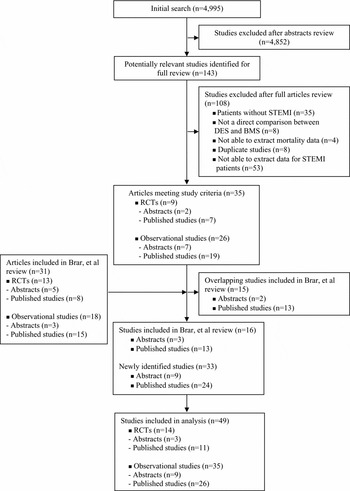
A total of fourteen RCTs that enrolled 7,654 patients and thirty-five observational studies reporting data from 44,894 patients were selected for the comprehensive meta-analysis using the studies included in the previous systematic review of Brar et al. and our search of primary studies between January 1, 2008 and August 31, 2009 (Figure 1) (Reference Begg and Mazumdar1). Of the 143 full-text articles reviewed after screening the titles and/or abstracts of 4,995 citations for primary studies that we search, 108 citations were excluded. Thirty-three articles were newly identified studies not included in the previous review. The characteristics of the included studies are presented in Supplementary Tables 3 and 4, which can be viewed online at www.journals.cambridge.org/thc2011002.
Study flow diagram. STEMI, ST-segment elevation myocardial infarction; DES, drug-eluting stents; BMS, bare-metal stents; RCTs, randomized controlled trials.

Mortality
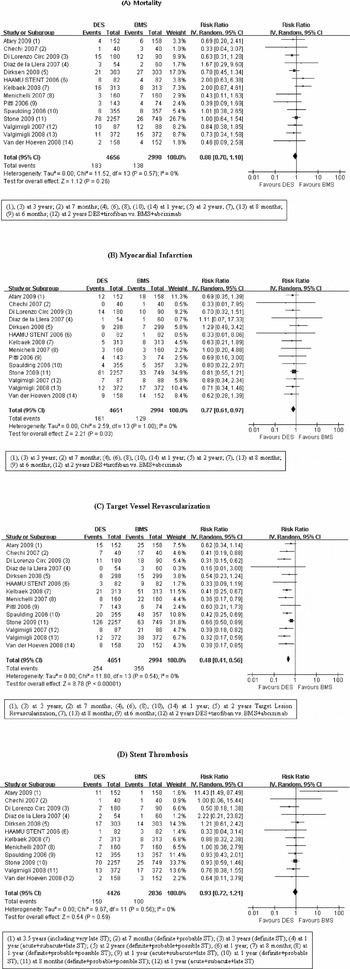
In fourteen RCTs, the pooled-RR of mortality for DES versus BMS was 0.88 (95 percent CI, 0.70 to 1.10, p = .26) and we did not find sufficient evidence of heterogeneity in a random-effects model (Figure 2A). The results were similar in fixed-effects model (RR, .89, 95 percent CI, 0.71–1.11, p = .30). Mortality was not significantly different between DES- and BMS-treated patients in subgroup analysis by different types of DES (Table 1).
Meta-analysis of Drug-Eluting Stents (DES) versus Bare Metal Stents (BMS) for Each Outcome in Randomized Controlled Trials by Types of DES

Note. I-V, inverse-variance method; RR, risk ratio; CI, confidence interval.
Outcomes of drug-eluting stents (DES) versus bare metal stents (BMS) in randomized controlled trials. IV, inverse variance; CI, confidence interval. Dots represent individual study estimates; boxes, study weights and lines, 95 percent confidence intervals (CI).

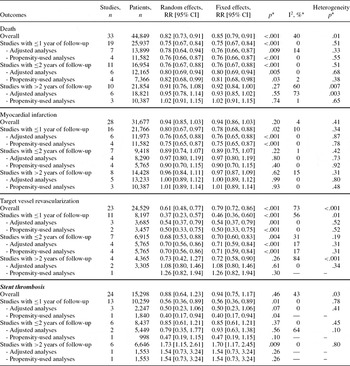
In thirty observational studies, DES use was associated with a 28 percent reduction in mortality compared with BMS use (p = .0004) in a random-effects model and a 25 percent reduction (p < .00001) in a fixed-effects model. There was a high level of heterogeneity (I2 = 40 percent, p = .01) which disappeared when studies were categorized as studies reporting follow-up with ≤1 year and ≤2 years (Table 2 and Supplementary Figure 2A, which can be viewed online at www.journals.cambridge.org/thc2011002). The relative benefit of DES versus BMS was consistent among studies with follow-up with ≤2 years.
Meta-analysis of Drug-Eluting Stents (DES) versus Bare Metal Stents (BMS) for Each Outcome in Observational Studies
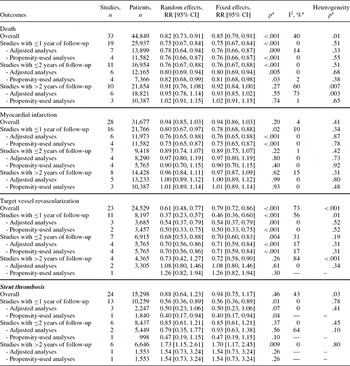
Note. RR, risk ratio; CI, confidence interval; RE, random-effects model; FE, fixed-effects model; * Values for a random-effects model are reported.
We did not find apparent systematic bias as assessed by funnel plot among RCTs (Begg test and Egger test, p = .381 and 0.466, respectively) or observational studies (Supplementary Figures 3 and 4, which can be viewed at www.journals.cambridge.org/thc2011002). Meta-regressions which were conducted to investigate the heterogeneity demonstrated no variability in the RR depending on the duration of clopidogrel use (p = .214) and the follow-up period (p = .257) in RCTs, and the observational studies' quality score of MINORS (p = .957 and 0.397 for the follow-up duration within 1 year and 2 years, respectively).
Myocardial Infarction
In fourteen RCTs, the pooled RR of recurrent myocardial infarction (MI) for DES versus BMS was 0.77 (95 percent CI, 0.61 to 0.97, p = .03) and we did not find sufficient evidence of heterogeneity (Figure 2B).
In twenty-eight observational studies, the pooled-RR for DES versus BMS was 0.94 (p = .20) in a random-effects model. There was no evidence of statistical heterogeneity among the trials (I2 = 4 percent, p = .41). The insignificant RR of MI was similar in analyses restricted to studies with follow-up ≤2 years and >2 years. However, DES versus BMS was associated with a significant 20 percent reduction in MI (95 percent CI, 0.67 to 0.97, p = .02) among studies reporting follow-up of with ≤1 year. The relative benefit of DES versus BMS was consistent among studies reporting adjusted data and propensity-used data with ≤1 year of follow-up (Table 2).
We did not find apparent systematic bias as assessed by funnel plot among RCTs (Begg test and Egger test, p = .951 and 0.770, respectively) or observational studies (Supplementary Figures 3 and 4). Meta-regressions demonstrated no variability in the RR depending on the duration of clopidogrel use (p = .936) and the follow-up period (p = .996) in RCTs, and the observational studies' quality score of MINORS (p = .781 and .666 for the follow-up duration within 1 year and 2 years, respectively).
Target Vessel Revascularization
In fourteen RCTs, the DES use resulted in a 52 percent reduction in TVR compared with the BMS use (p < .00001) in a random-effects model with no evidence of heterogeneity (Figure 2C). The relative benefit of DES versus BMS in the reduction of TVR was consistent among different types of DES (Table 1).
TVR was significantly reduced with DES versus BMS by 39 percent in a random-effects model in 23 observational studies. DES was associated with 63 percent reduction in TVR within 1 year of follow-up (p < .00001). The relative benefit of DES versus BMS was consistent but decreased among studies within 2 years of follow-up (RR, .68, p = .004). In studies with >2 years of follow-up, the beneficial effect of DES disappeared (RR .73, p = .26) in a random-effects model. There was a high level of heterogeneity which decreased a lot among studies which reported adjusted data (Table 2 and Supplementary Figure 2C).
We further explored any potential publication bias using the Duval and Tweedie trim and fill method given the asymmetry in the funnel plot on visual inspection (Supplementary Figures 3 and 4) and significant Egger's test result (p = .014) although Begg's test result was insignificant (p = .584). The pooled RR of TVR incorporating six hypothetical imputed studies resulted in 0.52 (95 percent CI, 0.44 to 0.62) in a random-effects model, which almost did not change the original pooled estimates for TVR. None of each study influenced the primary effects estimate, and meta-regressions showed few variability in the RR based on the duration of clopidogrel use (p = .077) and the follow-up period (p = .749) in RCTs, and the MINORS score (p = .598 and 0.716 for the follow-up duration within 1 year and 2 years, respectively).
Stent Thrombosis
In twelve RCTs, the pooled-RR of stent thrombosis for DES versus BMS was 0.93 (p = .59) in a random-effects model and we did not find sufficient evidence of heterogeneity (Figure 2D). For the stent thrombosis meta-analysis, we did not include the STRATEGY study which compared DES plus tirofiban with BMS plus abciximab because abciximab is known to have much stronger anti-coagulant effect than tirofiban (Reference Valgimigli, Campo and Arcozzi28).
In 24 observational studies, the stent thrombosis RR for DES versus BMS was 0.88 (p = .46) and 0.94 (p = .57) in a random-effects model and a fixed-effects model, respectively, with a significant amount of heterogeneity. However, the high level of heterogeneity disappeared when studies were categorized by the number of years made for follow-up. Among studies with ≤1 year of follow-up, DES use was associated with a significant reduction in stent thrombosis compared with BMS use (RR, .56, p = .01). However, we did not find the relative benefit of DES versus BMS in studies with ≤2 years of follow-up. There was rather an increase in stent thrombosis in DES versus BMS in six studies which reported follow-up of over 2 years (RR, 1.73, 95 percent CI, 1.15 to 2.61, p = .009) (Table 2 and Supplementary Figure 3A). Three studies were from conference abstracts (Reference Kim, Park and Seo15;Reference Nakamura, Bae and Cahyadi19;Reference Park, Kang and Lee23).
There was no evident systematic bias in RCTs (Begg test and Egger test, p = .837and 0.599, respectively) or observational studies based on visual inspection of funnel plots and statistical test results (Supplementary Figures 3 and 4). Meta-regressions demonstrated no variability in the RR depending on the duration of clopidogrel use (p = .486) and the follow-up period (p = .594) in RCTs, and the MINORS score (p = .109 and 0.621 for the follow-up duration within 1 year and 2 years, respectively).
Quality of the Evidence
We decreased the quality of evidence in terms of limitations in design because the sequence generation and allocation concealment method were not clearly defined in RCTs. Although the double blinding was broken or unclear in most studies, we did not decrease the quality of evidence because this was not regarded to affect the performance bias in stenting. The levels of evidence in RCTs for TVR, mortality/MI, and stent thrombosis were assessed as high, moderate, and low. The levels of evidence in observational studies for all outcomes were considered low to very low.
DISCUSSION
To our knowledge, our study is the first extensive systematic review and meta-analysis including RCTs and observational studies with the study quality assessment and evaluating the quality of evidence comparing DES versus BMS in patients with AMI especially STEMI. We showed that there were no detectable differences in mortality or stent thrombosis when comparing DES and BMS in RCTs. On the other hand, a significant reduction was observed from the DES-group in recurrent MI and TVR by 24 percent and 52 percent, respectively. We did not find any evidence of statistical heterogeneity or publication bias among these studies. The quality of the evidence derived from the RCTs was evaluated as “moderate” for mortality and myocardial infarction, “high” for TVR, and “low” for stent thrombosis.
In observational studies, the use of DES was associated with significant reductions in mortality and TVR compared with BMS by 18 percent and 39 percent, respectively. However, there was no significant difference between DES and BMS in recurrent MI or stent thrombosis. Meta-analyses were performed by periods of follow-up, because there was significant heterogeneity in the pooled data. The use of DES was still associated with significant reductions in mortality and TVR. However, there were no differences between DES and BMS in 2 years of follow-up even though DES was associated with significant reductions in the recurrent MI and stent thrombosis within 1 year of the index stenting. Among six observational studies (N = 6,646) with over 2 years of follow-up, using DES was associated with a significant elevation of stent thrombosis compared with BMS. We found no evidence of statistical heterogeneity and publication bias when studies were analyzed by periods of follow-up. The quality of the evidence from non-RCTs was “very low” or “low” for all outcomes.
We assessed the safety, efficacy, and effectiveness of DES versus BMS by using two types of studies, RCTs and observational studies. RCTs are known to be a gold standard study design to evaluate the efficacy and safety of a certain intervention because a random allocation is used to minimize the influence of measured and unmeasured confounders. However, RCTs are not powered enough to assess safety outcomes with low incidence. Moreover, results from RCTs are less generalizable than those from observational studies because RCTs are performed under a controlled environment with homogenous population. Large-scale observational studies may detect the difference in safety outcomes between different treatment strategies and reflect the real-world practice with heterogeneous population comparing DES versus BMS in routine clinical practice. Therefore, both types of studies are useful to assess the safety, efficacy, and effectiveness of DES versus BMS.
Death rates were found to be significantly reduced with the use of DES versus BMS in observational studies with a mitigated effect in RCTs. The discrepancy of results comparing DES with BMS between RCTs and observational studies could be explained by several points. Observational studies with a larger population size were able to detect the difference in mortality in DES versus BMS because the risk of mortality in RCTs was low as 40 per 1,000 and 45 per 1,000 for DES and BMS, respectively. The data from observational studies are more generalizable and provide more power to detect safety outcomes with low frequency.
On the other hand, observational studies are subject to measured and unmeasured confounding, which result in biased comparison of treatment effects between DES and BMS. Multivariable adjustment and propensity score methods can be used to attenuate the influence of measured confounders on the effect of DES versus BMS within each study. As expected, the overall summary estimate of mortality in observational studies of DES versus BMS was mitigated in the subgroup analysis using adjusted results compared with the unadjusted analyses. However, these approaches only address the measured confounders in assessing the treatment effect of DES versus BMS. The unmeasured confounders that may affect treatment decisions, including medication usage, are not considered. Thus, the results in observational studies are not free from unmeasured confounding unless the statistical approaches such as the instrumental variable method are used. The difference in the significance of summary estimates of mortality between observational studies and RCTs might be due to unmeasured confounders.
The results of RCTs showing the reduction of recurrent MI were congruent with the results of observational studies with less than 1 year of follow-up with respect to the safety of DES versus BMS. For the stent thrombosis, the overall results of both study designs were consistent in demonstrating a nonsignificant difference between DES and BMS. However, it is notable that there was a statistically significant increase in the risk of very late stent thrombosis (>2 years from the index stenting) with the use of DES versus BMS in observational studies. Some studies concerned the use of DES in AMI about the long-term safety especially with the late stent thrombosis (Reference Finn, Nakazawa, Kolodgie and Virmani8). Although the current study found an increase in the very late stent thrombosis with the use of DES, this result does not address the safety issue adequately because three of six studies used in the analysis were from conference abstracts and data on the duration of clopidogrel use were unavailable. The results of both RCTs and observational studies demonstrated a marked reduction in TVR with the use of DES versus BMS. The magnitude of the reduction in TVR with DES was slightly greater in RCTs compared with the magnitude in observational studies. This difference may reflect the use of DES in heterogeneous population with more complex and broader indication for stenting.
Our results for mortality, TVR, and stent thrombosis in RCTs comparing DES with BMS are consistent with other reports and meta-analysis (Reference Brar, Leon and Stone1;Reference De Luca, Stone and Suryapranata3;Reference Iijima, Byrne and Dibra13;Reference Kastrati, Dibra and Spaulding14;Reference Moreno, Fernandez and Calvo18;Reference Pan, Zhong and Xiang22;Reference Pasceri, Patti and Speciale24;Reference Piscione, Piccolo, Cassese, Galasso and Chiariello25). Contrary to previous studies, we found a significant reduction of recurrent MI in DES versus BMS in RCTs (Reference Brar, Leon and Stone1;Reference De Luca, Stone and Suryapranata3;Reference Kastrati, Dibra and Spaulding14). The discrepant finding is mainly due to the addition of new RCTs, updates of previous conference abstracts to published articles, and the correction of data extraction erroneously done in previous reports. Different from previous meta-analyses, we assessed the quality of studies by study types and the level of evidence for the meta-analyses results that we produced. Moreover, exhaustive lists of studies that were not included in previous meta-analyses were incorporated in our analyses. A large-scale of RCTs such as the Harmonizing Outcomes with Revascularization and Stents in Acute Myocardial Infarction (HORIZONS-AMI) trial and numerous observational studies (i.e., the Global Registry of Acute Coronary Events [GRACE]) have been published recently between 2008 and 2009.
In this study, we intend to compare clinical consequences after the use of DES and BMS in STEMI patients who require emergent procedures. We found a previous study which performed an extensive overview and quality assessments of systematic reviews on invasive treatment of stable coronary artery disease (Reference Kuukasjarvi, Malmivaara and Halinen17). Different from the previous overview which covered all patients with stable coronary artery disease, we focused our overview on systematic reviews in patients with acute myocardial infarction especially with STEMI and who received stents. We concentrated on STEMI patients because the clinical characteristics of STEMI patients are different from those with overall coronary artery disease. In addition, we focused on comparing different types of stents (DES versus BMS) and did not consider percutaneous coronary interventions without stents and coronary artery bypass graft. Several systematic reviews and meta-analyses that compared DES and BMS in patients with acute myocardial infarction have been published since 2006.
This systematic review should be interpreted within the context of several limitations. Similar to any systematic review, our conclusions drawn from individual studies are not exempt from the limitations of included studies themselves. Because we were not able to obtain individual patient level data, we had to rely on summary data at the study level. Lastly, we failed to investigate the effect of DES versus BMS on stent thrombosis by different types of stent thrombosis (i.e., definite, possible, early, late) especially in RCTs due to few number of studies. However, we did not find any concern in publication bias and heterogeneity after the visual inspection of funnel plots and statistical tests, although we used the aggregate number of stent thrombosis disregarding the definition used in individual study.
POLICY IMPLICATIONS
The National Evidence-based Healthcare Collaborating Agency (NECA) in Korea recommended the use of DES in STEMI patients with increased risk of revascularization (20). This was based on the evidence from our full systematic review showing the clinical effect of treating patients with AMI. In this study, we did not identify the types of patients with increased risk of revascularization. However, the risk of revascularization is generally higher in diabetes, chronic kidney disease, long diffuse disease, small vessel disease, and patients with multiple stents based on clinical experts' opinion. Thus, NECA recommends that the decision of choosing whether to use DES or BMS should be discussed at an individual level between clinicians and patients considering their conditions. Further research needs to be directed toward identifying the conditions which will benefit from the use of DES compared with BMS.
In conclusion, the use of DES compared with BMS was associated with a significant reduction in revascularization without an increase in the incidence of mortality, myocardial infarction, or stent thrombosis within 2 years of the index stenting in this meta-analysis of 52,503 patients with STEMI. Our findings suggest that the use of DES appears to be safe and efficacious compared with BMS across RCTs and in the real-world settings considering currently available evidence.
SUPPLEMENTARY MATERIAL
Supplementary Table 1
Supplementary Table 2
Supplementary Table 3
Supplementary Table 4
Supplementary Figure 1
Supplementary Figure 2
Supplementary Figure 3
Supplementary Figure 4
CONTACT INFORMATION
Hae Sun Suh, MPharm, PhD (haesun.suh@neca.re.kr), Hyun Jin Song, BPharm, MS (hjsong@neca.re.kr), Ji Eun Choi, RN, PhD (jechoi@neca.re.kr), Eun Jin Jang, PhD (ejjang@neca.re.kr), Hee Jeong Son, BA (sonhj@neca.re.kr), Sang Moo Lee, MD, PhD (lsm@neca.re.kr), National Evidence-based Healthcare Collaborating Agency, Changkyung Building 8F1, Wonnam-Dong 28-7 Jongno-Gu, Seoul 110-450, South Korea
Jung-Sun Kim, MD, PhD (kjs1218@yuhs.ac), Division of Cardiology, Donghoon Choi, MD, PhD (cdhlyj@yuhs.ac), Division of Cardiology, Yonsei University College of Medicine, Seodaemun-Gu Seongsanro 250, Room 626, Seoul 120-749, South Korea
CONFLICT OF INTEREST
All authors report having no potential conflicts of interest.