I
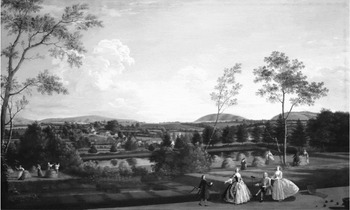
Edward Haytley's painting of The Montagu Family at Sandleford Priory in 1744 epitomises many of the ways in which the English poor of the mid-eighteenth century were socially situated in oil painting, and thus helps to contextualise the genre changes that occurred subsequently. This painting shows the poor ‘in their place’, as desired and perhaps seen by the patron who commissioned the picture. Edward Montagu was a grandson of the first Earl of Sandwich. Two years earlier he had married Elizabeth, the daughter of Matthew Robinson of West Layton, Yorkshire. She later became famous as a ‘feminist’ blue stocking.Footnote 1 Their mansion was known as the Priory, having earlier been an Augustinian Priory founded about 1200. Her husband died in 1775, aged eighty-three. After his death she had major alterations made to the house, not visible in the painting, having it transformed by James Wyatt into the Gothic style.Footnote 2 The painting, shown in figure 1, is of a scene in the morning, and in it we see the Montagu family at leisure, with Edward Montagu seated on the south side of his house, near evidence of a recent game of bowls.Footnote 3 In the near to middle distance eight haymakers can be seen, agricultural workers from the village beyond, which is the small settlement of Newtown. The viewer of this painting is situated, as if a guest, probably looking out of a first floor window of the mansion.
Edward Haytley, The Montagu Family at Sandleford Priory (1744). Source: Private collection (image courtesy of Lowell Libson Ltd).

The picture has eschewed almost all the classical referencing and design that one often finds in the work of early to mid-eighteenth century painters like George Lambert or Richard Wilson. Its use of light has been influenced by Claude Lorrain's seascapes and paintings of the Roman Campagna, yet unlike the many imitations of Claude, it lacks strongly buttressing or stable forms on either side, Italianate landscape features, ruins of questionably English provenance, or references to classical mythology. It retains light-dark horizontal banding as a device to carry the eye into the distance, but in other regards is quite different to the Claude Lorrain inspired paintings that had been frequent hitherto. Shedding much of that genre inheritance, a painting such as this has content and purpose which were more attuned to home-grown requirements. It is a variant on country house painting.Footnote 4 Intricately and purposefully designed, it conveys subtle information about the Montagu family, their senses of gendered and social hierarchy, their almost domesticated landed management, their villagers and the village community. In relation to questions about changing images of the migrant poor in English landscape painting, it imparts very clear elite ideas about the village inhabitants, which need to be seen within the context of the entire picture. It shows the rural poor ‘in their place’, so to speak, and is a benchmark from which to compare subsequent portrayals of migrant or vagrant poor who, it will be argued here, became far more visible in English painting and visually separated from their social superiors from the mid eighteenth century.
The Montagu family are shown relaxing. The male head of the family is seated, while both women stand. One woman through the gesture of her arms ‘attends’ to him, an up-turned chair behind her either indicating some carelessness, possibly linked to the game of bowls that has occurred, or the promptitude with which she has risen to assist him. He appears to address a comment to her while pointing towards the dress of the other woman, who stands looking at the viewer. It is not clear which is his wife and who the second woman is. The lady on the left holds a hand out to receive a chair from the rather unobtrusive yet well-dressed servant, who does not warrant her glance. The chair, it seems, will find its way to an appropriate place for her. Edward Montagu is well attired, of course, but the ladies are dressed in a way that speaks of conspicuous consumption and lavish ostentation.Footnote 5 Their dresses are clearly on show here, as a form of eye-catching property. These women might be considered well-adorned attachments of Edward Montagu, akin to the property and lands that are in view, an interpretation that may connect with the later ‘blue stocking’ activities of Elizabeth Montagu. The man sits; the women stand attentively, yet are about to sit or have been sitting; the servant is clearly working and brings a chair with no reward of recognition or polite gratitude. If the women and their dresses are forms of conspicuous consumption, it is worth noting also that on a stand by the man there is a telescope, another item of conspicuous expenditure following the innovations in optical and marine instrument making of the previous seventy years. This is an instrument of inspection and control, through which one seated bewigged man looks, casually crossing his legs between the billowing textures and colourful intricacies of grateful feminine dress, that seem to cast their light upon him. The telescope is a scientific device that extends his male gaze, a prized possession of the male aristocrat. Its inclusion here perhaps indicates perennial male pride in gadget ownership. Yet it has male-controlled social purpose. That telescope points directly down to the village in the distance and is perfectly aligned to peer down the main street of the village. Proudly owned, it is seemingly used to scrutinise a village and its social life in which, the painting's viewer deduces, Edward Montagu can also take pride, a community over which he exercises close yet seemingly benign control. In this small vignette of elite domestic, social and gendered power relations, with the body languages appropriate to its actors, with its subtle contrasts of gender and class, with its display of material culture, the painter communicates essays of modern social history, rich in potential for feminist and Foucauldian theory.
The landscape in the painting is represented as openly to be seen, stripped of the often heavy side trees or classical masonry of many early eighteenth-century paintings, for example by George Lambert. The trees are ethereal, light in appearance, early summer in foliage. There is a clear sense of season here. Many of those trees and shrubs connect with the people by echoing the shapes of the female dresses, as do the piles of hay, helping to unite people and landscape into a working or leisured whole. This is an enclosed landscape, in two senses. There is no sign here of an open-field village, indeed it appears to be ‘long-enclosed’, in the sense that it pre-dates parliamentary enclosure. It is thus a so-called ‘enclosure by agreement’, which means in effect that concentrated landed power has pushed through enclosure in the absence of landed opposition, and without the need for an Act of Parliament. Such enclosures took place most readily in, and were associated with, parishes where landed power was concentrated, that is in relatively or completely ‘closed’ villages.Footnote 6 Enclosure of this kind also confirms the Montagu family as long established. This is not ‘new wealth’ buying into country life. The enclosures in this case stretch as far as the eye can see, and are enclosed in a second sense by the encircling three or four hills in the far distance. Everything within this ambit, we need to be informed, is productive, regulated, privately owned, farmed under an enclosed system, with the supposed advantages of such a system as habitually extolled by the growing numbers of enclosure advocates in the eighteenth century. The landscape in this case is virtually manicured and garden-like. All its fine details are perfectly in place. Almost all the trees and shrubs are faultless in shape and disposition and the hedges are adjusted impeccably to accommodate certain trees in the middle distance. This is a ‘model’ village before such a term was usually applied. However, beyond the village boundaries one sees wild waste and hills with scanty or no sign of enclosures. Within Montagu's control, under the regulation and oversight of one all-seeing eye, and as far as that technologically assisted eye can gaze, all is productive and bountiful. Beyond there is only waste and barren or poorer land.
Next, one notices two water features, between the mansion and the village. These may be re-landscaped older fisheries associated with the Priory, which had been founded by Geoffrey, Earl of Perche.Footnote 7 Their remnants are still discernible in modern aerial photography.Footnote 8 In a social and pictorial sense, these water features serve to separate the mansion to some extent from the village, over which it still has a good view, and from the haymakers in the left middle distance. A semi-encirclement of what may predominantly be larch trees on the right also helps develop a sense of privacy, without disturbing the inspecting view. Larch was often planted on estates as it was fast growing and made perfect fencing material. Its recommended usage conforms to the needs of an enclosed village. Just beyond the left hand water feature is twenty or so feet of newly constructed hurdle fencing. In other words, a sense of productivity, of fish and useful timber, is combined with an aesthetic of water-designed landscape, conducing to a proper idea of social distance: the villagers are overlooked and managed just like their landscape. They are in their place, yet the landscape is such that they do not intrude socially on the elite. They can be seen, especially via Montagu's telescope, far more readily than they can see the Montagu family, and they seem happily preoccupied with their work.
For unlike the Montagu family, those villagers are indeed at work haymaking. Their grass space is productive, for hay, while the Montagu's grass space is leisured, mown closely for bowls. Women villagers work as well as men, in fact they predominate. There is as yet no problem with imagery of female agricultural workers of the kind that would emerge later, possibly even in Gainsborough, but most markedly in the Victorian period.Footnote 9 This view of haymaking shows considerable decorum compared to some depictions, with which Haytley may have been familiar,Footnote 10 yet these haymakers are hardly exerting themselves. Their ash hay rakes are light and easily held. Their poises are studio-like, in advance of George Stubbs,Footnote 11 and their dress and headwear verge towards the ostentatious by labouring standards. They are attired in a way that is intended to affirm the benevolent and generous principles of the Montagu family. These people are at a distance yet in their place. They are working, but not exploited, well dressed and clearly well housed, in an enclosed village with impeccably thatched and well ordered houses. They are respectable and a credit to the estate, productive and harmoniously at one in a visibly hierarchical social order in which women also know their place. The internal dynamics of the Montagu family show an appropriate family hierarchy, feminine and class deference, while at some remove downwards one sees villagers dressed to standard and conducting themselves in a way that in the terms of its period is also a credit to Edward Montagu's management and benevolent control. Everyone knows their place here. There is no sign of dissent, dissatisfaction or displacement. There are no migrants passing through and no signs of conditions that might instigate out-migration or vagrancy. Surely nothing here could induce such villagers to leave their place and step out as migrants or vagrants in search of employment or a better deal.
The hierarchical community functions through a clear line of control that starts with an axiomatic gendered hierarchy and deference within the leading family, and spreads downwards, and through the painting's angles of vision. The processes of patron-artist communication are, as usual, closed to analysis. We do not know what was visually suggested by whom, nor how a pictorial scheme came about from presumptions or statements about authority and control. Nor do we know much about Edward Haytley; even his origins and dates are unknown. However, there is no doubt that Edward Montagu, in his own terms, has been extraordinarily well served by an intelligent and sensitively co-operative painter, who has provided a prospect onto a certain line of vision, that of the mind that stares down Montagu's telescope, who has erased any sign of alternative social views or dissentient outlooks, who has added no ambiguities of artistic delivery,Footnote 12 and has thus been alert in figuring the desired essentials of this commissioned painting.
II
I have chosen just one mid eighteenth-century landscape painting to show these values pictorially, but there are many others before 1750 that could have been used to similar effect: Wollaton Hall and Park, Nottingham by Jan Siberechts (1697),Footnote 13 Haytley's The Brockman Family at Beachborough (1744),Footnote 14Hawking and Haymaking (c. 1720) or Dixton Manor, Haymaking (1710–20), both by unknown painters,Footnote 15 come to mind, with their depiction of order and of harmonious work, orchestrated from on high. In their various ways, the poor are ‘in their place’ in these paintings, pictorially accommodated and part of a seemingly harmonious social order, unthreatening, providing an ordered picture of social ease and apparent contentment. Ragged migrant poor may be seen in some classically influenced art, for example in some of George Lambert's paintings, or in Richard Wilson's paintings of banditti,Footnote 16 influenced by Salvator Rosa, but there they are usually part of a derivative Italianate landscape that casts no unfavourable aspersion on the responsibilities of a known English estate or patron. Market traders or roadside travellers had previously been abundant in Flemish or Dutch drawing, print-making and painting, for example in work by Wynants, Pieter Molijn, or Ruisdael. The roadside poor, including vagrants or beggars, were also common, as in some of Rembrandt's remarkable and humane etchings,Footnote 17 and even gypsies were portrayed, as for example in Jacques de Gheyn's Three Gypsies.Footnote 18 Such figures influenced English landscape art, yet when these figures are shown as English in the early to mid eighteenth century, they are not usually in conspicuous poverty. Until perhaps about 1750, their English rural equivalents are very rarely shown as vagrant types. Indeed, they are often very well dressed.Footnote 19 In many cases, they are shown at leisure, or at work that hardly seems toilsome,Footnote 20 and they clearly correspond to a worked and productive landscape, as in Edward Haytley's painting.
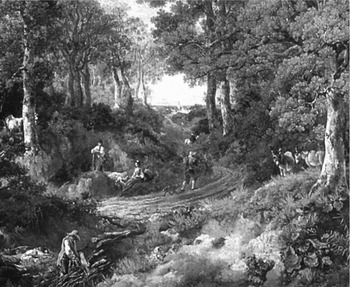
One of the first signs in England of a different rendition of what is clearly intended to be the English poor is Thomas Gainsborough's early painting Cornard Wood (c. 1746–8), sometimes called Gainsborough's Forest, following a 1790 engraving of it.Footnote 21 This is influenced by earlier Dutch painting, notably Jacob van Ruisdael. Like some of Ruisdael's painting it appears to depict an area of forest common land, and is naturalistic in its detail both of nature and the working poor. Unlike some depictions of woodlands as culturally closed and insular,Footnote 22 the centre of the painting shows a tramp and his dog walking through the wooded landscape, trudging to the settlement in the distance, which is Great Cornard, just south-east of Sudbury, to judge from the spire,Footnote 23 and the shape of its church is replicated in the two trees on its left. These central details of the painting are shown in figure 2.
Thomas Gainsborough, detail of Cornard Wood (c. 1746–8).

The tramp has his back to us, slumped in tired walk. He has the characteristic ragged shins that William Cobbett and others later emphasised as a sign of poverty, notable for example in comment on early nineteenth-century Ireland or the Irish in England. The shins of the other men are carefully obscured. He is ignored by the woodland workers and the sitting woman among them who does not work. He carries a bag tied to a stick, like many others we will see, and his dog has utility for poaching. Indeed, for this reason dogs were later thought to be an uncomfortably suggestive addition to paintings of the rural poor. The hint of something amiss in rural Suffolk, that has generated this vagrant-like movement through such a wood, is unmistakable. The ragged shins were to be a feature that was repeated in some later Gainsborough paintings such as the ploughman in Woodcutter Courting a Milkmaid, (1755), and later in Constable, for example the boy on The Leaping Horse (1825), and other painters. In all cases, this was clearly intended as a pictorial sign of poverty, associated both with migrants and many of the non-migrant poor.
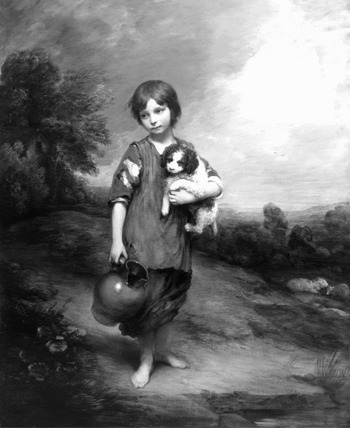
Poverty is conspicuous in some of Gainsborough's subsequent paintings, most notably his A Cottage Girl with Dog and Pitcher (1785),Footnote 24 seen in figure 3, where the downcast look, the tired bedraggled dog, the broken pitcher, the raggedness of the girl's windblown clothing, her vulnerability to a dramatic sky, and her bare feet, carry unmistakable messages. In some cases Gainsborough paints the poor in a more positively dressed way, as in some of his cottage door paintings,Footnote 25 or the boy taking a break from the itinerant wagon on waste ground and doing some fishing in Sunset: Carthorses Drinking at a Stream (c. 1760), also known as The Brook by the Way, or most notably the fore-grounded and well dressed commoning couple in Woodcutter Courting a Milkmaid (1755). In these paintings the scene of leisure, access to livestock and natural resources, and semi-independence is almost invariably symbolically overhung by a blasted oak, suggesting that this way of life will soon cease, in view of enclosure or other threats to the commons and associated life that these paintings depict. A similar use of blasted oaks is frequent in John Crome's pictures of heaths and woodland.Footnote 26 And Gainsborough's imagery of the poor is never contained on the same canvas or paper as his commissioned gentry or aristocratic pictures. These latter subjects do not appear to need or wish to see their social inferiors presented in any way, even at a distance, even in circumstances that might be indicative of a mature or historic social responsibility for them. There are no village poor in Mr and Mrs Andrews, nor his other higher society portraits. It is very revealing that the social orders become well separated in Gainsborough, in contrast to the work of Edward Haytley and many other immediate artistic predecessors. These Gainsborough paintings are no longer about reciprocal relations between social orders, about their respective positions, socially or pictorially, or about the social status accruing accordingly. Issues of responsibility are elided. Thus the elite are not ‘tainted’ in any way by imputations of failed responsibility towards the poverty-stricken or migrant poor, for those poor, whether ragged or otherwise, stand alone in what is now a separate genre of much less saleable painting, albeit one from which Gainsborough apparently derived most satisfaction. In Gainsborough's work two distinct ‘classes’ of paintings have emerged, a separation of which he was well aware. One was highly profitable, although he wrote that ‘I'm sick of Portraits. . .these fine ladies and their tea drinkings, dancings, husband-hunting, etc’. While landscapes and village subjects earned him far less, he much preferred them as ‘his natural turn’.Footnote 27 The widely varied social subjects across these two genres, from the aristocracy down to the rural labourer, have become distinct, disengaged and visually unconnected with each other in his paintings.
Thomas Gainsborough, A Cottage Girl with Dog and Pitcher (1785).

III
This increasing view of poverty in Gainsborough, and accompanying signs of migrant poor, was dramatically kindled and heightened by George Morland (1763–1804). Arduously trained by his father, Henry Robert Morland, a London artist and art dealer, George Morland was a superb draughtsman and a highly productive painter of rural themes. His short life was characterised by excessive drink, persistent debt, possible venereal disease by 1797, and a contemptuously dismissive attitude to potential patrons or clients, who had little or no control over his subject matter.Footnote 28 As one of his biographers, J. T. Nettleship, commented, he had a ‘wayward hatred of polite society which became a fixed aversion in his later years’.Footnote 29 Vagrant or migrant poor were rare in Gainsborough's paintings, and it is questionable whether the poor in his Charity Relieving Distress (1784)Footnote 30 or in Francis Wheatley's Rustic Benevolence (1791) are truly migrant, but they became very common in Morland's work. In his personal life he is known to have often associated with migrants, gypsies, post-chaise drivers and others on the roads, indeed on occasion he joined them when escaping from his creditors. The entry in the 1812 General Biographical Dictionary asserts that:
He is generally acknowledged to have spent all the time in which he did not paint, in drinking, and in the meanest dissipations, with persons the most eminent he could select for ignorance or brutality and a rabble of carters, hostlers, butchers – men, smugglers, poachers, and postilions, were constantly in his company and frequently in his pay.Footnote 31
Fishermen and smugglers sat for him in the Isle of Wight, where one author commented rather patronisingly on ‘his fondness for the society of those much beneath him’.Footnote 32 The migrant poor are a major feature in his work, especially from about 1790, when his painting largely discarded an earlier sentimentalism.Footnote 33
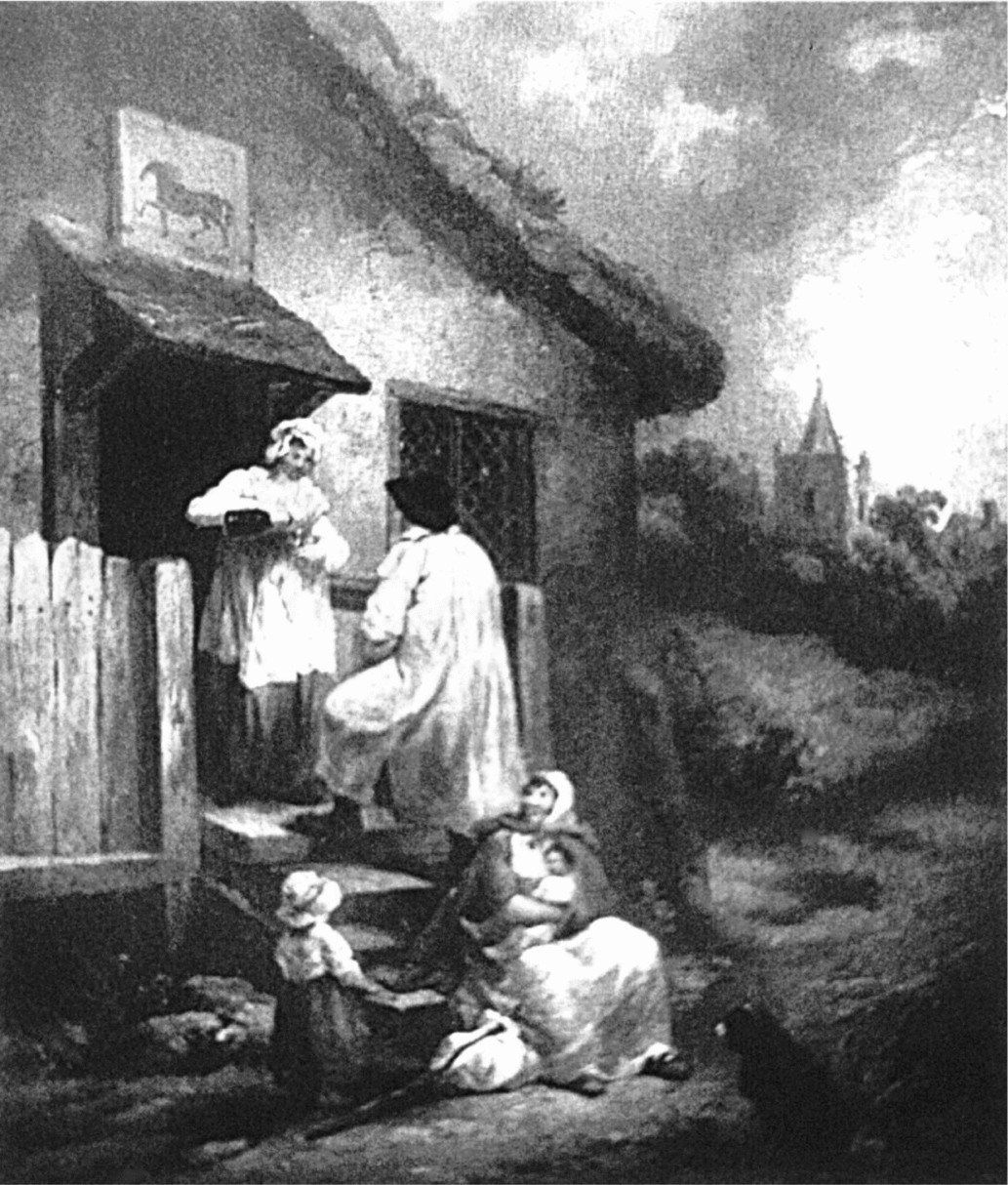
Some of these images are of obvious economic migration, involving market-purpose carts, such as Morning: or Higglers Preparing for Market (1791), or his The Market Cart (n.d.), comparable to many images by W. H. Pyne, or some Gainsborough paintings and engravings, representing road travel of a routine nature or goods being moved. Sometimes, as in some of his Isle of Wight or Kentish pictures, there are suspicions or overt signs of smuggling, wrecking, poaching or other illicit activity, which he handles in a non-condemnatory way. He also painted views of army deserters, another form of migrant. Morland's poor are shown now as a class apart, as a secret people largely unknowable to the paintings’ viewer, often huddled together in conversation, whether at entrances to a cave, at alehouse doors, or the like. Such imagery of shared understandings seems to cast them as part of a larger entity of the labouring poor. In other cases they appear isolated and socially marginalised, seemingly destitute migrants shown as lone people or a family on the roads. An example is The Dram (figure 4), where a migrant family stop on the steps of a village inn to request drink, which is obligingly supplied, with the sign of a trotting horse above the door suggesting movement. A woman with baby and young child slump tiredly on a lower step looking up expectantly as the smocked man with his back to the viewer obtains drink, watched by what is presumably their dog, while a stick and bundle lie on the ground.
George Morland, The Dram (undated).
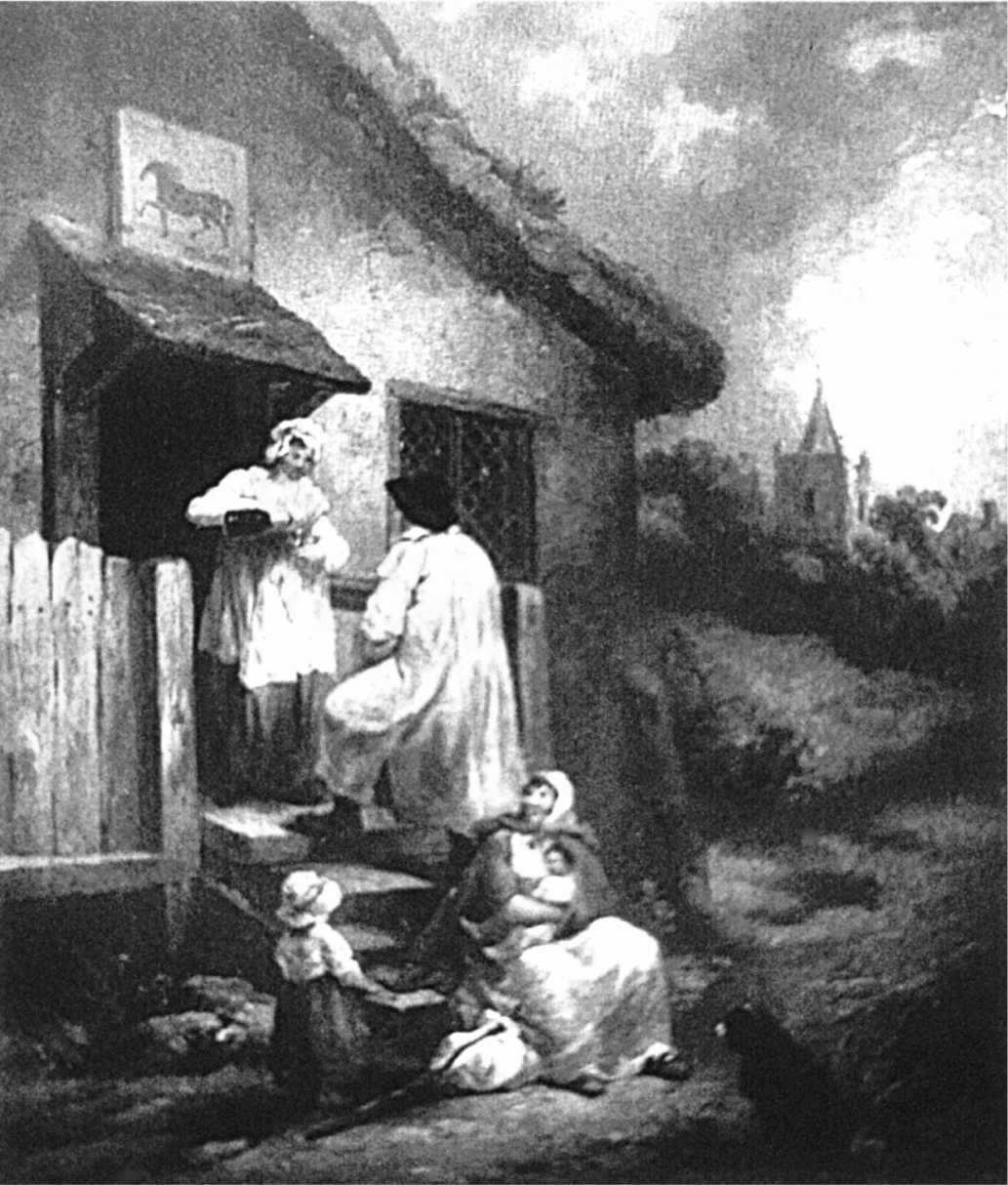
This image also raises issues of religion and charity in Morland's painting. In the right distance an Anglican church is placed ironically, for in Morland's view the church offers no helping hand to people in this predicament, and their drink-desirous migrancy takes no heed of its supposed moral injunctions. Indeed, in one Morland painting, which I have viewed as a mezzotint by William Ward called The Warrener (1806), the distant church tower is painted immediately next to a pair of bull's horns which are directed at it, suggesting the early cuckoldry and charivari insult from which, some argue, the modern ‘V’ sign originates, while a figure who appears to be a labourer returns to his expectant family with a pair of seemingly poached rabbits. These images differ markedly from many earlier artistic representations of the poor, when a frequent theme had been the ‘deserving’ poor as ordained by God, and where charity towards them was a way of accessing heaven. Poverty in much early modern European and English imagery had indicated Christian forbearance, humility and caritas.Footnote 34 Yet with one exception involving gypsies (figure 5), almost no such imagery exists in Morland's work after 1790. Discarding an earlier sentimental genre, ‘deserving’ and ‘undeserving’ categories of poor seem wholly absent, as do religious or moral criteria of presentation and judgement. There is nothing theological about Morland's images of ‘the poor’ and of ‘poverty’, and no insistence that they are ‘sinful’ in their conduct. Nor are the poor caricatured, satirised or handled in a carnivalesque style, in the manner of James Gillray or some of Thomas Rowlandson's work, which included ‘vagabonds’.Footnote 35 Morland's images are secular and non-judgemental views of the poor, and in his paintings the church is presented as an ironic or hostile irrelevance to the plight of those depicted, and as an institution scorned by migrant poor.
George Morland, Morning, or the Benevolent Sportsman (1792), © The Fitzwilliam Museum, Cambridge.

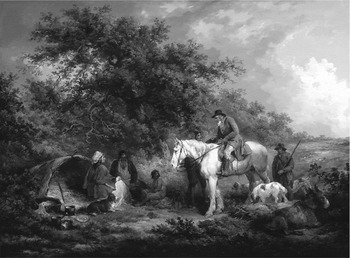
In some cases the apparent titles of Morland's paintings dealing with these themes suggest that the migrants are ‘gypsies’, a class of people hitherto hardly treated in English paintings with English settings, although Gainsborough had painted his Landscape with Gypsies in c. 1753–4.Footnote 36 Morland certainly mixed with gypsies and sought their company.Footnote 37 Yet it is often hard to be sure whether he intended a group to be ‘gypsies’ or not, and whether any such title can be given credence, for many were named later by owners, dealers or galleries. Gypsies were often called ‘Egyptians’ at the time and in vagrancy legislation.Footnote 38 In a few Morland pictures, there are swarthy portraits of people by roadsides or in woodland encampments with faces of such a dark hue that one must believe that a gypsy group was intended. A sitting man in Morland's Morning, the Benevolent Sportsman (1792) is an example of this, shown in figure 5. The painting and its charitable theme was unusual for Morland in that it was commissioned for Lieutenant-General Sir Charles Stuart (1753–1801), who seems to have wanted to make a moral point about benevolence and the treatment of gypsies, soon after the humane repeal of vicious Elizabethan legislation against them.Footnote 39 It is also worth noting that this ‘benevolent sportsman’ gives money to a group who seem to defy all notions of being ‘deserving’, and who even seem a little puzzled by his intervention.
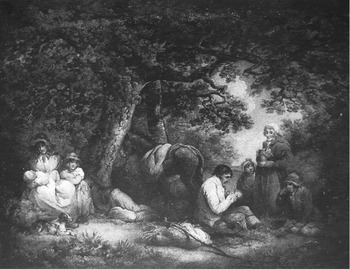
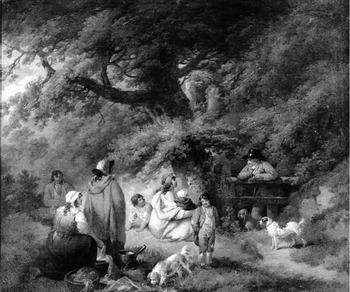
Morland, along with writers like John Clare, clearly shared a view of gypsies as ejected and persecuted.Footnote 40 Yet in many other Morland paintings there are no such apparently ‘Egyptian’ depictions. The poor are shown wearing the same smocks, red cloaks, bonnets and hats as his rural labourers and their families, and one doubts whether the representation is intended to be of gypsies. Many of their faces are distinctly non-‘Egyptian’. The artist makes no discernible attempt to show them as gypsies and they appear to be English migrant or vagrant poor. Among many examples of this is figure 6, ambiguously entitled Gipsy Encampment but also known as Travellers, a frequently occurring title in Morland's work, as well as the pale-faced woman and child in figure 7.
George Morland, Gipsy Encampment, also entitled Travellers (c. 1791).

George Morland, Gipsies in a Wood, or Travellers (n.d.)

Whether gypsy or not, these are often family groups, usually containing one to three children. In a few paintings, quite an extended family, including one or more elderly persons is indicated, as in figure 6. Bundles of possessions, red cloaks, pitchers for drink, and walking sticks are frequent items. The red cloaks were standard parish poor law issue. The people are almost always waysiders, often with a fire lit, a pot over it tied under three bound sticks, or placed nearby. An image of a child huddled in front of such a fire is also in one of Morland's multiple-image soft-ground etchings of 1804. In most of these pictures a rather desolate air prevails. That atmosphere is reinforced by a body language that often ignores the viewer, for example with sleeping figures, or indeed a body language that can occasionally seem remarkably brutal and foreboding.
This is most notable in his Gypsies in a Wood, or Travellers (figure 7), where the man on the right is hulking, brutish and possibly dangerous. His broad back is to the observer, a fold in his smock taking on the appearance of an almost devil-like tail. This body language and the attitudes struck by the subjects are indicative. They are reclining in sleep with an upturned pitcher or jug indicating the drinking of ale, with no sign of sentimental treatment. There are a number of Morland paintings and prints similar to this, such as The Wayfarers (1784), or Gipsies, engraved as a mezzotint by William Ward in 1792.
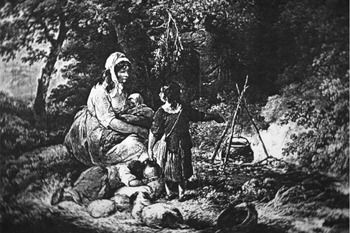
In some cases Morland's women are shown without male companions, in the presence of their young children, with a child pointing to a pot over the fire as if to ask if there is anything in it, as in the untitled figure 8, which also shows a child seemingly lying in anguish and a baby in the wayside mother's arms. Many of the subjects in this genre of Morland's work have despairing or abjectly despondent faces. There are signs of drink in some of these illustrations, notably The Dram (figure 4), yet this is not a universal feature, and these paintings seem to eschew the moral message of a couple of Morland's earlier views of poverty, such as his The Effects of Youthful Extravagance and Idleness,Footnote 41 where the title suggests that blame was directed at the poor family itself.
George Morland, untitled (n.d.).

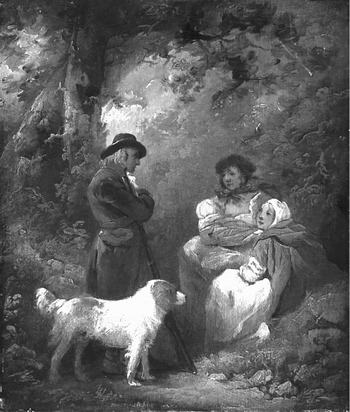
In some of his paintings, women portrayed with a child appear sexually vulnerable, with a leering male onlooker of a different class, sometimes deemed to be a ‘sportsman’, as in the seemingly predatory and indicatively titled The Lucky Sportsman (figure 9). This portrays a domineering armed man with a large dog, questioning two women with a baby in a remote woodland area. One of the women casts her eyes downwards before his stare. The image is reminiscent of the worried and fearful woman in Morland's The Door of a Village Inn. She is shown standing before a mounted man on horseback with a distinctly phallic shaped, positioned and angled stick pointed at her, with a trussed bundle over his horse, one of its rear hoofs pawing the ground, while before the building, in the centre of the painting, what appears to be a female smock and a stocking are draped over a stone wall. A downcast young man tends a smoking fire with his back turned to the scene and two sullen and silent children are in the door way, one holding a food bowl which is stared at by the other, before a black interior.Footnote 42
George Morland, The Lucky Sportsman (1791), Courtesy of the Huntington Art Collections, San Marino, California.

Other Morland paintings of gypsies or wayfarers repeat these suggestions, as in his Encampment of Gipsies (see figure 10), where a higher class hatted and well dressed male observer with a dog leans against a gate and looks down at three ragged women wayfarers and their equally ragged children. One woman with a conspicuously bared shoulder stares back at him, the angle and position of the saucepan handle has not occurred by chance, and also points straight to the male gaze, while a sullen man of their class sits with downcast face in the background, as though impotent to intervene.
George Morland, Encampment of Gipsies (n.d.), © The Fitzwilliam Museum, Cambridge.

This suggestion of sexual vulnerability was not new in English landscape art. Explicit examples include John Collet's Landscape with a Squire and a Farm-girl (1770),Footnote 43 William Hogarth's two paintings Before and After of 1730–1,Footnote 44 and a painting by Edmund Bristow,Footnote 45 but the theme is striking in some of Morland's paintings of female migrants and wayfarers.Footnote 46 The implication seems to be that this kind of poverty, when affecting women who are outside any settled community and its oversights, made them especially prone to such predatory behaviour by higher class males.
These paintings are ‘generic’ with regard to a sense of place: they have no place, no recognisable venue of the painting. In Haytley's painting of the Montagu family we know exactly where the painting is set; in Gainsborough's Cornard Wood the vagrant passes through a known wood and location, towards a known town. The same is true of most such earlier depictions, leaving aside derivative Italianate settings, and of course this place precision was highly desired by artistic patrons for reasons relating to ownership, pride and reputation. Place entails possession and responsibility, and of course parish officers can be named and blamed. A parish has a status, embellished in folklore for good or ill. It has a legal reputation in relation to settlement and vagrancy laws. People have rights in a place and appeals can be made to local Justices of the Peace. But in Morland this has changed: there has been a marked decline in the representation of known locality in painting. In the very large majority of cases, whether in farmyard, cottage or roadside scenes, let alone winterscapes or coastal views, it is completely unclear where they are set. In a few, detective work and close biographical information can establish a probable site that, in the most general of artistic terms, has formed a basis for the painting. The Door of a Village Inn, for example, is probably set in Enderby in Leicestershire, given some vernacular similarities with his View at Enderby, Leicestershire (1792). Usually, however, his sites for migrant poor are what we might persuade a modern anthropologist such as Marc Augé to call ‘non-places’, referring ‘to places of transience that do not hold enough significance to be regarded as “places”’.Footnote 47 And they have this significance in Morland long before the era of ‘supermodernity’ that Augé believes inaugurates them. For Augé, they take the modern form of motorways, motels, and so on; in Morland they are naturalistic, roadside, anonymous, and thus seemingly remote from ‘community’ in any known sense of eighteenth-century England. These poor are certainly in English settings, but they are out of place, they have no place. A few public house signs aside, significant clues about place and location such as country houses, readable road signs, and known topographical features are almost never provided. This is deliberate, for these poor are placeless, peripheral, homeless, roadside transients. We do not know where they are going, if anywhere. In this regard, Morland differs from many other illustrators of poor migrants.Footnote 48 We do not even know what county these migrant poor may be painted in, although outside London Morland worked mainly in Kent (especially Margate), the Isle of Wight (Shanklin, Cowes, Yarmouth, Freshwater Gate), and Leicestershire (Enderby). It is part of Morland's originality to couple empathy with placelessness in his pictures, more so than in his contemporary Thomas Bewick's comparable box woodcuts of migrants. This characteristic is part of Morland's own povertied emancipation from obligation to patrons. It separates him from the often proprietorial drawing and painting of Constable, or the very saleable views of Turner, or the artistic intent and remuneration of so many other artists. And in Morland's case this handling of wayside poverty is clearly no Rousseau or Wordsworth derived version of romantic vagrancy,Footnote 49 with idealised or picturesque ‘vagrants’. Such romanticism is seen in paintings such as James O'Connor, A Thunderstorm: the Frightened Wagoner (1832),Footnote 50 in which the travellers’ alienation from any known place adds to the terror or ‘sublimity’ of the scene. Morland's various paintings, entitled Land-Storm, The Thunderstorm or The Approaching Storm, show travellers in places unknowable to us and perhaps to them, but their pedestrian vulnerability and haste in the face of a storm is wholly unromanticised in mood, predicament and landscape. Nor are they picturesque in location. And in his representations of gypsies there is no trace of the romanticised ‘eastern’, turbaned, exotic, theatrical imagery that one sees in many other ‘gypsy’ illustrations of this period, for example in images of Sir Walter Scott's Meg Merrilies.Footnote 51
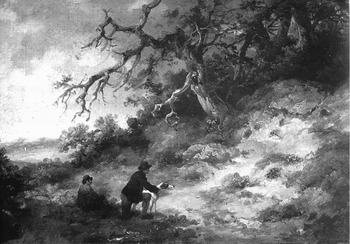
The naturalistic surrounds of these images of migrant poverty reinforce the frequent tone of despair and vulnerability. Gainsborough used blasted oaks and related symbolism to confirm the terminal nature of the unenclosed commoning life he depicted. The writing is on the wall for this form of life, he is correctly if sadly suggesting. To judge from the humane and attractive way he drew them, his sympathies often seem to be with the commoners. In some cases, rival symbolism, of for example a young birch tree, which had silver/moneyed symbolism in European cultures, overhangs the part of the painting indicative of future directions: one of post-enclosure tenant farmer and landlord profits, and labouring wage discipline.Footnote 52 In much eighteenth-century painting, a healthy oak or beech tree symbolised the longevity of landed power, durability and the attachment of the landed family to the estate, as we see it used for example with the oak behind the iron seat in Mr and Mrs Andrews. In that case, the nouveau riche couple try to assert a landed connectivity that Gainsborough perhaps regards with cynicism. Even so, Gainsborough does what is needed when he paints the foot of Mr Andrews on, and akin to, the oak's roots. Morland adapted and subverted this kind of tree symbolism in some of his paintings of poachers, gypsies, migrants and others involved in illicit activities. He did so by showing tree branches which clutched down at the painting's subjects, claw-like and tentacular, making use of the natural jagged angularity of oak branches, as though symbolising a legal system intent on catching the non-conforming people underneath. The best example, although in this case probably not of migrant poor, is his Ferreting (1792), shown in figure 11,Footnote 53 which was called The Rabbit Warren in the engraving by S. Alken.Footnote 54 There is no hint here that Morland has morally dissociated himself from this pair of men: one of them looks appealingly at the painting's viewer, both are clean-shaven, the dog is one that was often drawn by Morland, who was notoriously fond of animals.
George Morland, Ferreting (1792), Courtesy of the British Sporting Art Trust.

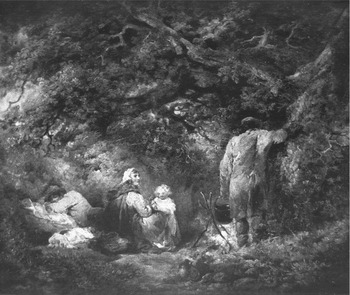
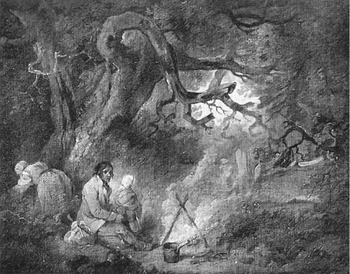
The same setting, with the same tree and its clutching branches, overhang his rather despondent Gipsy Encampment (n.d.) in the Walker Art Gallery, Liverpool,Footnote 55 accentuating a sense of desolation and isolation from any settled or supportive community. An example is shown in figure 12, supposedly entitled Gypsies, above the glum-faced man. The bareness of the oak tree's branches also enhances the grim sense of season of which Morland made more extreme use in his many countryside winterscapes. And there is further irony here too. For these migrant poor under such an oak tree are at an opposite extreme, in their poverty, to the propertied elite pictorially associated with oak trees hitherto.
George Morland, Gypsies.

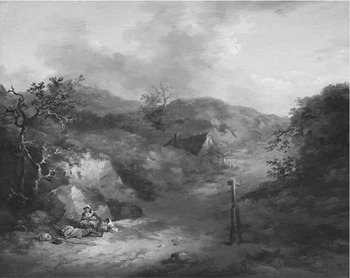
To similar but even more desolate effect, there is Morland's Rest by the Way, or Hillside Tramps Reposing, of 1792 (figure 13), showing a bleak landscape, with nobody else in view other than the seemingly exhausted roadside family. Here the tree or shrub just above these people is defoliated, symbolically indicative of their plight, in contrast to other greenery in the wider scene. This contributes some ambiguity of season. Unlike those in Haytley's painting, these people are removed from seasonal routines expressed in the life of a rural working community. The house in the middle distance is irrelevant to the travellers’ plight, for they have not stopped by it, and that house might be virtually anywhere in marginally hilly regions of England. Furthermore, the road sign is unreadable to us. Perspective has squeezed the directional pointers to minute proportions, perhaps as if no worldly direction is possible. And that sign stands strangely on two legs, as though itself wondering which way to go. At least it is upright, which contrasts with the recumbent man, lying at such a place, dead beat, his face covered, and seemingly discarded from any community. This situation perhaps has further connotations, for it calls to mind Brewer's Phrase and Fable wording: ‘Cross-roads. All (except suicides) who were excluded from holy rites were piously buried at the foot of the cross erected on the public road’.Footnote 56 And in popular folklore at this time, the burial of the restless spirit at crossroads was deliberate, so that it does not know which way to go.
George Morland, Rest by the Way (1792), also entitled Hillside Tramps Reposing.

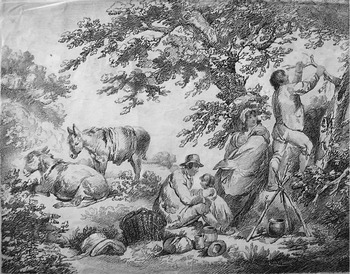
In contrast to jagged, accusatory or barren tree symbolism, there were images in which the migrant poor take hold of the trees and branches, breaking them off for firewood, usually acting illegally in such wood collecting. Morland, markedly unlike a painter like Edward Haytley, had no hesitation in showing illegal activity among the poor, whether that be smuggling, ship wrecking, wood gathering, poaching and dealing in game, and he seems to be in complete sympathy with the perpetrators. One of the two children in his painting Gathering Sticks (1791) has a distinctly furtive look, while the other is resolute and glum. And given the clawing ‘legal’ symbolism of some of Morland's trees and branches, his soft-ground etching shown in figure 14 has added meaning, of almost an anti-legal retaliatory nature, as the sympathetically drawn family of roadside migrants, with clean-shaven men,Footnote 57 break off tree branches for their use.
George Morland, Travellers. (Private collection: K.D.M. Snell).

These pictures by Morland of 1790 to 1804 are striking in their insistence on the theme of roadside migrant poverty in a landscape of anonymity. Examples of migrant poverty could certainly be found earlier, as in Gainsborough's Cornard Wood, and in Dutch seventeenth-century painting or in at least three of Rembrandt's etchings. Themes of beggars and poverty call to mind Jusepe de Ribera, Georges de La Tour, or Caravaggio. Yet these themes had been rare in English art, especially with regard to the migrant poor. Beyond classically imitative work by painters such as Richard Wilson or George Lambert, mid eighteenth-century rural painting had seemed more concerned to represent the poor as settled, well dressed, at a distance but respectable, part of a hierarchical working estate or parish community, often but not necessarily working, usually marshalled and shown in a way intended to reflect the patron's controlling influence and benevolence. Like the property being extolled, they appear as social assets to the patron who commissioned the painting. Such imagery would have been shown in the parlours of the well-heeled with no reluctance or embarrassment. In Gainsborough, however, one sees a bifurcation of this theme, as the social impracticality and undesirability of coexisting social strata or cross-class imagery finally asserted itself. In the work of Morland this change becomes demanding and remarkable. Poverty is represented now as frequently having a roadside location. Its signs are unmistakable and harsh. With the one exception of Morning, or the Benevolent Sportsman (figure 5), gentry are never shown in Morland's paintings of migrant or excluded poor, and if representatives of a prosperous farmer class appear they often do so as male predators to isolated women or as envied pot-bellied hunters of game denied to others, as in his undated painting A Tavern Interior with Sportsmen Refreshing.Footnote 58
I have sketched this artistic transition essentially as a chronologically evolving comparison between Haytley, Gainsborough and Morland. This change in rural artistic representation appears to bear a remarkable parallel to any historical argument that would stress a growing rural problem of English southern and midland vagrancy and itinerant poverty from the later eighteenth century. Those problems were linked to extraordinary inflation, demographic growth, growing illegitimacy, the effects of midlands enclosure of arable land which frequently involved turning it to pasture, rising poor rates and seasonal or absolute increases in agrarian unemployment. They also produced increasing numbers of the poor who were becoming vulnerable to the settlement and vagrancy laws.Footnote 59 An emerging growth of class separation and a rootless loss of a sense of place for many among the poor are clearly signalled in the representations of rural England discussed. From the 1740s onwards, these changes reach an epitome in Morland, accentuated by a remarkable empathy between painter and subject matter that owed much to Morland's own associations, predicaments and problems.Footnote 60
A number of themes in representations of migrant poverty predominated after the late eighteenth century. John Constable, as John Barrell has argued, tended to avoid the theme, sinking the labouring poor deep into his landscapes, although rare exceptions are the fore-grounded but very shadowed wayside squatter huddled in a makeshift tent in Constable's Dedham Vale (1828),Footnote 61 or perhaps his earlier oil sketch of a Man Resting in a Lane (1809),Footnote 62 the class of that man being uncertain. Later painting of rural migrants included images of Irish famine victims. An example is Erskine Nikol, An Ejected Family (1853),Footnote 63 by a Scottish painter who regularly visited Ireland between 1846 and 1850, showing in this painting a family on the road because of non-payment of rent. Or one thinks of Frederick Goodall's An Irish Eviction (1850).Footnote 64 In Scotland and Ireland humane and sympathetic studies of migrants, ‘vagrants’ or roadside beggars fitted with a national narrative of dispossession and clearances, and this may be why so many individualised pictures like William Lizars, John Cowper, an Edinburgh Beggar (n.d.)Footnote 65 were associated with those two countries. John Singer Sargent, The Tramp (c. 1904)Footnote 66 was a rare English version of this genre, albeit painted much later. Wayside ‘gypsy’ groups had many illustrators, such as Frederick Walker, The Vagrants (1867),Footnote 67 where an ambiguity about whether the subjects are ‘gypsy’ or gorgio (the gypsy term for the non-gypsy) echoes identification issues in Morland's work.
There were many other views of gypsies, by Philip de Loutherbourg,Footnote 68 John Phillip, Joseph Stannard,Footnote 69 Frederick Sandys, Dante Gabriel Rossetti,Footnote 70 Augustus John, and others. This was a changing genre that deserves treatment in its own right. There are many post-Morland ‘realist’ depictions of roadside poverty, of which Hubert von Herkomer's Hard Times (1885) is the best known.Footnote 71 A child-focused example was William Small, The Good Samaritan (1899),Footnote 72 of a doctor tending a sick wayside child. Indeed, changing Victorian views of childhood produced much sentimentalisation of wayside poverty, including paintings such as Briton Rivière, His Only Friend (1871),Footnote 73 in which a bare-footed ragged boy and his dog lie exhausted by a roadside milestone indicating that London is thirty-one miles away. Emigrant themes had become common in all four countries of the British Isles. Richard Redgrave's The Emigrant's Last Sight of Home (1858),Footnote 74 in which the departing emigrant holds his arms open towards Abinger in Surrey, was originally exhibited with lines from Oliver Goldsmith's poem ‘The Traveller’. On the continent at this time the influential Gustave Courbet was painting scenes such as The Charity of a Beggar at Ornans (1868).Footnote 75 The Russian Sergei Ivanov's Death of a Migrant Peasant (1889), like Morland's figure 13 above, is centred on a recumbent migrant on the road, and ‘shows the bitter consequences of failure, the collapse of all hope’.Footnote 76 After Morland's premature death, the visualisation of the migrant poor or vagrants clearly took various forms. Yet many of these perpetuated the post-1790 realism that was pioneered by Morland in his views of wayside poverty. Morland died in 1804. His death triggered convulsive fits in his wife who died a few days after him. Much later, ‘social realism’, in the work of painters like Frederick Walker, Luke Fildes, Frank Holl and Hubert von Herkomer, hit the road. This was instigated and defined as a new phenomenon in art that addressed social concerns and was pessimistic or bleak, anti-romantic, critical of the establishment and a form of naturalistic realism. In fact the artistic ‘social realism’ widely seen as a new phenomenon of the 1860s and 1870s seems to have been well inaugurated by George Morland seventy or so years earlier.
Acknowledgements
I am grateful to those attending the Humanities Research Centre Conference at the University of Warwick on ‘Idle and Disorderly Persons: The Representations and Realities of the Mobile Poor in Early Modern England’ (March, 2011), for their comments, and to John Barrell, Janet Couloute, David Hitchcock and Michael Rosenthal for further advice. Space is limited here to reproduce all the paintings and prints discussed, but in almost all cases a search on the internet for the painter and named painting will produce the image required.