


Introduction
Cognitive models of obsessive-compulsive disorder (OCD) propose that maladaptive beliefs lead to negative interpretations of intrusions and distress (Rachman, Reference Rachman1993, Reference Rachman1997; Salkovskis, Reference Salkovskis1985, Reference Salkovskis1989). In support, both correlational (Freeston and Ladouceur, Reference Freeston and Ladouceur1993; Obsessive Compulsive Cognitions Working Group [OCCWG], 1997, 2003; Ólafsson et al., Reference Ólafsson, Arngrímsson, Árnason, Kolbeinsson, Emmelkamp and Kristjánsson2013; Salkovskis et al., Reference Salkovskis, Wroe, Gledhill, Morrison, Forrester and Richards2000; Yorulmaz, Gençöz and Woody, Reference Yorulmaz, Gençöz and Woody2010) and experimental (Bouchard, Rhéaume and Ladouceur, Reference Bouchard, Rhéaume and Ladouceur1999; Ladouceur et al., Reference Ladouceur, Rhéaume, Freeston, Aublet, Jean and Lachance1995; Ladouceur, Rhéaume and Aublet, Reference Ladouceur, Rhéaume and Aublet1997; Lopatka and Rachman, Reference Lopatka and Rachman1995) studies have demonstrated the presence of such beliefs in OCD, yet the etiology of OCD-related beliefs remains largely unknown.
Salkovskis, Shafran, Rachman and Freeston (Reference Salkovskis, Shafran, Rachman and Freeston1999) proposed a model of childhood experiences that contribute to the development of OCD-related beliefs. This model proposed five primary pathways to the development of beliefs regarding inflated responsibility: (1). Heightened responsibility as a child: beyond age norms/given message they are responsible for preventing negative outcomes beyond their control. (2) Rigid and extreme codes of conduct as a child: early environments characterized by extreme or rigid teachings where non-compliance results in punishment. (3) Overprotective and critical parenting leading to lack of experience with responsibility as a child: environment characterized by anxiety and excessive attempts to protect the child; hypothesized to also be associated with depressive symptoms. (4) Incidents in which one's actions/inactions caused a serious misfortune: events where the individual believes that s/he is responsible, or missed an opportunity to prevent it; may be linked with depression. (5) Incidents in which it appears that one's actions/inactions/thoughts influenced a serious misfortune: when in reality the events are only coincidental.
Initial studies of the hypothesized pathways to developing OCD-related beliefs articulated by Salkovsis et al. (Reference Salkovskis, Shafran, Rachman and Freeston1999) provide some support for the model. Two studies in student samples have found significant associations between the proposed childhood experiences and OCD-related beliefs (Coles and Schofield, Reference Coles and Schofield2008; Smári, Þorsteinsdóttir, Magnúsdóttir, Smári and Ólason, Reference Smári, Þorsteinsdóttir, Magnúsdóttir, Smári and Ólason2010). A third study, evaluating adolescents who were successfully treated for OCD, (presumably reducing potential recall biases due to current symptoms; Lawrence and Williams, Reference Lawrence and Williams2011) found higher reports of incidents associated with negative outcomes compared to non-anxious controls, but no group differences on the other hypothesized pathways.Footnote 1
The current study is the first to test the Salkovskis et al. (Reference Salkovskis, Shafran, Rachman and Freeston1999) model of the development of OCD-related beliefs in individuals with current OCD. Four hypotheses were tested: (1) self-reported childhood experiences associated with inflated responsibility would be associated with current responsibility beliefs, and to a lesser degree with beliefs about the importance and control of thoughts and beliefs about perfectionism and uncertainty. This hypothesis was drawn from the Salkovskis et al. (Reference Salkovskis, Shafran, Rachman and Freeston1999) model, which emphasizes responsibility beliefs and prior work with the PIRBS that has shown the strongest correlations with this belief domain in particular (Coles and Schofield, Reference Coles and Schofield2008). (2) Based on the cognitive model that experiences shape beliefs that influence interpretations that ultimately lead to symptoms, we hypothesized that these childhood experiences would be correlated with current OC symptoms. (3) We evaluated the prediction (cf. Salkovskis et al., Reference Salkovskis, Shafran, Rachman and Freeston1999) that recall of overprotection and actions believed to have caused or influenced misfortune would be related to depressive symptoms. Finally, (4) We hypothesized that individuals with OCD would report having experienced higher levels of these childhood experiences than both anxious controls and individuals free of psychiatric disorders.
Method
Participants and procedure
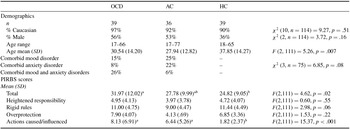
Three groups of participants completed the study: (1) individuals with OCD; (2) individuals with social anxiety disorder (and no comorbid diagnosis of OCD), termed Anxious Controls (ACs); and (3) individuals free of current or past diagnoses, i.e. healthy controls (HC). Characteristics for the three groups are shown in Table 1. Diagnoses were assigned based on DSM-IV-TR (American Psychiatric Association, 2000) criteria and patients participated prior to beginning cognitive behavioral therapy. HCs were paid for their participation.
Demographic information and PIRBS total and subscale scores by group

Notes: OCD = OCD clinical group, AC = anxious control group, HC = healthy control group. Superscript letters denote differences between group means.
Measures
The Anxiety Disorders Interview Schedule IV-Lifetime Version (ADIS-IV-L; Brown, Di Nardo and Barlow, Reference Brown, Di Nardo and Barlow1994) was used to determine current diagnoses. Training of personnel involved observing interviews conducted by senior personnel and then “matching” diagnoses with senior personnel on six interviews (three conducted by the trainer and three conducted by the trainee; cf. Brown, Di Nardo, Lehman and Campbell, Reference Brown, Nardo, Lehman and Campbell2001; Di Nardo, Moras, Barlow, Rapee and Brown, Reference Di Nardo, Moras, Barlow, Rapee and Brown1993). Finally, all diagnostic interviews were reviewed by the study PI (MEC).
The Pathways to Inflated Responsibility Scale (PIRBS; Coles and Schofield, Reference Coles and Schofield2008) is a 23-item self-report measure of the pathways to inflated responsibility beliefs proposed by Salkovskis et al. (Reference Salkovskis, Shafran, Rachman and Freeston1999). A total score and four subscale scores can be computed: heightened responsibility (HR); rigid rules (RR); overprotection (OP); and actions caused/influenced misfortune (ACI).Footnote 2 The PIRBS total score (α = .86) and all subscales (α's > .78) have demonstrated strong internal consistency and 6-month retest reliability (r = .71) in an unselected sample (Coles and Schofield, Reference Coles and Schofield2008). The PIRBS total and subscale scores had strong internal consistency in the OCD (α's >.77), AC (α's >.79) and HC groups (α's >.73).
The Obsessive Beliefs Questionnaire-44 (OBQ-44; Obsessive Compulsive Cognitions Working Group (OCCWG), 2001; Steketee and OCCWG, Reference Steketee2005) is a 44-item self-report measure of OCD-related beliefs in three domains: responsibility and threat estimation (OBQ-RT); perfectionism and intolerance of uncertainty (OBQ-PC); and importance and control of thoughts (OBQ-ITC). The OBQ-44 total and subscale scores have demonstrated strong internal consistency (α's = .89 to .95) and convergent validity in clinical samples (Steketee and OCCWG, Reference Steketee2005).
The Obsessive-Compulsive Inventory (OCI; Foa, Kozak, Salkovskis, Coles and Amir, Reference Foa, Kozak, Salkovskis, Coles and Amir1998) is a 42-item self-report measure of the frequency of OCD symptoms and associated distress in the past month. OCI scores are strongly correlated with other measures of OCD symptoms in clinical and unselected samples (r's = .65 to .81). Only OCI-F scores were included herein as OCI-F and OCI-D scores were strongly correlated in the OCD group (r = .95, p < .001).
The Beck Depression Inventory-II (BDI-II; Beck, Steer and Brown, Reference Beck, Steer, Ball and Ranieri1996) assessed depressive symptoms over the past 2 weeks. This measure is widely used as an index of depressive symptom severity and has shown excellent retest reliability (r = .93; Beck et al., Reference Beck, Steer and Brown1996) and internal consistency (α = .91; Beck, Steer, Ball and Ranieri, Reference Beck, Steer, Ball and Ranieri1996).
Results
Childhood experiences and OCD-related beliefs by group
To examine whether the pattern of correlations between childhood experiences and OC-related beliefs varied according to group, we tested multi-group models using Amos and SPSS 20.0. In the initial model, the correlations between the PIRBS subscales and the OBQ subscales were allowed to vary freely, and were then constrained to be equivalent across groups in a second model. Imposing the constraint of group equivalence resulted in a significant worsening of the model fit (χ2 (56) = 153.51, p < .001) suggesting group differences in relations between PIRBS and OBQ subscales. Therefore we examined Pearson correlations between the PIRBS scales and OBQ subscales in each group. The correlations and their significance at both the p < .05 and p < .01 levels are shown in Table 2. Given that these analyses included 45 tests, we only interpret results with an alpha of p < .01 to reduce potential Type I errors. Beliefs regarding responsibility and threat were significantly associated with PIRBS totals, OP and ACI scores in the OCD group only. Beliefs regarding perfectionism and certainty were significantly associated with PIRBS totals and ACI again in only the OCD group. Finally, beliefs regarding the importance of and need to control thoughts were not significantly correlated with PIRBS totals in any of the groups.
Correlations between childhood experiences and OCD-related beliefs, OCD symptoms, and depressive symptoms by group

Notes:OBQ-RT = responsibility and threat estimation beliefs, OBQ-PC = perfectionism and intolerance of uncertainty beliefs, OBQ-ICT = importance and control of thoughts beliefs, OCI-F = frequency of OCD symptoms, BDI-II = severity of depressive symptoms. OC = Individuals with OCD (n = 39), AC = Anxious Controls (n = 36), HC = Healthy Controls (n = 39), PIRBS = pathways to inflated responsibility beliefs, HR = heightened responsibility, RR = rigid rules, OP = overprotection, ACI = actions caused/influenced misfortune. * = p ≤ .05 (two-tailed), ** = p ≤ .01 (two-tailed). Given the large number of correlations between the PIRBS scales and OBQ scales only effects with p ≤ .01 were interpreted for these analyses.
Focusing on the OCD group, Z-tests of dependent correlations revealed that ACI scores were significantly more strongly correlated with OBQ-RT beliefs than with OBQ-ICT beliefs (Z = 1.96, p = .05). There were also two non-significant trends suggesting that HR scores were more strongly correlated with OBQ-PC beliefs than with either OBQ-RT beliefs (Z = 1.81, p = .07) or with OBQ-ICT beliefs (Z = 1.89, p = .06).
Given the small correlations between HR and RR with OBQ-RT and prior gender differences in OCD-related beliefs (Bolton, Dearsley, Madronal-Luque and Baron-Cohen, Reference Bolton, Dearsley, Madronal-Luque and Baron-Cohen2002; Magnúsdóttir and Smári, Reference Magnúsdóttir and Smári2004; Coles et al., Reference Coles, Wolters, Sochting, De Haan, Pietrefesa and Whiteside2010), we examined these relations by gender. In individuals with OCD, OBQ-RT was positively correlated with recollections of experiences with HR (r = .19) and RR (r = .28) in men (n = 22), but negatively correlated with HR (r = −.19) and RR (r = −.31) in women (n = 17). Correlations between recollections of HR and RR with OBQ-ITC were also in opposite directions for males (r's = −.16, −.12 respectively) and females (r's = .03, .06, respectively); however, none of these relations were statistically significant (all p's > .05).
Childhood experiences and OCD symptoms
In OCs, increased PIRBS total, OP and ACI scores were significantly associated with increased OCD symptoms (OCI-F; see Table 2). In contrast, PIRBS HR and RR scores were not significantly correlated with OCD severity.Footnote 3 Significant relations between the PIRBS and OCI were not found in the AC and HC groups.
Childhood experiences and depressive symptoms
In individuals with OCD, ACI scores were significantly correlated with depressive symptoms (BDI-II; see Table 2) and this relation was similar in magnitude to the correlation with OCI-F (Z = 0.19, p = .85). However, OP was not significantly correlated with BDI-II scores in individuals with OCD. Further, findings showed small (and non-significant) correlations between BDI-II and HR, and RR. Finally, PIRBS and BDI-II totals were not significantly correlated. Depressive symptoms were not related to any childhood experiences in the AC group; however, they were significantly related to experiences with overprotection in the HC group (see Table 2).
Levels of childhood experiences
PIRBS scores across domains revealed significant group differences on PIRBS total and ACI scores (see Table 1), with follow-up Student Newman Keuls showing individuals with OCD scored higher on the PIRBS Total and ACI scores than HCs, but did not differ on either scale from ACs. There was a non-significant trend for RR, with the means suggesting that OCs and HCs scored higher than the ACs. Group differences were not found on HR or OP.
Duration of illness and childhood experiences
Given the retrospective nature of the PIRBS, we examined whether duration of OCD was significantly associated with PIRBS scores in individuals with OCD. To the extent that having OCD symptoms biases one to recall more childhood experiences, as outlined by Salkovskis et al. (Reference Salkovskis, Shafran, Rachman and Freeston1999), it would be anticipated that having OCD for a longer period of time would be associated with higher scores on the PIRBS scales. HR, RR and OP were not significantly correlated with OCD duration (r's = .04, .04, and .28, respectively, all p's >.05). However, ACI and the PIRBS totals were significantly correlated with OCD duration (r’s = .41 and .36, respectively, both p's < .02).
Discussion
Results of the current study provide modest support for the proposed role of childhood experiences outlined by Salkovskis et al. (Reference Salkovskis, Shafran, Rachman and Freeston1999) in the development of OCD-related beliefs. Though there was some evidence for a relationship between childhood responsibility experiences, OCD-related beliefs and symptoms, the evidence was not as systematic as the model would predict. Regarding the extent to which respondents reported having the various childhood experiences, individuals with OCD reported more childhood experiences where one's actions caused or influenced misfortune than did healthy controls, but they were not found to differ from anxious controls. Overall, the findings of the current study provide modest support for the model put forth by Salkovskis et al. (Reference Salkovskis, Shafran, Rachman and Freeston1999).
Results further suggest that gender may play an important role in the relations between OCD-related beliefs and childhood experiences with heightened responsibility and rigid rules. Of note, evidence suggests that females may report more negative life experiences occurring during their childhood (e.g. Briggs and Price, Reference Briggs and Price2009) and report less frequent intrusive obsessive thoughts than males (Belloch, Morillo, Lucero, Cabedo and Carrió, Reference Belloch, Morillo, Lucero, Cabedo and Carrió2004). If future studies confirm gender differences in OCD related beliefs and childhood experiences, this could suggest the interaction between gender and beliefs could be pertinent for investigating differential treatment response of males versus females (e.g. Basoglu, Lax, Kasviskis and Marks, Reference Başoğlu, Lax, Kasvikis and Marks1988; Castle et al., Reference Castle, Deale, Marks, Cutts, Chadhoury and Stewart1994; Raffin, Fachel, Ferrão, Pasquoto de Souza and Volpato Cordioli, Reference Raffin, Fachel, Ferrão, Pasquoto de Souza and Volpato Cordioli2009).
Given that this is the first study of the Salkovskis et al. (Reference Salkovskis, Shafran, Rachman and Freeston1999) model using a clinical OCD sample, and findings suggesting that gender differences may have masked some relations in the full sample, this model is worthy of further attention. However, the initial findings suggest that additional thinking is needed regarding the development of OCD-related beliefs. One area warranting consideration is the integration of genetic influences (alone, as well as interacting with environmental factors) into models of the development of such beliefs (Taylor, Afifi, Stein, Asmundson and Jang, Reference Taylor, Afifi, Stein, Asmundson and Jang2010; Taylor and Jang, Reference Taylor and Jang2011). A recent twin study of OCD-related beliefs in a community sample showed that up to 40% of the variance in OCD-related beliefs could be attributed to genetic influences (Taylor et al., Reference Taylor, Afifi, Stein, Asmundson and Jang2010). Ultimately, integrated models of genetic and environmental influences on OCD need to be developed and tested. Age of onset may also be important as cognitive factors may play a larger role in “late” onset OCD (e.g. age 18 or above).
The study presented here had several limitations. First, the relatively small size of the current sample prohibits firm conclusions. Second, retrospective reports of childhood experiences may have been biased by current beliefs and/or symptoms. Findings that OCD duration was related to reports of experiences believed to cause/influence harm may reflect memory biases. However, it is also possible that observed differences may reflect group differences in how individuals with and without OCD interpret events when they occur (Mathews and Mackintosh, Reference Mathews and Mackintosh2000). Finally, the cross-sectional design used herein limits the conclusions that can be drawn about causality. It may be the case that early childhood experiences predispose an individual to psychopathology via the development of maladaptive beliefs as hypothesized by Salkovskis and colleagues (Reference Salkovskis1999). However, it may also be the case that these childhood experiences are the result of anxious characteristics being observed and responded to by parents (Burkhouse, Gibb, Coles, Knopik and McGeary, Reference Burkhouse, Gibb, Coles, Knopik and McGeary2011; Rankin Williams et al., Reference Rankin Williams, Degnan, Perez-Edgar, Henderson, Rubin and Pine2009) or early inflated responsibility beliefs influence individual's experiences of their environment (Hammen, Reference Hammen1991; Liu and Alloy, Reference Liu and Alloy2010).
Ultimately, understanding how OCD-related beliefs develop is worthy of additional attention. The current study suggests that understanding the development of such beliefs will require thinking about influences beyond the childhood responsibility experiences proposed by Salkovskis et al. (Reference Salkovskis, Shafran, Rachman and Freeston1999), including potentially both genetic and other environmental influences.




Comments
No Comments have been published for this article.