Introduction
During recent decades, assisted reproductive technologies in cattle have achieved considerable advances, such as a combination of in vitro embryo production (IVP) and ovum pick-up (OPU). An average of four to six available oocytes from a single cow are collected by OPU or a single slaughtered valuable oocyte donor cow (Hasler, Reference Hasler1998; Merton et al., Reference Merton, Ask, Onkundi, Mullaart, Colenbrander and Nielen2009). However, most laboratories currently culture up to 20 embryos in a 20–50-μl droplet or up to 50 embryos in 400–500 μl in a well in vitro (Krisher & Wheeler, Reference Krisher and Wheeler2010; Vajta, Reference Vajta2010) to obtain transferrable embryos. Small groups of 1–10 embryos in a droplet or a well have been shown to have low blastocyst rate and quality compared with large groups of 20–25 embryos (Donnay et al., Reference Donnay, Van Langendonckt, Auquier, Grisart, Vansteenbrugge, Massip and Dessy1997; Ikeda et al., Reference Ikeda, Takahashi and Katagiri2000; Nagao et al., Reference Nagao, Iijima and Saeki2008; Senatore et al., Reference Senatore, Xu, Suárez Novoa, Gong, Lin, Bella, Moreno, Mannino, Tian, Presicce, Wu and Du2010; Ward et al., Reference Ward, Lonergan, Enright and Boland2000; Vajta et al., Reference Vajta, Peura, Holm, Paldi, Greve, Trounson and Challensen2000). Therefore, a culture system for a small group of embryos is required to improve blastocyst yield. It has been reported that, if embryos were cultured in a custom-made microwell in a large well (WOW) (Vajta et al., Reference Vajta, Peura, Holm, Paldi, Greve, Trounson and Challensen2000; Matoba et al., Reference Matoba, Fair and Lonergan2010) and in a commercially available polystyrene-based WOW (25 microwells) (Sugimura et al., Reference Sugimura, Akai, Somfai, Hirayama, Aikawa, Ohtake, Hattori, Kobayashi, Hashiyada, Konishi and Imai2010), the blastocyst rate was significantly higher than that of droplet culture. In addition, Sugimura et al. (Reference Sugimura, Akai, Hashiyada, Aikawa, Ohtake, Matsuda, Kobayashi, Kobayashi, Konishi and Imai2013) demonstrated that the blastocyst rate in small-group culture (five embryos) in a WOW was higher than in a droplet.
Gopichandran & Leese (Reference Gopichandran and Leese2006) reported that embryos surrounded by three or eight adjacent embryos showed low blastocyst development compared with those surrounded by five adjacent embryos when bovine embryos were cultured in a group in a droplet. It was also reported that the number of adjacent embryos (three, five, or eight) did not affect blastocyst development in a custom-made WOW dish (Matoba et al., Reference Matoba, Fair and Lonergan2010). This discrepancy may have been caused by the large depth (500 μm) of microwells of custom-made WOW dishes (Matoba et al., Reference Matoba, Fair and Lonergan2010) because the overall diameter of embryos ranges from 150–190 μm (Linder & Wright, Reference Linder and Wright1983). It is thought that usage of a commercially available WOW dish is preferable to achieve a high and stable blastocyst rate for culturing a small number of embryos. However, an embryo in a microwell (169 μm in depth) in the WOW dish developed by Sugimura et al. (Reference Sugimura, Akai, Somfai, Hirayama, Aikawa, Ohtake, Hattori, Kobayashi, Hashiyada, Konishi and Imai2010) can be affected by factors outside of the microwell. Thus, we should examine the effect of the number of adjacent embryos on blastocyst production by a commercially available WOW dish.
In the present study, we examined the effects of the total number of embryos (five versus 25 embryos) and the number of adjacent embryos (zero, three, five, and eight embryos) in a WOW dish on blastocyst development.
Materials and methods
All the chemicals used for this study were purchased from Sigma-Aldrich (St. Louis, MO, USA), unless otherwise stated.
In vitro maturation (IVM) of bovine oocytes was performed as described previously (Takahashi et al., Reference Takahashi, Hishinuma, Matsui, Tanaka and Kanagawa1996). In brief, cumulus–oocyte complexes (COCs) aspirated from follicles (2–8 mm in diameter) of slaughterhouse-derived ovaries were cultured for 22 h in a droplet (about 10 COCs/50 μl) of maturation medium under a humidified atmosphere of 5% CO2 in air at 39 ˚C. Maturation medium consisted of HEPES-buffered TCM-199 (Invitrogen, Grand Island, NY, USA) supplemented with 10% fecal calf serum (FCS; Invitrogen), 0.2 mM sodium pyruvate, 0.02 units/ml follicle-stimulating hormone, 1 μg/ml estradiol-17β, and 50 μg/ml gentamicin sulfate.
In vitro fertilization (IVF) was conducted according to a procedure described previously (Takahashi & Kanagawa, Reference Takahashi and Kanagawa1998). Briefly, after the thawing of frozen semen, motile sperm were separated using a Percoll gradient (45 and 90%). COCs were co-incubated with motile sperm (5 × 10⁶ cells/ml) in droplets (10–13 COCs/100 μl) of modified Brackett and Oliphant's isotonic medium (Takahashi & First, Reference Takahashi and First1992) containing 3 mg/ml fatty acid-free bovine serum albumin (BSA) and 2.5 mM theophylline for 18 h at 39 °C under a humidified atmosphere of 5% CO2, 5% O2, and 90% N2.
In vitro culture of presumptive zygotes
In vitro culture (IVC) of presumptive zygotes was performed using the procedures that were basically the same as described previously (Takahashi & Kanagawa, Reference Takahashi and Kanagawa1998). After co-incubation with sperm, presumptive zygotes freed from cumulus cells by vortexing were washed three times and cultured for 150 h in droplets or a WOW dish using a modified synthetic oviduct fluid medium that contained 1 mM glutamine, 12 essential amino acids for basal medium Eagle, seven non-essential amino acids for minimum essential medium, 10 μg/ml insulin, 5 mM glycine, 5 mM taurine and 1 mM glucose (Takahashi & Kanagawa, Reference Takahashi and Kanagawa1998), and added 3 mg/ml fatty acid-free BSA instead of polyvinyl alcohol at 39˚C under 5% CO2, 5% O2 and 90% N2. Polystyrene-based WOW dishes that have 25 microwells (5 × 5 microwells with 170-μm depth, 290-μm diameter, and 400-μm distance between them; Dai Nippon Printing Co. Ltd., Tokyo, Japan) were prepared as described previously (Sugimura et al., Reference Sugimura, Akai, Somfai, Hirayama, Aikawa, Ohtake, Hattori, Kobayashi, Hashiyada, Konishi and Imai2010). In brief, 125 μl of culture medium were placed within the circular wall of WOW dish that contained microwells and covered with paraffin oil (Nacalai Tesque, Inc., Kyoto, Japan). Twenty-five embryos were placed individually in each microwell in a WOW dish. For the culturing of five embryos, four embryos were placed in the microwell of four corners and the remaining one was put into the center microwell in a WOW dish (no adjacent embryo).
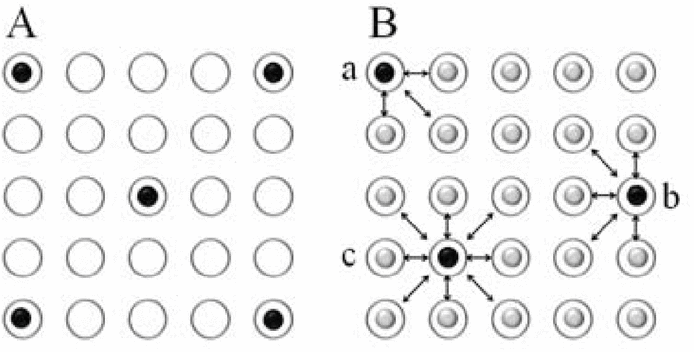
To examine the effect of embryo number in a droplet and a WOW dish on the development to blastocysts, small or large numbers of embryos (5–6 or 25–26, respectively) inseminated by bull A sperm were cultured in a 40-μl droplet. Another large number of embryos inseminated by bull B sperm were cultured in a droplet (25–30 embryos/30 μl), and five or 25 embryos were cultured in a WOW. The effect of the number of adjacent embryos in a WOW was examined using data of the five-embryo culture (no adjacent embryos; Fig. 1 A) and the 25-embryo culture with different numbers of adjacent embryos (three, five, and eight embryos; Fig. 1 B). Cleavage and blastocyst rates were assessed after 30 h and 150 h of IVC, respectively. All embryos that developed to blastocysts were subjected to counting of their cell numbers using an air-drying method (Takahashi & First, Reference Takahashi and First1992).
Different numbers of adjacent embryos in 25 microwells in a WOW dish.
(A) Embryo with no adjacent embryos. (B) a: Embryo with three adjacent embryos; b: embryo with five adjacent embryos; c: embryo with eight adjacent embryos.

Statistical analysis
The frequencies of cleavage and development to blastocysts, and cell numbers in blastocysts were compared by one-way analysis of variance (ANOVA) followed by Tukey–Kramer's honestly significant difference (HSD) test as the post hoc test. Proportions of blastocysts among the embryo groups placed in different positions of a WOW dish (different numbers of adjacent embryos) were compared by chi-squared test. All analysis was performed using JMP Pro software (version 10.0.2, SAS Institute, Cary, NC, USA).
Results
As shown in Table 1, when embryos were cultured in a droplet, cleavage and blastocyst rates of the large-number group (25–26 embryos/droplet) tended to be higher than those of the small-number group (5–6 embryos/droplet) (P = 0.14 and 0.07, respectively). In addition, the total cell number in blastocysts of the large-number group was significantly higher than that of the small-number group (P < 0.01). When embryos were cultured in WOW, blastocyst rates were high regardless of embryo number in the WOW dish and similar to that of the large-number group in a droplet. Furthermore, the number of adjacent embryos in a WOW dish did not affect the development to blastocysts and total cell numbers in blastocysts, as shown in Table 2.
Effect of embryo number in a droplet and a WOW dish on embryonic development

a,b Values (means ± standard deviation (SD)) with different superscripts differ significantly (P < 0.01).
Effect of the number of adjacent embryos (position of embryos) in a WOW on the development of embryos to blastocysts and their cell numbers

Data were pooled from four replicates of culture of 25 embryos and three replicates of culture of five embryos with WOW (bull B) in Table 1.
Cell numbers in blastocysts are means ± standard deviation (SD).
Discussion
Culture of small numbers of embryos in a droplet reduced the blastocyst rate and the quality of blastocysts (mean cell numbers in blastocysts) compared with those for embryos cultured with large numbers of embryos in a droplet (Nagao et al., Reference Nagao, Iijima and Saeki2008; Senatore et al., Reference Senatore, Xu, Suárez Novoa, Gong, Lin, Bella, Moreno, Mannino, Tian, Presicce, Wu and Du2010). In the present study, there was no reduction in blastocyst rate and quality in a WOW dish. This result is in agreement with previous findings that the development of embryos to blastocysts was independent of the total number of embryos in a WOW dish (Sugimura et al., 2013). We speculated that diffusible factors such as autocrine/paracrine growth factors released by embryos can be diffused in a droplet and influence the growth of their adjacent embryos (Stokes et al., Reference Stokes, Abeydeera and Leese2005). A small amount of autocrine/paracrine factors may be secreted by a small number of embryos, would be easily diluted in a droplet, and would show few effects on embryonic development. However, in this WOW dish, diffusible factors secreted by individual embryos probably accumulated in a microwell, which may provide a suitable microenvironment for their development, as suggested in a previous study (Swain & Smith, Reference Swain and Smith2011). Moreover, adjacent embryos in a WOW dish also did not affect blastocyst development and mean cell numbers in blastocysts in the present study, as previously described (Matoba et al., Reference Matoba, Fair and Lonergan2010), even though the depth of the microwell was different.
In conclusion, the polystyrene-based WOW dish used in this study is effective for individual embryo culture of small groups, and there is no reduction in embryo development, regardless of the number of adjacent embryos (position of embryos) in microwells of the WOW.
Acknowledgements
We thank Genetics Hokkaido Association for the donation of frozen bull sperm.