In the United States, the closing decades of the nineteenth century witnessed a significant expansion in the landscape of higher education. From 1820 to 1859, 225 private universities were built, and over the next 40 years, an additional 348 were founded (Goldin and Katz Reference Goldin and Katz1999). By 1881, Ohio alone had 37 institutions for a population of 3 million people. In contrast, England had four universities serving a population nearly eight times that size (Goetzmann Reference Goetzmann2009).Footnote 1 The high density of private universities and their remarkable quality would become an enduring characteristic of the American higher education system. Where did this growth in educational infrastructure originate? What sustained such a seemingly disproportionate level of investment?
This article studies the economic and competitive forces that shaped the pattern of American collegiate development on the eve of its formative years. We test the hypothesis that denominational competition drove the increase in college establishment prior to 1890. We document that virtually all private colleges established in this period had denominational roots or origins. This sectarian ethos of early college entry reflected the religious tenor of nineteenth-century American life. Owing to the diversity of Christian denominations in the American population, denominational affiliation was an instrument of strategic choice and a source of horizontal differentiation. We argue that differentiation along the dimension of religion lessened the degree of tuition competition among colleges and precipitated an “excess” number of entrants within narrow geographical markets.
Scholars have long noted the “virtues” of the U.S. education system within the first hundred years of the republic’s inception (Goldin and Katz Reference Goldin and Katz2010). A large strand of literature has emphasized the fundamental principles of fiscal independence, secular control, and public provision as crucial to its success and diffusion. However, with notable exceptions, this existing literature has focused on elementary and secondary education. Largely omitted is a discussion of higher education prior to 1890, when, paradoxically, denominational and private interests played a substantially more nuanced role. By exploring the origins and foundations of the “knowledge industry,” this paper contributes a missing but complementary chapter to the story of early American educational exceptionalism.
We begin by building a database of all known bachelor’s degree-granting institutions in the nineteenth-century United States. We use several sources, namely the U.S. census, Tewksbury (Reference Tewksbury1932), Burke (Reference Burke1982), and the Annual Report of Commissioners of Education (U.S. Office of Education 1870). Whenever possible, we document the exact geographic location, private versus public status, cost of tuition and board, enrollment and faculty, level of endowment, and, importantly, denominational affiliation. Using geographic information, we link these institutions back to the underlying counties in which they were initially built.
By combining decadal population censuses with the censuses of religious bodies covering the same period, we assemble a rich panel dataset of U.S. counties spanning 1850 to 1890 that includes detailed accounts of religious composition and membership. Specifically, we use county-level data on each denomination’s total church seating capacity to proxy for denominational market size. We measure denominational competition by constructing a Herfindahl index based on denominations’ market shares.
Our empirical analysis reveals a positive and significant relationship between local religious diversity and the establishment of colleges, both in the cross section and over time. Our panel estimates relate the changes in the number of colleges within a county to the changes in the degree of religious fragmentation. A back-of-the-envelope calculation suggests that there would have been approximately 22 percent fewer colleges by 1890 if the United States had been dominated by a single denomination.
The estimated coefficients are robust to controlling for an extensive set of confounding factors. Our baseline controls include county fixed effects, year fixed effects, and state-year fixed effects. County fixed effects account for unobservable heterogeneity that is time-invariant, and state-year fixed effects allow each state to have time-varying changes in its propensity to build colleges. We also expand controls to include 1850 demographic characteristics that interacted with a time-trend to account for the possibility that counties prone to build colleges may have started with more favorable population or industrialization conditions. Furthermore, we include total church accommodations and denomination fixed effects to show that our results are not driven by religiosity or the presence of any single denomination.
We take several additional steps in order to rule out competing explanations. First, one might worry that the panel result suffers from reverse causality: colleges may attract a heterogeneous population and increase local religious diversity. This is unlikely since colleges in the nineteenth century were small and attended mostly by students from the matching denomination.Footnote 2 We also use an event-study specification to show that growth in higher education occurred only after counties became religiously diverse.
Next, counties with a tolerance for religious diversity may attract a more educated or innovative population, leading to a higher demand for advanced education. Although the demand for advanced education is a time-varying unobservable, we address it in two ways. First, we control levels of basic education, which is a necessary condition for demanding higher education. Using full count censuses, we construct measures for literacy rate and school attendance for children under the age of 14. Second, we approximate upper-tail human capital by controlling for the average yearly patents in the preceding decade. Including time-varying controls for basic education and innovation hardly affects the coefficient of interest.
Another natural concern is that religious fragmentation may be concentrated in industrial clusters, and there are many reasons to believe that industrial centers may have developed robust civil societies that make them more suitable locations for higher education. For instance, industrial areas may have lower costs of travel and more extensive funding to support college development. To address this, first, we included controls for access to railroads, miles of railroads, and 1850 manufacturing output interacted with a time trend in our regressions. Next, we also tested the robustness of our estimates by dropping the more industrialized northeast region or the midwest. Finally, we controlled for a particular civil society institution that was closely tied to industrial communities at the time: the Knights of Labor (KOL). Founded in 1869, KOL was a prominent national labor organization that expanded quickly in the late nineteenth century. Its membership was comprised of industrial workers, and their presence served as a useful proxy for both industrialization and the existence of civic institutions. Our results remain consistent when controlling for the counts of KOL assemblies, suggesting that the effects of religious fragmentation are not driven by secular trends in industrialization.
Finally, an important concern is the confounding effect of ethnic diversity. In particular, mass migration from Europe occurred during this period. One might be worried that immigrants from different ethnicities built their own colleges and that changes in denominational fragmentation simply reflected the changes in immigration or the ethnic composition of the population. To properly account for this, we control the share of immigrants and create a Herfindal index based on country of birth, constructed using the full count censuses.Footnote 3 Migrant diversity does not absorb any effect from denominational diversity, nor is it a significant predictor for college establishment.
So what explains the variation in denominational fragmentation? Ultimately, whether we can interpret our results as causal depends on the answer. In order to provide more historical context for this process, we explore two historical forces that shaped religious composition in the nineteenth-century United States. First, we highlight the impact of the Second Great Awakening. The Second Great Awakening was a nineteenth-century religious movement during which the United States underwent a resurgence in religious activities and experienced an unprecedented expansion in church membership. The episode led to the formation of new denominations and increased religious diversity. Using data from the states of New York and Ohio, we show that towns that experienced more revival activities associated with the Second Great Awakening built more colleges in the following decades. Second, we discuss how denominational splits increase religious fragmentation. Existing denominations have sometimes experienced divisions due to theological disputes. Focusing on the Methodist Church, we discuss denominational splits over the issue of slavery and illustrate how new denominations that split from mainline Methodists founded their own colleges. In both instances, the quantitative and anecdotal evidence are consistent with the notion that new churches and denominations precipitated growth in higher education.
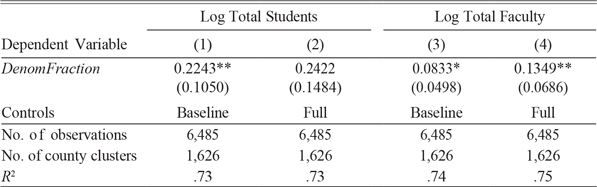
Having shown the effect of religious fragmentation on the number of colleges, we then examine the effect on student enrollment. While religious competition may have expanded the supply of colleges, whether this would translate into meaningful increases in educational attainment is far from clear. In particular, one may be concerned that the increasing number of colleges simply dispersed students and faculty without increasing the total enrollment. We first show that enrollment did indeed increase with the number of colleges in aggregate (see Online Appendix Figure A7). Then, we replicate our main regression on total students and faculty. We find religious competition has positive, although noisier, effects. We interpret this correlation as evidence for the role of religious competition in spurring college provision.
An extensive literature, beginning with the pioneering work of Max Weber, has explored the connection between religious norms and educational or economic outcomes. Our paper contributes to this literature by illustrating that competition and interaction between narrowly defined denominations can impact the equilibrium provision of upper-tail human capital. Comparatively, there is relatively little empirical research on the consequences of religious diversity, and the existing works on religion have largely offered channels that are sociological rather than economic.Footnote 4
Drawing from the industrial organization literature on differentiated products and entry, we attempt to disentangle the underlying mechanisms specific to our context. Starting a college in the nineteenth-century United States was a precarious proposition that carried a significant risk of failure. In this competitive environment, we posit that denominational differentiation provided a mechanism to insulate entrants from onerous competition on tuition and to extract higher rent.
We build on our reduced-form evidence and rationalize the results within the framework of historical university competitions. We consider college denomination to be a dimension for horizontal differentiation, such that colleges can cater to specific consumer preferences via affiliation choices. Denominational differences effectively rendered colleges less substitutable. The key results hinge on two crucial assumptions: (1) students exhibit preferences for colleges with a denominational affiliation that matches their own; and (2) colleges recruit students locally.
Without fully formalizing the model, we assess the strength of these parameters that govern the underlying incentives and gains from differentiation. We use individual micro data to estimate an empirical model of school choice and assess how student preferences vary within the population. To our knowledge, little is known about the demand side of colleges in the nineteenth century. We use a unique student-level dataset from Burke (Reference Burke1982). Burke (Reference Burke1982) assembled the dataset using college directories, alumni records, and biographies that contain information on student characteristics and the college attended. We estimate a conditional logit discrete choice model and diagnose how various factors, such as religious affiliation, distance, and tuition, affect observed choice.
We found that students strongly preferred to attend a college with a denomination that matched their own. Our preferred estimates indicate that students were willing to travel up to 233–247 kilometers farther and pay an additional $113–$225 per annum for a college of that quality.Footnote 5 The revealed preferences imply that colleges, even in close proximity, can secure sufficient demand by differentiating themselves denominationally. Consequently, the number of entrants sustained in equilibrium will increase the denominational heterogeneity in the underlying population. In a counterfactual world with less local religious diversity or mandated secular universities to the exclusion of religious interests, the number of colleges established would be substantially lower.
At a glance, the significance of colleges in the mid-nineteenth century is easy to overlook. During the antebellum and postbellum years, the fraction of college-educated persons in the population was small, as in all nations. However, the mere number of degrees conferred belies the significance of universities in the later stages of industrialization, a key historical period referred to as the Second Industrial Revolution. There is increasing evidence that knowledge at the upper tails mattered significantly more for economic development than average human capital or literacy (Squicciarini and Voigtländer Reference Squicciarini and Voigtländer2015), and universities themselves played a remarkable role in facilitating the Commercial and Industrial Revolutions (Cantoni and Yuchtman Reference Cantoni and Yuchtman2014; Mokyr Reference Mokyr2009). Furthermore, Card (Reference Card2001) documents that even proximity to colleges impacts educational attainment decisions.Footnote 6 A striking implication that follows is that the spatial distribution of universities has a first-order impact on the aggregate educational stock of a country’s labor force. If the twentieth century is designated the “human-capital century” (Goldin Reference Goldin2001), this paper endeavors to analyze the initial conditions to which that is owed. The strength of the U.S. higher education system lies in both the quantity of schools as well as the quality of those institutions. While our paper is primarily concerned with explaining the former phenomenon, in the Online Appendix, we explore the link between the increased entry of colleges and broader educational outcomes such as school quality. We track the development of denominational colleges through the Second Industrial Revolution and provide suggestive evidence consistent with the notion that schools responded to increased market competition by investing in quality.
RELATED LITERATURE AND CONTRIBUTIONS
This paper bridges three distinct strands of literature. First, it contributes to the extensive body of research on the economics of religion and, within that, the link between religion and human capital. This literature has sociological roots dating back at least to Max Weber’s thesis, which proposed a connection between the Protestant doctrine and work ethic. Recent work has documented the economic success of regions that converted to Protestantism early (Bai and Kung 2015; Becker and Woessmann Reference Becker and Woessmann2009). Instead of linking to work ethic as Weber theorized, Becker and Woessmann (Reference Becker and Woessmann2009), Becker, Pfaff, and Rubin (Reference Becker, Pfaff and Rubin2016), McCleary (Reference McCleary2013), Cantoni (Reference Cantoni2013), Cagé (Reference Cagé, Monga and Justin2015), and Calvi, Hoehn-Velasco, and Mantovanelli (Reference Calvi, Hoehn-Velasco and Mantovanelli2020) find that Protestantism increases human capital accumulation and suggest that as an explanation through different case studies.Footnote 7
A recurring theme along this line of research is that norms associated with a specific religion or denomination matter. This is echoed in evidence from developing country settings. Examples include Geruso and Spears (Reference Geruso and Spears2017), which explores the Hindu–Muslim cleavage’s relevance for sanitation habits, Chaudhary and Rubin (Reference Chaudhary and Rubin2011) discuss the relationship among reading, writing, and religion in colonial India. Other notable recent papers include Squicciarini (Reference Squicciarini2020), Kuran (Reference Kuran2016), and Chaney (Reference Chaney2013).Footnote 8
Beyond the consequences of adopting specific religions or denominations, economists have also studied the interactions between denominations or religions more broadly.Footnote 9 In this domain, the closest paper to our own is Iyer, Velu, and Weeks (Reference Iyer, Velu and Weeks2014), which looks at competition among different religions (Hindu, Muslim, Christian, Sikh, and Jain) in contemporary India and models how economic inequality induces religious organizations to provide nonreligious services. To the best of our knowledge, our paper is the first to investigate the relationship between religious competition and institutions of higher education.
Subsequently, economists have employed the rational choice frame-work to understand how religious competition matters (Becker and Murphy Reference Becker and Murphy2003; Bisin and Verdier Reference Bisin and Verdier2000; Iannaccone and Berman Reference Iannaccone, Berman, Durlauf and Blume2008; Montgomery 2003; Prummer and Siedlarek Reference Prummer and Siedlarek2014; Putnam 2000 and Campbell; Walrath Reference Walrath2016). However, the existing literature has been primarily concerned with the effect of religious competition on religious practices; less well understood are the ramifications of religious competition on a broader set of outcomes or the formation of institutions.Footnote 10
Outside of economics, the relationship between denominational growth and higher education in the nineteenth-century United States has been corroborated by narrative evidence from a number of educators and historians (Finke and Stark Reference Finke and Stark2005; Geiger Reference Geiger and Geiger2000b; Herbst Reference Herbst1982). Most recently, Urquiola (Reference Urquiola2020) studied the market forces that shaped the history of U.S. higher education, and his book echoes similar sentiments as our paper regarding the role of religious organizations in the formation of the U.S. college system in the nineteenth century. Our paper contributes to the narrative arguments by empirically testing the relationship and providing the economic mechanism for why the high entry was sustained.
Second, our paper relates to literature on the economic implications of diversity. Studies have typically emphasized the economic costs of diversity. For instance, Easterly and Levine (Reference Easterly and Levine1997) show that ethnic diversity adversely affects public policies associated with economic growth, such as the black market, low provision of infrastructure, and low levels of education. Alesina et al. (Reference Alesina, Arnaud Devleeschauwer, Kurlat and Wacziarg2003) find that the provision of public goods such as education, roads, and sewers is inversely related to ethnic fragmentation in U.S. cities. However, several studies have pointed out the positive side of diversity on economic growth. Cinnirella and Streb (Reference Cinnirella and Streb2017) document a positive correlation between religious diversity and innovation in Prussia. In the U.S. context, Ager and Brückner (Reference Ager and Brückner2013) construct an ethnic diversity index based on historical immigrants’ nativity and identify a positive effect of diversity on output growth. Our paper expands on this literature by showing that fractionalization within narrowly defined Christian denominations had a positive effect on educational growth.
Finally, because we treat college building as an entry problem, we draw from industrial organization literature on differentiated products and firm entry in the spirit of Bresnahan and Reiss (Reference Bresnahan and Reiss1991) and Mazzeo (Reference Mazzeo2002). Iannaccone (Reference Iannaccone1992) introduced the use of industrial organization concepts in the economic analysis of religion. McBride (Reference McBride2008) and Montgomery (2003) use the methods of industrial organization and product differentiation to examine the relationship between pluralism and participation. We build on these insights and conceptualize religious affiliation as a strategic choice. We also explicitly quantify the preference for religious homophily in the context of nineteenth-century higher education.
HISTORICAL BACKGROUND
The connection between American higher education and religion dates back to the colonial period. Nearly all of the colonial colleges had denominational affiliations: Harvard and Yale were Congregational, the College of William & Mary and Columbia were Episcopalian, and Princeton was Presbyterian, just to name a few.
University services were intertwined with religious functions. In addition to providing a curriculum in classical education, colleges train and supply future ministers.Footnote 11 Since denominations differed in their interpretation of the Bible, to prepare students for religious vocations, colleges catered to specific denominations, and denominational differences in university education truly mattered. Ministerial work remained a promising career path throughout the Antebellum period. More than half of Harvard graduates became ministers in the the 60 years following its founding. For the first 12 years after its founding (Tewksbury Reference Tewksbury1932), nearly three-fourths of the graduates of Yale became ministers. A steady 17 percent of Princeton graduates became ministers from 1824 to 1854 (Geiger and Bubolz 2000).
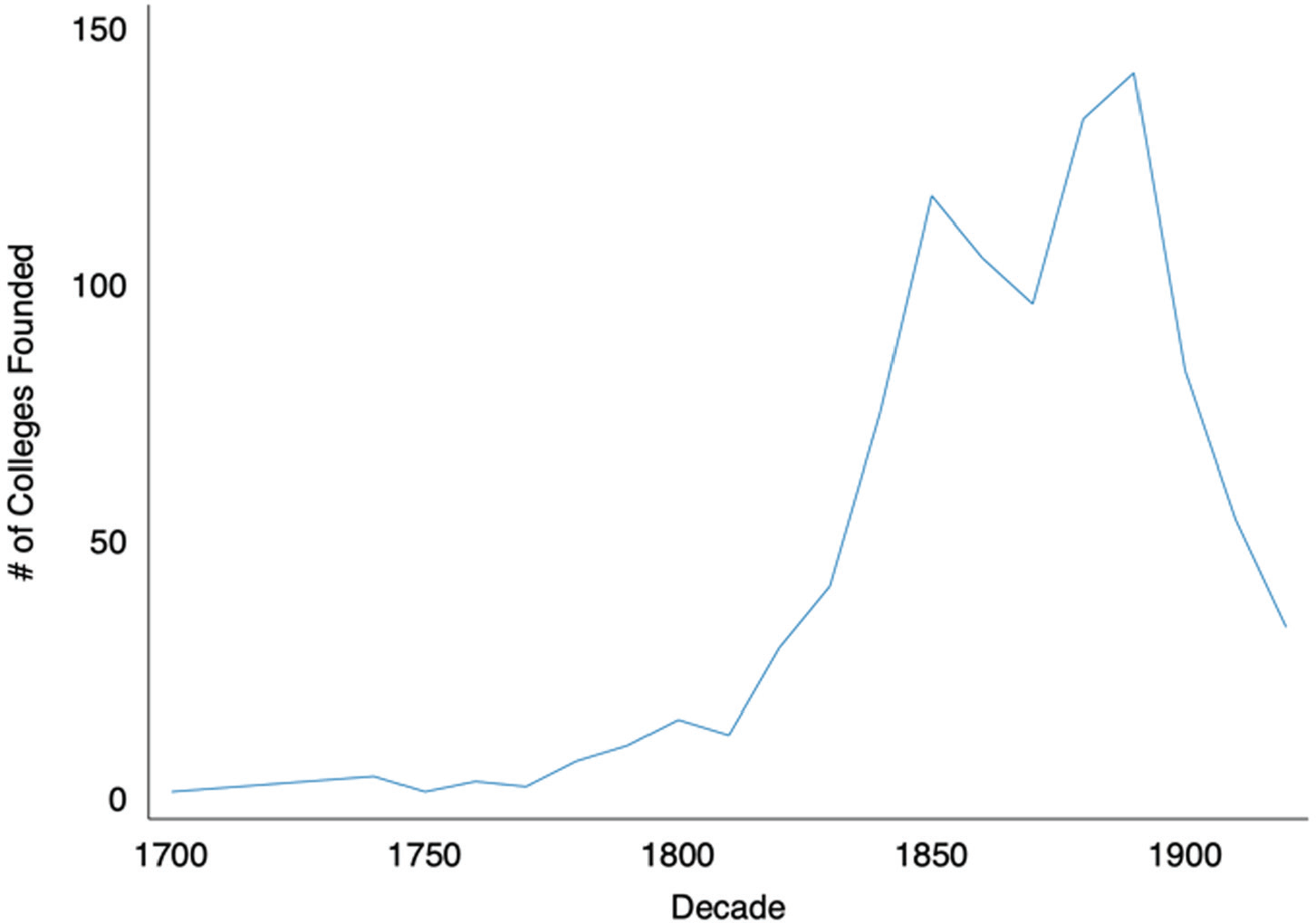
Denominational involvement in higher education continued and intensified in the nineteenth-century United States. Prior to the nineteenth century, the landscape of higher education was fairly static. Fewer than 50 institutions were founded between 1638 and 1819 compared to the period of accelerated expansion from 1850 to 1890, during which 60–80 institutions were founded annually. Using the data from the Report of Commissioner of Education in 1928 (U.S. Office of Education 1930), Figure 1 shows the remarkable rise in the number of colleges founded between 1850 and 1900. The growth in colleges vastly exceeded the growth in population, with a total of five colleges per million people in 1790, rising to 16 per million in 1880. By 1880, the United States had five times as many colleges as the entire continent of Europe, and nearly all colleges built during this time had affiliations with a specific denomination or church.
COLLEGE EXPANSION
Notes: The figure reports the number of surviving colleges built in each decade from the 1700s to the 1930s.
Source: The Report of Commissioner of Education for 1928 (U.S. Office of Education 1930).

COLLEGE EXPANSION BY INSTITUTIONAL TYPE
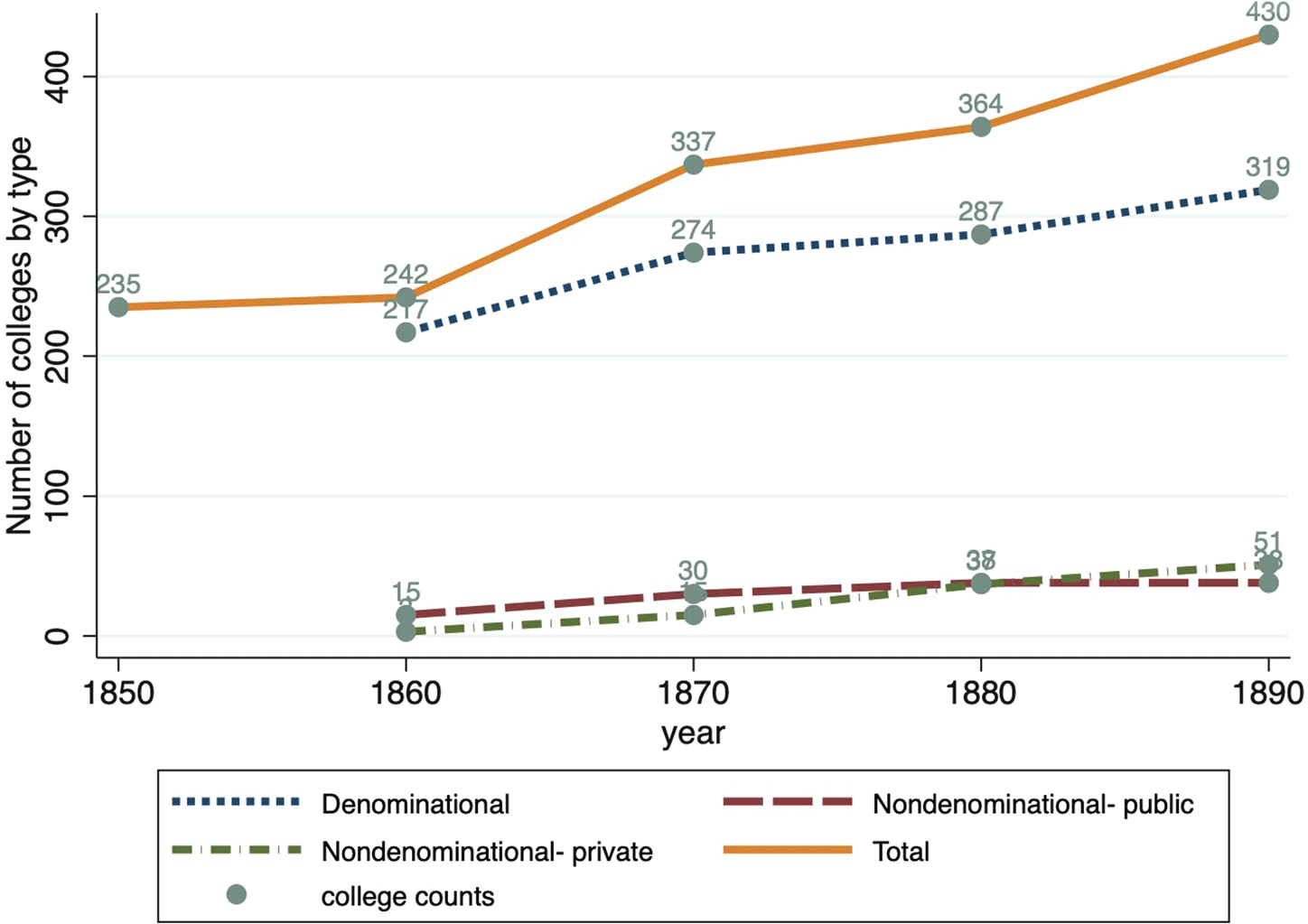
Source: Authors’ illustration. See Xiong and Zhao (2022).

Religious denominations played a vital role in procuring economic support for affiliated colleges. In some cases, a denomination motivated local donors. Potts (Reference Potts1971) stated that the official or verbal sanction from a religious organization legitimized the endeavor and encouraged local financial support. Since colleges founded in the early nineteenth century were located in rural towns far away from major population centers and recruited students from areas within a 50-mile radius (Church and Sedlak Reference Church and Sedlak1997), denominational influence on local economic support mattered.
In other cases, denominations played a more active role in university finances. They formed agencies and organizations that specialized in college fundraising. For instance, by order of the Indiana Conference (a Methodist society), all Methodist ministers in Indiana were agents for Indiana Asbury University, with the responsibility to “solicit funds, procure students, and collect what books the liberality of the public may bestow…” (Findlay Reference Findlay and Geiger2000, p. 118). The Indiana Conference even gave instructions to preachers for more effective solicitation.Footnote 12 The Baptist, Presbyterian, and Congregationalist societies had organizations analogous to those of the Methodists.Footnote 13 The denominational network became a financial resource and allowed institutions to secure resources beyond their immediate surroundings.
The ability to fundraise beyond a local network provided denominational colleges with a source of competitive advantage. This became especially true as access to formal credit markets was difficult given the nonprofit disposition of the projects. As a result, denominational colleges enjoyed a greater likelihood of survival. Ninety percent of Protestant colleges founded before 1860 survived the Civil War, while only 37 percent of nondenominational colleges and 74 percent of state colleges did (Burke Reference Burke1982). In the absence of a nondenominational source of funding, college leaders oriented their rhetoric toward the religious aspects of their institutions. Denominational affiliation became an existential necessity. The result was the unique American private college system controlled by denominational societies and bodies of laymen (Burke Reference Burke1982).
The deepening of denominational involvement in higher education occurred against the backdrop of an unprecedented increase in religious diversity in the United States. One contributing factor was the intense periods of Protestant religious revivals that took place in the early nineteenth century, commonly referred to as the Second Great Awakening. The movement introduced innovations such as camp meetings (an outdoor religious gathering usually held in a rural area), which helped to convert new parishioners. Active denominations such as the Baptist, Methodist, and Presbyterian churches grew into the dominant positions and saw a marked increase in their membership. Several new denominations, such as Seventh-day Adventists, Disciples of Christ, Church of Christ, etc., were born amid the Second Great Awakening.
These newer denominations entered the competition for higher education. In the 1810s, the three oldest denominations, Congregationalists, Episcopalians, and Presbyterians, were associated with 70 percent of all colleges; by the time of the Civil War, this share had dropped to one-third (Burke Reference Burke1982). Newer denominations, such as Methodists and Baptists, were affiliated with one-third of all colleges by 1860 (Johnson Reference Johnson2008). The drive was less out of the need to educate ministers and more from the concern about losing the allegiance of young men educated by rival denominations (Church and Sedlak Reference Church and Sedlak1997).
This tit-for-tat relationship is probably best illustrated by an example from Ohio:
Ohio Methodists chafed at Presbyterian control over the two nominally state universities, Ohio and Miami. Their response was to found Ohio Wesleyan College in 1842. The Brethren had eschewed colleges until they felt pressured into launching Otterbin in 1847. For the German Reformed Church, the long distance to their seminary in Mercersberg, Pennsylvania, was the decisive factor in starting Heidelberg College (1850). The founding of Antioch (1852) might be considered another variation on this theme. Liberal Christians, who opposed denominational distinctions, sought to found a nonsectarian college of a high rank (Geiger Reference Geiger and Geiger2000a, p. 143).
Denominational influence in higher education diminished following the end of the nineteenth century, after which industrial philanthropy took on a more prominent role in college development. Prior to the 1900s, nondenominational fundraising had been sporadic and unpredictable (Geiger Reference Geiger1997). Since the early twentieth century, educational fundraising has become more professionalized through organized advancement and development programs (Chan Reference Chan, Henry, Lavine, Stark and Hocker2016). Large-scale philanthropy and private donations from newly wealthy industrialists and their families crowded out the relative importance of denominational patronage. Substantial amounts of alumni donations also became, for the first time, a recurrent and reliable source of income (Geiger Reference Geiger1997). Consequently, the comparative advantage of denominational affiliation declined, and from the 1900s onward, many formerly religious institutions began undergoing a process of secularization.
DATA
To relate the extent of religious competition to the establishment of colleges, we combined three datasets on religious denominations, colleges, and students. In this section, we describe the data and introduce the sources.
RELIGIOUS COMPETITION
We begin by constructing a panel of religious fragmentation at the county level and its variation over time. This is our main explanatory variable. For this purpose, we consult historical information on religious bodies included in the decennial censuses conducted in 1850, 1860, 1870, and 1890. Although the U.S. Census began in 1790, the compilation of religious data did not begin until 1850. A balanced sample of 1,632 counties harmonized to 1850 boundaries is included in the panel analysis.
From 1850 to 1890, census enumerators gathered facts concerning the number of churches, their locations, and their seating accommodations. The information is broken down by denominational affiliation. In 1850, the census identified 18 principal denominations. To the best of our ability, we standardize denominational categories over time to account for differences in the granularity of definitions. Nevertheless, by 1890, there were 24 denominations, which reflected the religious growth and innovations that characterized the period. Online Appendix Table A2 reports the average and maximum share of denominational accommodation at the county level for each denomination.
The Baptists and Methodists dominated throughout the decades we focus on, representing over half of the religious share. They were followed by three distant competitors: Presbyterian, Episcopalian, and Congregationalist. Although these three enjoyed the prime status of state-supported religions in the colonial era, their influence waned as their authority passed. Lutherans and Catholics thrived as considerable flows of immigrants entered the country. However low in national popularity, the maximum number shows the possibility for almost any denomination to exercise control locally. The dynamics over the decades and across space created considerable variation in religious composition across counties and over time, making our panel analysis feasible.
To measure religious competition, we use church seating capacity as a proxy for market size. We compute denominational competition as 1 minus a Herfindahl-Hirschman index of the share of each denomination’s accommodations in total accommodations. Intuitively, this is a measure of market concentration, and the value is greater in counties where the religious market is less concentrated. Specifically, the denominational competition in county c is:
 $$DenomFractio{n_c} = 1 - {\sum _i}s_{ic}^2,$$
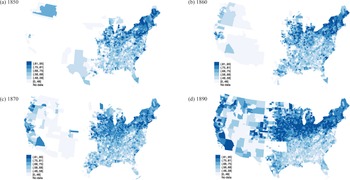
where s ic is the share of denomination i’s accommodations as a fraction of total church accommodations in county c. Figure 3 shows the spatial distribution of denominational competition from 1850 to 1890: it was high in the northeast and midwest but also in Gold Rush California and in frontier states such as Colorado. Beyond regional disparities, there were also sizable differences across counties in each state, allowing identification of within-state variation.Footnote 14
DENOMINATIONAL COMPETITION: 1850–1890
Notes: Panels a, b, c, and d map DenomFraction for each county in the corresponding decade.
Source: U.S census.

COLLEGE INFORMATION AND LOCATION
Compiling information from four sources, we build an original dataset of nineteenth-century U.S. colleges. In 1850, the U.S. Census recorded the number of colleges in each county. For 1860, we rely on enumerations of colleges by two historians. In his doctoral thesis, The Founding of American Colleges and Universities, Donald Tewksbury cataloged antebellum colleges from state legislatures and charters.Footnote 15 The list of permanent colleges was published in the thesis, but the list of failed colleges was lost. Permanent here means surviving to 1920; therefore, the Tewksbury colleges are a subset of all operational colleges in 1860.Footnote 16
To complete the list of colleges standing in 1860, we transcribed additional data from Burke (Reference Burke1982). His method of collecting data contrasts with that of Tewksbury. He utilized city registries, directories, and any proof of existence he could find. He then investigated whether a college actually taught collegiate courses and compiled those that did into a list.
Each entry contains detailed information for each college. Both authors emphasized the denominational affiliations of colleges and recorded them when they existed. Based on the union of colleges identified in the two sources, we construct and geocode an entirely new and comprehensive dataset of colleges along with information on their location, history, and denominational status. The data are then tabulated to provide county-level counts of colleges by 1860.
The Annual Report of Commissioners of Education (U.S. Office of Education 1870) has provided rather detailed information on colleges on an annual basis since the 1870s. In these reports, the commissioners conducted censuses of institutions of higher education on a voluntary basis through surveys. Extensive information was collected, including name, location, denomination affiliation, founding date, endowment, land value, library volume, enrollment, expenses, tuition and board. All the information was self-reported by each college. To address and mitigate problems associated with nonresponse, we interpolate missing data by filling in the information provided in adjacent years. Ultimately, we can assemble a fairly complete set of colleges for 1870 and 1890.
Figure 2 plots the total number of colleges in our compiled dataset from 1850 to 1890. We can identify denominational colleges from 1860 to 1890. We divide the category of nondenominational colleges into public and private. Between 1860 and 1890, the number of denominational colleges grew by more than 35 percent. The growth rate from 1870 onward is offset by the concurrent secularization of existing denominational colleges. The new colleges built in this time period were over-whelmingly denominational.
We further digitized reports from 1875, 1885, 1895, 1900, 1905, 1910, and 1914. From each report, we transcribed the name and location of each institution, total students, total faculty, total endowment, and, when available, enrollment of graduate students and academic majors. We linked colleges across these reports to track their growth during the second industrial revolution.
STUDENT MICRO DATA AND COLLEGE CHOICES
To the best of our knowledge, little is known about the demand side of colleges in the nineteenth century. Because of the lack of linked administrative data dating from this period, there is a scarcity of information on who attended colleges, their choice of school, and the factors determining those choices. We overcome this challenge and introduce a unique source of matched student college data to the literature.
We acquired a dataset on the Antebellum college students from Colin Burke. He surveyed a large array of related materials held in the Library of Congress, the libraries of almost all universities and colleges, alumni registers, yearbooks, and other archival records of the colleges. From the text of the individual biographies included in those documents, Burke extracted rich demographic information about the students and their educational paths.
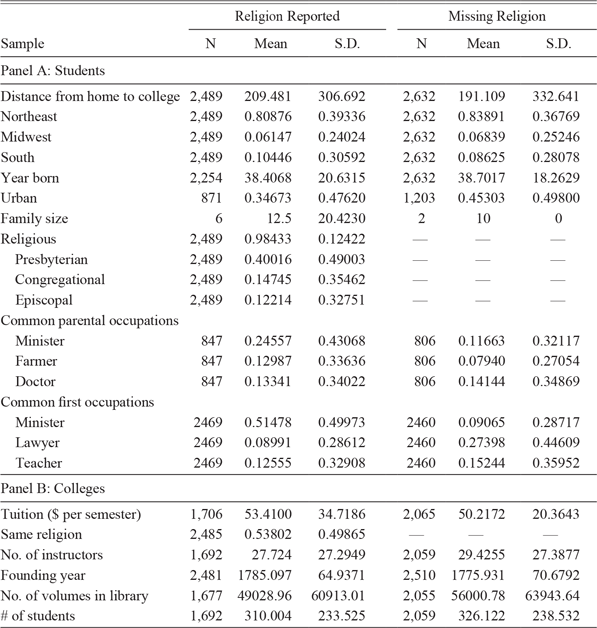
The dataset contains approximately 12,000 students. However, the amount of information available for each student varies. A complete entry with a full set of covariates includes a student’s name, hometown, college destination, denominational affiliation if known, occupation, and parental occupation. We make a sample restriction to exclude students without hometown information. Moreover, the original codebook was lost, so we had to reverse engineer the colleges attended by students by cross-referencing college zip codes with student rosters and other auxiliary information. Ultimately, we end up with approximately 5,000 students. Summary statistics of all students and colleges appearing in the sample are provided in Table 6.
The first observation of interest is that students on average traveled a relatively short distance, 200 kilometers, from their hometown to attend college. This reinforces the notion that colleges served local and isolated markets. Therefore, it is sensible to consider a county as the relevant market definition and the within-county variation in religious competition as the pertinent demand factor. This substantiates the county-level analysis in the following section.
Second, we see that the tuition charged by colleges was relatively low. Higher education in the nineteenth century, even among elite institutions, is best characterized as a buyer’s market. The pool of applicants was small, and admission was not competitive. Colleges such as Columbia and Harvard regularly struggled to fill their fall classes and advertised steadily to do so through August or September, just days from the semester’s start.Footnote 17 The strong competitive forces exerted downward pressure on tuition.
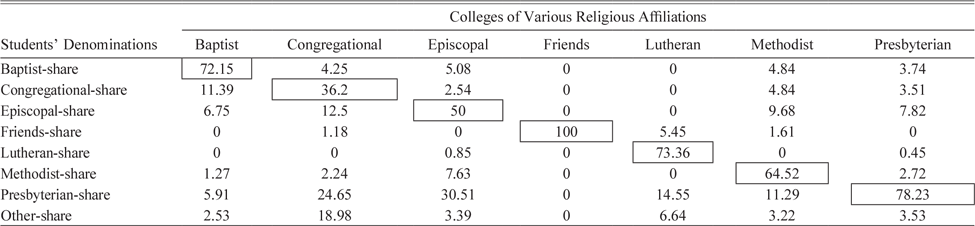
Finally, we observe that ministry was a popular occupation choice, which was an important underlying demand for attending colleges of matching denominations. While the majority of students attended same-denomination colleges, cross-denomination enrollment was nontrivial (see Table 7). This suggests, that consistent with our reading of the historical narratives and school charters, denominational fit or compliance was rarely, if ever, a de facto requirement for admission or attendance.
HISTORICAL CONTROLS
We gather county economic and demographic characteristics covering the period 1850–1890 from the U.S. Census. Haines (2010) provides decadal, county-level data on manufacturing, and agricultural production as well as migration and demographic information for each county from the Census of Population, the Census of Agriculture, and the Census of Manufactures. Transportation data comes from Atack (Reference Atack2013), which are linked with shape files of United States county boundaries to account for the spread of railroads.
To control for internal migration and immigration, the share of foreign-born and out-of-state population are calculated from the full count micro data released by IPUMS. We further construct a fragmentation measure for immigrants’ countries of origin. To control for education levels, we calculate the share of the literate population and total school attendance for children under the age of 14 from the full count micro data released by IPUMS.Footnote 18
To show that a higher level of innovation is not a mediator to college establishment, we control for average yearly patents in the previous decade. For instance, in the census year 1850, we control for the average yearly patents from 1841 to 1850. The historical patent data comes from Petralia, Balland, and Rigby (Reference Petralia, Balland and Rigby2016).
We further control the KOL union as a placebo civil society related to industrialization. The earliest KOL union was founded in Philadelphia in 1869. By 1890, there had been 10,886 assemblies founded in 166 counties and 49 states. The information on each KOL assembly was gathered by Garlock (2009), and the county location was assigned by Bittarello (Reference Bittarello2019). Based on their work, we count the number of KOL unions at the county level in each census year.
Denominations and Supply of Colleges
Before turning to the main empirical analysis, we document the patterns of denominational college building, which are central to our research design. Using the cross section of colleges in 1860, we analyze the determinants of denominational affiliation. In particular, we examine whether the affiliation decisions were strategic, that is, if they responded to local demand factors.
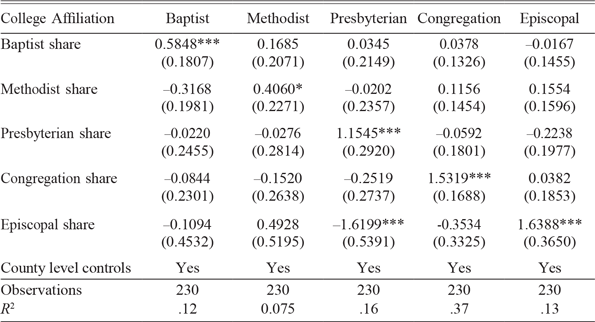
Table 1 shows that the denominational composition within a county plays a significant role in driving the observed supply. We provide results for the six denominations that had the largest total accommodations. A unit of observation is a college in 1860. The table presents an OLS regression of a dummy for whether a college is affiliated with a certain denomination (Baptist in Column (1), Methodist in Column (2), Presbyterian in Column (3), etc.) on the market shares of those denominations while including geographic and socioeconomic controls. Given the construction of the dependent variable, the coefficient can be interpreted as the marginal effect of a denomination’s market share on the likelihood of a college’s affiliation with the denomination, conditional on the existence of a college.
EFFECT OF RELIGIOUS SHARE ON COLLEGE’S DENOMINATIONAL CHOICE

Notes: The table reports linear estimates where the unit of observation is a college in 1860. Dependent variables are dummy variables that take a value of 1 when a college chooses denominational affiliation to be Baptist, Methodist, Presbyterian, Congregation, Episcopal, and Christian, respectively. Religious share of each of the six denominations in the county that the college were located are included, with share of own denomination as variable of interest. We control for a set of county level social economic conditions: total denominational accommodations, population, foreign population ratio, manufacturing output, and a dummy for railroad access.
Source: See Section Data for details on data construction.
We find that the probability that a college affiliates with a certain denomination increases with the market share of that denomination. For instance, the larger the Baptist share of denominational accommodations in a county, the more likely a college’s affiliation is Baptist. Methodist and Presbyterian denominations exhibit the same pattern. The estimated coefficient for the Episcopalian share on college affiliation is the largest among the six, with an elasticity of over one. This implies that a 10 percentage point increase in the Episcopalian share increases the likelihood of an Episcopalian affiliation by 16 percentage points.
The results can be rationalized by a standard model of entry and competition where the profitability and survival of a college depend on whether enough students can be recruited locally. Under the assumption that a student derives higher utility from enrolling in a college that matches his or her own denomination and dislikes traveling long distances, a college’s likelihood of adopting a denomination should increase with its share of the local population. This provides preliminary evidence regarding the salience of affiliation choices.
We also show that denominational influence in higher education declined following the end of the nineteenth century. Online Appendix Figure A5 illustrates that the number of colleges founded as nondenominational institutions and the rate of secularization among previously denominational institutions rose sharply from 1890 onward.
PANEL ANALYSIS
This section explores the relationship between religious fragmentation and college establishments through OLS estimation in the panel framework. We exploit the extent to which religious fragmentation varies at different points in time to investigate the effect of changes in religious diversity on changes in the number of colleges. A discussion of endogeneity concerns and their corresponding robustness checks is presented following the main results.
Main Results
To identify the effect of religious fragmentation, we employ a two-way fixed-effects strategy. Our sample consists of a balanced panel of counties that we observe across four decades, from 1850 to 1890. To accommodate changes in boundary definitions over time, we harmonize the data according to the 1850 county boundaries.Footnote 19 Our dependent variable is the number of colleges in the inverse hyperbolic sine transformation, as it approximates the natural logarithm of colleges and allows retaining zero-valued observations. Our dataset contains 6,485 observations and 1,626 unique counties.Footnote 20
We estimate the following regression:

where subscripts c, s, and t index the county, state, and decade, respectively; the outcome is the total number of colleges in Inverse Hyperbolic Sine (IHS) transformation; DenomFraction is the constructed Herfindahl index of denominational competition; Denom jct are denomination fixed effects equaling 1 if denomination j had at least 1 church in county c in decade t; δ c and δ t are a set of county and decadal fixed effects; θ st are state year fixed effects; X ct is a vector of time-varying controls; and ct is an error term. The coefficient of interest, β, captures the relationship between denominational diversity and college counts. A positive β provides evidence that religious competition leads to more college establishments.
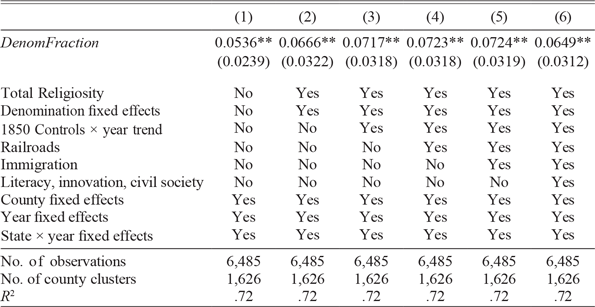
Table 2 presents the estimation results from several different specifications of controls. Column (1) reports the baseline model, including only county, decade, and state-year fixed effects. The inclusion of county fixed effects allows us to flexibly address unobservables that affect settlement patterns for both denominations and colleges that are time-invariant and geographically fixed. This is intended to capture sharp regional differences in habitability, the availability of public funds, social structure (the practice of slavery), and some degrees of cultural attitude. The decadal fixed effects, on the other hand, capture the national trend in collegiate development. State-year fixed effects allow each state to have varying responses to religious diversity or a varying trend in collegiate development. In the remaining columns, we successively expand the set of controls included. Throughout all specifications, we cluster standard errors at the county level to account for spatial auto-correlation over time. Replication files for Table 2 and the following results are available from Xiong and Zhao (2022).
EFFECT OF RELIGIOUS RIVALRY ON COLLEGE FOUNDING: PANEL ESTIMATES

* = Significant at the 10 percent level.
** = Significant at the 5 percent level.
*** = Significant at the 1 percent level.
Notes: The table reports arcsinh-linear estimates where the unit of observation is a county-decade pair. DenomFraction is our constructed Herfindahl Index of denominational competition that equals 1 − ΣAccommodation 2j, where Accommodation j defines the seating share of denomination j in county c. Time varying county-level controls include total religiosity measured by total sitting capacity in churches, fixed effect of every denomination, access to railroads, miles of railroads, share of foreign-born, ethnic fragmentation for foreign-born, literacy rate, total school attendance between ages 6–13 in logarithm, average annual patents, number of KOL unions. 1850 controls include population in logarithm, urban/male/aged 5 to 18/white/foreign population share, manufacturing output/employment/investment. Standard errors are clustered at the county-level.
Source: See Section Data for details on data construction.
Column (2) includes denominational fixed effects and total religiosity. Christian denominations vary in their attitudes toward higher education, and some denominations were more inclined toward investment in human capital than others (Finke and Stark 1989; Iannaccone Reference Iannaccone1994). For instance, the Catholicism fixed effect addresses the concern that the Catholic Church tends to build more colleges. Because of this, we use denomination fixed effects γ j to account for the influence of specific denominations.
We also address overall religiosity by controlling for total church accommodation TotalDenom ct . By including these fixed effects and controls, our coefficient on religious fragmentation is identified only from variation in the composition of religious bodies as opposed to the presence of any single denomination or the intensity of religiosity. Column
(2) shows the estimates with total accommodation and denomination fixed effects.
We expanded controls in Column (3) by adding 1850 demographic characteristics that interacted with a year-trend. In doing so, we account for the possibility that counties prone to building colleges may have started with more favorable demographic or industrialization conditions. Included in the 1850 controls are demographic characteristics (population in logarithm, the share of the population that was urban, male, aged 5 to 18, white, and foreign) and industrialization measures (manufacturing output, employment, and investment).
In Column (4), we control for miles of railroads and an indicator variable for having a railroad. Railroad construction in the United States increased dramatically in the late nineteenth century. Controlling rail-road access is especially important now that the growth of transportation networks has significant implications for urbanization and economic development. In particular, many sources of anecdotal evidence have suggested that having a railroad connection was a key factor considered when college founders selected candidate locations.
Next, we add controls related to immigration. Immigrants, especially their cultural fragmentation, can be a source of religious diversity. In addition to the share of foreign-born, we also include an inverse Herfindahl index on foreign-born countries, EthinicityFraction, to show that the effect of religious fragmentation is not driven by diverse immigration sources. We follow methods in Ager and Brückner (Reference Ager and Brückner2013) to group countries of similar cultural backgrounds.Footnote 21 Column (5) shows the coefficient on DenomFraction is 0.0724 with immigration controls.
Finally, in Column (6), we add measures for basic education, innovation, and civil society. Each element can contribute to college founding through increasing demand for higher learning. We measure levels of basic education by controlling for literacy rate and total school attendance for children under 14. There is substantial evidence documenting the relationship between Protestantism and elementary education. While the literacy rate positively correlates with colleges, the coefficient on religious fragmentation remains robust. Although Protestant religiosity relates to basic levels of education, we show that religious fragmentation does not.
Counties with a tolerance for religious diversity may attract a more innovative population. To show that a higher level of innovation is not a mediator to college establishment, we control for average yearly patents in the previous decade. Consistent with recent work by Andrews (forth-coming), we do not find that patent growth preceded college founding.
Even though we control for county and state-year fixed effects, one might still worry that religiously diverse counties generally set up more organizations. For example, counties that became population magnets and industrial clusters could have been better suited for college sites and built more churches and civil societies. To alleviate this concern, we control a particular civil society that was closely tied to industrial communities at the time: the KOL union. Founded in 1869, KOL was a prominent national labor organization that expanded quickly in the late nineteenth century. They were a precursor to modern labor unions comprised of industrial workers, and their presence serves as a useful proxy for both industrialization as well as the existence of civic institutions. We find that controlling for the counts of KOL assemblies does not crowd out the effect of religious fragmentation.
With the full set of controls, the coefficient on denominational fragmentation is 0.0649, significant at the 5 percent level. The Inverse Hyperbolic Sine transformation of colleges allows mathematical computation on elasticity (see Bellemare and Wichman (Reference Bellemare and Wichman2020)). The estimated elasticity at the mean value of our dependent variable is 0.22. To put this effect size into context, we consider the counterfactual where the United States had only a single denomination; our estimates imply that there would have been approximately 22 percent fewer colleges in the complete absence of denominational diversity. In conclusion, we find a large, positive, and robust relationship between denominational fractionalization and the growth of operating colleges exists. Because our estimate is based on within-sample variation from 1850 to 1890, to the extent that college building in 1850 already reflected prior denominational fragmentation, this will understate the overall historical impact of religious competition.
Robustness and Additional Results
RESULTS ON ENROLLMENT AND TOTAL FACULTY
While our hypothesis predicts that denominational competition expanded the supply of colleges, it is unclear whether more colleges translated into a greater provision of human capital. The entry of a new college may not increase educational output if it only diverts existing students from incumbent colleges. To see whether these effects are meaningful, we estimate our panel regression on the number of students and faculty. Table 4 shows that denominational diversity increased total student enrollment and the number of faculty. This suggests that the educational access provided by additional colleges outweighed any diversionary effects there may have been.
HORSERACE AMONG VARIOUS DIVERSITY INDEXES

* = Significant at the 10 percent level.
** = Significant at the 5 percent level.
*** = Significant at the 1 percent level.
The table reports arcsinh-linear regression of the effect of religious competition on total colleges. Each unit of observation is a county-decade pair. Coefficient of DenomFraction is reported. Baseline controls include county fixed effects, year fixed effect, state by year fixed effects. Standard errors are clustered at the county-level.
Source: See Section Data for details on data construction.
EFFECT OF RELIGIOUS RIVALRY ON TOTAL ENROLLMENT AND FACULTY: PANEL ESTIMATES

* = Significant at the 10 percent level.
** = Significant at the 5 percent level.
*** = Significant at the 1 percent level.
Notes: The table reports a log-linear regression of the effect of religious competition on total student enrollment and the number of faculty. Each unit of observation is a county-decade pair. Coefficient of DenomFraction is reported. Baseline controls include county fixed effects, year fixed effect, state by year fixed effects. Full controls further include total religiosity measured by total sitting capacity in churches, fixed effect of every denomination, access to railroads, miles of railroads, literacy rate, total school attendance between ages 6–13 in logarithm, average annual patents, number of KOL unions, and 1850 controls times year fixed effects, where 1850 controls are population in logarithm, urban/male/aged 5 to 18/white/foreign population share, manufacturing output/employment/investment. Counts on enrollment and faculty are not available in 1860. We impute them by multiplying the number of colleges in 1860 with the enrollment/faculty per college averaged between 1850 and 1870. Standard errors are clustered at the county-level.
Source: See Section Data for details on data construction.
HORSE RACE REGRESSIONS BETWEEN VARIOUS DIVERSITY INDICES
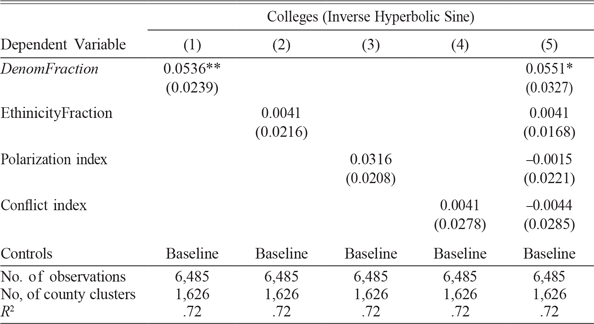
Although the effect of denominational fragmentation is robust to social-economic controls, regional differences, and time trends, it can still be correlated with other types of diversity. To show that only denominational fragmentation explains college founding, we conduct horse race regressions that test denominational fragmentation against ethnicity fragmentation, denominational polarization, and polarization between Catholicism and Protestantism.Footnote 22 Table 3 shows the result of these regressions among the four indices. Columns (1)–(4) show that none of the other indices are significant predictors when included in a regression with denominational fragmentation. Finally, Column (5) stacks all indices in a single regression and confirms that the coefficient on denominational fragmentation remains consistent.
ROBUSTNESS
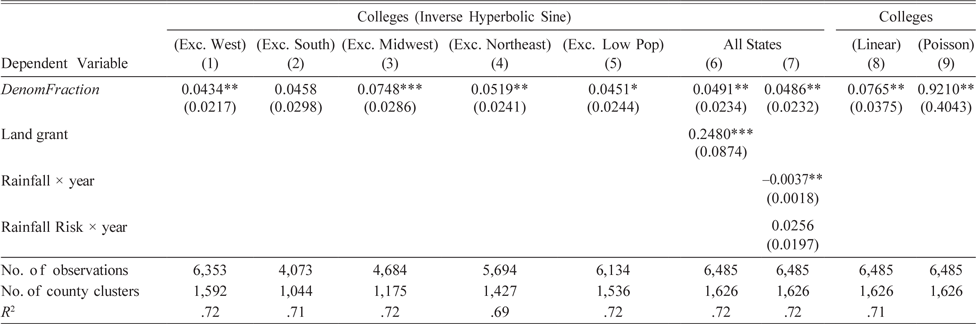
We further explore the robustness in Table 5. To address concerns that any particular region drives the findings, we also estimate our main models while dropping individual regions: the Western Territories, the South, the Midwest, and the East. Columns (1)–(4) of Table 5 presents the results for this set of robustness exercises. The results are qualitatively similar across all subsamples. We take the robustness of the positive relationship across the different models for both outcomes and samples to be compelling evidence that our estimated impacts are not driven by any particular group of states but rather reflect a general pattern.
ROBUSTNESS ESTIMATES WITH BASELINE MODEL

* = Significant at the 10 percent level.
** = Significant at the 5 percent level.
*** = Significant at the 1 percent level.
Notes: The table reports estimates with baseline controls: county fixed effects, year fixed effect, and state by year fixed effects. Columns (1)–(7) report arcsinh-linear regression of the effect of religious competition on colleges, Column (7) reports linear regression, and Column (8) reports Poisson regression. Column (1) drops states that were territories in 1850, Column (2) drops southern states, Column (3) drops midwestern states, Column (4) drops northeastern states, and Column (5) drops states with population smaller than 1,000 in 1850. Standard errors are clustered at the county-level.
Source: See Section Data for details on data construction.
In Columns (6) and (7), we address two additional competing stories. We control land-grant universities and show that the establishment of public universities does not undermine the forces of denominational diversity. Because Ager and Ciccone (Reference Ager and Ciccone2018) show that religious membership in the nineteenth-century United States was more widespread in counties where agricultural risk was higher, we also control for rainfall risk.Footnote 23
Finally, in Columns (8) and (9), we estimate linear and Poisson models using the number of colleges as the outcome variable. The results are significant at the 5 percent level and qualitatively similar to our main specifications.
SOURCES OF RELIGIOUS DIVERSITY
What drives the underlying variation in denominational fragmentation? Fundamentally, whether we can interpret our estimates as causal or merely correlational depends on the answer. An unfortunate shortcoming of our research design is the lack of transparency with regard to what explains the variation in our explanatory variable. Religious diversity is certainly an endogenous outcome of a complex set of historical processes. Although we control for correlates to the best of our ability, the issue of joint determination in our research question is of critical concern. The remaining unobserved characteristics are serious threats because they might bias, or in the worst case, invalidate, the hypothesized relationship between religious diversity and higher education.Footnote 24
In this section, as an attempt to resolve these latent ambiguities and provide more context to our analysis, we discuss two historical forces that shaped religious fragmentation, which then in turn facilitated the growth of higher education.
Second Great Awakening
Unlike most established countries at the time, historically, the United States did not have a state-sponsored religion. Hence, religious proselytizing began in the colonial period and accelerated after independence, rising to a fever pitch during the Second Great Awakening. During this period, membership in evangelical denominations grew twice as rapidly as population growth (Finke and Stark Reference Finke and Stark1992), and newer denominations also found opportunities to enter the market.
The Second Great Awakening was characterized by numerous revival meetings, whether they were the orderly preaching organized by the Formalists or the ecstatic camp meetings set up by the Anti-Formalists.Footnote 25 The revival events reshuffled the local religious composition and gave rise to entirely new denominations.
We combine data on revival activity and colleges in order to examine the relationship between them. Our data on revivalism come from Hammond (2007), who collected information from religious newspapers on religious revivals in New York and Ohio between 1825 and 1835.Footnote 26
Hence, our empirical analysis is confined to a decade-long period in these two states. However, this choice of time and location is not arbitrary. Ohio and New York, especially upstate New York, were particularly important regions during the Second Great Awakening.Footnote 27
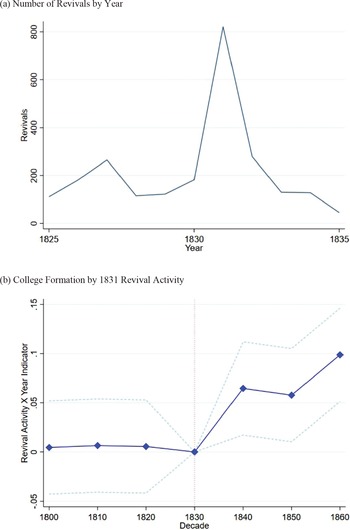
Online Appendix Figure A3 illustrates the yearly trend in revival activity by the total number of revival events and the number of people converted. The graph shows a significant spike in activity in 1831, during which the influential Rochester Revival occurred. The Rochester Revival is considered a significant point in the narrative history of the Second Great Awakening. This particular revival, organized by Pastor Charles Finney, was noted for introducing several innovations into revival practices and inspiring zeal in nearby towns when revival activity reached its arguable zenith. It led to an unprecedented level of revival activity across the two states. This is confirmed in the data, where we observe that revival activity peaked in New York and Ohio during that year, both in terms of the number of revivals and the geographic spread of revival activity.
Therefore, the year 1831 represents a major shock in the flow of revival activities. Motivated by this, we look at the process of college building before and after 1831 in towns that experienced this revival shock versus those that did not. This is implemented via a generalized difference-in-differences strategy, where we compare changes in the number of colleges built by the decade in towns that had a high level of revival activity with towns that did not have a lot of revival activity.
Figure 4 visually summarizes these results by plotting coefficients from a dynamic specification in which we interacted high 1831 revivals with decadal indicators. We define high revival activity as towns belonging in the 95th percentile of the number of revivals in their respective state. In accordance with the idea that revivals led to college growth, we observe that towns that experienced more revival activity in 1831 developed a significantly greater number of colleges in subsequent decades. These patterns are consistent with the idea that religious revivals in 1831 led to collegiate development. Given that revival activities shifted the religious composition of local towns and led to the formation of new denominations, this underscores our main hypothesized relationship.
REVIVALISM ACTIVITY AND COLLEGE GROWTH ACROSS TIME
Notes: Panels (a) and (b) present the trend of revival activity measured by total number of revival meetings, total number of converts, and total number of affected counties, respectively.
Source: Authors’ illustration. See Xiong and Zhao (2022).

Denominational Splits
Another source of variation in denominational fragmentation comes from divisions within extant denominations. Historically, churches could split into multiple branches when there were disputes over religious issues or theological topics. The history of Yale College best illustrates this type of split: after orthodox churches in Connecticut had separated themselves from their sister churches in Massachusetts, Connecticut refused ministers who graduated from Harvard. The subsequent founding of Yale, as some evidence suggested, was to supply orthodox ministers to Connecticut churches (Tewksbury Reference Tewksbury1932).
In the nineteenth-century United States, religious fault lines were often associated with the church’s official position and stance on the issue of slavery.
Within the Methodist denomination, these divisions manifested themselves in the formation of the Methodist Episcopal Church-South (MEC-S), which broke from the mainline Methodist Episcopal Church in 1844. Historical evidence suggests that this splintering led directly to the formation of new colleges. Motivated by the desire to train ministers, the Methodist Episcopal Church-South would go on to found several institutions of higher education, including Vanderbilt University, Asbury University, Paine College, Oklahoma City University, Central College, Southern Methodist University, and Texas Wesleyan University.Footnote 28
During the same time period, additional splits from the Methodist Church also occurred. For instance, the African Methodist Episcopal Church and the Colored Methodist Episcopal Church were formed in 1816 and 1870, respectively. These predominantly African-American congregations also founded new institutions of higher education that include Allen University, Miles College, and Lane College.
This is not to suggest, however, that these denominational divisions were exclusively a Methodist phenomenon. Similar offshoots were also common in other large denominations such as Baptist, Presbyterian, and Congregationalist churches.
While it is beyond the scope of this paper to document all denominational splits that took place, these specific anecdotes suggest that denominational divisions often precipitated the need for new collegiate institutions. As a result, the formation of new denominations accompanied the growth of higher education.
STUDENT PREFERENCES AND SCHOOL CHOICE
In this section, we attempt to provide some evidence of the potential mechanisms that underlie these findings. We regard the denominational affiliation of a college as a product characteristic and a strategic choice by the school. This dimension of horizontal differentiation allows universities to exactly cater to the preferences of consumers. To the degree that the underlying taste in the population is heterogeneous, this will be reflected in the increased provision of varieties within a decentralized market. Colleges can avoid competing on price by maximally differentiating themselves along the religious spectrum. Importantly, the gains from differentiation from these standard Hotelling channels allow for a greater number of entrants to be sustained in equilibrium. This intuition can be formalized in models akin to Seim (Reference Seim2001) and Gentzkow, Shapiro, and Sinkinson (Reference Gentzkow, Shapiro and Sinkinson2011).
The fundamental assumptions central to this demand-driven explanation are that (1) colleges serve local markets and (2) consumers exhibit a preference for schools with denominational affiliations that match their own. We assess the strength of these assumptions and the preference for religious homophily by estimating an empirical model of school choice. In other words, we attempt to answer the question: Did students actually prefer to go to colleges affiliated with the same denomination as their own?
For this purpose, we utilize a sample of linked nineteenth-century student-college data where college choice and student demographics are jointly observed. The sources of these data are described in detail in the Data section. It contains rich demographic information about the students, and we merge college characteristics from the Reports to the Commissioner of Education (U.S. Office of Education 1870).
Our sample consists of students who attended undergraduate institutions and whose hometown was observed. This sample restriction provides the minimum information required to calculate the distance students traveled to attend their respective colleges of choice.
We measure students’ preference to attend schools with the same denomination by estimating a discrete choice demand model that uses college choices, along with data on each student, to estimate preferences for school characteristics and how they vary in the population. The empirical model is the familiar conditional Logit framework for discrete choice described in McFadden (Reference McFadden1974), applied to a setting in which students choose the college to attend (Hastings, Kane, and Staiger Reference Hastings, Kane and Staiger2005).
The framework is based on the expected utility framework, where students derive utility from attending colleges. Let U ij be the expected utility of individual i from attending school j. Then, we suppose that student i chooses school j because it maximizes his or her utility over all possible schools in the choice set:

where U ij represents utility over a vector. We assume that it is a linear function of observed student and school characteristics, X ij, plus an unobserved component, ε ij, that reflects the unobserved idiosyncratic preference of student i for school j:

We assume that the unobservable component, ε ij, is distributed i.i.d. extreme value type I, which yields the usual Logit form for the conditional choice probabilities and allows us to recover the utility parameters.
Several variables comprise the baseline X ij vector, starting with an indicator variable for whether the denomination of the college matches the denomination of the student. We are particularly interested in the coefficient of this variable. It reflects the marginal likelihood of attending a school attributed to the religious conformity between the student and the school. Also X ij contains other alternative-specific characteristics, such as the distance from home to the college (in km), tuition charged by the school (quoted in per-semester figures), the size of the school in terms
of total enrollment, and the quality of the school as measured by faculty size, the volume of books in the library, and the founding date of the college. We also estimate alternative specifications where we include additional fixed effects. First, we include county-origin fixed effects. This is a flexible way of controlling for unobservable characteristics related to the student that correlate with the place of origin. Second, we also include county-of-college fixed effects, which are a proxy for the unobserved labor market conditions or career opportunities at the location of the college and could have driven admission.
We conduct our analysis on two samples of students: (1) the subsample of students whose denominational backgrounds were recorded and (2) the full sample of students, including those with missing denominational information. The first sample is a selected sample of the entire population. From the summary statistics shown in Table 6, this group of students differs on several key observable characteristics from the overall population of students. Thus, the estimates based on this group are likely not representative of the true preference parameters and are more akin to an upper bound. With the full sample of students, we can conservatively assume that every student whose denomination information was not recorded is nonreligious and did not attend a college of their own denomination. This biases the results against our expectations and provides a conservative lower bound on the religious preference of the overall student population. The baseline estimates are reported in Table 8. In the first two columns, we consider the full sample of students. In the subsequent specifications, we include only students whose religious affiliation was provided.
STUDENT MICRO-DATA SUMMARY STATISTICS

Notes: Panel A provides descriptive statistics for two samples of students from our student-college linked data. We report separately the mean and standard deviation of students whose religious affiliation was available and students whose religious information was missing. Panel B provides the summary statistics of colleges attended by all students in our sample.
Source: See Section Data for details on data construction.
RELIGIOUS DISTRIBUTION OF STUDENTS

Notes: Using our student-college linked data, this table reports the religious distribution of students for colleges of different religious affiliations. Boxed cells are the share of students whose own denomination matches their college’s denomination.
Source: See Section Data for details on data construction.
COLLEGE CHOICE, CONDITIONAL LOGIT COEFFICIENTS

* = Significant at the 10 percent level.
** = Significant at the 5 percent level.
*** = Significant at the 1 percent level.
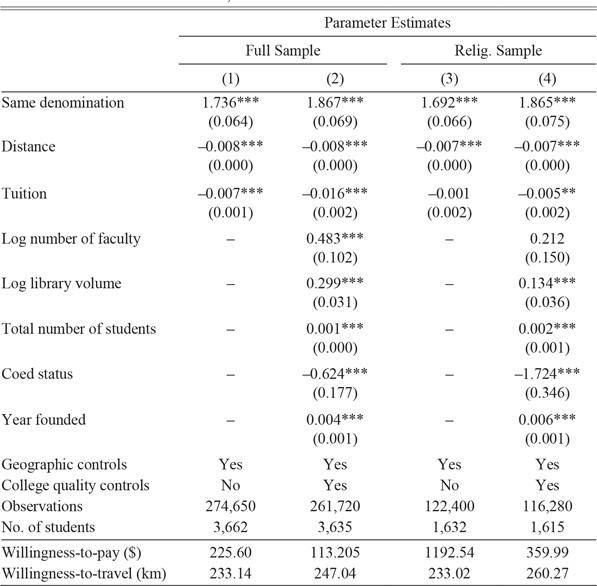
This table shows results from estimating the conditional Logit model discussed in Student Preferences and School Choice, with standard errors clustered at the county of home level. In Columns (1) and (2), the sample consists of student-college linked observations where the denomination of student is observed. Columns (3) and (4) include all student-college linked pairs, and the denomination of the student is imputed to be 0 if it is missing. Geographic controls are state fixed effects and a college’s latitude and longitude. College quality includes characteristics such as the number of faculty, volume of books in the library, years since establishment, coeducational status, etc.
Source: See Section Data for details on data construction.
The coefficient on the indicator variable for a college being affiliated with the same denomination as the student is consistently positive and robust across different specifications. This indicates that a college having the same denominational affiliation as the student is associated with an increase in the probability of the student choosing the college, conditional on other attributes.
Other coefficients retain the expected signs: students are more likely to choose colleges that are closer to their homes, charge less tuition, and are of higher quality (we proxy for institutional quality based on establishment date, total faculty, and volume of books in the library).
Comparing estimates between the two samples of students, we see that most coefficients are similar. Interestingly, however, the tuition coefficient diminished significantly for the sample of students whose religious denomination was stated. This indicates that tuition was much less predictive of attendance for religiously inclined and devoted students, suggesting that this group of students was less price sensitive.
Coefficient estimates in these models do not have a direct interpretation in terms of magnitude, but the relative size of the coefficients is informative. We derive the marginal willingness-to-pay (WTP) as a ratio of the coefficient of the non-price attribute of interest to the coefficient of the marginal price or tuition.Footnote 29
Intuitively, this WTP represents the marginal dollar value that a student is willing to spend per semester to attend a college that is affiliated with the same denomination as his or her own. Similarly, we derive the marginal willingness-to-travel (WTT) as the ratio of the non-distance variable to the coefficient on the distance from home to school. This is interpreted as the additional kilometers a student is willing to travel for the corresponding feature.
For our sample of students, we find that in terms of both WTP and WTT, school denomination is a valued amenity. Based on conservative estimates from the full sample, students on average have a marginal WTP of $113–$225 per year for attending a college with an affiliation identical to their own. Analogously, students were willing to travel up to 233–247 kilometers further to attend a college with a matching denomination (240 kilometers is approximately the distance from Chicago, Illinois, to Madison, Wisconsin). These figures are large given that the average payment and distance traveled to colleges were only $59 and 210 kilometers, respectively.
Evidently, students derived high utility from attending colleges with affiliations matching their personal denominations. Denominational affiliation was a significant consideration in determining college choice. This implies that there were substantial returns or gains on the part of colleges from establishing denominationally specific colleges to cater to each denomination, and consequently, the entry of colleges would be increasing the diversity of denominations. The strong revealed preferences for same-denomination schools suggest high returns to religious differentiation on the part of the college.
One limitation regarding our data is that our sample mainly consists of students from the Northeast region (New England in particular), therefore it is not nationally representative, and the extent to which our results generalize to the overall student population remains uncertain.
Nevertheless, we contend that the effect of religious competition on the market structure of higher education is at least partially explained by the availability of religion as a dimension of product differentiation.
CONCLUSION
The United States is unique in its absence of state-sponsored religions and, consequently, the proliferation of religious denominations and factions in the nineteenth century. In this paper, we examine an unintended consequence of religious diversity on the market provision for higher education. We built a new database of nineteenth-century colleges and documented that nearly all private colleges had denominational roots. Combining this with census data, we provide county-level evidence that competition within Christian denominations increased the number of colleges. We argue that horizontal differentiation along denominational affiliation helped private colleges survive, and we tested key assumptions with student micro data.
We make progress toward causality by addressing several competing explanations and incorporating a wide variety of controls. We also show that going from below to above the median denominational diversity coincided with the timing of college establishments. Our results are further corroborated by two historical case studies: the Second Great Awakening and divisions within the Methodist Church. In both cases, the quantitative and narrative evidence support the notion that religious diversity precipitated the growth of higher education.
There is broad consensus among policymakers and researchers alike that universities play a significant role in economic development. At a cross-country level, an exceptional aspect of the contemporary United States is the strength of its higher education system, in terms of both the quantity of schools and the quality of those institutions. While the results in this paper pertain only to the supply of private denominational colleges, we contend that this historical episode laid the foundation for the success of American higher education.
The “knowledge” industry remains, to this day, a key feature of “American Exceptionalism.” U.S. universities dominate global rankings: its top private research universities accumulate considerable wealth, attract talented students and faculty from abroad, and set the world’s highest academic standards. This productive system is in part a consequence of unique circumstances in the nineteenth century: the absence of state-sponsored religion and the proliferation of Christian denominations. The relationship between religion and education is rich and nuanced, and our findings contribute to the understanding of this complex relationship in a setting with strong market forces and a divided church.