Implications
Concomitant with the dynamic and dramatic improvements in growth rate, body size, breast yield and feed conversion by intense genetic selection, muscle abnormalities or myopathies have begun to appear, which adversely affect the poultry meat industry. White striping and wooden breast are the most recent abnormalities and occur with high incidence under commercial growth conditions. Today, the meat industry is forced to downgrade these defective meats because of low aesthetic acceptability. Therefore, there is growing interest in the meat industry to understand what effects these abnormalities have on the different quality traits of raw and processed meat.
Introduction
In the recent past, there have been tremendous improvements in growth rates and breast yield, which have dramatically increased commercial meat production. Notwithstanding, these advances are associated with several important implications in the quality of the meat obtained. In particular, genetic improvements are related to the large increase of birds during growth, resulting in histological and biochemical modifications of muscle tissues that lead to different types of myopathies (Barbut et al., Reference Barbut, Sosnicki, Lonergan, Knapp, Ciobanu, Gatcliffe and Wilson2008; Petracci and Cavani, Reference Petracci and Cavani2012). In this context, several studies have shown that breast muscle fibres of fast-growing strains showed a shift towards glycolytic metabolism and are characterised by a larger diameter, lower capillary-to-fibre ratio, greater intercapillary distance and lower rate of protein degradation compared with unselected breeds (Sosnicki and Wilson, Reference Sosnicki and Wilson1991; Mahon, Reference Mahon1999; Schreurs, Reference Schreurs2000). All these changes have contributed to the appearance of different structural and metabolic abnormalities within muscle that are usually accompanied by myodegeneration and subsequent regeneration (Dransfield and Sosnicki, Reference Dransfield and Sosnicki1999; Sandercock et al., Reference Sandercock, Barker, Mitchell and Hocking2009; Petracci and Cavani, Reference Petracci and Cavani2012)
Recently, abnormalities have also been observed in breast muscles characterised by degenerative myofibrillar proteins that impair the functionality of cell membranes (Kuttappan et al., Reference Kuttappan, Shivaprasad, Shaw, Valentine, Hargis, Clark, McKee and Owens2013a; Sihvo et al., Reference Sihvo, Immonen and Puolanne2014). This myodegeneration can be explained by the increased rate of growth of muscles, which exceeds the physiologically sustainable growth rate, leading to muscle damage (Wilson, Reference Wilson1990; Mahon, Reference Mahon1999). In particular, the main abnormalities that have emerged raise concerns over the quality of meat affected by white striping (Kuttappan et al., Reference Kuttappan, Brewer, Clark, McKee, Meullenet, Emmert and Owens2009) and wooden breast (Sihvo et al., Reference Sihvo, Immonen and Puolanne2014) abnormalities. White-striped fillets are characterised by the appearance of white striations parallel to muscle fibres on the surface of the Pectoralis major muscle (Kuttappan et al., Reference Kuttappan, Brewer, Clark, McKee, Meullenet, Emmert and Owens2009). Approximately 3% of medium-sized birds (average live weight 2.75 kg) from standard and high-breast yield genotypes raised under commercial conditions in Italy are affected by severe white striping (Petracci et al., Reference Petracci, Mudalal, Bonfiglio and Cavani2013a). Recently, it has also been observed that white-striped meat can be accompanied by another type of muscle abnormality called ‘wooden breast’, which is characterised by macroscopically visible hard, bulging and pale area in the caudal part of the fillet (Sihvo et al., Reference Sihvo, Immonen and Puolanne2014). Moreover, wooden breast and white striping exhibit similar histological changes consisting of moderate-to-severe polyphasic myodegeneration with regeneration, as well as variable amounts of interstitial connective tissue accumulation or fibrosis (Sihvo et al., Reference Sihvo, Immonen and Puolanne2014).
The effect of these muscle abnormalities is not confined to histological changes, as the aesthetic characteristics are also strongly impaired. The poultry industry downgrades this defected meat, which is commonly used to manufacture processed products. Although its inclusion in processed products eliminates the problem of aesthetic defects, some studies have shown that white-striped meat has inferior technological properties such as reduced water holding and binding capacities and poor texture (Petracci et al., Reference Petracci, Mudalal, Bonfiglio and Cavani2013a). In addition, some investigators have started to evaluate the inclusion of wooden breast meat in different proportions in sausage and nuggets (Puolanne and Ruusunen, Reference Puolanne and Ruusunen2014).
Both white striping and wooden breast abnormalities have a similar histological impact on the muscle and can frequently be found in the same breast muscle grown under commercial productions, as recently reported by Sihvo et al. (Reference Sihvo, Immonen and Puolanne2014). The quality traits of white-striped breast fillets have been previously assessed (Kuttappan et al., Reference Kuttappan, Brewer, Apple, Waldroup and Owens2012a; Petracci et al., Reference Petracci, Mudalal, Bonfiglio and Cavani2013a; Petracci et al., Reference Petracci, Mudalal, Babini and Cavani2014), whereas no information is available on the quality traits of raw and marinated fillets affected by wooden breast. Therefore, the aim of this study was to evaluate the separate and combined effects of white striping and wooden breast abnormalities on the quality traits of breast fillets.
Material and methods
Sample selection and preparation
Two individual trials were conducted using 192 boneless, skinless, Pectoralis major muscles from 52-day-old male Ross 708 broilers (3.7 kg live weight) selected from the deboning area of a commercial processing plant at 3 h postmortem on the basis of the presence of white striping and wooden breast abnormalities. Breast fillets were grouped into four classes based on the criteria proposed by Kuttappan et al. (Reference Kuttappan, Lee, Erf, Meullenet, McKee and Owens2012b) and Sihvo et al. (Reference Sihvo, Immonen and Puolanne2014) to describe white striping and wooden breast abnormalities, respectively, as follows:
-
∙ Normal (N): fillets with neither hardened areas nor white striations on the surface;
-
∙ White striping (WS): fillets that superficially showed medium-to-thick white striations;
-
∙ Wooden breast (WB): fillets with diffuse hardened areas and pale ridge-like bulges at the caudal end;
-
∙ White striping and wooden breast (WS/WB): fillets affected by both WS and WB abnormalities.
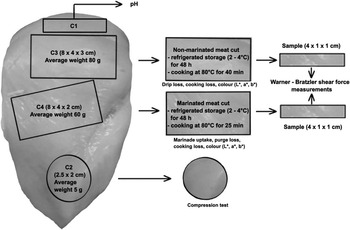
In each trial, samples were bagged by group (24/group) and transported under refrigerated conditions to the laboratory. Upon receipt at the laboratory, superficial fat, cartilage and connective tissues were trimmed from fillets, which were subsequently stored at 2 to 4°C throughout handling and measurements. At 24 h postmortem, colour (CIE L*=lightness, a*=redness and b*=yellowness) was measured in triplicate on the bone-side surface of each fillet using a Chroma Meter CR-400 (Minolta Corp., Milan, Italy). Subsequently, each fillet was individually weighed and used for morphometry measurements (width, length and height). As shown in Figure 1, fillets were subsequently cut to obtain four sub-samples (C1, C2, C3 and C4) that were used for quality analyses. The first subsample (C1) was cut from the cranial section and used to assess ultimate pH, which was determined by homogenising 2.5 g of meat in iodoacetate solution as described by Jeacocke (Reference Jeacocke1977). A raw cylindrical meat cut (C2) 2.5 cm diameter×1 cm height, weighing about 5 g, was excised from the caudal part of each fillet and used for the compression test. In addition, a parallelepiped cut (C3, 8×4×3 cm) weighing about 80 g was excised from the cranial part of each fillet and used to assess non-marinated quality traits (drip loss, cook loss, colour after cooking and the Warner-Bratzler shear force). Finally, the last parallelepiped meat cut (C4, 8×4×2 cm) weighing about 60 g was excised from the middle part of each fillet and used, after tumbling, to evaluate the quality traits of marinated breast meat (marinade uptake, purge loss, cooking loss, colour after cooking and the Warner-Bratzler shear force).
Sampling protocol: C1, Meat cut used for pH measurements; C2, Meat cut used for the compression test; C3, Meat cut used for assessing quality traits on non-marinated meat; C4, Meat cut used for assessing quality traits on marinated meat.

Morphometry measurements
Geometrical measurements of fillets were determined in cm with an electronic calliper, as described by Mehaffey et al. (Reference Mehaffey, Pradhan, Meullenet, Emmert, McKee and Owens2006) with slight modifications. Length was measured in the longest dimension of the fillet, whereas width was measured from the longest distance from side-to-side in the middle of the fillet. Height was measured at three points: the first height (H1) was measured at the highest point in the cranial part, the second height (H2) was measured at the midpoint of the breast length and the third height (H3) was measured as the vertical distance far from the end of the caudal part by 1 cm in a dorsal direction.
Meat quality measurements
Meat cuts sampled from the caudal part of fillets (C2, Figure 1) were compressed to 40% of the initial height using a 25-kg loading cell connected to a 50-mm DIA cylinder aluminium probe using TA. HDi heavy-duty texture analyser (Stable Micro Systems Ltd, Godalming, Surrey, UK). The test speed of the probe was 1 mm/s, whereas the pre- and post-test speeds were both 3 mm/s. The compression value was recorded as the maximum force required to compress 40% of the initial height of the sample and expressed in kg.
Parallelepiped meat cuts excised from the cranial part of each fillet (C3, Figure 1) were stored in covered plastic boxes over sieved plastic racks for 48 h at 2 to 4°C. After storage, the C3 cuts were re-weighed and the difference in weight was used to determine drip loss. Subsequently, the C3 cuts were packaged under vacuum and cooked in a water bath at 80°C for 45 min (Petracci and Baeza, Reference Petracci and Baeza2011). The difference in weight before and after cooking was used to determine cooking loss. Colour values (L*, a*, b*) were measured on the upper surface of the cooked cut. Cooked C3 cuts were stored under refrigeration for 2 h, and a strip (~4×1×1 cm) was then excised parallel to the fibre direction. Strips were sheared perpendicularly to the fibre direction using a TA. HDi heavy-duty texture analyser (Stable Micro Systems Ltd), equipped with a Warner-Bratzler shear blade with a 5 kg loading cell using the procedure described by Sams et al. (Reference Sams, Janky and Woodward1990). The actual cross-sectional area at the shearing point was measured with an electronic calliper, and shear values were expressed in kg.
Finally, C4 meat cuts were individually labelled and marinated by the addition of 150 ml marinade solution (7.6% sodium chloride and 2.3% sodium tripolyphosphate) per 1 kg of meat using a small-scale vacuum tumbler (model MGH-20; Vakona Qualitat, Lienen, Germany). Tumbling time was 46 min under vacuum (−0.95 bar) with 800 total revolutions (three working cycles of 13 min/cycle and two pause cycles of 3 min/cycle). After tumbling, the C4 cuts were weighed again and the difference in weight was used to determine marinade uptake. C4 cuts were stored in covered plastic boxes over sieved plastic racks for 48 h at 2 to 4°C. After storage, the cuts were re-weighed and the difference in weight was used to determine the purge loss. The samples were then packaged under vacuum and cooked in a water bath at 80°C for 24 min. The difference in weight before and after cooking was used to calculate the cooking loss. In addition, total yield was calculated based on the weight after marination and cooking divided by the initial weight of raw meat before tumbling. Colour values (L*, a*, b*) after cooking and the Warner-Bratzler shear force were measured as described for C3 meat cuts.
Statistical analysis
Data were analysed using the ANOVA option of the GLM procedure present in SAS software (SAS Institute Inc, 1988) and by testing the main effects for type of meat quality abnormality (N, WS, WB and WS/WB) and replication, as well as the interaction term on meat quality traits. Means were separated using Tukey’s honestly test of the GLM procedure (SAS Institute Inc, 1988).
Results
Weight, dimension and texture of raw fillets
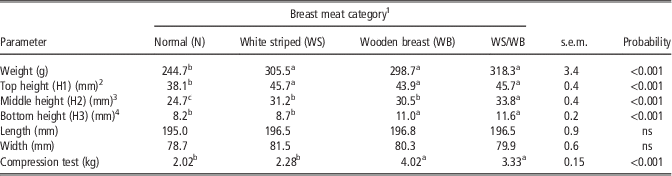
The results for weight, dimension and the compression test of breast fillets are shown in Table 1. Fillets affected by WS, WB and WS/WB abnormalities had significantly higher (P<0.001) weights and thickness at the top (H1), middle (H2) and bottom (H3) positions compared with normal fillets. None of the abnormalities had any significant effect on either length or width of the fillets. However, fillets affected by both defects (WS/WB) exhibited the highest H2 (P<0.05). As for H3, fillets affected by only WB or WS/WB exhibited significantly higher (P<0.05) values compared with both WS and N fillets, which showed no significant differences. The same trend was observed for raw meat texture. In particular, WS/WB and WB showed significantly higher compression values (3.33 and 4.02 kg, respectively) than WS and N fillets (2.28 and 2.02 kg, respectively; P<0.001). There was no significant difference between WS and N fillets.
Effect of breast abnormalities on weight, dimension and texture of raw chicken fillets

a to cMeans within a row followed by different superscript letters differ significantly (P⩽0.05).
1 n=48/group.
2 H1 was measured at the thickest point in the cranial part.
3 H2 was measured at half distance of the breast length.
4 H3 was measured far from the end of the caudal part by 1 cm towards a dorsal direction.
Quality traits of non-marinated breast meat
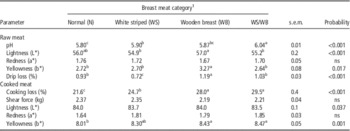
The quality traits of non-marinated breast meat samples are shown in Table 2. Fillets affected by WS/WB had the highest (P<0.001) ultimate pH values (6.04). In addition, although the pH of WB fillets did not differ compared with N fillets, WS samples had a significantly higher (P<0.05) value than N fillets. Considering the colour of raw meat, the WB group showed higher lightness values (L*) compared with WS and WS/WB fillets (57.0 v. 54.9 and 55.2, respectively; P<0.001), whereas N samples exhibited an intermediate value. Moreover, WB fillets also had higher (P<0.05) yellowness values, whereas there were no significant differences among the other groups. Redness was not affected by breast fillet abnormalities. Compared with the N group, WS/WB fillets had similar drip losses, whereas WB and WS fillets exhibited significantly higher (P<0.05) and lower (P<0.05) values, respectively. In general, all types of abnormalities showed higher (P<0.001) cooking losses compared with N fillets. In particular, WB or WS/WB fillets had the highest (P<0.001) cooking losses. However, the presence of abnormalities had no effect on the shear force or colour of cooked meat with the only exception of yellowness, which was higher (P<0.05) in WB and WS/WB than in N fillets.
Effect of breast abnormalities on quality traits of non-marinated chicken meat

a to cMeans within a row followed by different superscript letters differ significantly (P⩽0.05).
1 n=48/group.
Quality traits of marinated breast meat
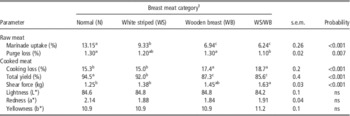
The results of marinade uptake and quality traits of breast meat following tumbling are presented in Table 3. All parameters were significantly (P<0.01) affected by the presence of WS, WB or WS/WB, with the exception of cooked meat colour. All groups affected by abnormalities showed lower (P<0.001) values of marinade uptake compared with N fillets. In particular, WB and WS/WB showed lower values of marinade uptake than the WS group (6.94% and 6.24% v. 9.33%, respectively; P<0.001). Despite the lesser ability to absorb marinade, WB and WS/WB fillets also had greater cooking loss compared with WS and N meat (17.4% and 18.7% v. 15.3% and 15.0%, respectively; P<0.001). On the other hand, fillets affected by WS/WB showed significantly lower (P<0.001) values of purge loss compared with N and WB fillets, whereas the value of WS was somewhat lower than the values of N and WB, but was not statistically significant. Considering the shear force of cooked meat, fillets with both defects showed the highest shear force compared with the N and WS groups (1.63 v. 1.25 and 1.38 kg, respectively; P<0.001), whereas WB exhibited an intermediate value (1.45 kg).
Effect of breast abnormalities on quality traits of marinated chicken meat

a to cMeans within a row followed by different superscript letters differ significantly (P⩽0.05).
1 n=48/group.
Discussion
The rate of growth is one of the most important factors related to the incidence of muscle abnormalities (Mitchell, Reference Mitchell1999). Herein, differences in the physical growth pattern between different muscle abnormalities were evaluated by measuring the weight and dimension of fillets. In general, the results of this study revealed that abnormal fillets showed higher weights and greater thickness compared with normal ones. These findings are consistent with those of Kuttappan et al. (Reference Kuttappan, Shivaprasad, Shaw, Valentine, Hargis, Clark, McKee and Owens2013a), who found that white striping was associated with heavier and thicker fillets. However, our results also showed that wooden breasts generally had higher weight and thickness. This indicates that birds of the same flock with superior breast development are more prone to individual and combined abnormalities. This can be considered as further support for the hypothesis that selection for growth rate and breast yield plays a major role in the occurrence of these emerging aberrations (Petracci and Cavani, Reference Petracci and Cavani2012). However, the increased weight of fillet did not result in any changes in length or width. This is in general agreement with previous studies (Lubritz, Reference Lubritz1997; Brewer et al., Reference Brewer, Kuttappan, Emmert, Meullenet and Owens2012), which reported that weight had much greater impact on thickness compared with length and width of fillets. The wooden breast abnormality was associated with a remarkable increase in the bottom fillet height (H3) compared with both normal and white-striped fillets. This is clearly because of the presence of a ridge-like bulge at the caudal end in wooden fillets, as previously described by Sihvo et al. (Reference Sihvo, Immonen and Puolanne2014). Accordingly, evaluation of bottom fillet height could be proposed as a criterion to discriminate breast fillets affected by the wooden breast abnormality. In this regard, it has been shown that the greater hardness observed empirically in wooden breast fillets can be objectively evaluated using the compression test. In fact, wooden breast fillets, regardless of the presence of white striping, exhibited higher instrumental hardness than normal samples, while the texture of raw meat of white-striped fillets was not modified.
The higher ultimate pH of white-striped fillets compared with the normal group is also in agreement with previous findings (Kuttappan et al., Reference Kuttappan, Brewer, Clark, McKee, Meullenet, Emmert and Owens2009; Petracci et al., Reference Petracci, Mudalal, Bonfiglio and Cavani2013a). In this regard, several earlier studies indicated that the positive relationship between the development of breast muscle and ultimate pH is the result of a decrease in glycolytic potential (Berri et al., Reference Berri, Wacrenier, Millet and Le Bihan-Duval2001; Berri et al., Reference Berri, Le Bihan-Duval, Debut, Santé-Lhoutellier, Baéza, Gigaud, Jégo and Duclos2007). Although former studies compared unselected and selected lines in terms of growth rate and breast yield, and in our study birds were collected from the same fast-growing hybrid, there was still a large range in growth rates as seen by the large differences in breast weights from birds of the same age. It may be argued that the growth rate for each individual bird is involved in ultimate pH, so that chickens with greater breast development may exhibit higher ultimate pH values. However, the most interesting result is the large difference in pH between the WB and WS/WB groups. In fact, breast muscles showing both abnormalities exhibited pH values even higher than 6, which are common in dark, firm and dry meat (Fletcher, Reference Fletcher2002). The cause for this increase in pH due to wooden and white striping abnormalities is not known. In this regard, a previous study clearly showed the presence of massive histological degeneration of muscle fibres in wooden breast and white-striped fillets (Sihvo et al., Reference Sihvo, Immonen and Puolanne2014). This anomaly may reduce the glycogen content or modify the onset of acidification during the postmortem time and lead to an increase in ultimate pH. However, further investigations are needed to confirm these hypotheses.
Concerning colour, wooden fillets showed lighter colour values (L*) compared with WS and WS/WB fillets, whereas normal fillets exhibited intermediate values. These differences may be due to both different ultimate pH values and muscle tissue modifications following histological degeneration of abnormal breast muscles. In agreement with our previous study (Petracci et al., Reference Petracci, Mudalal, Bonfiglio and Cavani2013a), it appears that even if white striping is associated with higher ultimate pH values, there are no relevant colour changes compared with normal fillets. On the other hand, Sihvo et al. (Reference Sihvo, Immonen and Puolanne2014) reported that WB fillets were visually pale, an observation that was instrumentally confirmed in the present study where wooden breast fillets without superficial white striping showed higher lightness and increased yellowness. However, when fillets were affected by both abnormalities, there was no change in meat lightness. This may be explained by the high pH observed in fillets affected by both abnormalities, which have increased meat darkness (Swatland, Reference Swatland2008) that is partially counteracted by the effects of the WB abnormality. However, further studies are needed to elucidate the possible role of these concomitant effects.
As for drip losses, it can be suggested that the higher pH values observed in white-striped fillets allowed for an increased ability to retain liquid during storage than normal breast meat. However, in our previous study (Petracci et al., Reference Petracci, Mudalal, Bonfiglio and Cavani2013a), we did not find any modifications in either moderate or severe white-striped fillets. On the other hand, wooden fillets had higher drip losses than normal ones, although the ultimate pH was similar to both normal and white-striped fillets. In this case, it can be speculated that extensive loss of membrane integrity and the presence of a thin layer of fluid viscous material over the wooden breast (Sihvo et al., Reference Sihvo, Immonen and Puolanne2014) caused an increased loss of liquid during refrigerated storage of the meat, regardless of a slightly higher ultimate pH. In this regard, when wooden breast was associated with white striping, drip loss was similar to normal fillets. As previously hypothesised for colour, this may be due to the very high pH observed in fillets with both abnormalities, which is commonly associated with an increased ability to retain liquid (Fletcher, Reference Fletcher2002). This may have partially counteracted the negative effects of the wooden breast abnormality.
However, although the negative impact of breast abnormalities on raw meat quality properties seems to be mitigated by the concomitant rise in ultimate pH, the ability to bind marinade solutions and retain liquid during cooking in both non-marinated and marinated meat were also severely impaired. In our earlier study (Petracci et al., Reference Petracci, Mudalal, Bonfiglio and Cavani2013a), white-striped fillets were shown to exhibit higher cooking losses and lower marinade yields. This was attributed to a dramatic reduction in total crude protein content and, in particular, of the myofibrillar fraction (Mudalal et al., Reference Mudalal, Babini, Cavani and Petracci2014; Petracci et al., Reference Petracci, Mudalal, Babini and Cavani2014), which plays a major role in determination of protein functionality during processing (Petracci et al., Reference Petracci, Bianchi, Mudalal and Cavani2013b). The main novel findings of this study are that the wooden abnormality causes much lower marinade uptake and cooking losses irrespective of the presence of white striping. These outcomes, together with the observations on raw meat, clearly indicate that wooden breast abnormality results in more severe adverse effects on meat quality attributes compared with white striping. Based on these findings, it may be argued that wooden breast is associated with more damage to muscle tissue than white striping. Previous observations showed that histopathological changes in white-striped and wooden breast muscles have similar features (Kuttappan et al., Reference Kuttappan, Brewer, Clark, McKee, Meullenet, Emmert and Owens2009; Sihvo et al., Reference Sihvo, Immonen and Puolanne2014), and thus a common aetiology may be hypothesised. However, Sihvo et al. (Reference Sihvo, Immonen and Puolanne2014) observed that wooden fillets were affected by an inflammatory process as demonstrated by the presence of T lymphocytes, which were not observed in white-striped fillets (Kuttappan et al., Reference Kuttappan, Huff, Huff, Hargis, Apple, Coon and Owens2013b). As a consequence, it might also be proposed that white striping occurs during an early stage of muscle degeneration, whereas breast fillets become ‘wooden’ only at a later stage of development.
Finally, the shear force of both non-marinated and marinated meat was modestly affected by the presence of both abnormalities. In particular, although raw wooden fillets showed higher resistance to compression, these differences had little impact on the cooked meat texture. The small differences observed with marinated meat can be associated with lower marinade yield rather than to a direct effect of the wooden breast abnormality. High amounts of liquid losses during cooking are usually associated with increased toughness of meat (Murphy and Marks, Reference Murphy and Marks2000). In a recent study, it was also found that inclusion of wooden breasts to some extent in sausages and nuggets increased the shear force and binding strength (Puolanne and Ruusunen, Reference Puolanne and Ruusunen2014).
Conclusions
In conclusion, the higher weights of white-striped and wooden breast fillets compared with normal breasts can be considered as further support for the hypothesis that selection for growth rate and breast yield plays a major role in the occurrence of these emerging abnormalities. In addition, the presence of either or both abnormalities resulted in a large reduction in the quality traits of breast meat. Although the negative impact of both abnormalities on raw meat quality seems to be mitigated by the concomitant rise in ultimate pH, the ability to bind marinade solutions and retain liquid during cooking in both unprocessed and marinated meat was severely impaired. In addition, the implications of these abnormalities on meat quality were very distinct, as wooden breast fillets exhibited dramatically poorer cooking and processing yields, irrespective of the concomitant presence of white striping. It was also established that measurements of height or compression force in the caudal part of fillets may be used as a tool to discriminate between white striping and wooden breast abnormalities. Further studies are needed to understand the causes for the different behaviour of white striping and wooden breast abnormalities and to identify processing strategies that can minimise their inferior quality.
Acknowledgement
We thank the Martini Alimentare s.r.l., Gatteo (FC), Italy, for supplying samples for this research.