INTRODUCTION
Marine animals are defined as cosmopolitan if they are reported from two or more oceans, including connected seas (Sterrer, Reference Sterrer1973). Since it was first described from the south coast of England as Nereis sanguinea Montagu, Reference Montagu1813, the eunicid polychaete Marphysa sanguinea has been reported to occur in most temperate and tropical seas, from estuaries down to depths of 200 m. The original morphological description was brief with few diagnostic characters given, and no type material was deposited. Despite this, it has been recorded from many localities around the world leading to the designation of M. sanguinea as a cosmopolitan species. Recently there has been some debate, however, that M. sanguinea from these different geographical regions may in fact be a series of cryptic species (morphologically difficult to distinguish) (e.g. Hutchings & Karageorgopoulos, Reference Hutchings and Karageorgopoulos2003).
Quatrefages (Reference Quatrefages1865) based his description of the genus Marphysa on specimens of M. sanguinea from France, and it is recognized as the type species of the genus. Since then the species has been recorded from many parts of the world including: the north coast of France and the English Channel Islands, where it is known as ‘rock-worm’ as it is found in permanent burrows, deep in rock fissures; Sado Estuary in Portugal, in Spain (Parapar et al., Reference Parapar, Besteiro and Urgorri1993); the Mediterranean coast of France (Bellan, Reference Bellan1964); the Venetian Lagoon, Italy (Prevedelli, Reference Prevedelli1989; Gambi et al., Reference Gambi, Castelli, Giagrande, Predevedelli, Zunarellie-Vandini and Dauvin1994); the Gulf of Elat in the eastern Mediterranean basin (Ben-Eliahu, Reference Ben-Eliahu1976); North Carolina on the Atlantic coast of America (Day, Reference Day1967); the Gulf of Mexico, Venezuela (Liñero-Arana, Reference Liñero-Arana1990); the Caribbean (Salazar-Vallejo & Carrera-Parra, Reference Salazar-Vallejo and Carrera-Parra1997); California on the Pacific coast (Hartman, Reference Hartman1968; Fauchald, Reference Fauchald1992); shallow sub-tidal areas of western Mexico (Fauchald, Reference Fauchald1970); New Zealand (Day, Reference Day1967), Queensland, Australia (Day, Reference Day1967; Forbes, Reference Forbes1984); Japan (Miura, Reference Miura1977); Korea and Taiwan (Choi, Reference Choi1985); India (Hartman, Reference Hartman1968); the Indian Ocean and the Red Sea (Fauvel, Reference Fauvel1923). In Africa, Day (Reference Day1959, Reference Day1967) recorded M. sanguinea as common in muddy sand banks and Zostera beds, in Senegal, south-west Africa and the Cape of South Africa.
Fauchald (Reference Fauchald1992) points out that the identity of these different populations of Marphysa sanguinea is problematic and, as presently accepted, M. sanguinea is the most variable species in the genus (Fauchald, Reference Fauchald1970). In addition to the morphological variation, there is substantial ecophysiological variation, such as the differences in habitat described above, which has routinely not been considered by traditional polychaete taxonomists. Knowlton (Reference Knowlton1993) has argued that the conventional, virtually exclusive use of qualitative morphology as the taxonomic yardstick has severely impeded the recognition of species boundaries in marine invertebrates. Phenetic similarity between two organisms can be the result of convergent evolution or speciation having occurred relatively recently (Knowlton & Weigt, Reference Knowlton, Weigt and Claridge1997) and has the consequence of masking real biodiversity. On the other hand, specific mate recognition systems (SMRS) which involve the signalling between mating partners or their cells (Paterson, Reference Paterson and Vrba1985), can be very informative when the identity of sibling species is under scrutiny. Behavioural and chemically mediated recognition differences, in the choice of mates (Stanhope et al., Reference Stanhope, Connelly and Hartwick1992), in egg–sperm detection (Palumbi, Reference Palumbi1992) and settlement preferences of larvae (Morrow et al., Reference Morrow, Thorpe and Piton1992) have been employed to differentiate between a number of species’ complexes. Sibling species are also often found to exhibit distinct habitat preferences, as defined by their ecophysiology (Gamenick et al., Reference Gamenick, Vismann, Grieshaber and Giere1998), host specificity or other ecological parameters such as depth and salinity (Knowlton, Reference Knowlton1993). It has recently been suggested by Klautau et al. (Reference Klautau, Russo, Lazoski, Boury-Esnault and Thorpe1999) that such omissions may have led to the world-wide clustering of many morphologically similar, but evolutionary distinct species, into single, artificially cosmopolitan morphospecies. Perhaps the most holistic approach to this problem is to use an ‘integrative’ approach to taxonomy, such as that suggested by Dayrat (Reference Dayrat2005), which combines traditional morphological descriptions with modern molecular techniques and the ecophysiology and reproductive biology of the organism, as a more robust methodology for differentiating between morphologically similar species using a ‘weight of evidence’ approach.
For a species to be considered genuinely cosmopolitan, it must maintain its genetic cohesiveness, mediated by gene flow, throughout its geographical distribution (Klautau et al., Reference Klautau, Russo, Lazoski, Boury-Esnault and Thorpe1999). Several molecular methodologies have been developed, which are well suited to estimating levels of effective gene flow between natural populations (Avise, Reference Avise1994; Ferraris & Palumbi, Reference Ferraris and Palumbi1996; Karp et al., Reference Karp, Isaac and Ingram1998). In particular, it has been demonstrated (for review, see Hadrys et al., Reference Hadrys, Balick and Schierwater1992) that the RAPD-PCR technique, with its high resolution power, can elucidate the taxonomic identity of sibling species, establish systematic relationships and assess genetic relatedness and differentiation in mammals (Lavrenchenko et al., Reference Lavrenchenko, Potapova, Lebedev and Ryskov2001), teleosts (Lehmann et al., Reference Lehmann, Hettwer and Taraschewski2000), molluscs (Andre et al., Reference Andre, Lindegarth, Jonsson and Sundberg1999), nematodes (Cenis, Reference Cenis1993), cnidarians (Lasker et al., Reference Lasker, Kim and Coffroth1996), plants (Paterson & Snyder, Reference Paterson and Snyder1999), insects (Audisio et al., Reference Audisio, De Biase, Romanelli, Angelici, Ketmaier and De Matthaeis2000), bacteria (Nigatu et al., Reference Nigatu, Ahrne and Molin2001) and polychaetes (Schmidt & Westheide, Reference Schmidt and Westheide1997/1998, Reference Schmidt and Westheide1999, Reference Schmidt and Westheide2000; Gibson et al., Reference Gibson, Paterson, Taylor and Woolridge1999; Westheide & Hass-Cordes, Reference Westheide and Hass-Cordes2001). Several polychaete species thought to be cosmopolitan have on detailed morphological studies been found to represent a suite of sibling species, e.g. the polychaete Terebellides stroemii (Hutchings & Peart, Reference Hutchings and Peart2000) and Owenia fusiformis (Ford & Hutchings, Reference Ford and Hutchings2005).
A recent and detailed re-description of Marphysa sanguinea from the type locality Cornwall, on the south-west coast of England (Hutchings & Karageorgopoulos, Reference Hutchings and Karageorgopoulos2003), and the designation of a neotype have lead to a re-evaluation of this cosmopolitan species. Material from populations previously identified as M. sanguinea from Queensland, Australia were compared with the neotype of M. sanguinea and found to be different and described as a new species M. mullawa (Hutchings & Karageorgopoulos, Reference Hutchings and Karageorgopoulos2003). They suggested that other populations currently referred to as M. sanguinea may also be significantly different from the neotype and represent currently undescribed species.
This investigation is a study of the South African population of Marphysa from Buffel's Bay, on the Cape Peninsula of the western Cape. Marphysa sanguinea was originally recorded in Africa by Day (Reference Day1967). A comparison between the Buffel's Bay population of Marphysa and ‘M. sanguinea’ specimens of the John Day Collection at the South African Museum (SAM A20583) revealed them to be the same species. However, a detailed taxonomic study, together with the use of RAPD-PCR analysis and a study of sperm ultra-structure, revealed significant morphological, genetic and reproductive differences when compared with M. sanguinea from the type locality of Devon, England. This has led to the description of the South African Buffel's Bay population as a new species of Marphysa.
MATERIALS AND METHODS
Morphological description
Specimens were collected carefully by hand from the intertidal boulder-field at Buffel's Bay (18°29′27″E 34°21′6″S), Cape Point National Park, in the western Cape of South Africa. Specimens were fixed according to the method of Day (Reference Day1967) and the following measurements were made; length from head to pygidium (if complete), maximum anterior width including parapodia, total number of chaetigers and the segment at which the first branchiae appear. Notes were made if the posterior segments were regenerating and whether the specimen contained gametes. Jaws were dissected and observed. Selected material was examined under SEM in order to describe the types of chaetae present. Material has been deposited in the South African Museum (SAM) and the Natural History Museum, London (NHM).
RAPD-PCR analysis
SAMPLED POPULATIONS
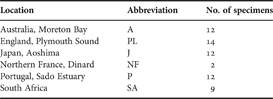
A total of 61 individuals of populations of Marphysa was obtained from six locations (Table 1). Live specimens were collected intertidally, fixed in 100% ethanol and maintained in separate containers, at 4°C, prior to DNA extraction. (Note that this sequencing was carried out prior to the Australian population being described as a new species, Marphysa mullawa (Hutchings & Karageorgopoulos, Reference Hutchings and Karageorgopoulos2003).)
Sampling locations for the populations of Marphysa used in the RAPD-PCR analysis.

DNA EXTRACTION
Three to four parapodia were dissected from each specimen and the ethanol was allowed to evaporate. The tissue samples were placed in 1.5 ml centrifuge tubes and were incubated with 300 µl Puregene® ‘Cell Lysis Solution’ (Gentra Systems Inc., Minneapolis) and 5 µl proteinase K (1 µg ml−1) at 37°C, overnight. Proteins were precipitated with 100 µl 3 M potassium acetate, by chilling on ice and centrifugation at 18,000 g for 10 minutes. The RNA in the supernatant was degraded with RNase (20 ng ml−1), in a 37°C water bath for 30 minutes. The DNA was further purified by a single extraction with 400 µl phenol/chloroform/isoamyl alcohol (25:24:1, saturated with 10 mM Tris, pH 8.0 and 1 mM EDTA), followed by 400 µl chloroform/isoamyl alcohol (24:1). Separation of the phases was accelerated by centrifugation at 18,000 g for 5 minutes. Following precipitation with 300 µl isopropanol, the DNA was harvested by centrifugation at 18,000 g for 15 minutes. The resulting DNA pellet was washed twice in 70% ethanol to remove salts, air dried, dissolved in 1 mM Tris–HCl, pH 8.0, with 0.1 mM EDTA and stored at 4°C.
PCR
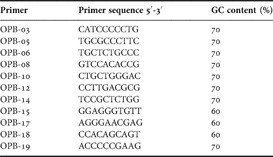
The DNA amplifications were conducted following the method of Williams et al. (Reference Williams, Kubelik, Livak, Rafalski and Tingey1990), with minor modifications. A total PCR reaction volume of 25 µl was used, containing buffer (10 mM Tris–HCl, pH 9.0, 50 mM KCl, 1.5 mM MgCl2, 0.1% Triton X-100, 0.2 mg ml−1 BSA), 100 µM of each dATP, dTTP, dCTP, dGTP (Promega), 5 pM decamer primer, 1–10 ng template DNA and 1.0 U Taq Polymerase (Q BIOgene). Of the 20, arbitrary decamer primers (Operon Technologies, Alameda, California) that were screened, 11 (listed in Table 2) were utilized. The remaining nine were rejected because they failed to amplify any products for some populations or if they did, the bands were few (less than four) usually with one, very bright, dominating the results. Amplifications were conducted with a HYBAID PCR-Express thermocycler. Negative controls, without template DNA, were also included. An initial denaturation step at 94°C for 4 min was followed by 45 cycles, a final elongation step at 72°C for 4 min and a holding step at 4°C. Each cycle included denaturation for 1 min at 94°C, annealing for 1 min at 36°C and extension for 2 min at 72°C. Fastest available transition times were employed between steps, except for the transition between annealing and extension where a ramp rate of 0.4°C sec−1 was used (Wolff & Peters-Van Rijn, Reference Wolff and Peters-Van Rijn1993).
The decamer primers used in PCR for DNA amplification (Operon Technologies Inc., Alameda, California, USA).

GEL ELECTROPHORESIS
The PCR products were resolved by electrophoresis on 1.5% agarose gels (Promega), prepared in 0.5 X TBE buffer (45 mM Tris-borate, 1 mM EDTA) at 5 V cm−1 for two hours. A 100 base-pair DNA ladder (Promega) was used as a size marker. Gels were stained with ethidium bromide (0.1 µl ml−1) for 20 min and the banding pattern was visualized under ultraviolet light, on a UVP Transilluminator. Images of the gels were digitally captured using LabWorksTM Analysis Software v. 3.0 and were magnified on Photoshop 5.0, prior to scoring.
GEL SCORING AND STATISTICAL ANALYSIS
The amplification products were examined visually, for monomorphic and polymorphic markers. All visible bands were scored into a 0/1 matrix (0 for absence, 1 for presence of a marker). The matrix was fed to and analysed by the cluster analysis program TREECON 1.2 (Van de Peer & de Wachter, Reference Van de Peer and de Wachter1994), which also calculated the genetic distance values from the Nei & Li (Reference Nei and Li1979) similarity index. Cluster analyses were carried out with the algorithms of UPGMA (unweighted pair group method using arithmetic averages), WPGMA (weighted pair group method using arithmetic averages), Complete Linkage, Single Linkage (Sneath & Sokal, Reference Sneath and Sokal1973) and neighbour joining (Saitou & Nei, Reference Saitou and Nei1987), including bootstrap values of 1000 replicates.
SEM OF SPERM ULTRA-STRUCTURE
For the scanning electron microscopy work on Marphysa sanguinea (from locality of neotype) and M. elityeni sp. nov. sperm, samples of coelomic fluid were taken from ripe males and fixed in 2.5% gluteraldehyde buffered in 0.2 M phosphate buffer at pH 7.4 with 0.14 M NaCl. Circular cover slips (10 mm in diameter) were coated in protein and left to dry on a hot plate. The coverslips were then washed carefully in the phosphate buffer before small samples of the dry sperm were pipetted directly onto the coverslips and left overnight in the buffer solution. The sperm encrusted coverslips were then rinsed in phosphate buffer and dehydrated through a series of Analar ethanol solutions (30%, 15 min; 50%, 15 min; 70%, 15 min; 80%, 15 min; 90%, 15 min; 95%, 15 min; 3 × 100%, 15 min). Following removal from 100% ethanol a few drops of HDMS (hexamethyldisilazane) were dispensed onto the coverslips and left to evaporate (5 min). Coverslips were then mounted onto SEM stubs using carbon glue and sputter coated with gold palladium (60:40). Sperm were then viewed using a Leo S440 scanning electron microscope and images captured in the jpeg format, allowing image manipulation using Adobe Photoshop 5.0.
RESULTS
Morphological description
SYSTEMATICS
Marphysa sanguinea: Day, Reference Day1967: 369, figure 17.5u–y. Not Montagu, Reference Montagu1813.
ETYMOLOGY
Xhosa (African language prevalent in the western Cape) for ‘Marphysa in the rocks’, since this species is found beneath rocks and boulders of intertidal boulder-fields.
TYPE MATERIAL
Holotype specimen and two paratypes (deposited at the South African Museum, SAM A21478–A21481), along with a range of voucher material (including adult males) from the type locality. Four mature specimens (two male and two female) from type locality used for SEM examination.
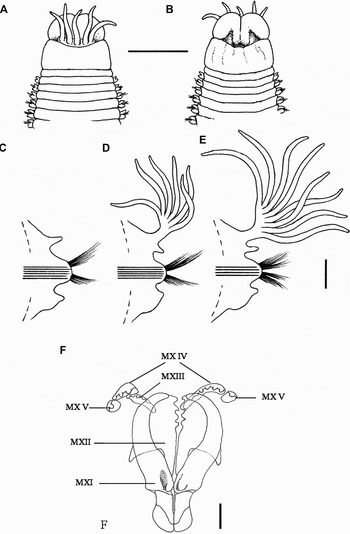
Holotype (SAM A21478, Figure 1): adult female (coelomic cavity full of developing oocytes); 461 mm in length, complete specimen with pygidium present with 486 chaetigerous segments, but with signs of regeneration of posterior segments. Anterior width 10 mm and body uniform in width until the extreme posterior region where body tapers. Body highly dorso-ventrally flattened, rectangular in cross section.
Illustration of paratype of Marphysa elityeni sp. nov. (A) Ventral view; (B) dorsal view; (C) parapodia from segment 10; (D) parapodia from segment 50; (E) parapodia from mid-body segment; and (F) jaws (illustrations by Cedric Hunter). Scale bars: A & B, 5 mm; C–F, 1 mm.

Paratype 1 (SAM A21479): adult female (coelomic cavity full of developing oocytes); 740 mm in length, complete specimen with 533 chaetigerous segments, but with signs of regeneration of posterior segments. Anterior width 10 mm and body uniform in width until extreme posterior region where body tapers. Three parapodia removed from anterior, mid and posterior regions mounted on slides and illustrated (Figure 1). Jaws dissected but left in body. Some damage to bottom lip and a slight tear in body wall.
Paratype 2 (SAM A21480): adult female (coelomic cavity full of developing oocytes); 351 mm in length, complete specimen with 557 chaetigerous segments, but with signs of regeneration of posterior segments. Anterior width 15 mm. Three parapodia removed from anterior, mid and posterior regions, mounted on slides and examined. Jaws dissected but left in body, some damage to side of mouth.
Paratype 3: (deposited at the Natural History Museum, London, NHM 2007.69, along with voucher material NHM 2007.70-79) adult female (coelomic fluid full of developing oocytes); 355 mm in length, complete specimen with 579 chaetigerous segments, but with signs of regeneration of posterior segments. Anterior width 11 mm. Three parapodia removed at segments 10, 50 and a mid-body segment. Jaws dissected but left in body.
Type locality: inter-tidal boulder field at Buffel's Bay (18°29′27″E 34°21′6″S), Cape Point National Park, Cape Peninsula, western Cape, South Africa, in September 2004 by C. Lewis.
ADDITIONAL MATERIAL EXAMINED
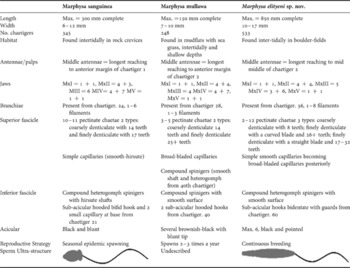
Over 30 adult specimens, ranging in size from 175 mm to 850 mm, were also collected from the type locality at Buffel's Bay, dissected and examined. A number of complete specimens were deposited at the South African Museum as voucher material (SAM 214781). Material was compared to voucher material from the John Day Collection at the South African Museum currently designated as Marphysa sanguinea (SAM A20583). A summary of the morphological descriptions and a comparison to M. sanguinea from the type locality and the Australian M. mullawa are outlined in Table 3.
Summary of the morphological and ecophysiological differences between three Marphysa species all previously considered to be the cosmopolitan species M. sanguinea.

Max., maximum.
DIAGNOSIS (BASED ON ALL TYPE AND NON-TYPE COMPARATIVE SPECIMENS EXAMINED)
Anterior body cylindrical, becoming wider and highly dorso-ventrally flattened in posterior segments. Body same width throughout most of its length, slight attenuation at anterior end becoming more marked in last few segments. Pygidium with two pairs of smooth and subulate ventrally pygidial cirri, dorsal-most pair approximately 5 times longer than inferior ventral pair.
Prostomium, from which antennae arise, wider than long, pair of upper lips present anteriorly. Upper lips bilobed, wider than long and flattened (Figure 1A & B). Demarcation between upper lips and prostomium visible only ventrally. Five occipital antennae comprise one pair of smooth, lateral palps, shorter than remaining three centrally arranged antennae. Median antenna longest, extending back to middle of second chaetigerous segment, shorter lateral antennae extending back to middle of first chaetigerous segment. Antennae arise from slightly elevated area compared to upper lips. Purple pigmented spot between palps and lateral antennae on each side, presumably an eye-spot. Ventrally, lower lips swollen, mouth opens terminally, pair of lateral lips concealed inside mouth. Peristomium consists of two rings, anterior almost three times as long as posterior.
Jaws: cutting plate of mandibles with calcified tips (white). Maxillae black and heavily sclerotized, maxillary formulae: Mx I = 1 + 1; Mx II = 4 + 4; Mx III = 5 + 0; Mx IV = 3 + 6; Mx V = 1 + 1.
First few parapodia and posterior-most parapodia smaller in size than intervening ones, but of similar structure. Anterior-most parapodia inserted ventrolaterally, subsequent parapodia in full lateral position. Dorsal cirri triangular, ventral cirri small and globular in anterior segments, becoming larger and more elongated but still globular along body length (Figure 1C–E). Parapodia comprise small, rounded low pre-chaetal lobe, small but slightly inflated acicular lobe and large, post-chaetal lobe swollen in anterior segments, less swollen in posterior segments. Branchiae present from chaetigers 42–52 (36 in holotype), initially consisting of single small lobe, reaching maximum number of eight filaments off single axis by chaetigers 70–85, never completely covering dorsum. Last 15–25 chaetigers without branchiae, not present on regenerating segments.
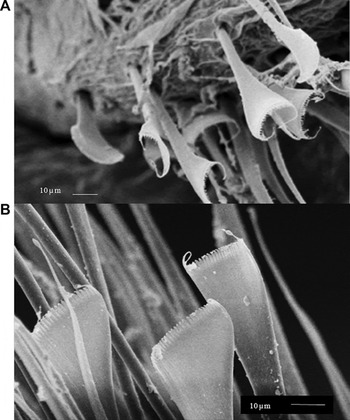
Chaetae arranged in two fascicles (Figures 1C–E & 2A,B (description of cheatae based on all comparative material examined, variations observed between individuals are described). Superior fascicle has: (1) 2–12 finely denticulate pectinate cheatae present on all chaetigers, positioned on upper edge of superior bundle, consisting of two types: (i) short with curved blade and 26–32 teeth, 4–8 present from chaetigers 3–10 to 100–150, absent on posterior chaetigers (Figure 2A); and (ii) long with straight blade and 17–32 teeth, increasing from two on anterior chaetigers to maximum 12 in midbody chaetigers (around chaetiger 100–150), decreasing to two near pygidium (Figure 2B); (2) 0–7 coarsely denticulate pectinate cheatae with 7–8 teeth, present on posterior segments only; and (3) simple, smooth, narrow capillary chaetae in anterior segments, replaced by broad bladed capillary chaetae from chaetigers 150–170. Inferior fascicle consists of: (1) compound heterogomph spinigers, with smooth shafts and diagonal joints present on all chaetigers; (2) fine capillary chaetae present on all chaetigers; and (3) sub-acicular hooks on inferior fascicle, bidentate with guards, present irregularly in posterior segments from chaetigers 60–70, mostly one per chaetiger, rarely two, light brown. Aciculae black and pointed, maximum number of six reached by chaetiger 10, decreasing to one in posterior segments (embedded hence not visible on the SEM photographs, but can be seen through thin walls of parapodia, illustrated in Figure 1C–E).
Colour: when live, specimens iridescent beige-pink anteriorly becoming deep brown posteriorly, with darker pigmentation dorsally. Preserved specimens become pale creamy-beige and lose iridescence. Variations in colour include iridescent blues and greens along reproductive segments (from chaetigers 70–80).
NOTES ON REPRODUCTION
In the population studied at Buffel's Bay, mature males and gravid females can be found all year round, suggesting a strategy of continuous reproduction. Females have been found to contain two or three cohorts of oocytes at any time along with small oocytes in the ovary. Adult males contain sperm at several stages of development together with large quantities of fully grown spermatozoa in the coelomic cavity all year round. This is quite different to the annual epidemic spawning described for Marphysa sanguinea (Karageorgeopoulos, Reference Karageorgopoulos2003).
REMARKS
Marphysa elityeni sp. nov. differs from the Hutchings & Karageorgopoulos (Reference Hutchings and Karageorgopoulos2003) description of M. sanguinea in a number of morphological characters, as summarized in Table 3. The distribution and type of pectinate chaetae in the superior fascicle differs significantly between the two species, with the number of pectinate chaetae present on each superior fascicle being far more variable in M. elityeni (from 2–12) than M. sanguinea (10–11). Marphysa elityeni has three types of pectinate chaetae; coarsely denticulate, finely denticulate with a straight blade and finely denticulate with a curved blade (Figure 2A & B). Marphysa sanguinea has only two types of pectinate chaetae present, none with a curved blade. The pectinate chaetae also differ in the number of teeth present between the two species. The coarsely denticulate pectinate chaetae of M. elityeni have only eight teeth in comparison to 14 in M. sanguinea, whilst both types of finely denticulate chaetae in M. elityeni have 17–32 teeth compared with just 17 in M. sanguinea. There are differences in the surface of the capillary chaetae found on the inferior fascicles, with those present in M. elityeni having a smooth surface and in M. sanguinea having hirsute shafts. The types of sub-acicular hooks present also differ between the two species; those in M. elityeni are bidentate with guards whereas M. sanguinea has hooded bifid hooks. The number of filaments that make up the branchiae reaches a maximum of eight in M. elityeni, and six in M. sanguinea.
Marphysa elityeni sp. nov. Scanning electron micrographs of the parapodia showing the chaetal types present; (A) curved bladed finely denticulate pectinate chetae; and (B) straight bladed finely denticulate chaetae.

The two species also differ significantly in the habitats which they occupy, reproductive strategy, and sperm ultrastructure and have a high genetic distance, as discussed below.
RAPD-PCR analysis
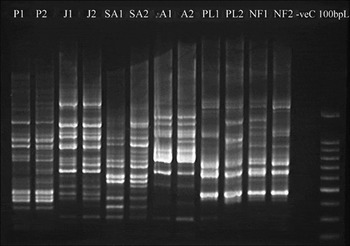
The 11 selected primers reproducibly amplified a total of 542 DNA fragments, with lengths ranging from 200 to 3000 base-pairs. None of these molecular markers, however, were shared by all six populations of Marphysa. On the contrary, less than 3% of the total bands were shared between all pairs of populations combined, with the exception of animals obtained from England and northern France, which produced almost identical RAPD fingerprints (Figure 3) with all primers. For the remaining populations, there were clear differences in the amplification patterns obtained with any primer (e.g. Figure 3). All populations possessed large numbers of monomorphic, diagnostic characters: Portugal 40%; Japan 51%; South Africa 70%; Australia 53%; England 30%. We are reluctant to give a percentage for northern France, because of the small sample size. However, if the northern France and southern England animals were considered as a single group, the same 30% of monomorphic bands (as for England) are diagnostic for both populations.
RAPD banding pattern of two individuals from six populations of Marphysa sanguinea, produced with primer OPB-17. Abbreviations as in Table 1; -veC, negative control; 100bpL, ladder (500 bp bold).

Table 4 summarizes the genetic distances within and between the six populations of Marphysa, as calculated from the Nei & Li (Reference Nei and Li1979) similarity index. The close genetic resemblance observed between the animals of each locality translates into low genetic distances (see Table 4). On the contrary, inter-population distances range from 0.95 to 0.99. These values are very near to the maximum separation value of 1.0, with the exception of southern England and northern France specimens. The latter populations are linked with a genetic distance of 0.13, which lies well within the range of values (0.05–0.16) established for intra-population distances.
The mean and range of genetic distance values, within and between the six Marphysa sanguinea populations, calculated from the Nei & Li (Reference Nei and Li1979) similarity index.

* Distance between two animals, therefore, mean and range not available.
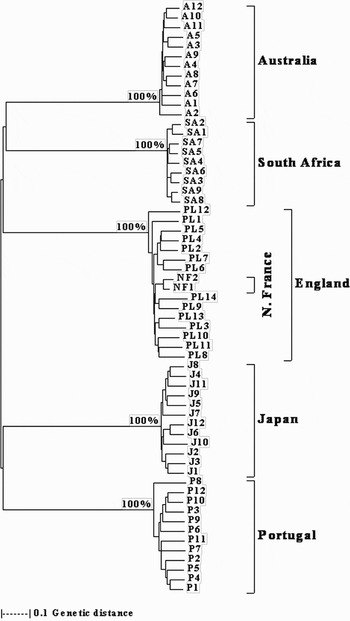
The five undertaken cluster analyses revealed almost identical topologies. Respective populations formed separate clusters, always with bootstrap values of 100% (Figure 4), again, with the exception of the northern France population, which clustered well within the southern England animals.
Neighbour joining phenogram of six Marphysa sanguinea populations. Bootstrap values indicated only on the most crucial branching points. Clustering based on genetic distances derived from Nei & Li (Reference Nei and Li1979) similarity coefficient.

Sperm ultrastructure
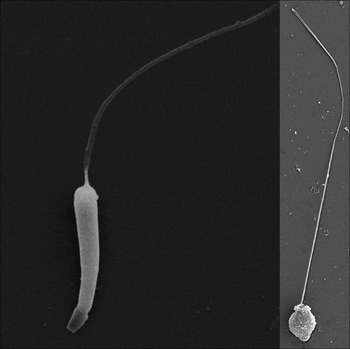
Scanning electron micrographs of mature spermatozoa from the South African Marphysa elityeni sp. nov. and M. sanguinea from the type locality at Plymouth, UK are shown in Figure 5. In M. elityeni fully developed spermatozoa are highly modified from the spherical shape that is typical of broadcast spawners, being larger and filiform in shape. The acrosome is a long cone (1.8 µm in length) with a deep sub-acrosomal invagination. The nucleus is very elongated (7–8 µm in length and 1.5–3 µm wide) and the midpiece is short (0.9 µm in length) and contains six large mitochondria with prominent cristae, the flagellum is relatively thick and long. This sperm morphology differs considerably from that of M. sanguinea, which have the typical round-headed ect-aquasperm of broadcast spawners.
Scanning electron micrographs of mature spermatozoa from (A) Marphysa elityeni sp. nov. and (B) Marphysa sanguinea collected from Devon, England. Scale bars: A, 10 µm; B, 20 µm.

In fully differentiated spermatozoa of M. sanguinea the overall length of the sperm (head + tail) is approximately 60 µm. The nucleus is perfectly spherical with a diameter of 3–4 µm and the nuclear material is homogeneous granular and electron dense. The acrosome sits on a small flattening of the nucleus and it has the shape of a very slightly convex cap, 1 µm in diameter. On the outside, the acrosome appears highly smooth or polished and its contents are deeply electron dense, in comparison to the nucleus. The flagellum is composed of the typical 9 + 2 arrangement of axoneme pairs.
DISCUSSION
By using an integrative taxonomic approach (as defined by Dayrat, Reference Dayrat2005) combining traditional morphological descriptions with modern molecular techniques, and information regarding the ecology and reproductive biology of the organism, we have re-examined populations of Marphysa from South Africa previously described as Marphysa sanguinea by Day (1976) in comparison to the re-description of the type species from the south-west of England, UK (Hutchings & Karageorgopoulos, Reference Hutchings and Karageorgopoulos2003). The extremely high level of genetic differentiation, together with differences in morphology (summarized in Table 3) and the entirely different sperm morphology, provide conclusive evidence that the South African species of Marphysa found along the western Cape is in fact a separate species from M. sanguinea. We therefore have described the South African Marphysa as the new species, Marphysa elityeni sp. nov. Type and voucher material has been deposited at the South African Museum in Cape Town, and paratypes at the Natural History Museum, London.
The detailed re-description of Marphysa sanguinea from the type locality in Cornwall, UK (Hutchings & Karageorgopoulos, Reference Hutchings and Karageorgopoulos2003), together with the use of SEM, has allowed a much more detailed comparison of the morphological characteristics with the South African population than was previously possible. This has enabled the small but significant differences in morphology, e.g. differences in dental formulae, branchial filament arrangement and the chaetal types present, to be identified. When compared to specimens of ‘Marphysa sanguinea’ from the John Day Collection at the South African Museum, the Marphysa specimens collected from the population at Buffel's Bay were found to be identical except for the presence of finely pectinate chaetae, not mentioned in Day's original (1967) description. It can therefore be assumed that they represent the same species that John Day was describing, since the use of SEM techniques were required to observe the presence of finely pectinate chaetae, which were not visible using light microscopy alone.
The most remarkable result of this study is the extremely high levels of genetic differentiation revealed between allegedly conspecific populations of Marphysa sanguinea. The findings presented here further the argument that Marphysa sanguinea represents a series of cryptic species, rather than a cosmopolitan species, and that other global populations currently designated as M. sanguinea may in fact represent new species. A genetic distance of 0.96 between the South African population studied here and Marphysa sanguinea specimens from the type locality at Cornwall, UK, certainly provides substantial support to the morphological and ecological differences as evidence that these, in fact, represent separate species.
Genetic distance values derived from RAPD-PCR analysis can provide very useful quantification of genetic divergence (Avise, Reference Avise1994). Unfortunately, there is no standard species specific genetic distance value, and possibly will never be, not even within a given taxon (Mayden, Reference Mayden and Claridge1997). Solé-Cava & Boury-Esnault (Reference Solé-Cava and Boury-Esnault1999) obtained genetic distance values ranging from 0.50 to 0.90 when comparing species of sponge, whilst even lower values have been estimated between sibling species of mice (0.45–0.73, Lavrenchenko et al., Reference Lavrenchenko, Potapova, Lebedev and Ryskov2001) and eels (0.38–0.56, Lehmann et al., Reference Lehmann, Hettwer and Taraschewski2000). However, the extent to which such values can be extrapolated to other taxa and used to make taxonomic decisions remains largely unclear (Schmidt & Westheide, Reference Schmidt and Westheide2000). For polychaetes, Schmidt & Westheide (Reference Schmidt and Westheide1997/1998) obtained considerable genetic distance values (0.74–0.87) between three morphologically similar species of Nerilla, whilst Schmidt & Westheide (Reference Schmidt and Westheide2000) found large genetic distances (0.84–0.90) separating three Hesionides species. These values, with the exception of the southern England and northern France animals, are somewhat smaller than the ones derived for all pairs of Marphysa populations in this study (0.95–0.99). Since the latter genetic distances are the highest we have seen derived from RAPD data describing conspecific populations of polychaetes or different species for that matter, evidence strongly suggests that there is sufficient genetic differentiation between the geographically separated populations of Australia, England, Japan, Portugal and South Africa for them to belong to distinct, but possibly morphologically similar species of Marphysa.
This is confirmed for the Australian population in a recent study by Hutchings & Karageorgopoulos (Reference Hutchings and Karageorgopoulos2003), who conducted an ultra-structural morphological assessment of the Australian population. This revealed considerable morphological differentiation between M. sanguinea from England and the Australian animals, which Hutchings & Karageorgopoulos (Reference Hutchings and Karageorgopoulos2003) designated as the new species Marphysa mullawa. The cluster analysis presented here (Figure 4) strongly suggests that the Japanese population (previously described as M. iwamushi by Izuka, Reference Izuka1907 but then synonymized with M. sanguinea by Imajima & Hartman, Reference Imajima and Hartman1964) and the Portuguese population also represent cryptic species. This would need to be confirmed with morphological and ecophysiological studies. Preliminary morphological investigations of adjacent populations of M. elityeni sp. nov. along the Western Cape of South Africa, would suggest that these may also represent separate, and as yet, un-described species, although it was not possible to describe these in detail. This is certainly the case in Australia where there are reportedly several undescribed species along the east coast (unpublished thesis of Hadisaputra, University of Sydney). These populations certainly require further investigations to properly elucidate their true taxonomy.
Added to the morphological and molecular evidence for the designation of Marphysa elityeni as a new species, are the major differences in reproductive biology, particularly the different sperm morphology in comparison to M. sanguinea (a full description of the reproductive biology of M. elityeni is currently in preparation). In M. elityeni, gravid males and females can be found all year round, suggesting a strategy of semi-continuous or continuous reproduction. Females have been found to contain two to three cohorts of oocytes at any time along with small oocytes in the ovary. Adult males contain spermatozoa at several stages of development together with large quantities of fully grown spermatozoa in the coelomic cavity all year round. This is quite different from the annual epidemic spawning described for M. sanguinea (Karageorgeopoulos, 2003). The sperm ultrastructure for the two species is different, and perhaps provides the strongest evidence for them belonging to separate species. Marphysa elityeni has highly modified sperm with an elongated nucleus and a long cone-shaped acrosome and a large sub-acrosomal space, whilst M. sanguinea has typical ect-aquasperm with a small, rounded nucleus and a small, cap-like acrosome.
Distinct differences in ecology are also observed, with Marphysa sanguinea, M. elityeni and M. mullawa being found in different habitats. The larger M. elityeni is found in semi-permanent burrows within the coarse sediment underlying large boulders in inter-tidal boulder fields of the western Cape (personal observation), where they form the dominant meiofauna. Marphysa sanguinea is found actually within the rocks in the inter-tidal zone whilst M. mullawa occurs intertidally and in shallow subtidal muddy sediments with sea grass in sheltered embayments (Hutchings & Karageorgopoulos, Reference Hutchings and Karageorgopoulos2003). Examination of the stomach contents of M. elityeni revealed large amounts of undigested kelp detritus (personal observation), suggesting that they feed on the associated microbial communities, although fighting and cannibalistic behaviour was observed in animals maintained together in laboratory conditions.
Overall, this paper has revealed that Marphysa sanguinea is not a cosmopolitan species as previously considered. It is most likely not even a collection of morphologically indistinguishable sibling species, but rather an array, mainly of pseudo-sibling species (e.g. M. sanguinea, M. mullawa and M. elityeni), since they could be distinguished morphologically once the appropriate characters were considered. Using the integrative approach, which combines molecular and ecophysiological data with the morphological comparisons, strengthens this case dramatically, highlighting the importance of this new approach for discerning species. Marphysa sanguinea has well-established fisheries in several parts of the world. The worms have been routinely harvested as live bait for the recreational fishing industry, and their supply covers national and international trading networks (Olive, Reference Olive1994). Also, in response to the increased demand for polychaete biomass used as feed in the finfish and crustacean aquaculture industries, there are efforts (in Australia, England, Italy and Portugal) to establish an aquaculture-based supply of M. sanguinea. It is therefore, very important to draw to the attention, not only of the scientific community, but also of the aquaculture industry that M. sanguinea in fact encompasses several different species. It is almost certain that these newly identified species have very different biology, competitive ability or pathogen tolerance and specificity. Since there is the tendency for transporting live material, every precaution should be taken to avoid, for example the introduction of non-endemics or pathogens.
ACKNOWLEDGEMENTS
This work was supported by a South African National Research Foundation NRF research Grant no. 2053548, with the support of the International Ocean Institute's Women and The Sea Programme, and was conducted using the facilities at the Marine & Coastal Management Research Aquarium at Seapoint, Cape Town. Thanks to Miranda Waldron at the University of Cape Town EM Unit and Liz Hoenson of the South African Museum for her help with the taxonomy work and for making available specimens of Marphysa ‘sanguinea’ from the John Day Collection. Thanks must go also to Faith Madubula-Swanpoel and Cynthia Mtengwane for their help with finding a suitable Xhosa name for Marphysa elityeni. Many thanks to Dr Kirsten Wolff and Dr Rory Cooney for their assistance with PCR and Dr Mike Kendall for his hospitality at Plymouth Marine Laboratory.
The authors would like to thank Mr Peter Cowin of SEABAIT Ltd for kindly providing samples from Australia and South Africa, Dr Tomo Miura for the Japanese specimens, Mr J.P. Garcês for the Portuguese sample and Mr Stanislas Dubois for the northern France worms. Also Professor W. Westheide is acknowledged for providing reprints and Professor P.W.J. Olive and Peter Garwood for their help with the manuscript.