INTRODUCTION
Fire is an episodic environmental process in the earth system with a geological history as long as that of land plants (Scott and Glasspool, Reference Scott and Glasspool2006). It can influence, directly or indirectly, the global climate through changing atmospheric chemistry (Crutzen and Andreae, Reference Crutzen and Andreae1990; Saleh et al., Reference Saleh, Robinson, Tkacik, Ahern, Liu, Aiken and Sullivan2014; Yue et al., Reference Yue, Ciais, Cadule, Thonicke and van Leeuwen2015) and terrestrial landscapes (e.g., Bowman et al., Reference Bowman, Balch, Artaxo, Bond, Carlson, Cochrane and D'Antonio2009). Extremely destructive fires can also result in substantial socio-ecologic loss (Duncanson et al., Reference Duncanson, Woodward and Reid2002) and, in the coming decades, global climate change can increase the risk of extreme fire events (Jolly et al., Reference Jolly, Cochrane, Freeborn, Holden, Brown, Williamson and Bowman2015). Therefore, it is crucial to understand the characteristics of fire activity and the driving factors to effectively manage their negative impacts.
Climate-driven changes were the primary factors dominating regional wildfire activity until the Industrial Revolution, even in long-settled regions of the world (Marlon et al., Reference Marlon, Bartlein, Carcaillet, Gavin, Harrison, Higuera, Joos, Power and Prentice2008). Combining modern meteorological data with direct records of fire occurrence based on ground investigations and/or remote sensing has contributed significantly to the understanding of the interactions between fire and weather conditions (Koutsias et al., Reference Koutsias, Xanthopoulos, Founda, Xystrakis, Nioti, Pleniou, Mallinis and Arianoutsou2013; Turco et al., Reference Turco, Llasat, von Hardenberg and Provenzale2014). However, the limited temporal scope of those studies does not provide an adequate context for examining the individual impacts of climate and human activities on long-term fire regime changes (Marlon et al., Reference Marlon, Bartlein, Gavin, Long, Anderson, Briles and Brown2012). Paleoecological studies also show that local fire regimes are not consistent and vary at the decadal to millennial timescales (Carcaillet and Brun, Reference Carcaillet and Brun2000; Marlon et al., Reference Marlon, Bartlein, Walsh, Harrison, Brown, Edwards and Higuera2009). Thus, it is useful to adopt a long-term perspective to understand the causes of changing fire regimes and to project future fire activity in a warming world.
Over the past several decades, an increasing number of studies concerning climatic effects on biomass burning have been carried out in the East Asian Summer Monsoon (EASM) region. These studies are based on the records from lakes (Wu et al., Reference Wu, Wang, Zhang and Xiao2008; Han et al., Reference Han, Marlon, Cao, Jin and An2012), loess (Wang et al., Reference Wang, Ding and Peng2012; Tan et al., Reference Tan, Han, Cao, Chang Huang and An2015), and peaty sediments (Zhao et al., Reference Zhao, Ma, Leipe, Long, Liu, Lu, Tang, Zhang, Wagner and Tarasov2017; Ma et al., Reference Ma, Zheng, Man, Dong, Li and Huang2018). However, remarkably few fire history reconstructions have been developed in the Indian Summer Monsoon (ISM) areas of China (Xiao et al., Reference Xiao, Shen, Haberle, Han, Xue, Zhang, Wang and Tong2015; Zhang et al., Reference Zhang, Sun, Zhao, Wang, Xue and Shen2015). Fire regimes in the EASM region have been impacted by human activities for at least 5.0 ka (Mu et al., Reference Mu, Qin, Zhang and Xu2016), which complicates the extraction of the climatic influence. In contrast, significant human activities in the ISM region occurred only in the last 2.2 cal ka BP (Shen et al., Reference Shen, Jones, Yang, Dearing and Wang2006; Wu et al., Reference Wu, Zhou, Liu, Chen, Wei, Sun, Yu, Bloemendal and Chen2014). Therefore, fire history studies in this region can provide better contexts to understand long-term fire behavior in response to natural climate change. Furthermore, considering that there is a spatial heterogeneity in the climate evolution during the Holocene between the EASM and ISM regions (An et al., Reference An, Porter, Kutzbach, Wu, Wang, Liu, Li and Zhou2000; Wang et al., Reference Wang, Liu and Herzschuh2010b), whether the fire regime history in both areas is different is also a pending question.
Black carbon (BC) is a combustion continuum ranging from char and charcoal to graphite and soot particles produced by incomplete combustion of fossil fuels and biomass (Schmidt et al., Reference Schmidt, Skjemstad, Czimczik, Glaser, Prentice, Gelinas and Kuhlbusch2001). Due to its resistance to oxidation and biodegradation in natural conditions, BC can be well preserved without significant alteration after burial in sediment sequences (Bird and Gröcke, Reference Bird and Gröcke1997; Knoblauch et al., Reference Knoblauch, Maarifat, Pfeiffer and Haefele2011). Therefore, BC signatures in geological deposits can be used as a marker of paleo-fire occurrence in the surrounding areas (Daniau et al., Reference Daniau, Harrison and Bartlein2010; Wolf et al., Reference Wolf, Lehndorff, Mrowald, Eckmeier, Kehl, Frechen, Pätzold and Amelung2014). In this study, we present a Holocene fire history record spanning ~9.4 ka from Lake Ximenglongtan (XMLT) in Southwestern China based on the BC content in the core sediments. We then compare our results with local and regional records from the EASM and ISM regions to examine whether there is a spatial heterogeneity in fire regime evolution between them. Finally, we explore possible climatic effects on fire incidence during the Holocene by comparing the fire results with other climate proxies.
Study site
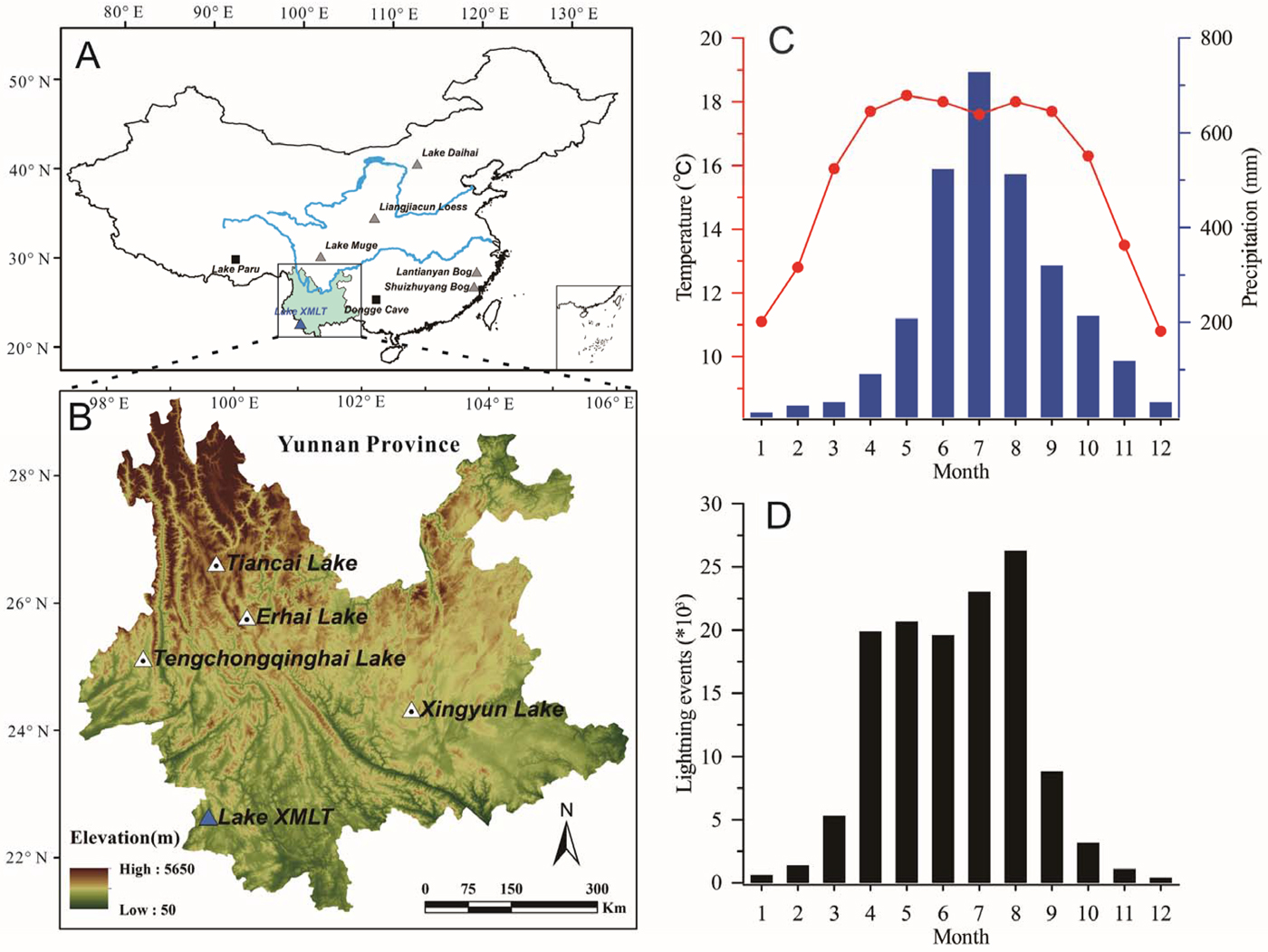
Lake XMLT (22°38.33′N, 99°36.00′E; 1140 m asl) is located in the southeast of Ximeng County, Yunnan Province, southwestern China (Fig. 1A). Its surface area is about 0.5 km2 and its catchment area is about 1.5 km2. They are limited by hills to its southern, western, and eastern sides with elevations ranging from 1300 to 1400 m asl. The maximum water depth is 18.5 m, and the mean water depth is 11.5 m. The lake is mainly recharged by precipitation, catchment runoff, and a perennial inlet stream on its southwestern side. There is an outlet on the eastern side of the lake flowing into the Mengsuo River.
(color online) (A) Location of Yunnan Province and the study sites mentioned in this study, including Paru Co(Morrill et al., Reference Morrill, Overpeck, Cole, Liu, Shen and Tang2006), Lake Muge (Sun et al., Reference Sun, Zhang, Shen, Chen and Liu2016), Liangjiacun Loess profile (Tan et al., Reference Tan, Han, Cao, Chang Huang and An2015), Lake Daihai (Han et al., Reference Han, Marlon, Cao, Jin and An2012), and Dongge Cave (Dykoski et al., Reference Dykoski, Edwards, Cheng, Yuan, Cai, Zhang, Lin, Qing, An and Revenaugh2005) as well as Lantianyan Bog and Shuizhuyang Bog (Zhao et al., Reference Zhao, Ma, Leipe, Long, Liu, Lu, Tang, Zhang, Wagner and Tarasov2017; Ma et al., Reference Ma, Zheng, Man, Dong, Li and Huang2018). (B) Location of Lake Ximenglongtan (XMLT) and the other paleoclimate reconstruction sites (Erhai Lake, Shen et al., Reference Shen, Jones, Yang, Dearing and Wang2006; Tiancai Lake, Zhang et al., Reference Zhang, Chang, Cao, Sun, Shulmeister, Tang, Langdon, Yang and Shen2017; Xingyun Lake, Wu et al., Reference Wu, Chen, Lv, Brenner, Curtis, Zhou, Chen, Abbott, Yu and Chen2018) and fire history records (Tengchongqinghai Lake, Xiao et al., Reference Xiao, Haberle, Li, Liu, Shen, Zhang, Yin and Wang2017a) in the region of the study site. (C) Summary climate data from Ximeng meteorological station showing monthly temperature and precipitation (http://data.cma.cn/). (D) Inter-monthly variation of lightning strikes in southwest China based on satellite observations from 1998–2007 (Wang et al., Reference Wang, Liu, Wang, Mai and Chen2010a).

The study region is characterized by a subtropical humid monsoon climate. It is mainly influenced by warm and humid airflow brought by the ISM from the Indian Ocean and the Bay of Bengal during the summer (Zhang et al., Reference Zhang, Chang, Cao, Sun, Shulmeister, Tang, Langdon, Yang and Shen2017). During the winter, with the southward movement of the planetary wind systems, the climate is mainly controlled by the southern branch of the Westerlies (Zhang et al., Reference Zhang, Chang, Cao, Sun, Shulmeister, Tang, Langdon, Yang and Shen2017). The Ximeng meteorological station (22°37.48′N, 99°36.00′E; 1155 m asl), 1.4 km south from Lake XMLT, records a mean annual air temperature (MAAT) of 15.6°C and a mean annual precipitation of 2806 mm (http://data.cma.cn/ accessed June 2017). Most of the precipitation is concentrated in the rainy season from May to October, which accounts for 75% of the annual precipitation (Fig. 1C). Satellite-based observation data of lightning activity in southwestern China shows that late spring and midsummer is the main lightning activity season when about 85% of lightning flashes in a year occur (Wang et al., Reference Wang, Liu, Wang, Mai and Chen2010a) (Fig. 1D). The combination of dry climate and high lightning activity during the winter and spring makes this area at high risk of forest fires (Lü and Yang, Reference Lü and Yang2011).
MATERIAL AND METHODS
Coring, sampling, and dating
A 1060-cm-long sediment core (XMLT-1) was retrieved from the deepest part of the lake in a water depth of 18 m, using a UWITEC platform coring system in July 2013. The core was subsampled continuously at 1-cm intervals and stored at ~4°C prior to analysis.
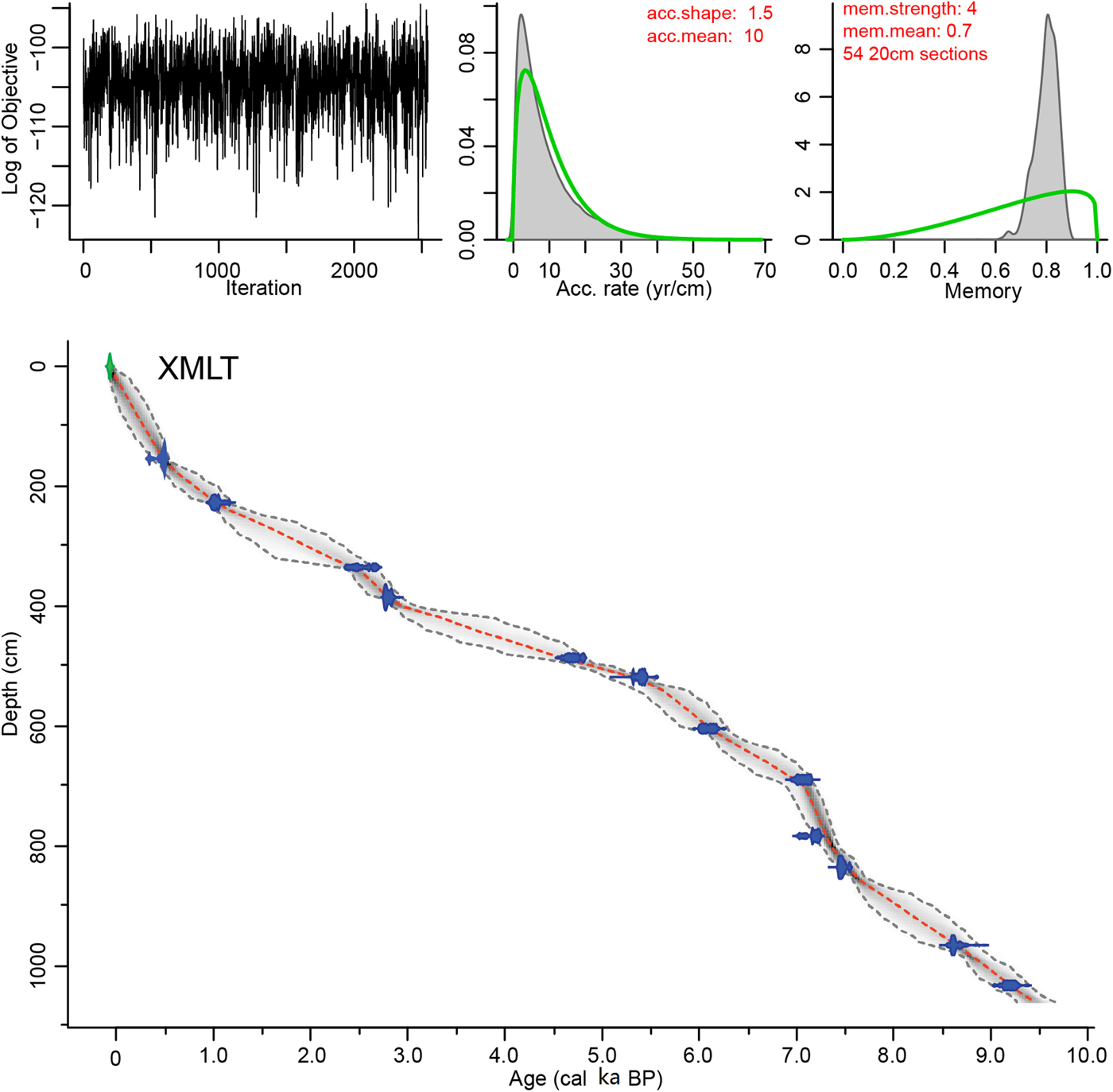
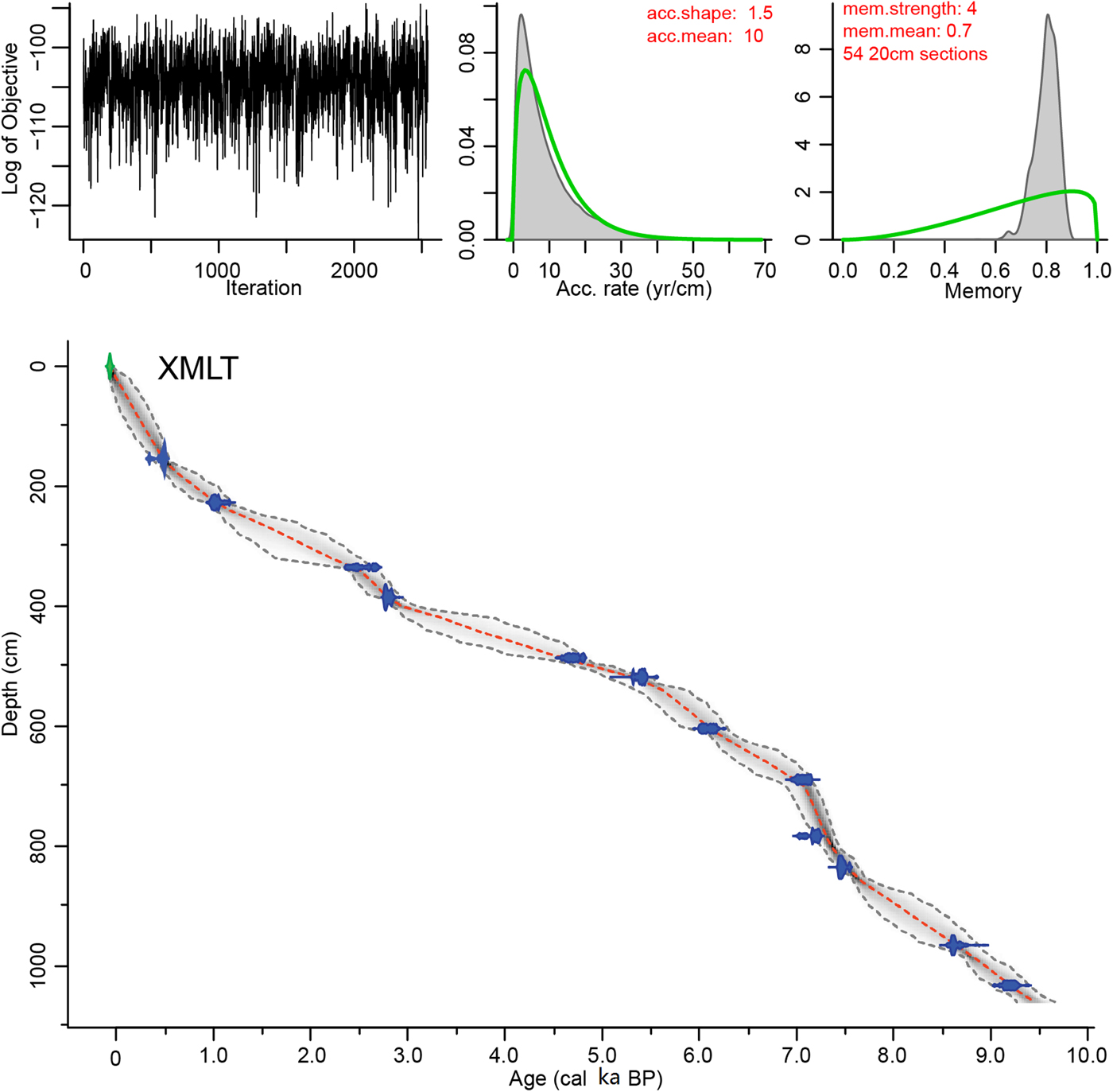
The sediment chronology was established using accelerator mass spectrometry (AMS) 14C dating and the details were described in Ning et al. (Reference Ning, Zhang, Sun, Chang and Shulmeister2017). In brief, 12 dates were obtained from the analysis of terrestrial plant fragments performed at the Beta Analytic Radiocarbon Dating Laboratory (United States). Calibrations of the dates to calendar years BP (0 BP = AD 1950) were processed using the Calib 7.1 program based on the IntCal13 calibration dataset (Reimer et al., Reference Reimer, Bard, Bayliss, Beck, Blackwell, Ramsey and Buck2013). Taking the variation of sedimentation rates into consideration, the depth versus age curve was interpolated using a Bayesian Model in the Bacon program implemented in R 3.1.0 (Braconnot et al., Reference Braconnot, Harrison, Kageyama, Bartlein, Masson-Delmotte, Abe-Ouchi, Otto-Bliesner and Zhao2012). The default setting for lake sediments (memory strength of 4, memory mean of 0.7, and accumulation mean of 10) was used in plotting (Braconnot et al., Reference Braconnot, Harrison, Kageyama, Bartlein, Masson-Delmotte, Abe-Ouchi, Otto-Bliesner and Zhao2012; Reimer et al., Reference Reimer, Bard, Bayliss, Beck, Blackwell, Ramsey and Buck2013; R Development Core Team, 2013). The age of the core top (0 cm) was assumed to be modern and given as ~63 yr BP and the calculated basal age of the core is ~9.4 cal ka BP. The final age-depth relationship is presented in Figure 2.
(color online) Age-depth model for Lake XMLT sediment core produced by Bacon software (Blaauw and Christen, Reference Blaauw and Christen2011). The details of the age model are described in Ning et al. (Reference Ning, Zhang, Sun, Chang and Shulmeister2017).
BC analysis
The core sediments were sampled at a 4-cm interval for analysis of BC content. The chemical method developed by Lim and Cachier (Reference Lim and Cachier1996) was used to extract the BC. In brief, about 1.0 g of powdered dry bulk sediment was treated with HCl (3 M), HF (10 M)/HCl (1 M) and HCl (10 M), in sequence, to remove the carbonates and part of the silicates. The acid-treated samples were dried and powdered and then oxidized using 0.2 M K2Cr2O7/2 M H2SO4 at 55°C for 60 h to remove soluble organic matter and kerogen. The remaining refractory carbon in the residue is regarded as BC, including charcoal and atmospheric soot particles. Dried samples were then ground and homogenized in an agate mortar. The BC content of the treated samples was determined using a Finnigan MAT Delta Plus mass spectrometer coupled with an elemental analyser (Flash EA1122). Replicate analyses of standard samples indicate a precision better than 0.1‰. To avoid the effects of varying deposition rate on the interpretation of BC content, we present the BCMSR (mg/cm2/yr) as a proxy of fire activity, calculated by the following equation:
 $${\rm BCMSR} = {\rm C}_{{\rm BC}}\lpar {\rm \%} \rpar \times {\rm BD}\lpar {{\rm g}/{\rm c}{\rm m}^3} \rpar \times {\rm SR}\lpar {{\rm cm}/{\rm yr}} \rpar $$
where CBC is BC concentration, BD is the bulk density of the sediment, and the SR denotes the sedimentation rate.
RESULTS
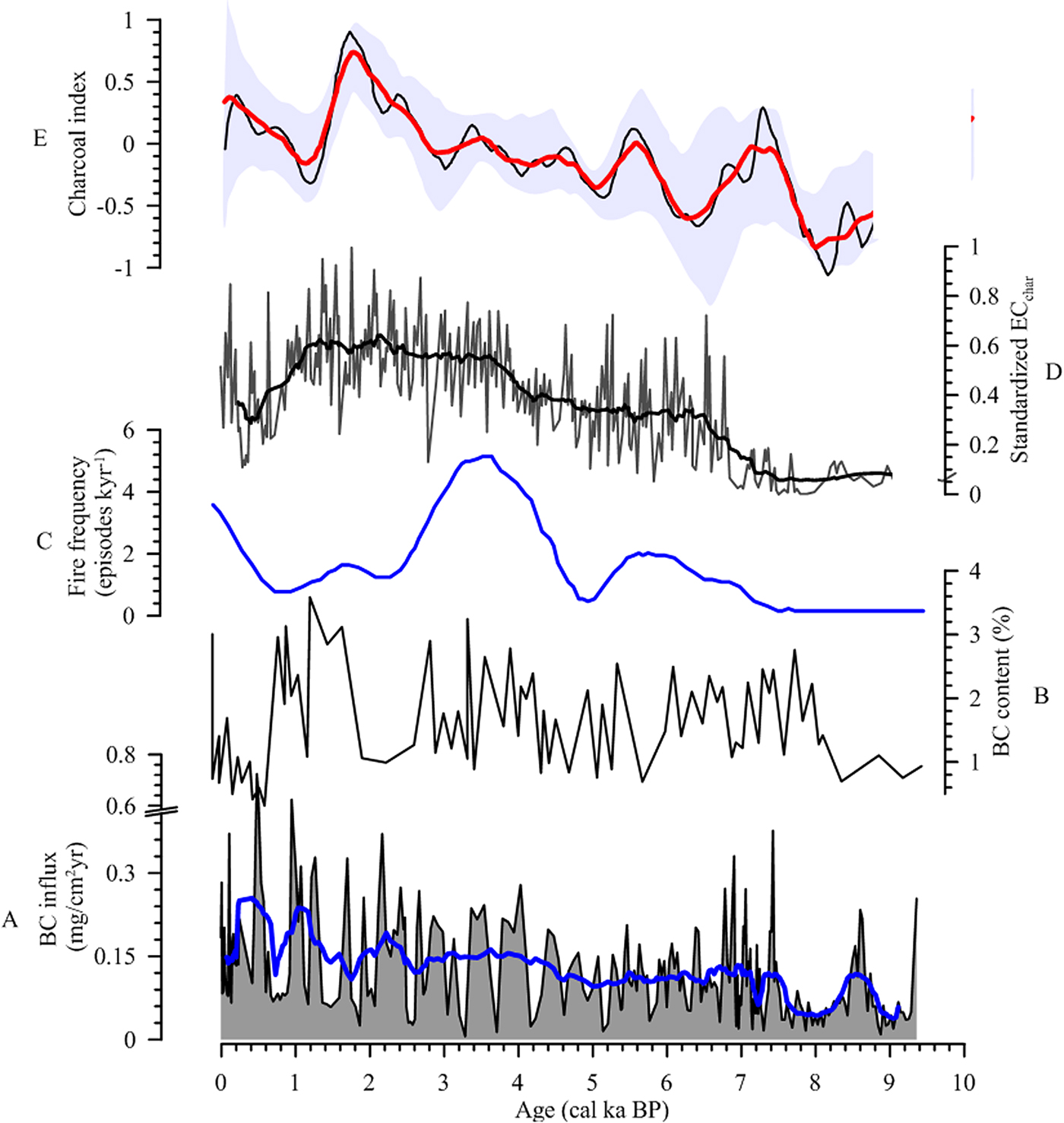
The BCMSR in Lake XMLT ranges from 0.01 to 0.72 mg/cm2/yr with an average of 0.13 mg/cm2/yr. The Holocene long-term (centennial timescale) BCMSR variation based on an 11-sample running mean (400–500-year intervals) can be divided into three intervals: prior to 7.6 cal ka BP, from 7.6 to 2.2 cal ka BP, and from 2.2 cal ka BP to present. From 9.4 to 7.6 cal ka BP, the BCMSR is relatively stable and low with an average of 0.06 mg/cm2/yr. A prominent increase in BCMSR (from 0.04 to 0.38 mg/cm2/yr) occurred around 7.6 cal ka BP, which is followed by a BCMSR plateau (mean 0.14 mg/cm2/yr) between 7.6 and 6.8 cal ka BP. A long-term gradually increasing trend (from 0.09 to 0.37 mg/cm2/yr, mean 0.13 mg/cm2/yr) between 6.8 and 2.2 cal ka BP is observed in the sediment record. Over the last 2.2 ka, the BCMSR (mean 0.20 mg/cm2/yr) increased again with some substantial peaks superimposed on it.
DISCUSSION
Regional fire history in southwestern China
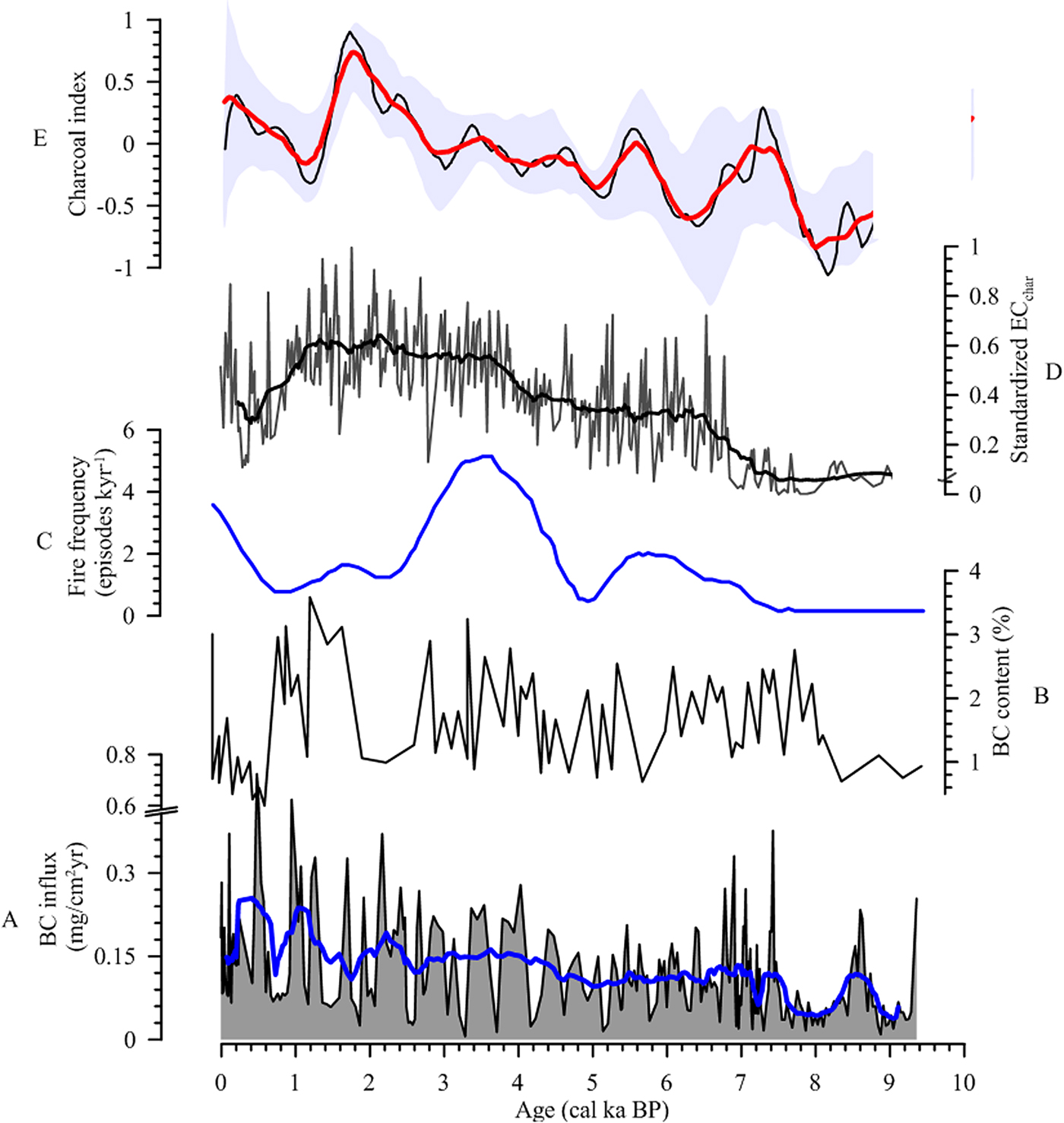
The fire event reconstruction from Lake XMLT reveals that the fire activity was not constant over the Holocene. Relatively low and stable fire incidence occurred during the early Holocene from 9.4 to 7.6 cal ka BP. A notable increase in fire events was observed around 7.6 cal ka BP, and the occurrence of fire continued to gradually increase until 2.2 cal ka BP. The much higher BCMSR and substantial peaks over the last 2.2 ka suggest that the fire activity has increased further with episodes of remarkable fire events. This general pattern of fire regime evolution during the Holocene is consistent with previous studies in southwestern China (e.g., Zhang et al., Reference Zhang, Sun, Zhao, Wang, Xue and Shen2015; Sun et al., Reference Sun, Zhang, Shen, Chen and Liu2016), even though there are temporal differences in the onset of the high fire activity period (Fig. 3B and C). The BC records from Tengchongqinghai crater lake (Fig. 1B) suggest that fire was largely absent during the early Holocene (from 11.1 to 8.0 cal ka BP), while it increased in an irregular manner from 8.0 cal ka BP to the present (Zhang et al., Reference Zhang, Sun, Zhao, Wang, Xue and Shen2015) (Fig. 3B). The BC record from Lake Muge (Fig 1A) in western Sichuan Province, shows a Holocene fire history characterized by a low fire incidence between 9.2 and 5.6 cal ka BP, followed by a relatively high frequency fire phase from 5.6 cal ka BP onward (Sun et al., Reference Sun, Zhang, Shen, Chen and Liu2016). The fire frequency derived from the charcoal record in Tengchongqinghai crater lake (Fig. 1B) was relatively low before 7.5 cal ka BP and increased gradually from 7.5 to 3.0 cal ka BP (Xiao et al., Reference Xiao, Haberle, Shen, Xue, Burrows and Wang2017b) (Fig. 3C). Synthesis of these records indicates a low fire activity period during the early Holocene and a gradually increasing trend over the mid- to late Holocene.
Comparison of fire history recorded in Lake XMLT (A, this study) with that in ISM and EASM regions, including BC record (Zhang et al., Reference Zhang, Sun, Zhao, Wang, Xue and Shen2015, B) and charcoal records (Xiao et al., Reference Xiao, Haberle, Shen, Xue, Burrows and Wang2017b, C) from Lake Tengchongqinghai, element carbon record from Lake Daihai (Han et al., Reference Han, Marlon, Cao, Jin and An2012, D), and the compiled charcoal index for East Asia (Marlon et al., Reference Marlon, Bartlein, Daniau, Harrison, Maezumi, Power, Tinner and Vanniére2013, E). The blue line in curve A shows the 11-sample running mean. Relatively similar fire history during the Holocene has been recorded in both monsoonal areas. (For interpretation of the references to color in this figure legend, the reader is referred to the web version of this article.)
We also observed some differences in the nature of the fire history records. For example, the comparison of the BC content in different lake sediments indicates that the fire activity at higher elevations (Zhang et al., Reference Zhang, Sun, Zhao, Wang, Xue and Shen2015; Sun et al., Reference Sun, Zhang, Shen, Chen and Liu2016) was much stronger than that at lower ones (this study, Supplementary Fig. S1). Fire activity, on multi-decadal to centennial timescales, recorded in different archives was also not synchronous (Zhang et al., Reference Zhang, Sun, Zhao, Wang, Xue and Shen2015; Xiao et al., Reference Xiao, Haberle, Li, Liu, Shen, Zhang, Yin and Wang2017a, Reference Xiao, Haberle, Shen, Xue, Burrows and Wang2017b). These discrepancies indicate that there are local and regional differences in the occurrence of fire. We speculate that this inconsistency can be attributed to local topographic effects and consequent variability in vegetation communities. Southwestern China has very complex topography with nearly north-south aligned mountain ranges widely distributed. These high mountains can result in significant local climatic gradients (Barry, Reference Barry2008), which in turn influence fire regimes through their effects on fuel loads and fuel moisture via site productivity and microclimate (Rollins et al., Reference Rollins, Morgan and Swetnam2002). Furthermore, the characteristics of individual lakes, such as the catchment and surface areas, can also affect the content of burned carbon materials in the sediment sequence through their influences on the primary sediment accumulation rates and the delivery of BC to the lake.
Comparison of fire activity in the ISM and EASM regions
The Holocene fire history inferred from the BC content in Lake XMLT is generally similar to that of the EASM regions. The elemental carbon record from Lake Daihai in northern China indicates that fire activity was relatively low prior to 8.0 cal ka BP and then gradually increased from 8.0 to 2.0 cal ka BP (Han et al., Reference Han, Marlon, Cao, Jin and An2012) (Fig. 3D). Charcoal and BC influx results from the Chinese Loess Plateau show a gradually increasing trend in fire activity during the mid- to late Holocene (Tan et al., Reference Tan, Huang, Pang and Zhou2013; Tan et al., Reference Tan, Han, Cao, Chang Huang and An2015). Most recently, a synthesis of the fire history in the eastern monsoonal region of China shows that the fire activity was low between 9.5 and 7.5 cal ka BP and then increased (Xue et al., Reference Xue, Zhong, Li, Cheng, You, Wei and Shang2018). These results indicate a period of relatively low and stable fire activity during the early Holocene and increasing fire activity over the mid- to late Holocene in both monsoon areas. On a broader spatial scale, similar fire activity during the Holocene is recorded in the composite standardized biomass-burning record from 36 sites in eastern Asia, even though there are some peaks during the early Holocene that might be related to early human impacts on fire regime (Marlon et al., Reference Marlon, Bartlein, Daniau, Harrison, Maezumi, Power, Tinner and Vanniére2013) (Fig. 3E). Similarities in the fire history recorded in the different archives might suggest similar climatic effects on fire activity in monsoonal regions on millennial timescales. If real, those effects should have been governed by the same external forcing.
Climatic forcing of fire occurrence
The incidence of fire is influenced by complex interaction between climatic conditions, fuel availability, and ignition sources (whether anthropogenic or natural [lightning or volcanic]) (Marlon et al., Reference Marlon, Bartlein, Daniau, Harrison, Maezumi, Power, Tinner and Vanniére2013). Paleolimnological records reveal that significant human activity in southwestern China occurred from ~2.2 cal ka BP onwards (Shen et al., Reference Shen, Jones, Yang, Dearing and Wang2006; Wu et al., Reference Wu, Zhou, Liu, Chen, Wei, Sun, Yu, Bloemendal and Chen2014). Archaeological finds also show that the first mass immigration of population into southwestern China occurred at ~2.0 cal ka BP (Zhou and Miao, Reference Zhou and Miao1989). This means that the fire regime changes recorded in Lake XMLT, during the early and middle Holocene (prior to ~2.0 cal ka BP), should reflect natural fire history caused by climate- or edaphic-driven changes rather than human burning practices. Climate change (mainly temperature and precipitation) can influence the fire regime both directly, through influencing ignition, fuel moisture, and the prevalence of fire weather, and indirectly, through changes in vegetation composition and productivity (Daniau et al., Reference Daniau, Harrison and Bartlein2010). From a global perspective, most paleo-fire studies extending to the last glacial period reveal that the fire incidence during warm intervals is generally higher than that during cold intervals (Power et al., Reference Power, Marlon, Ortiz, Bartlein, Harrison, Mayle and Ballouche2007; Daniau et al., Reference Daniau, Bartlein, Harrison, Prentice, Brewer, Friedlingstein and Harrison-Prentice2012; Marlon et al., Reference Marlon, Bartlein, Daniau, Harrison, Maezumi, Power, Tinner and Vanniére2013). This relationship is modulated by precipitation through its effects on fuel availability and fuel moisture (van der Werf et al., Reference van der Werf, Randerson, Giglio, Gobron and Dolman2008; Moritz et al., Reference Moritz, Parisien, Batllori, Krawchuk, Van Dorn, Ganz and Hayhoe2012). In monsoon regions, vegetation curing is critical, and this is related primarily to the volume of precipitation (Zhang et al., Reference Zhang, Sun, Zhao, Wang, Xue and Shen2015; Xiao et al., 2017) and to dry winter season temperatures (Li et al., Reference Li, Hughes, Su, Anberrée, Oskolski, Sun, Ferguson and Zhou2017b) rather than to a simple temperature relationship.
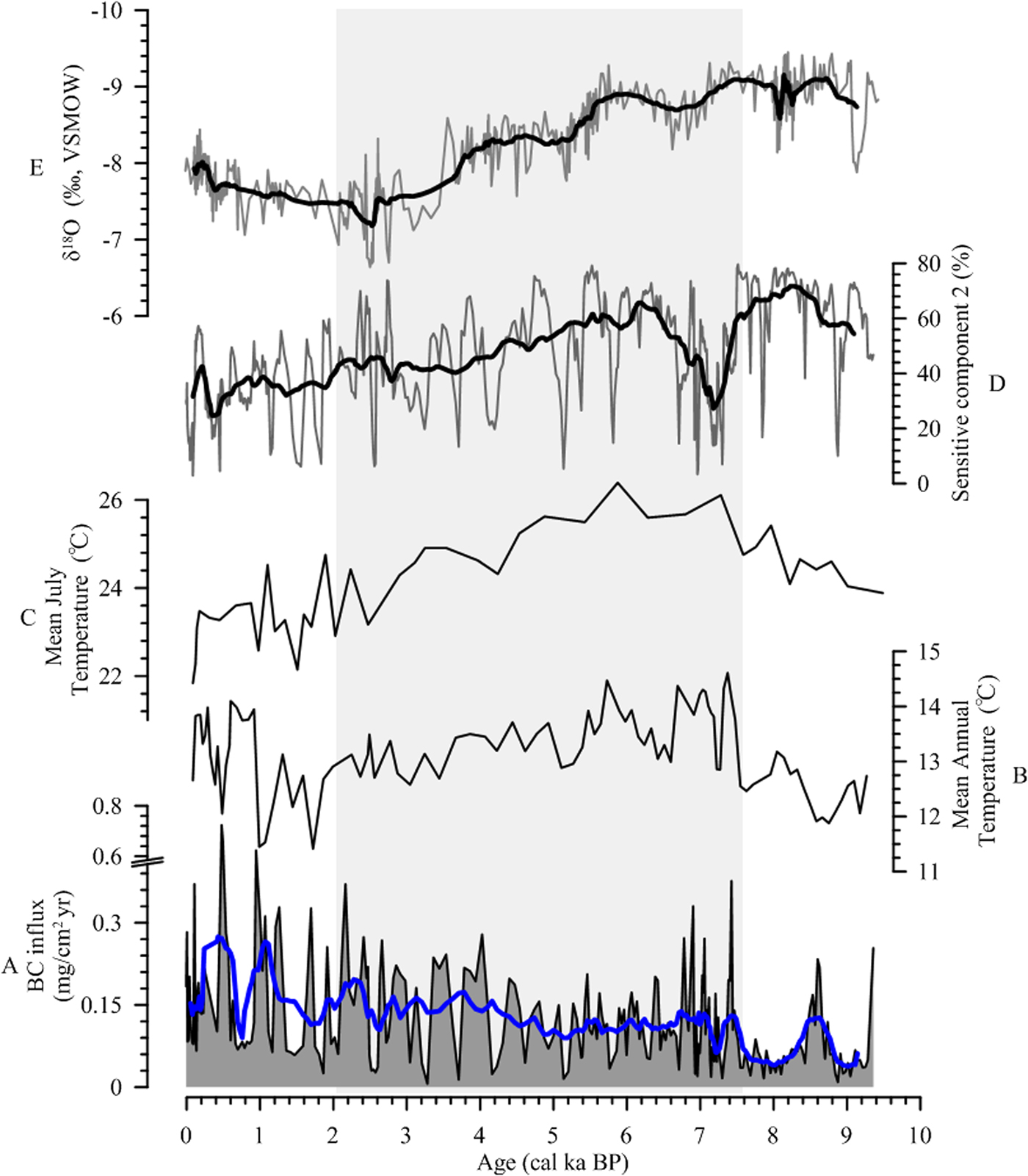
During the early Holocene (from 9.4 to 7.6 cal ka BP), the low fire occurrence recorded in Lake XMLT corresponds well with the cold and humid climate documented in the records from southwestern China (Zheng et al., Reference Zheng, Li, Wang, Naafs, Yu and Pancost2015; Ning et al., Reference Ning, Zhang, Sun, Chang and Shulmeister2017; Zhang et al., Reference Zhang, Chang, Cao, Sun, Shulmeister, Tang, Langdon, Yang and Shen2017). The brGDGT-based MAAT reconstructions from the same core as this study (Ning et al., Reference Ning, Zhang, Shulmeister, Chang, Sun and Ni2019) (Fig. 4B) and those from Hongyuan Bog on the eastern Tibetan Plateau (Zheng et al., Reference Zheng, Li, Wang, Naafs, Yu and Pancost2015) show an especially pronounced cold interval during the early Holocene (before 7.6 cal ka BP). The summer temperatures reconstructed from Lake Tiancai (Zhang et al., Reference Zhang, Chang, Cao, Sun, Shulmeister, Tang, Langdon, Yang and Shen2017) and Lake Xingyun (Wu et al., Reference Wu, Chen, Lv, Brenner, Curtis, Zhou, Chen, Abbott, Yu and Chen2018) (Fig. 4C) in Yunnan Province (Fig. 1B), based on chironomid assemblages and pollen composition, respectively, remain relatively low during the early Holocene. The coarser grain size in Lake XMLT (Ning et al., Reference Ning, Zhang, Sun, Chang and Shulmeister2017) (Fig. 4D) and more negative δ18O value in Dongge Cave (Dykoski et al., Reference Dykoski, Edwards, Cheng, Yuan, Cai, Zhang, Lin, Qing, An and Revenaugh2005) (Fig. 4E) indicate a relatively high precipitation interval during the early Holocene. The explanations for low fire activity response to those climatic conditions are straightforward. Low temperature limited fuel availability (Power et al., Reference Power, Marlon, Ortiz, Bartlein, Harrison, Mayle and Ballouche2007; Daniau et al., Reference Daniau, Harrison and Bartlein2010) and high precipitation increased the fuel moisture (Krawchuk and Moritz, Reference Krawchuk and Moritz2011). Nevertheless, Lake XMLT is located in a subtropical region that is unlike both the main Tibetan Plateau and lowland southern China. Temperature changes during the Holocene can result in changes in the proportion of dominant vegetation types but may have very little influence on overall plant productivity (Xiao et al., Reference Xiao, Haberle, Shen, Xue, Burrows and Wang2017b). Pollen results from an adjacent area in Xishuangbanna (140 km southeast to Lake XMLT) have also confirmed this inference (Gu et al., Reference Gu, Pearsall, Xie and Yu2008). Thus, the fuel biomass should not be the constraining factor for fire activity in this study area (Zhang et al., Reference Zhang, Sun, Zhao, Wang, Xue and Shen2015; Xiao et al., Reference Xiao, Haberle, Shen, Xue, Burrows and Wang2017b). Instead, lower temperature and higher precipitation might have limited lightning ignition (Price, Reference Price2009), shortened the duration of the dry season, and lowered soil moisture deficits, which cumulatively resulted in low fire occurrence (Li et al., Reference Li, Hughes, Su, Anberrée, Oskolski, Sun, Ferguson and Zhou2017b).
Comparison of fire history recorded in Lake XMLT (A, this study) with the climatic proxies from southwestern China (B-E). (B) brGDGTs-based Mean Annual Temprature record from Lake XMLT (Ning et al., Reference Ning, Zhang, Shulmeister, Chang, Sun and Ni2019); (C) Pollen-based Mean July temperature reconstruction from Lake Xingyun (Wu et al., Reference Wu, Chen, Lv, Brenner, Curtis, Zhou, Chen, Abbott, Yu and Chen2018); (D) Sensitive component 2 of grain size indicating the precipitation changes from Lake XMLT (Ning et al., Reference Ning, Zhang, Sun, Chang and Shulmeister2017); (E) Stalagmite δ18O variation from Dongge Cave (Dykoski et al., Reference Dykoski, Edwards, Cheng, Yuan, Cai, Zhang, Lin, Qing, An and Revenaugh2005). The blue and dark black lines in curve A and curve D as well as E is 11 and 31 samples moving average results, respectively. The cool and humid climate during the early Holocene suppressed the fire incidence, while a drier climate from the mid- to late Holocene primarily increased fire evolution instead of temperature. (For interpretation of the references to color in this figure legend, the reader is referred to the web version of this article.)
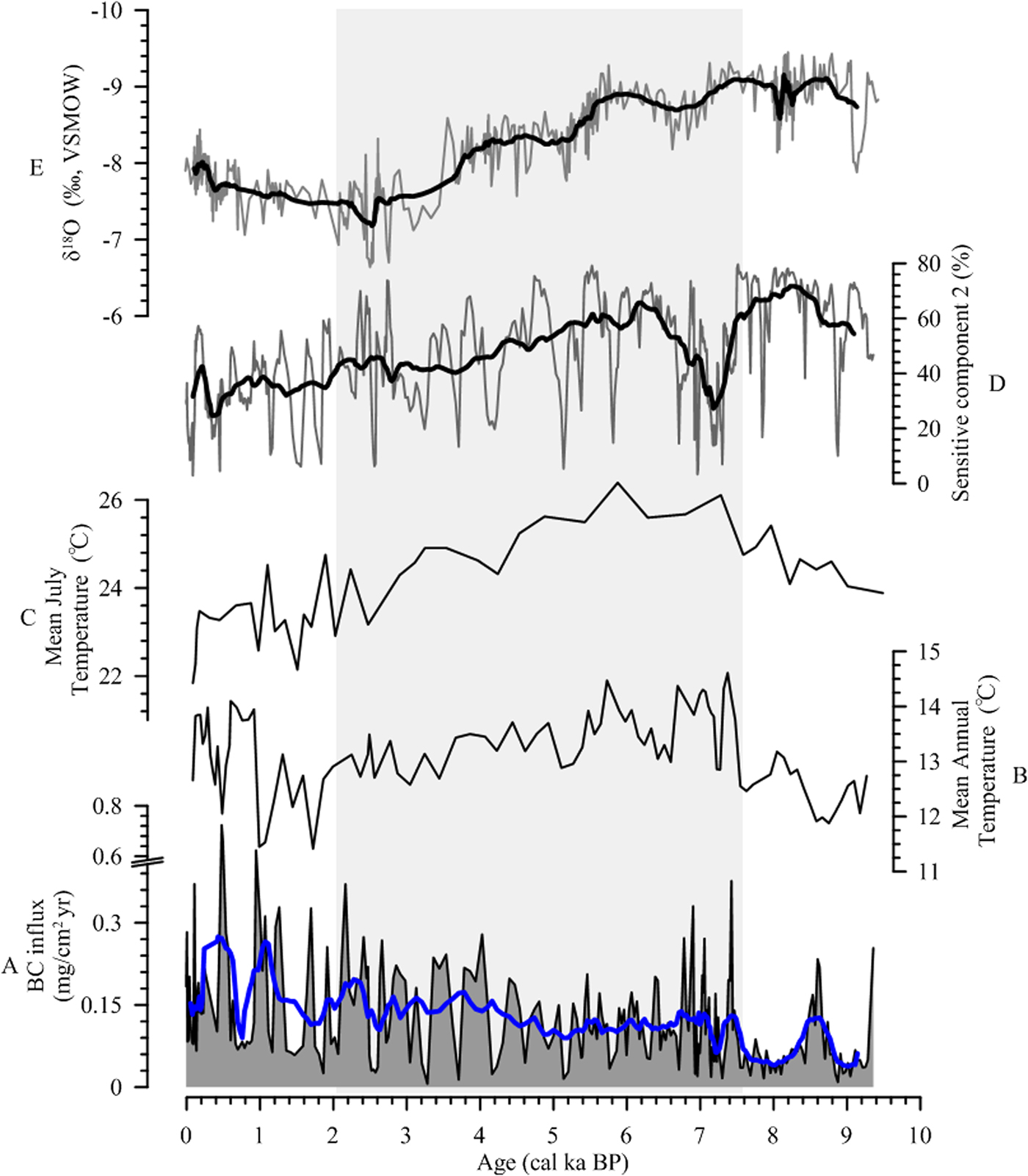
The remarkable increase in fire activity that occurred at ~7.6 cal ka BP agrees well with the abrupt MAAT increase recorded in Lake XMLT at ~7.6 cal ka BP (Ning et al., Reference Ning, Zhang, Shulmeister, Chang, Sun and Ni2019) (Fig. 4B) and in Hongyuan Bog at ~7.8 cal ka BP (Zheng et al., Reference Zheng, Li, Wang, Naafs, Yu and Pancost2015). The ensuing higher fire activity period between 7.6 and 6.8 cal ka BP is closely coincident with a higher temperature interval recorded in previous studies (Zheng et al., Reference Zheng, Li, Wang, Naafs, Yu and Pancost2015; Wu et al., Reference Wu, Chen, Lv, Brenner, Curtis, Zhou, Chen, Abbott, Yu and Chen2018). Furthermore, this interval of higher fire activity is also identical to the drier climate that occurred around 7.5 cal ka BP, which is reflected in adjacent records (Morrill et al., Reference Morrill, Overpeck, Cole, Liu, Shen and Tang2006; Zhang et al., Reference Zhang, Wang, Sun and Shen2016). A warmer climate is expected to enhance fire-supporting weather through increasing lightning ignitions (Price, Reference Price2009) and drought duration (IPCC, 2007), which in turn accelerates fuel curing leading to higher fire occurrence (van der Werf et al., Reference van der Werf, Randerson, Giglio, Gobron and Dolman2008; Daniau et al., Reference Daniau, Bartlein, Harrison, Prentice, Brewer, Friedlingstein and Harrison-Prentice2012). In addition, drier climates have also been proposed to have an effect on cloud microphysics through increasing suspended aerosols and cloud condensation nuclei (Williams et al., Reference Williams, Rosenfeld, Madden, Gerlach, Gears, Atkinson and Dunnemann2002), which leads to increased lightning activity (Price, Reference Price2009). Thus, the combined effect of higher temperature and lower precipitation during this interval could have facilitated the occurrence of fires.
During the mid- to late Holocene (between 7.6 and 2.2 cal ka BP), a gradual increase in fire activity occurred in concert with the weakening of ISM intensity as suggested from stalagmite δ18O values (Dykoski et al., Reference Dykoski, Edwards, Cheng, Yuan, Cai, Zhang, Lin, Qing, An and Revenaugh2005) (Fig. 4E), pollen (Xiao et al., Reference Xiao, Haberle, Shen, Yang, Han, Zhang and Wang2014; Zhang et al., Reference Zhang, Wang, Sun and Shen2016), and modelling results (Jin et al., Reference Jin, Schneider, Park, Latif, Khon and Zhang2014). In particular, the notable increase of fire incidence initiated at ~5.0 cal ka BP corresponds well with the onset of much lower precipitation as recorded in previous studies. The pollen-based MAP reconstruction results from Xingyun Lake show a drier climate after ~5.0 cal ka BP (Chen et al., Reference Chen, Chen, Chen, Zhou, Wu, Tang, Zhang, Huang and Yu2014). The pollen record from Lake Wuxu in southwestern China indicates that summer precipitation has decreased significantly since ~4.9 cal ka BP (Zhang et al., Reference Zhang, Wang, Sun and Shen2016). Hydrogen isotopes (δ2H) of leaf wax from Paru Co in the southeastern Tibetan Plateau records a marked ISM rainfall decline after ~5.2 cal ka BP (Bird et al., Reference Bird, Polisar, Lei, Thompson, Yao, Finney, Bain, Pompeani and Steinman2014). All those results demonstrate a close negative correlation with the amount of precipitation delivered by the ISM (Supplementary Figure 2), which indicates that the moisture content might have primarily controlled fire occurrence in this monsoon dominated region. However, during this period, neither the MAAT (Zheng et al., Reference Zheng, Li, Wang, Naafs, Yu and Pancost2015; Ning et al., Reference Ning, Zhang, Shulmeister, Chang, Sun and Ni2019) (Fig. 4B) nor the summer temperature declined (Zhang et al., Reference Zhang, Chang, Cao, Sun, Shulmeister, Tang, Langdon, Yang and Shen2017; Wu et al., Reference Wu, Chen, Lv, Brenner, Curtis, Zhou, Chen, Abbott, Yu and Chen2018) (Fig. 4C). Unlike the early Holocene when cool temperatures inhibited fire, the temperature decline here is associated with a reduced summer monsoon and a consequently drier climate. This relationship between climate and fire is different from that inferred on a global scale (Power et al., Reference Power, Marlon, Ortiz, Bartlein, Harrison, Mayle and Ballouche2007; Marlon et al., Reference Marlon, Bartlein, Daniau, Harrison, Maezumi, Power, Tinner and Vanniére2013) but is similar to the results in other monsoon regions of China (Tan et al., Reference Tan, Huang, Pang and Zhou2013; Tan et al., Reference Tan, Han, Cao, Chang Huang and An2015; Xiao et al., Reference Xiao, Haberle, Shen, Xue, Burrows and Wang2017b).
External forcing of fire variation
On millennial timescales, climate-fire linkages are governed by changes in the latitudinal distribution of solar radiation (Marlon et al., Reference Marlon, Bartlein, Daniau, Harrison, Maezumi, Power, Tinner and Vanniére2013). This can influence the seasonality of temperature and precipitation by impacting large-scale atmospheric circulation patterns, such as the position of the intertropical convergence zone (ITCZ) (Fleitmann et al., Reference Fleitmann, Burns, Mudelsee, Neff, Kramers, Mangini and Matter2003) and the strength of the ISM (Kutzbach, Reference Kutzbach1981; Fleitmann et al., Reference Fleitmann, Burns, Mangini, Mudelsee, Kramers, Villa and Neff2007). The orbitally-induced reduction of Northern Hemisphere (NH) summer insolation (Laskar et al., Reference Laskar, Robutel, Joutel, Gastineau, Correia and Levrard2004) (Fig. 5F), over the Holocene, gradually reduced the land-sea thermal contrast and, therefore, the monsoonal rainfall was unable to penetrate as far northward. The southward migration of ITCZ and the weakening of ISM have resulted in a gradual decline in the precipitation in southwestern China (Zhang et al., Reference Zhang, Wang, Sun and Shen2016; Zhang et al., Reference Zhang, Sun, Chang, Ning and Shulmeister2018). Insufficient recharge of root-zone moisture reserves caused by reduced monsoonal precipitation may limit transpiration and canopy humidity in the following dry season (Chen et al., Reference Chen, Morton, Andela, van der Werf, Giglio and Randerson2017). This favours fuel desiccation and allows fires to grow larger and more intense. In addition, we observed that the evolution of the fire regime at Lake XMLT generally follows the increasing trend of NH winter insolation (Laskar et al., Reference Laskar, Robutel, Joutel, Gastineau, Correia and Levrard2004) (Fig. 5F). Higher insolation increased the sensible heat flux as well as the Bowen ratio (sensible heat flux/latent heat flux) in dry seasons, which increased the cloud base height and the efficiency of lightning production, leading to higher fire incidence (Toumi and Qie, Reference Toumi and Qie2004). In addition, higher insolation might have also increased the dry season temperature that was proposed as the main factor controlling the frequency of fire in southwestern China in Maxent modelling results (Li et al., Reference Li, Hughes, Su, Anberrée, Oskolski, Sun, Ferguson and Zhou2017b). Therefore, we infer that the combined effects of summer and winter insolation, during the Holocene, have predominantly controlled fire activity by influencing summer precipitation and winter/spring temperature, respectively, and hence both fuel moisture and curing.
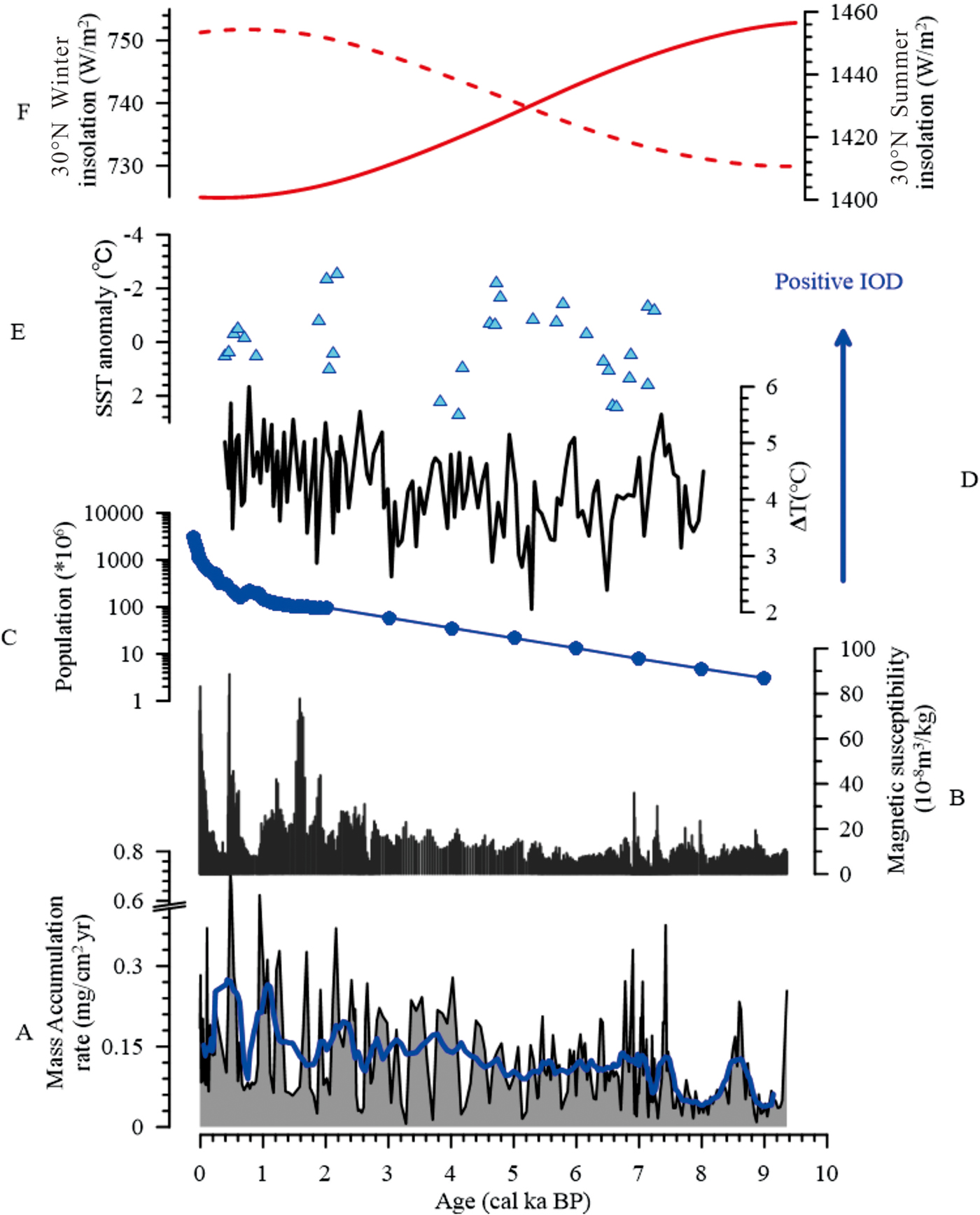
Comparison of fire history recorded in Lake XMLT (A) with the possible natural and anthropogenic drivers, including (B) historical catchment erosion reflected by sediment magnetic susceptibility in Lake XMLT indicating catchment erosion; (C) Holocene population changes in Asia regions (Marlon et al., Reference Marlon, Bartlein, Daniau, Harrison, Maezumi, Power, Tinner and Vanniére2013); (D) the upper water vertical temperature gradient in the eastern Indian Ocean (Kwiatkowski et al., Reference Kwiatkowski, Prange, Varma, Steinke, Hebbeln and Mohtadi2015); (E) Coral Sr/Ca-based Sea Surface Temperature (SST) estimation from the Mentawai Islands in the eastern Indian Ocean (Abram et al., Reference Abram, McGregor, Gagan, Hantoro and Suwargadi2009); and (F) Orbital-scale 30°N insolation changes during winter (dashed line) and summer (solid line) (Laskar et al., Reference Laskar, Robutel, Joutel, Gastineau, Correia and Levrard2004). The blue line in curve A shows the 11-sample running mean. Both boreal summer and winter insolation are important in Holocene fire variation in this monsoonal area and the IOD events have an impact on the fire activity on multidecadal timescale. Catchment erosion cuased by increasing human activity during the late Holocene diluted the fire signal. (For interpretation of the references to color in this figure legend, the reader is referred to the web version of this article.)
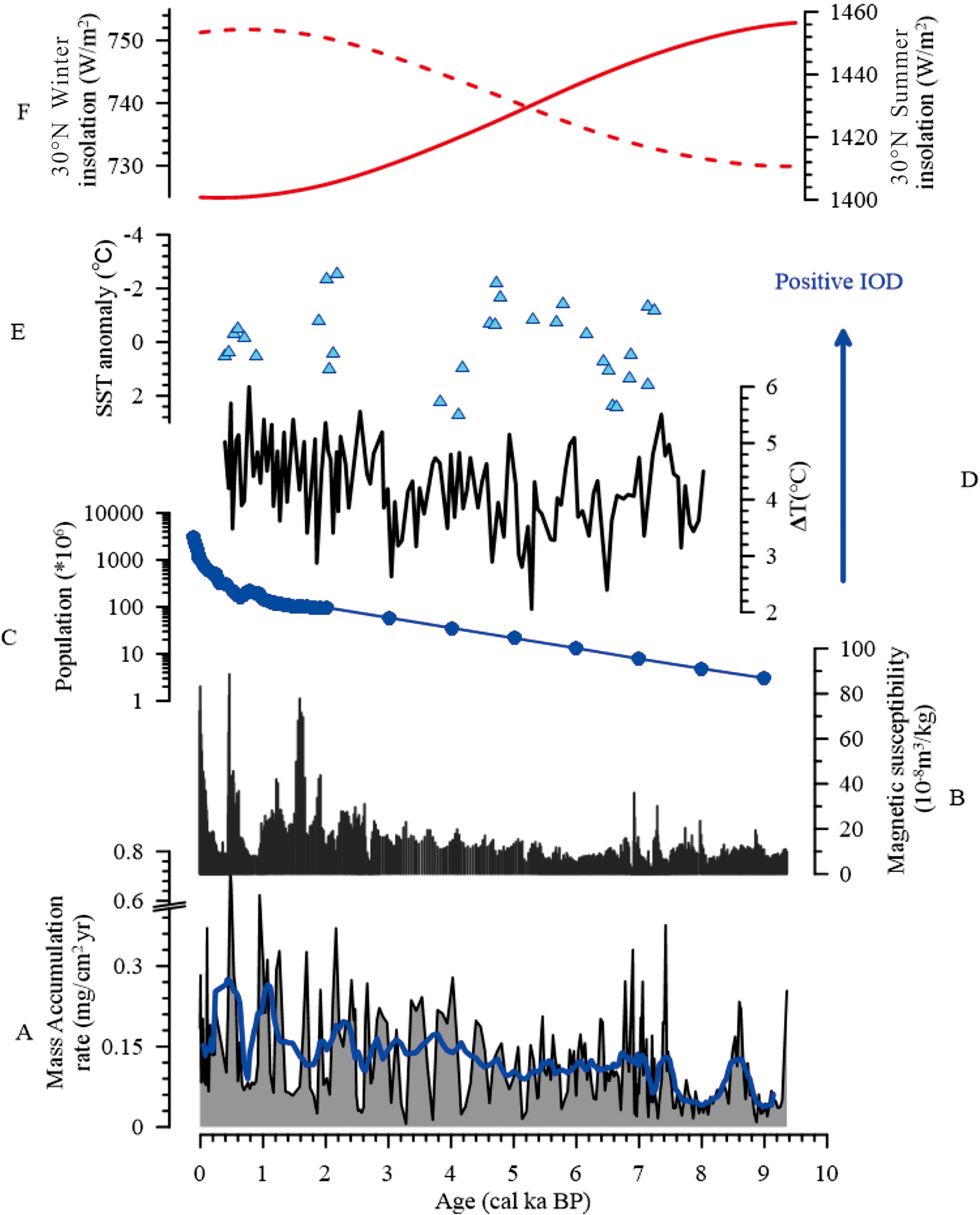
Another critical factor in shaping the fire patterns in Indian monsoon regions may be related to the Indian Ocean Dipole (IOD) phenomenon because of its significant influence on the ISM intensity (Ashok et al., Reference Ashok, Guan, Saji and Yamagata2004; Crétat et al., Reference Crétat, Terray, Masson, Sooraj and Roxy2017; Li et al., Reference Li, Liu, Wang, Herzschuh, Ni, Liao and Xiao2017a). Previous studies suggested that IOD events could directly influence the ISM through modifying the local Walker and Hadley cell over the Indian Ocean (Guan et al., Reference Guan, Ashok and Yamagata2003; Ashok et al., Reference Ashok, Guan, Saji and Yamagata2004; Pokhrel et al., Reference Pokhrel, Chaudhari, Saha, Dhakate, Yadav, Salunke, Mahapatra and Rao2012). During positive (negative) IODs, an enhanced ascending (descending) and a northward (southward) shift of the uplifting branch of the Hadley cell bring more (less) moisture from the south into the monsoon trough regions (Pokhrel et al., Reference Pokhrel, Chaudhari, Saha, Dhakate, Yadav, Salunke, Mahapatra and Rao2012). In addition, the warm (cold) western Indian Ocean during positive (negative) IODs can produce an anomalous anticyclonic (cyclonic) circulation at the low levels over the Bay of Bengal (BB) and eastern Arabian Sea, which can induce a westerly (easterly) wind anomaly (Yuan and Cao, Reference Yuan and Cao2013). Both phenomena can increase (decrease) the moisture transport from BB to the continent. Thus, changes in monsoonal precipitation induced by IOD events would significantly influence plant mortality and fuel moisture and hence the fire incidence. In our study, the notable increase in the BC content at 7.0 cal ka BP corresponds well with the prominent increase in the Sea Surface Temperature in the eastern Indian Ocean, reflecting a negative IOD interval (Abram et al., Reference Abram, McGregor, Gagan, Hantoro and Suwargadi2009) (Fig. 5E). The periods of relatively high sedimentary BC content (e.g., 4.6–4.2, 3.4–3.7, and 3.2–2.6 cal ka BP) occurred in concert with the deepening of thermocline in the eastern IOD, which also indicates a negative IOD event (Kwiatkowski et al., Reference Kwiatkowski, Prange, Varma, Steinke, Hebbeln and Mohtadi2015) (Fig. 5D). These observations suggest that the fire history in southwestern China has been impacted by changing IOD conditions over the Holocene.
Possible human impacts on fire records
Over the last 2.2 cal ka BP, the increasing BCMSR indicates an interval of much higher fire activity. This is consistent with the drier and warmer climate reflected by the grain size and branched glycerol dialkyl glycerol tetraethers (brGDGTs) records in Lake XMLT (Ning et al., Reference Ning, Zhang, Sun, Chang and Shulmeister2017, Fig. 4B; Ning et al., Reference Ning, Zhang, Shulmeister, Chang, Sun and Ni2019, Fig. 4D). However, we observed that there are episodes of much higher BCMSR than in previous intervals, reflecting either more fire incidence or higher fire intensity during the late Holocene. This phenomenon cannot be solely attributed to changes of climate conditions, since the magnitudes of drought and warming during this period have not exceeded that of the mid-Holocene. Another possible explanation comes from the intensified human effects on fire incidence. Paleolimnological study from Lake Erhai demonstrated that human turbulence has occurred as early as 7.5 cal ka BP (Dearing et al., Reference Dearing, Jones, Shen, Yang, Boyle, Foster, Crook and Elvin2008). However, significant human activity in southwestern China occurred from ~2.2 cal ka BP onwards (Shen et al., Reference Shen, Jones, Yang, Dearing and Wang2006; Song et al., Reference Song, Yao, Wortley, Paudayal, Yang, Li and Blackmore2012; Xiao et al., Reference Xiao, Haberle, Shen, Xue, Burrows and Wang2017b). Large-scale migration of Han peoples to Yunnan Province initiated at ~2.0 cal ka BP (Elvin et al., Reference Elvin, Crook, Jones and Dearing2002). Since then, Ximeng County was under the control of the Han Dynasty and subsequent Chinese dynasties (He and Xia, Reference He and Xia2011). The increasing human population would have increased deforestation by slash-and-burn for agricultural purposes. The increasing mining and smelting in the adjacent area, as indicated by increasing concentrations of heavy metals in sediments from Lake Erhai, Xingyun, and Shudu (Dearing et al., Reference Dearing, Jones, Shen, Yang, Boyle, Foster, Crook and Elvin2008; Jones et al., Reference Jones, Cook, Zhang, Langdon, Jordan and Turney2012; Wu et al., Reference Wu, Zhou, Liu, Chen, Wei, Sun, Yu, Bloemendal and Chen2014), should have also increased the fuel combustion. Both processes can contribute to the BC deposition. Furthermore, the notable increase in magnetic susceptibility over the last 2.2 ka provides further evidence for the intensified human activities (Fig. 5B). Thus, we infer that the higher BCMSR during the late Holocene more likely resulted from increasing artificial fire, reflecting human impacts on fire activity.
CONCLUSIONS
In this study, we analysed the BCMSR from Lake XMLT spanning the last ~9.4 ka and linked it to climate changes and human activities. Our results show that the sedimentary BCMSR before 2.2 cal ka BP provides a natural fire history record, which is closely related to climate-driven changes. The relatively higher BCMSR over the last 2.2 ka indicates higher fire occurrence that can be attributed to intensified human-induced fire events. The relatively cool and humid climate during the early Holocene limited lightning ignition and increased the fuel moisture, which in turn decreased the fire incidence, while the opposite phenomenon occurred around 7.6 cal ka BP. Instead of temperature, the gradual decrease in monsoonal precipitation caused by the weakening ISM predominantly increased the fire occurrence during the mid- to late Holocene (from 7.6 to 2.2 cal ka BP). On a millennial timescale, we observe that the BCMSR varied inversely with NH summer insolation but in conjunction with NH winter insolation. This indicates that both summer and winter insolation are important in Holocene fire variation in this monsoonal area through their influence on monsoonal precipitation and fire season temperature, respectively. Furthermore, our results suggest that the IOD has also affected the fire incidence through its influence on monsoon intensity.
ACKNOWLEDGMENTS
We would like to thank Dr. Rong Chen, Dr. Ming Ji, and Dr. Hongqu Tang for field assistance. We thank Prof. Langdon and two anonymous reviewers for the comments on this paper. This research was supported by the National Natural Science Foundation of China (No. 41888101, 41572337) and the Program of Global Change and Mitigation (2016YFA0600502). Dongliang Ning is funded by a scholarship from the UCAS Joint PhD Training Program.
SUPPLEMENTARY MATERIAL
The supplementary material for this article can be found at https://doi.org/10.1017/qua.2019.57.