Introduction
ENT disorders are frequently encountered by many non-ENT doctors including general practitioners and emergency department doctors.Reference Donnelly, Quraishi and McShane 1 , Reference Lennon, O'Donovan, O'Donoghue and Fenton 2 ENT problems are common, with a study of participants aged over 14 years identifying the prevalence of hearing loss as 18 per cent, tinnitus as 17 per cent, runny nose as 15 per cent, hay fever as 18 per cent, severe sore throat as 31 per cent and dizziness as 29 per cent.Reference Hannaford, Simpson, Bisset, Davis, McKerrow and Mills 3 ENT problems account for 1.5 per cent of emergency department attendances (overall, the commonest identified first diagnosis is dislocation, fracture, joint injury or amputation, at 4.6 per cent). Seventy-two per cent of general practitioners see at least three children with ENT problems each day, and half of the children that a general practitioner sees will have ENT problems.Reference Donnelly, Quraishi and McShane 1 , Reference Lennon, O'Donovan, O'Donoghue and Fenton 2 , Reference Baker 4 Referrals to ENT account for 13 per cent of all general practitioner referrals to secondary care, making ENT the third commonest specialty group referred to.Reference Coulter, Noone and Goldacre 5
However, the structure of post-graduate training is such that not all non-ENT doctors will rotate through ENT; therefore, ENT in the undergraduate curriculum assumes a relatively greater importance compared to other specialties.Reference Donnelly, Quraishi and McShane 1 , Reference Clamp, Gunasekaran, Pothier and Saunders 6 However, a 2004 study in the UK found that only 78 per cent of medical schools had a compulsory ENT attachment, and the average length of time spent in ENT was one and a half weeks.Reference Mace and Narula 7 Both the proportion of medical schools offering undergraduate ENT training and the duration of attachment appear to have reduced recently.Reference Khan and Saeed 8 Numerous surveys have shown that most junior doctors in emergency medicine, general practice and other specialties feel that an increase in undergraduate ENT training is warranted.Reference Lennon, O'Donovan, O'Donoghue and Fenton 2 , Reference Clamp, Gunasekaran, Pothier and Saunders 6 , Reference Sharma, Machen, Clarke and Howard 9 , Reference Powell, Cooles, Carrie and Paleri 10 A link to patient care has also been shown, as the quality of care was lower (as defined by higher emergency admission rates) in hospitals where the ENT first on-call tier service was provided by generic junior doctors rather than by ENT-specific doctors.Reference Evans, Backhouse and Owens 11
Taking all of this into consideration, it is necessary that the pressured undergraduate ENT syllabus focuses on the most important topics.Reference O'Dunn-Orto, Hartling, Campbell and Oswald 12 Our research aimed to define these topics, and to establish what relevant stakeholders think of ENT knowledge amongst non-ENT doctors and what they think of undergraduate ENT teaching.
A literature review of research with similar aims identified only one publication; that study was a two-round Delphi review investigating which topics should be included in the undergraduate ENT curriculum.Reference Lloyd, Tan, Taube and Doshi 13 The methodology used in that study differs significantly from this paper. The results and differences of the two studies are compared in the discussion.
Materials and methods
Several methods for informing the content and design of medical curricula have been previously described in the literature, including panels of experts, surveys and Delphi reviews. In our study, we adopted a mixed methods (qualitative and quantitative) approach to establish the opinions of ENT clinicians and other important stakeholders. Mixed methods were employed to provide both qualitative and quantitative data. The qualitative data allows greater insight into the subjective components of answers to our research questions, whilst the quantitative data serves primarily to facilitate prioritisation of responses and secondarily to validate some of the qualitative-based interpretations. Hence, qualitative and quantitative data contribute in different but complementary ways to the analysis and final conclusions.Reference Dicicco-Bloom and Crabtree 14 , Reference Giddings and Grant 15
Clinicians were interviewed to identify a set of important ENT topics. These were then used to develop an online questionnaire, which was distributed to clinicians and students. The interviewees’ opinions on current ENT knowledge and undergraduate ENT teaching were also explored and analysed using principles of thematic analysis, as described by Braun and Clarke.Reference Braun and Clarke 16 Thematic analysis is a qualitative research method that allows the identification of themes and patterns. Ethical approval for this anonymised study was obtained from Dundee University Research Ethics Committee.
Interviews
The telephone interview was chosen as the method to address our aims, as interviews are able to explore views, experiences and beliefs of individuals on specific matters.Reference Braun and Clarke 16 – Reference Opdenakker 18 Focus groups would be an alternative, but participants may have been more reluctant to engage with the discussions, disclose personal deficiencies or criticise others. Simple questionnaires were also discounted because of the comparatively basic data provided.Reference Braun and Clarke 16 Communication asynchronous in time and/or place (e.g. e-mail, online messages) was also deemed inappropriate as such methods suffer from a lack of instantaneous response and no social cues, verbal or non-verbal, which ultimately may lead to compromised data.Reference Opdenakker 18 Logistically, the telephone interview was chosen in order to increase convenience for the participant. Although the telephone interview lacks non-verbal cues, the slight anonymity given by the telephone may afford a freer discussion.Reference Novick 19
The following questions were asked: (1) ‘What do you think of current ENT knowledge amongst non-ENT doctors?’; (2) ‘What do you think of current ENT undergraduate teaching?’; (3) ‘Are there any gaps in ENT knowledge amongst non-ENT doctors?’; (4) ‘What are the really important areas that should be covered in the undergraduate curriculum?’; (5) ‘What do you think is currently not taught enough?’; (6) ‘Is there anything that is taught too much at present?’; and (7) ‘What should ENT professionals be doing to improve ENT teaching?’
The questions were intended to generate data that capture the breadth and depth of the interviewees’ opinions about the topic, thus allowing development of a suitably focused and relevant questionnaire, where important topics would be chosen by a greater range of different stakeholders. The interviews were semi-structured with open questions, and there was flexibility to adjust question order and to probe into answers.Reference Braun and Clarke 16 , Reference Gill, Stewart, Treasure and Chadwick 17 The first interview was initially considered a pilot; however, no amendment to the interview design was required.
The interviews were recorded, anonymised and immediately transcribed in full. The data were then analysed with NVivo 10.2.1 software (QSR International, Melbourne, Australia) using principles of thematic analysis.Reference Braun and Clarke 16
In an effort to maximise the potential detection of opinion diversity in the sample, purposive sampling was used; a wide range of participants, including ENT, non-ENT, general practitioner and emergency department trainees, ENT-based medical students, ENT and emergency department consultants, emergency nurse practitioners, and general practitioners, were invited to join in both parts of the study (i.e. interviews and questionnaire). Patients were not included as it was felt that an element of broad medical knowledge was required. Participants were recruited via explanatory posters and participant information sheets. These materials were distributed locally. In order to remove conflicts of interest, there were no line-management or tutor responsibilities between the researchers and the participants.
Eight preliminary interviews were conducted with the following: three ENT registrars, two foundation doctors, one general practitioner, one general practitioner trainee and one psychiatry trainee. All interviewees had either current or previous ENT experience, or had an interest in ENT. The interviews lasted on average 9.5 minutes.
There is no standardised way of determining appropriate sample size in qualitative research.Reference Sandelowski 20 However, Fugard and Potts provide a framework for sample size in thematic analysis, based on expected population theme prevalence and how many instances of theme occurrence are desired.Reference Fugard and Potts 21 In our study, one occurrence of a topic was deemed sufficient to justify inclusion, and we set out to identify themes that are important to 25 per cent of clinicians. Using the Fugard and Potts method, our study was sufficiently powered, as eight interviewees would give an 80 per cent power of observing one instance of a topic that is important to 25 per cent of those interviewees.
Questionnaire design and distribution
The ENT topics identified in the interviews were used to devise an online questionnaire that examined how stakeholders rated and prioritised ENT undergraduate topics. A questionnaire is a time-efficient way of collecting numerous responses from geographically dispersed participants, and is ideal for closed questions where a ranking of options (i.e. prioritisation) is required.Reference Leung 22 , 23
Having considered other methods, we chose a four-point descriptive categorical scale with ranked answers (not important, somewhat important, quite useful, very important) to ensure that a decision was made by the responder, one way or the other (unlike with a five-point scale).
Initially, the Survey Monkey® based online questionnaire was successfully piloted amongst four ENT registrars. E-mail with snowball sampling was considered to be the most appropriate means of distribution.Reference Yager, Kunkle, Fochtmann, Reid, Plovnick and Nininger 24 The main predicted drawback of this was the inability to determine true response rate; however, we felt this was an acceptable compromise when compared to the alternatives. 25 Approximately 285 stakeholders were estimated to have received the invitation to participate. Amongst the stakeholders, there were the interviewees, national ENT contacts of the interviewees and the senior author, regional general practitioners and general practitioner trainees, emergency department doctors, emergency nurse practitioners, and local final-year medical students.
Forty-four people took part: an estimated 15.5 per cent response rate. There were 32 qualified doctors; 6 were general practitioners, 4 were consultants (1 in ENT), and a total of 7 of the doctors specialised in ENT. The other 12 participants were medical students.
What constituted sufficient importance for inclusion of the topic in the proposed curriculum was not decided in advance, as we did not know what to expect from the data. Instead, we categorised the data once collected, in order to define suitable topic inclusion criteria.
Statistical analysis was carried out using IBM SPSS® version 22. Differences in proportion were analysed using the Fisher's exact test.
Results
Interview-identified themes
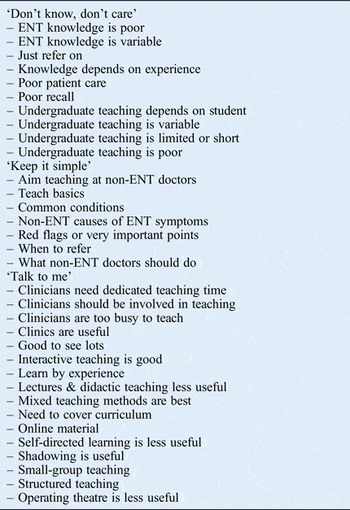
Complete coding across the entire dataset was undertaken, with individual data extracts coded in as many ways as applicable. A mixture of data-derived semantic codes (typically clinical conditions) and researcher-derived codes were used.Reference Braun and Clarke 16 Coded data were then further reviewed to identify three non-hierarchical themes. Table I shows the themes and all the identified associated codes, which are discussed further in the remainder of this section.
Themes and associated codes

‘Don't know, don't care’
This theme suggests that some doctors know little about ENT and do not care either. For example, ENT knowledge was described by interviewees as ‘non-existent’, ‘limited’, ‘could be better’, ‘lacking’, ‘poor’ and ‘sparse’. As a result, patients were ‘managed quite poorly’ and ‘inappropriately treated’. Lack of interest in ENT was also apparent, ‘… if it's an ENT problem, you just refer. … They'd refer people without having examined them’ (Dr A). Furthermore, ENT knowledge was seemingly dependent on previous exposure, rather than the result of systematic medical education. For example, one participant's own undergraduate ENT learning was described thus, ‘it was just a week. I don't really remember much of it, it didn't really help me when I became an ENT F2 [foundation year two trainee], I just had to learn it all again’ (Dr A). Universally, interviewees felt strongly that improvements were required; however, notably, all the interviewees and researchers had either a current or previous association with ENT.
‘Keep it simple’
This theme reflects that teaching should aim to teach what non-ENT doctors need to know, rather than complex ideas that are only of clinical relevance to ENT surgeons. In the current study, examples of ENT areas felt to be most important were, ‘what you would normally see in primary care and in the ED [emergency department]’ (Dr E), ‘what the basic treatment is’ (Dr G), ‘understanding of the simple things’ (Dr H), and relevant to ‘when you are doing emergency medicine or a general job’ (Dr G).
‘Talk to me’
This theme represents the opinion amongst interviewees that undergraduate ENT teaching is often too didactic. The interviewees expressed that the operating theatre, lectures and self-directed study were less useful for learning. There were no strong opinions expressed with regard to online learning. In terms of other clinical teaching environments available, there was a strong preference for clinics, shadowing and small-group teaching.
The initial questioning of what our interviewees thought of current undergraduate ENT teaching led to them offering suggestions for improvement. Our interviewees emphasised that undergraduate ENT teaching should be interactive, with an emphasis on two-way communication. They also highlighted that clinicians should be intimately involved in teaching, and should have dedicated time for this.
A specific example of the ‘talk to me’ theme included ‘you cannot teach by just talking to people’ (Dr E). In addition, value was attributed to the clinical setting and patient context: ‘it has to be in connection to the patient that is there’ (Dr D), and ‘anything that allows them to see how to diagnose and treat is useful’ (Dr A). However, there was overall acceptance that didactic teaching is required to a certain extent to ensure that the full curriculum is covered for all students.
An important aspect of this theme is that clinicians need to be given time to teach: ‘it's not easy to give students adequate time in clinic’ (Dr C), and ‘you've got to have an appropriate number [of clinic patients] so that you as a doctor are providing the care to patients, but also you are able to discuss issues with the student’ (Dr E).
Important topics
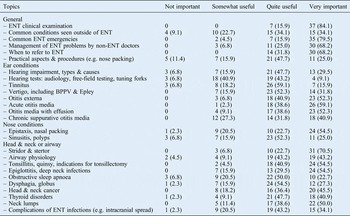
Separate to the themes identified, our interviewees were asked to pinpoint the most important topics that should be covered in the undergraduate ENT curriculum. The resultant list of participant-derived topics is included in Table II, and was used to construct the questionnaire for the subsequent survey.
How participants rated different ENT topics

Data represent numbers (and percentages) of participants rating a topic in that category. BPPV = benign paroxysmal positional vertigo
Questionnaire data analysis and findings
All participant-derived topics from the preceding interviews were deemed ‘very important’ or ‘quite useful’ by at least 50 per cent of survey responders (Table II).
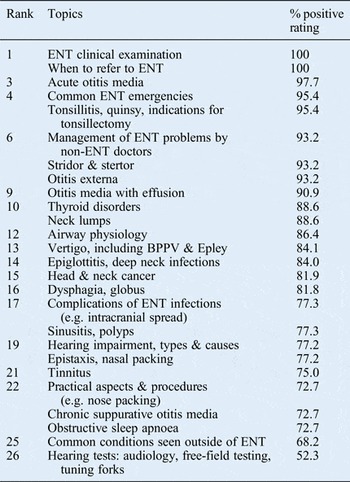
In order to determine how the ratings of topics compared with each other, the responses of ‘very important’ and ‘quite useful’ were combined into a new ‘positive response’ category (‘not important’ and ‘somewhat useful’ represented a ‘negative response’). Positive responses were then calculated as a percentage of the responses for each topic, with subsequent organisation into rank order (Table III). The highest rated topics, in order of priority, were: clinical examination; when to refer; acute otitis media; common emergencies; tonsillitis and quinsy; management of ENT problems by non-ENT doctors; stridor and stertor; otitis externa; and otitis media with effusion.
Ranking of ENT topics

Positive ratings represent the proportions of participants that rated a topic or method as either ‘very important’ or ‘quite useful’. BPPV = benign paroxysmal positional vertigo
Discussion
Summary of findings
In order to address our aims, we employed a mixed methods approach. The initial interviews were designed to investigate: what the stakeholders thought of knowledge amongst non-ENT doctors, current undergraduate ENT teaching, and which topics should be taught. The themes ‘don't know, don't care’, ‘keep it simple’ and ‘talk to me’ were identified.
The interviews identified a series of topics that were used in the subsequent questionnaire and survey. The questionnaire was distributed amongst stakeholders, with the aim of identifying the most important undergraduate ENT topics. The highest rated topics, in order of priority, were: clinical examination; when to refer; acute otitis media; common emergencies; tonsillitis and quinsy; management of ENT problems by non-ENT doctors; stridor and stertor; otitis externa; and otitis media with effusion.
Methodology rationale
Mixed methodology had advantages in this project. The interviews provided information on clinicians’ opinions of ENT knowledge and undergraduate training, something that would be difficult to obtain with a pure quantitative method. Specifically, it also allowed the identification of the ‘talk to me’ theme, relating to teaching methods, rather than topics. Whilst teaching methods were not related to our original aim, our qualitative interviews allowed it to be identified by our participants as an important aspect of undergraduate ENT teaching, and something that would warrant further investigation. Essentially, we were able to explore the views of the clinicians in depth. On the other hand, our quantitative questionnaires were a convenient way of grading the importance of the ENT topics, as this would be logistically much more difficult to achieve with qualitative methods. The end result is a study that contains both qualitative and quantitative data, which individually provide information relevant to the research question, and contribute in different but complementary ways.Reference Dicicco-Bloom and Crabtree 14 , Reference Giddings and Grant 15
Lloyd et al. aimed to define what the ENT undergraduate curriculum should contain, but adopted a very different methodology, carrying out a Delphi review.Reference Lloyd, Tan, Taube and Doshi 13 In Lloyd and colleagues’ study, participating stakeholders (ENT surgeons, emergency department doctors, general practitioners and paediatricians) were asked to rate 232 ENT topics on a Likert scale of 1–10, with 10 being the highest. Although Delphi methodology may be superior to a simple questionnaire, our study has the advantage of working with participant-derived topics, rather than researcher-derived ones, and placing the participants at the centre of topic identification. In addition, Lloyd et al. had considerable duplication amongst the 232 topics in their study, and asking participants to rate such a large number of topics risks fatigue. On the other hand, using a comprehensive list of researcher-derived topics to cover all aspects of ENT could lead to more thorough subject coverage than in our study. Thus, the methodologies of our work and that of Lloyd and colleagues’ are different, with advantages and disadvantages, yet both papers contribute complementary and valuable information on the subject of undergraduate ENT teaching.
Our research was undertaken in Nottingham. Surveying in other regions may have yielded different results, although if one compares our data with published literature this would seem unlikely. It was difficult to recruit large numbers of interested participants for interviews or questionnaire completion, with an estimated questionnaire response rate of 15.5 per cent. We believe that our low response rate was to some degree inevitable, as non-ENT professionals may not see a relatively small specialty like ENT as important. Moreover, they may have felt inadequately incentivised to participate. Conversely, whilst efforts are generally made to maximise response rate, those that responded are likely to be interested in ENT, undergraduate training or medical education overall, and their responses are especially valuable.
Opinions on ENT knowledge amongst non-ENT doctors
The ‘don't know, don't care’ theme highlights that our interviewees felt that doctors know little about ENT and do not care. They do not address their knowledge deficits and are happy to simply refer patients to ENT. Furthermore, the consensus was that these deficits are largely the result of inadequate undergraduate ENT training. One might deem the theme title (‘don't know, don't care’) to be provocative or perhaps disparaging; however, we feel it is a fair representation of the theme, and it would be wrong to falsely avoid this. In fact, this is amongst the most important of our findings; the strength of feeling amongst the interviewees’ comments strongly suggests that this is in fact a serious issue. This opinion would be difficult to establish via a purely quantitative study. Hence, our research question is confirmed as being important, and our qualitative methods are powerfully justified; research that used purely quantitative methods could miss this strength of opinion.
The implication of the ‘keep it simple’ theme is that the topics delivered to all undergraduate medical students should be relevant to all newly qualified doctors on graduation. This, combined with half of graduates tending to choose general practice, suggests that ENT teaching should be aimed at the level of a generalist. 26 , Reference Schwartz, Basco, Grey, Elmore and Rubenstein 27 Interestingly, this view was shared by our interviewees with ENT backgrounds, indicating a realistic sense of perspective for ENT and its place in a medical curriculum as a whole. Although we did not investigate the reasons for our participants’ responses, a logical explanation for this theme is that the vast majority of newly qualified doctors will either rotate through general specialties (such as emergency medicine or general practice), or encounter patients admitted to hospital under different specialties (e.g. cardiology) with new ENT signs, symptoms or problems. Furthermore, ENT is important to doctors outside of ENT, yet published data suggest that ENT teaching at undergraduate level fails to sufficiently prepare doctors for daily practice.Reference Lennon, O'Donovan, O'Donoghue and Fenton 2 , Reference Hannaford, Simpson, Bisset, Davis, McKerrow and Mills 3 , Reference Sharma, Machen, Clarke and Howard 9 , Reference Powell, Cooles, Carrie and Paleri 10
This study has found a generally poor opinion of ENT knowledge amongst non-ENT doctors (‘don't know, don't care’), and, to the best of the authors’ knowledge, this is the first study to have examined this question using qualitative research methods. With reference to one of the General Medical Council's primary principles of good medical practice, wherein ‘Doctors must put patients' safety first and make sure the care they provide is safe and effective’, clearly junior doctors, regardless of their specific training programmes, want to know ‘enough’ about other specialties in order to keep their patients safe. 28 One can argue that perhaps rarer, more interesting or conceptually more challenging ENT topics may help to cultivate interest in ENT amongst undergraduates. However, despite all of our interviewees having at least some current interest or previous experience in ENT (some were in fact ENT registrars), they unanimously agreed the theme. Therefore, in the context of a very busy curriculum, and ENT being comparatively one of the smaller specialties, it is essential that we ‘keep it simple’ when delivering the common, important and emergency-related topics within the undergraduate ENT syllabus.
Key ENT topics
The ‘talk to me’ theme represents the opinion amongst interviewees that current undergraduate ENT teaching can often be too didactic. The interviewees said that this could be improved by having more clinicians to teach, and for them to use more interactive teaching methods such as those afforded in clinics, shadowing and small-group teaching. This resonates with the concept of student-centred teaching, which has been recognised for years.Reference Harden, Sowden and Dunn 29 , Reference Huba and Freed 30 The ‘talk to me’ theme is in alignment with the contemporaneous move away from didactic teaching, towards interactive, integrated and multifaceted learning.Reference Powell, Cooles, Carrie and Paleri 31 , Reference Johnson, Charchanti and Troupis 32 However, the theme also identified concerns from our interviewees that clinicians need time within their schedule and/or clinical sessions to deliver excellent care for patients, whilst simultaneously providing high-quality teaching.
An attempt was made to try to categorise topics into ones to either be included or excluded, but there were no topics that were obviously deemed by many to be of little or no use, so there was no clear way to exclude topics. Similarly, the least favoured topic received over 50 per cent of responses categorised as positive (i.e. ‘very important’ or ‘quite useful’ responses), and one would find it difficult to justify the exclusion of such a topic.
Formal topic inclusion and exclusion criteria for the proposed curriculum were not set in advance. Scientifically, it would have been more rigorous to do so, but as we did not know in advance what to expect of the data, we examined and categorised the data once available. In this study, our value judgement decided that if more than half of respondents rated a topic as ‘very important’ or ‘quite useful’ (i.e. a positive response), then this would amount to inclusion. Asking stakeholders for their definitions of inclusion and exclusion criteria was also considered; however, given the response rates already encountered, this was deemed unlikely to be successful. Furthermore, pre-defined exclusion criteria would have risked the exclusion of potentially important topics. Thus, it was logical to include all topics in the survey questionnaire, and to then apply a ranking system based on the proportions of positive ratings, with subsequent prioritisation.
We found that the highest rated topics in our survey were: clinical examination; when to refer; acute otitis media; common emergencies; tonsillitis and quinsy; management of ENT problems by non-ENT doctors; stridor and stertor; otitis externa; and otitis media with effusion. This supported our second interview response theme, ‘keep it simple’. The relatively low number of participants precluded a meaningful subgroup analysis (e.g. ENT doctor vs non-ENT doctor).
There were a few unexpected findings in our study. For example, ‘common conditions seen outside of ENT’ was rated low, and it may have also been expected that ‘practical aspects’, ‘epistaxis’ and ‘sleep apnoea’ would rate higher given that they are common or important. Certainly, these categories scored well in Lloyd and colleagues’ Delphi review.Reference Lloyd, Tan, Taube and Doshi 13 However, as our work and the Delphi review have starkly differing methodologies, a direct comparison should be made cautiously.
Despite the difficulty of the comparison, Lloyd and colleagues’ findings were similar to ours. They found that key topics were those relating to conditions that are ‘common, urgent, life-threatening or important’;Reference Lloyd, Tan, Taube and Doshi 13 this is in keeping with our ‘keep it simple’ theme. Therefore, our research and Lloyd and colleagues’ complement each other, with both studies providing undergraduate educators with data that allow the design of evidence-based ENT curricula. It is hoped that this new information will be used to decide what topics to include and how to prioritise them.
Future work
As alluded to earlier within the methodology discussion, our qualitative interviews identified the ‘talk to me’ theme, which summarised opinions of teaching methods used in undergraduate ENT teaching. Whilst teaching methods do not strictly relate to our original aims, clearly they are related to undergraduate ENT teaching as a whole. Furthermore, the strength of opinion within the qualitative interviews justifies their discussion.
Much has been written on the subject of different teaching methods, with one college identifying 150 different methods. 33 Two broad educational strategies can be chosen: teacher-centred, where the teacher transmits information and the student passively receives it (didactic); or student-centred, where students themselves gather and synthesise information, and develop generic communication, critical thinking and problem solving skills, with the teacher acting as a coach and facilitator.Reference Huba and Freed 30
Technological advances offer potential improvement in teaching methods, but they need to be evaluated and used appropriately.Reference Alamro and Schofield 34 , Reference Webb and Choi 35 For example, online learning has been found to be useful in teaching basic knowledge and simple technical skills, but not in understanding complex spatial anatomy.Reference Fung 36 In Fung's recent study, it was suggested that the ideal ENT curriculum, as designed by students, would include 32 per cent lectures, 31 per cent laboratory training (including practical sessions and simulation), 22 per cent clinician-led tutorials, and 15 per cent computer-assisted or online learning.Reference Fung 36 However, this may not represent the full picture. A recent large comprehensive review of educational interventions to improve musculoskeletal teaching (including anatomy) examined small-group teaching, patient educators, and computer-assisted or online learning.Reference O'Dunn-Orto, Hartling, Campbell and Oswald 12 This study found that all these teaching methods, including online learning, provided significantly greater benefits than traditional didactic teaching.Reference O'Dunn-Orto, Hartling, Campbell and Oswald 12 This is particularly topical with the recent changes, improvements and ongoing review by ENT-UK and Student and Foundation Doctors in Otolaryngology (‘SFO-UK’) of their considerable catalogues of high-quality, peer-reviewed online learning resources (e.g. e-lefENT).
Whilst online learning is not necessarily a two-way conversation between teacher and student, it does offer numerous advantages. These include the fact that the student can choose what to learn and when. This is particularly relevant when one considers that the circumstances in which a newly qualified doctor learns are very different to the circumstances of an undergraduate medical student. For example, a junior doctor's working patterns dictate that time for independently directed learning tends to be out of hours. Furthermore, newly qualified doctors are no longer in purpose-built educational buildings, but rather they are in hospitals and other clinical environments. Therefore, online learning affords considerable mobility of learning resources and convenience of access, which helps to alleviate issues associated with these changes of circumstance.
In addition, junior doctors may often miss scheduled teaching seminars or lectures within working hours, because of unpredictable on-call or clinical commitments. This can be circumvented with the provision of online podcasts or video-recorded lectures. As mentioned previously, this does not typically afford a two-way teacher–student conversation, but nonetheless this is strictly feasible given recent technological advances. The online student–teacher conversation can be in real time; however, more commonly, the conversation tends to be asynchronous, via discussion boards and blogs. Whilst the asynchronicity may be seen as a potential drawback, this actually offers a number of advantages. Perhaps most important of these, a discussion board provides a permanent record of current and previous learning conversations between the students and teachers. This allows for collaborative learning and peer support, which might well suit medical students and trainee doctors, given the practical circumstances of their training.
One can appreciate that online learning resources encourage more independent, self-directed and proactive learning from the student. This has formed the basis of what has become somewhat of a revolution in education, where the more traditional teaching process has been challenged. This refers to ‘the flipped classroom’ as defined in the literature. It describes a process where the student has more ownership and responsibility for their learning, and is often made possible by online resources or ‘technology-enhanced learning’.Reference Hamilton and Tee 37 – Reference Provini 39
Finally, in accordance with the General Medical Council's ‘Good Medical Practice’ and ‘Promoting Excellence’ guidelines, doctors are expected to be lifelong learners in a process that starts during their undergraduate training. 28 , 40 This infers that doctors should be encouraged to be responsible for their own training and learning. Therefore, in order to cultivate these behaviours and maximise the continuity of teaching methods from undergraduate to post-graduate training, it may be beneficial to make online teaching methods and resources such as e-lefENT available to medical students.
-
• ENT disorders are common and frequently encountered by non-ENT specialist doctors
-
• Not all doctors experience ENT during post-graduate rotations, highlighting the importance of undergraduate ENT training
-
• Undergraduate ENT topics should relate to conditions that are ‘common, urgent, life-threatening or important’
-
• Junior doctors feel that ENT knowledge amongst doctors is poor and improvements in undergraduate ENT training are required
-
• Stakeholder-derived as opposed to researcher-derived ENT topics are provided, adding to the quality of findings and conclusions
-
• When formulating undergraduate ENT curricula, it is essential to ‘keep it simple’ by delivering the most common, important and emergency-related topics
This discussion of teaching methods highlights the need to gain further understanding of this aspect of undergraduate ENT teaching. Previous studies investigating general undergraduate medical teaching have identified a clear preference for student-centred approaches and small-group learning, and these methods often achieve better outcomes.Reference O'Dunn-Orto, Hartling, Campbell and Oswald 12 , Reference Beers and Bowden 41 Furthermore, we have described how these methods may be delivered on an online platform. However, we do not know that this is necessarily the case for ENT. It is likely that the methods the students value are also the ones that provide the best education and lead to better knowledge, skills and behaviours, and ultimately patient care, but this cannot be assumed. Just because a method is popular does not mean it is the best way of achieving desired educational outcomes. This, in combination with our ‘talk to me’ theme and recent advances within ENT online learning, invites the prospect of valuable future research in this area in order to further optimise the delivery and design of the undergraduate ENT curriculum.
In conclusion, this mixed methods study aimed to identify what doctors thought of ENT knowledge amongst non-ENT doctors and of undergraduate ENT training, and what topics should be included in the curriculum. Qualitative interviews with doctors identified a consensus that ENT knowledge amongst non-ENT doctors is poor (‘don't know, don't care’), and that this is a serious issue which needs to be addressed. The interviews also identified that ENT topics taught at undergraduate level should be common and important (‘keep it simple’), and taught interactively (‘talk to me’). The highest rated ENT topics were: clinical examination; when to refer; acute otitis media; common emergencies; tonsillitis and quinsy; management of ENT problems by non-ENT doctors; stridor and stertor; otitis externa; and otitis media with effusion. Future research that considers the question of the best teaching methods for the delivery of undergraduate ENT teaching would be valuable.
This study would be useful to educators reviewing undergraduate ENT curricula, with the ultimate aim of improving and prioritising teaching in the busy curriculum and improving patient care in the future.