Introduction
In recent years, there has been increasing attention on persistent grief reactions that do not abate the following bereavement. ICD-11 has recently introduced a new diagnosis, termed prolonged grief disorder (PGD), to describe grief reactions that comprise persistent yearning for the deceased and associated emotional pain, and clinical features involving bitterness, disrupted sense of identity, difficulty accepting the loss, and impairment in future goal setting and activities; this criterion stipulates that these symptoms need to persist beyond 6 months after the death (Maercker et al., Reference Maercker, Brewin, Bryant, Cloitre, Reed and van Ommeren2013). PGD affects approximately 7–10% of bereaved people (Kersting, Brähler, Glaesmer, & Wagner, Reference Kersting, Brähler, Glaesmer and Wagner2011; Lundorff, Holmgren, Zachariae, Farver-Vestergaard, & O'Connor, Reference Lundorff, Holmgren, Zachariae, Farver-Vestergaard and O'Connor2017), and represents a significant public health issue because it increases the risk for functional impairment, suicidality, psychiatric comorbidity, poor health behaviors, and somatic complaints (Prigerson et al., Reference Prigerson, Horowitz, Jacobs, Parkes, Aslan and Goodkin2009).
The need to understand the mechanisms underpinning PGD has led to attempts to map the neural profiles of pathological grief responses. Neuroimaging studies of grief have primarily focused on functional MRI (fMRI) responses during presentation of reminders of the deceased, and reported enhanced activation of reward networks (nucleus accumbens) (O'Connor et al., Reference O'Connor, Wellisch, Stanton, Eisenberger, Irwin and Lieberman2008), caudal posterior cingulate (Gundel, O'Connor, Littrell, Fort, & Lane, Reference Gundel, O'Connor, Littrell, Fort and Lane2003) and middle and posterior cingulate gyrus, inferior frontal gyrus, middle temporal gyrus, thalamus, and brainstem (Kersting et al., Reference Kersting, Ohrmann, Pedersen, Kroker, Samberg and Bauer2009). There is also evidence that during an emotional Stroop task, participants with severe grief responses are characterized by reduced rostral anterior cingulate cortex (ACC) activity (Arizmendi, Kaszniak, & O'Connor, Reference Arizmendi, Kaszniak and O'Connor2016), and increased amygdala, insula, and dorsolateral prefrontal cortex (DLPFC) activations (Freed, Yanagihara, Hirsch, & Mann, Reference Freed, Yanagihara, Hirsch and Mann2009). These neural networks overlap markedly with neural circuity implicated in related psychopathological states (Shalev, Liberzon, & Marmar, Reference Shalev, Liberzon and Marmar2017). This is an important issue for understanding the neural mechanisms of PGD because there is significant overlap between PGD and posttraumatic stress disorder (PTSD) and depression. Factor analysis and principal component analysis studies have demonstrated that although there is strong symptom overlap between PGD, PTSD, and depression, PGD is also a distinct syndrome (Boelen & van den Bout, Reference Boelen and van den Bout2005; Golden & Dalgleish, Reference Golden and Dalgleish2010). Although there is abundant neuroimaging evidence regarding PTSD and depression, and an emerging evidence for PGD, there are no studies that have addressed the issue of distinct neural processes associated with PGD. To map the potentially distinctive neural circuitry associated with PGD, this study compared individuals with PGD, bereaved controls (BC), PTSD, and major depressive disorder (MDD) on an emotion processing task during fMRI. On the basis of previous neuroimaging studies that have highlighted the role of reward circuitry in PGD (O'Connor et al., Reference O'Connor, Wellisch, Stanton, Eisenberger, Irwin and Lieberman2008) and the common observation that PTSD and MDD involve activation of a negative affect network involving the amygdala, ACC, and insula, we hypothesized that PGD would be distinguished from BC by activation and connectivity within both negative emotion processing and reward brain networks. Further, we explored the distinctive activation and connectivity in PGD relative to PTSD and MDD, with the expectation that PGD would be characterized by distinctive patterns of activations in negative emotion processing.
Method
Participants
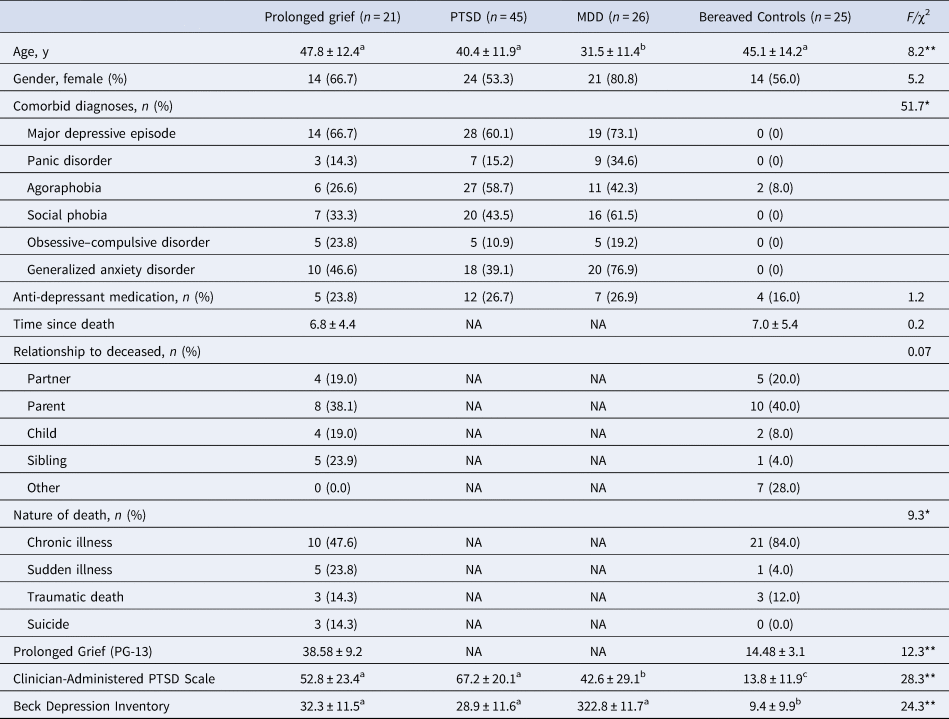
The sample initially comprised 123 participants but after removing participants because of motion during scanning, the final sample comprised 117 participants who were recruited from public advertising to participate in a study on brain functioning. All participants were initially asked if they had experienced bereavement as a result of the death of a close family member, partner, or friend. There were 21 participants who satisfied the ICD-11 criterion for PGD, as diagnosed by clinical psychologists using the Prolonged Grief − 13 (Prigerson & Maciejewski, Reference Prigerson and Maciejewski2007). Additionally, there were 25 BC who did not satisfy the PGD criteria or any other Axis I psychiatric disorder (as assessed by the Mini International Neuropsychiatric Interview; MINI version 5.5) (Sheehan et al., Reference Sheehan, Lecrubier, Harnett-Sheehan, Amorim, Janavs and Weiller1998). There were 45 participants who met DSM-IV criteria for PTSD following assault (n = 19, 42.2%), police duties (n = 14, 31.1%), motor vehicle accidents (n = 5, 11.1%), childhood abuse (n = 3, 6.7%), or witnessing violence (n = 4, 8.9%); PTSD was diagnosed by clinical psychologists using the Clinician Administered PTSD Scale (CAPS; Blake et al., Reference Blake, Weathers, Nagy, Kaloupek, Gusman and Charney1995). There were 26 participants with a primary diagnosis of MDD, as defined by the MINI. Participants with a history of neurological disorder, psychosis, or current substance dependence were excluded. No MDD or PTSD participants were bereaved. Table 1 presents the participant characteristics. The protocol allowed participants to be on prescribed medication if they were on a stable dosage for at least 2 months prior to the scan; 28 (23.9%) participants were currently using selective serotonin uptake inhibitors (SSRIs) and there was no difference in medication use between groups [χ2 (117) = 1.77, p = 0.80].
Participant characteristics

Note: Clinician-Administered PTSD Scale scores based on 17 PGD, 45 PTSD, 14 MDD, and 18 bereaved control participants who reported being trauma-exposed and were administered the CAPS. *p < 0.05. **p < 0.001. Different superscripts indicate significant differences between groups.
Measures
Prolonged Grief Assessment (PG-13; Prigerson & Maciejewski, Reference Prigerson and Maciejewski2007). Prolonged grief was assessed using a semi-structured interview based on the PG-13. The PG-13 assesses for the presence of yearning and emotional distress at the lost relationship (Criterion A), difficulty accepting the death, shock, avoidance of reminders, numbness, bitterness, difficulty engaging in life, identity disturbance, and a sense of purposelessness and meaninglessness (Criterion B). Items are scored by clinicians on a five-point scale (1 = not at all, 5 = several times a day/overwhelmingly). A diagnosis of PGD is made if Criterion A has been met for at least 6 months, five out of nine Criterion B items are endorsed daily or to a disabling degree, and there is evidence of serious day-to-day impairment in functioning (Criteria C).
Clinician-Administered PTSD Scale (CAPS; Blake et al., Reference Blake, Weathers, Nagy, Kaloupek, Gusman and Charney1995). The CAPS is a structured interview designed to measure DSM-IV PTSD symptom severity in ‘the last 4 weeks’. The CAPS comprises 17 questions scored on two five-point Likert scales that index frequency (0 = never, 4 = daily) and intensity (0 = none, 4 = extreme) to provide an overall severity score (range, 19–136; higher scores indicate greater severity).
The Mini-International Neuropsychiatric Interview (version 5.5; MINI; Sheehan et al., Reference Sheehan, Lecrubier, Harnett-Sheehan, Amorim, Janavs and Weiller1998) was used to assess MDD.
The Beck Depression Inventory-2nd edition (BDI; Beck, Steer, & Brown, Reference Beck, Steer and Brown1996) is a 21-item self-report inventory designed to measure depressive symptoms ‘in the past 2 weeks’. Items are scored on a four-point Likert scale to provide an overall severity score (range, 0–63; higher scores indicate greater severity).
Procedure
The study was approved by the Western Sydney Area Health Service Human Ethics Committee and participants provided written informed consent. Participants were then administered the MINI to assess for current MDD, panic disorder, agoraphobia, social phobia, obsessive–compulsive disorder, and generalized anxiety disorder. Participants were also administered the CAPS to assess PTSD and PG-13 to assess for PGD.
Facial emotional paradigm
The passive face viewing task used in this study used facial expressions depicting different emotions selected from standardized series of facial expressions of fear, anger, disgust, sadness, happiness, and neutral (Korgaonkar, Grieve, Etkin, Koslow, & Williams, Reference Korgaonkar, Grieve, Etkin, Koslow and Williams2013). In the subliminal condition run, emotional faces were presented for 16.7 ms, followed immediately by a neutral face mask for 150 ms, with an interstimulus interval of 1233.3 ms. To control for conscious detection on the basis of perceptual features, the neutral masked faces were offset by 1 degree in random directions. We have previously used behavioral psychophysiological testing to demonstrate that the presentation of facial stimuli at ⩽20 ms meets signal detection criteria for discrimination of emotional expression (Williams et al., Reference Williams, Liddell, Rathjen, Brown, Gray and Phillips2004). In the supraliminal condition run, each face was presented for 500 ms separated by a 750 ms interstimulus interval, based on evidence that conscious discrimination of emotions is reliably achieved at durations ⩾330 ms (Williams et al., Reference Williams, Liddell, Rathjen, Brown, Gray and Phillips2004). In both condition runs, images were presented in five blocks of eight faces of the same emotion, with each emotion block presented in a pseudorandom order. A total of 240 facial stimuli were presented in each of the supraliminal and subliminal conditions.
Imaging acquisition
Imaging was performed on a 3T GE Signa HDx scanner (GE Healthcare, Milwaukee, Wisconsin, USA) using an eight-channel head coil. Functional images were acquired using an echo planar imaging MR sequence with parameters: TR = 2500 ms, TE = 27.5 ms, flip angle = 90°; FOV = 24 cm × 24 cm, matrix size = 64 × 64. A total of 120 functional T2*-weighted volumes (one per two faces) were acquired, comprising 40 contiguous slices parallel to the intercommissural (AC-PC) line, with 3.5 mm thickness for each run. Three dummy scans were obtained prior to the start of each acquisition. High-resolution T1-weighted anatomical structural images were also acquired in the sagittal plane using a 3D spoiled gradient echo (SPGR) sequence: TR = 8.3 ms; TE = 3.2 ms; flip angle = 11°; TI = 500 ms; NEX = 1; ASSET = 1.5; frequency direction: S/I; matrix size = 256 × 256. A total of 180 contiguous 1 mm slices were acquired covering the whole brain resulting in a 1 mm3 isotropic voxel resolution. This sequence was collected for use in the normalization of the fMRI data to standard space.
fMRI data analysis
Pre-processing (realignment and unwarping, spatial normalization into standardized MNI space, smoothing using an 8 mm FWHM isotropic Gaussian kernel) and statistical analysis of fMRI data was conducted using Statistical Parametric Mapping (SPM8, Wellcome Department of Neurology, London). Briefly, data were first realigned and unwarped to the initial image of each task run and screened for motion artifacts using the Artifact Detection Tools (www.nitrc.org/projects/artifact_detect/). Next for normalization to stereotactic MNI space, the T1-weighted SPGR images were normalized to standard space using the FMRIB nonlinear registration tool and the fMRI EPI data were coregistered to the T1 data using FMRIB linear registration tool (Andersson, Jenkinson, & Smith, Reference Andersson, Jenkinson and Smith2007a, Reference Andersson, Jenkinson and Smith2007b). The normalization warps from these procedures were stored for use in functional to standard space transformations. To account for any physiological noise, an average signal was estimated using a mask in the ventricles and white matter, and was removed from the motion-corrected fMRI time series. All fMRI data were smoothed using an 8 mm Gaussian kernel and high pass filtered (cut-off of 128 s).
First-level general linear models for each task consisted of regressors representing blood oxygen level dependent (BOLD) responses for each emotion block and the motion parameters. Separate contrast images were calculated for sad and happy v. neutral faces to assess activation and connectivity elicited by signals of potential loss and positive affect and reward, respectively. We chose neutral as baseline for comparison because of previous published work in all three disorders have largely compared emotional face processing relative to neutral. However, considering the growing recent debate that ‘neutral’ stimuli may not be an appropriate baseline when evaluating emotion processing (Filkowski & Haas, Reference Filkowski and Haas2017), we also evaluated whether the group differences observed for loss and reward contrasts were not driven due to a difference in neutral processing by comparing neutral v. ‘rest’. These contrast images were normalized to standard space (2 mm × 2 mm × 2 mm) using normalization warps estimated in the preprocessing steps outlined above and were used for second-level random-effects analyses.
We performed two major sets of analyses that were guided by our primary comparisons. First, we compared PGD and BC participants because these participants were matched on the history of bereavement and differed on the basis of their grief reaction. To understand the neural mechanisms underpinning emotion processing in PGD, we first evaluated voxel-wise neural differences between the PGD group relative to BC in a two-sample t test. The second set of analyses focused on the distinctiveness in neural processes between PGD, PTSD, and MDD because we were interested in determining the extent to which distinct neural responses were associated with PGD relative to the other disorders; to achieve this, we performed a voxel-wise ANOVA analysis with group as a between-subject variable. For significant main group effects, post hoc tests were conducted on significant clusters to evaluate pair-wise group effects. We also evaluated neural abnormalities that were common to PGD, PTSD, and MDD groups relative to controls using a conjunction analysis. To evaluate our hypothesized regions of interest in brain networks underlying negative emotion processing and reward, we used the AAL atlas to define the bilateral amygdala, insula, caudate, pallidum, putamen, ACC regions whereas the DLPFC was defined using a 10 mm sphere centered around coordinates (L: −36, 20, 26; R: 46, 30, 18) identified from a meta-analysis of 105 functional imaging studies of facial emotion processing (Fusar-Poli et al., Reference Fusar-Poli, Placentino, Carletti, Landi, Allen and Surguladze2009) and the medial orbitofrontal cortex (mOFC) (0, 54, −8) was defined based on a meta-analysis of 142 functional imaging studies of reward valence processing (Liu, Hairston, Schrier, & Fan, Reference Liu, Hairston, Schrier and Fan2011). We employed a voxel peak-level family-wise error (FWE)-corrected p value of 0.05 to assess significant effects.
Functional connectivity related to significant clusters was also evaluated using generalized psychophysiological interaction (gPPI) and was analyzed voxelwise as done for activations. Briefly, generalized context-dependent PPI models identify how task-specific changes in the BOLD signal, of different regions across the brain, interact over time. The model generates a regressor of the onset times of each facial emotion condition in the task, and individually convolves this with the hemodynamic response function to form a psychological interaction term. The physiological regressor (the estimated neural activity of a specified seed region, derived from the deconvolved BOLD signal of this seed) is then multiplied by the psychological interaction term, and other relevant covariates, i.e. motion regressors, to create the gPPI. We can then explore the correlation of BOLD response throughout the brain and neural activity in the seed region, during any of the task conditions, providing an effective measure of task-related connectivity. To evaluate any neural differences beyond our hypothesized ROIs, we also performed an exploratory whole-brain voxel-wise analysis.
Finally, for neural effects that distinguished the PGD group, we also evaluated correlations between neural measures and PG-13 scores in the PGD group.
Results
Participant characteristics
Participant characteristics are presented in Table 1. PGD and BC groups did not differ on the type of death, relationship to deceased, or time since death. The four groups did not differ on gender distribution, age, or SSRI use. As expected for the diagnostic groups, PGD participants reported higher PGD scores than controls (p < 0.001), and greater CAPS scores than MDD (p < 0.001) and controls (p < 0.001). PTSD participants had higher CAPS than controls (p < 0.001), and MDD (p = 0.009). MDD, PTSD, and PGD participants did not differ in BDI severity, but all three groups had greater BDI scores than controls (p < 0.001).
Neural mechanisms underpinning emotion processing in PGD
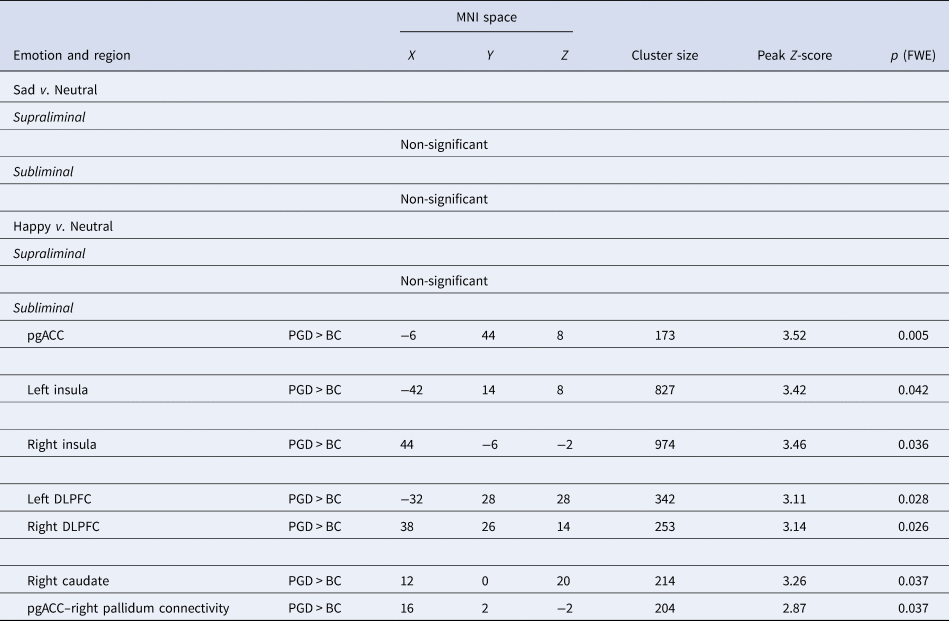
The PGD group was significantly different from BC only for subliminal processing of happy faces (Table 2 and Fig. 1). No differences were observed for processing of sad faces (both supraliminal and subliminal) or supraliminal processing of happy faces. The PGD group demonstrated greater activation in the bilateral insula, bilateral DLPFC, pregenual ACC, and right caudate relative to BC. Greater functional connectivity between the pregenual ACC and right pallidum was also observed for PGD as compared to BC during the processing of supraliminal happy faces. There were no significant differences at FEW-corrected p < 0.05 for the exploratory whole-brain analyses for all contrasts.
Neural mechanisms underpinning emotion processing in prolonged grief disorder (PGD): neural regions that were different between PGD and bereaved controls (BC) during subliminal processing of happy v. neutral faces. pgACC, pregenual anterior cingulate cortex; DLPFC, dorsolateral prefrontal cortex.

Neural mechanisms underpinning emotion processing in prolonged grief disorder (PGD): comparison between PGD and bereaved controls (BC).

Distinctiveness and commonalities in neural processes between PGD, PTSD, and MDD
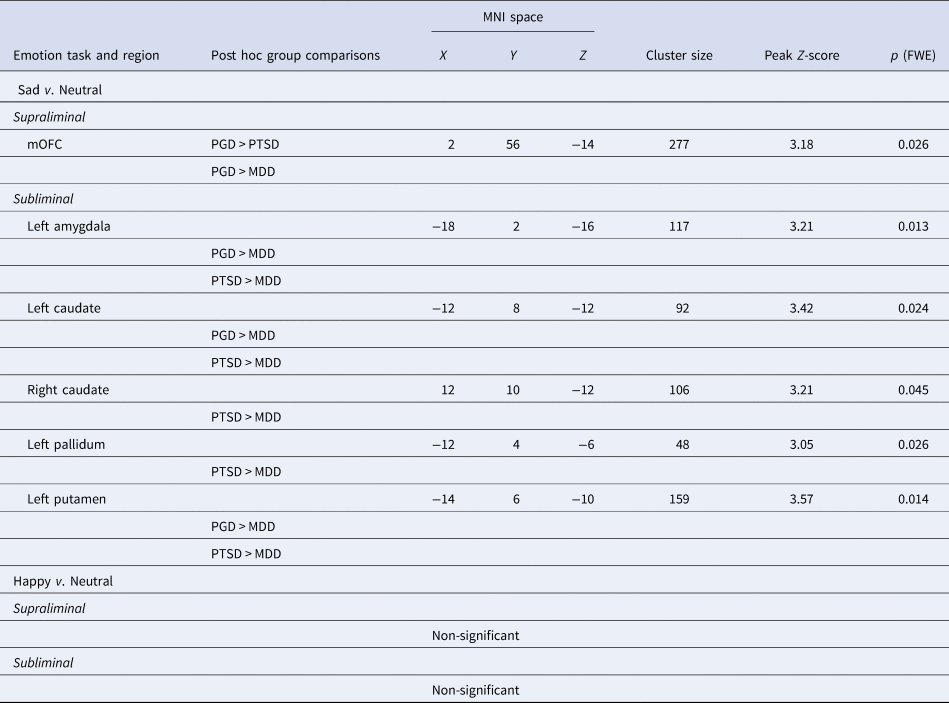
Significant ANOVA main effects of the group were observed for the mOFC during supraliminal processing of sad faces and for the left amygdala, bilateral caudate, left pallidum, and left putamen during subliminal processing of sad faces (Table 2). Post hoc comparisons revealed that PGD individuals had greater activation than both PTSD and MDD for the mOFC during supraliminal sad processing.
For subliminal sad processing, both the PGD and PTSD groups were distinct from MDD (PGD and PTSD > MDD) for functional activations in the left amygdala, caudate, and putamen (see Table 3). Additionally, only the PTSD group demonstrated significantly greater activation than MDD in the right caudate and left pallidum. There were no differences between PGD and PTSD for subliminal processing of sad faces.
Distinctiveness in neural processes between prolonged grief disorder (PGD), posttraumatic stress disorder (PTSD) and major depressive disorder (MDD)

No connectivity differences relative to these clusters were observed between the three groups. Also, there were no group differences for happy face processing or at the exploratory whole-brain level for all contrasts. Also, using conjunction analyses, there were no effects that were common across the PGD, PTSD, and MDD groups relative to controls. All of the significant findings above were also not found to be driven due to group differences in neutral face processing (p > 0.05 for the Neutral condition for all clusters).
Correlations of neural activations with PG-13 measure
We extracted mean contrast estimates for clusters that were significantly different between the PGD and BC/PTSD/MDD groups and correlated them with the PG-13 scores in the PGD group. Neural activations or connectivity were not significantly associated with the severity of PGD in the PGD group.
Role of medication
To test the potential role of medication on the observed findings, we conducted 2 (Diagnostic Group: PGD/MDD/PTSD) × 2 (Medication: Yes/No) ANOVAs for each finding that was significant. For each neural measure, the main effect for diagnostic group remained significant. Importantly, there were no main effects for medication status or diagnostic group × medication interaction effects. These findings suggest that medication did not impact the observed findings.
Discussion
The major findings of this study were that PGD patients displayed greater activation (a) than BC controls in the bilateral insula, bilateral DLPFC, pregenual ACC, and right caudate during subliminal processing of happy faces, (b) than PTSD and MDD patients in the mOFC during supraliminal processing of sad faces, and (c) than MDD patients of the left amygdala, caudate, and putamen during subliminal viewing of sad faces.
The observation of greater activation in the bilateral insula and caudate during subliminal processing of happy faces in PGD patients than BC participants is consistent with proposals that PGD involves alterations to reward networks. For example, there is evidence that prolonged grief is associated with distinctive activations of reward brain networks (O'Connor et al., Reference O'Connor, Wellisch, Stanton, Eisenberger, Irwin and Lieberman2008; see also Arizmendi et al., Reference Arizmendi, Kaszniak and O'Connor2016), indicative of the frustrated goal-seeking inherent in PGD patients as they long for the deceased. Relatedly, reward networks are implicated in the response to rejection from loved ones (Fisher, Brown, Aron, Strong, & Mashek, Reference Fisher, Brown, Aron, Strong and Mashek2010). Further, one meta-analysis of psychological pain reported evidence that recalled sadness is associated with increased activity in the caudate, left insula, and putamen (Meerwijk, Ford, & Weiss, Reference Meerwijk, Ford and Weiss2013). Notably, although this accumulative evidence points to the activation of these networks in reaction to negative emotional states, we observed greater activation of these regions during the processing of happy faces. This apparently paradoxical finding can be understood in the context of evidence that PGD patients have difficulty accessing positive emotions and memories (Maccallum & Bryant, Reference Maccallum and Bryant2010), presumably because of the ready activation of sadness that is central to PGD (Maccallum & Bryant, Reference Maccallum and Bryant2008). The centrality of sadness in PGD may result in happy faces triggering negative affective responses because PGD individuals are vigilant to the absence of their primary source of happiness (i.e. the deceased) (Maccallum & Bryant, Reference Maccallum and Bryant2013).
The increased bilateral DLPFC and pregenual ACC activation during preconscious processing of happy faces suggests that these stimuli led to greater recruitment of networks implicated in emotion regulation and cognitive control (Williams, Reference Williams2016). Notably, ventral nodes of the ACC can be activated even during the subliminal presentation of negative emotions (Kober et al., Reference Kober, Barrett, Joseph, Bliss-Moreau, Lindquist and Wager2008; Williams et al., Reference Williams, Das, Liddell, Kemp, Rennie and Gordon2006). The activation of these regulatory networks during the processing of positive stimuli can also be explained in terms of PGD engaging regions that down-regulate aversive emotional states elicited by the happy faces. Consistent with the evidence that the painful emotions experienced by PGD individuals are central to the disorder (Robinaugh, LeBlanc, Vuletich, & McNally, Reference Robinaugh, LeBlanc, Vuletich and McNally2014), the presentation of happy faces may elicit top-down processes to limit the consequent aversive states.
The observation of greater mOFC activation during sad face presentation in PGD than in PTSD and MDD underscores the importance of reward networks in PGD. Convergent evidence points to the mOFC being pivotal for integrating reward processing and hedonic experience (Kringelbach, Reference Kringelbach2005). Much evidence points to the role of the mOFC in making stimulus–reward associations, and has strong connections with regions that integrate sensory and reward information, including somatosensory inputs, the nucleus accumbens, and the limbic system (Wallis, Reference Wallis2007). PGD patients have distinct activation of the nucleus accumbens during processing reminders of the deceased (O'Connor et al., Reference O'Connor, Wellisch, Stanton, Eisenberger, Irwin and Lieberman2008), suggesting that these individuals excessively recruit neural networks associated with reward when reminded of their loss. Taken together with the current finding of greater mOFC activation, these findings point to PGD being distinguished from PTSD and MDD by its recruitment of reward networks when sadness is triggered. In the context of evidence that the mOFC is activated in depression (Drevets, Reference Drevets2001) and anhedonia (during processing of happy faces) (Keedwell, Andrew, Williams, Brammer, & Phillips, Reference Keedwell, Andrew, Williams, Brammer and Phillips2005), it is noteworthy that PGD had even stronger activation than MDD; this difference underscores how reward processing is apparently more evident in people with PGD relative to those with depressed mood.
Greater functional connectivity between the pregenual ACC and right pallidum was also observed for PGD as compared to BC during the processing of happy faces. The pallidum is central to reward processing (Haber & Knutson, Reference Haber and Knutson2010; Smith, Tindell, Aldridge, & Berridge, Reference Smith, Tindell, Aldridge and Berridge2009), with much evidence that lesions of the pallidum inhibit reward processing (Dallimore, Mickiewicz, & Napier, Reference Dallimore, Mickiewicz and Napier2006) and manipulations that augment pallidum function enhance appetitive drives (Smith & Berridge, Reference Smith and Berridge2005). The greater connectivity between this region and the pregenual ACC may suggest PGD involves stronger connections between reward and regulatory functions during processing of happy faces. This interpretation accords with models of mood disorders that propose a network that links the medial prefrontal cortex with the pallidum (and other striatal regions) to explain dysfunctions in mood (Price & Drevets, Reference Price and Drevets2010).
For subliminal sad processing, PGD and PTSD participants had greater activation than MDD participants in the left amygdala, caudate, and putamen. The caudate and putamen are part of a neural network implicated in processing positive affect (Liu et al., Reference Liu, Hairston, Schrier and Fan2011). There is evidence that MDD is associated with greater activation of the caudate and putamen relative to controls during processing of genuine (v. posed) sad faces (Groves et al., Reference Groves, Pitcher, Melzer, Jordan, Carter and Malhi2018), and that the caudate is activated during processing of images of participants' romantic partners (Aron et al., Reference Aron, Fisher, Mashek, Strong, Li and Brown2005). The finding of greater activation in these regions in PGD relative to MDD during subliminal presentations of sad faces suggests that prolonged grief is distinguished from depression by the former's greater activation of this reward circuit. The lack of differences between PGD and PTSD during subliminal processing of sad faces is unexpected, but may be attributed to the demonstrated tendency for PTSD individuals to have disturbed functions in reward processes (Felmingham et al., Reference Felmingham, Falconer, Williams, Kemp, Allen and Peduto2014).
Both PGD and PTSD participants displayed greater amygdala activation to sad faces than MDD participants; however, there was no difference between PGD and PTSD. Although earlier work indicated that the amygdala was predominantly associated with fear (Murphy, Nimmo-Smith, & Lawrence, Reference Murphy, Nimmo-Smith and Lawrence2003), more recent work has indicated that the amygdala is implicated in a range of emotional responses, including sadness (Kirby & Robinson, Reference Kirby and Robinson2017). This interpretation is consistent with recent reports that challenge the notion of emotion-specific brain regions (Wager et al., Reference Wager, Kang, Johnson, Nichols, Satpute and Barrett2015). The reduced amygdala activation in MDD relative to PGD and PTSD accords with evidence that amygdala activation is greater in response to sad faces for bipolar but not unipolar depressive individuals (Almeida, Versace, Hassel, Kupfer, & Phillips, Reference Almeida, Versace, Hassel, Kupfer and Phillips2010).
Interestingly, there were different findings during subliminal and supraliminal presentations of faces. Whereas PGD had greater activations than BC participants during the subliminal presentation of happy faces in reward networks, PGD had greater activation than PTSD and MDD in the mOFC during the supraliminal presentation of sad faces. This pattern suggests that persistent grief reactions in bereaved individuals are characterized by automatic processing of reward networks in response to positive stimuli, which is consistent with evidence that models that emphasize the vigilance that PGD individuals have toward potential reminders of one's loss (Boelen, van den Hout, & van den Bout, Reference Boelen, van den Hout and van den Bout2006; Maccallum & Bryant, Reference Maccallum and Bryant2013). In contrast, PGD seems to be distinguished from PTSD and MDD by greater activation of the mOFC during controlled processing of negative stimuli, which suggests that the distinctive nature of this psychopathology lies in its controlled processing of negative stimuli.
We note a number of methodological limitations. First, the sample size for the PGD group was modest (n = 21), and accordingly the current findings need to be replicated with larger sample sizes. In this context, we note that conclusions drawn from the current study are tempered by the recognition that our sample sizes did not permit analysis of subtypes of MDD, PTSD, or PGD. Second, some participants were using antidepressant medication at the time of scanning, and it is possible that antidepressants may have impacted on the findings; however, the medication dosage was stabilized prior to the study for a period of 2 months and there was no difference in medication use between patient groups. Third, we did not include trauma-exposed control comparators that would have allowed us to compare the responses of PTSD participants with those of trauma-exposed controls (and for this reason we did not conduct a direct comparison between the four groups). PGD and PTSD require different comparison groups because although traumatic bereavement is a common cause of PTSD (Benjet et al., Reference Benjet, Bromet, Karam, Kessler, McLaughlin, Ruscio and Koenen2016) the disorder is also commonly triggered by non-bereavement events; further, most cases of PGD are triggered by non-traumatic bereavement (Prigerson et al., Reference Prigerson, Horowitz, Jacobs, Parkes, Aslan and Goodkin2009). Fourth, we note that a potential order effect existed because subliminal presentations always occurred prior to supraliminal presentations; however, this was done to minimize the possibility of consciously detected stimuli priming responses to the subliminal presentations. Fifth, we note that future research should attempt to disentangle the contributing role of genetic factors to neural profiles in these disorders. There is some overlap in symptoms between PTSD, MDD, and PGD, and there is evidence that comorbidity between disorders can be explained by common genetic profiles (Koenen et al., Reference Koenen, Fu, Ertel, Lyons, Eisen and True2008; Sartor et al., Reference Sartor, Grant, Lynskey, McCutcheon, Waldron and Statham2012). Understanding how common and distinct genetic liability for each disorder interacts with neural activation will advance our understanding of the distinctive neural processes in PGD.
In summary, these findings provide the first demonstration that PGD has distinct neural responding to emotional stimuli relative to both PTSD and MDD. In the context of debates over the distinctiveness of PGD relative to other conditions that can arise following bereavement, these data are important because they highlight that PGD distinctively activates reward networks, which accords with most conceptual models (Maccallum & Bryant, Reference Maccallum and Bryant2013) that posit the appetitive dysfunction in PGD associated with the yearning for the deceased person. Further neural study is required of the nature of PGD because understanding the reward mechanisms affected in PGD may elucidate potential psychological and pharmacological interventions to ameliorate the cravings for the deceased.
Financial support
This research was supported by an NHMRC Program Grant (1073041). The funder had no role in study design, data collection or analysis, or report preparation.
Conflict of interest
No authors are declaring a conflict of interest.