While many proven interventions have successfully reduced certain healthcare-associated infections (HAIs),Reference Pronovost, Needham and Berenholtz 1 Clostridium difficile infection (CDI) remains common in many institutions. Strategies to reduce the risk of CDI (eg, reduced antimicrobial use and enhanced environmental cleaning)Reference Gerding, Muto and Owens 2 have been difficult to sustain across facilities. One challenge specific to controlling CDI is that the condition results in diarrhea, facilitating environmental surface contamination.Reference Trick, Temple, Chen, Wright, Solomon and Peterson 3 , Reference Sethi, Al-Nassir, Nerandzic and Donskey 4 In addition, C. difficile spores are resistant to alcohol-based hand gelReference McDonald, Owings and Jernigan 5 and most disinfectants used for room cleaning.Reference Dubberke, Gerding and Classen 6 To test a control strategy enhanced by the use of probiotics, we collaborated with the Illinois Department of Public Health to identify hospitals with high CDI rates as reported to the Centers for Disease Control and Prevention (CDC) that were actively engaged in infection prevention efforts (eg, hand hygiene and environmental disinfection). We contacted these hospitals and identified a large teaching hospital with the capacity to implement a probiotic-based quality improvement intervention.
Although most CDI cases can be treated with antibiotics, primary prevention is critical for the following reasons: (1) almost 1 in 5 treated patients experiences a recurrence, and each recurrence increases the likelihood of treatment failure; (2) infected patients serve as a reservoir for ongoing transmission; and (3) implementation of contact isolation precautions can have deleterious consequences for patients.Reference Stelfox, Bates and Redelmeier 7 Also, CDI can result in severe disease, leading to colectomy and death. Because C. difficile is spread between patients,Reference Johnson, Clabots, Linn, Olson, Peterson and Gerding 8 primary prevention reduces the risk of exposure for other patients.
Some probiotic strains hold promise to interfere with colonization and/or infection with C. difficile. The appeal of probiotics is in part due to relative safety and public acceptance, which is supported by a substantial body of evidence suggesting efficacy.Reference Goldenberg, Ma and Saxton 9 – Reference Johnson, Maziade and McFarland 11 The interpretation of clinical trials is complicated by differences in probiotic agents and intended use, that is, primary versus secondary prevention. If proven effective, certain probiotic strains would be a relatively simple, safe, low-cost solution likely to be accepted by patients.
We evaluated the impact of a hospital-wide policy to prescribe a probiotic mixture to eligible adult antibiotic recipients. We chose an agent (Bio-K+, Laval, Quebec, Canada) containing 3 Lactobacillus spp: L. acidophilus (CL1285), L. casei (LBC80R), and L. rhamnosus (CLR2). This agent has been proven effective and safe by meta-analysisReference Johnson, Maziade and McFarland 11 of 3 randomized trialsReference Beausoleil, Fortier and Guenette 12 – Reference Gao, Mubasher, Fang, Reifer and Miller 14 and in a single center before-and-after quality improvement initiative.Reference Maziade, Andriessen, Pereira, Currie and Goldstein 15 We report our findings from this quality improvement intervention.
METHODS
Setting and Population
We performed a before-and-after quality improvement intervention at a 694-bed teaching hospital near Chicago, Illinois. We compared 12-month baseline (October 1, 2012, through September 30, 2013) and intervention periods (November 1, 2013, through October 31, 2014). October 2013 served as a 1-month run-in period, during which probiotic distribution was implemented. We excluded all patients on neonatal, pediatric, and oncology units. To minimize the risk of adverse events, we excluded patients with leukopenia (white blood cell count <1,000 cells per mm3), pancreatitis, or transplant recipients regardless of unit location. The institutional review board deemed this study to be a quality improvement intervention, and full review was waived.
Intervention
Patients who were to receive their initial dose of antibiotics at the project hospital were prescribed probiotic capsules (Bio-K+, Laval, Quebec, Canada) containing 100 billion colony-forming units (CFUs) of probiotic, which had previously been confirmed.Reference Goldstein, Citron, Claros and Tyrrell 16 The organisms were L. acidophilus (CL1285), L. casei (LBC80R), and L. rhamnosus (CLR2); alphanumeric designations represent a company-assigned trademark. The 3-strain probiotic mixture was to be initiated within 12 hours of the initial antibiotic dose; thus, patients receiving antibiotics before hospital admission were ineligible. Recipients of perioperative antibiotic prophylaxis were also excluded. Patients restricted from oral intake were not given probiotic capsules; however, those receiving enteral tube feedings were provided with a commercially available liquid slurry of the same probiotic preparation. The 3-strain probiotic mixture was administered during the antibiotic course and for 5 days after the final dose of antibiotic. Discharged patients were sent home with probiotic to complete their entire course. Inpatient probiotic distribution required pharmacist review of antibiotic prescriptions including a manual review of an automated printout of clinically ineligible patients. We were unable to build probiotic distribution through the clinical decision support system.
Observational Hospital-Level Study
Our primary outcome was the incidence of hospital-onset CDI among all patients on eligible units. We used a clinical definition of CDI,Reference McDonald, Coignard, Dubberke, Song, Horan and Kutty 17 requiring the presence of symptoms, determined by the hospital epidemiologist, and detection of C. difficile in stool. Clostridium difficile was detected by polymerase chain reaction (Xpert PCR assay, Cepheid, Sunnyvale, CA) during the entire project. We did not monitor patients after hospital discharge. We calculated the incidence rate ratio (IRR) and 95% confidence intervals (CIs) expressed per 10,000 patient days. We used segmented regression analysis to compare the incidence during baseline and intervention periods, reporting deviations in level (ie, test for immediate intervention effect) and slopes (ie, test for a delayed intervention effect). Given the decline in incidence during the final 6 months of the intervention and based on previously identified postintervention delays in reducing CDI,Reference Longtin, Paquet-Bolduc and Gilca 18 we performed a post hoc analysis comparing the incidence between the initial and final 6 months of the intervention. We obtained the number of community-onset (CO) cases of C. difficile reported to the Centers for Disease Control and Prevention (CDC) National Healthcare Safety Network (NHSN) during the project period, which included emergency department patients and those cultured during their first 3 hospital days; rates were reported by quarter. We evaluated the trend in CO cases and included the number of CO cases in the segmented regression models. To evaluate C. difficile testing intensity, we evaluated the frequency at which patients were tested hospital-wide, and we compared the proportion of tests positive for C. difficile toxin between baseline and intervention periods. We routinely conducted in-person meetings at the project hospital, during which no changes in infection prevention programs and no new antibiotic stewardship initiatives were reported.
Case-Control Study
To conduct a patient-level analysis, we performed a matched case-control study, sampling patients hospitalized during the intervention. We selected CDI case patients who were eligible to receive probiotic (ie, receipt of a therapeutic course of antibiotics on an intervention unit, without clinical exclusions, and not receiving antibiotics on admission), and who developed CDI ≥24 hours after antibiotic exposure. Control patients (ie, no CDI identified) were pair-matched to case patients by age (±10 years), temporal proximity of antibiotic initiation date (±10 days), and geographic proximity (hospital unit) when antibiotics were started. Control patients had to have been hospitalized for at least 4 days and exposed to a course of at least 1 antibiotic on the list of high-risk antibiotics received by at least 1 case patient. We recorded data on age, sex, race–ethnicity, daily exposure to probiotic and antibiotics, timing of initial probiotic relative to initial antibiotic dose, presence of tube feeding, comorbidities, prior hospitalizations at the same facility, preadmission location (eg, home, hospital, long-term care facility), use of a proton pump inhibitor, and severity of illness and risk of mortality (range, 1–4 for each score) recorded at discharge. We inputted these data into proprietary software embedded in the electronic medical record (3M Health Information Systems, St Paul, MN).Reference Song, Srinivasan, Plaut and Perl 19 , Reference Averill, McCullough, Goldfield, Hughes, Bonazelli and Bentley 20 We defined per-protocol probiotic administration in the following 2 ways: (1) complete adherence to protocol (ie, on-time administration and no missed days) and (2) on-time administration of the first dose and receipt of ≥80% of inpatient doses.Reference Hernan and Robins 21 We did not monitor postdischarge probiotic receipt. We collected daily administration of probiotic and antibiotics.
Statistical Analysis
We compared cases to controls using the 2-sample t test and the McNemar χ2 test. To evaluate the protective effect of the probiotic mixture adjusting for exposure time, we performed survival analyses. We censored controls at the same duration of time from initial antibiotic exposure to when their corresponding case patient developed CDI, so the at-risk periods were similar. We constructed Cox proportional hazards regression models for time-varying covariates, inclusive of interaction terms. We constructed conditional logistic regression models with the dependent variable as case status (yes/no). In conditional logistic regression models, we summed probiotic and antibiotic exposure days and modeled cumulative exposure for each patient.
RESULTS
Observational Study
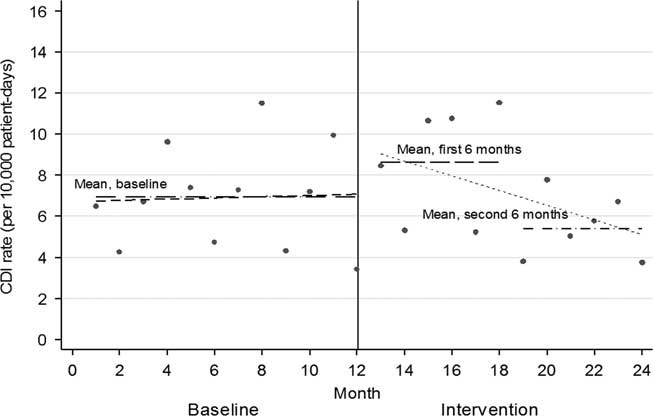
For eligible hospital units, there were 177,184 patient days during the baseline period and 182,832 patient days during the intervention period. More C. difficile assays were performed in the baseline than in the intervention period: 210 versus 186 per 10,000 patient days (P<.001). However, the percentage of tests positive for C. difficile (ie, number of tests positive per number of tests performed×100) was similar during the baseline period (19%) and the intervention period (20%). The CDI incidence was similar in the baseline and intervention periods: 6.9 versus 7.0 per 10,000 patient days (P=.95). When we compared baseline and intervention periods by regression analysis, the decreasing incidence observed during the intervention was not significantly different from the baseline (Figure 1). We observed a decreased incidence of CDI during the second half of the intervention period (months 7–12) compared to the first half of the intervention period: 5.4 versus 8.6 per 10,000 patient days (IRR, 0.6; 95% CI, 0.4–0.9; P=.009). When compared to the baseline, we detected a trend toward a lower incidence in the second 6 months of the intervention that did not reach statistical significance (IRR, 0.8; 95% CI, 0.5–1.1; P=.13) (Figure 1). We observed a nonsignificant decrease in community-onset cases during the project period. However, adjustment for this decline in the regression models did not appreciably change our results.
Comparison of CDI rates between the baseline and intervention periods. Antibiotic recipients in the intervention period were to receive probiotic. aShort-dash lines represents the fitted slope from the regression models; long-dash lines represent the mean values. Statistical tests: level change, baseline to intervention (P=.29); slope change, baseline to intervention (P=.22); incidence difference, baseline to last 6 months of the intervention (IRR, 0.8; 95% CI, 0.5–1.1; P=.13); incidence difference, first to last 6 months of the intervention (IRR, 0.6; 95% CI, 0.4–0.9; P=.009).

Case-Control Study
When we reviewed the medical records of patients who developed CDI during the intervention period (N=128), slightly more than half (68, 53%) were included in the case-control study. Potential case patients were excluded for the following reasons: no in-hospital antibiotic receipt (21, 16%); preoperative antibiotic prophylaxis (16, 12%); clinically ineligible (11, 9%); CDI within 24 hours of antibiotic receipt (6, 5%); receiving antibiotics before hospitalization (3, 2%); unable to match to a control patient (2, 2%); and unavailable medical record for 1 patient.
Among the 136 patients (68 matched pairs) in the case-control study, 35 (26%) received the probiotic according to the protocol (ie, dosed on time and every eligible day); 36 (26%) received no probiotic; 29 (21%) received their first dose late; 25 (18%) missed doses; and, 11 (8%) received their first dose late and missed doses. Using 80% of doses received as the threshold for per-protocol dosing, 48 (35%) received the probiotic intervention per protocol. Among the 103 patients for whom the dosage form was recorded, most received capsules alone (66%); a substantial minority (34%) received at least 1 dose as slurry. The mean age was 67 (±14 SD) years and the mean length of stay was 17 (±14 SD) days. On average, case patients had a worse severity of illness than control patients: 3.7 versus 3.3 (P=.004). The most common sources of admission were home (62%), nursing home (24%), or interfacility acute-care transfer (11%).
Case patients were no less likely to have received probiotic than control patients: 18 of 68 (26%) versus 17 of 68 (25%). The mean number of days of probiotic receipt was similar for case patients and control patients: 4.4 days versus 3.9 days, respectively. In multivariable models, we found no protective effect from probiotics by either conditional logistic regression or proportional hazards models. By conditional logistic regression, factors associated with CDI were tube feeding (adjusted odds ratio [aOR], 4.6; 95% CI, 1.3–17; P=.02), chronic kidney disease (aOR, 4.2; 95% CI, 1.1–17; P=.04), high severity of illness (aOR, 2.6; 95% CI, 1.1–6.2, P=.03), and peptic ulcer disease (OR, 5; 95% CI, 2.4–250; P=.007). Probiotic receipt did not reduce CDI risk (aOR, 0.95; 95% CI, 0.8–1.2; P=.65).
Because missed doses were common, we looked for patterns associated with missing a probiotic dose. Missing a dose was not associated with presence of a feeding tube, sex, comorbidity, or day of the week. Because of variability in staffing, we expected that a specific day of the week might be associated with missing doses, but we detected no differences in probiotic receipt across days of the week.
DISCUSSION
In this large before-and-after evaluation of a probiotic agent to prevent CDI among hospital patients receiving antibiotic therapy, we found a possible delayed benefit from the intervention. Meta-analyses summarizing individual randomized controlled trials provide evidence that certain probiotic agents can significantly reduce the risk of CDI.Reference Goldenberg, Ma and Saxton 9 – Reference Johnson, Maziade and McFarland 11 Despite consistent findings across probiotic formulations (ie, low between-study heterogeneity), one challenge facing clinicians and institutions is to select the optimal probiotic agent. Here, 2 major decision points are (1) whether to choose bacterial probiotic (usually inclusive of a Lactobacillus spp.) or yeast probiotic (eg, Saccharomyces boulardii) and (2) whether the agent should have >1 organism. Such choices are driven by evidence of efficacy, safety, and cost. Because evidence from 3 randomized controlled trials and a single-center before-and-after study showed similar reductions in CDI, we chose a multispecies formulation comprising L. acidophilus (CL1285), L. casei (LBC80R), and L. rhamnosus (CLR2).Reference Beausoleil, Fortier and Guenette 12 – Reference Maziade, Andriessen, Pereira, Currie and Goldstein 15 Although our implementation did not reduce overall CDI incidence during the entire 12-month intervention period, we found a reduction in CDI during the final 6 months of the intervention.
The delayed reduction in CDI rate is consistent with the following prior studies. In a before-and-after intervention similar to ours, the CDI rate declined several months after introduction of probiotic.Reference Maziade, Andriessen, Pereira, Currie and Goldstein 15 In a separate intervention focused on the detection of C. difficile with isolation of patients, the decline in CDI rate was not immediate but occurred over time.Reference Longtin, Paquet-Bolduc and Gilca 18 We speculate that the delayed probiotic effect could be due to several independent or synergistic factors. First, our intervention hospital had a relatively high baseline rate of CDI, which might have contributed to high-density environmental contamination. The effectiveness of a probiotic may be related to the environmental burden of C. difficile spores; for example, probiotic might be more effective during relatively low-inoculum exposures. Thus, a reduction in environmental burden (eg, surface contamination) would be needed before probiotic effect is realized. Such an explanation is supported by the known prolonged environmental survival of C. difficile spores.Reference Weber, Rutala, Miller, Huslage and Sickbert-Bennett 22 Second, probiotics might reduce the excretion of viable organisms, and because the intensity of environmental contamination contributes to patient acquisition,Reference Samore, Venkataraman, DeGirolami, Arbeit and Karchmer 23 a gradual reduction in contamination would lead to reduced patient acquisition over time. Third, the possible ‘herd effect’ likely to result from saturating high-risk patients with probiotics was not achieved during our intervention given the substantial proportion of case patients ineligible for probiotic receipt (41%). Fourth, given the before-and-after design, enhancements or deteriorations in infection control practices may have been unrecognized by the project team. However, there were no changes in environmental cleaning policies, antimicrobial stewardship activities, or modifications to other infection control policies during the study period. Specifically, the laboratory assay (PCR) results for C. difficile toxin detection remained constant throughout the baseline and intervention periods.
Because we were unable to electronically extract patient-level antibiotic and probiotic receipt data, we evaluated the association between probiotic receipt and CDI through a matched case-control study. To control for known major confounders, we matched case-control pairs on age, patient-care unit, and date of onset for antibiotic administration. We found that cases had higher severity-of-illness scores than controls; however, after adjusting for severity of illness, we found no protective effect from the probiotic. Despite this negative finding, we expect that there were critical unmeasured factors that increased risk of CDI among case patients. Ideally, we would have had comprehensive assessments of each patient’s severity of illness on initiation of antibiotics. Also, prehospitalization antibiotic exposure data would have been a useful surrogate for disruption of a patient’s microbiome, but it was not available.Reference Halpin and McDonald 24
It is possible that the probiotic mixture had a beneficial effect unmeasured in the case-control study, such as modulating C. difficile in antibiotic recipients who were colonized but not symptomatic. Such a possibility is suggested by Freedberg et alReference Freedberg, Salmasian, Cohen, Abrams and Larson 25 in their proposed ‘herd effect’ of antibiotics, wherein antibiotics taken by individual patients puts other patients at risk for CDI.Reference Freedberg, Salmasian, Cohen, Abrams and Larson 25 In the study by Freedberg et al, receipt of antibiotics by prior hospital room occupants was associated with increased risk for CDI in subsequent occupants of the same room. Their hypothesis is that antibiotics promote C. difficile proliferation and subsequent environmental contamination in colonized, but not necessarily symptomatic, patients. Our data were also limited by the fact that we did not have the resources to monitor antibiotic recipients after hospital discharge, a time during which patients remain at high risk to manifest CDI and when the full effect of probiotic receipt might be realized.
Despite the largely proven safety of the probiotic mixture, we and clinical staff were concerned about potential harms, particularly clinical infections by probiotic organisms. We believed that the 3 Lactobacillus spp were low risk given the frequency of patient exposure to probiotics and uncommon recovery from clinical specimens. During our intervention, only a single episode of Lactobacillus bacteremia was recorded for a probiotic recipient. When we performed blinded genetic analysis of the patient’s isolate to those recovered from the 3-strain probiotic capsules, we determined that the bacteremia was unrelated to probiotic receipt.Reference Aroutcheva, Auclair and Frappier 26 Regarding safety, in prior studies, side effects were either reduced or unchanged in probiotic recipients compared with controls.Reference McFarland, Huang, Wang and Malfertheiner 27 , Reference Johnston, Ma and Goldenberg 28
A fundamental limitation of our project was low intervention fidelity among intended recipients, and a substantial number of at-risk patients were ineligible for the intervention (eg, pre-hospital or perioperative antibiotic receipt, clinical ineligibility, and no in-hospital antibiotic receipt). Through a chart review for the case-control study, we discovered that only 1 in 4 eligible antibiotic recipients received probiotic per protocol. Among those not receiving the intervention per protocol, the most common event was complete omission of probiotic, that is, not a single administered dose. Monitoring probiotic distribution during the intervention was performed, but the results were inconsistent with our retrospective chart review. Particularly influential factors impeding probiotic receipt were (1) frequent initiation of antibiotics before admission, either in the community or emergency room; (2) intention to administer only perioperative antibiotics; and (3) our system of probiotic distribution required manual evaluation of eligibility lists by pharmacists combined with the need for episodic pharmacy staffing with temporary personnel during the intervention. Anecdotally, patient refusal was rare and clinician refusal was uncommon. Future projects that pair probiotic with antibiotic administration would benefit (1) from an electronic, automated clinical decision support rule; (2) from the inclusion of emergency room patients; and (3) from possibly relaxing criteria for clinical eligibility (eg, a lower leukopenia threshold or requiring active pharmacologic immunosuppression for transplant recipients).
In conclusion, we found a decreased rate of CDI during the final 6 months of a 12-month before-and-after quality improvement intervention of a 3-strain probiotic mixture for primary prevention of CDI. The delayed effect is consistent with prior literature and may have been related to poor fidelity to the protocol for probiotic administration and a delayed gradual reduction in environmental contamination. Our quality improvement intervention in a large hospital encountered substantial implementation challenges. It is critical that such real-world applications are evaluated and reported to guide future quality-improvement research efforts based on the lessons learned. Given the foundation of evidence supporting probiotics to prevent CDI, interventions that achieve better distribution of probiotic and focused environmental cleaning before intervention and control periods are needed to quantify the impact of probiotics on CDI.
ACKNOWLEDGMENTS
We acknowledge Chinyere Alu, Division Chief, Patient Safety and Quality, Illinois Department of Public Health, for identifying the project hospital and coordinating the early communications.
Financial support: This study was supported by the Centers for Disease Control and Prevention, Prevention Epicenters Program (grant no. U54CK000161 to R.A.W.). The study hospital was supported by Bio-K+ through the provision of probiotic formulations at no cost and of monetary support for a research assistant to collect data.
Potential conflicts of interest: S.J. is a member of the advisory board for Bio-K+. W.T. received compensation for travel to present findings to the advisory board. All authors report no conflicts of interest relevant to this article.