How do Europarties choose their policy positions? While political parties in the European Union (EU) have received increasing scholarly attention in recent years, little is known about position formation within Europarties, which are transnational party federations of national parties that organize legislative activity on the European level.Footnote 1 They coordinate the activities of their national member parties and their associated party groups in the European Parliament (EP) by setting and coordinating the EU policy agenda.Footnote 2 Like their national member parties, Europarties have their own statutes, budgets and secretariats, which are legally independent from their national party members and the EP party group.Footnote 3 As the competences of the EU, and in particular the powers of the EP, have increased over time, these federations have developed into genuine European parties.Footnote 4 In their role as transnational parties, Europarties have adopted their own election manifestos in the run-up to the EP elections ever since its first direct election in 1979. These party manifestos guide the legislative activity of the Europarties and their associated party groups in the EP. Based on the general policy guidelines set out in the party programmes, members of the EP (MEPs) regularly receive voting instructions and can be punished by their party groups for not adhering to them.Footnote 5 The importance of their policy platforms is further reflected in the requirement that new members must officially agree to follow the party policy laid down in the manifesto.Footnote 6
Even though national parties join Europarties according to their ideological orientation and policy proximity to Europarties,Footnote 7 national parties vary greatly in their specific policy positions. The European People's Party (EPP), for instance, comprises Christian-Democratic as well as Conservative parties, whereas the Party of European Socialists (PES) incorporates Socialist and Social-Democratic parties such as the British Labour Party, the French Socialists and the German Social Democratic Party. The Europarties are therefore characterized by a high degree of internal ideological divergence. Accordingly, Hix has concluded that the Europarties have been deeply divided with regard to drafting common election manifestos.Footnote 8 For instance, in the run-up to the first EP election, the adoption of the EPP election manifesto was extensively delayed by a disagreement between the Dutch Cristen Democratisch Appèl on the one hand and the German Christlich Demokratische Union and Christlich Soziale Union on the other hand over the role of Christian principles in their common Europarty programme.Footnote 9 Similarly, Külahci demonstrated in an empirical analysis of PES tax harmonization policy in the late 1990s that the PES was unable to act and position itself cohesively on this issue due to diverging economic interests, differences in domestic institutional settings and substantive ideological diversity among its national member parties.Footnote 10 Despite these differences, the national parties must adopt a common position in order to speak with a single voice at the European level. In order to understand party competition in the EU, we therefore not only have to study the interaction between different Europarties, but also their internal functioning. In particular, we need to evaluate how these ideologically diverse national member parties coordinate and arrive at a common position adopted in the election manifesto of a Europarty. This article therefore addresses the question of how policy position choice within Europarties can be explained.
Very little is known about how these national member parties come to an agreement when drafting a Europarty's election manifesto. Even though Europarties and their political groups in the EP have received increasing scholarly attention in the past decade, their internal position formation remains largely understudied. By contrast, considerable attention has been paid to the cohesion of EP political groups and the voting behaviour of individual MEPs.Footnote 11 In an attempt to go beyond the focus on mere voting cohesion, McElroy and Benoit studied the decision of national parties to join political groups in the EP.Footnote 12 They found that national parties were primarily driven by the desire to maximize the congruence between their own ideal policy positions and those of the EP party group. They only studied national parties’ decisions about whether to join an EP party group; it remains unclear how the policy positions of European parties are formed. Several other scholars have empirically mapped the policy positions of European parties and have analysed the dimensionality of the European political space using manifesto data, expert surveys, roll-call analysis and cross-national survey data.Footnote 13 However these studies merely provide policy position estimates for Europarties; they do not explain how these policy positions come about. More specifically, we still know little about how the diverse national member parties agree on the common policy position that the Europarty adopts in its election manifesto.
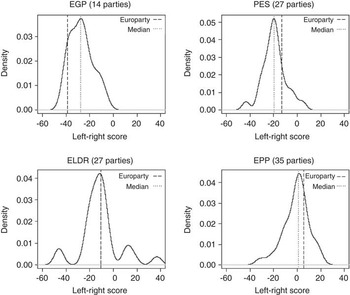
One could argue, for instance, that Europarties adopt policy positions that reflect the central tendency of their national party members. However empirical evidence suggests otherwise. Figure 1 plots the policy positions of the four Europarties (indicated by the dashed lines), the distribution of the ideal points of their national member parties (indicated by the solid lines) and the median position of the national member parties (indicated by the dotted lines). The policy position estimates were extracted from their election manifestos adopted for the 2004 EP election.Footnote 14 The figure illustrates that the Europarties do not simply adopt a policy platform that reflects the median position of their national member parties. The policy positions of the EPP and the PES are shifted to the right, whereas the position of the European Green Party (EGP) is located further to the left than its median national party member. Only the European Liberal, Democrat, and Reform Party (ELDR) adopts a policy position in line with the median position of its member parties. Hence national member parties are not equally represented in their Europarty, which has important implications for democratic representation on the one handFootnote 15 and the voting behaviour of MEPs on the other hand.Footnote 16
Europarty positions and the distribution of their national member parties’ positions in 2004 Note: EGP = European Green Party, PES = Party of European Socialists, ELDR = European Liberal Democrat and Reform Party, EPP = European People's Party.

How can this pattern be explained? What determines policy position choice within Europarties? We have only a limited amount of descriptive and anecdotal knowledge about how the Europarties adopt policy positions when drafting their election manifestos. Their election manifestos are officially adopted by the party congresses that are held in the build-up to EP elections.Footnote 17 The party congresses bring together representatives from national member parties and the party groups in the EP and the Committee of the Regions.Footnote 18 Before an election manifesto is officially adopted by a party congress, a working group is set up to prepare and negotiate the draft programme.Footnote 19 Once the working group comes to a compromise, the election manifesto is approved by the party leaders’ meeting before it is officially adopted by the congress. The party leaders’ meeting consists of the national party leaders, the prime ministers from the member parties (if they are not also their party leaders), the president and vice presidents of the Europarty, the leader of the EP party group and the members of the European Commission who are affiliated with the national party members.Footnote 20 Though we have an idea of which actors are involved in drafting an election manifesto, we do not have any systematic evidence about what factors determine the outcome of position formation. This is a more general problem in the literature on political parties; there is hardly any systematic knowledge of manifesto creation in any other political context.Footnote 21
This study therefore aims to overcome the literature's shortcomings by explaining policy position choice within Europarties. We argue that position formation should be understood as a multilevel bargaining process in which policy-seeking national parties compete to influence their Europarty's policy position choice. We expect that the national parties’ ability to succeed in this multilevel competition is determined by their legislative resources. We first develop the argument in greater detail and derive the central hypothesis that guides the empirical analysis. We then illustrate the study's research design and explain the empirical test of our theoretical expectations. We conclude with a summary of the findings and a discussion of the broader implications for policy position choice within political parties and political representation in Europe.
Multilevel Party Competition and Legislative Resources
This section presents a theoretical model of preference formation within multilevel settings to explain how European parties’ policy positions are formed. We conceptualize position formation within Europarties as a two-level bargaining process in which national parties compete with each other in an attempt to upload their own policy positions to their Europarty. We expect that national parties’ ability to shape the policy preference of their Europarty is determined by their legislative resources; that is, the share of seats they control in the EP.
Parties are conceptualized as rational, goal-oriented and purposeful collective actors. Following De Swaan's party behaviour model,Footnote 22 we assume that parties are policy-seeking actors and that they are motivated by political goals that guide their behaviour. We also assume that they intrinsically value policy outcomes and sincerely believe in the policy goals they seek to achieve. Political parties therefore strive to maximize their influence on policy-making to achieve a policy outcome that is as close as possible to their own ideal position. A party's ability to pursue its policy objectives depends on its capacity to shape the political decision-making process. Political parties therefore also implicitly strive for office as a means of influencing policy.Footnote 23
EP elections have often been described as ‘second-order’ elections that are generally viewed as less important as there is ‘less at stake’ than in national elections, which determine the composition of the domestic government.Footnote 24 As a result, public salience and turnout is considerably lower than in national elections. However the powers of both the EU and the EP have increased considerably over time, and successive treaty changes have turned the EP into a powerful co-legislator. Policy-seeking national parties therefore have strong incentives to influence European decision-making through the EP, as a large number of political decisions is taken at Brussels.
While national-level political parties can independently choose their policy goals and single-handedly pursue their policy objectives in the domestic arena, the situation on the European level is much more complex: national parties come together in Europarties, which are transnational federations of national parties from a wide variety of member states. Even though national parties join these Europarties based on their ideological orientation and policy proximity,Footnote 25 there is a considerable variation in terms of the ideal policy positions of national parties within the same European party. For example, the British Labour Party, the French Socialists and the German Social Democratic Party are all members of the Party of European Socialists, but they vary extensively in their ideology (see Figure 1). Despite these ideological differences, national parties within the same Europarty have to settle on a common policy position in order to speak with one voice in Brussels and effectively pursue their goals on the European level. Europarties have accordingly adopted their own election manifestos ever since the first direct EP election in 1979. These party manifestos guide the legislative activities of the Europarties and their associated party groups in the EP. MEPs regularly receive voting instructions based on the policy guidelines of these manifestos, and they can be punished for not adhering to them.Footnote 26 New member parties are also required to officially agree to follow the manifestos’ policies.Footnote 27
Given that national parties within the same Europarty differ considerably in their policy goals, the crucial question is how these very diverse national parties arrive at a common policy position at the European level. In other words, how do national parties with diverse policy preferences agree on a common position as expressed in the election manifesto of their Europarty? In order to explain Europarties’ policy position choices, their preference formation is conceptualized as a two-level party competition in which the success of national parties depends on their share of EP seats.Footnote 28 As discussed earlier, we conceptualize political parties as policy-seeking actors that pursue a particular policy objective. While national parties can independently choose and pursue their own policy goals in the domestic arena, they cannot single-handedly do so on the European level. By contrast, they have to come to an agreement with other members of their Europarty concerning the policy positions of their common European party federation. National parties therefore seek to influence position formation within their Europarty in order to upload their own policy preferences to their European party. The importance that national parties attach to the election manifestos of their Europarties is reflected by the seniority of the representatives that national parties send to negotiate the Europarty manifestos. For instance, the British Labour Party sent its foreign minister to lead the working group that was set up in 1998 to draft the PES election manifesto for the EP election in 1999.Footnote 29 The French, German and Italian member parties also sent high-ranking officials to these working group meetings.Footnote 30
National parties that are members of the same European party therefore compete with each other in an attempt to upload their own individual policy preferences to the European party. Drawing on insights from the literature on coalition governments, we argue that a national party's share of parliamentary seats determines its success. Coalition theorists have argued that the payoffs that political parties gain from coalition governments crucially depend on the resources a party brings to the coalition.Footnote 31 GamsonFootnote 32 reasoned that ‘any participant will expect others to demand from a coalition a share of the payoff proportional to the amount of resources which they contribute to a coalition’, which has been famously denoted as ‘Gamson's law’.Footnote 33 Even though Europarties do not constitute traditional government coalitions, which are the focus of previous coalition research, they are alliances of national parties that share a variety of features with government coalitions. National parties come together in Europarties to achieve common legislative objectives, just as national parties come together in a coalition government in order to govern together. Similarly, national parties demand payoffs for their participation in Europarties, just as national parties demand payoffs from their participation in coalition governments. Europarties can therefore be conceptualized as transnational coalitions of national parties that demand payoffs for their participation. Gamson's law therefore offers important insights to help understand payoff allocation in Europarties.
Payoffs are goods that are distributed among coalition partners and used by them to advance their individual objectives.Footnote 34 In line with the policy-seeking party model, we assume that the crucial payoffs for national parties on the European level consist of policy prerogatives.Footnote 35 National parties pursue their own policy objectives and try to upload their individual policy goals to their Europarty. They seek to adopt a common Europarty position that is as close as possible to their own preferred position. In a unidimensional policy space, the utility for national parties declines with the distance between the Europarty position and their own policy stance. This utility function is formulated as follows:
 $$ {{U}_j}\: = \:{\rm{ - (}}{{P}_{NATj}}{\rm{ - }}{{P}_{EUR}}{{{\rm{)}}}^{\rm{2}}}, $$
where Uj is the utility for a national party j. PNATj is the position of national party j on the unidimensional policy scale and PEUR is the location of its Europarty on the ideological scale. Thus the utility rises as the policy distance between a national party and its Europarty decreases, and reaches its maximum at zero – indicating absolute congruence between the Europarty and the preferred position of the national party.
We furthermore assume that the most important resource that a national member party provides to its Europarty is its share of seats in the EP.Footnote 36 Their seat share reflects the degree of legislative support that national member parties can deliver to their Europarty to achieve common policy objective.Footnote 37 The strength of a Europarty, or more precisely its associated party group, crucially depends on the number of seats it controls in the EP. As decisions in the EP are taken by majority vote, the ability of Europarties to achieve their policy goals in this forum depends on their seat share. The EP's powers have considerably increased over time; it is now a veritable co-legislator on the European level. Policy-seeking parties can therefore influence the EU legislative process through the EP in order to achieve a policy outcome that is as close as possible to their preferred policy positions. The ability to shape EU policy-making through the EP is determined by the legislative resources of national parties. The higher a national party's seat share, the larger its impact on the EP's position on policy initiatives and – ultimately – on policy outcomes. National member parties that won a large number of parliamentary seats therefore provide their Europarty with considerable legislative resources that are necessary to achieve the common policy objective. As a result, the number of seats a national party can bring to the table directly determines its level of influence in negotiations about defining common policy position for their European party. As Euromanifestos are drafted in the run-up to EP elections, the number of seats a national party currently controls is decisive. National parties that gained a large number of seats in the last election have demonstrated their ability to win a large number of parliamentary mandates for their Europarty. Since their prospects of wining a similarly large number of seats in the upcoming election are promising, they therefore wield greater power in drafting the Europarty manifesto. Hence the larger the share of parliamentary seats a national party currently controls, the higher the policy payoffs it can gain from negotiations with other members of the same Europarty.Footnote 38
 $$ {{P}_{EUR}}\: = \:\mathop{\sum}\limits_{j\:{\rm{ = }}\:{\rm{1}}}^J {{{P}_{NATj}} \,\ast \,{{\alpha }_j}}, \; \; with\,\mathop{\sum}\limits_{J\:{\rm{ = }}\:{\rm{1}}}^J {{{\alpha }_j}\:{\rm{ = }}\:{\rm{1}}} $$
Formula 2 illustrates our theoretical model.Footnote 39 We expect that the policy position PEUR that a Europarty adopts is the result of multilevel negotiations in which J national member parties attempt to upload their positions to their Europarty. The policy position choice of a Europarty PEUR corresponds to the sum of the weighted preferences of national member parties. The preferences of national member parties PNATj are weighted by their legislative resources aj. The legislative resources of a national party correspond to its share of the aggregated number of EP seats that all national member parties bring to their Europarty. The policy preferences of national parties with a high degree of legislative resources aj have a larger impact on the policy position of the Europarty PEUR. Therefore the policy position of a Europarty does not correspond to the average position of its national parties. National member parties do not have an equal weight in multilevel negotiations; their influence depends on the number of EP seats they control relative to the other member parties. Policy position choices of Europarties are therefore skewed towards national parties that gain a large number of seats. Hence the distance between the ideal point of a national party and the policy position of its Europarty is negatively associated with its legislative resources. National member parties with a high seat share are located closer to the ideal point of their Europarty than national parties that won only a small number of parliamentary seats.
HYPOTHESIS: The greater the legislative resources of a national party, the smaller the distance between its own national policy position and the policy position adopted by its European party.
Research Design
In this section we describe how we constructed the dataset that was used to empirically test our theoretical expectations. We first explain how we measured the policy positions of European and national parties, as well as the distance between these position estimates. Afterwards we will discuss how the explanatory and control variables were operationalized.
Measuring Policy Positions of Parties and their Distances
To measure the policy positions of European and national parties, we rely on the Euromanifesto dataset.Footnote 40 European parties, and most of their national member parties, have adopted election manifestos for all EP elections since its first direct election in 1979. Party manifestos have been used by a wide variety of scholars to estimate the policy positions of political parties, since the parties clearly spell out their ideological stances on a variety of policy issues.Footnote 41 The most widely used dataset on policy positions is provided by the Comparative Manifesto Project (CMP), which analyses national party manifestos in a wide variety of countries from 1945 until today by means of manual hand coding.Footnote 42 The CMP developed a classification scheme with fifty-six categories grouped into seven policy domains. Where possible, directly opposing pro and contra categories were specified. The Euromanifesto project (EMP) manually codes the election manifestos issued by European and national parties for EP elections using a coding scheme similar to the one developed by the CMP. Human coders first divided the election programmes into ‘quasi-sentences’ that contain an argument understood as ‘the verbal expression of one political idea or issue’.Footnote 43 These quasi-sentences were then allocated to the appropriate categories, as specified in the EMP coding scheme.
In order to compute policy position estimates, we drew on the widely used ‘RILE’ procedure. As discussed above, the Euromanifesto project divided all EP election manifestos into quasi-sentences and allocated them to predefined policy categories. Some of these categories are considered to indicate left-winged policy positions and some are classified as right-winged issues. The ‘RILE’ scaling technique yields policy position estimates from these coded manifestos based on the following procedure. First, the percentages of left and right categories of the total number of coded quasi-sentences are computed. Then the percentage of left sentences is subtracted from the percentage of right sentences. Negative scores represent left positions and positive scores represent right positions. At the extreme, a party devoting its entire program to left-wing issues would score −100; similarly a totally right-winged program would receive a score of +100. For example, if a party manifesto contained 200 quasi-sentences, of which 100 (50 per cent) are allocated to left categories and 40 (20 per cent) to right categories, it would receive a score of −30 (that is, 20–50). Concerning the European dimension, we used the ‘pro-anti European integration scale’ constructed by subtracting the percentage of anti-EU sentences from the percentage of pro-EU sentences. In this case, positive scores represent a pro-integration attitude, while negative values represent an anti-integration position.Footnote 44
There are also alternative approaches to measuring policy positions; expert surveys are the most prominent.Footnote 45 There is a vibrant discussion in the literature about the quality of manifesto data and expert surveys for the measurement of policy positions, as each approach is associated with certain advantages and disadvantages.Footnote 46 We decided to use Euromanifesto data for theoretical and empirical reasons. First, from a theoretical point of view, this study analyses Europarties’ preference formation with regard to drafting common Europarty election manifestos. We conceptualized preference formation as a two-level party competition in which national parties compete to influence the policy position that the Europarty adopts in its election manifesto. From a theoretical perspective, the election manifestos adopted by the Europarties and their national member parties are therefore the ideal data source for our analysis. Secondly, from an empirical point of view, it is crucial that the estimates measure policy positions at the time of EP elections to have simultaneous position estimates for when national parties negotiate their Europarty manifestos. As the expert surveys are only available for a limited number of time points, and are not available simultaneously for national parties and their Europarties, we decided to rely on the Euromanifesto data, which provides us with simultaneous policy position estimates for all Europarties and all their national member parties for all EP elections in 1979, 1984, 1989, 1994 and 2004. We performed the following check, based on the Chapel Hill expert survey data, to test the robustness of our results.Footnote 47 First, we computed the Europarty position based on the average positions of its national member parties, as estimated by the expert survey. Secondly, we computed the Europarty position based on the average positions of its national member parties, weighted by their relative seat share, in line with our theoretical model summarized in Formula 2. Finally, we compared these estimates to the Europarty position estimates derived from the Euromanifesto data. The results indicated that the average expert survey position of national parties – weighted by their relative seat share, as suggested in our theoretical model – better predicts the Euromanifesto positions than the simple average expert survey positions of national parties. The expert survey data therefore supports our findings and the validity of the Euromanifesto position estimates.
In order to study policy position formation within European parties, we concentrated on the four major parties on the European level, as they have dominated politics in the EU:Footnote 48 the EPP, the PES, the ELDR and the EGP. The EPP is the largest political group in the EP and currently controls 271 of its 736 seats: it incorporates forty-eight Christian Democratic and Conservative parties from the twenty-seven EU member states. The PES brings together the EU's Socialist, Social Democratic and Labour Parties; it is currently represented by 184 MEPs and it is composed of thirty-three national parties. The third-largest political force in the EP is the ELDR, which has seventy-two of the 736 seats and brings together fifty-four liberal parties from various European countries. The EGP, which comprises thirty-eight green parties from various European countries, currently has the smallest number of representatives in the EP (forty-seven). All together the dataset includes 286 observations, which constitute national member parties that aim to shape the election manifestos adopted by the four major Europarties across the six EP elections between 1979 and 2004.
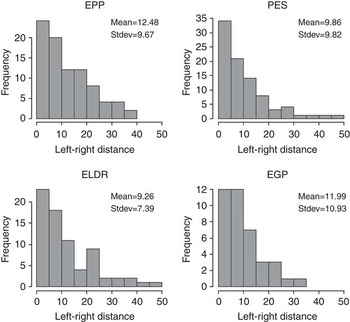
To measure the absolute distance between the ideal points of national member parties and the policy position adopted by their European party (PEUR − PNATj) we computed the Euclidean distance between these two positions. We analysed the distance between European parties and their national members on the left-right scale for two reasons. First, several scholars have empirically evaluated the policy space at the European level and concluded that it is characterized by a unidimensional left-right space.Footnote 49 Secondly, although some other scholars disagree and suggest that the European political space is characterized by two dimensions (left-right and pro-anti European integration dimensions),Footnote 50 there is hardly any variation on the pro-anti European integration dimension.Footnote 51 This is particularly the case, since we focus on the four major European parties that largely agree on the scope of European integration, as compared to Eurosceptic parties. Figure 2 illustrates the absolute ideological distance between national parties and their Europarties on the left-right scale. To check the robustness of our results across a different conceptualization of the dimensionality of the European political space, we repeated our analysis for the two-dimensional space (left-right/pro-anti integration). We measured the distance between national parties and their Europarties on the left-right and pro-anti European integration based on the two-dimensional Euclidean distance.
Absolute distance between national parties and their Europarty on the left-right scale, 1979–2004 Note: EGP = European Green Party, PES = Party of European Socialists, ELDR = European Liberal Democrat and Reform Party, EPP = European People's Party.

Measuring Independent Variables
We measured a national party's legislative resources by the number of EP seats it won in the last EP election relative to other member parties of the same Europarty. We therefore used the lagged legislative resources of national parties to predict their influence on Europarties’ policy position choices.Footnote 52 The number of parliamentary seats simultaneously captures the overall weight of a national party's member state in the EP and its relative importance in its home country, as a party's seat share is determined by its domestic vote share and the number of seats allocated to its home country in the EP. The vote share of national parties in their home country or the absolute number of seats are, by contrast, insufficient to measure the supply of legislative resources to their Europarty. For instance, a national party from Malta could win 100 per cent of the national votes, but would still provide fewer seats to its Europarty than a German party winning only 10 per cent of the national votes, since Malta only has six seats, while Germany has ninety-nine seats in the EP. Similarly, as the EPP overall currently controls 271 seats while the EGF controls fifty-eight, a national member party of the EPP that won twenty seats is less important to its Europarty than a Green party that only won ten seats, since the Green party provides about 17 per cent of its Europarty seats while the Conservative party only provides 7 per cent of all the EPP seats.
To obtain the number of seats relative to other member parties of the same Europarty aj of national party j, we divided the number of seats xj obtained by party j by the total number of seats gained by all members of the same Europarty. To ease interpretation of the regression coefficients, we then multiplied the estimate by 100 so that the measure of legislative resources ranges from 0 to 100.
 $$ {{\alpha }_j}\: = \:\frac{{{{x}_j}}}{{\sum _{{j\: = \:1}}^{J} {{x}_j}}}{\rm{\ast100}} $$
As the proximity model of voting predicts that European parties adopt policy positions based on the distribution of their supporters’ policy preferences, we controlled for the distance between the ideal points of national parties and the median policy position of the potential European electorate.Footnote 53 We measured the location of the median ideal point using survey data gathered from the European Election Studies (EES) for EP elections between 1989 and 2004. For the 1979 and 1984 elections we relied on Eurobarometers 12 and 22.Footnote 54 All these surveys included several questions about electoral participation and voting behaviour in EP elections. One of the questions refers to the classical left-right individual self-placement. This variable ranges from 0 (extreme left) to 10 (extreme right) and is available for all EP elections. The EES furthermore comprises a question that measures citizens’ attitudes towards European integration. This variable ranges from 1 (unification has already gone too far) to 10 (integration should be pushed further).Footnote 55 Unfortunately this question was only included in the last two EES waves (1999 and 2004), which causes a significant reduction in the number of cases. We transformed these two scales so that they correspond to the ideal point scales of political parties.Footnote 56
The median ideological position of the potential electorate of a European party was calculated as the median policy position of citizens that voted for the party.Footnote 57 Thus for each Europarty we calculated the median ideal point of its potential electorate on the left-right scale for each election, and on the pro-anti European integration dimension for the 1999 and 2004 elections. In order to measure the distance between a national party and the median position of the potential European electorate of its Europarty, we then computed the Euclidean distance on the left-right scale and in the two-dimensional policy space.
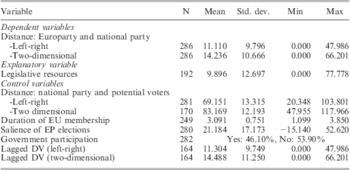
We also included several additional control variables in the analysis. To account for the potential learning effects of prior experience in negotiating the policy positions of European parties, we controlled for the duration of EU membership of a national party's home country, measured by the number of years between its accession and the date of the election. We used the logged number of years, as it is plausible to assume that the size of the learning effect decreases over time. We also controlled for the salience of EP elections in different member states of the EU. If EP elections are particularly salient in a member state, national parties from this country might, on average, have stronger incentives to influence the position formation of their Europarty, as their domestic constituents more closely monitor the election campaign than in countries where EP elections raise little public interest. We would therefore expect that the policy distance to Europarties decreases, on average, with the salience of EP elections in the home countries of national member parties. It has to be noted, however, that national parties from the same country might place different emphasis on EP elections, despite the high salience of EP elections to their electorate. We measured the salience of EP elections as the difference in turnout between European and national elections.Footnote 58 European elections are generally regarded as ‘second-order’ elections that, just like many local and regional elections, lack salience; therefore turnout is generally low.Footnote 59 There is seen to be ‘less at stake’ in second-order elections than in first-order elections (typically national parliamentary elections). As a consequence, there are fewer incentives for people to vote in these contests, so turnout is generally lower than in national elections.Footnote 60 We also took into account whether national parties were in government at the national level by including a dummy variable that was coded based on data gathered from the Political Data Yearbook published by the European Journal of Political Research. National parties that form the government in their home country are represented through their MEPs as well as their ministers in the Council of the EU and their heads of government in the European Council. As members of the Council at both levels, national government parties can crucially affect the EU's agenda and the outcomes of legislative processes. They can therefore determine the policy issues on which Europarties have to position themselves, and due to their voting power in the Council, they can also offer legislative support to Europarties with regard to upcoming policy initiatives. Since they can also rely on an extensive network of preparatory bodies, they enjoy important information advantages over national opposition parties. It is therefore crucial to control for government participation. Table 1 provides summary statistics of all variables in the model.
Summary Statistics of Variables

Data Analysis
The special structure of the data has to be taken into account in order to test our theoretical expectations. National parties are members of European parties and seek to shape the policy positions of their European party in the run-up to EP elections. More specifically, every national party is a member of one particular European party and competes with other members of the same European party to shape the election manifesto adopted by the Europarty for a specific EP election. For instance, since the German Social Democratic Party and the Spanish Socialist Workers’ Party are both members of the PES, they compete to shape the policy positions that the PES adopts in its election manifesto. European parties also compete every five years in European-wide elections to the EP. For each of these elections, all four major European parties adopt a new election manifesto, which their national member parties seek to influence. Position formation in the run-up to EP elections might vary considerably, with contextual characteristics specific to each particular election. For instance, the ability of national member parties to influence policy position choices within European parties might be affected by the number of EU member states or the issues on the political agenda during a specific election campaign. The election-specific context might therefore facilitate (or hamper) national parties’ ability to shape the election programme of their European party.
National parties are therefore clustered within the four major European parties and each specific election year so that the observations are not completely independent, as assumed by ordinary regression. In order to take this clustering of data into account, we estimated ordinary least square (OLS) regression with clustered robust standard errors.Footnote 61 As national parties are clustered simultaneously in Europarties and election years, we created a cluster variable that takes this twofold clustering into account. The data structure leads to twenty-four clusters based on four Europarties (EPP, ELDR, PES, EGP) and six elections (1979, 1984, 1989, 1994, 1999, 2004). In addition to the clustering, the dataset is also characterized by a time component, as six succeeding elections are analysed. To control for potential autocorrelation induced by the time-series structure of the data, we included the lagged dependent variable.Footnote 62 However, as incorporating lagged dependent variables is also associated with a number of problems, we have also estimated the model without the lagged dependent variable.Footnote 63 As the results are substantially the same, we only present the full model, which includes the lagged dependent variable.Footnote 64
Unfortunately, we can only compute the ideological distance between the potential European electorate and the national parties on the left-right scale for all elections to the EP. As mentioned previously, the self-placement of voters on the pro-anti European integration dimension is only available for the 1999 and 2004 elections. Including the ideological distance on the pro-anti European integration dimension thus considerably decreases the number of observations. We therefore also estimated the OLS regression excluding the ideological distance between national parties and voters on the European dimension to test whether the effects detected in the smaller sample also hold across a larger number of cases. As the results are substantially the same, we only present the complete models including all variables.
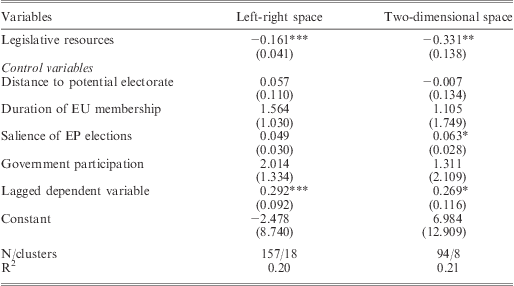
Table 2 presents the results of the regression analysis. The first model reports the results of the analysis of the distance between European and national parties on the left-right scale. The second column contains the results of the analysis based on the distance in the two-dimensional left-right and pro-anti EU space. As theoretically expected, the legislative resources of national parties are negatively associated with the distance between their ideal point and the policy position of their Europarty. Across both models, legislative resources have a statistically significant negative effect on the ideological distance between a national party and its Europarty. More precisely, if legislative resources increase by one unit, the distance between a national party and its Europarty decreases by 0.161 units in the left-right and by 0.331 units in the two-dimensional space. National parties with a large number of parliamentary seats are therefore particularly successful in pulling their Europarty position towards their ideal points: the higher the legislative resources of a national party, the stronger its ability to determine position formation within its Europarty. By contrast, the distance between the policy position of a national party and the median position of the potential European electorate does not have a statistically significant effect in any of the model specifications. Similarly, the duration of EU membership, the salience of EP elections and being in government at the domestic level do not have a systematic effect on the ability of national parties to shape position formation within their Europarty. The lagged dependent variable has a statistically significant positive effect, which indicates that national parties that fail to shape the election manifesto of their Europarty at t 0 will most likely also not be successful in determining its policy position choice at t 1.
OLS Regression with Clustered Standard Errors
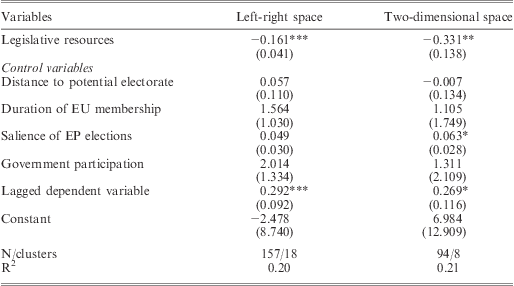
***p ≤ 0.01, **p ≤ 0.05, *p ≤ 0.10; standard errors in parentheses.
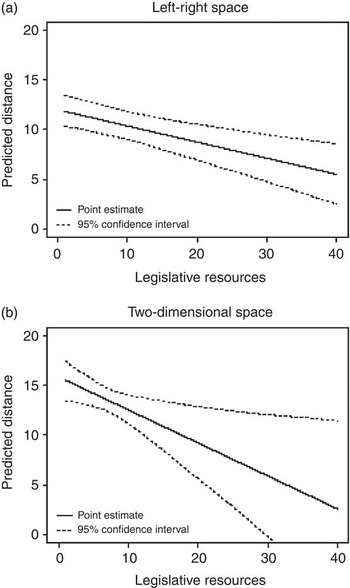
To illustrate the effect of legislative resources on the ideological distance between national parties and their Europarty, we simulated predicted values as suggested by King, Tomz and Wittenberg.Footnote 65Figure 3 displays the simulated predicted distance in the (a) left-right and (b) two-dimensional spaces as legislative resources change while holding all other variables constant. The point estimates of the predicted values are indicated by the solid lines and the 95 per cent confidence intervals are illustrated by the dashed lines. The predicted distance between Europarties and their national member parties in the left-right and two-dimensional space constantly decreases with an increase in national parties’ legislative resources while other variables are held constant. Thus legislative resources have a steady positive effect on the ability of national parties to influence policy position choice within their European party.Footnote 66
The effect of legislative resources

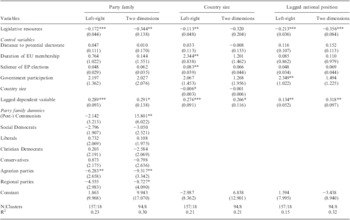
To test the robustness of the findings, we estimated three further model specifications (see Table 3). First, we included a dummy variable for party family to check whether the effect of legislative resources on the policy position choice of Europarties might differ across different party families. The results confirm the previous analysis, as legislative resources also have a statistically significant effect on policy position choice if we control for party family. Secondly, one might also argue that the size of the country could be driving the effect of legislative resources, in the sense that parties from large member states dominate position formation. However country size is already implicitly included in the model, as the number of EP seats a national party can win depends on the size of the country. The allocation of EP seats to member states is more or less proportional to their population. National parties from large member states such as Germany (99 seats) can therefore win more seats than parties from small member states such as Malta (six seats). The legislative resources of national parties therefore already implicitly take country size into account. However, in order to test the robustness of the findings, we estimated an additional model specification that explicitly controlled for country size measured by the population in hundreds of thousands of inhabitants. Even when additionally controlling for population size, the direction (and, by and large, also the size) of the effect of legislative resources remains constant. Thus the effect of legislative resources is not driven by the size of the country, but instead has an independent effect on position formation. It has to be noted, however, that the effect of legislative resources is only statistically significant in the left-right space and not in the two-dimensional space, which might be explained the smaller number of cases (N = 94) and the relatively high correlation between legislative resources and population size in that sample (r = 0.59). Thirdly, as some national party manifestos may be drafted only after the Europarty has already adopted its election manifesto, we reran the analysis using national parties’ policy position estimates obtained from their party manifestos from the previous EP election. We essentially arrived at the same findings whether we used the election manifestos of national parties drafted for the same or the previous EP election.Footnote 67
Alternative Model Specifications

***p ≤ 0.01, **p ≤ 0.05, *p ≤ 0.10
Note: The reference category for the party family dummies is green parties. Standard errors in parentheses.
Conclusion
While political parties in the EU have received increasing attention in the past decade, we know little about how Europarties arrive at the policy positions expressed in their election manifestos. In an attempt to overcome the shortcomings of the literature, this study analysed position formation within Europarties. We argued that national parties compete with each other in an attempt to upload their own policy positions to their European party in order to decrease the ideological distance between their nationally adopted policy platform and the Europarty position. We hypothesized that the ability of national member parties to shape the policy position choice of their Europarty is determined by their legislative resources: their share of seats in the EP. We tested our theoretical expectations using an empirical analysis of position formation within the four major Europarties for all EP elections between 1979 and 2004. The results confirmed our theoretical expectations: the policy positions of Europarties do not reflect the average positions of their national member parties or the European electorate, but are instead skewed towards national parties with a large seat share.
These findings have important implications for our understanding of party competition and political representation in the EU in particular, and for position formation within political parties in general. The previous literature on party politics in the EU has largely focused on the competition of political parties in the legislative arena.Footnote 68 However, in order to fully comprehend how party competition works in the EU, we have to understand position formation within Europarties. Europarties have developed from loose umbrella organizations into veritable transnational parties that structure the activities of their party groups in the EP. National parties can therefore not pursue their own individual policy objectives, but must arrive at a common position with national parties from other member states that belong to the same Europarty. Thus the entire scope of political competition among national parties does not openly unfold in the legislative arena, but is channeled and settled beforehand through internal position formation within Europarties. While this study has shed light on the formation of policy positions within Europarties, it is largely unknown how policy disagreement within Europarties occurs in the first place. Future research should therefore investigate why national parties within the same Europarty have diverging preferences, and whether policy disagreement varies across different policy fields.
The analysis indicated that the policy position choices of Europarties are biased towards national member parties with high legislative resources. This has important implications for political representation in the EU. National parties are not equally represented by their Europarties, but these are dominated by parties with a large seat share. This means that national parties from small member states are systematically disadvantaged in the political arena at the European level. As they cannot deliver a large number of EP seats, their position is less likely heard than the voice of national parties from large member states. Europarties are therefore more responsive to the policy preferences of citizens from large member states, while citizens from small member states are less likely to be represented. Our results concerning the role of small states in the position formation of Europarties correspond to the findings in the broader literature on EU decision-making processes. Tallberg, for instance, finds that the three big member states – France, Germany and the UK – crucially determine the outcome of the European Council summits that set the broader agenda for policy-making in the EU.Footnote 69 Similarly, Hayes-Renshaw and Wallace note that large member states generally have more power in the Council than small states. Our findings therefore further corroborate previous analyses, as large member states not only dominate the formal legislative process through their voting power in the Council and their large seat share in the EP, but they also dominate position formation within Europarties.Footnote 70 Citizen preferences from small member states therefore have a much smaller chance of affecting legislative outcomes in the EU, and are also disadvantaged when it comes to shaping the positions of Europarties.
Finally, these findings also have important implications for our understanding of policy position formation within political parties more generally. We have demonstrated that policy position choice within Europarties can be conceptualized as a multilevel competition among national member parties that compete with each other in an effort to upload their own policy preferences to their European party. We believe that policy position choice within national parties in strongly federalist countries can be conceptualized in a similar fashion. National political parties in strongly federalist systems are composed of regional parties or party associations that have a major impact on the decisions taken by the national leadership. We expect that regional parties or party associations similarly engage in a two-level competition concerning the adoption of the national election manifesto, in which their legislative resources are decisive for their success. This study can therefore shed light on political parties’ manifesto creation more generally.