INTRODUCTION
The election of Edward W Brooke to the U.S. Senate in 1966 was the first time that an African American had been popularly elected to the country's most powerful legislative chamber. Unsurprisingly, discussion of the election has focused on its racial dimensions, and scholars have long credited Brooke's victory in Massachusetts to a “deracialized” election strategy in which both the candidate and the electorate ignored racial matters (e.g., Jeffries Reference Jeffries1999; Nordin Reference Nordin2012; Sokol Reference Sokol2014; Sonenshien Reference Sonenshein1990). This article revises this prevailing historical explanation of Brooke's election, arguing that scholars have crucially misinterpreted the way race featured in the campaign. Drawing from a wealth of primary sources, this paper argues that Brooke was much more of a “race-conscious” candidate than is generally remembered.
Applying Desmond King and Rogers Smith's paradigm of racial policy alliances to the electoral arena, this paper proposes that Brooke more accurately should be described as a “race-conscious” candidate (King and Smith Reference King and Smith2014). First, Brooke's strong sense of his own racial identity and his understanding of race in American history align much more closely with the “race-conscious” coalition than that of the “color-blind” alliance. Second, Brooke's policy agenda was not “color-blind” or “deracialized” but contained a set of race-conscious policies designed to tackle racism beyond de jure racial discrimination. Third, Brooke's appeal to white voters subtly but unmistakably acknowledged the aspirations of wanting to “make history” and “do the right thing” by electing a qualified African American candidate. Relatedly, as interviews with key campaign staff indicate, Brooke's racial symbolism was an important factor in drawing liberal whites to work and volunteer for his campaign. Finally, Brooke was uniquely successful as a black Republican candidate in the post-Civil Rights Act era in being able to command an overwhelming majority of the black vote. This paper shows that Brooke's support among blacks was exceptionally high for a Republican candidate, even in Massachusetts in the 1960s. The support suggests a strong linkage between Brooke and the African American community. The first half of Brooke's Reference Brooke1966 campaign slogan “Proudly for Brooke: A Creative Republican” signals the race-conscious dimension of his candidacy.
The article will proceed as follows. The first section sets out the theoretical framework. The second section analyses Brooke's racial identity and his political development. The third section turns to Brooke's strategy in the 1966 U.S. Senate campaign. Finally, the fourth section explores why such an appeal was thought to be effective, given the widespread advice given to black candidates in the 50 years since Brooke's election that deracialized appeals are necessary for political success in majority-white jurisdictions.
This article makes extensive use of primary materials drawn from several archives: Senator Brooke's official papers held in the Library of Congress and his personal papers at Boston University, as well as the papers of his Democratic opponent Governor Endicott Peabody, which are held at the John F Kennedy Presidential Library. From these repositories, I focused attention on the content of internal campaign memoranda, correspondences, internal polling reports, and newspaper clippings. The article also draws from two interviews which I conducted with Senator Brooke in the final year of his life—one by phone in February 2014 and one at his home in May 2014. I also interviewed key members of the Brooke campaign staff as well as Brooke's opponent for the Republican nomination. Where anonymization is necessary, interviewees are coded with “EB” followed by a unique number, for example, “EB3”. In addition, several first-hand accounts of the 1966 election, including Brooke's own autobiography, Elinor Hartshorn's PhD thesis, and an analysis published by Brooke's pollsters, have proved to be invaluable sources of primary material (Becker and Heaton Reference Becker and Heaton1967; Brooke Reference Brooke2007; Hartshorn Reference Hartshorn1973).
RACE-CONSCIOUS VERSUS COLOR-BLIND POLITICS
The first section of this paper offers a reassessment of the theoretical framing of Edward Brooke's racial campaign strategy, long thought to be an example of a “deracialized” campaign strategy. I argue that scholars have wrongly understood the racial dimensions of Brooke's candidacy due to inadequate theorization of the possible campaign strategies available to black candidates in majority-white jurisdictions. This paper argues that the conditions of Brooke's candidacy (timing within the development of the civil rights movement, racially non-confrontational competition, candidate biography, and the racial attitudes of his electorate) gave Brooke license to speak to white voters with much more straightforward race-conscious language and content than commentators have generally believed is possible for a black candidate in a majority-white election.
Most scholarship on black electoral politics has been limited to two models of black candidacy: the “racialized” campaign model, which is said to be typical of majority-black constituencies and the “deracialized” campaign model in majority-white constituencies. Huey Perry described these two models as the “twin pillars” of black electoral politics (Perry Reference Perry and Perry1996, xii). The majority-black racialized campaign is associated with black “militancy”, black-specific policy issues, and a “confrontational” political style (Gillespie Reference Gillespie and Gillespie2010, 204; Swain Reference Swain1995, 79; Thernstrom and Thernstrom Reference Thernstrom and Thernstrom1997, 483). In contrast, the key features of the deracialized model include the offer of a “race-neutral” policy program, the adoption of a “non-threatening” political style, and the avoidance of racial discourse in mobilizing either black or white voters (McCormick and Jones Reference McCormick, Jones and Persons1993; Wilson Reference Wilson1990).
The deracialized model's central hypothesis is that white voters will not support a black candidate who overtly identifies with his or her black racial identity. If black candidates can avoid associations with their black racial identity, then they can minimize the salience of race in the campaign and attract white support on a non-racial basis. According to this view, the only way in which black politicians win election in majority-white jurisdictions is by purging any racial content from their campaigns.
In the 1960s, the population of Massachusetts was 2.2% African American. Brooke remains the only black U.S. senator to have been elected from a state whose proportion of black residents is lower than the national average. Therefore, according to the racialized/deracialized campaign paradigm, one would expect Brooke to deploy a “deracialized” campaign strategy in order to appeal to the 97.8% of Massachusetts voters who were not African American. Indeed, Brooke's success has widely been credited to running a “deracialized” campaign (Nordin Reference Nordin2012, 114). Typical of this conclusion, Jason Sokol has presented Brooke's election as an exceptional and fleeting moment in the U.S. history where voters existed in “an alternate reality—a place where race was no political object” (Sokol Reference Sokol2014, 103).
Similarly, Judson Jeffries has argued that Brooke was successful because he minimized the role of race in his campaign, distanced himself from the civil rights movement, and focused exclusively on issues that “transcend” race (Jeffries Reference Jeffries1999). A closer inspection of the campaign, however, reveals that in his public speeches and policy documents, Brooke freely acknowledged the symbolic significance of his candidacy, supported the Johnson civil rights agenda openly, and even criticized the administration for not going far enough in tackling enduring racial inequalities. On the other hand, Brooke's racial campaign strategy resolutely rejected racial exclusivity, black nationalism, and forms of “black power” associated with other contemporary black leaders like Adam Clayton Powell, Amiri Baraka, and Stokely Carmichael.
Therefore, I argue that neither the “racialized” nor the “deracialized” model accurately captures the racial campaign strategy adopted by Edward Brooke. Instead, I suggest that scholars turn to the historical-ideational paradigm of King and Smith, who contend that American politics is divided by racial policy alliances (King and Smith Reference King and Smith2014). They define these as “durable coalitions of political actors, activist groups, and governing institutions united by their stances on the central racial policy issues in the eras of American politics their conflicts help define” (Smith et al. Reference King and Smith2011). King and Smith's typology is valuable because it reorients focus to politicians’ philosophical commitments rather than predominantly on their presentational differences. “Color-blind” advocates are willing to remove legal barriers to discrimination but oppose racially targeted policies and tend to discount the enduring role of race in shaping life outcomes. Indeed, color-blind advocates consider any race-based public policy to be inherently discriminatory and racist, even if such policies are targeted at assisting historically marginalized racial minorities. In contrast, the race-conscious policy coalition holds that centuries of slavery and racial apartheid in American have had an enduring social and political legacy, even in an era of formal, legal equality. They argue that policies should be made with the explicit concern for reducing America's severe racial inequalities because the mere removal of de jure racial discrimination is insufficient to addressing the effects of centuries of racism in America. Advocates within the race-conscious coalition are critical of color-blind philosophy which they believe “disguises (sometimes deliberately) or normalizes (sometimes unwittingly) relationships of power and subordination” (Guinier and Torres Reference Guinier and Torres2002, 42).
Turning to electoral politics, if an African American candidate were to follow a “color-blind” campaign strategy, we would expect the candidate to avoid discussion of lingering structural racial inequalities and to purge racially targeted legislation from his or her policy agenda. Empirical differences in racial outcomes in housing, education, employment, health, and so forth are difficult to deny, but a color-blind candidate would regard these differences as coincidental to race and racial attitudes rather than explained in part by them. In contrast, if an African American candidate pursued a “race-conscious” strategy, we would expect him or her to speak about race and racial inequalities openly as well as adopt positions which would be aimed at advancing the material conditions of African Americans.
Sokol argues that Brooke waged “a color-blind campaign”, but this runs contrary not only to Brooke's willingness to speak about racial inequality but also his personal view that African Americans faced unique, enduring disadvantages as a result of historic racial injustice. In his book The Challenge of Change, which was published in the spring of 1966, Brooke argued that removing racist laws was insufficient. He wrote, “Even with all the freedom in the world, the great majority of Negroes would be woefully ill-equipped to make a reasonably equal life for themselves in America's competitive society” (Brooke Reference Brooke1966, 152). In the next two sections, I will demonstrate that neither Brooke's personal understanding of racial inequality nor his political rhetoric conformed to a “color-blind” approach. Edward Brooke was firmly a race-conscious politician.
EDWARD BROOKE'S RACE-CONSCIOUS POLITICAL DEVELOPMENT
Before interrogating the racial dimensions of Edward Brooke's campaign for the U.S. Senate, it is important to establish Brooke's biographical narrative and to situate his racial identity in its historical context. Attempts to present Brooke as a “deracialized” candidate have wrongly deracinated Brooke from his strong personal rootedness in the black community, which this paper argues was a key component of his political identity.
Edward Brooke's Racial Biography
Born in 1919, Brooke was raised in a middle-class, black neighborhood in Washington, District of Columbia, a city which was racially segregated in the provision of many goods and services, including housing, education, parks and recreation facilities, civic organizations, and entertainment venues (Landis Reference Landis1948). Although Brooke described his happy and comfortable upbringing as being in a middle-class “cocoon”, scholars would be wrong to suggest that Brooke's upbringing was “color blind”, as Elinor Hartshorn implies (Hartshorn Reference Hartshorn1973). Brooke acknowledged that he had “known racial prejudice” and that as a child, “My parents taught me that racial prejudice is a sin” (Brooke Reference Brooke2007, 2, 9). Brooke's biographer John Henry Cutler correctly identifies the tensions between Brooke's class proximity to “mainstream” American society and his simultaneous racial segregation from it (Cutler Reference Cutler1972). For example, the Brookes were denied entry to Washington theatres, but the family could occasionally venture up to the New York City to enjoy this middle-class luxury. Brooke's father was a bureaucrat in the Veterans Administration, which had been segregated under the presidency of Woodrow Wilson (Wolgemuth Reference Wolgemuth1959). While able to provide his family with a comfortable living, Brooke explained in an interview with this author that his father “was a frustrated man” whom he believed was denied promotion due to racism (Author interview with Brooke, May 3, 2014).
Until the age of 26, Brooke socialized almost entirely in exclusively black contexts and admitted to “rarely dealing with whites” (Brooke Reference Brooke2007, 4). In addition to living in a segregated neighborhood, Brooke's education was spent at all-black institutions, including his undergraduate education at Howard University, where Brooke made connections with students who would later become leading figures in the black community, including Walter Washington the first elected mayor of the District of Columbia (Brooke Reference Brooke2007, 16). Brooke joined Alpha Phi Alpha, the oldest black fraternity in the country, which he credits with being a source of early political training (Brooke Reference Brooke2007, 15). He served as chapter president, became a national officer, and in later life contributed over $100,000 to the organization.Footnote 1 Brooke remarked in an interview with this author that he provided a recommendation for Martin Luther King to join the fraternity while King was a divinity student at Boston University (Author interview with Brooke, May 2014). A letter sent by Brooke to King three days before King's murder is addressed “Dear Martin”, suggesting that the men were on a first-name basis.Footnote 2
Graduating from Howard in June 1941, Brooke soon found himself called up for military service in the U.S. Army following the bombing of Pearl Harbor (Brooke Reference Brooke2007, 18). Brooke's experience in the army, serving in the all-black 366th combat infantry, made stark the injustices of the “separate but equal” policy which governed the segregated U.S. military. Brooke's biographer says that his time in the army “opened Brooke's eyes” to the sharpness of racial injustice which had been dulled by his comfortable upbringing among other middle-class blacks (Cutler Reference Cutler1972, 27). Brooke writes in his autobiography that he was frustrated to see whites receive far better facilities and treatments than blacks (Brooke Reference Brooke2007, Ch 2). He told this author, “I faced segregation and discrimination upfront, in a blatant way, really for the first time” (Author interview with Brooke, May 2014). While serving in Italy, Brooke believed that white commanders would sometimes unnecessarily put the black soldiers in especially dangerous and deadly circumstances (Brooke Reference Brooke2007, 26–29).
It was not until after World War II that Brooke first spent time in a majority-white environment. Brooke opted to study at Boston University School of Law's accelerated law program, which was funded by the GI Bill. In Brooke's class of 300 students, seven were black. Brooke recalled, “it was still the first time I had come face to face with integration. I mean, everything else I had done in my lifetime had been segregated” (Author interview with Brooke, February 5, 2014). Although Boston University was majority-white, Brooke lived in the majority-black Roxbury, known as “Boston's Harlem” (Cutler Reference Cutler1972, ix). Brooke explained to this author, “I don't remember ever having opportunities to live elsewhere. I lived in the black community even when I came back from the war” (Author interview with Brooke, February 2014).
Brooke made his entry into politics after he settled in Boston. It was in Roxbury, at the urging of local community and religious leaders, that Brooke ran for the Massachusetts House of Representatives, losing both times. After spending the 1950s as a volunteer activist for the state Republican Party, in 1960 Brooke was nominated to be the Republican candidate for Secretary of the Commonwealth, a constitutional executive position whose main responsibility is the conduct of elections. Brooke was the first black candidate in the country to be nominated by a major party for statewide office since Reconstruction. Brooke lost to Democrat Kevin White, who would later become mayor of Boston, but he exceeded expectations, winning over one million votes. Brooke believes that this particular election was critical to his later political success (Author interview with Brooke, May 2014).
Two years later, Brooke was nominated to be Massachusetts attorney general. His victory in November 1962 marked the first time an African American had won statewide office in any state since Reconstruction. In 1964, Brooke was handily re-elected, receiving more votes than any other Republican in Massachusetts history to that point. Although in the presidential race Lyndon Johnson won the state with 76.2% of the vote, opinion polls found that 64% of Johnson supporters had a positive opinion of Brooke.Footnote 3
By the mid-1960s, Brooke was a well-established politician who was regarded highly by blacks and whites alike. As attorney general, he was responsible for prosecuting high-profile cases of political corruption and gained wider national attention for his role in coordinating the police response to the infamous “Boston Strangler” murders. Although his early life had been spent almost exclusively within the black community, Brooke had managed to break into majority-white state politics in an unprecedented way. While Brooke had not limited himself to exclusively black politics, he remained proud of his black racial identity and cognizant of the need to represent the issues and aspirations of that community.Footnote 4
Racial Identity
As his biography manifests, it is unsurprising that Brooke had a strong sense of racial identity. Racial identity refers to a person's sense of “linked fate” with people of a similar racial or ethnic background. “Linked fate” is measured by the degree to which, in this context, Brooke believed that his own interests in particular were tied to those of other African Americans in general (Dawson Reference Dawson1994, 77). Brooke himself expressed the view that blacks share a common bond when it comes to matters of racial equality. It is “something they are born with, that they have to live with”, he explained (Brooke, quoted in Wright Reference Wright2011, 95). Brooke's life exhibits signs of sharing this solidaristic bond with the African American community; although, he never operated to the exclusion of cooperation with whites.
Brooke's personal racial identity was tied to a wider race-conscious analysis of American history. Brooke told his biographer John Henry Cutler, “The American Negro didn't come over on the Mayflower… but he was right behind it—in chains. And he rowed the boat to get here” (Brooke, quoted in Cutler Reference Cutler1972). Given that Brooke's grandfather, with whom he had been close, had been born a slave and Brooke felt that his own father had been denied job promotions because of racial prejudice, he was able to place his own family's racial history within the wider story of American race relations (Author interview with Brooke, May 2014). Brooke was conscious of the enduring effect that generations of race-based slavery and segregation had yielded on the condition of black people in America. In a policy statement released in August 1966, Brooke argued, “Racial discrimination has struck at the heart of the American dream for over two hundred years”.Footnote 5 For Brooke, racism was an historic sin which continued to affect all black Americans.
It is important to underscore that Brooke was one of the last elected black leaders who personally knew someone who had been born into slavery. Brooke's namesake, his paternal grandfather, was believed to have been born a slave on a plantation near Fredericksburg, Virginia (Brooke Reference Brooke2007, 5). In an interview with this author, Brooke recalled his grandfather fondly, “I was very close to him. He was an interesting man. Dark colour and wide eyes. Straight black hair. So you could see the Indian [heritage], which was quite beautiful. He was very jovial and whatnot. He himself I think was educated by the slave masters. They must have taken to him and seen that he had potential and he was bright” (Author interview with Brooke, May 2014). While the Brookes had progressed from slavery to the black middle class within a generation, Brooke did not perpetuate the notion that the American Dream was available to blacks in the same way it was to whites.
Similarly, Brooke was one of the last black politicians who was a Republican in part because of a familial loyalty to the GOP as the party of emancipation. Brooke's father, who had migrated to Washington from Virginia, was a loyal Republican, “as almost all Negroes were then [in the early twentieth century]; they rallied around the party of Lincoln and Emancipation” (Brooke Reference Brooke2007, 6). It was not until the 1932 election that African Americans’ historically stalwart support for the Republicans began to fade. At that election, the black journalist Robert Vann predicted there would be “millions of Negroes turning the picture of Lincoln to the wall” (Vann, quoted in Buni Reference Buni1974, 194). But because residents of the District of Columbia had no voting rights, no representation in Congress, and no elected municipal government, Brooke confessed that his family paid little attention to politics and remained loyal to the Republicans, even during the New Deal. As late as the 1956 presidential election, Republicans won as much as one-third of the black vote (Townes Reference Townes1969, 1). For the Brookes, support for the Republicans remained tied to their racial history as liberated African Americans.
This is not to say that a man of Brooke's intellect was a Republican simply because his father was. Joshua Farrington is right to say that commentators should avoid reducing mid-20th century black Republicans to “elderly partisans clutching to hallowed memories of Abraham Lincoln” (Farrington Reference Farrington2016, 3). Focus on presidential voting can be misleading because it obscures substantial variation in state-level Republican politics. It is important to understand that in the 1950s and 1960s the Massachusetts Republican Party was led by moderates and liberals, such as Christian Herter, Leverett Saltonstall, Henry Cabot Lodge, Joseph Martin, and Elliot Richardson. Brooke, ideologically, shared much in common with them. He explained to this author, “I just felt they better represented what I felt, not just on civil rights but on a myriad of foreign and domestic policies”. The state's Democratic Party was associated with white ethnic machine politics and patronage, issues which Brooke vigorously targeted first as chair of the Boston Finance Commission and then as attorney general. He added, “I was more comfortable with them [Massachusetts Republicans] more so than the corrupt Democrats” (Author interview with Brooke, February 2014). Given this backdrop, Leah Wright Rigueur exaggerates when she describes Brooke as an “enigma” to his party (Wright Rigueur Reference Wright Rigueur2015, 95). Within the context of northeastern moderate to liberal Republicanism, Brooke's partisan affiliation fit comfortably with his policy commitments. Brooke, however, distinguished between the Massachusetts Republican Party and the national Republican Party. He explained to this author, “I was never comfortable with the national Republican Party––nor were they really ever comfortable with me. I was a loner in the Senate, a loner in my own party, and to some degree in my own race” (Author interview with Brooke, February 2014).
Jeffries claims that Brooke was successful because he did not wear “his blackness on his sleeve” (Jeffries Reference Jeffries1999, 585). It is not precisely clear what Jeffries means by this. If by it he means that Brooke eschewed traditional sources and manifestations of black politics, Jeffries is incorrect. Although Brooke did not confine himself to black identity politics, he did not withdraw from it either. Brooke's first run for public office was prompted by the urging of African American civic, political, and religious leaders in Roxbury (Cutler Reference Cutler1972, ix). Furthermore, Brooke maintained close links with historically black organizations through his membership of the black fraternity Alpha Phi Alpha, the Urban League (whose executive director, Whitney Young, Brooke emulated), and the National Association for the Advancement of Colored People (NAACP), for which he served as director of the Boston branch in the 1950s. As an elected official, Brooke was conscious of his symbolic status as the nation's only black senator. Brooke explained, “I was viewed by millions of black Americans, in every state, as ‘their’ senator” (Brooke Reference Brooke2007, 153). He recalled that as he was being sworn in as senator in January 1967, he thought to himself, “Would I let my race down and prove the bigots right?” (Ibid., 146). Brooke's personal understanding of American racial history and his own place in it sits much more comfortably in the race-conscious alliance than with the color-blind coalition.
THE 1966 MA SENATE CAMPAIGN
In this section, I turn to the 1966 U.S. Senate election in Massachusetts. I argue that Brooke's public comments on race are indications of a race-conscious rather than color-blind policy agenda. Brooke not only publicly condemned both de jure and de facto racial inequality but also presented racially targeted policy solutions. Additionally, primary documents from within the Brooke campaign as well as that of his Democratic opponent Endicott Peabody reveal that both sides believed there was a political advantage in appealing to racially liberal whites on theme of “doing the right thing” by voting for an African American. Internal polling for the Brooke campaign and contemporary newspaper commentaries provide some evidence of this electorate.
The Context
In September 1965, Edward Brooke announced that he would not run for re-election as Massachusetts attorney general. According to Elinor Hartshorn, Brooke planned to stand for the Senate if three-term incumbent Senator Leverett Saltonstall stepped down (Hartshorn Reference Hartshorn1973, 118). Brooke's announcement in September put pressure on Saltonstall, who was 73, to announce his retirement. An October 1965 report in the Boston Globe recognized that Brooke's announcement was “clearly a squeeze on Saltonstall” (Boston Globe, September 26, 1965). On December 29, 1965, Saltonstall announced that he would not seek re-election. The following day, Brooke announced he would seek the Republican Party's nomination for the U.S. Senate.
Although initially it seemed that Brooke might face a primary challenge from Republican Governor John Volpe, over the next few weeks the liberal-to-moderate party establishment consolidated around Brooke. Conservatives, who were not widespread within the Massachusetts Republican Party, stood protest candidate J Alan MacKay, vice president of the pro-Goldwater group Young Americans for Freedom, against Brooke in the state Republican convention in June 1966. Brooke overwhelmingly defeated MacKay, with 1,485 delegates’ votes against 215 votes for MacKay.
In the general election, Brooke's Democratic opponent was former governor Endicott “Chub” Peabody. Peabody had received the endorsement of the Democratic Party convention in June 1966 and defeated Boston mayor John Collins in the September Democratic primary. Peabody was a liberal, Harvard-educated lawyer who descended from an old Massachusetts family. He was a direct descendent of John Endicott, one of the founders of the Massachusetts Bay Colony. Both his father and grandfather had been Episcopal bishops (New York Times, December 4, 1997).
On civil rights, the Peabody family had a strong record of racial tolerance. His mother Mary was a civil rights activist who had been arrested during a sit-in in a segregated Florida restaurant in 1964. When the governor was told of his mother's arrest, he responded with admiration for her “courage, sincerity, and determination” (Ibid.). On implicitly racialized matters, such as crime, Peabody's positions were equally or more liberal than those of Brooke. For instance, Peabody was opposed to the death penalty, and according to Raphael Sonenshein, Peabody's record on “law and order” matters was viewed as more permissive than that of Brooke (Sonenshein Reference Sonenshein1990, 230). This is not to say that Brooke was a hard-line “law and order” Republican. Most of Brooke's most famous prosecutions were targeted toward white-collar criminals, and in the early 1970s Brooke described the term “law and order” as “a codeword for, basically, racism” (Brooke, quoted in Cutler Reference Cutler1972, 312).
Peabody was a viable challenger, but he had considerable weaknesses. He had only served one term as governor, which in those days lasted for only 2 years, before being unceremoniously dumped by his party for Francis X Bellotti, his own lieutenant governor. Peabody also had a (probably unfair) reputation for being dim-witted.Footnote 6 A joke from the period told to this author by multiple interviewees went as follows: What three places in Massachusetts are named after the governor? Endicott, Peabody, and Marblehead (Author interviews with EB3, EB4, EB5). This may help to explain why Peabody's unfavorable ratings ranged between 24% and 29% throughout the 12 months leading to the election, whereas Brooke's unfavorable ratings never exceeded 7% (Becker and Heaton Reference Becker and Heaton1967). On election day, Brooke swept the state, winning 341 of Massachusetts's 351 towns and 60.7% of the vote. He outperformed both John and Ted Kennedy in the share of the vote which they had received in their first bids for the Senate (51.1% and 55.4%, respectively).
Race-Conscious Policy Agenda
Among the key features of the “deracialized” strategy are a focus on “racially transcendent” issues and the offer of a “race neutral” policy program (McCormick and Jones Reference McCormick, Jones and Persons1993, 76, Wilson Reference Wilson1990). It has been argued by some commentators that Brooke was largely quiet on the matter of civil rights. Jeffries, for example, claims that Brooke “distanced” himself from the civil rights movement (Jeffries Reference Jeffries1999). Sokol asserts that Brooke “tried to sidestep racial issues” in the campaign (Sokol Reference Sokol2014, 130). Rick Perlstein suggests, implausibly, that Brooke won due to his support from conservative racial backlash voters (Perlstein Reference Perlstein2008, 165).
These assessments are far from accurate. As one of Brooke's campaign team rebuffs, “Everybody knew he was for civil rights. There was no question” (Author interview with EB1). As Massachusetts attorney general, Brooke had made a name for himself in the Republican Party by calling on the party to articulate stronger support for civil rights. At the 1964 Republican National Convention in San Francisco, Brooke gave a speech urging the party to endorse a more robust civil rights plank in its platform. He spoke of his pride of being a Republican, a party “founded on the principals of freedom, equality, and justice for all men”. He warned that “a weak and vague plank on this important issue could well serve to encourage disobedience to law which could result in racial violence”. He called for stronger language to ensure that the party seized “the opportunity of uniting people of all races to foster love and respect for every individual”.Footnote 7
Brooke's disappointment with the party's failure to strengthen its support for civil rights combined with nominee Barry Goldwater's opposition to the Civil Rights Act led Brooke to disavow Goldwater in that year's presidential election, publicly snubbing Goldwater when he came to Boston for a rally at Fenway Park. In his memoirs, Brooke reflected that a “tragic result” of Goldwaterism “was to deny opportunity to black Americans at a time when the majority of Americans wanted progress and social justice” (Brooke Reference Brooke2007, 107–108). In Massachusetts, Goldwater won a dismal 23.4% of the vote while Brooke was re-elected as attorney general with 67.2% of the vote. Goldwater only carried the Deep South and his home state of Arizona. Brooke lamented that the Republicans’ success in the South was “an exception which is more cause for alarm than satisfaction” (Brooke Reference Brooke1966, 7). He argued that the strategy of winning Southerners “motivated by anti-civil rights (or anti-Negro) sentiment…reflected shamefully on the party's moral stature” (Brooke Reference Brooke1966, 13). At its worst, he accused the 1964 Republican presidential campaign of making “appeals to naked racism” (Ibid.).
In his senatorial campaign, far from side stepping the issue of race, Brooke spoke about race in his public speeches, wrote a chapter about race in his 1966 book The Challenge of Change, and issued a lengthy policy document on race, “Negroes and the Open Society”, in August 1966. Brooke diagnosed racial inequality as America's “most urgent and dramatic domestic problem” (Brooke Reference Brooke1966, 148). He wrote, “Racial inequality permeates every aspect of our national life” and argued that America's 20 million non-whites were treated as second-class citizens (Brooke Reference Brooke1966, 158, 148).
During the campaign, Brooke stood firmly with the racial liberals in the Republican Party in supporting the Johnson civil rights agenda. He praised the 1964 Civil Rights Act and the 1965 Voting Rights Act as “by far the most valuable” legislative achievements in the history of the civil rights movement (Brooke Reference Brooke1966, 152). He also stated that he would have voted for the failed 1966 civil rights bill, which a majority of Republican senators opposed (McAdam and Kloos Reference McAdam and Kloos2014, 103). According to a civil rights lawyer quoted in a contemporary newspaper article, Brooke “hasn't fudged on a single [civil rights] issue, not one”.Footnote 8 In an interview with this author, Brooke remained adamant that he was a strong supporter of civil rights legislation as both a candidate and an elected official: “I think my record so far as civil rights legislation is concerned is almost unparalleled” (Author interview with Brooke, May 2014). Adding credence to this claim, NAACP Washington Bureau Director Clarence Mitchell told Ebony in 1967, “Brooke is more informed and knowledgeable on civil rights than any other first term senator I have met. He is concerned and interested, and I am proud of him” (Mitchell, quoted by Booker Reference Booker1967).
Not only does the high salience of race in Brooke's campaign rhetoric suggest a race-conscious candidacy but also Brooke supported policies which clearly distinguish him from the “color-blind” coalition. While the color-blind policy alliance accepts the need to remove racially discriminatory legal barriers, Brooke argued that ending racial discrimination in the law was insufficient. During the 1966 campaign, Brooke condemned the de facto segregation that existed in the North nearly as strongly as he condemned de jure segregation in the South. Brooke argued that segregation in the North has “risen primarily from community custom and indifference”. In a policy paper distributed during the senatorial race, Brooke argued, “Discrimination is a system that will yield only to a coordinated, comprehensive, strategic attack”.Footnote 9 Brooke maintained that targeted racial policies were required to reduce racial inequality in housing, employment, and education. Many of these policies, including his support for forced busing, the use of federal loans to accelerate housing integration, and the removal of public money from facilities which had failed to desegregate, placed Brooke in the minority of public opinion, even in Massachusetts.Footnote 10 His positions can hardly be viewed as “playing safe” to appeal to white voters, given that they were at odds with the majority of the Massachusetts electorate. For example, Brooke's internal polls found that 60% of Massachusetts voters disagreed with his position on school desegregation.Footnote 11
Scholars have almost uniformly downplayed Brooke's race-consciousness in order to present him as a “color-blind” or “deracialized” candidate and, in doing so, have overlooked a more significant aspect of his political success: the ability of a race-conscious black candidate to win in a majority-white electoral context.
Race-Conscious Appeals to African Americans
Political scientist who have studied “deracialized” black candidates’ sometimes report diminished support among African American voters as a consequence, particularly when blacks have the option of an alternative racially liberal candidate to support (see Gillespie and Tolbert Reference Gillespie, Tolbert and Gillespie2010). Black Republicans especially have found it difficult to secure black support (King-Meadows Reference King-Meadows and Persons2009). In 1966, Brooke's Democratic opponent easily fit the criteria of an attractive racially liberal option for black voters. As governor, Peabody had been a driving force behind Massachusetts Racial Imbalance Law, which would lead to forced busing to integrate the state, and his family was known for being active in the civil rights movement (Sokol Reference Sokol2014, 117).
Yet, Brooke consistently retained the support of African Americans. Hartshorn writes that when Brooke ran for the Massachusetts House of Representatives in 1952, he was viewed by the blacks of Roxbury as “one of their own” (Hartshorn Reference Hartshorn1973, 54). Hartshorn's analysis of Brooke's two attempts to be elected to the Massachusetts legislature in the 1950s suggest that he won strong backing from African Americans but was ultimately unsuccessful due to his failure to win support from ethnic white voters (Hartshorn Reference Hartshorn1973, Ch 2).
African American support for Brooke continued when he ran for statewide office in the 1960s. William Cowin, who worked for Brooke in the 1960s, recalls an interaction which took place during the 1962 Republican primary for attorney general between his mother and their black housekeeper from Roxbury:
My mother learned she was a Republican and said, “Are you going to vote in the primary?” This was the Brooke-Richardson primary. “Oh yes, Mrs Cowin, I always vote.” “And, Estelle, I want you to vote for Mr Richardson.” [laughs] And Estelle said, “Oh Mrs Cowin, I can't vote for Mr Richardson. I have to vote for Mr Brooke. Mr Brooke worships at my church; Mr Brooke lives in the community.” It was amazing that this uneducated woman hit all the notes without ever saying, “I have to vote for him because he's a Negro” (Author interview with William Cowin, September 24, 2013).
By the time of his Senate campaign, Carmen Durso, Brooke's field director, explains that Brooke “was a hero to young black people”, who saw him as a positive role model (Author interview with Carmen Durso, September 24, 2013). Hartshorn, concurrently, explains that in the senatorial election “the Blacks claimed Brooke as one of their own and supported him” (Hartshorn Reference Hartshorn1973, 207).
These recollections are supported by oecological evidence that large numbers of African American voters crossed party lines to vote for Brooke. In 1966, Brooke won 82.4% of the vote in Boston's 27 majority-black precincts, which far exceeded the support which these areas gave to any other Republican on the ballot. That year, Republican gubernatorial nominee John Volpe, who was on the same ballot and secured a larger margin of victory than Brooke statewide, won only 39% of the vote in the black precincts (Ibid., 205). Nationally, Republican congressional candidates in 1966 received only 17% of the African American vote.Footnote 12
Support from African Americans at the magnitude which Brooke achieved has rarely been repeated by other black Republican candidates. When Republican Michael Steele ran for the U.S. Senate in Maryland in 2006, his campaign embarked on an intensive black voter outreach effort and Steele received personal advice and support from former Senator Brooke (Author interview with Michael Steele, September 4, 2013). Yet, Steele was able to capture the support of only one-quarter of the state's large African American population in spite of facing a white opponent.Footnote 13 Tim Scott, who in 2014 became the first black Republican elected to the US Senate since Brooke, won only 10% of the black vote in South Carolina.Footnote 14
Race-Conscious Appeals to Whites
While African Americans were a loyal constituency, they were numerically insubstantial, making up just over 2% of the state population. A strategy which appealed only to African Americans was ill-suited to win in such a statewide context. Instead, I argue that Brooke's race-conscious rhetoric and policy agenda was mainly targeted to the state's liberal white population.
Jason Sokol has argued that the Massachusetts “electorate would prove itself to be color-blind” by electing Edward Brooke (Sokol Reference Sokol2014, 108). Yet, the notion that voters were “blind” to Brooke's race is not supported by the evidence. In contrast with the view that white voters “overlooked” race, survey data and interviews suggest that liberal whites were motivated to vote “proudly” for an African American candidate. In an interview with this author, Brooke's field director Carmen Durso explains that the campaign believed that Brooke's support for civil rights policies would prove popular with many Massachusetts whites (Author interview with Durso). Internal strategy documents from the Peabody campaign reveal that the Democrats recognized that the Republicans had much to gain from the “dazzling” Brooke, who as a “Negro Republican Senator from Massachusetts would be a stunning asset for the Republicans”.Footnote 15 The Republicans acknowledged this point among themselves. Even Barry Goldwater, whom Brooke refused to support in 1964, wrote a letter to Brooke admitting, “I believe your election to the US Senate would be good for the country and for the party”.Footnote 16
More generally, Brooke campaign staff believe that in 1966 white liberals in Massachusetts were “ready” to elect a black man (Author interview with Durso). Brooke presented his candidacy as a way for Americans to demonstrate their commitment to equality. In a press release shortly before the election, Brooke stated, “We have a common responsibility, to ourselves and to the world, to prove that our way of life is more than a few words inscribed in the Declaration of Independence”.Footnote 17A senior member of the Brooke team recalls that not only was Brooke a good candidate with a strong track record, but also he “made people feel good. You could say, ‘Gee, I'm doing the right thing. I'm voting for a black man’.” (Author interview with EB3).
Evidently aware of this potential source of support in the electorate, Campaign Consultants Inc, whom Brooke hired in March 1966, devised the slogan ‘Proudly for Brooke: A Creative Republican”, which appeared on over 20,000 bumper stickers and pins during the 1966 election (Hartshorn Reference Hartshorn1973, Ch 6). The decision to select this slogan caused some controversy within his campaign team. Brooke's close advisor William Cowin recalls that for some in the campaign, “the message was vote proudly for [Brooke] because [he's] a black man. Do this. You can feel good. You can feel good as a white to vote for a black man” (Author interview with Cowin).
However, Brooke's campaign manager Al Gammal, who was more politically conservative than Brooke, sent a memo to Brooke urging the candidate to abandon the slogan: “I do not like the word ‘proudly’, and certainly not in this context. It has a highly negative implication. You can be proud of someone for a number of reasons, none of which qualify him for the office he is seeking…If the salient implication, and it may be taken that way, is that we are proud of you because you are a Negro from Massachusetts, then I resent it and so will the people, and for that matter, so ought you.”Footnote 18 According to his staff, at the time Brooke did not agree (Author interviews with EB3 and EB4). Gammal repeated his dismay in an interview: “I was violently opposed to it. Proud of what? That Ed was a Negro? The immediate thing you think of is race” (Gammal, quoted in Hartshorn Reference Hartshorn1973, 175). Cowin notes that while Gammal may have thought that the slogan was racist, “the attorney general didn't see that at all…the General wanted it and we went with it” (Author interview with Cowin).
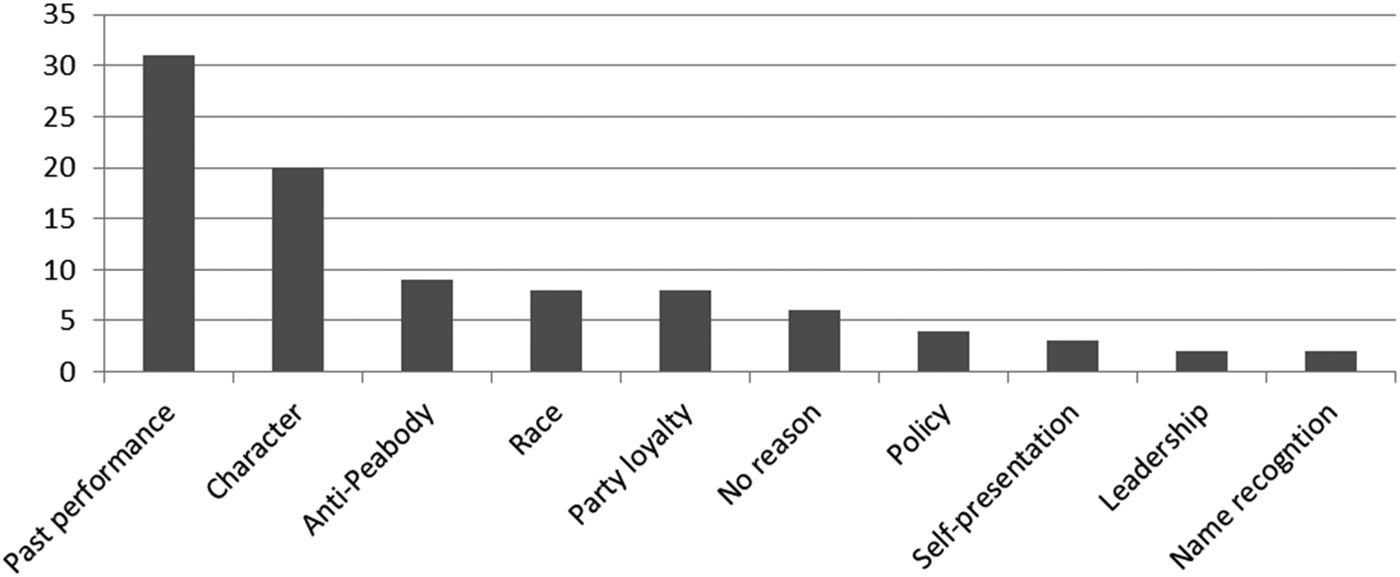
While it is difficult to determine how many voters were attracted to vote for Brooke on the basis of race-conscious appeals, there is some—admittedly limited—polling data to suggest that race was the main motivation for some whites to vote for Brooke. Brooke's internal polling firm Opinion Research Corporation conducted interviews with voters in October 1966 asking them to state succinctly why they were supporting Brooke. The transcribed interviews have been recorded and are held in the Brooke archive in the Library of Congress. I have coded 93 responses into 10 categories: anti-Peabody, character, leadership, name recognition, party loyalty, past performance or experience, policy, race, self-presentation, or no reason. The most common reason people cited was their approval of the job he had done as attorney general (one-third of responses). Race was the fourth most common response, with 8.6% of the sample. The results of the analysis are displayed in Figure 1 followed by a selection of the responses filed in the “race” category.Footnote 19
“It would be nice to show that Massachusetts people aren't against the colored if they are industrious.”
Reasons for supporting Brooke, October 1966. n = 93.

“I think we should have a Negro representing us, and he's done a good job as attorney general.”
“I think he is colored and we need someone to help the colored as well as the whites, and I respect him very much.”
“[I l]ike what he's been doing. He's magnetic. Feather in our cap to send a Negro to Washington.”
“It is a step forward because of his race, and it is about time a step forward was taken. I like the way he handles himself.”
While the sample is frustratingly small, these qualitative responses give an insight into positive racial voting. It was an unmistakably present, although far from an exclusive, factor in Brooke's support among white voters. After I presented these figures to Stephen Herbits, who worked as a researcher for the Brooke campaign in 1966, he suggested that the positive racial appeal may have been even stronger than the chart suggests: “I have a feeling that the strong measure of ‘past performance’ was less the reason people supported him than the granting of permission for people to support him for other reasons, an important one being race. The ‘permission’ factor is critical in American politics and I believe it was in play here. Hence, while the chart is accurate, I think it understates the support for him because of race” (Author correspondence with Stephen Herbits, February 2, 2014).
White Activists
In addition to attracting votes from whites, the symbolic significance of Brooke's race was a major factor in attracting talented staff from around the country to work for his campaign, the overwhelming majority of whom were white. Justice Department attorney Joe McMahon came to Massachusetts specifically to work for Brooke. He explained in an interview with this author that he moved to the Bay State because “I wanted to work for the leading Republican African American”. McMahon, who was hired by Brooke as a traveling assistant, adds, “I was so dedicated to him, mainly because I had worked in the civil rights division of the Justice Department under Bobby Kennedy… So, my focus was entirely on the idea that we needed to develop diversity in the country, and diversity in the country meant we had to have African Americans at high levels of our political structure because otherwise we were going to continue not to have the role models and to have people not to feel that justice was also theirs” (Author interview with Joe McMahon, September 5, 2013).
In addition to paid staff, the campaign received “hundreds” of mainly young volunteers who wished to help Brooke, including Wellesley College student Hillary Rodham (Ryan Reference Ryan2004, 12). One of Brooke's advisors summarizes the motivation of the many of the volunteers: “I think they thought, ‘You know gee, this is something really unusual. Here is a black man who is going to get elected to the Senate. And, he's a person of great quality, great intelligence, and can articulate. He can reach out. This is an historic opportunity.’ And people wanted to be part of it, and they were not rebuffed when they came to him”’ (Interview with EB3).
While acknowledging that many campaigners were attracted to Brooke partly because he was an African American, it is also important to point out that race would have been one of a number of other motivating factors. Brooke was an accomplished and successful attorney general. Furthermore, in an interview with this author, Brooke highlights his service as an army officer and subsequent role as state commander of AmVets, citing them as crucial experience. In an interview with this author, Sally Saltonstall Willis, who had campaigned for Brooke since he first ran for statewide office in 1960 and was the niece of his predecessor Senator Leverett Saltonstall, agrees, “I think [his experience] had a lot to do with it too. People credited him with doing a really good job and so…he was known. It wasn't like he was stepping in not having any experience. I think people might have questioned that” (Author interview with Sally Saltonstall Willis, September 23, 2013).
1966 AS A “RACE-CONSCIOUS” MOMENT
For some observers, it might seem curious that a race-conscious African American was able to win election to the U.S. Senate in 1966 but no other African American was able to do so again until 1992. In the 50 years since Brooke's election, African American candidates are routinely advised to pursue a deracialized campaign strategy if they expect to win white votes. Why, then, did Brooke with a race-conscious strategy attract substantial support from white voters?
In this section, I analyze the public opinion attitudes of the residents of Massachusetts in 1966. I argue that the location of the election was crucial. While racial prejudice was present in Massachusetts, the state viewed itself as more enlightened than the rest of the country and electing Brooke was seen to be a “feather in our cap” as one resident put it. Additionally, I contend that Brooke's election was extremely well timed, coming before the most serious urban riots and white backlash to integration in the North.
Massachusetts Exceptionalism
According to campaign staff, explicit racial prejudice was rare. Brooke himself contended that he did not recall much racism on the campaign trail in 1966. “I shook mostly white hands, looked into mostly white faces, and with very few exceptions, saw no anger in their eyes” (Brooke Reference Brooke2007, 139). It is unlikely that racial prejudice was absent in the election, but this author holds that negative racial voting manifested itself less strongly than the aforementioned positive racial voting.
From a prima facie perspective, the lack of racial hostility might seem surprising given Americans’ racial attitudes during the 1960s. A Harris poll from October 1965 found that white Americans continued to have deep-seated racial prejudices. This was true even outside of the South. Fifty-four percent of non-Southerners agreed with the statement “Negroes tend to have less ambition”; 48% agreed that “Negroes have looser morals”; and 36% agreed that “Negroes have less native intelligence” (Washington Post, October 28, 1965). With the highest record of racial prejudice of all, the poll found that 82% of Americans outside of the South objected “to a close friend or relative marrying a Negro”. In spite of these feelings against inter-racial marriage, Brooke's marriage to an Italian woman rarely was mentioned by his opponents or the press in a negative fashion.Footnote 20 Peabody, who had very tolerant racial views, was not likely to raise the matter, and it seems that even the voters rarely mentioned it. One member of Brooke's campaign staff says that because of Remigia Brooke's “colour and features, you could think she was black”. He adds, “She was more of an ethnic oddity than Brooke was” (Author interview with EB4).
Some in Brooke's campaign have argued that Massachusetts was exceptional even among northern states in its high level of racial tolerance (Author interview with EB2). Stephen Herbits, for instance, argues that “Massachusetts, being one of the most progressive states in the country, was very keen on the idea of electing an African American” (Interview with Herbits, January 14, 2014). This sentiment was captured when Brooke was first chosen by the Republicans to stand for statewide office. The white woman who seconded his nomination told the Republican state convention, “Massachusetts has had a great heritage in equal rights that started before the Civil War…we need to be reminded that we are still at the forefront of civil rights and must practice what we preached” (McSherry, quoted in Cutler Reference Cutler1972, 55).
Internal polls from Brooke's policy consultants Opinion Research Corporation offer evidence that Massachusetts was exceptionally racially tolerant. In August 1966, 22% of Massachusetts voters felt that the federal government was doing “too little” to “help Negroes gain equal civil rights”, whereas nationally that figure was only 5%. There appears to be a sense among Massachusetts dwellers that their state was more enlightened than other states. The North Adams Transcript, a newspaper based in the Berkshires of western Massachusetts, argued that to reject Brooke on the basis of his race “would dump Massachusetts to the level of such benighted states as Georgia and Alabama” (Table 1).Footnote 21
Attitudes toward federal equal rights legislation for African Americans, 1966

In your view, is the federal government doing too much or too little to help Negroes gain equal rights? (Autumn 1966).
No opinion (13% and 25%, respectively), Source: Opinion Research Corporation.
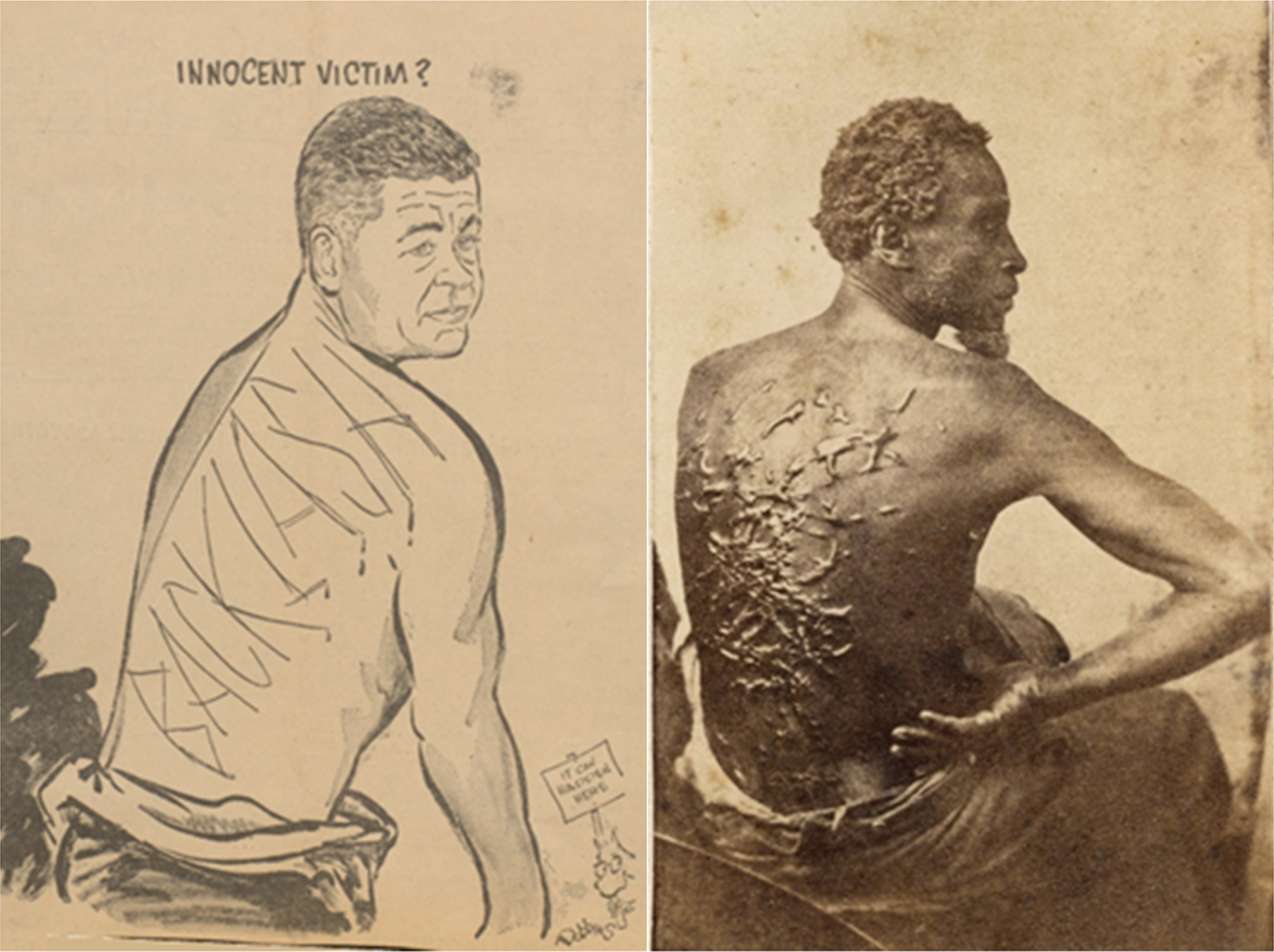
A cartoon in the Boston Herald in October 1966 captured this sense of foreboding, warning that a defeat of the eminently qualified Brooke would send a sinister message to the rest of the country. The newspaper provocatively evoked the famous abolitionist photograph of an ex-slave, which was published in Harper's Magazine in 1863. Depicting Brooke with a scarred back, forming the words “backlash”, a small creature in the corner of the cartoon warns, “it could happen here”. For many in Massachusetts, the historical stakes could not have been higher (Figure 2).
Fear of Backlash. Left: Edward Brooke, depicted in the Boston Herald, October 1966. Right: An ex-slave, depicted in Harper's Weekly, July 1863.

This is not to say Massachusetts voters were entirely racially permissive. While racism was largely latent, it had some outward manifestations. Notably, the Boston Red Sox was one of America's baseball teams most reluctant to take black players. Virtually just as many Massachusetts voters (23%) thought that the federal government was doing “too much” for black civil rights as those who thought it was doing too little. Furthermore, 68% of the Massachusetts public believed that a person should have the right to refuse to sell his or her house to an African American. Nonetheless, compared with 41% of the American public who felt that the federal government was doing too much to help African Americans, Massachusetts does appear to have had an above-average level of racial tolerance during this period (Becker and Heaton Reference Becker and Heaton1967).
Safe Black?
Some commentators and members of Brooke's own team have forwarded the notion that Brooke was acceptable to white voters because he was a “safe black”. One senior member of the campaign team posited that Brooke could win white voters over “because he was safe. He wasn't a militant. He wasn't a bomb thrower. That's very important. He will resist that to his last breath that somehow he was a ‘safe black’ and that helped, but it did. Vital, vital, vital” (Author interview with EB3). This senior staff member is surely correct in the sense that Brooke was not associated with black power militants. A Harris poll in 1966 showed that only 2% of whites believed that Stokely Carmichael was helping the cause of civil rights. Brooke himself made comments in the campaign to distance himself from Carmichael, while not detaching himself from the broader civil rights agenda.
Related to these “safe black” arguments are statements which focus on Brooke's phenotype. Brooke and most of his family were fair-skinned African Americans, with family lore indicating a mix of African, European, and Native American ancestry.Footnote 22 In fact, I found that in the 1910 U.S. Census, Brooke's father was classified as “mulatto” rather than “Negro”; although, it should be noted that in the 1880, 1900, 1920, and 1930 censuses, Brooke's father was classified as a “Negro”, and his 1917 draft registration card lists him as “black”.Footnote 23 Hartshorn argued that Brooke's light skin was a major component in facilitating his electoral success (Hartshorn Reference Hartshorn1973, 35). A member of the campaign team concurs: “The thing about Brooke was he never seemed—it's horrible to say—but he seemed quite white, you know?” (Author interview with EB2).
Brooke, however, did not share this view. In an interview in 1999, Brooke stated, “I seriously doubt that whites are any less prejudiced against fair-skinned blacks than they are against darker-skinned black candidates” (Brooke, quoted in Jeffries Reference Jeffries1999, 583). Nayda Terkildsen has found that the difference in white voters’ evaluation of light-skinned and dark-skinned African American politicians is not statistically significant (Terkilsden Reference Terkilsden1993, 1043). Furthermore, in Brooke's case it is fair to say that Massachusetts voters were under no illusions that Brooke was not African American. Before he won the Republican nomination in June 1966, an internal poll commissioned by Brooke revealed that nearly 80% of voters in the state were able to identify Brooke as the only African American politician out of a list of 15 Massachusetts politicians (Becker and Heaton Reference Becker and Heaton1967). If certain voters held that blacks were intellectually inferior, untrustworthy, or incapable of holding office, it is unlikely that the shading of skin color would be enough to disabuse such people of those views.
However, it is worth considering Brooke's elite status within the black community. His light skin was a prized element within its elite, as was the fact that Brooke could trace his family's high status to slavery where his ancestors were apparently household rather than field slaves. As such, they were sometimes given more autonomy by whites than other slaves. The privileged status of these African Americans often carried into the post-bellum society (Frazier Reference Frazier1957, 23). Verna Keith and Cedric Herring write that after slavery, they experienced “an advantage over other blacks in obtaining education, higher-status occupations, and property” (Keith and Herring Reference Keith and Herring1991, 760). In return, they were expected to show more loyalty to whites and often served as intermediaries between the white and black communities. To say that Brooke occupied an elite status does not contradict the fact that he was race-conscious, of course. Studies have shown that well-educated African Americans express as strong or, in some cases, stronger sentiments of racial linked fate than average (see Dawson Reference Dawson1994).
Timing
Finally, I contend that Brooke's election was exceptionally well-timed. It came soon after the euphoria of the passage of the Civil Rights Act and Voting Rights Act, which were both popular in Massachusetts, but before the urban riots of the “long hot summer” of 1967 and the 1968 King assassination riots, which diminished white support for race-conscious politics.
Rick Perlstein argues that the 1966 mid-term elections were a triumph for racial “backlash” voters, declaring it as “a referendum on the Negro revolution” in which white Americans declared that they had had enough (Perlstein Reference Perlstein2008, 166). While it is true that some liberal Democratic candidates such as Pat Brown in California were defeated, Perlstein's emphasis on Brown's candidature in particular overlooks the widespread success of liberal and moderate Republicans in that year's election. In that year, Republicans George Romney, Nelson Rockefeller, Clifford Case, Howard Baker, John Sherman Cooper, Spiro Agnew, and Winthrop Rockefeller won their gubernatorial and senatorial elections with moderate to liberal programs on civil rights. In addition, none of the 112 House Republicans who voted for the Voting Rights Act lost their seats.
Brooke's election in 1966 came before two sets of significant events in American racial history which caused white northerners to turn more actively against claims for black racial equality. The first were the riots/rebellions of 1967 and 1968. Most notably, the Newark and Detroit riots of the summer of 1967 were the worst urban unrest in the United States since the New York draft riots during the Civil War. Flying over Detroit, Governor George Romney remarked, “it looked like the city had been bombed” (Romney, quoted in Kabaservice Reference Kabaservice2012, 214). These uprisings as well as the 1968 riots following Martin Luther King's assassination diminished white support for the black racial equality agenda. Mark McLay writes that the “net effect of the urban crisis was a white backlash against further black progress” (McLay Reference McLay2016, 2). It is important to note that while many Republicans blamed the 1967 summer riots on communists and irresponsible black leaders, the new Senator Brooke did not. He responded, “In my view, the riots…are neither communist inspired not the result of an interstate conspiracy… Hunger, bad housing, ill health, and a lack of work need no allies to create an atmosphere which breeds violence” (Brooke, quoted in Thurber Reference Thurber2013, 240). These conclusions were echoed the following year in the famous Kerner Commission Report on Civil Disorders, on which Brooke sat as its only black member.
The second set of events occurred closer to home. In the mid-1970s, after Brooke's re-election in 1972, the city of Boston erupted in violent backlash to a school desegregation order which would entail the forced busing of children from different, racially homogenous parts of the city to achieve a more equitable racial balance across the city's schools. Four-fifths of white Bostonians were opposed to Judge W Arthur Garrity's June 1974 busing order (Formisano Reference Formisano1991, 18). Garrity was involved in the order's implementation for 11 years and issued 415 subsequent orders, making him the most personally involved judge in desegregation in the United States. It is important to note that, in spite of the deep unpopularity in his adopted hometown, Brooke supported Garrity's order. After weeks of violent protest in response Garrity's integration order that year, Brooke wrote a letter to the Boston Globe, chastising, “All of us should be ashamed. Boston is the cradle of liberty… But the strife in our city reveals that the fear, the hate, the suspicion that is racism, looms darkly not only in the Heart of Dixie but in the Cradle of Liberty.”Footnote 24
Had such events occurred sooner, Brooke's support for racially targeted policies, including busing, would likely have made his initial candidacy much more fraught. Indeed, Brooke lost his re-election effort subsequent to the Boston busing riots. Even though he was a Republican, Jesse Jackson and Coretta Scott King came to Massachusetts to campaign for Brooke against his Democratic opponent Paul Tsongas as late as 1978, highlighting the loyalty which Brooke retained from African Americans. Brooke's earlier, successful re-election in 1972 might be posited as being assisted by an exceptionally weak, largely anonymous opponent at a time which was sufficiently distant from the riots of the late 1960s but before the Boston busing riots of 1974–5.
CONCLUSION
Edward Brooke's election to the U.S. Senate was a major historical feat, which was not again repeated by a black Republican until nearly 50 years later. It is evident that the racial dimensions of his campaign merit serious attention, and this article has been in part an effort to complicate assumptions that Brooke was a color-blind candidate who ran a deracialized campaign. While Brooke did not emphasize racial issues in a manner that was hostile or exclusivist, he did not ignore race, publicly identifying racial injustice and proposing race-conscious policies to address them at both legal and societal levels. It is also evident that for some white voters, supporting a black candidate as a matter of pride was a powerful motivation. This article has also attempted to integrate the viewpoints of the candidate, the campaign team, and voters. It is clear that the dominant models of “racialized” and “deracialized” campaigns do not fully capture the variety of ways in which black candidates present their racial identity to majority-white electorates.
Instead, Edward Brooke should be seen as a race-conscious candidate whose rhetoric and policy agenda reflected Brooke's personal analysis of the enduring legacies of slavery and racial prejudice. The racial dimensions of Brooke's candidacy deserve continued scholarly attention—not because Brooke successfully ran a “deracialized” campaign but because Brooke, as an African American, was able to present a race-conscious policy agenda to a white electorate and win their support.
Acknowledgments
The author wishes to thank the late Senator Edward Brooke, William Cowin, Carmen Durso, Stephen Herbits, J Alan MacKay, Joe McMahon, and Sally Saltonstall Willis for agreeing to be interviewed. Marie Lanser Beck, Stephen Herbits, and Desmond King are thanked for providing comments on earlier drafts of the paper. Appreciation is given to Senator Brooke and Mrs Anne Brooke for granting permission to examine the Brooke Archive at the Library of Congress. The author also thanks Al Gammal and Joe Gammal for sharing their memories and mementoes from the campaign