During the past decade, the US Department of Veterans Affairs (VA) widely implemented telehealth to improve access to care, in particular specialty care that would otherwise not be available to some veterans living in rural or economically impoverished areas.1,2 VA telehealth, which includes clinical video telehealth, home telehealth, and the transmission of diagnostic images, vital signs, and other patient data,3 uses electronic communications and video-teleconferencing to exchange medical information between different types of health-care providers or between health-care providers and patients.
The VA serves a distinct patient population, many of whom are highly vulnerable and lack resources to seek care elsewhere.Reference Agha, Lofgren and VanRuiswyk4 Veterans who use the VA as their usual source of care tend to be poor, unemployed, single, have poorer health status, and use more care than both veterans who do not use VA for care and the general adult population.Reference Agha, Lofgren and VanRuiswyk4-Reference Randall, Kilpatrick and Pendergast6 During disasters, these veterans might be more at risk and more likely to need care. With the advances in communication technology, telehealth has the potential to expedite post-disaster medical response efforts.Reference Xiong, Bair and Sandrock7,Reference Schultz and Brooks8 In fact, telehealth has been widely used during the response and recovery phases of disasters.Reference Xiong, Bair and Sandrock7,Reference Vo, Brooks and Bourdeau9-Reference Latifi and Tilley11 Similarly, at the VA during the first few months post-Hurricane Sandy (2012), when the Manhattan VA Medical Center (VAMC) was closed due to damage sustained from flooding, we reported that the use of VA telehealth services increased substantially.Reference Der-Martirosian, Griffin and Chu12 This brief report expands our previous work and examines the use of VA telehealth services during the 2017 Atlantic hurricane season at 3 VAMCs (Houston, Texas; Orlando, Florida; and San Juan, Puerto Rico).
As the first major hurricane in 2017, Harvey strengthened to Category 4 on August 25 and made landfall near Houston, Texas, at peak intensity. Harvey was the first major hurricane to strike the United States since Irene in 2011 and “Superstorm” Sandy in 2012. In the 4-d period following Harvey’s landfall, many areas received more than 50 inches of rain as the system lingered over eastern Texas and the adjacent Gulf of Mexico waters, causing catastrophic flooding.13 In Houston, Texas, the Michael E. DeBakey VA Medical Center (ie, Houston VAMC), which serves over 113,000 patients,14 did not evacuate and did not close, even though over 50% of their staff were unable to report to work.
Approximately 2 wk after Harvey (9/5/2017), Hurricane Irma made landfall, and a state of emergency was declared in 67 counties in Florida where the hurricane caused significant damage.15 The Orlando VAMC, which serves more than 110,000 veterans in Central Florida,16 did not evacuate and continued its operations. In less than 2 wk after Irma (9/17/2017), Maria also made landfall in Florida, compounding the devastation.
Puerto Rico was also impacted by both Irma and Maria and experienced massive destruction of its critical infrastructure, including major interruptions in the telecommunications system.Reference Zolnikov17 During Irma and Maria, the San Juan VAMC in Puerto Rico, which is part of the VA Caribbean Healthcare System and serves a population of 150,000 veterans,18 did not evacuate and continued to receive new patients. Even though none of the VA medical hospitals in these impacted locations closed, some impacted VA community-based outpatient clinics were forced to close in Texas, Florida, and Puerto Rico because of the flooding that occurred as a result of the 3 hurricanes.
METHODS
Using outpatient workload data from the VA Corporate Data Warehouse, a national repository of clinical and administrative data from VA medical facilities, detailed information about each clinical visit was extracted for 3 VAMCs: Houston VAMC, Orlando VAMC, and San Juan VAMC, which were impacted by the three 2017 Atlantic hurricanes (Harvey, Irma, and Maria). The initial study cohort for Houston VAMC included VA-users who had accessed the VAMC at least once in the 24 mo (study period) before Hurricane Harvey. Similarly, for the other 2 VAMCs (Orlando and San Juan), the initial study cohort included VA-users who had accessed their respective VAMC at least once in the 24 mo before Hurricanes Irma and Maria. For the final analysis, the 3 study cohorts included 60,401, 74,101, and 46,949 VA patients who had used VA outpatient services during the study period at each of the 3 respective medical facilities (Houston, Orlando, San Juan VAMCs).
The total number of daily outpatient visits 365 d before and 365 d after each hurricane was identified using clinic encounter codes. For each VAMC, the daily use of all telehealth outpatient services (such as home health, telephone primary care, telephone triage, telephone mental health, and all other encounters associated with telecare or telemedicine clinic codes) were identified and grouped into 1 category as telehealth visits. The percentage of daily telehealth outpatient visits was calculated by dividing the total number of telehealth outpatient visits by the total number of outpatient visits. The distribution of the percentage of daily telehealth outpatient visits 365 d before and 365 d after each landfall was examined for each VAMC.
This study was approved by the VA Greater Los Angeles Healthcare System’s Institutional Review Board.
RESULTS
Figure 1 illustrates the percentage of telehealth use 365 d before and 365 d after Harvey for Houston VAMC. The average percent of daily telehealth visits during the 365 d before Harvey was 18%. Within the first week post-Harvey, however, telehealth use increased substantially, reaching its peak at 55%, which represents a total of 1790 telehealth visits 6 d post-Harvey.
Percent Telehealth Outpatient Visits at the Houston VAMC, 365-d Before/After Hurricane Harvey

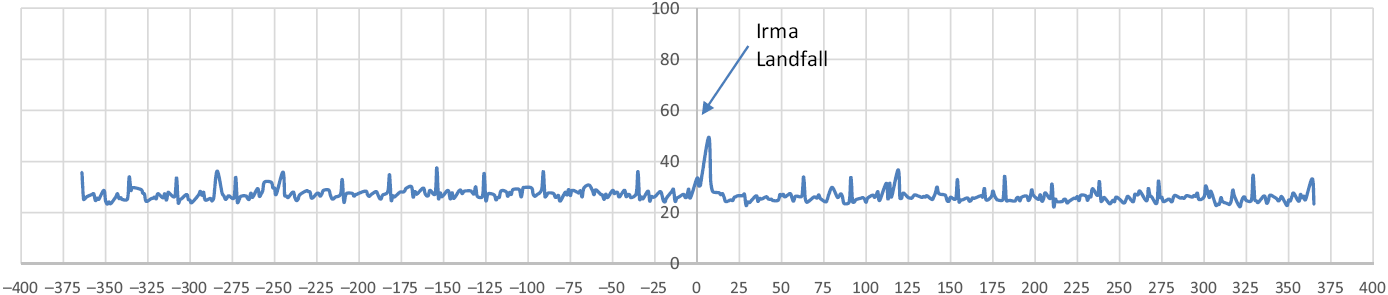
Figure 2 illustrates the percentage of telehealth use 365 d before and 365 d after Irma for Orlando VAMC. The average percent of daily telehealth visits during the 365 d before Irma was 27%. Within the first week post-Irma, however, telehealth use increased substantially, reaching its peak at 50%, which represents a total of 1325 telehealth visits 4-d post-Irma.
Percent Telehealth Outpatient Visits at the Orlando VAMC, 365-d Before/After Hurricane Irma

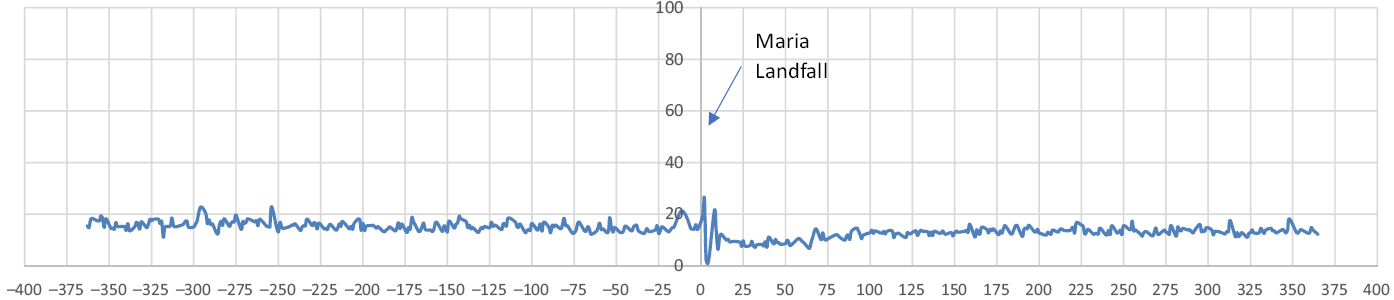
Figure 3 illustrates the percent of telehealth use 365 d before and 365 d after Maria for San Juan VAMC, which also includes Irma landfall approximately 12 d before Maria. Pre-Irma, the percent of daily telehealth visits averaged around 14%. Immediately after Irma landfall, daily telehealth visits increased to 21%. On the day Maria made landfall in Puerto Rico, telehealth visits increased to 26%. However, 4 d after Maria, it dropped to less than 1%, peaking again to 22% 8 d post-Maria. After this second peak, telehealth visits started to drop and did not reach prehurricane levels during the 175-d post-Maria.
Percent Telehealth Outpatient Visits at the San Juan VAMC, 365-d Before/After Hurricane Maria

At the Houston VAMC, the most common VA telehealth services used immediately after Harvey were: primary care, home health, and mental health services. At the Orlando VAMC, the most common VA telehealth services immediately after Irma were: triage, primary care, and mental health services. For the San Juan VAMC in Puerto Rico, the sample size was insufficient to report which types of telehealth services contributed to the increased use immediately after Irma or Maria.
DISCUSSION
When face-to-face care is not feasible, telehealth can connect vulnerable patients to their health-care providers during disasters and other times of stress and uncertainty and reduce the likelihood of adverse patient outcomes. The use of telehealth services at the VA during the 2017 Atlantic Hurricanes demonstrates the possibility of virtual care as an alternative to not receiving care or receiving delayed care.
We found that, during the first week after Hurricane Harvey, telehealth use at the Houston VAMC increased substantially, reaching 55%. Similarly, in the case of the Orlando VAMC immediately after Hurricane Irma, use of telehealth services increased substantially, reaching 50%. Given that there were several power outages and disruptions in telecommunication services in Puerto Rico during and immediately after Hurricanes Irma and Maria, there was a modest increase in telehealth use at San Juan VAMC. First, it peaked at 21% immediately after Irma and peaked again to 26% on the day Maria made landfall but dropped down to less than 1% after Maria, and then increased 8-d post-Maria to 22%. Therefore, due to multiple power outages in Puerto Rico, use of telehealth services at the San Juan VAMC was sporadic.
Although telemedicine has become an important component of health care during the past 2 decades, it is still underutilized,Reference Kim, Arrieta and Eastburn10 especially during disasters. Many argue that wider use of telemedicine should be incorporated into disaster preparedness plans as a routine practice,Reference Latifi and Tilley11,Reference Sailors, Duke and Walls19-Reference Graschew, Roelofs, Rakowsky and Latifi22 but more studies are needed to identify how best to incorporate telehealth into disaster response. In particular, our study highlights the importance of critical electrical infrastructure for telehealth services. Even though recent technological advances in telecommunication have simplified disaster communication, making telemedicine more accessible to a greater number of hospitals, health-care systems, population health, and individual patients,Reference Doarn and Merrell23,Reference Alverson, Edison and Flournoy24 the availability of electrical power and the local telecommunication infrastructure has a major impact on whether telehealth services can be used during disasters.
Future studies should evaluate key elements, such as adequate resources, workflow integration, regulatory and technology issues, provider resistance, and diagnostic fidelity and confidentiality, that are critical to successfully implementing telehealth during disasters.Reference Kim, Arrieta and Eastburn10 Moreover, the use of telehealth to improve access to care for persons who do not have a usual source of care or who may only have access to telehealth from providers who are not part of their usual health-care system, and the potential implications for continuity of care in the latter case, remain important areas for further study. For the VA, the use of post-disaster telehealth for veterans who receive VA-paid health services from the community rather than directly from the VA, is also an area in need of study.
The study has limitations. The VA administrative and clinical data provide no information regarding whether the patient or health-care provider initiated the virtual contact.
CONCLUSIONS
Telehealth has the potential to expand access to care, improve continuity of care, and reduce adverse health outcomes during disasters. Telehealth may be particularly important for providing specialty care, such as mental health services, after a disaster. Furthermore, integration of telehealth into “business as usual” instead of an “add-on” delivery tool could ultimately improve both access and continuity of care during both routine and disaster situations.Reference Jury and Kornberg25
Acknowledgments
This material is based upon work supported by the United States Department of Veterans Affairs, Veterans Health Administration, Office of Patient Care Services. The views expressed in this brief report are those of the authors and do not necessarily reflect the position or policy of the Department of Veterans Affairs or the United States government.
Conflicts of Interest
All authors declare no conflict(s) of interests.