Introduction
Descriptions of the Nordic welfare states often refer to the concept of universalism (Kildal and Kuhnle, Reference Kildal and Kuhnle2005a; Esping-Andersen, Reference Esping-Andersen1990). In particular, the literature acknowledges the universal social care sectors as one of the most characteristic features of this welfare model (Sipilä, Reference Sipilä1997; Daly and Lewis, Reference Daly and Lewis2000). In contrast to more liberal and conservative welfare regimes, the Nordic countries extended the right to social care to the middle and upper classes as well as lower income groups. To uphold the legitimacy of the public care systems, the Nordic states set out to provide qualitative services to all citizens (Anttonen and Sipilä, Reference Anttonen, Sipilä, Anttonen, Häikiö and Stefánsson2012; Sipilä, Reference Sipilä1997). In the 1980s and early 1990s, however, the comprehensive social care systems came to be criticised for being rigid and inflexible due to the monopolistic nature of service delivery. The lack of choice and diversity in the provision of services came into focus in public debates and the Nordic social policy agenda became influenced by an increased reliance on marketisation (Rostgaard, Reference Rostgaard2011; Vabø, Reference Vabø2006).
Marketisation refers to a process where market mechanisms such as competition, private provision and economic incentives are introduced into the public sector in order to make it more economically efficient (Pollitt and Bouckhaert, Reference Pollitt and Bouckhaert2011). Two common forms of marketisation, especially in the social area, have been contracting out and arrangements to enable service users to choose between competing providers, so called user choice (Le Grand and Bartlett, Reference Le Grand and Bartlett1993; Taylor-Gooby, Reference Taylor-Gooby2008). In the Nordic countries, the trend towards marketisation in the provision of welfare services has been salient not least in the eldercare sector, where the first reform enabling contracting out was launched in the early 1990s. Since then, contracting and user choice have been implemented to make the provision of services more cost-efficient, empower users, and create more diversity in service provision (Meagher and Szebehely, Reference Meagher and Szebehely2013). Since marketisation reforms imply that new institutional arrangements are put in place and economic incentives are given a more prominent role, it has been asked whether they alter the previous features of Nordic eldercare, characterised by publicly provided and tax-funded services (Szebehely and Trydegård, Reference Szebehely and Trydegård2012; Vabø and Szebehely, Reference Vabø, Szebehely, Anttonen, Häikiö and Stefánsson2012; Meagher and Szebehely, Reference Meagher and Szebehely2013; Rostgaard, Reference Rostgaard2011; Anttonen and Häikiö, Reference Anttonen and Häikiö2011). A particular question has been whether Nordic eldercare retains its universal features, which imply that care services are allocated solely on the basis of personal needs and thus are available to all citizens on an equal basis. So far, however, most analyses of the implications of marketisation on universality in Nordic eldercare have been carried out as single country studies (Szebehely and Trydegård, Reference Szebehely and Trydegård2012; Rostgaard, Reference Rostgaard2011; Anttonen and Häikiö, Reference Anttonen and Häikiö2011) and when systematic comparisons have been made, the concept of universalism has not been clearly defined (Meagher and Szebehely, Reference Meagher and Szebehely2013).
This paper aims to answer the question whether, and if so in what way, the marketisation reforms that have been undertaken in the Nordic countries in recent decades challenge the universalistic character of their eldercare services. To answer the research question, marketisation reforms enacted between 1990 and 2015 in four countries – Sweden, Norway, Denmark, and Finland – will be analysed through a comparative case study (Brady and Collier, Reference Brady and Collier2010). The empirical materials consist of political steering documents such as governmental bills and legislative acts, complemented by policy evaluations and previous research to gain a more thorough understanding of the reform effects in each country. The findings suggest that, while the impact of marketisation reforms differs somewhat between the countries, the overall result is a weakening of the universalistic character of their eldercare systems. Although universalistic features, such as need-based distribution of care services and public funding, remain key principles in all four countries, there is also an increased reliance on private provision, particularly in Sweden, Denmark and Finland. Furthermore, the introduction of additional and privately funded services, supplied by private providers, enables users with the economic resources to turn to the private market to top-up the comprehensiveness and quality of their service. This increased availability of private services undermines the universalistic character of the eldercare systems in the Nordic countries and could potentially stratify access to quality care among different societal groups.
The concept of universalism
The concept of universalism has been a prominent topic in the social policy literature since writers such as Marshall (Reference Marshall1964) and Titmuss (Reference Titmuss and Titmuss1976) recognised it as an important principle in the creation of the modern welfare state. Despite the widespread interest in universalism, there is no broadly accepted definition of the concept. Rather, universalism has become a vague concept whose meaning tends to vary between different welfare areas (Goul-Andersen, Reference Goul-Andersen2012). One reason for this ambiguity is that the concept of universalism has, first and foremost, been developed with regard to social insurance systems (Korpi and Palme, Reference Korpi and Palme1998; Esping-Andersen, Reference Esping-Andersen1990; Kildal and Kuhnle, Reference Kildal, Kuhnle and Standing2005b), without clearly addressing the social service dimension of the welfare state. This argument has been stressed, not least by Anttonen, who claimed that the meaning of universalism, as defined in relation to social insurances, is unable to account for the specific characteristics of universal social service programmes where quality differences can occur although the service is formally available to all citizens, and where eligibility is often based on personal needs rather than pre-established rights (Anttonen, Reference Anttonen2002; Anttonen et al., Reference Anttonen, Häikiö and Stefánsson2012a).
During recent years, new attempts have been made to create a definition of universalism applicable to both social insurances and social services. One contributor to this literature is Goul-Andersen (Reference Goul-Andersen2012) who identifies five different dimensions of universality. First, that eligibility and entitlements are clearly defined rights and not a matter of discretion. Second, that rules for inclusion apply to all citizens or residents who could be relevant beneficiaries. Third, that universal benefits and services are financed by general taxes rather than by social contributions. Fourth, that the benefits typically should be the same for all citizens; at the very least no-one should be excluded by means-testing. Last, the benefits should be adequate enough to prevent the middle classes from turning to the private market.
It has been questioned, however, whether Goul-Andersen's definition is fully equipped to address the social service sector. Blomqvist (Reference Blomqvist2016) states that the position that eligibility and entitlements should be formulated as rights rather than as a matter of discretion is more applicable to social insurances than to social services, where access generally is based on professional needs-assessment. Thus, rather than emphasising citizens’ formal rights to services, it is more fruitful to focus on the second and fourth dimensions of Goul-Andersen's definition, stressing that the rules for inclusion should apply to all citizens irrespective of their financial situation. Equal rules for inclusion are often considered an important dimension of universalism, addressing questions of who has the right to use a particular service, and on what conditions (Anttonen et al., Reference Anttonen, Häikiö, Stefánsson, Sipilä, Anttonen, Häikiö and Stefánsson2012b). This issue has also been stressed in other attempts to formulate a definition of universalism applicable to both social insurances and social services (see Béland et al., Reference Béland, Blomqvist, Goul-Andersen, Palme and Waddan2014; Blomqvist and Palme, Reference Blomqvist and Palme2015; Blomqvist, Reference Blomqvist2016). In an alternative definition provided by Blomqvist and Palme (Reference Blomqvist and Palme2015), universalism consists of four dimensions: inclusion, funding, provision and benefits. For a service to be considered universal, Blomqvist and Palme (Reference Blomqvist and Palme2015) argue that the rules of inclusion either should be based on equal distribution or needs-assessment. In contrast to social insurances, assessment of personal needs has generally been considered the most egalitarian principle of inclusion within social services, since it identifies all citizens as potential users and prohibits their financial situation or employment status from constituting criteria for eligibility (Anttonen et al., Reference Anttonen, Häikiö, Stefánsson, Sipilä, Anttonen, Häikiö and Stefánsson2012b).
With regard to the issue of funding it has been suggested that universal welfare programmes should be financed through taxes rather than social contributions (Goul-Andersen, Reference Goul-Andersen2012). To equalise universal insurance schemes with tax funding, however, appears problematic, not least given the nature of the Beveridge system as adopted in the UK (Béland et al., Reference Béland, Blomqvist, Goul-Andersen, Palme and Waddan2014; Goul-Andersen, Reference Goul-Andersen2012). In contrast, it corresponds well to how universalism has come to be understood in relation to social services, where tax-based funding is seen as an egalitarian means to pool social risks within the population (Anttonen, Reference Anttonen2002; Blomqvist and Palme, Reference Blomqvist and Palme2015). In the social service literature, the issue of contributions has therefore focused upon whether universal service schemes can be combined with user fees and, if so, how large can these contributions be? (Kildal and Kuhnle, Reference Kildal and Kuhnle2005a; Rauch, Reference Rauch2007). According to Blomqvist and Palme (Reference Blomqvist and Palme2015), user fees may threaten universalism if they prevent low-income citizens from using the services. However, subsidised and income-related fees do not per se challenge the universal dimension of public funding.
Blomqvist and Palme (Reference Blomqvist and Palme2015) also stress that public provision can be considered an important dimension of universalism, as this makes it possible to ensure that all services have the same content and quality. Public provision has also been emphasised by Anttonen and Sipilä (Reference Anttonen, Sipilä, Anttonen, Häikiö and Stefánsson2012), who argue that universal social service programmes are generally characterised by public provision. Both in the Nordic countries and in the UK, public provision of social services, including primary education, has also been argued to promote social integration and improve and equalise citizens’ social and economic circumstances. This suggests that privatised service provision can be seen as a weakening of universalism, even if the system is still based on public funding and need-based inclusion (Blomqvist and Palme, Reference Blomqvist and Palme2015). This might be especially salient in the Nordic context, where predominantly public provision of social services constitutes an important principle in the post-war welfare state legacy.
Another aspect of universalism that has been discussed in recent literature is adequacy, which has been taken to mean that a replacement rate in the social insurances that only provides poverty protection cannot be considered universal, but that universalism calls for more generous benefits. Or, as argued by Goul-Andersen (Reference Goul-Andersen2012), if private supplements of public income protection systems are necessary to maintain a decent standard of living, the benefit is not adequate enough to be categorised as universal. Blomqvist and Palme (Reference Blomqvist and Palme2015), have argued that, in order to be relevant to the social services, the concept of adequacy should also include aspects of quality and that universalism in this area implies that services are of such high quality that the better off choose to remain in the publicly funded system, rather than seeking more qualitative alternatives in the private sector.
The interpretation of adequacy presented by Blomqvist and Palme is closely related to the universal dimension of comprehensive usage emphasised by Anttonen (Reference Anttonen2002) and Béland et al. (Reference Béland, Blomqvist, Goul-Andersen, Palme and Waddan2014). According to Anttonen, a universal care programme should not only be formally open to all, but also used by a great majority of the population. Comprehensive usage is thus dependent on whether most citizens stay in the public system, rather than the better off turning to private markets for social protection. To avoid the emergence of stratified markets, it has been argued that the quality and coverage of public services should be so good that no demands for other alternatives arise (Blomqvist and Palme, Reference Blomqvist and Palme2015). Based on this argument, the quality of social services is important because it can prevent the emergence of complementary markets for social protection and thereby ensure that the better off also stay in the public system. However, if such markets emerge, it can be seen as an indication that there is less comprehensive usage of public programmes even if these are formally accessible to all citizens (Béland et al., Reference Béland, Blomqvist, Goul-Andersen, Palme and Waddan2014; Blomqvist and Palme, Reference Blomqvist and Palme2015).
To sum up this review, it appears that the meaning of universalism varies somewhat between programmes for social insurances and programmes for social services, especially with regard to the fact that rules of inclusion rest on personal needs rather than rights and that high quality, rather than adequacy, is emphasised as means to meet the objective of comprehensive usage. In order to analyse whether the eldercare systems in Sweden, Denmark, Finland and Norway remain universal, it is thus reasonable to utilise a definition adapted to the uniqueness of the social service programmes. Therefore, the meaning of universalism in this paper will be defined through four different dimensions: (i) equal inclusion based on needs; (ii) public funding, potentially combined with subsidized and regulated user fees; (iii) public provision; and (iv) comprehensive usage, implying that a majority of the citizens use the public system rather than private markets. This definition also captures the unique features of social services in the Nordic welfare states, as they developed after the Second World War, and thereby accounts for how universalism has traditionally been interpreted in the Nordic context.
The marketisation of Nordic eldercare after 1990
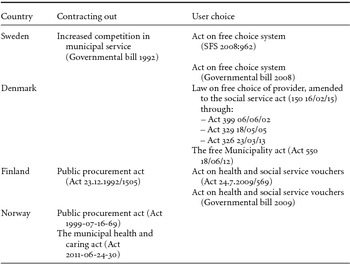
As stated in the introduction, the main marketisation reforms introduced in Nordic eldercare have either taken the form of contracting practices, where local governments have been allowed to contract service provision to private firms and organisations, or of various organisational models where users are free to choose between competing providers. Other forms of choice, where users organise their care through public cash benefits such as direct payments and individual budgets (Stevens et al., Reference Stevens, Glendinning, Jacobs, Moran, Challis, Manthorpe, Fernandez, Jones, Knapp, Netten and Wilberforce2011; Fernandez et al., Reference Fernandez, Kendall, Davey and Knapp2007) have had less relevance in the Nordic countries and will not be treated here. In the following section, an empirical overview of the marketisation reforms introduced in Sweden, Denmark, Finland and Norway will be given. Thereafter, a comparison of the development in each country will be made based on the four dimensions of universalism identified above. Table 1 shows a summary of the reforms included in the study, divided by country.
Governmental bills and legislative acts included in the study

Sweden
When the first marketisation reforms were implemented in Sweden in the early 1990s, the system for providing eldercare was, as in all Nordic countries, comprehensive, publicly financed through income taxes and based almost completely on public provision. In 1993, only 2.5 per cent of all eldercare was provided by private (non-profit) organisations (Trydegård, Reference Trydegård and Szebehely2001). In the same year, this situation began to change as the national parliament enacted a bill which enabled increased competition in municipal service (Governmental Bill, 1992). In a manner which was similar to developments in other Nordic countries, the reform separated the purchaser and provider functions and enabled all willing municipalities to contract out eldercare provision to private providers, including for-profit firms, through competitive tendering. While leaving the system of direct administrative control, municipalities remained responsible for regulating the sector through contractual agreements and for assessing needs to determine eligibility for care. The reform aimed to enhance bureaucratic transparency, increase efficiency and stimulate privatisation of provision (Governmental Bill, 1992). In 2001, 12 per cent of all users received residential care from private contractors, and eight per cent received privately provided home-care (Swedish Association for Local Authorities, 2004).
Although the contracting reform enabled private provision, users were typically directed to a provider chosen by the municipalities (Jordahl and Öhrvall, Reference Jordahl, Öhrvall and Jordahl2013). Thus, in 2008, the parliament enacted legislation enabling user choice of provider (SFS 2008:962). It is not mandatory for municipalities to implement the reform but, if a municipality decides to apply user choice, either in residential or home-based care, they are obliged to follow the legislation in terms of free choice systems (SFS 2008:962). To increase provider pluralism, the reform stipulates that municipalities must enter into a contract with all providers that meet their essential establishment requirements. The providers are thereafter free to establish themselves in the local eldercare market and get reimbursed by the municipality based on how many users they attract, according to a pre-determined formula (SFS 2008:962). By allowing users to allocate resources between competing providers, the government intended to make services more customised to the individual user and increase their consumer power vis-à-vis providers. Access to care continued to rest on professional needs assessment and municipalities were still responsible for ensuring a certain quality standard among the authorised providers. By increasing provider competition and allowing users to allocate resources, however, part of the regulatory powers were transferred to the users, and it was expected that this would increase the overall service quality (Governmental Bill, 2008).
In 2015, approximately 125 of 290 municipalities had introduced user choice in home-based care and 13 municipalities offered choice in residential care (Swedish Competition Agency, 2015). In the same year, 25 per cent of home-care users and 21 per cent of users of residential care received privately provided eldercare (National Board of Health and Welfare, 2015). The funding of the system, however, remained public and a maximum fee reform from 2002 caps the user fees, whose levels are regulated by the Social Service Act (SFS 2001:453). Aggregated, the user fees in Sweden cover approximately four to five per cent of the eldercare costs (Szebehely and Trydegård, Reference Szebehely and Trydegård2012). A further element of the Swedish choice reform was that private providers were allowed to supply additional services to their users, which they pay for privately (Governmental Bill, 2008). This implies that users who have the financial means can purchase private services to top-up their publicly granted care. Although only about eight per cent of all home-care clients currently utilise this opportunity (Swedish Competition Agency, 2013), research indicates that persons with a strong financial situation are overrepresented among this group (Erlandsson et al., Reference Erlandsson, Storm, Stranz, Szebehely, Trydegård, Meagher and Szebehely2013).
To summarise, the marketisation reforms in Sweden have not affected the principles of need-based inclusion and public funding. By allowing municipalities to contract out service provision and offer providers freedom of establishment, however, the share of private provision has increased. Moreover, the opportunity to supply additional services on the part of private providers implies that users with economic resources can turn to the private market to complement their needs-assessed eldercare.
Denmark
In Denmark, marketisation principles were first introduced in the eldercare sector with the implementation of the purchaser-provider model in 1996. However, it is only since 2002, when the national parliament enacted the Law on Free Choice of Provider, that marketisation really has gained ground in Danish eldercare (Act 399 06/06/2002). The act was amended to the Social Service Act and obliged municipalities to offer a choice of home-care provider (Act 150 16/02/2015). The legislation only regulated home-care and the delivery of residential care has thus not been subject to user choice. The choice legislation has been further amended since it was first enacted. In 2013, however, 97 out of Denmark's 98 municipalities had created choice through the so-called competition by endorsement model (Bertelsen and Rostgaard, Reference Bertelsen, Rostgaard, Meagher and Szebehely2013). According to the endorsement model, the municipalities must contract all providers that meet the pre-determined municipal requirements. To empower users and increase quality, providers are thereafter given the freedom of establishment, and are reimbursed based on the number of users they attract (Act 329 18/05/2005). The choice legislation did not alter the principle of need-based inclusion and Danish eldercare still rests on public funding through income taxes. Home-care users do not pay any fees, but municipalities can, within predetermined limits, charge a fee for rent and services provided through residential care (Act 150 16/02/2015).
Since residential care was excluded from the Danish choice reform, this sector is still characterised by public provision. In 2013, only one per cent of all residential care users lived in a private facility. In home-care, on the other hand, the introduction of choice clearly increased the role of private provision. In 2002, 2.5 per cent of all users received home-care from private providers, compared to approximately 36 per cent in 2013 (Bertelsen and Rostgaard, Reference Bertelsen, Rostgaard, Meagher and Szebehely2013). The increase of privately provided home-care in Denmark has also enabled users of private providers to top-up their needs-assessed care by purchasing extra time or more frequent services from their provider (Rostgaard, Reference Rostgaard2011). In contrast to Sweden, the Danish government did not officially advocate such development and there is no data describing the usage of these additional services. Following 2012, the right to offer additional services was extended to public providers in nine Danish municipalities (Act 550 18/06/2012).
In March 2013, the Danish parliament enacted an additional choice reform, enabling willing municipalities to create a choice of home-care provider through so-called vouchers (Act 326 23/03/2013). In order to further stimulate the conditions for private provision, the reform implied that users of eldercare would be able to choose freely between all care companies registered at the tax agency. Unlike the Danish endorsement model this reform implied that no contractual agreement was entered into between the municipalities and the home-care providers (Act 326 23/03/2013). Instead, an agreement would be signed directly between the user and the provider (Act 150 16/02/2015). As for the Swedish choice model, it was not mandatory for municipalities to implement this reform and most Danish municipalities still utilise the endorsement model to create user choice.
To sum up, the marketisation reforms implemented in Danish eldercare do not challenge the principles of need-based inclusion and public funding. With regard to the provision of services, residential care still rests on public provision, whereas the introduction of user choice has increased the share of privately provided home-care. Similar to the other Nordic countries, Denmark has also enabled private providers to supply additional services, which their users pay for by private means.
Finland
In Finland, the marketisation process in the eldercare sector started in the early 1990s with the enacting of the public procurement act, enabling municipalities to contract-out the provision of residential and home-based care to for-profit providers (Act 23.12.1992/1505). The reform aimed to facilitate provider pluralism but was criticised for not enhancing user participation. Users remained passive and were typically directed to providers chosen by the municipality (Karsio and Anttonen, Reference Karsio, Anttonen, Meagher and Szebehely2013). As a response, more attention was given to direct user involvement and, in 2004, the parliament provided a legal framework for the municipalities to utilise service vouchers as a means to increase user choice in the provision of home-care services. The usage of service vouchers, however, was modest (Vuorenkosko, Reference Vuorenkoski2009) and, in 2009, the national parliament therefore enacted a specific law, the act on health and social service vouchers, extending the ability of municipalities to use vouchers in all aspects of health and social services (Act 24.7.2009/569). The main objectives behind this reform were to create more choice for service users, to enhance efficiency and to further increase for-profit provision, especially from small firms (Act 24.7.2009/569; Governmental Bill, 2009). Finnish municipalities were not obliged to implement the act on service vouchers, but could decide for themselves whether and for what services the reform should apply. Hitherto, the reform has been implemented in approximately half of the 313 municipalities. With regard to eldercare, this has first and foremost been used within home-care services, covering about nine per cent of the users (Karsio and Anttonen, Reference Karsio, Anttonen, Meagher and Szebehely2013). When a municipality implements the reform, users are given the ability to choose between private providers approved by the municipality. For a provider to be approved, the quality must be at least the same as for public provision, but municipalities can also require higher quality than the minimal levels regulated by law (Governmental Bill, 2009).
In Finland, older citizens become eligible to eldercare based on need. As in all Nordic countries, needs-assessed eldercare is funded by taxes and income-adjusted user fees. The fees have traditionally been higher in Finland than in the other countries, covering 15–20 per cent of the cost (Anttonen and Häikiö, Reference Anttonen and Häikiö2011; Karsio and Anttonen, Reference Karsio, Anttonen, Meagher and Szebehely2013). An important aspect of the Finnish choice reform is that it is based on municipally funded service vouchers. The value of the voucher is set by the municipality based on the user's need for care, adjusted to income. Thereafter, the users select the provider of their choice, which will be publicly reimbursed with the same amount as the value of the voucher. In that sense the Finnish choice system rests on public funding. However, there is no regulation of the price a private provider can charge for their services, implying that all costs exceeding the voucher value will be paid by the users. In order to control the costs for the users, municipalities can exclude providers if they consider their price too high (Governmental Bill, 2009).
The Finnish choice reform also implied that no contract would be entered into between the municipalities and the private care providers. Instead, an agreement would be made directly between the user and the provider, regulating all aspects of the service delivery (Governmental Bill, 2009; Act 24.7.2009/569). Although the municipality is still responsible for ensuring service quality among the approved providers, this indicates a transfer of responsibility from the state to individual users to oversee the content and quality of the services they receive. If users do not want to receive a voucher, municipalities must ensure that they get access to eldercare in another way, either through in-house or contracted provision. Moreover, the Finnish choice reform also contained the opportunity for private providers to supply additional services which their users would purchase privately to improve their publicly funded care (Governmental Bill, 2009).
In contrast to the other Nordic countries, Finland has had a previous tradition of outsourcing residential eldercare to non-profit providers. Even so, the marketisation reforms aimed to further increase the share of private providers. In 1990, private providers employed 12 per cent of all eldercare workers. Ten years later, the corresponding percentage was 26 and, in 2010, 34 per cent of all personnel in the Finnish eldercare sector were privately employed. As in Sweden, this growth of private provision is primarily an increase in for-profit provision (Karsio and Anttonen, Reference Karsio, Anttonen, Meagher and Szebehely2013).
To summarise, the marketisation reforms implemented in Finnish eldercare have not altered the principle of need-based inclusion and the system is still first and foremost based on public funding. Through the introduction of user choice by means of vouchers, however, providers have become more independent vis-à-vis the municipalities to set their own service prices. In a similar way to Denmark and Sweden, the introduction of marketisation has further increased the share of privately provided eldercare and the Finnish choice reform has enabled private providers to supply additional services through which users with economic means can top-up their publicly granted care.
Norway
Marketisation did not become part of the political reform agenda in Norwegian eldercare until the late 1990s, when a few of the biggest municipalities started to outsource eldercare provision to non-public providers. Until then, private alternatives to municipal care had been few. In 1997, a legislative change enabled municipalities to outsource eldercare provision through the public procurement act (Act 1999-07-16-69). Rather than taking the full step to privatise provision, however, many Norwegian municipalities settled on separating the purchaser and provider functions within their organisation as a means to increase efficiency and manage service provision at arm's length. In 2007, 63 of Norway's 450 municipalities applied some kind of purchaser-provider model in their eldercare service (Vabø et al., Reference Vabø, Christensen, Fadnes Jacobsen, Dalby Trætteberg, Meagher and Szebehely2013). As in the other Nordic countries, it has remained a municipal responsibility to assess the needs of aspiring users and to finance eldercare through local taxes and income-adjusted user fees (Act 2011-06-24-30; Vabo and Burau, Reference Vabo and Burau2011). For residential care, municipalities charge a fee that can amount to approximately 80 per cent of the user's income. Home-care services that contain personal care are free of charge, whereas domestic tasks such as cleaning and grocery shopping can be subject to a fee (Øien et al., Reference Øien, Karlsson and Iversen2012).
In contrast to Sweden, Finland and Denmark, Norway has not enacted any national legislation for user choice. However, since the municipalities are free to organise service provision as they see fit, as long as all older citizens in need have access to publicly funded eldercare, they have the option of introducing user choice models if they want to (Act 2011-06-24-30). This implies that, although there is no enacted system for user choice, there is no legislation prohibiting it. In 2012, 36 municipalities had implemented some kind of choice system in their eldercare service. In contrast to the other Nordic countries, user choice in Norway does not necessarily involve private providers. Instead citizens can be offered a choice between public and private providers or between different public providers (Vabø et al., Reference Vabø, Christensen, Fadnes Jacobsen, Dalby Trætteberg, Meagher and Szebehely2013). This is reflected in the continued low share of privately provided eldercare. In 2012, only three per cent of all eldercare expenditures were used for private home-care and nine per cent for residential care (NHO Service, 2012). Most Norwegian municipalities have not separated out the functions of purchaser and provider, nor implemented reforms for increased provider choice. A few municipalities, however, have enabled private home-care providers to offer additional eldercare services to be purchased privately. This policy initiative is similar to the systems with additional services in Sweden, Denmark and Finland as it enables users to top-up their publicly granted eldercare with private means (KS FoU, Reference FoU2013). To summarise, the marketisation reforms in Norway have not altered the principles of need-based inclusion and public funding, and the share of private provision has not increased as much as in the other Nordic countries. Following Sweden, Denmark and Finland, however, some Norwegian municipalities have enabled private providers to supply additional services, which their users pay for by private means.
Taken together the descriptions of the marketisation reforms introduced in the eldercare sectors in the four Nordic countries between 1990 and 2015 show some clear similarities. Sweden and Finland were the first to introduce contracting reforms, enabling local governments to outsource eldercare provision to private firms and organisations. A few years later, following the developments in Denmark, they both also introduced user choice in order to empower users and further stimulate privatisation of service provision. In Norway, the marketisation trend has been less salient than in the other Nordic countries. Although the Norwegian public procurement act of 1997 enables contracting out, many municipalities have been reluctant to privatise eldercare provision. Furthermore, Norway has not introduced a national choice reform.
Do the marketisation reforms in eldercare challenge the notions of universalism in the Nordic countries?
In order to answer the question of whether the introduced marketisation reforms have undermined the universality of the Nordic eldercare systems, the described reform developments will be analysed. Using the definition of universalism developed above, the concept is treated as an ideal type against which smaller or larger distances can be measured, rather than a dichotomous variable. Each dimension of universalism will be addressed and discussed based on the following questions: Who is included, or provided with access to public eldercare? What actors are allowed to provide eldercare and do they affect the public provision? Do the reforms alter the share of, or the principles behind, public funding? Do the reforms challenge the comprehensive usage of publicly funded eldercare by paving the way for the emergence of complementary (private) markets?
Still formal inclusion, but shift to user responsibility
There is no indication that marketisation challenges the dimension of equal inclusion. Neither contracting out nor user choice has affected the principle that citizens become eligible for eldercare through professional needs-assessment. Through the increased reliance on user choice in Sweden, Denmark and Finland, however, users tend to become more responsible for the quality of their eldercare. This raises the question of ‘equal inclusion to what?’. On the one hand, it is still a municipal responsibility to ensure at least a minimum quality level among the available providers. On the other hand, the choice reforms in all three countries aimed to empower users by giving them more regulatory power, implying that the quality of the received eldercare will, at least partly, depend on their own choice of provider. Moreover, if Danish municipalities start implementing the newly enacted voucher reform they will no longer approve providers in advance. Instead, users will choose among all care companies registered at the tax agency, after which a service agreement will be entered into directly between the users and the provider. Despite the legislated municipal responsibility to ensure service quality, such a system implies that the public authorities’ ability to define and control quality diminishes and it becomes an open question as to what kind of service the public system grants access to. Through the Finnish choice model, municipalities still authorise providers but no contract is entered into between the municipalities and the providers. Rather, similar to the Danish voucher reform, every aspect of the service arrangement is regulated through a contractual agreement between the provider and the individual user, implying that users must be able to define their needs and control contract compliance.
This tension between qualitative services for all and an individuated care responsibility is salient in the home-care sectors, which are most affected by user choice in all three countries. Although municipalities in Sweden, Denmark and Finland can utilise pre-set establishment criteria to control eldercare quality, an increased regulatory responsibility is simultaneously placed on the individual user. This individuated responsibility does not alter the principle that eldercare should be distributed based on needs, but it actualises questions about public monitoring abilities and whether all users have the same opportunity to make informed choices. If not, it might result in unevenly distributed access to quality care based on elderly citizens’ capacity to evaluate information. Norway has not enacted any choice reform, and this tension is therefore not present in the Norwegian context.
Essentially public funding but an increased reliance on private provision
With regard to public funding, marketisation does not directly challenge this dimension. Income-adjusted and capped fees ensure that Sweden, Denmark and Norway are still in line with this universal dimension. In Finland, however, the implications of the choice reform are more ambiguous. Although the reform implies that all eldercare users must be offered a tax-funded voucher there is no maximal limit for the service price charged by the providers, meaning that the user pays all costs exceeding the voucher value. Municipalities can deny providers approval based on price but, if it is not included as a selection criterion, increasing differences between the voucher value and the service price might erode the meaning of public funding. Thus to ensure that the dimension of public funding is maintained when implementing the Finnish choice reform, it is important that municipalities consider the price when approving prospective providers.
Public provision is the dimension most contested by the introduction of marketisation, with the exception of Norway. Both contracting and user choice have affected the provision of residential and home-based care in Sweden, and in Denmark the share of private home-care providers has increased due to the user choice reform. Also the development in Finland shows a shift towards an increased reliance on private provision, even though this existed to some extent before the introduction of marketisation reforms. Although a majority of users still utilise publicly provided eldercare in Sweden, Denmark and Finland, this development indicates a shift in relation to previous policies and thus weakens the universalism dimension of public provision.
A general movement towards topping-up services
The universality dimension of comprehensive usage implies that the majority of citizens should use the public system, without turning to private markets. This principle has been affected by the marketisation reforms in Nordic eldercare in so far as the implementation of user choice and privatisation models have been combined with an extended right, on the part of private care providers, to offer additional services in exchange for private payment. This means that, although the same systems are tailored to all citizens, users of private providers can top-up their publicly granted eldercare, for instance by buying domestic services or increasing service frequency. Allowing for the purchase of private services to top-up publicly funded ones indicates a shift from universalism in the post-war Nordic models of eldercare in two ways. First, it represents a deviation from the idea of comprehensive usage as it is paving the way for a private market of eldercare to which users can turn to make their publicly granted care more comprehensive and qualitative. Second, if the reliance on topping-up services is unevenly distributed among user groups the dimension of comprehensive usage will be undermined because eldercare increasingly will be distributed on the basis of income, rather than need. Today additional services occur in all the Nordic countries, albeit to different degrees. Since the reliance on private provision is still scarce in Norway, however, the supply of additional services is lower than in the other countries.
Concluding discussion
The aim of this article was to assess whether marketisation challenges the universality of eldercare in Sweden, Denmark, Finland and Norway. To answer this question, reforms enabling contracting and user choice have been analysed based on four universalistic dimensions: equal inclusion based on needs, public funding, public provision, and comprehensive usage. The analysis showed that marketisation has challenged at least two of the dimensions: public provision and comprehensive usage. Following the introduction of marketisation reforms in Sweden, Denmark and Finland, the logic of service provision in eldercare has shifted from public provision to a mixture of public and private. Although this development has only affected the home-care sector in Denmark, it indicates a shift from the previous reliance on public provision and constitutes a deviation from this universalistic dimension in the three countries. Although the Norwegian procurement act enables municipalities to contract out eldercare provision to private actors, reliance on private provision is still rare and the system thus remains more in line with this universalistic dimension.
Through the introduction of private provision and user choice, home-care users in all Nordic countries, albeit to varying degrees, are now able to top-up their publicly funded care services by purchasing additional services from their private providers, if they have such. With the exception of a few municipalities in Denmark, only private providers are allowed to supply additional services, which gives them a competitive advantage in relation to public ones. Allowing private care providers to sell additional services challenges the universalistic dimension of comprehensive usage as it paves the way for a private market of eldercare to which users can turn to improve the quality and comprehensiveness of their publicly granted care. The extent to which such practices will further diminish the universalistic character of the eldercare systems in the Nordic countries, however, depends also on the generosity and quality of the public system. If publicly funded eldercare remains so comprehensive that few demands for top-up services are voiced, they do not necessarily impair universality. On the other hand, if the reliance on private topping-up services increases and their usage becomes unevenly distributed among groups of users, this will continue to undermine the dimension of comprehensive usage, especially if entitlement criteria for public care become stricter. Thus, it might be too early to assess the long-term effect of topping-up services in Nordic eldercare at this point. Future research on universalism in the Nordic countries should therefore focus on how the usage of additional services is distributed and how it interacts with the public commitment to finance eldercare, both with regard to citizens’ willingness to pay taxes and to political policy preferences.
To summarise, the findings in this paper suggest that marketisation challenges the universality of eldercare in at least three of the four countries: Sweden, Denmark and Finland. By introducing marketisation reforms such as contracting and user choice, these countries have undermined the universalistic character of the eldercare system in two dimensions of the concept: public provision and comprehensive usage. On the other hand, the analysis shows that the dimensions of equal inclusion and public funding remain relatively unaffected by the introduction of marketisation, indicating that fundamental principles of universalism remains intact in the three countries. In Norway, the eldercare system has generally remained more in line with the definition of universalism as there are still very few private providers, and private markets for care services are less developed.
Another finding in the paper is that the eldercare systems in Sweden, Denmark and Finland have undergone similar transitions in their process of marketisation. In this sense, they can still be grouped together on the basis that they use a similar ‘model’ for eldercare provision; and could be described as a reformed Nordic eldercare model labeled choice-universalistic. This implies that although the countries remain universal in the sense that need-based access and public funding remain key principles, the systems are based on mixed provision and emphasise each individual user's rights and responsibilities to shape his or her eldercare. In this quest for more individualised services, the introduction of additional services undermines the universality of comprehensive usage and users' equal access to quality care. The final question might then be ‘what does this tell us about the long-standing goal of social equality in these countries?’. Although private provision entails a deviation from the universalistic principles according to the definition of the concept, it does not necessarily result in more unequal inclusion. However, if more responsibility to monitor the content and quality of care services is placed on the individual, while users with private means are provided with the opportunity to purchase more comprehensive services, the equality of the systems clearly declines. Hence, by separating out different dimensions of universalism, such as inclusion, financing, provision and usage, additional insights into how reform programmes can influence this principle can be gained, contributing to a fuller understanding of how universalism is affected by new organisational logics such as marketisation.
Acknowledgement
I gratefully acknowledge financial support for the study from The Swedish Research Council.