Introduction
While loneliness may occur at any lifestage, it is an emergent mental health (Nicolaisen and Thorsen, Reference Nicolaisen and Thorsen2014) and public health concern for older adults in general (Gerst-Emerson and Jayawardhana, Reference Gerst-Emerson and Jayawardhana2015). Furthermore, immigrant populations are consistently reported as being at greater risk of loneliness than native-born citizens (Dong et al., Reference Dong, Chang, Wong and Simon2012; Fokkema and Naderi, Reference Fokkema and Naderi2013; Simon et al., Reference Simon, Chang, Zhang, Ruan and Dong2014; de Jong Gierveld et al., Reference de Jong Gierveld, van der Pas and Keating2015). For example, more than one in four older Chinese Americans reported loneliness symptoms, particularly the lack of companionship, compared to fewer than one in six for the general older adult population (Simon et al., Reference Simon, Chang, Zhang, Ruan and Dong2014). Similarly, loneliness rates for five different groups of older immigrants in Britain were considerably greater than for the general population (Victor et al., Reference Victor, Burholt and Martin2012). Older immigrants’ loneliness may be particularly evident during the resettlement phase (Dolberg et al., Reference Dolberg, Shiovitz-Erza and Ayalon2016), although this may ease after an extended time as a resident (Wu and Penning, Reference Wu and Penning2015). Additionally, older immigrants have reported being significantly more lonely than their peers who were born in the host country (de Jong Gierveld et al., Reference de Jong Gierveld, van der Pas and Keating2015; Wu and Penning, Reference Wu and Penning2015; Dolberg et al., Reference Dolberg, Shiovitz-Erza and Ayalon2016; Lin et al., Reference Lin, Bryant, Boldero and Dow2016). Conversely, loneliness may be simply conveyed from one nation to the next. This conclusion is based on the finding that loneliness rates for those age 65 and over, from five ethnic minority populations in Britain, loosely matched the rates reported in studies conducted in their countries of origin (Victor et al., Reference Victor, Burholt and Martin2012). Nevertheless, there is more to be learned about older immigrants’ resettlement circumstances and loneliness. In Canada, for example, older South Asian immigrants’ time at home alone, regardless of living circumstances, was highly predictive of loneliness (Ng and Northcott, Reference Ng and Northcott2015); and in England and Wales, older migrants with social networks oriented towards family, rather than non-family, reported lower loneliness levels (Burholt et al., Reference Burholt, Dobbs and Victor2018).
The recent pattern of older adults’ voluntary and forced migration means many nations are experiencing an increasingly ethnically diverse ageing population (United Nations, 2015). Further examination of late-life immigrants’ loneliness is justified in the context of the changing global demographics, the reported ontological or lived experiences of immigrating later in life (Dong et al., Reference Dong, Chang, Wong and Simon2012), as well as the paucity of evidence-based knowledge about minority populations’ loneliness (Simon et al., Reference Simon, Chang, Zhang, Ruan and Dong2014). Yet many studies fail to distinguish between those who have reached older adulthood having immigrated earlier in life and late-life immigrants.
In this paper, the term ‘older immigrants’ is used to refer to older adults who belong to the immigrant generation and have aged in the host country; whereas the term ‘late-life immigrants’ is used to signify those who were considered older adults on arrival in the host country. This distinction gains salience for providing relevant data and social implications for nation states that receive late-life immigrants. For example, within a nationally representative sample of Canadians aged 60 and over, those who had resided in the country for fewer years, having immigrated at a later lifestage, reported significantly greater loneliness compared to those who had immigrated to Canada earlier in an earlier lifestage (Wu and Penning, Reference Wu and Penning2015). Chinese people who immigrated to New Zealand later in life to be with adult children said their social isolation and loneliness was caused by accentuated demands to do the household chores and care for grandchildren (Zhang, Reference Zhang2014). Similarly, late-life Korean immigrants in New Zealand described profound life changes from instrumental to relational modes of engagement (Park and Kim, Reference Park and Kim2013). One participant's desolate loneliness was expressed as ‘I felt becoming deaf, blind, and mute after immigration’ (Park and Kim, Reference Park and Kim2013: 159). Such words are echoed by Indian late-life immigrant women in Canada who arrived for family reunification with adult sons or daughters (Choudhry, Reference Choudhry2001). As one expressed, ‘I feel I am alone in this world, [with] nobody to listen to and nobody to talk to’ (Choudhry, Reference Choudhry2001: 385). Nonetheless, loneliness intensity has been shown to vary among older immigrant sub-groups with average loneliness scores increasing significantly when the host country's culture and dominant language differ greatly from the country of origin (de Jong Gierveld et al., Reference de Jong Gierveld, van der Pas and Keating2015), and when those who report strong ethnic attachment have smaller and less-satisfying social networks (Kim, Reference Kim1999). Socially contextualised research on loneliness for older adults in general and sub-groups within populations, such as first-generation older immigrants, builds a sound knowledge base on which to design public policy and targeted social services. By 2012, the largest Asian immigrant groups in New Zealand were Chinese, Indian and Korean, with Auckland being the host city of choice. The present research draws from a previous grounded theory study conducted with late-life immigrants from these countries which explored how their community participation contributed to civic society (Wright-St Clair and Nayar, Reference Wright-St Clair and Nayar2016). The original study did not aim to explore loneliness or social isolation; yet stories about being lonely or isolated within the new host communities kept arising. Therefore, this project is a secondary analysis of descriptions of loneliness and/or social isolation within the texts about community participation gathered from Chinese, Indian and Korean late-life immigrants in Auckland, New Zealand. For the purpose of this project, loneliness is understood as subjective distress, or sense of detachment, when social relationships are experienced as dissatisfying or deficient in quantity and/or quality (Andersson, Reference Andersson1998; de Jong Gierveld, Reference de Jong Gierveld1998). People's social network size, in itself, is not indicative of loneliness; yet social isolation within one's network may be associated with loneliness. Social isolation is understood as a condition in which people have ‘minimal contact with others and/or a generally low level of involvement in community life’ (Grenade and Boldy, Reference Grenade and Boldy2008: 469).
Research design and methods: original study
The original study used grounded theory methodology and methods to explore how late-life Chinese, Indian and Korean immigrants participate in the community. As such, it aimed to describe the core social process the participants used to participate in the community, integral to building a substantive theory of how they participated. Local intermediaries in the Chinese, Indian and Korean communities were engaged as research collaborators to ensure the study design and implementation was culturally relevant, or responsive to the communities’ social structures and preferences (Torres, Reference Torres1999). They were fluent, native speakers of Mandarin, Hindi and Korean, respectively, as well as English. Native-speaking, bilingual research assistants and translators were contracted to assist with data gathering and translation of all data into English. Multi-lingual information about the study was available to potential participants. Written consent was a condition for participation. The methods and resulting substantive theory have been published previously (Wright-St Clair and Nayar, Reference Wright-St Clair and Nayar2016; Wright-St Clair et al., Reference Wright-St Clair, Nayar, Kim, Wang, Sodhi, Chung, Suchdev and Hu2017).
Participants
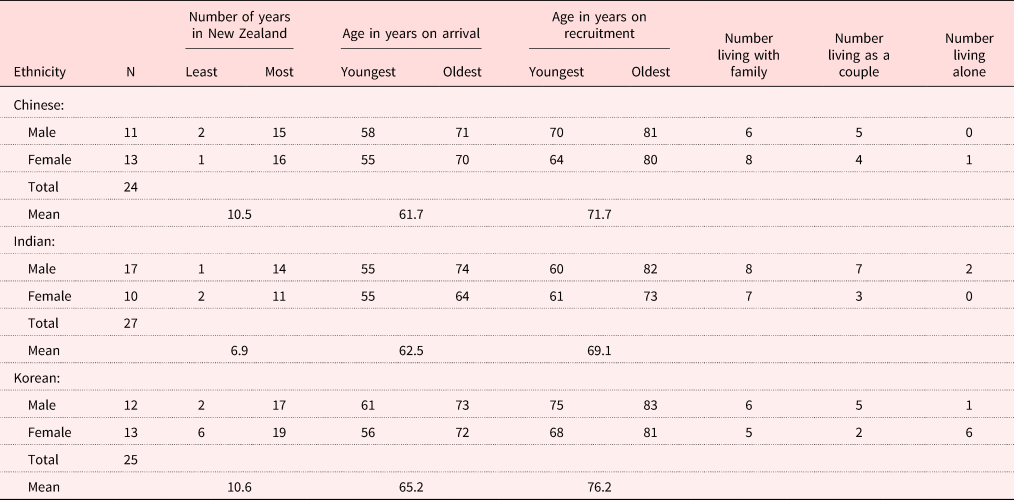
Inclusion criteria were self-identifying Chinese, Indian or Korean people, who were aged 55 years or more on arrival in New Zealand, had resided in the country for at least six months and were 60 or older at the time of recruitment to the study. Seventy-six participants, 24 Chinese, 27 Indian and 25 Korean, were recruited (see Table 1). Fairly even numbers of males (40) and females (36) consented to participate. None withdrew from the study. More lived with their adult children than did those who lived as a couple or lived alone at the time of the study. No Chinese males or Indian females reported living alone. More Korean females reported living alone than did any of the other demographic groups. On average, the Korean participants had lived slightly longer in New Zealand and were older on arrival and at the time of recruitment.
Participant demographic profile

Procedure
Participants were purposively recruited, aided by the local intermediaries and research assistants, through community venues that older immigrants frequented. They were invited to join one of three co-ethnic focus groups; for males only, for females only or a mixed-gender group. The Chinese and Indian participants chose to meet at a Chinese and an Indian community centre, respectively, whereas the Korean participants chose two Korean churches, based on proximity, for their group interviews. The nine focus group discussions, lasting between 90 and 120 minutes, were conducted in the participants’ languages of first choice: Mandarin and Korean for the Chinese and Korean groups, led by culturally compatible research assistants; and English with some Hindi for the Indian groups, led by the second author with research assistant support as needed. After each person had introduced him or herself in each group, the facilitator encouraged all participants’ views to be contributed without any aim to reach a consensus. As the researchers, we attended all groups to set up the furniture, manage the recording devices, serve food and drinks, and to assist with participants’ general comforts. We noticed the tendency for participants to allow another to finish talking before contributing themselves. Following initial data analysis, five participants from each ethnic group were invited to an individual interview, lasting up to 90 minutes, designed to explore how they participated in the community in more depth, check initial analyses and develop categories. All individual and group interviews were audiotaped, transcribed and, where indicated, translated into English for analysis.
Research design and methods: secondary analysis
For this secondary analysis project, we started with the original translated interview texts with no opportunity to ask participants to elaborate on their stories. In addition to the participants’ explanations of how they participated in the community, used to build the original study's substantive theory, the interview transcripts contained expressions of their post-immigration loneliness and/or social isolation. Therefore, hermeneutics, as a methodology for understanding another person's language (Dreyfus, Reference Dreyfus1991), was chosen to inform the secondary analysis design. Gadamer's ([1975] Reference Gadamer2004) hermeneutic methods and circular structure of understanding the parts, the particular stories, and the whole, the full data-set, were used to gain an understanding of the participants’ quotes.
Data analysis
The question asked in this secondary analysis project was ‘what does the text say about these late-life immigrants’ experiences of loneliness or social isolation?’ It was assumed that, even though arrival in New Zealand had occurred up to 19 years earlier, any meaningful experiences would be established in participants’ memories, and not readily forgotten (Gadamer, [1975] Reference Gadamer2004). The study participants had not been asked specifically about loneliness or social isolation as conditions for community participation. Consequently, this project's task was to return to the original translated transcripts with the aim of understanding the stories that contained language describing loneliness and/or social isolation. The stories were kept in their original form. The hermeneutic task was to ‘understand the sense of the text’ (Gadamer, [1975] Reference Gadamer2004: 363) from the horizon of these late-life immigrants’ experiences of being in a social context disparate to the one with which they held a life-long familiarity. In this paper, the terms ‘whole text’, ‘texts’ and ‘text or quotes’ are used to refer to the full data-set, the transcripts and the extracted participant quotes, respectively.
As researchers, we adopted secondary analysis methods congruent with Gadamer's ([1975] Reference Gadamer2004) hermeneutic conditions, namely accepting the understandings gained would only ever be towards knowing late-life immigrants’ loneliness experiences; holding our own pre-understandings meant we came to the task with our own horizons of understanding; staying open to what the text was saying by always questioning the text, and being prepared to have our horizons of understanding expanded by attending to the unanticipated text (Gadamer, [1975] Reference Gadamer2004). Gadamer's methods for the ‘how’ of doing hermeneutics were used as a guide to doing the analysis. Firstly, the ‘hermeneutic rule that we must understand the whole in terms of the detail and the detail in terms of the whole’ (Gadamer, [1975] Reference Gadamer2004: 291) was applied by reading and re-reading the whole text, the 24 translated interview transcripts, to gain a general understanding of language and what the collective texts were saying. Then, the nine focus group and 15 individual transcripts were grouped by ethnicity, Chinese, Indian or Korean, to enable any culturally relevant understandings to be preserved. Within the three groups of texts, the transcripts were sequenced by interview order to make it easier to track forwards to particular stories and backwards to their original locations in the texts. These grouped Chinese, Indian and Korean texts were then read and re-read from the horizon of asking what does this text say about experiences of loneliness or social isolation? Next, all sections of text that described or pointed to such experiences were extracted and the quotes coded to identify them by participant (pseudonym), ethnicity (C = Chinese, I = Indian, K = Korean), gender (F = female, M = male), interview type (fg = focus group, i = individual interview) and focus group number (1, 2 or 3) where relevant. For example, ‘Wanru_CFfg1’ signifies text spoken by Wanru who was a Chinese female in the first Chinese focus group. A total of 153 direct quotes were extracted from the transcripts: 57 (F = 27, M = 30) spoken by 23 Chinese (13 female and ten male) participants; 42 (F = 21, M = 21) by 13 Indian (seven female and six male) participants; and 54 (F = 32, M = 22) by 18 Korean (ten female and eight male) participants.
The 153 ethnically grouped, collated quotes formed the parts of the whole text for this project's hermeneutic analysis. Next we worked to ‘transpose ourselves into the perspective within which’ (Gadamer, [1975] Reference Gadamer2004: 292) participants had formed their views. That is, we worked iteratively to get as close as possible to understanding the lived realities of what was said. The grouped texts were read and re-read, and details in the quotes about events that happened and how things were experienced were questioned and annotated in regard to what they said about loneliness and/or social isolation. Similar descriptions across all of the stories, regardless of ethnicity, helped these late-life immigrants’ perspectives to be seen. Then, particular quotes were re-read and annotated whilst holding a ‘prejudice of completeness’ (Gadamer, [1975] Reference Gadamer2004: 294). In other words, we stayed open to the view that each quote held a completeness in how the text's meanings were expressed. We assumed that these participants knew more about the phenomenon than we did, therefore, their words and descriptions provided the clues to our understanding. We noticed the polarities of ‘familiarity and strangeness’ (Gadamer, [1975] Reference Gadamer2004: 295) in how the parts and the whole of the text addressed us, allowing us to hear the expected stories, such as the loneliness that came from leaving behind long-time friends in the country of origin, and the unexpected, such as becoming sick from the loneliness. It was in the interplay between the familiar and the strange that the text's meanings were heard, named and clustered together, regardless of the speakers’ ethnic backgrounds. We were led by the participants’ language and the understandings the quotes conveyed to us to describe three shared experiences, as presented in the Results section.
Results
The participants’ descriptions, in the midst of the original research data, held expressions of emotional and social aloneness, and of being apart from much of what was going on. Their meanings were clustered into three experiences: being unsettled, feeling sidelined and being oriented towards social connectedness. Each ontological notion is defined, followed by direct quotes of highly illustrative text.
Being unsettled
Numerous stories announced the unsettling nature of going about life in resettlement for these late-life immigrants. New Zealand was chosen as a place to be reunited with adult children and, very often, grandchildren. Yet, the texts spoke of being unsettled when previously familiar things, people and places were not there. Participants talked of noticing being distressed in some way. For example, Sam (CMfg3) noticed he ‘felt very uncomfortable … I didn't feel easy in my heart’, and Yu (CFfg1) found the neighbourhood so totally different that after six months she ‘wanted to go back to China and asked [her daughter] to buy ticket for me. I could not stay here’. Such text announced people's unsettling loneliness through their longing to be ‘back home’ where their satisfying friendships were. Kwan's quote illustrates how distance communication with his friends back in Korea was not enough to dispel his feelings of deep, enduring loneliness:
I lived and retired in Seoul and came to New Zealand after being invited by my daughter and son-in-law. It was ten years ago when I first came here. Before I came here, I was expecting a better life than in Seoul. However, I felt lonely after I came here … I was very lonely. I also got illness because of loneliness. I had no friends and places to go. I rang and wrote letters to my Korean friends. However, as much as I heard from my friends in Korea I felt lonely more and more and finally I got sick. Then, I came to think that I have lived a long enough life so I need to prepare for my death. (Kwan_KMfg2)
The participants’ language showed how being in the new context could be bewildering, uninviting and socially isolating because of its difference. Michelle's (KFi) comment suggests her, and other recent settlers’, loneliness arose from the isolation: ‘New seniors here feel very lonely and afraid to go outside because all their circumstances and environment are changed.’ Historical, intuitive knowledge about spaces and places was out of place. Some things were hard to comprehend which evoked uncertainty to going out of the house:
I don't find my way. Because in India we have different houses and we have different type of landmarks in our mind. Here in the beginning I feel everything same. Everything neat and clean, everything, every house is small, small, everything same. (Manari_IFi)
The texts conveyed two common, socially isolating experiences that contributed to being unsettled. The first, not speaking, or not being fluent in, English appeared often in the texts as something that held people back from joining in with host communities. Such quotes conveyed the discomfort of going about everyday life in English-speaking contexts. Consequently, the absence of common language was isolating and confining. David described:
There are many inconvenient things because of language problem. I can communicate only using body language or short words … Everywhere except our home, what we can do is limited. Even though we want to buy some food, we can't because I can't speak English. That makes us visit only Korean restaurants and shops so our area of activity becomes very small. (David_KMfg2)
The second experience was the general reliance on public transport to move about the community, and the time taken out of the day if going somewhere that required transfer between two or more buses. While many were thankful for the government-issued ‘gold card’ that entitled them to restricted, free public transport, not driving a car was a noticeable constraint to feeling settled:
There are a few people who ask me to do some social activities outside. Actually I want to go. I cannot drive. It is hard to ask my children to pick me up every time, since they need to work … The good thing is I can take a bus for free … but only during the day by consideration of safety. (Zang_CFfg1_i)
Some unexpected realities of being a later-life immigrant showed in the text, wherein taken-for-granted changes that come with being older were in themselves unsettling. Being the age they were was thrown into sharp relief when age-changes hindered settling in. By's thinking that her older age limited her capacity to remember new words in English was a shared sentiment:
I learnt some English by myself or in our [Chinese] organisation, but I found the effect was not good because I am aged. I could only remember in the class, but the knowledge would be forgotten soon after the class. (By_CFfg1)
Being out of their familiar cultural context was unsettling. In the text were descriptions of having to think about how a familiar culture played out amidst the unfamiliar. One way such disparate cultural understandings played out was the immigrants’ ever-present caution ‘to be very careful not to make mistakes’ (Joanna_KFfg1) and experiential knowledge of how unsettling cross-cultural encounters could be when they do not go as anticipated. Kiran's quote suggests such unsettling encounters get in the way of forming the social relationships he seeks:
I am eager to talk to people, but I try to understand the person whether he would react favourably or not. Often people don't like, often. Because probably they are busy with their own thinking, planning or what to do, or they're worried they've got late. So sometimes, I pass some jocular remark and I try to understand the reaction. And then the unfavourable reaction starts, so that's a barrier for me. I understand for some reason it's not going well. (Kiran_IMi)
Being unsettled meant the unfamiliar and unwanted required more attentiveness, more noticing, more time and was more worrying. The quotes illustrate that loneliness, in the distressing absence of close friend relationships and social isolation, in the lack of involvement in the wider social life, contributed to these late-life immigrants’ feeling unsettled within the host community.
Feeling sidelined
The text held quotes of being within yet aside from things in some way. Sometimes it was a feeling of being put aside by, or stepping aside from, family; sometimes holding on to cultural ways meant feeling out of step with adult children and grandchildren; and sometimes it was feeling indiscernible within the new host society. There was a sense of distancing and of being distanced or isolated from the mainstream, as voiced similarly by Tracey and Mary:
Although we are old, we still use our brains and our own ideas. It is hard for us to enter into the mainstream society. What can we do? (Tracey_CFfg3)
We rarely communicate with other Chinese here. So I think the small community is not so good. The big communities are the Centre and West Chinese organisations. But we only participate in Chinese community activities. We are not involved in mainstream society. (Mary_CFi)
Some text disclosed how being late-life immigrants from a disparate society brought its own obscurity when they felt unseen for who they were as a people or unwanted within the community. Some described excluding moments of feeling discriminated against because of racial difference, as told by Subhash and Harry, respectively:
I like to mix up with people. I tried to mix up with some Kiwi people [New Zealanders] here but I can't understand their accent. And secondly I just found that, they're not very much keen to accept me …Some I found that some sort of a distance they were keeping. So I stopped … Most of them respect but there are some racists you can make out. You say good morning and they look that side, so that's their own thing. All sorts of people will be there, in any community. (Subhash_IMi)
When my wife and I take a walk or drive a car, young Kiwi people shout abuse towards us to surprise us. When we take a walk, some people don't stop their dogs approaching to us. It scares us very much …We have to be very concerned even when we take a walk. If we see some big Kiwi people gathering, we have to avoid them. We know they will not harm us but just in case. When also we say hello to them, some people just ignore us. (Harry_KMi)
Experiences of feeling sidelined were revealed in moments of being culturally out of step with adult children's and/or grandchildren's ‘New Zealand ways’. Niru talked for many when she said ‘we have to look after home … we have to look after three grandchildren … they should know how to respect’ (Niru_IFfg3). Such accounts showed participants’ sense of obligation to pass on cultural traditions when so often their commitments were thwarted or not wanted. Such quotes revealed disappointment and sadness:
My granddaughter knows little about Chinese culture, tradition and etiquette. As for this, I talked about it to my son saying that we must teach about Chinese good tradition … I drive my granddaughter to New Market to play ping-pong after school. Every time I drop her off there, she just takes her bag and shoes and leaves without saying a word. I didn't say anything about it. But I didn't think her behaviour was good. So I mentioned it to my son later and … I advised him to teach her … She tends to forget how she should behave and then returns to the old behaviours … It would be different if she were born in China. (Jak_CMfg3)
Feeling not listened to carried with it a message of being uninvolved and out of step with how things were now done in the family household. Han described creating temporary physical distancing as a way of defusing his tension when he felt his cultural efforts were sidelined:
I didn't live with my grandchildren in Korea but since I moved to New Zealand, I am living with them. However, they don't listen to me. Their ways of thinking are different from me. So sometimes I regret I came here. If I stay with them at home we only have troubles so I often go driving and come back home late time. (Han_KMfg2)
Other quotes described how partnered and non-partnered participants had chosen to distance or socially isolate themselves more tangibly by moving out from their adult children's homes into separate accommodation. Choosing to live separately from adult children and grandchildren happened because of ‘problems like culture differences, some prefer to keep their own family problems for their own and therefore isolate themselves’ (CXN_CMfg2). Kiran, at 82, reasoned it was time to be less involved in his family's life; ‘[My] grandfather duties are over. The child has become five years old. More or less he's capable of certain things doing himself. So I told my son and daughter-in-law I will stay alone now’ (Kiran_IMfg1). Harry's quote, as for some others, speaks more directly of isolating himself by moving aside to relieve unexpected post-immigration difficulties in co-habiting with adult children and grandchildren:
For the first four years, I lived with my son's family. At that time, my grandchildren were only four and five years old but after they grew up, it became hard to live with them. They are speaking English and changed their food and life. So my wife and I moved out. (Harry_KMfg2)
Being oriented towards social connectedness
Alongside the texts pertaining to being unsettled and feeling sidelined were those that showed these late-life immigrants longed to engage in satisfying relationships beyond the family, and to join with others in the community. Cultural familiarity drew them towards what was similar. Hehn's (CFfg1) words stood for many when she commented, ‘since my major task is taking care of grandchildren and doing some cleaning work at home … I focused on household at the time so I knew nothing about the outside’. Finding themselves lonely from social isolation seemed to be the state that oriented them towards making meaningful social connections. Being oriented towards connectedness was a mode of turning away from loneliness and social disconnectedness. The language used reveals they wanted to be with others, to move from being alone to being alongside. The language of finding warmth and of being like a big family shows in numerous stories. Fairy's quote highlights the emotional connectedness she experienced in joining together:
See like now our nature is to live peacefully and jointly with everyone, so like if we get parties, clubs, we go there we talk to them, this way we share happiness and sorrow and this way also we sharing emotional bond with others, physically we are not that much fit, we also want some company outside. (Fairy_IFfg3)
In an associated way, Shin Min's quote reveals the unspoken social connectedness when friends just knew to come for her, and to wait. Yet it was the song from their shared past that revealed the good of being together:
After my daughters left New Zealand, I moved to the central region. Then I firstly attend in an English-learning class. I still did not know where held the activities. Once some friends waited me outside and invited me to come, so I come with them. When I entered into this door, a very beautiful song [from the second part of Health Dance] came to my ears. Suddenly, all tears were in my eyes … Sometimes I felt sad, I would come here and then I would have a good mood. (Shin Min_CFfg1)
There is a comfortableness in being with other late-life immigrants, like themselves, where ‘everyone speaks the same’ (Yoo_KFfg3). It invites community involvement; it enables engaged relationships. Co-ethnic churches featured many times in the texts. Churches are contexts that beckon togetherness and may provide comfortable places and spaces for wider involvement in the community. Churches are conspicuous places and seemingly familiar spaces to move towards. A number of quotes revealed these late-life immigrants were pragmatic in using community churches to seek out social connectedness with other co-ethnic seniors to relieve loneliness, as illustrated by Mike's description:
I almost always participate only in activities held by Chinese organisations. I went to Church to study English a few times … What's more, it can help dispose of the spare time at home and connect with the outside. I have nothing to do at home. Always sitting is not good for elderly people … In my opinion, we must actively participate in the community when we feel lonely. Since actively going out can release pressure and refresh our mood. It can help us relieve the loneliness. In a word, we should go to the community and communicate with other people. (Mike_CMi)
Kwan described a similar logical diligence in going early mornings to worship with others at the Korean church. He went on to describe ‘I was changed. Now, I am living my life full of hope’ (Kwan_KMfg2), suggesting being in communion with co-ethnic others delivered more than the initial comfort he sought. May's quote below elaborates on this idea. It illustrates how co-ethnic churches were described often as more than spaces that invited and provided togetherness in communion. They invited giving to community and provided purpose through social connectedness.
I attended the church at an early stage. I did not feel lonely since I almost lived in church. Their love really touched me … I participated in church, such as I worked as volunteer. We did a lot to help others. Also, I participated in community activities. We feel warmly here. We look like a big family. (May_CFfg1)
While most of the text spoke of being oriented towards co-ethnic social connectedness, others had talked of longing to join with people in the wider society; ‘to meet Kiwi senior people’ (Paul_KMfg2). Subhash's quote is illustrative of the often talked of, unsuccessful orientations towards connecting with non-co-ethnic others:
Nearby there's a church. So, in that church are some meetings, some senior meetings were there. I saw the noticeboard. I went there but I did not find any Indian, mostly they were all whites. So, I tried to talk, I tried to go myself but I could not understand when they talked, because understanding the accent is a big problem. (Subhash_IMi)
On the whole, the social connectedness found in supporting and caring for each other, engaging with friends and neighbours was a way of ameliorating loneliness. The last two quotes illustrate the felt reciprocity in a gift given, in the first through telephone befriending and the second through sharing foods of significance, and the gift received, happiness and less loneliness, respectively:
Now my wife knows there are a lot of people who are socially isolated who are living alone and they don't have much company, they can't move about. She has got many friends so she telephones them. Busy at least three or four hours a day, she just telephones them … just talking about anything; about food, about cooking, about households, about friends, so she feels happy, they feel happy. (Ram_IMfg1)
I have made a move once. The former place I had lived was full of friendly neighbours who took care of me. For instance, as a gift, they always gave me some cherries picked up from the South Island where their relatives lived and I gave them dumplings and steamed stuffed buns in return. Although we are speaking in different language, we get along well with each other … He was mindful towards me and I felt I became a member of this society step by step, with less loneliness. Interestingly, less loneliness accompanies me. (Li_CMfg3)
Overall, the texts suggest that being oriented towards social connectedness was influential in two ways for these late-life immigrants; it enhanced their drive to seek out and connect socially with others, typically within their co-ethnic communities, and it invited gifts in return that went beyond common understandings and spoken words.
Discussion
This secondary analysis applied Gadamer's conditions for engaging hermeneutically with the text. His assertion that ‘a genuine conversation is never the one that we wanted to conduct’ (Gadamer, [1975] Reference Gadamer2004: 385) was evident in this project. During the original grounded theory study of how Asian late-life immigrants participated in society, the informants talked about experiences of, or pointed to, being lonely or socially isolated. As such, their frank descriptions emerged within the natural flow of conversations about participating and may, therefore, be more revealing than they might have been to direct questions about loneliness or social isolation. The full set of 153 quotes analysed in this project included more extracts from the interviews with the Chinese males and the Korean females, and more overall from the females (80 quotes) than the males (73 quotes). This might mean these cohorts experienced greater loneliness and/or social isolation, or that they were more willing to talk about such experiences. Many participants described deeply personal experiences in frank terms; yet, we do not know if details were held back or stories untold because of a perceived stigma of loneliness. Late-life immigrants’ loneliness experiences have been researched (Park and Kim, Reference Park and Kim2013; Tummala-Narra et al., Reference Tummala-Narra, Sathasivam-Rueckert and Sundaram2013; Taube et al., Reference Taube, Jakobsson, Midlov and Kristensson2015). However, the use of Gadamer's ([1975] Reference Gadamer2004) philosophical hermeneutics to conduct a secondary analysis of the ontological nature of participants’ experiences of loneliness and/or social isolation is somewhat novel. Dahlberg's (Reference Dahlberg2007) use of a reflective lifeworld research method to interpret the meanings within interview transcripts describing 12–82-year-olds’ loneliness experiences is similar in its existential philosophy; yet, differs in its approach to gathering data to enable analysis of the phenomenon's general structure and meanings. This project's hermeneutic method required going back to already-gathered research transcripts to explore, and interpret afresh, what the text was saying about loneliness and social isolation. Three ontological notions were interpreted in this project: ‘being unsettled’, ‘feeling sidelined’ and ‘being oriented towards social connectedness’.
The term ‘being unsettled’ signifies these late-life immigrants’ experiences of feeling overwhelmingly forlorn and of being disconcerted by the strange new cultural context. The texts suggest resettlement for these Chinese, Indian and Korean late-life immigrants was in itself unsettling. The study's participants described longing for the satisfying relationships they had with friends back home, and the isolating bewilderment with the host's culture and places encountered, and the challenges of learning English later in life. Ontologically, the quality of unsettledness shows itself in not-being-at-home or being uncomfortable in an obtrusive world that is ‘not functioning for me’ (Dreyfus, Reference Dreyfus1991: 183). Existentially, ‘everyday familiarity collapses’ (Heidegger, Reference Heidegger1962: 233) and bewilderment emerges. Consistent with the literature, the participants’ language conveyed their subjective distress and feelings of detachment as described in loneliness definitions (de Jong Gierveld, Reference de Jong Gierveld1998). Their experiences of being unsettled were described as more pronounced in the months and years immediately after arrival (Wu and Penning, Reference Wu and Penning2015; Dolberg et al., Reference Dolberg, Shiovitz-Erza and Ayalon2016).
Participants’ experiences of feeling sidelined, isolated from or uninvolved with community and/or family life were evident when they talked of feeling racially discriminated against, distanced from the mainstream because of language or freedom of mobility, or at odds culturally with adult children and grandchildren. Their language conveyed a discrepancy between the social isolation they experienced, and the connectedness they craved. Their experiences are consistent with social and emotional loneliness arising from a felt gap between the desired and actual quality of relationships (de Jong Gierveld et al., Reference de Jong Gierveld, van der Pas and Keating2015). Regardless of living circumstances, the study's participants expressed feelings of not mattering to others to whom they were closest. Ontologically, such relationships are lonely relationships, deficient and indifferent modes … [of] Being-with-one-another’ (Heidegger, Reference Heidegger1962: 158).
The secondary analysis findings are in line with results from other studies. The New Zealand literature has reported older Korean immigrants experiencing boredom or discouragement when ways to engage at home or in the community were lacking (Park and Kim, Reference Park and Kim2013); and older Chinese immigrants at times feeling slighted and insufficiently appreciated by adult children (Zhang, Reference Zhang2014), ‘fundamentally out of place, alone and socially isolated’ (Li et al., Reference Li, Hodgetts and Ho2010: 789), with language difficulties as a highly disruptive influence on community participation (Selvarajah, Reference Selvarajah2004). Similarly, the North American literature has reported older Chinese immigrants’ cultural and language differences as compounding their social isolation (Simon et al., Reference Simon, Chang, Zhang, Ruan and Dong2014), a majority of late-life Asian Indian immigrants as agreeing or strongly agreeing they ‘felt isolated, lonely, or left out of things’ (Mukherjee and Diwan, Reference Mukherjee and Diwan2016: 248) and older South Asian immigrant women as feeling ‘forced to become passive’ (Choudhry, Reference Choudhry2001: 386) when daughters-in-law took over their traditional matriarchal roles.
Alongside and within the quotes pointing to these late-life immigrants being unsettled and feeling sidelined was text showing ways of always being oriented towards social connectedness. They acted on such longings by seeking out meaningful relationships with others like them outside the household: other co-ethnic late-life immigrants who they could be with and commune with easily. Going to a culturally familiar church was a commonly voiced way of relating spiritually with others and increasing the level of involvement in the community. Doing caring deeds for people within co-ethnic communities, such as having a chat by telephone with someone lacking company, was more than helping others: it was a way orienting oneself away from social isolation and loneliness. Congruent with the gerontology literature, older people are concerned with reducing their own and others’ social isolation and loneliness through building social networks and community connectedness (Grenade and Boldy, Reference Grenade and Boldy2008). Ontologically, Heidegger (Reference Heidegger1962: 155) used the term ‘Being-there-too’ to describe the human experience of relating to others in the world when there is sameness in the things cared about. Interpreted in the context of this research, the participants were resolute in seeking the company of other co-ethnic, late-life immigrants with whom they shared important things in common. They worked to overcome practical challenges in order to develop social relationships beyond their families. Whether it was noticed immediately or over time, having the company of adult children and grandchildren was not enough. Being oriented towards social connectedness with other late-life immigrants is consistent with acting to relieve the fear and distress of loneliness (Dreyfus, Reference Dreyfus1991). Wanting to be with others like them drew this study's participants towards becoming involved in their respective ethnic communities. Likewise, it has been evidenced that older Asian Indian immigrants who were not proficient in English were more likely to seek social connectedness through ethnic community organisations than those with English proficiency (Diwan, Reference Diwan2008).
Limitations
The understanding of late-life immigrants’ loneliness and social isolation is limited by the fact that participants were recruited through community venues where late-life immigrants gathered; therefore, those who volunteered had already taken steps to locate communities of people with whom they felt they belonged. Additionally, this project was a secondary analysis of existing data with no opportunity to seek clarification of events or meanings. In using Gadamerian hermeneutic methods, we assumed we could come to understand the participants’ realities of being lonely and/or socially isolated from contemplating their stories and the language within them. Further, we understand the results are our interpretations from reading all the stories; they may not be how the participants themselves understand their experiences. Conversely, this might have been a strength as stories about loneliness and social isolation appeared spontaneously in the interview-based data about community participation. Nonetheless, the potential existed for some nuanced meanings to be lost in the process of translating the original interview transcripts into English (van Nes et al., Reference van Nes, Abma, Jonsson and Deeg2010). The marked similarities between the Chinese, Indian and Korean late-life immigrants’ stories add credence to the interpretations drawn from them.
Conclusion
Overall, a mood of loneliness coloured these late-life immigrants’ resettlement experiences. From an ontological perspective, ‘moods are fundamental modes of existence that are disclosive of the way one is or finds oneself in the world’ (Freeman, Reference Freeman2014: 445). Accepting this understanding, in relocating internationally to be with adult children and grandchildren, these late-life immigrants found themselves distanced amidst and by the unfamiliar. A mood of loneliness appears in how the participants described what was unsettling to them, and in feeling aside from the main play in numerous family and community encounters. At the same time, the text suggests a fundamental longing to be with others who were like them and this feeling remained with them. The yearning to connect with others and be involved in the community provided the impetus for turning away from a lonely and isolated existence. It made seeking out encounters with mainly co-ethnic communities of other late-life immigrants possible.
Author ORCIDs
Valerie A. Wright-St Clair, 0000-0002-7505-3946; Shoba Nayar, 0000-0002-9777-5915
Acknowledgements
The authors acknowledge Shimu Wang, Supreet Sodhi and Hagyun Kim, the research assistants; and Mr Hu Chongbao, Mr Jeet Suchdev and Mrs Audrey Chung, the local intermediaries for this study. Their participation made this study possible.
Financial support
This work was supported by the Auckland University of Technology, Faculty of Health and Environmental Sciences Contestable Research Fund (grant number CGH 26/12).
Author contributions
Both authors contributed to conceptualisation of the paper. The first author had primary responsibility for data analysis and manuscript writing.
Conflict of interest
The authors report no conflicts of interest, or financial interests or benefits from this research.
Ethical standards
Ethical approval was granted for the original study and the secondary analysis by the Auckland University of Technology Ethics Committee (AUTEC 12/100).