

“The floating of the exchange rate in 1972 changed the conduct of macroeconomic policy in a fundamental way … the sterling exchange rate did not seem to be determined by fundamentals, that is to say by relative rates of inflation and that state of the trade balance. Instead, it took on a life of its own, responding to news and changes in market sentiment, as well as signals sent out by the monetary authorities in a vain attempt to keep it under control. Far from easing the external constraint, free exchange rates meant that policy makers were obsessed by the need to please the markets.”Footnote 1
Reference BrittonBritton, A. (1991), Macroeconomic Policy in Britain, 1974–1987
1. Introduction
Whilst it is traditional in economics to think of the external balance as simply placing a constraint on domestic activity,Footnote 2 the Institute increasingly realises that it is more the case that integration into an increasingly complex system of payments and trade has affected the structure of production and the pattern of employment across the UK and also been the source of both economic shocks and mechanisms to share risk. In its quarterly commentaries and forecasts of an open economy,Footnote 3 such as the UK, the Institute has recognised that many domestic risks tend to be manifestations of global developments, involving trade, migration and capital flows, which in the past couple of decades have very much involved the encroachment of new or emerging economies on the old world order.Footnote 4 In terms of international economics, there have been rising tensions between nation states that are emerging or have advanced in the past.Footnote 5 This is because wages and the rate of return on capital, the return to the factors of production, are more or less set internationally rather than domestically with considerable domestic consequences for the distribution of income and employment opportunities, whilst at the same time promoting an astonishing level of economic catch-up for the emerging economies.Footnote 6
The basic economic story is that in any country, whether income is high or low, the main determinants of income are capital employed per person and the level of technological efficiency (Reference OultonOulton, 2018). If, as a result of relatively open trade, all countries have access to similar technologies, at least to some extent, it must be that the quantity of capital employed plays a major role in explaining large income differences. We tend to think that the marginal return on the quantity of capital employed tends to fall as the amount of capital employed increases, as it becomes increasingly harder to find high return projects. So it follows that the marginal return on capital in countries where there is a lot of capital employed – high income countries – will be low compared to countries where there is significantly less capital employed (aka low income countries). And so, just like the wind, capital should flow from high to low income countries in order to exploit higher returns and this process should tend to raise the global average rate of return. And if capital flows to and from countries in the world economy followed something like this process, it ought to drive catch-up or convergence in the distributions of global income as capital flows to poorer countries and raises income accordingly.
And yet when we look at the basic facts they do not fit this prediction. The net investment position of the UK, which represents overseas assets held by UK PLC minus the claims on UK PLC, does not appear to show a build-up net of assets in the period following capital account liberalisation in 1979, rather it has mostly been building up net liabilities (see Reference LaneLane, 2015). These liabilities represent overseas claims on UK households and firms’ assets and indicate the extent to which international capital flows have become a pervasive influence on the economy. In the UK, in particular, they have impacted on the behaviour of banks and hence on credit dynamics, as well as on sovereign and bank-bond markets. On the asset side, banks in such an environment have a choice between domestic and international lending and securities. On the liabilities side they can supplement domestic retail and wholesale deposits with much greater cross-border supply, so that even for domestic banks, lending need not be constrained. Besides amplitude, the composition of capital inflows also matters for fragility. Research has shown a strong link from net debt flows to domestic credit expansion in a range of countries and periods (Reference AllenAllen, 2005, and Reference LaneLane, 2013).
The theory also implied that capital would be re-allocated from low return to high return economies, which would have tended to increase real interest rates but they seem to have trended downwards, as capital has flown the other way. So for substantial parts of the period of economic and financial liberalisation, capital has travelled from lower to higher income countries, with corresponding surpluses in the former and deficits in the latter, and this process has lowered rates of return as the marginal unit of capital has been used by countries with lower returns on capital borrowed from countries with very high propensities to save.
I shall consider the implications of the increasing dominance of capital flows and the changes in real interest rates for the UK economy (see Reference KindlebergerKindleberger, 1987). In Section 2, I shall outline some key judgements expressed in work undertaken at the Institute; Section 3 examines the current account; Section 4 outlines the counterpart puzzle in terms of capital flows, and Section 5 considers the impact on asset prices from international savings and investments, Section 6 outlines some resulting problems, Section 7 looks at savings and investment again and Section 8 at the international investment position; Section 9 looks at the exchange rate and I conclude with some thoughts for how we might tackle analysis in future.
2. A NIESR view
The Institute's own histories of the postwar period, Reference DowDow (1964), Reference BlackabyBlackaby (1978), Reference BrittonBritton (1991) and Reference ChadhaChadha et al. (2016) have been keenly aware of both the nature of the external constraint and the complexities it brought to macroeconomic management. Whilst expanding the opportunity set, the external sector seemed for a large part of the postwar period to imply yet another sector to regulate. Dow (1964, p. 385) outlines four main factors driving the external position: a high propensity to import during an economic expansion; large “swings in the terms of trade, chiefly due to changes in the world price of commodities we import”; changes in net property income from abroad; and changes in net grants and transfers. And even though the current account was on average in surplus in the postwar period up to the early 1960s, Dow believed that “if the economy had been run not only at a more stable, but also at a lower average pressure of demand, this would have reduced the rise of prices; and that this in turn would have produced a greater expansion in exports (p. 390).”
The pressure on activity that Dow emphasises provides the backdrop for devaluation in 1967. Blackaby's Narrative chapter provides compelling reading on the sequence of crises leading to the devaluation. But he is also clear on the absence of any transformative impact on the economy, or indeed on policy of the devaluation. He argues that: “there was the same overriding preoccupation with the balance of payments; the same need was felt to defend the exchange rate which had, after all, moved to a new fixed parity. There were, as before, speculative runs on sterling, and again these forced the government to take deflationary measures”. A later chapter in the book by Tew outlines the panoply of measures designed to improve the external position: from export promotions, to travel allowances, an export rebate, import surcharge and a temporary import deposit scheme. To illustrate the concern, Tew shows that the share of overseas travel in consumer expenditure had almost doubled in the postwar period from around 0.8 per cent in 1952 to over 1.5 per cent in 1973.
But it was not only that the external value of the currency was an objective of stabilisation policy but by the 1980s it had become clear that the main influencers on the British economy were from overseas. We had in effect become a small open economy and had to accept world prices. Reference BrittonBritton (1991) writes of the 1970s: “three developments in particular had profound effects on Britain: the management of international economic relations under a system of floating exchange rates; the consequences of the cartelisation of oil production, and the slower growth of output and productivity, in almost all industrialised countries during the 1970s”. Discretionary macroeconomic policy just did not respond well to these events and nearly contributed to the loss of any credible nominal anchor. The subsequent refocussing of monetary policy on inflation culminated with the adoption of another external anchor on 8 October 1990 by joining the European Exchange Rate Mechanism (ERM); the peg lasted until 16 September 1992.Footnote 7
The post-ERM period is examined in Chadha et al., (2016), which looks at the period from 1992 to 2007, during which globalisation has cast a long shadow. The long expansion in activity was unusual but also seems with hindsight to have been sustained by external forces with an equalisation in factor prices and a dominant role for international capital flows in explaining domestic economic developments. Table 1 illustrates how the stock of assets and liabilities generates an overall return on the current account that does not correspond exactly to their magnitude.

In the volume two papers discussed the international sector. Reference Key, Paul, Weale and WieladekKey, Paul, Weale and Wieladek (2016) explore how the United Kingdom was able, despite a current account trade deficit and apparent net external liabilities, both to earn a positive balance of net income from abroad almost every year and to improve its net external position during the Long Expansion. The puzzle is that the current account deficit, particularly in the ten years leading up to the financial crisis, does not square with the stability of net external assets over that period, unless there were higher systematic capital gains on the UK's assets compared with its liabilities. Indeed, between 1997 and 2012 the UK seems to have earned a total of capital gains or unidentified income worth nearly 20 per cent of 2012 GDP. The authors’ new dataset shows that the UK, like the USA, enjoyed favourable returns on investment categories that were broadly similar for assets and liabilities. The authors note that the data do not reveal whether investors in UK foreign assets are more skilled than those investing in the UK, or whether they merely run greater risks. A substantial component of the improvement in the net income flow between the early 1990s and the middle of the next decade appears to have been a consequence of regulatory changes. In particular, the improvements due to financial regulation appear positive, while those due to product market regulation are negative. Indeed the importance of capital gains on investments made in the past in funding current account deficits was highlighted by recent Bank of England research by Reference Burgess and ShanbhogueBurgess and Shanbhogue (2017).
On the influence of trade on domestic inflation, Reference Lewis and SalaheenLewis and Saleheen (2016) note the frequent claim that globalisation and the falling costs of transport and information contributed to the low-inflation experience of the developed world during the Long Expansion. Part of this was associated with the emergence of China as a major exporter of manufactured goods, due in part to its low wage costs. Substitution of purchases towards these lower priced goods had a direct effect on inflation; but the growth of competition also put pressure on domestic producers in the developed countries to reduce costs and/or substitute new technology for high-cost labour. These forces would have been likely to exert downward pressure on inflation in importing countries, including the UK. They find evidence that the growth in imports that substitutes for products from advanced economies has been associated with a reduction in import prices and estimate that this switching to emerging-market-sourced goods reduced manufactured import price inflation somewhat. Rather than being somewhere else as an external constraint, the international economy seems to be increasingly embedded in our own economic structures, of finance, banking, supply chains and wage setting. Reference HollandHolland (2009) pre-empted much of this analysis by looking at mark-ups in a global value chain and Reference GoodhartGoodhart (2001) discussed, inter alia, the complications for the inflation forecast.
As it happens, the textbook Mundell-Fleming model, which provided the backdrop to the analysis of demand-side fluctuations, cannot deal very well with the key developments of dominant capital flows and declining real rates as real economic integration has progressed. In the classic postwar analysis, if the economy ran an external deficit at the point of market clearing in goods and money markets, the postwar model prescribes tighter monetary policy in order to help competitiveness by lowering domestic prices and also expansionary fiscal policy to restore full employment (see Reference Blake and WealeBlake and Weale, 1988). The outcome is a switch from private to public expenditure with a higher interest rate to attract overseas capital in order to fund the deficit. What that model could not confront was the contribution of supply-side shifts, otherwise known as efficiency, to business cycle fluctuations, how capital flows might impact on credit-constrained households and firms, the possibility that persistent current account deficits might not lead to a payments constraint because of the net positive returns from gross assets and liabilities and that a jump in the exchange rate might be very helpful.Footnote 8 The key development has been that the rest of the world is not an exogenous lump of external demand but represents part of our own production network.
3. The current account
Let us start from some simple principles. The balance of payments accounts record a country's international transactions. The current account measures the exports of goods and services to which we add net receipts of international income from interest paid or received on foreign assets or liabilities and any remittances or foreign aid. The capital account measures all asset transactions with overseas entities. The capital and current accounts add to zero. And a useful measure sometimes is the so-called basic balance which adds the current account to long term capital flows.Footnote 9
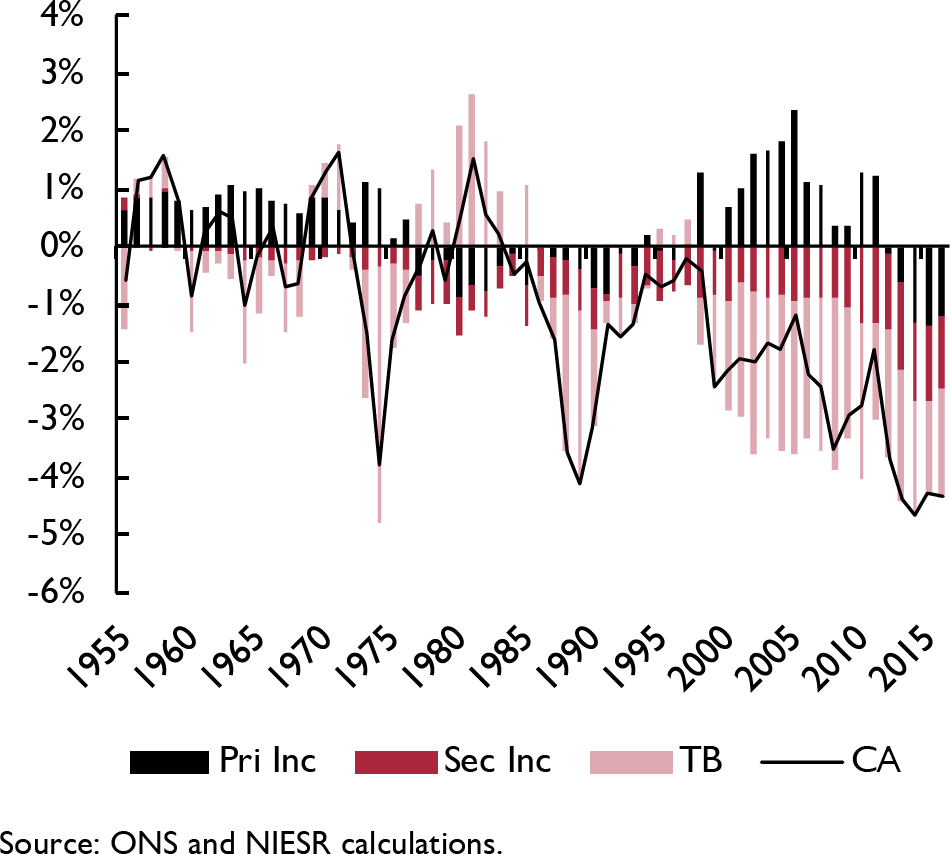
Current account and its components (% of GDP) 1946–2016

As already stated in Reference DowDow (1964), in the immediate postwar period when the economy was under many forms of capital and import and export controls, the current account was more often in surplus than deficit. There was a structural change in 1972/3 following both the abandonment of Bretton Woods and the first OPEC oil price shock, and the UK current account went into deficit. Apart from a couple of years in the early 1980s, there has been a deficit ever since, which we might term structural. Until 2011 the patterns in the current account were dominated by the trade balance in goods and services but there has been a marked deterioration in international income receipts, particularly in investment income and remittances.
The current account tends to be negatively correlated with output over the business cycle, which offers some casual succour,Footnote 10 in the sense that deficits indicate an economy in expansion and a surplus would indicate recessions. Naturally when we turn to the cyclical frequency we do not capture structural trends well. But that said there are two competing thoughts as to why the current account and activity might be negatively related. The former is tied up with ideas of capacity constraints in an expansion. So that in an upswing when demand in the economy starts to use up spare capacity there is a need to import from abroad leading to a current account deficit. This process might be accompanied by increasing domestic wage pressure and a move along the Phillips curve, forming a popular explanation for the Stop-Go cycles of the immediate postwar period. Indeed I shall return to it in its original Salter-Swan form.
The more modern approach that followed the abandonment of capital controls in 1979, is that the current account is the analogue of forward-looking behaviour, where, for example, households facing a richer future increase consumption today and borrow to finance it and adopt stable paths for consumption. A similar story can motivate firm-level investment, which would drive a countercyclical current account (see Reference Obstfeld and RogoffObstfeld and Rogoff, 2000). We can then interpret current account deficits in an expansion as simply borrowing from abroad to build a richer future. The persistence of the current account deficit is though something of a problem for the theory as it suggests that the richer economies are continually building more and more for a richer future and by borrowing from less well-off countries! Indeed Reference FarmerFarmer (2010) suggests a domestic objective for full employment based on operations on the asset-liability position.
4. The capital flow puzzle
The extent to which the supply side is determined globally can be illustrated by a very simple thought experiment. In a famous calculation, Robert Lucas (Reference LucasLucas, 1990) showed that if a rich and poor country have equivalent production technologies, differences in income per head arise solely because the amount of capital employed in the poorer country will be less than in the richer country, and this implies that the marginal efficiency of capital ought to be higher in the poorer country and so attract capital. For example, let us consider a two-country world comprising China and the US alone. Chinese per capita income is around $5,000 at the PPP exchange rate and the US is $45,000, implying that the rate of return on capital in the US should be a small fraction, around 3–4 per cent, of that in China. That should then mean that China runs a current account deficit financed by a US capital surplus. The reality has, of course, been the obverse, with the US recycling China's capital flows.
Let us for a minute look carefully at that calculation. We assume that output per unit of labour, yt, is simply a function of the overall level of technology, At, in the economy and the quantity of capital employed, ktα, where a represents the share of capital in the output production process, and t is a time subscript:

in which case the marginal return on capital, rt, is simply the derivative of output with respect to capital:

which if we substitute  , we can re-write as:

Given that the share of capital is somewhere between 0 and 1, the rate of interest must fall with the level of output per head in the economy. We can calculate the resulting relationship between the ratio of output in high versus low countries and the reduction in the fractional rate of return. For a higher output level relative to low income country reference point, we observe just how quickly the relative rate of return should fall. By the time that the rich country has some 10 times the income per worker of the poor country, then the rate of return on capital in that richer country should be less than ⅕ (and probably even smaller) of the rate of return in the poorer country and so capital should just be flying there.
In this simple framework there are naturally a number of reasons to temper our expectations of large differences in the rates of return. For example, the overall level of technology available is not the same, we can play with At or think of some other measure of technology such as human or intangible capital (Reference Haskel and WestlakeHaskell and Westlake, 2017) and argue that differences there explain difference in output rather than just difference in physical capital. And it is quite possible to use both these arguments to close the expected interest rate gap to a small number. But these arguments also imply that the workers in the poorer countries do not get more productive or that improved human capital stays in the richer economies. It seems to me that globalisation implies precisely the opposite.
Let us put these production function arguments to one side and think about behaviour that might change as the constraints on that behaviour evolve or change. The neo-classical view of the process of convergence implies that the poor countries would borrow capital today from the richer countries and their incomes would grow in line with that capital injection. Of course, once capital levels had converged there would be no further excess returns from capital flows but the first industrialised nations would then have built up financial claims on the productive capacity of the newly industrialised nations that would imply interest payments the other way in perpetuity. At this point the newly industrialised nations face a change in incentives, they might wish to avoid making these payments and renege to the nations that have financial claims on them – perhaps by ‘nationalising’ their key industries. In the language of economics, the newly industrialised nations may wish to behave in a time inconsistent manner (Reference Kydland and PrescottKydland and Prescott, 1977). But that is not the final part of the argument. We shall assume that the first industrialised nations are not quite so trusting and can see this future change in behaviour looming. And because they can see today that incentives will change in the future we end up with some form of the current outcome where high income states do not then lend today to these emerging economies.
There may even be another reason for the lack of capital flows as the result of another type of friction. The domestic producers in the poor country may benefit from high returns in uncompetitive economies where they exercise monopoly power and they may have no wish to see their practices upended by foreign capital that erodes their monopoly power (Reference IrwinIrwin, 1991). Furthermore, if these local firms are linked to the political power structure then they may be able to erect quite strong barriers to foreign investment. Such practices will of course increase the possibility that different levels of knowledge across the world economy remain localised rather than shared. But again it seems to me that a lot of knowledge has been shared as the world has become more globalised.
5. The impact on asset prices and debt
The real return on capital, or long-term real rate of interest, can be expected to adjust to equilibrate the pool of savings and planned investment. And as I have stressed, in a global economy, capital outflows should tend to go from wealthy-saver countries to poorer-borrower countries with limited savings but abundant investment opportunities. And as already mentioned it is appropriate to wonder out loud whether the root cause of the financial crisis has been the unnatural sight of capital flowing ‘uphill’, which is from poor to wealthy countries.Footnote 11
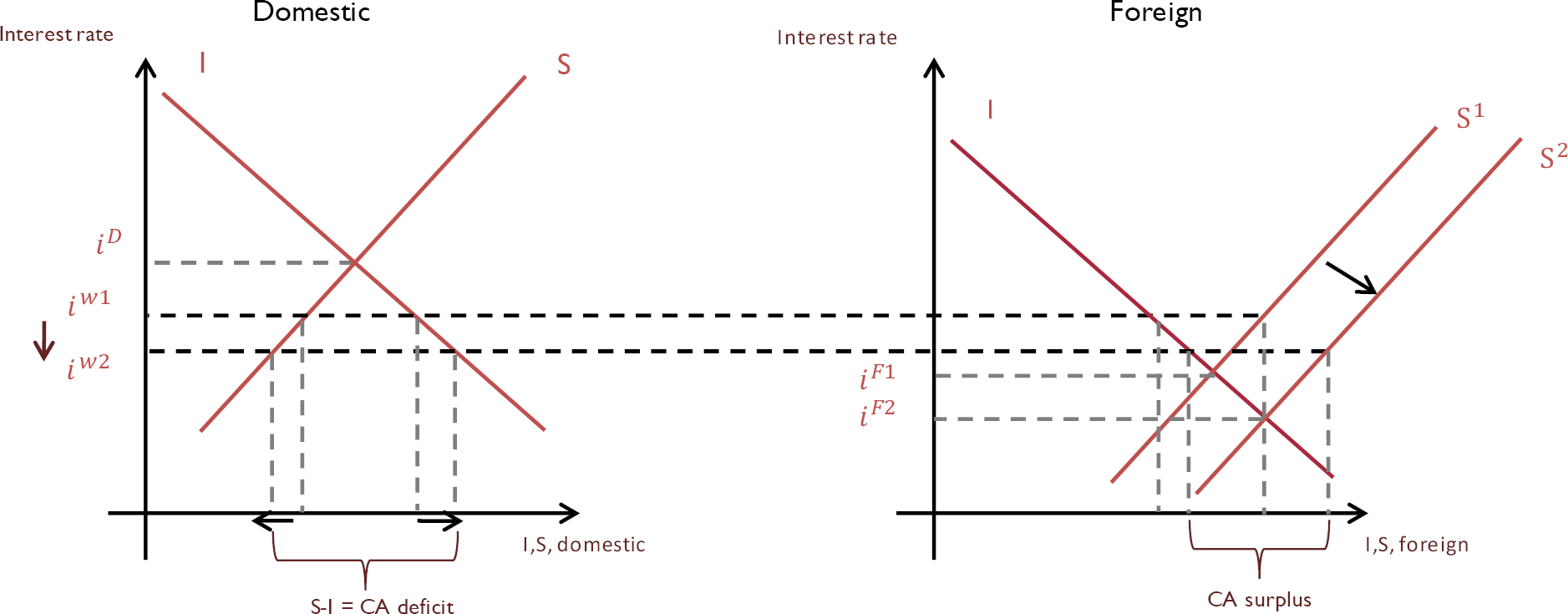
Let us first consider two closed economies (figure 2), which might represent on the one hand the set of advanced countries and on the other the set of emerging and developing countries (EDCs) in isolation, that is if they did not trade capital with the rest of the world. Planned savings in both sets of economies would equal planned investment at a unique but separate interest rate in segmented markets. Obviously there are lots of different type of investment vehicles which all must give different returns depending on their level of risk but let us suppose that risk adjusted returns are equalised at one interest rate, or there is a vector of interest rates in each economy, represented by one value.
Saving and investment in a small open economy

If the advanced countries and the EDCs are both closed economies, in the potential debtor country – on the left hand side of the figure – real interest rates would clear the domestic market for saving at iD and the equilibrium level for savings and investment would be determined accordingly; and this would represent the natural rate. Overseas in the EDCs, on the right-hand side of the figure, the higher level of savings at any given interest rate and lower investment demand would imply, if there were no capital mobility from saver-nations to borrower-nations, that the real rate there would be at the lower level of iF1 with savings and investment clearing internally.
This possibility explains why, in the absence of perfect capital flows, real interest rate differences may persist as real rates will depend on domestic savings and investment schedules alone. Indeed the calculation in the previous section implies that the pool of savings in the advanced economies will be higher than the pool in the EDCs, at any given real rate, which would imply that we should expect iD to be below iF Footnote 1. But let us maintain some semblance of a story that fits with the facts. And so when we open up to capital flows at initial interest rates, iD and iF Footnote 1, the debtors will expand investment demand in line with the supply of global savings and run a current account deficit (CAD) at some intermediate interest rate between iD and iF Footnote 1, let us say iw Footnote 1, and the creditor nations will generate a current account surplus (CAS) that meets the debtors’ demands.
The surplus (deficit) in each year adds (reduces) to net foreign assets in each year in the creditor (debtor) country and leads to an increasing stock of claims by the surplus nations on the debtor nations.Footnote 12 The counterpart of ‘excess’ savings in EDCs is ‘excessive’ (private and public) investment in the debtor nations. It is at this point that inflation targeting was supposed to provide the early warning because excessive demand should have led to inflation. But under a credible inflation targeting system, inflationary pressures may not emerge as previously and foreign capital may act to stimulate supply and complicate inference on the traditional inflation-output gap relationship.
Even then might reductions in debtor country demand (investment), for example by restricting access to finance, limit the accumulation of external liabilities? That policy may be part of any adjustment but not necessarily enough. Even if demand falls sufficiently with an inward shift in the investment demand function, I, to eliminate the debtor's current account deficit at stable world rates, iw Footnote 1, then creditors would still have excess savings. This excess level of savings would drive rates down further from iw Footnote 1 and lead to the re-emergence of a current account deficit, albeit with even lower world rates and a lower level of global imbalances. Obviously, large enough falls in debtor demand will achieve zero current account balances in both countries at very low R and low market clearing levels of debtor country savings and investment. Perhaps this is the outcome, as we try to understand the prolonged global slowdown after the financial crisis, in which we found ourselves?Footnote 13
There are two points to take from this model, which we have set out in a Metzler diagram. First, that global savings schedules may have loosened domestic financial conditions by driving down market interest rates and this helped to elevate asset prices and support debt-financed demand. Other things being equal, these events may shift the neutral policy rate upwards to offset the extra demand induced by higher levels of wealth. And it might possibly have been the case that increasing policy rates in the advanced economies earlier in the economic cycle may have tended to act against the loosening of financial conditions but such a response would not have been very clearly justified from a standard domestic inflation targeting framework. Secondly, the accrual of international debt today in the advanced economies suppresses future demand below where it would otherwise be and may also act to increase the volatility of asset prices as we try to uncover their appropriate path for the discount rate in the midst of these globalisation forces. And so policy models need both financial conditions to be articulated and choices on the optimal accrual of international claims to be formalised, or re-thought.Footnote 14
6. Problems
Now let us examine the story from the perspective of the implications for the advanced economies from this global event. In a very helpful note, Reference Mohanty and TurnerMohanty and Turner (2006) note that in the five years following the turn of the millennium, the cumulative current account surplus from EDCs was just under US$1.4Tn which, along with net capital inflows of some US$120Bn, helped explain the extraordinary increase in foreign exchange reserves of over US$1.5Tn. These holdings of foreign exchange reserves by EDCs represent a pool of savings recycled back to the advanced economies and typically held in US Treasuries or other government securities. For the EDCs themselves, the expansion of the asset side of the central bank balance sheet leaves them with the problem of whether to sterilise the increase by selling domestic assets of the same quantity to mop up the increase in any monetary liabilities or to allow domestic monetary liabilities to expand somewhat and effectively loosen domestic monetary policy. To the extent that there was some accommodation of the increase in assets, policy rates may have been lower than otherwise in the creditor countries.Footnote 15
The resulting reduction in real rates globally raises asset prices. For example, a perpetuity is valued at simple c/r, and so for a given cash flow, c, the fall in real rates, r, from, say, 5 per cent to 2 per cent, alone can raise asset prices by 250 per cent. If such a process of asset price inflation happens on a generalised scale, then the expected returns from all types of asset will fall and start to converge to that for the risk-free interest rate, which means that excess returns for risk-taking start to disappear. This overall increase in asset prices also provides the holders of capital with more collateral against any future loans they may wish to borrow. At the same time, those without net worth are left behind and initial conditions may be binding. At a stroke we have a process that surprises us from first principles but which seems to be the root cause of many of our current maladies.
Reference FratzcherFratzcher (2011) points out how after the financial crisis of 2007–8, significant capital flows for a sustained period headed towards EDCs and reversed the Lucas puzzle. The extraordinary loose monetary policies in many parts of the advanced world coupled with fixed but flexible exchange rates in EDCs created a tremendous incentive to reverse capital flows back downhill. These reverse flows were strongest where there seems to have been good institutional quality, low levels of country risk together with strong macroeconomic fundamentals and ‘orthodox’ policies.
The net investment international positions – the cumulative change in current accounts plus any valuation effects in the stock of international assets and liabilities – are therefore an increasingly important conduit for the amplification of shocks. The Bank of England's Financial Stability Report gives us the final position at end-2014 for a host of advanced and emerging countries. The UK and the US are quite obvious international debtors on the international balance sheet and note that the Euro Area as a whole has a deficit of some 15 per cent of GDP.Footnote 16Reference LaneLane (2015) suggests that for the UK, the return on overseas assets used to be significantly higher than the return required on liabilities to overseas, at 8 per cent versus 5 per cent, which if maintained today would imply that even with a net debt of some 20 per cent of GDP, positive flows to the current account would still accrue. But as the returns have equalised, these international investment positions have tended to make the exchange rate rather more sensitive to shocks, as we might expect it to jump (downwards) to clear the expected debt over the long-run.
Caballero et al. (2008) suggest that the impact of low real rates has been exacerbated by a shortage of risk-free assets in the world. This has meant that emerging country savings have tended to be recycled into an existing stock of assets appropriate for the demands of advanced economies alone but are insufficient to match the global growth in the demand for such assets, which has tended to place further upward pressure on the prices of safe or near-safe assets,Footnote 17 and further reduce interest rates and stoke a series of asset price bubbles, starting with commodity prices and ending up in housing. We do not need to make a distinction between private (or household) and public sector demand for risk-free assets as they will both tend to raise the prices of advanced economy low-risk assets.
Reference Gourinchas and JeanneGourinchas and Jeanne (2013) explore a further aspect of this phenomenon by noting that capital flows to low productivity nations, where the investment–output ratio is already high, means that capital flows seem to be promoting convergence in a rather odd manner. They find that, in order to explain the puzzle, countries that are catching up in productivity terms must ‘subsidise’ savings and those whose productivity growth is falling behind must somehow be ‘taxing’ savings. They discuss a number of possibilities. First that domestic savings by EDCs somehow produce productivity catch-up in a way that foreign capital would not. Alternatively, either as a result of cohort effects or habits, faster economic growth may raise savings by more than it does investment. In EDCs, low levels of financial development (or even repression) may limit the ability of households to borrow against future income or locate suitable savings vehicles. Finally, it might be that the conduit for productivity gains might be the traded sector, which leads to the joint development of current account surpluses and productivity gains.
Ultimately, it is difficult to escape from the notion, expressed well by Reference BernankeBernanke (2005), that there has been a ‘savings glut’ in many emerging economies. Indeed either as a result of the increase in foreign exchange reserves or by the simple observation that current account surpluses and real rates have fallen, it must be the case that, to some extent, private and public choices on current savings in EDCs have shifted the supply of savings out to the right. Appropriate policies may help reverse this process over time: “a more direct approach is to help and encourage developing countries to re-enter international capital markets in their more natural role as borrowers, rather than as lenders. For example, developing countries could improve their investment climates by continuing to increase macroeconomic stability, strengthen property rights, reduce corruption, and remove barriers to the free flow of financial capital. Providing assistance to developing countries in strengthening their financial institutions – for example, by improving bank regulation and supervision and by increasing financial transparency – could lessen the risk of financial crises and thus increase both the willingness of those countries to accept capital inflows and the willingness of foreigners to invest there.”
7. Savings and investment (again)
So many problems in economics come down to the question of the point at which savings and investment equal each other. In a closed economy or in the world as a whole savings will equal investment with the interest rate adjusting to bring about an equilibrium in the plans of agents. Indeed even if we add in the government sector, which may act to distort private sector choice by funding government consumption through taxes, savings will still equal investment.
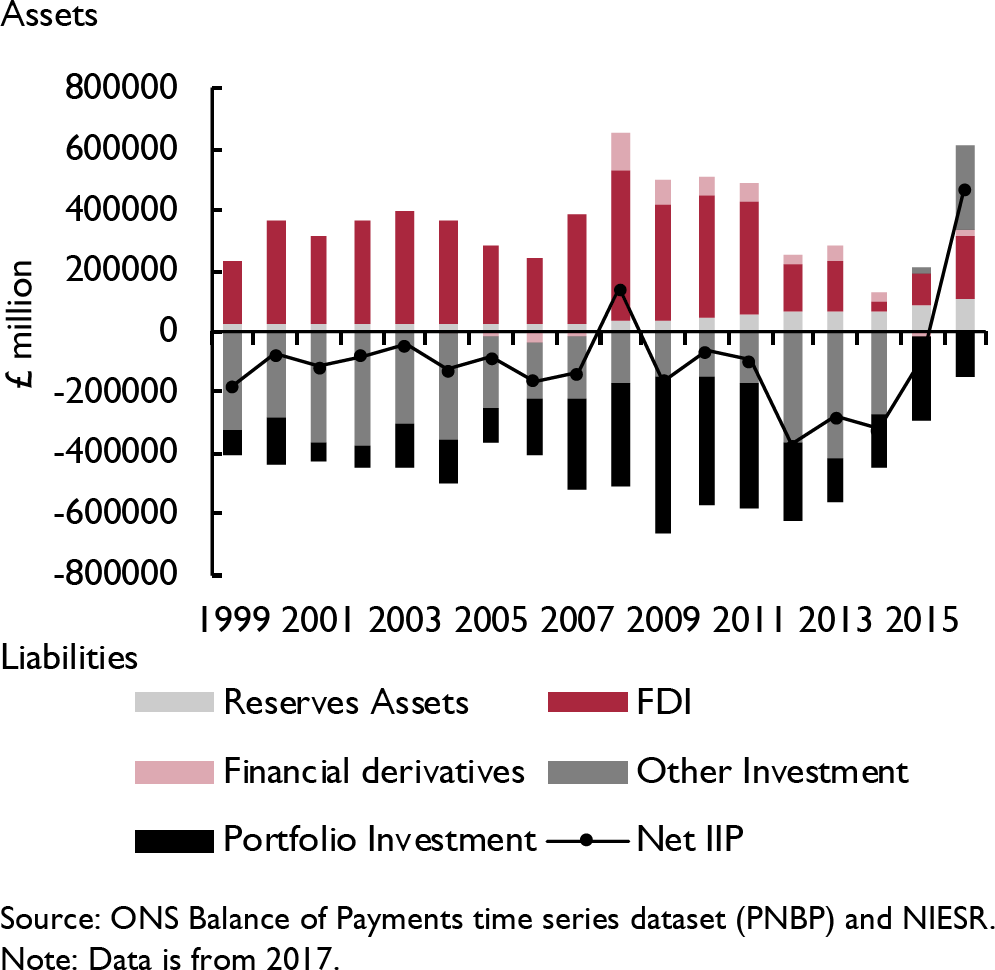
Decomposition of the NIIP

When we open the question up to consider an open economy, if the world interest rate is below that which clears the domestic market for savings, then domestic investment can exceed domestic saving with a current account deficit representing the supply of investment from abroad. Indeed, given a current account deficit, should the supply of savings in the rest of the world increase, the world interest rate will tend to fall and lead to an even larger current account deficit in the economy. Applying this argument, the secular pattern of current account deficits in the UK is likely to be well explained by the position of our domestic savings and investment schedules relative to those in the rest of world.
Furthermore a well-known puzzle in international economics foresaw this kind of structural story. Reference Feldstein and HoriokaFeldstein and Horioka (1980) found that the levels of domestic savings and investment in a country were highly correlated, implying that capital mobility might be not very high. If capital was highly mobile we would observe more of a disconnect between levels of investment and saving. But in a world of high levels of capital mobility the original explanation seems unlikely. And so what is more likely is that if certain countries increase savings, that will tend to reduce world real rates and so bid in more investment leading to a positive correlation between savings and investment. We will see this possibility echoed when we look at the stock of UK external assets and liabilities.
8. The UK's international investment position
The accumulated flows from the current account balance give us the net international investment position for a country. The stock of foreign assets held versus the stock of foreign claims on domestic assets is a more important constraint than the current account alone that reflects the net flow of these assets in any one year. The current account might be considered to be akin to a football team's result in any one match and the net international investment position more akin to the league position. The change in the international investment position represents the current deficit plus any valuation effects of the assets and liabilities and any change in the exchange rate.
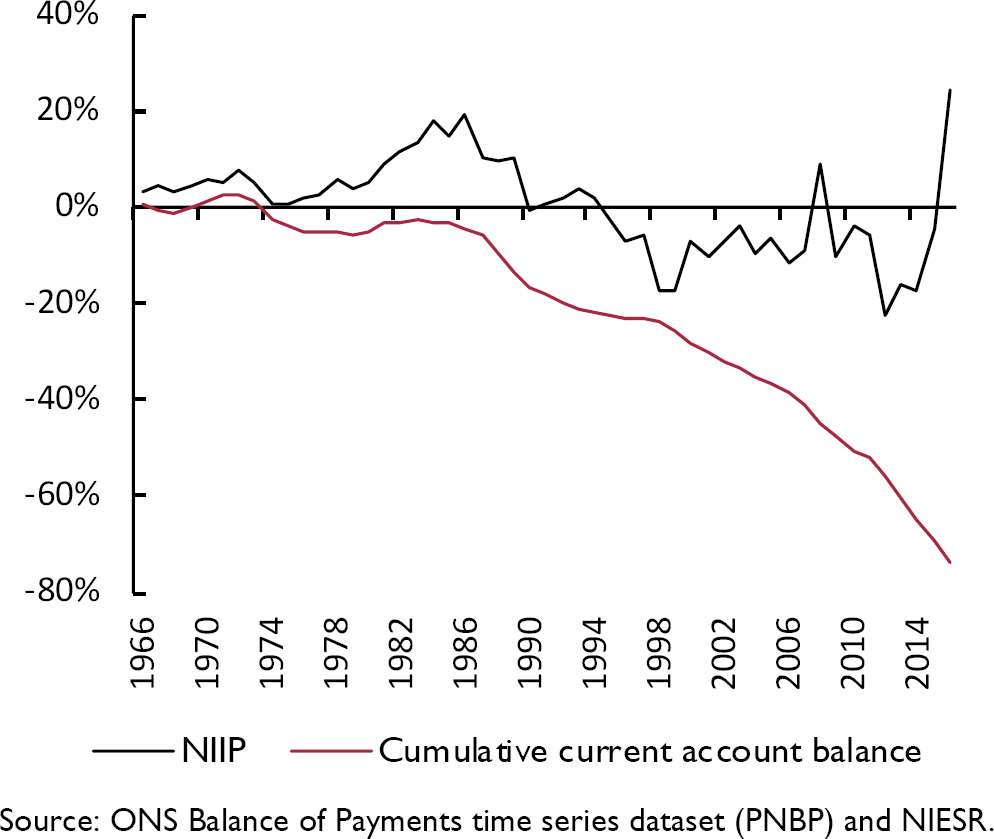
Over the past twenty years the UK's net international investment position has been negative apart from 2008 and 2016 when large exchange rate depreciations changed the relative prices of foreign currency-denominated assets versus sterling-denominated liabilities. Broadly speaking the positive balances on FDI have not quite matched the negative balances on portfolio and other investments. Rather like savings and investment, the value of assets and liabilities tend to follow each other in magnitude, with the net investment position relatively small compared to the magnitudes. The international balance sheet was around twice GDP some twenty years ago but now around six times GDP. We are highly geared; internationally speaking.
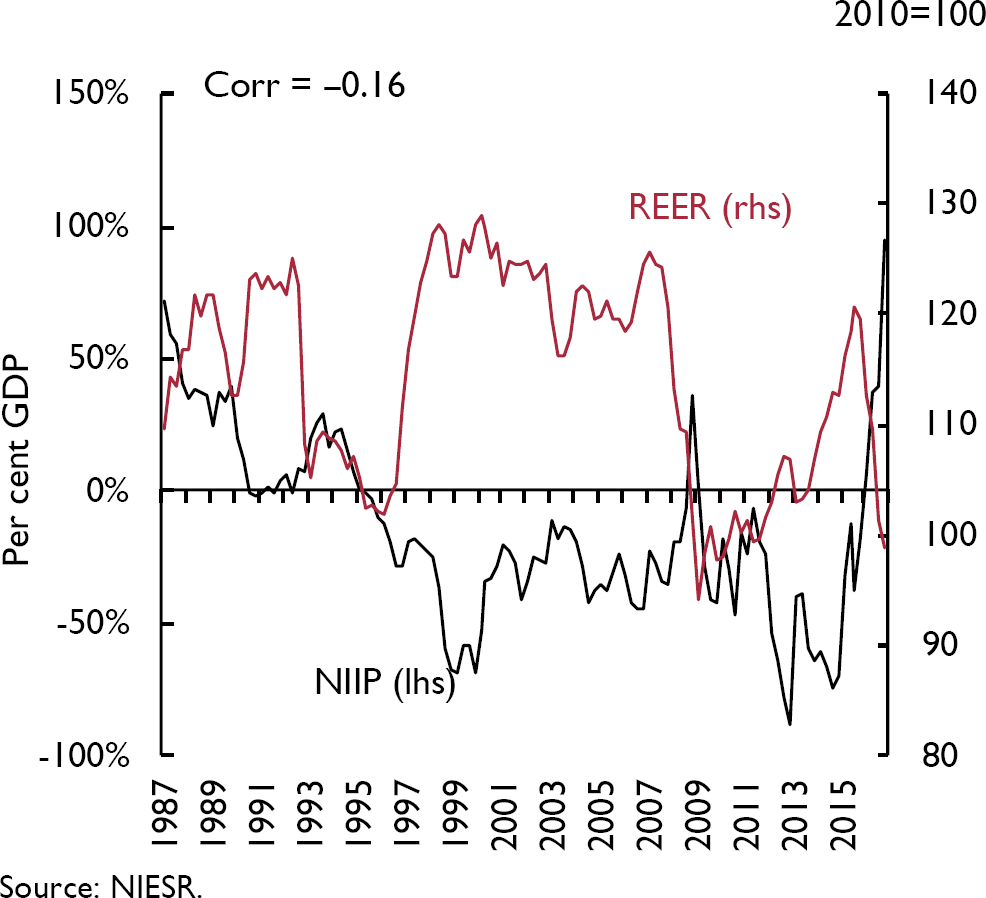
This continuing increase in the magnitude of assets and liabilities and any persistence in current account deficits would tend to have a number of implications. First valuation changes at home or abroad might easily lead to abrupt changes in the net investment position. Secondly, there may be an increased tendency for the exchange rate to jump in order to bring about a sequence of trade surpluses or deficits to ensure that the investment position tends to balance. Sterling, in particular, tends to have occasional jumps that seem to correct problematic developments in the net international investment position.Footnote 18 An interesting side point as well is that the net investment position, even if in deficit, may generate positive flows for the UK if the returns on assets are higher than the payments due on liabilities. For much of the period since 2000, the interest paid on sterling liabilities has been lower than the returns from overseas assets so the flows from the net international position have been negative.
The real effective exchange rate and the NIIP

The international investment position (IIP)

And so even though we seem to have a worrying stream of current account deficits, a combination of exchange rate changes, interest rate returns and valuation effects means that the net international investment position has a life of its own. The accumulated current account simply does not particularly explain the UK's net international investment position (Reference PrattenPratten, 1990).
9. The exchange rate and adjustment
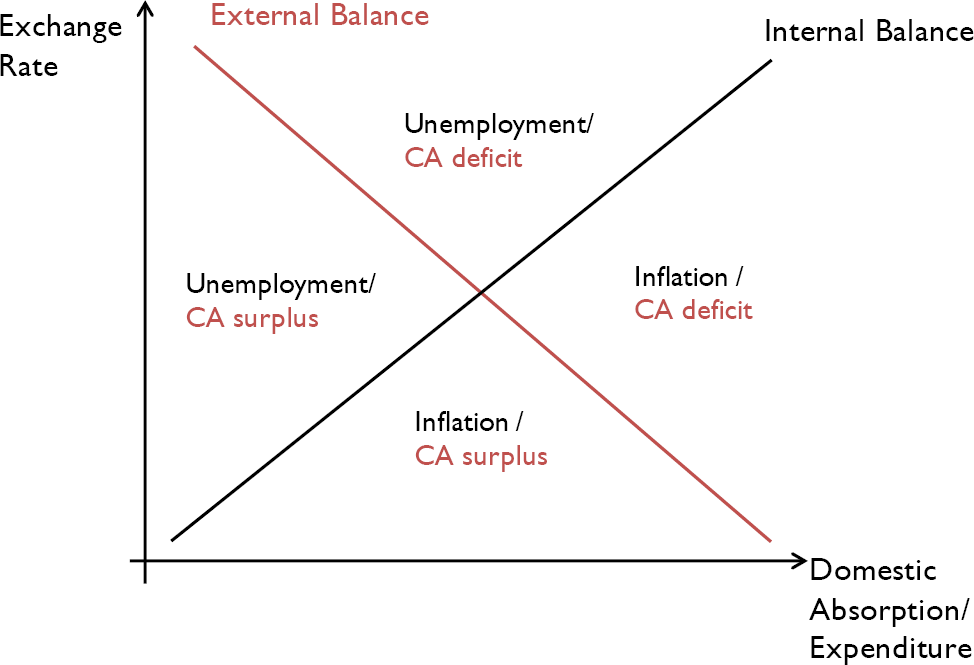
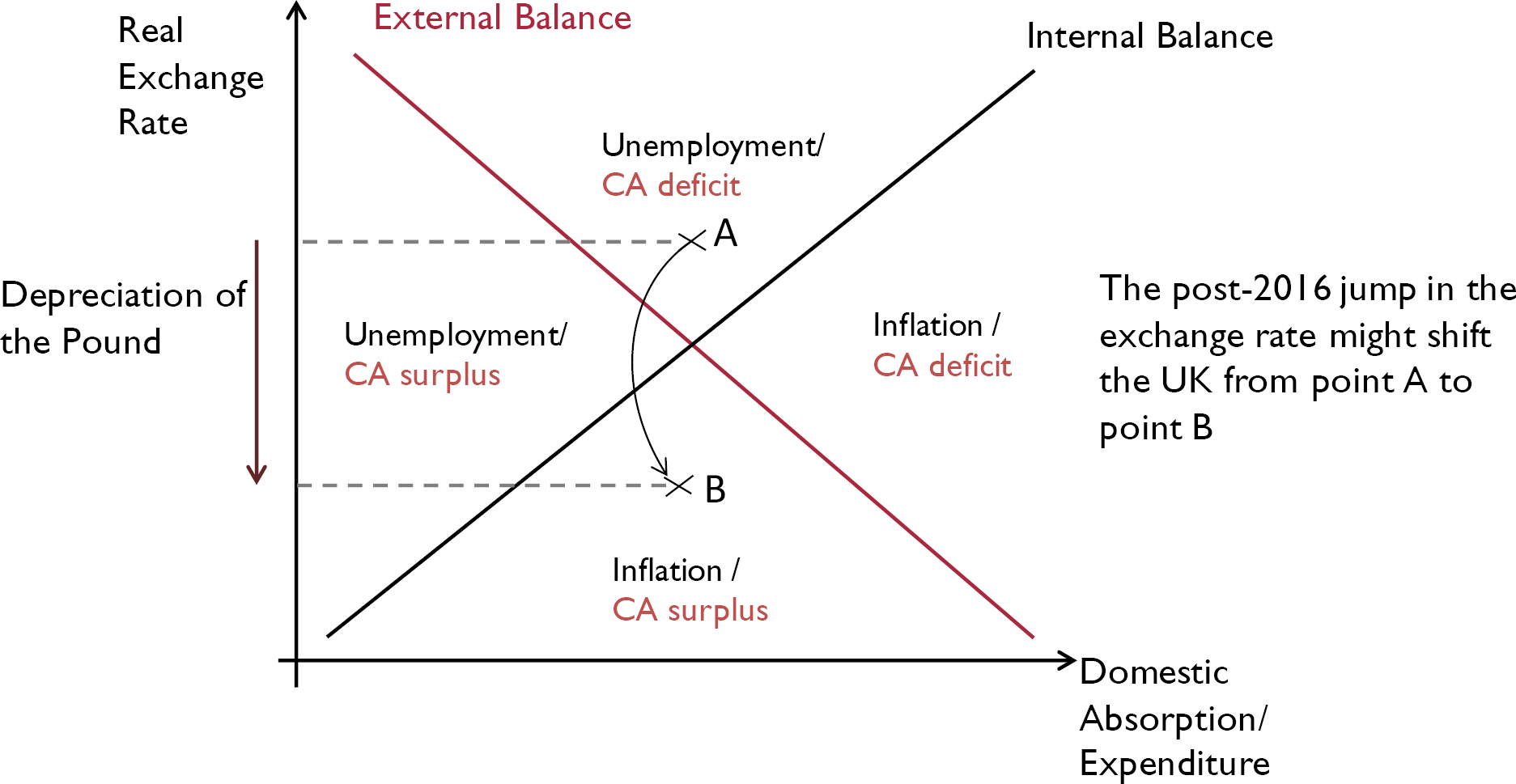
Let us see if we can bring together our observations to understand the jumps in the UK exchange rate.Footnote 19 We can start with the Salter-Swan approach to domestic and internal balance. Trace a locus that says as we increase domestic demand or absorption of goods, we need an appreciated exchange rate so that there is an incentive to switch goods to the domestic production sector. This is because at a higher exchange rate prices in the traded goods sector are cheaper and less attractive to domestic producers. If the exchange rate is too high for a given level of absorption there will be some unemployment and if it is too low, there will be some inflation.
For external balance to obtain, for higher levels of absorption we need a depreciated exchange rate so that there is more of an incentive to produce goods in the traded sector. If the exchange rate is too high for a given level of absorption, then there will tend to be a current account deficit and if it is too low then we can expect to observe a current account surplus. At the points of intersection, the economy is at full employment and in external balance. And in each of the quadrants we can observe four types of economy: unemployment – current account deficit; inflation – current account surplus; inflation – current account deficit and unemployment – current account surplus.
If the UK has both unemployment and a current account deficit then an exchange rate depreciation may help get to balance. The large exchange rate depreciation of 2016 may thus have been very helpful as it would help to eliminate the current account deficit and even bring about an inflation. But if the decision to leave the European Union does itself shift the loci, we may find after a short period of inflation no change in our overall structural external position.Footnote 20 Although the basic story is interesting as it requires an economy to locate an exchange rate that is consistent with external and internal balance, the modern form of production with links between intermediate and final production, as well as the role of international capital in meeting the demands of credit constrained agents means that (see Reference Corsetti, Dedola and LeducCorsetti et al., 2008, and Reference Benigno and ThoenessinBenigno and Thoenessin, 2008) it has remained nearly impossible to establish what is an appropriate exchange rate and current account deficit for any country at any time.
The Salter-Swan diagram

Real growth and the current account-to-GDP ratio

For example, Reference Corsetti, Dedola and LeducCorsetti et al. (2008) will be working on how the transmission of shocks across borders is affected by exchange-rate policies and how capital flows can contribute to a country's international competitiveness. Recent work explores how inefficient capital inflows interact with limited exchange-rate pass through. In these circumstances monetary and fiscal policies can switch from being expansionary to contractionary in response to capital inflows if there is complete versus incomplete pass-through. As the UK either consolidates or loses its role as a major financial centre, large capital inflows will be both the norm and a source of great volatility for the UK economy.
10. Conclusion
It is a dangerous word to introduce but I shall mention it in summarising where we are in this debate: mercantilism. Seventeenth century mercantilism had the following thoughts behind it. First that, in a world before constantly increasing income per head, there was broadly-speaking a fixed or constant stock of wealth in the world. And secondly, that the only way to increase a country's own wealth was to increase exports so that more of this fixed stock of wealth was accrued. Thirdly, economic policy was thus directed in a manner to regulate international trade so that it even spilt over into military conflict over commercial interests (Reference IrwinIrwin, 1991). A modern and sympathetic analysis of an objective to maximise exports might emphasise the extent to which there may be strategic benefits to a country from subsidising or promoting exports as it might allow a higher level of output than might otherwise be attained. Though in a game where everyone pursues such policies, no country is better off, so if we take the public policy choices of EDCs as given, the choice for advanced economies may become clearer. The world does not really work this way.
All that said, the current account deficit will continue to be a question for debate (Reference Mills and GouldMills and Gould, 2015). The old question of whether domestic absorption ‘causes’ the current account or whether the availability of foreign capital ‘causes’ the current account is not simple to answer. Because the outcome, the current account deficit, is the result of domestic and overseas preferences and the structure of the economy, it is not really possible, in general, to talk in terms of causality. The biggest concern from the UK's current external position is that it has led to a negative net investment position and that overall size of the external balance sheet dwarfs domestic output several times over.
It seems rather obvious to state that increasing levels of financial globalisation have made countries more vulnerable to global shocks. But it also then raises the possibility of gains from running domestic policy in a way that insulates such countries from these shocks and that implies significant strengthening of institutional frameworks and the adoption of policies that increase macroeconomic robustness. For example, monetary and fiscal policies may have to develop more and varied types of ammunition, and pay careful attention to the implications of possible shifts in global conditions. One common response has been to think about debt management strategies and also towards foreign exchange reserves that provide a country with more macroeconomic stability in the face of shocks or dislocations.
The general equilibrium problem is writ large. A radical shift in one market has changed the market clearing price in that market but it has had direct and indirect implications in many other markets, in aggregate and at the level of the household. These kinds of links are one reason why many macroeconomists like to work in general equilibrium frameworks so they can trace the impact of one shock in a number of markets where the whole set of responses are mutually consistent. If the whole set of markets were represented by an equivalent number of balls in a confined space, then the position of each market in that space would always depend on the position of all the other balls.
If the ‘physics-defying’ move in capital from low to high was a puzzle that had been well anticipated in the lecture halls in universities, we have not arrived at a sufficiently convincing answer to allow policy makers to work out the best or second-best responses. If the EDCs want to save ‘too much’ or do not have sufficient domestic investment vehicles, then should advanced economies use those savings themselves in private intermediation, ration their usage of savings with controls on credit or direct those savings to domestic infrastructure projects where social returns might be highest? We are still working out which, if any, of these is the right answer.Footnote 21 But the questions we face are additional to those of the extent of external demand questions that the Institute addressed in the immediate postwar period, where the external sector placed a constraint on behaviour. It is more the case today that the sector is embedded in our demand and supply structures and so can act as a boon, by helping to share risk and also promoting more efficient techniques of production but can be a bane by providing both amplifying and propagation mechanisms for shocks for global shocks.