“The heart of the revenue dilemma boiled down to converting the labor—the sole extractable resource—of state subjects into the ways and means of meeting state subsistence needs.”
—Young Reference Young1994, p. 126
In February 2014, France's Representative Council of Black Associations (CRAN) urged France to pay reparations for “crimes against humanity” that the state had committed during the construction of the Congo-Ocean railway between 1922 and 1934.Footnote 1 The 311 mile-long railroad, which connected the Atlantic coast at Pointe-Noire to the navigable parts of the Congo River at Brazzaville, had been built primarily with forced African labor. At the time, the French considered the route indispensable for the development of Equatorial Africa, as it would not only further open up the commercial potential of the region's interior wood and rubber basins, but also end French dependence on the only alternative line in the neighboring Belgian Congo (Manning Reference Manning1988, p. 30).
Although reliance on forced labor for public works projects was common practice in colonial Africa, the Congo-Ocean line gained especial notoriety for its harsh working conditions and excessive mortality rates (Austen Reference Austen1987, p. 129; Sautter Reference Sautter1967). The geographic environment of Central Africa posed serious challenges to the railway's construction, as it was to cut through various climatic and ecological zones, ranging from swamps to dense forests to high elevations. This not only exposed workers to extreme temperatures, disease, and the dangers of falling rocks and mudslides, but it also meant that the construction process was labor-intensive and physically demanding (Azevedo Reference Azevedo1981). Until the early 1930s, few provisions were made for adequate nourishment to replenish workers' physical strength after such strenuous labor, or for medical facilities to treat those that got injured or fell ill. It has been estimated that of the approximately 127,000 recruited workers, more than 14,000 lost their lives; this is the main reason CRAN seeks compensation 80 years later (Sautter Reference Sautter1967, pp. 269–70).
Historians have long interpreted the use of forced labor as a response to the severe challenges of colonial rule in Africa, challenges that were at least partly rooted in the continent's specific factor endowments. In contrast with large parts of Asia, Sub-Saharan Africa had remained only sparsely populated, and labor, rather than land, was the scarce production factor (Hopkins Reference Hopkins1973; Herbst Reference Herbst2000; Austin Reference Austin2005). Endemic labor scarcity posed at least two labor-market related problems for the colonial state: it made it difficult to accommodate a rapidly rising demand for indigenous wage workers, and it translated into a comparatively high price for labor (Frankema and van Waijenburg Reference Frankema and Waijenburg2012). African colonial governments responded to these conditions with a range of coercive labor market institutions, such as land alienation programs, vagrancy laws, and mandatory labor services, which aimed to increase the supply of African labor and reduce its free market price (Van Onselen Reference Van Onselen1976; Mosley Reference Mosley1983; Bowden, Chiripanhura, and Mosley Reference Bowden, Chiripanhura and Mosley2008).
A generally recognized but under-researched method by which labor coercion furthered colonial state building efforts is through its fiscal significance (Crowder Reference Crowder1968; Young Reference Young1994).Footnote 2 Across the board, African colonial states faced near-insurmountable barriers to develop revenue-raising capacity. Not only was it practically impossible to build on indigenous tax systems, as land taxation was virtually absent and direct surplus extraction from slave-based systems politically unfeasible, but trade revenues also still remained too small to fully finance colonial state building efforts. Indeed, the “revenue problem” was a defining feature of European rule in Africa.
How then did African colonial governments solve the revenue imperative? Research on colonial public finance has recently (re-)gained popularity among economic historians and has enhanced our understanding of the patterns and logic that underpinned the development of African colonial tax systems (Frankema Reference Frankema2010, Reference Frankema2011; Frankema and van Waijenburg Reference Frankema and Jerven2014; Gardner Reference Gardner2012, Reference Gardner, Frankema and Buelens2013; Huillery Reference Huillery2009, Reference Huillery2014; Mkandawire Reference Mkandawire2010). However, an important aspect of Africa's fiscal past has yet to surface in this literature: the role and relative importance of in-kind taxes that were levied on labor (forced labor).Footnote 3 Since surplus extraction from labor obligations does not show up in colonial budgets, it remains a largely “invisible” form of government revenue. Labor taxes, however, remained common practice until at least the 1940s. A comprehensive account of fiscal capacity building strategies in colonial Africa requires integration of this indiscernible source of revenue.
It is not surprising that income from labor coercion has been left out of the picture so far. Not only was the implied income from this source nowhere recorded, but forced labor also consisted of a diverse set of practices, most of which became highly contested in the course of the colonial period. The lack of homogeneity, combined with the growing incentives for colonial governments to leave behind few documented traces of their forced labor schemes, makes any attempt at estimating the value of labor coercion challenging, especially in a comparative framework. In fact, leading scholars of the African colonial state, such as Crawford Young and Alice Conklin, have long maintained that forced labor practices are “impossible to measure” or “impossible to quantify” (Young Reference Young1994, p. 173; Conklin Reference Conklin1997, p. 223).
Is trying to estimate contributions from forced labor a futile endeavor then? That depends on our objective. If we are looking for precise estimates of these non-monetized forms of revenue, we will indeed run into a myriad of data availability and reliability concerns that may compromise our conclusions. But providing exact numbers is not the most relevant aim at this stage. Above all, we first need to get a sense of how important this source of revenue was for African colonial governments. To do so, we need to produce reasonably conservative lower-bound estimates of the orders of magnitude that are at stake. In this article, I make a first attempt at doing so.
Although systematic information on forced labor practices is limited, it is not completely absent. For this study, I retrieved a substantial number of quantitative and qualitative sources on the French African labor corvée systems, known as the prestations. These sources provide a unique opportunity to construct conservative estimates of the invisible fiscal value of forced labor. My estimates reveal that the additional income French African colonial states were able to extract from labor duties in the earliest stages of their existence often well exceeded the total monetary component. These findings suggest that labor taxes may have been the central component of early revenue-raising strategies in most parts of French Africa. Integration of this aspect in studies on African colonial public finance is thus well warranted.
But the implications of my results are not just confined to the history of fiscal capacity building efforts in French Africa. Forced labor was practiced on a large scale by the other colonial powers as well, and not just in Africa. Similar systems of in-kind labor taxation existed in large parts of Asia, the Middle East, and the West Indies, and their fiscal significance, to the best of my knowledge, has not been systematically researched. Neither were labor duties an exclusively twentieth-century phenomenon. On the contrary, most paths towards modern fiscal systems in the West were paved with in-kind taxes on labor as well (Hailey Reference Hailey1939, p. 612; Conklin Reference Conklin1997, p. 215). The large magnitudes I document in this study for French Africa, suggest that historical studies on fiscal capacity building in developing economies should make a much greater effort to estimate and integrate such in-kind sources of state income into their analysis.
IN-KIND TAXES AND FISCAL CAPACITY
Taxation is central aspect of statehood. No state can govern without sufficient revenue to maintain domestic law and order, to protect its population and resources from external invaders, and to provide a basic level of public administration and services. Tax bases varied dramatically over time and between societies, as their size and composition was determined by different local opportunities to tax and tax-payers' willingness to part with their resources. However, despite such variation in the ways that the revenue imperative was historically met, most fiscal strategies shared the common trait that they included cash and in-kind levies.
Understanding how and what a state taxes tells us about the history of the state itself, about evolving state-society relations, and about the economic opportunities and challenges of surplus extraction. Social scientists have long recognized this (Schumpeter Reference Schumpeter1918; Levi Reference Levi1989; Tilly Reference Tilly1990; Hoffman Reference Hoffman2015). In recent years, economists have deepened the literature on the historical dynamics between taxation and state formation by providing a theoretical framework that captures the intrinsic relationship between state building efforts, fiscal capacity, and long-term economic development (Besley and Persson Reference Besley2009, Reference Besley and Persson2010). In the broader context of renewed impetus for African economic history (Austin and Broadberry Reference Austin and Broadberry2014; Fourie and Gardner Reference Fourie and Gardner2014; Fourie Reference Fourie2016), the “fiscal capacity framework” has come to revitalize research on African colonial tax systems, which has been a fruitful endeavor. These new studies have, amongst others, highlighted colonial governments' tendency to minimize tax efforts (Gardner Reference Gardner2012; Frankema Reference Frankema2011; Frankema and van Waijenburg Reference Frankema and Jerven2014), the long-term effects of historical public finance choices (Huillery Reference Huillery2009; Mkandawire Reference Mkandawire2010), and the incidence and distribution of relative tax burdens (Frankema Reference Frankema2010; Huillery Reference Huillery2014).
However, this recent gaze into Africa's fiscal past has remained incomplete in an important respect. To date, little to no attention is paid to the non-monetized components of colonial state finances. Virtually all African colonial governments raised revenue through various in-kind levies, such as cattle, grains, and rubber, and through a broad spectrum of labor obligations (Suret-Canale Reference Suret-Canale1971; Northrup Reference Northrup1988; Fall Reference Fall1993; Young Reference Young1994; Ball Reference Ball2005; Okia Reference Okia2012). In the context of a rapidly expanding literature on historical tax efforts, we should therefore pause for a moment and reflect on these forms of surplus extraction and what their incidence tells us about fiscal capacity.
I start from the premise that when a state is able to impose levies in the form of money, goods, or services, and enforce their collection in case of non-compliance, we are talking about taxation. This is not to say that there are no meaningful differences between the cash and in-kind components of the tax base, but these differences are largely ones of degree, and not of kind. For one, the quality of in-kind taxes is more variable and harder to monitor. Second, they have different levels of convertibility. Cash tax revenue is most versatile in this regard, as it can be spent on any good or service the government wants to consume. Goods, such as harvests or cattle, can in principle be converted into cash, but lose value to transaction costs. Converting labor services into cash is more problematic, as the taxable component is embodied in a “good” to which the government does not hold full property rights. With the exception of certain slave-based systems, the provider of the labor service comes with rights that limit a state's ability to exchange this contribution with any given party, or even at all.
The “embodied” characteristic of labor taxes also places greater limitations on its geographical allocation and treatment in general. Where a government could, for example, send collected grains or cattle to a region that is struck by famine or to military bases, it would face stricter regulations in moving labor services over large distances. If the long-distance movement of forced workers is allowed at all, it usually comes with maintenance costs, such the requirement to supply housing and food. Such restrictions narrow the spending options and efficiency of labor taxes across space.
In a similar vein, the rights that are attached to people make inter-temporal transfers more difficult. Cash can be saved and used in later years, and not directly using monetary revenue is overall a safe option for governments outside periods of hyperinflation. With produce and livestock, the possibility to save depends on the storability of the product, but there is also always the option to convert it into cash. Labor duties, though, cannot be accumulated in the same way. They usually have to be spent in the year they are levied, or the obligation will expire altogether. And even within the fiscal year of collection, there could be further limitations to their employment, such as harvest periods, and national and religious holidays.
The homogeneity in quality and greater spending flexibility of cash revenue are important reasons why governments generally prefer this form of state income. From that perspective, a high share of less desirable in-kind taxes may signal a degree of fiscal incapacity. At the same time, the presence non-cash revenues do still point to states' extractive and coercive capacity, especially when it concerns unpopular types of in-kind levies, such as labor services. Labor taxes should therefore be seen as part of the overall effective revenue base, but taking into account their inefficiencies they are symptomatic of the inability to tax in other ways.
Unless in-kind taxes were converted into cash and appear on the revenue side of the balance sheet, we are likely to overlook them. Labor tribute is particularly at risk of remaining unobserved for the exact reason that it was rarely first converted into cash before it was spent. One way economic historians can make in-kind taxes more visible is by computing the amount of cash revenue that a state would have needed to purchase the consumed goods and services as a market transaction. To estimate such a “shadow price” for the in-kind labor component of African colonial budgets, we first need to distinguish between the different kinds of labor obligations that were used, how they added implicit revenue to the budget, and the openness with which they were practiced and documented at the time.
COLONIAL FORCED LABOR PRACTICES: HETEROGENEITY AND SECRECY
Although forced labor immediately evokes the image of a revenue-maximizing extractive colonial state (Acemoglu, Johnson, and Robinson Reference Acemoglu, Johnson and Robinson2001; Tadei Reference Tadei2014; Lowes and Montero Reference Lowes and Montero2017), it should be remembered that the widespread reliance on involuntary labor in Africa was somewhat paradoxical in nature, and that it was a widely debated practice at the time. After all, part of European justification for the colonization of Africa had been to abolish slavery, the most extreme variant of “unfree labor” (Hopkins Reference Hopkins1973; Cooper Reference Cooper1996; Fall Reference Fall2002). There are of course several conceptual differences between slavery and forced labor, but the mere fact that Europeans resorted to massive schemes of coercion contradicted the very principles of free labor they had come to underwrite. The severe difficulties colonial officials faced in laying the infrastructural foundations for territorial expansion and solidifying hegemony, however, meant that such larger metropolitan ideals came second to practical realities on the ground. Faced with a limited voluntary supply of African labor and insufficient fiscal means to alter such labor supply conditions, colonial states came to rely directly and indirectly on unfree African manpower (Phillips Reference Phillips1989).Footnote 4
Similar to the collection of regular taxes, responsibility for the provision of forced workers was placed in the hands of indigenous leaders, who were incentivized through various “carrots” and “sticks.” In exchange for cooperation, chiefs received either a salary or a percentage share of the collected revenue. Failure to deliver the requested amount of taxes and workers, however, could result in penalties that ranged anywhere between steep fines and removal from power. European officials mainly relied on chiefs' authority and influence to compensate for the limited administrative capacity of the colonial state, but there were other advantages as well. For one, labor tribute systems often had deep pre-colonial roots. They provided colonial governments with a rare opportunity to directly tap into pre-existing systems of surplus extraction (Law Reference Law1978). Additionally, by placing the primary responsibility for labor recruitment in a local context, colonial officials were better able to exploit the nebulous distinction that still existed in many African societies between the concepts of “free labor” and “slavery” (Fall Reference Fall2002).
Despite a strong rhetoric of abolitionism, European administrators did often turn a blind eye to the continued existence of domestic slavery in the early phases of colonial rule and expansion, as not to jeopardize the more immediate and co-dependent objectives of establishing hegemony, raising revenue, and recruiting labor. The “pacification” of areas that had been secured in the carve-up of the continent was in part achieved by not interfering too much with existing indigenous labor relations. Moreover, the pressing need for a large supply of (cheap) labor left few incentives to question the free status of the recruits that chiefs provided, many of which were likely still enslaved.Footnote 5 Although colonial governments tried to hide it as much as possible from the critical eyes of anti-slavery activists, they widely “employed” such enslaved recruits as porters and for the construction of public works projects (Phillips Reference Phillips1989, p. 33). Tax revenue was derived indirectly from slavery as well, as most colonial budgets consisted partly of export duties on commodities that had been cultivated with slave labor (Ball Reference Ball2005; Klein Reference Klein1998; Salau Reference Salau2010). Such direct and indirect gains from domestic slave labor were especially common in the early stages of colonial rule, but were gradually repressed in the course of the twentieth century.
Colonial officials were well aware that pragmatic considerations drove their labor policies in Africa and how these contradicted the principles of free labor (Cooper Reference Cooper1996, pp. 24–27). The most sensitive issue, both for the European public and for colonial policy makers themselves, was the condoning and reliance on slave labor (Daviron Reference Daviron2010; Hogendorn and Lovejoy Reference Hogendorn and Lovejoy1993; Phillips Reference Phillips1989). Although a committed attempt to eradicate slavery did not occur until well into the twentieth century in some colonies, the veil of secrecy and opaqueness that surrounded colonial states' prolonged dependence on slave labor is indicative of the unwillingness to find justifications for it. The line demarcating the type of unfree labor that was unacceptable was thus in principle drawn at slavery. A more blurry line, however, guided the acceptability of other types of labor coercion, which became an intensely debated matter in the course of the colonial period.
Since forced labor schemes often built on pre-colonial labor tribute systems, they had many local variants. It is possible though to distinguish a few overarching categories, which will better facilitate computations (Fall Reference Fall1993). Next to forced cultivation, in which Africans were required to grow specific export crops and sell them for a given price, two other types of compulsory labor were at the heart of colonial labor policies. First, there were the so-called “labor taxes” or corvée labor, which obliged each adult African male to work a given number of days per year on local public works projects without pay. Based on a systematic dataset of such corvée duties in French Africa, I will estimate the shadow revenue that French colonial governments derived from such in-kind labor taxes. The specifics of the French corvée system, the prestations, will be discussed in greater detail in the next section.
Next to labor corvée, colonial governments also increased the supply of African labor and their fiscal purchasing power through conscription. Conscript labor differed from corvée in two important ways. First, where corvée was confined to relatively short periods of time, conscript labor was specifically introduced to secure workers for more extended periods of time. Most large public works projects, such as the construction of railways, needed a steady supply of cheap year-round workers, something the free market for wage labor largely failed to provide.Footnote 6 By forcing workers to accept long-term contracts—usually for the duration of six months up to three years—conscription allowed colonial administrations to increase the pool of workers and to control the erratic nature of labor supply.Footnote 7
Second, unlike corvée labor, conscripted work was remunerated and took place at sites far from workers' original place of residence. The wages that were “offered”—that is, fixed by the state—were by definition below market equilibrium wages, as there was excess demand. Although some provisions were made to compensate for the fact that workers could not go home at night, such as free rations and housing, these kinds of labor conditions were often neglected and poorly supervised. But it was not just the remote locations, the long durations of the contracts, and the repressed wages that deterred many African workers from voluntarily seeking this kind of wage employment. As illustrated by the example of the construction of the Congo-Ocean railway, which was largely built by labor conscripts, the work was often physically demanding and the sites were dangerous and unhealthy. The market-clearing wage for this kind of work would thus have been especially high, and the invisible revenue that colonial governments obtained from conscription was the difference between the set wage and the (unknown) market-clearing one.
The demand for conscript labor did not exclusively come from the state. Colonial governments faced pressure to deliver long-term workers for the private sector as well, as the profitability of most European plantations and mining companies depended on access to a cheap and constant workforce. Although colonial officials were somewhat uneasy about coercing labor for private sector purposes, they also believed the alternative—in which companies would be allowed to recruit workers independently—to be even worse (Phillips Reference Phillips1989). At the same time, however, colonial governments did benefit indirectly from providing compulsory labor to private sector employers, as this helped boost the volume of taxable export commodities.
Although all colonial powers in principle subscribed to the “civilizing merits” of compulsory labor, the kinds of coercion that were deemed acceptable, and the conditions under which they were to take place, became increasingly subject to debate.Footnote 8 This trend was partly propelled by a series of labor scandals in the early twentieth century, which intensified international scrutiny of colonial labor practices. Especially the atrocities that had taken place in King Leopold's privately ruled Congo Free State generated a massive public outcry in the early 1900s, and widely signaled a need for stricter (forced) labor regulations (Hochschild Reference Hochschild1998). After the disruptions of WWI, the newly founded International Labour Organization (ILO) became the main arena in which the creation of “universal” standards for indigenous labor practices was to be accomplished (Cooper Reference Cooper1996; Zimmermann Reference Zimmermann2010).
In 1930, the ILO produced its first Forced Labour Convention, which ultimately required its members to “suppress the use of forced or compulsory labour in all its forms within the shortest possible period” (ILO 1930). However, with all colonial powers still heavily dependent on labor coercion, immediate progress was in practice sought in curbing rather than ending such practices. Two main principles came to guide the employment of involuntary labor. Above all, the ILO prohibited forced labor “for the benefit of private individuals, companies, or associations” (ILO 1930, Article 6). Second, the ILO restricted the use of forced labor for public sector purposes by outlawing practices that involved “the removal of the workers from their place of habitual residence” (ILO 1930, Article 8). This meant that most large public works projects were thus in principle to be completed with “voluntary” labor, but the convention did not close all routes to using obligatory labor (Fall Reference Fall2002; Okia Reference Okia2012). Among the exceptions that the ILO still condoned were coercion for military service, exigency labor, and “minor communal services” that would be “in the direct interest of the said community” (ILO 1930, Article 2). The organization's involvement thus mainly resulted in restrictions on labor coercion for private sector purposes and conscription rather than on the more locally oriented labor corvée schemes.
This of course did not mean that colonial governments necessarily complied with the ILO regulations, as they found various ways to bend and evade the new rules (Echenberg and Filipovich Reference Echenberg and Filipovich1986; Young Reference Young1994; Cooper Reference Cooper1996; Akurang-Parry Reference Akurang-Parry2000; Ash Reference Ash2006). Although the attempts to curb forced labor remained limited until after WWII, the growing international scrutiny did mean that colonial powers had increasing motivations to hide (parts of) their coercive labor policies from the public eye. ILO involvement and the ensuing colonial evasion schemes, therefore, combined with the multifaceted nature of forced labor make a precise way of estimating the total implied fiscal contributions extremely difficult. But the purpose of this study, again, is not to give exact estimates. The main objective is to get a better sense of the orders of magnitude we should be thinking of when assessing the role and relative importance of forced labor for colonial fiscal capacity building efforts, and possibilities to do so exist.
The ILO's relatively permissive stance regarding “communal labor” makes corvée the most suitable starting point for estimating the fiscal significance of forced labor, as there was little need to hide these practices (yet), and records were left behind for such an exercise. The systematic way in which the French came to regulate and document corvée labor in their African colonies until its abolition in 1946 provides a particularly suitable opportunity to estimate a shadow price for revenue that was derived from labor tribute. The international community's increased patrolling of colonial labor policies, in turn, has also left complementary qualitative information behind on forced labor practices, their abuses, and their incidence in other parts of Africa. These sources not only allow me to do some sensitivity checks on “official” French sources, but also to speak to questions about the wider applicability of my findings, to which I return in the closing section. And although the magnitude of the corvée labor taxes I document does not include the revenue that was derived from other forced labor schemes, such as conscript labor, this only furthers the objective of estimating a conservative lower bound.
CORVÉE INCIDENCE IN FRENCH AFRICA
Under the prestations decree of November 1912, adult male inhabitants of French West Africa (AOF) in good health became officially subject to an annual tax that was to be paid in the form of labor on public work projects.Footnote 9 The design of this system was partly copied from already existing forms of official colonial labor services in the Dutch East Indies, Indochina, and Madagascar.Footnote 10 The Equatorial African federation, l'Afrique Equatoriale Française (AEF), followed suit with a similar decree in 1915, and the system was further extended to those parts of Cameroun and Togo that became part of the French Empire after WWI.Footnote 11 The consecutive corvée decrees stipulated that the “prestataires,” as the corvée workers came to be called, were exclusively to work on projects within five kilometers of their place of residence. When this condition could not be met, they were to receive rations. Additionally, the new corvée regime specified that the levied days were not to coincide with agricultural high seasons.
Although corvée labor applied with a few exemptions to all adult male French African inhabitants, the possibility existed to buy out the in-kind tax obligations against a fixed daily rate (rachat des prestations). In the early years of the prestations, this option remained somewhat of a prerogative that was restricted to Europeans and a few so-called évolués; those Africans that the colonial state considered as having evolved to a more “civilized” French lifestyle.Footnote 12 As the wave of international condemnation of unfree labor gained momentum in the course of the 1920s and 1930s, the French increasingly expanded the buy-out option to the rest of the population, but in most places, only few Africans made use of it (Young Reference Young1994, p. 175; Conklin Reference Conklin1997, p. 215).Footnote 13
Since corvée labor was intended for projects in the vicinity of workers' residence—mainly the creation and maintenance of a road and telegraph network—local colonial administrators (les commandants de circonscription) made decisions about the amount of corvée days and the height of the buy-out rates in most colonies. As a result, the number of prestation days each liable subject was expected to perform and the level of the buy-out rates often differed by year, by colony, and even by district. At the end of each year, the applicable number of corvée days per eligible worker and the corresponding buy-out rates for the subsequent fiscal year, were to be publicly announced in the official government gazette (le Journal Officiel). This information was often also included in an annexed section to the annual budget, which provided an overview of the colony's tax system. The prestations regulations were generally stated here right after the cash native taxes, underlining how much the French considered them as an integral part of their colonial fiscal policies.
Although official publication of the amount of corvée days per eligible worker, the buy-out rates, and the general rules surrounding their applicability was in principle to occur every year, this unfortunately did not happen in practice.Footnote 14 Sufficient documentation, however, exists for the purposes of this study. I collected all available data on the prestations from the governments gazettes and budgets in the Archives Nationales d'Outre-Mer in Aix-en-Provence, for the years in which the system was fully operative (1913–1937).Footnote 15 Before turning to a discussion of the data, the approach to calculating labor tax revenues should first more formally be stated.
As proposed earlier in this article, economic historians can make in-kind sources of tax revenue visible by creating a shadow price for their implied place on the expenditure side of the budget. In this specific case, I thus ask how much colonial states would have had to pay to hire all these non-remunerated corvée workers for an actual cash wage. It is worthwhile to point out that at the time, colonial officials themselves also saw the fiscal logic behind labor taxes in exactly this manner. In a decree of 31 December 1927, from Tanganyika, for example, continued practices of compulsory labor were defended on the grounds that “where the service required is one which in a civilized country would be performed by a local authority against a rate paid by the individual, unpaid labour may for the present by requisitioned.”Footnote 16
My calculation procedure thus follows the following equations. I start by multiplying the average number corvée days per eligible worker, D, in the relevant colony c and year t, with the corresponding estimated number of liable prestataires, L, and the average price for unskilled labor, w.

To then get the relative significance of corvée revenue, f ct, I compare forced labor value, F ct, with the total cash component that is reported in the budgets, R ct.

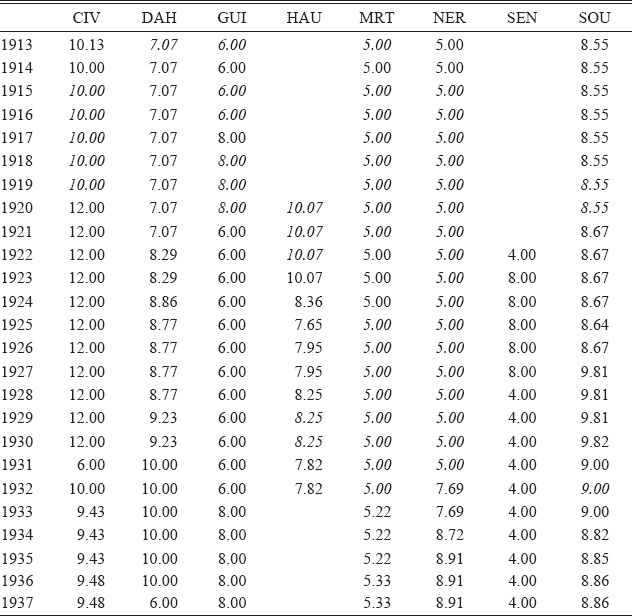
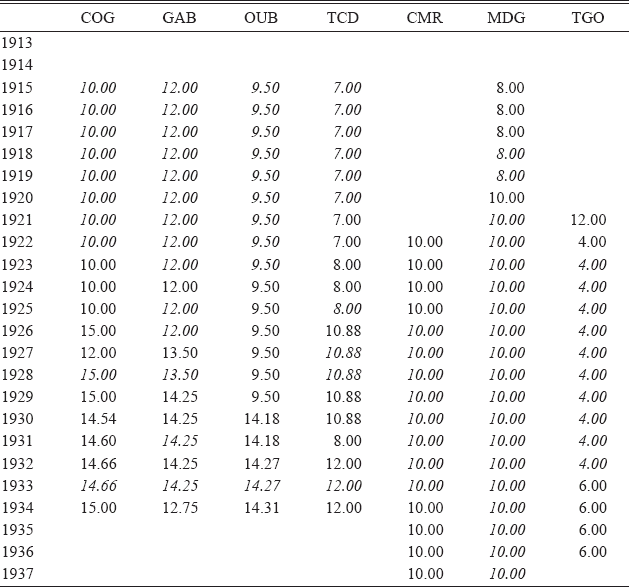
Scattered reporting on the prestations means that there are some data gaps in the series for the number of corvée days, D. I based my approach of “filling in” missing or ambiguously reported years on the following observation. For some years, the section on the prestations in the budget only contained qualitative information on the system and no specific data on the number of corvée days. However, most did include a reference to all of the previous relevant decrees that had been issued on this practice. This suggests that colonial governments may have only included data when a change occurred in the amount of corvée days. In such case, it makes sense to maintain the value of the last available observation for the missing years, and this principle I maintained for interpolating. All interpolated years of D are indicated in italics in Tables 1A and 1B.
AVERAGE ANNUAL CORVÉE DAYS PER ELIGIBLE WORKER IN FRENCH WEST AFRICA

Notes: CIV is Côte d'Ivoire, DAH is Dahomey (current Benin), GUI is Guinée, HAU is Haute Volta (current Burkina Faso), MRT is Mauritanie, NER is Niger, SEN is Sénégal, and SOU is Haut- Sénégal-Niger/Soudan (current Mali). For Mauritanie and Niger, the observations of five days per year (1913–1932 for Mauritania and 1913–1931 for Niger) are based on the maximum number of days allowed, as first specified in the decree of 16 November 1913 (see J.O. AOF 1913, p. 1097), but which line up neatly with the specified number of days reported later.
Sources: Various Budgets Locals and Journaux Officiels.
AVERAGE ANNUAL CORVÉE DAYS PER ELIGIBLE WORKER IN FRENCH EQUATORIAL AFRICA, CAMEROUN, MADAGASCAR, AND TOGO

Notes: COG is Congo, GAB is Gabon, OUB is Oubangui-Chari (current Central African Republic), TCD is Tchad, CMR is Cameroun, MDG is Madagascar, and TGO is Togo. For the Equatorial African colonies, the first decrees creating the prestations were from 9 April 1915 and 24 August 1916, but which I was not able to find. For these missing early years, I assumed the same number of days as for my first observation in each colony. For Tchad, the number of days of 1923 is based on scattered observations in the AEF Journal Official of 1923 (p. 233, 332) that lists both the total number of corvée days and the number of prestataires for a few districts. For Togo, the first year is a continuation of the German old system, which was reformed in 1922. All years were computed by taking the unweighted average of the number of corvée days in each district. If sub-districts were reported as well, the district number of corvée days was the unweighted averaged of the sub-districts.
Sources: Various Budgets Locals and Journaux Officiels; for Togo, the years 1922–1932 were derived from League of Nations, International Labour Conference, Twelfth Session. Volume II: Report of the Director Presented to the Conference, Geneva: International Labour Office 1929, p. 215, which summarizes the number of days of the 1922 decree that I could not locate.
A second complication lies in estimating the average number of corvée days. In many colonies there was some variation in corvée days across districts and even across sub-districts. Unfortunately, it is impossible to calculate a population-weighted average, as district-level demographic data are not only rarely available, but the frequently changing internal borders also make attempts to estimate them on the basis of occasional existing observations a futile and imprecise endeavor. Consequently, I computed an unweighted average of corvée days for each colony. In most places, the variation in corvée days within the colony was relatively small, or even non-existent, and the potential biases stemming from taking an unweighted average should thus be minimal. For the overall calculation of f ct, which should be seen as a rough estimate, the bias coming from this would remain relatively small even for places with greater variation.
The total corvée incidence in a colony in any given year, C ct, is the multiplication of the average number of corvée days, D ct, and the number of people that were liable for this tax, L ct. To get L ct, I first needed to deal with the challenges of population estimates for Sub-Saharan African countries before 1950. Colonial census taking frequently failed to incorporate all inhabitants living in more remotely located areas, or grossly overestimated the size of the population (Kuczynski Reference Kuczynski1948, Reference Kuczynski1949; Martin Reference Martin, Barbour and Prothero1961; Gervais and Mandé Reference Gervais and Mandé.2007). In recent years, however, economic historians have greatly improved the population figures for the colonial period. I rely on these new estimates instead of those made by colonial administrations (Manning Reference Manning, Ittman, Cordell and Maddox2010; Frankema and Jerven Reference Frankema and Jerven2014). Since these figures do not take into account any territorial changes, I adjusted for them to the extent possible.Footnote 17
The next step is to estimate the share of the African population that would have been made to perform these labor services. In most places, the prestations applied to all “able-bodied adult males,” as children, women, and the elderly were exempt from this tax. Unfortunately, most descriptions of the system do not specify the age at which a male subject would be considered an adult, instead of a child or senior. For places where I did see specifications about ages, the pool of “adult men” referred to those between 15–60 years.Footnote 18
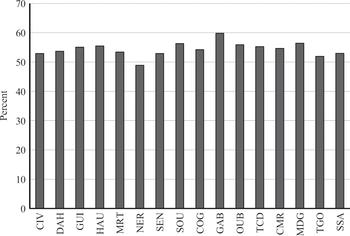
Although there is no reliable demographic information on gender and age composition for most African countries before 1950, we can use the United Nations' population estimates for 1950 as a point of departure. Figure 1 shows the estimated share of the age group 15–60 for each colony in 1950.Footnote 19 On average, this group was about 53 percent of the population. Assuming equal gender distribution, the baseline group of “adult males” that would have been liable to corvée duties would have been around 26.5 percent of the population.
PERCENTAGE SHARE OF THE AGE GROUP 15–60 OF TOTAL POPULATION IN 1950

There are reasons to believe, however, that a share of 26.5 percent would be too high. First, there were certain occupational groups exempt from the labor tax, such as chiefs, soldiers, and other colonial law enforcement employees. In some places, boys who were receiving formal education were exempt as well, which would have reduced the number of liable “adult” males in their late teens. These discharged groups, however, were only a small part of the population, especially as we go further back in time. A greater source of upward bias would come from the fact that this share still includes the sick and disabled, who were officially exempt as well. This group was likely substantial as diseases like malaria, sleeping sickness, and leprosy were prevalent, and people were generally less fit at an advanced age.
At the same time, we should be careful not to exaggerate the health criteria that had to be met for corvée labor either. No health evaluations were performed prior to the preparation of the labor tax-payer rolls, and colonial officials likely listed more people than we would (now) consider fit enough.Footnote 20 Such an attitude on the part of administrators reflected more than just a disregard for the official guidelines. What also mattered was that corvée was ultimately seen as a communal tax burden. As long as the total requested amount of labor was delivered, decisions about who was too sick or disabled were left to local authorities. This in part accounts for the reports of women and children performing corvée labor, compensating for “missing” male workers (Fall Reference Fall1993, Reference Fall2002; Cooper Reference Cooper1996).
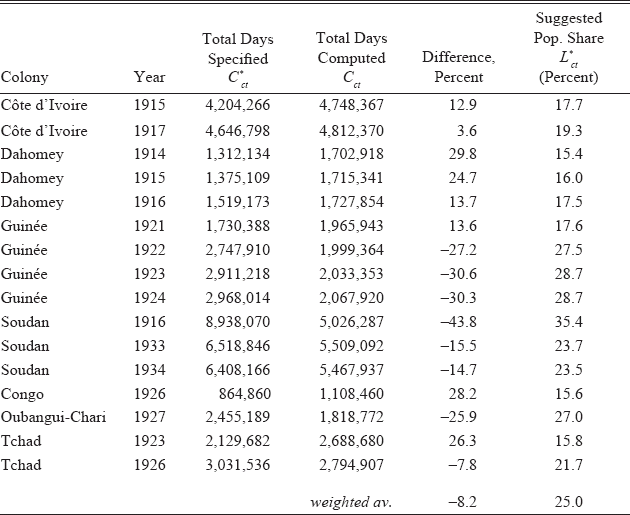
To see how many people colonial governments considered fit enough for corvée labor we would preferably consult contemporary labor tax-rolls. Unfortunately, only few such tax-rolls seem to have survived. Based on the ones I was able to retrieve, however, we can do the following assessment, which is shown in Table 2. Suppose we start from the hypothesis that colonial states believed that on average 20 percent of the population would be suitable for corvée work. If we multiply the number of people corresponding to 20 percent of the population with the number of individual prestation days, D ct, in that same year and colony, this would yield the hypothesized corvée incidence, C ct, that is listed in the fourth column.
TOTAL NUMBER OF CORVÉE DAYS SPECIFIED IN COLONIAL REPORTS VS. MY ESTIMATED TOTAL NUMBER OF CORVÉE DAYS

Notes: Note that lacking the actual population-weighted average number of days, D*ct, however, I have to derive L*ct on the basis on the non-population weighted number of days D ct. The last column reports the share of liable workers that are suggested by C*ct, assuming that D*ct = D ct.
Sources: The total number of computed corvée days C ct were based on population estimates from Frankema and Jerven (Reference Frankema and Jerven2014) and prestations data from various Budgets Locals and Journaux Officiels. The total number of actual specified corvée days, C*ct, were derived from the Journaux Officiels, except for Dahomey, where they were obtained from the Budgets Locals. For Côte d'Ivoire 1915, see J.O. 1915, pp. 134, 142, 195, 246, and 334, and for 1917, see J.O. 1917, p. 189; for Dahomey 1914 see BL 1915, p. 3, for 1915 see BL, p. 3, and for 1916, see BL 1917, p. 3; for Guinée 1921 see J.O. 1921, p. 54, for 1922 see J.O. 1922, p. 87, for 1923 see J.O. 1923, p. 27, and for 1924 see J.O. 1924, p. 43; for Soudan 1916 see J.O. 1916, p. 114, for 1933 see J.O. 1933 pp. 132–216, and for 1933 see J.O. 1933, pp. 676–7; for Congo 1926 see J.O. AEF 1925, p. 707; for Oubangui-Chari 1927 see J.O. AEF, p. 103; for Tchad 1923 see J.O. AEF, pp. 173, 233, and 301, and for 1926 see J.O. AEF, pp. 265, 301.
In the Journaux Officiels, I found a few sporadic labor tax-rolls that list the actual prestation incidence, C*pt, at the sub-district-level, p (postes). The first and second columns list all cases (colony and year) for which I encountered such information. Adding the total number of imposed corvée days for each post, ∑C*pt, yields the actual colony corvée incidence, C*ct, reported in the third column. From here I can then compare C*ct to the hypothesized corvée incidence, C ct, and make inferences about the number of workers the colonial state expected to be liable for corvée, L*ct (last column).
The fifth column shows the difference between the number of total corvée days the colonial state expected to be fulfilled, C*pt, and the ones that are based on a general labor tax liability of 20 percent, C ct. Although there is significant fluctuation around the hypothesized numbers—and which could stem from the fact D ct that is not population-weighted or that data were not reported for all posts—colonial governments on average seem to have expected a much higher share of the population, 25 percent, to pay these labor taxes. This number is close to the full share of adult males suggested by Figure 1 and could mean that colonial governments maintained a high threshold for health-based exemptions, if any. To be conservative, however, I will stick to the assumption of 20 percent of the population for the calculations of this study.
Before moving on to the remaining part of the estimation procedure, a few words should be spent on the potential discrepancies between the levels of corvée incidence that I calculated, C ct, and the on-the-ground application and abuses of the prestations. What on paper appeared as a relatively well-regulated system was far from so in practice. The limited administrative capacity of African colonial states meant that corvée labor was generally poorly inspected, leaving local district officers ample leeway to ignore its regulations. According to Babacar Fall (Reference Fall2002, p. 10), among of the frequent abuses of corvée labor were the “retention of the “prestataires” longer than the allowed period and the practice of using the same workers twice.” Even if the official actual number corvée incidence, C*ct, would have been available for my entire sample, such unauthorized use of the prestations would mostly not show up in my calculations. Although it is impossible to know how many additional corvée days were imposed in practice, surviving qualitative sources can give us some sense of the gravity this occasionally took on.
In the early years of colonial rule, excessive use was at times so severe that local officials felt compelled to report this to the higher levels of administration. One such letter from the Côte d'Ivoire states that, in order to construct the requested roads in his thinly population district, the official in charge:
… was forced to considerably raise the number of corvée days. Some natives had worked for several months consecutively. Cultivation (of crops) had been neglected and famine ran rampant in the region.Footnote 21
Another official complained that it was “useless” to base the labor tax duties on a formal baseline of ten days, when the native population in the region was in practice carrying out “30 to 60 days of work.”Footnote 22 Top-down pressure on local administrators to achieve the public work targets and collect the stipulated revenue has been well documented by historians. In French Equatorial Africa, an internal circular officially announced that the evaluation (and promotion) of colonial staff would “rest chiefly on the results that you obtain with respect to the native tax [3 francs a head], which should be the object of your constant attention” (Coquery-Vidrovitch Reference Coquery-Vidrovitch, Gann and Duignan1977, p. 171). Excessive use of the labor tax has in part been attributed to fact that responsibility for road construction was largely left to local administrators (Hailey Reference Hailey1939, p. 626).
Reports about unauthorized excessive use persisted well into the colonial period. In an evaluation of the French West African economy after the Great Depression, for example, the prestations are described as having remained “as before.” Not only were “[O]nly a limited few ‥ permitted to settle this tax in money,” it also maintained that “for the majority it means 30 to 40 long days' work in the year, and sometimes at the most inconvenient season” (Arnett Reference Arnett1935, p. 445). Although more than a month of actual corvée obligations contrasts starkly with the officially announced numbers, such orders of magnitude were the rule rather than the exception among the other colonizers, which I will address in the last section.
Other than outright abuse, there are more reasons to believe that the actual number of labor tax days was higher in reality than on paper. When Africans were unable to pay their cash taxes, for example, it was common practice to settle such deficits in additional labor tax days. Since this was a less contested practice, it was more openly admitted and some records are available on this form of internal accounting. When the government of Tanganyika defended the use of recruiting 33,097 porters to the ILO in 1927, the British found it “necessary to add” that among them were many “natives who had not paid their taxes.”Footnote 23 Such practices and abuses would thus make the calculated prestation incidence, C ct, possibly a (severe) underestimation.
But there are of course also reasons why the official prestation burden would be an overestimation. The computation rests on the assumption of full labor input, and does not correct for shirking or desertion. It is impossible to know how large such forms of non-compliance were, but it certainly occurred. Some scholars have suggested that desertion rates may have been in the order of 10 percent of the recruited workers, if not more (Echenberg and Filipovich Reference Echenberg and Filipovich1986, p. 544). However, it should be kept in mind that such high numbers were most common in places where the abuses of forced labor were most severe as well, and which are not factored in either.
If the levels of abuse would outweigh the desertion rates, my estimates would be on the conservative side. The available sources on such biases, however, do not provide ways to resolve this question in a systematic and satisfactory manner. In light of this, it is preferable to treat the prestation incidence as an expected number for now, instead of an actual number of days. This would also be in line with the starting point of an expected share of the population that colonial governments considered suitable for corvée. I will therefore proceed from here with the aim of comparing the expected value of corvée labor with the expected value of the cash component of the budget.
EXPECTED CORVÉE LABOR VALUE
To estimate how much it would have cost colonial states to buy the expected number of unpaid corvée days in cash, the total number of prestation days needs to be multiplied with an average price for unskilled labor in each colony. Although the French colonial yearbooks do not provide average wage rates in a similar aggregated way that the British Blue Books do, there are sources available to construct an unskilled wage series. The annually published Budgets Locals and the (occasional) annexed railway budgets contain detailed information about the remuneration of every (paid) worker that was employed by the colonial state. I collected all wage observations for unskilled workers (manoeuvres) that could I find in these sources for the years between 1913–1936, adding up to more than 65,000 in total, and constructed unskilled wages series w ct for each colony on this basis.
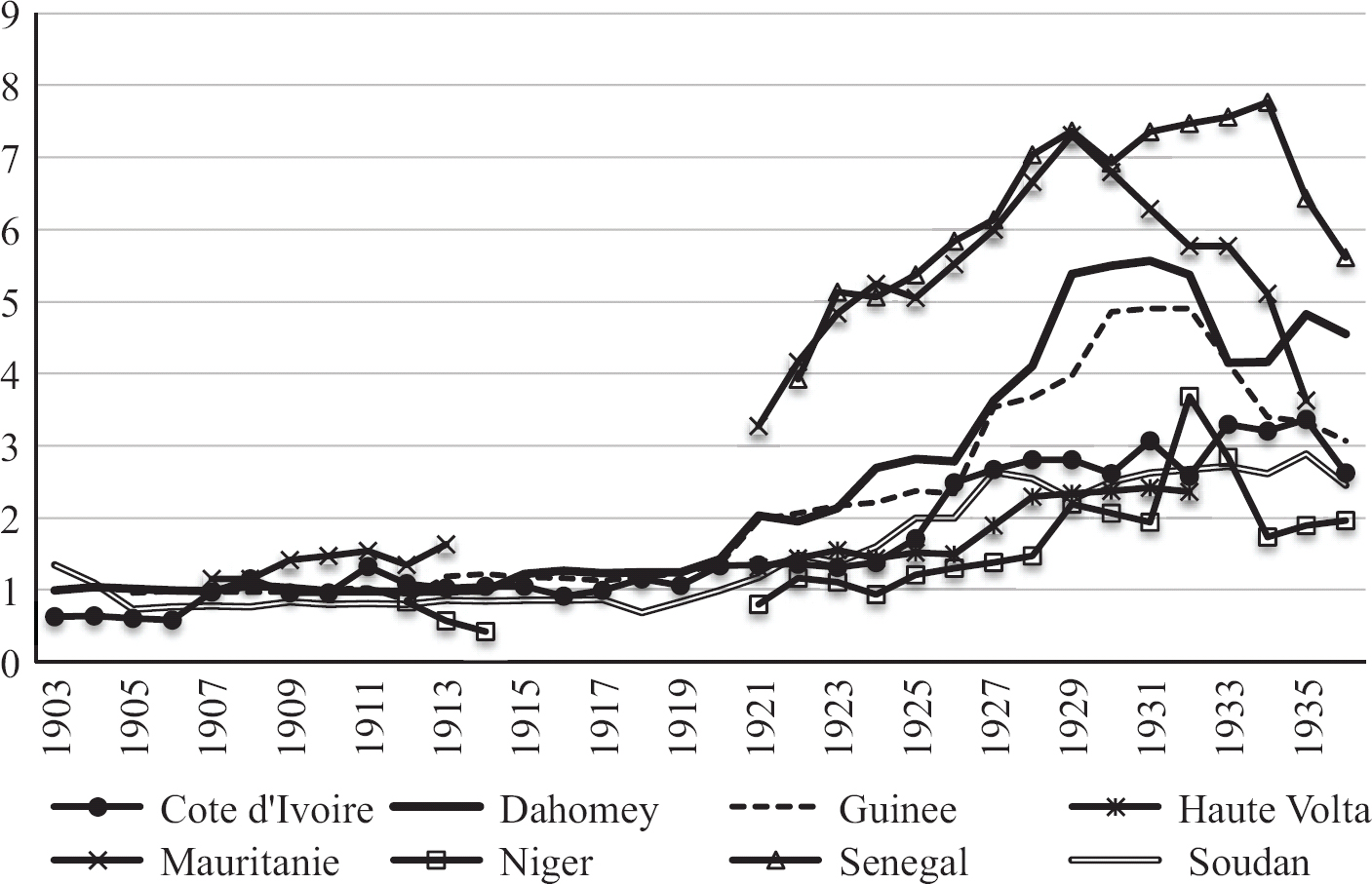
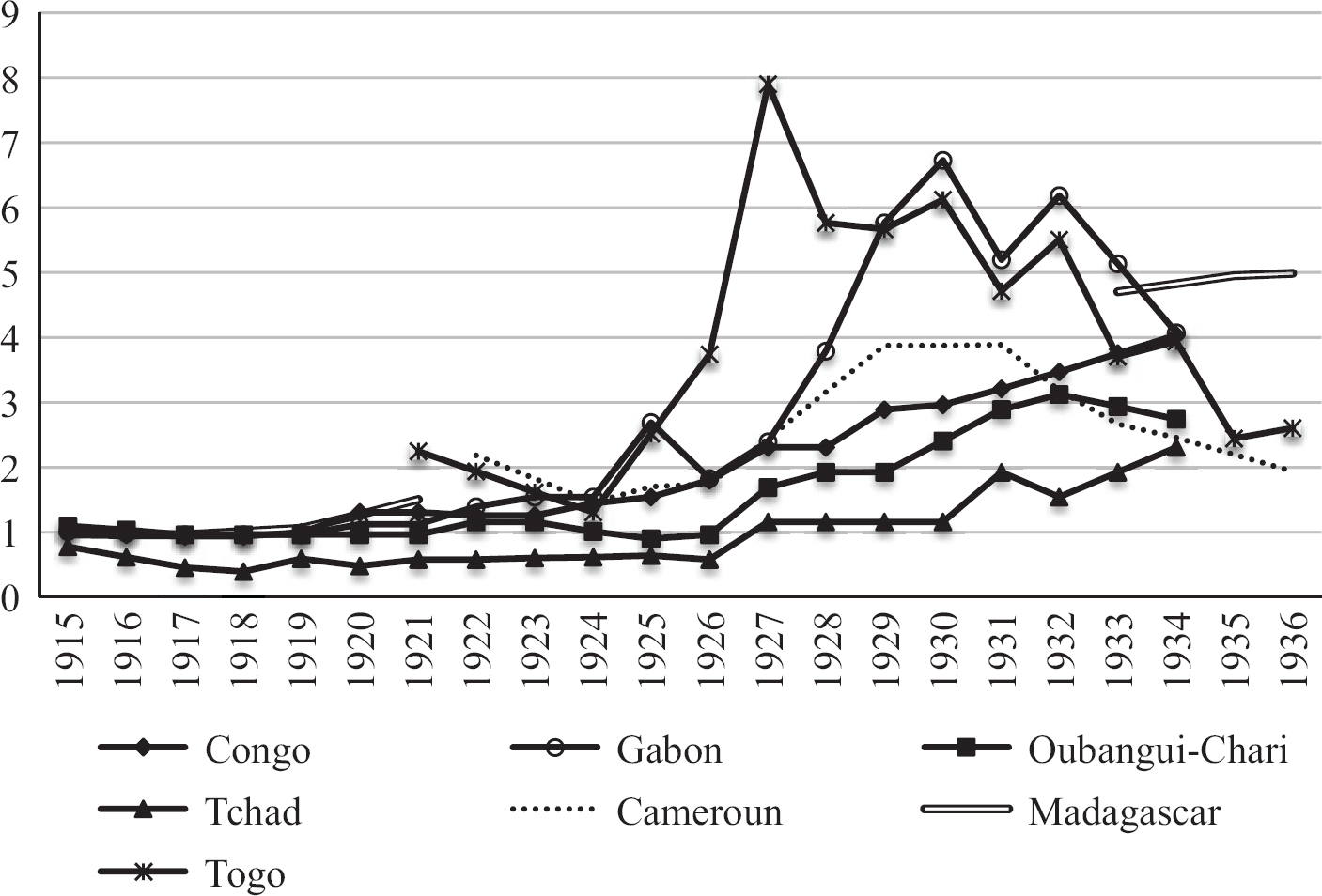
All wage series are shown in Figures 2A and 2B, where w ct is the average of the wage rates of each single worker that was reported. The reported wages in this source were specified as annual, monthly or daily remunerations, and do not include rations. Based on years for which information was available on the number of days of work per year, I maintained 312 annual and 26 monthly work days, and which is in line with the yearly number maintained for British Africa (Frankema and van Waijenburg Reference Frankema and Waijenburg2012). In case the category “manoeuvre” (unskilled laborer) was not available, which occasionally occurred in some of the earlier years of colonial rule, I took the category “planton” (office laborer). Years for which data was available for both manoeuvres and plantons indicate that going wage rates for these categories were generally at par with one another for the periods in which I needed to use them.
AVERAGE ANNUAL WAGE RATES FOR UNSKILLED LABOR IN THE AOF (IN FRANCS)

AVERAGE ANNUAL WAGE RATES FOR UNSKILLED LABOR IN THE AEF, CAMEROUN, MADAGASCAR AND TOGO (IN FRANCS)

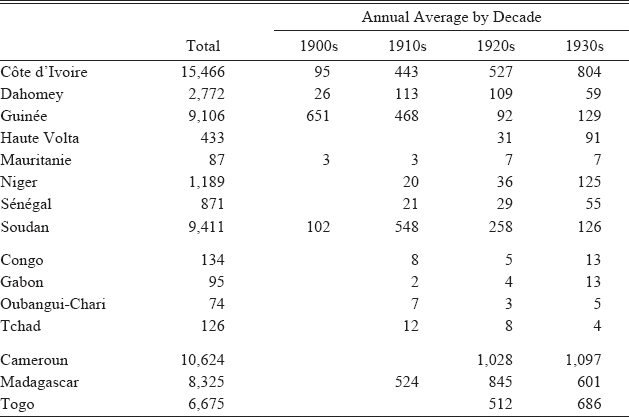
There are a few limitations of these new wage series that should be addressed explicitly. For one, the fact that some colonial states employed more unskilled workers than others, and that for some colonies annexed railway budgets were available, means that that there is significant variation in the number of wages that were available. Table 3 presents for each colony the number of unskilled wage workers for which information was available in decadal averages. The results reported in Table 4 and Figure 4 in the next section will thus have to be interpreted with such variation in the strength of the individual wage series in mind.
TOTAL NUMBER OF WAGE OBSERVATIONS AND DECADAL AVERAGES

Notes: The column “total” refers to the total number of wage observations for unskilled workers that were derived from the Budgets and annexes railway budgets. For Côte d'Ivoire, the series was based on the years 1903–1920 and 1922–1936 (1921 was interpolated); for Dahomey on 1903–1922; for Guinée on 1905–1907 and 1909–1936 (1908 was interpolated); for Haute Volta on 1920–1926, 1928, and 1931–1932 (1927 and 1929–1930 were interpolated); for Mauritanie on 1907–1913, 1921–1925, 1927, 1929, and 1932–1935 (1926, 1928, and 1930–1931 were interpolated), for Niger on 1912–1914, 1921–1925, 1927, 1929, and 1931–1937 (1926, 1928, and 1930 were interpolated); for Senegal on 1922–1937; for Soudan on 1903–1931 and 1933–1937 (1932 was interpolated); for Gabon, Congo, and Oubangui-Chari on 1915, 1917–1932, and 1934 (1916 and 1933 were interpolated); for Tchad on 1915, 1917–1922, 1925–1932, and 1934 (1916, 1923–1924, and 1933 were interpolated); for Cameroun 1922, 1924–1926, 1929, 1931–1934, and 1936 (1922, 1927–1928, 1930, and 1935 were interpolated); for Madagascar on 1913–1917, 1919–1921, 1925, 1929, 1933, and 1935–1936 (1918 and 1933 were interpolated); and for Togo on 1921, 1924, and 1926–1936 (1922–1923, and 1925 were interpolated.)
Sources: Various annual Budgets Locals (BL) and Budgets Annexes du Chemin de Fer (CF).
Second, colonial governments hired unskilled labor all throughout the colony: in the ports of the main coastal cities, along the railways stations, and in the rural public schools and agricultural stations. As a result, w ct thus also reflects areas with lower labor costs than just the colonial capital. It is not unlikely that colonial governments hired relatively more unskilled workers in the urban centers, which could mean that w ct would be somewhat skewed towards the urban wage rate. A shortcoming of the series is thus that it does not guarantee an even regional spread, so w ct could be an overestimation of the actual average wage.
There are also reasons why w ct may be too low. The reported payments in the Budgets Locals unfortunately do not allow me to distinguish between workers that were recruited and those that voluntarily worked for the stated rate of compensation. Since the fixed wages of forced workers are by definition below a free market rate, this would thus create downward bias on the average I computed. The latter effect would make the results of Table 4 and Figure 4 on the conservative side. However, to alleviate concerns about w ct being skewed towards (higher) urban rates for unskilled labor, I will present the results as both an upper and lower bound, where the lower bound is based on the 25th percentile of the collected wages, w ct_25, and the upper bound is based on the average, w ct.
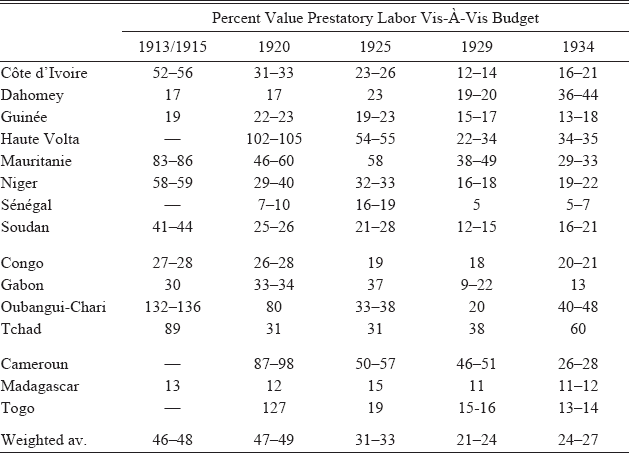
IMPLIED ADDITIONAL INCOME COLONIAL STATE FROM PRESTATIONS (PERCENT) RELATIVE TO THE SIZE OF THE BUDGET

Notes: The year 1913 was substituted for the year 1915 for the AEF. If one of the main components for the calculation was missing (Gross Public Revenue, number of corvée days, or wage information, and which could not be interpolated on the bases of two closely resembling surrounding years) the closest year was taken instead as to ensure that the overall temporal trends are visible. As a result, for Haute Volta, the year 1920 refers to 1921, and the year 1934 refers to 1932; for Mauritanie, the year 1920 refers to 1921; for Niger, the year 1920 refers to 1921; for Senegal it was impossible to find data before 1922, and 1922 here refers to 1920; for Cameroun, the year 1920 refers to 1922; for Togo, the year 1920 refers to 1921.
Sources: Prestations, wage, and revenue data were taken from various Budgets Locals, Budgets Generales, Budgets Annexes du Chemin de Fer, Comptes Definitifs, and Journaux Officiels. Population estimates were based on Frankema and Jerven (Reference Frankema and Jerven2014).
The principle that I maintained for the denominator, R ct, is that the monetary component of the tax base should reflect the regular and locally raised annual sources of government income. That is, R ct excludes amounts that came from occasional subsidies, loans, and withdrawals of the reserve funds. Not only did these types of revenue vary substantially by year, thereby complicating the selection of appropriate benchmark years, they also obscure what colonial states' local tax base truly was. Additionally, R ct was corrected for federal transfers. The majority of the French African colonies were part of a federation, which affected their fiscal organization. In these colonies, all revenue that was derived from customs, consumption taxes, excise, and domains, was automatically transferred to the federal budget. I subtracted any received subsidies from the federal government, and reallocated the local transfers to the federal budget back to the colonies from which they were derived.Footnote 24 Finally, to be consistent with the focus on the expected revenue of the numerator, I based R ct on the stated “prévisions” in the Budgets Locals instead of the Comptes Définitifs.
A final component that does not enter into my calculations, but that should be addressed, is that of the costs of coercion that were borne by the government. As is, the calculations measure the significance of labor taxes out of the total tax revenue without factoring in the costs of tax collection. The enforcement costs of labor taxes, however, were part of an “expenditure bundle” that chiefs received for several services combined. The coercion costs of different taxes can thus not be identified, and the calculated revenues exclude them in both the numerator and denominator. It should be noted though, that if one would be able to consider the contribution of labor taxes in terms of net revenues, it would not be unlikely that labor taxes were more costly to extract relative to other forms of taxation. In other words, the coercion costs borne by the government per unit value were likely larger for labor taxes than for other forms of taxation. If that were indeed the case, then the calculated relative contribution of gross labor taxes to gross overall tax revenue would be greater than its contribution in net terms.
RESULTS
Table 4 presents the results of my total calculation, f ct, reporting the relative additional value of the labor taxes vis-à-vis the cash component of the budget for five benchmark years. The earliest benchmark is intended to capture the first year in which prestatory labor was officially regulated. I maintained 1913 for the French West African colonies, and 1915 for the equatorial ones. Although corvée labor had deeper roots in Madagascar, I took the year 1913 as the first year for this colony as well. The remaining benchmark years, 1920, 1925, 1929, and 1934, aim to capture moments right after WWI, the mid-1920s, and before and during the Great Depression, and thereby follow the logic of earlier studies on African colonial tax systems (Frankema Reference Frankema2011; Frankema and van Waijenburg Reference Frankema and Jerven2014; Gardner Reference Gardner2012). All years report lower and upper bounds, which are based on w ct_25 or w ct for the implied costs of the expected amount of corvée incidence C ct.
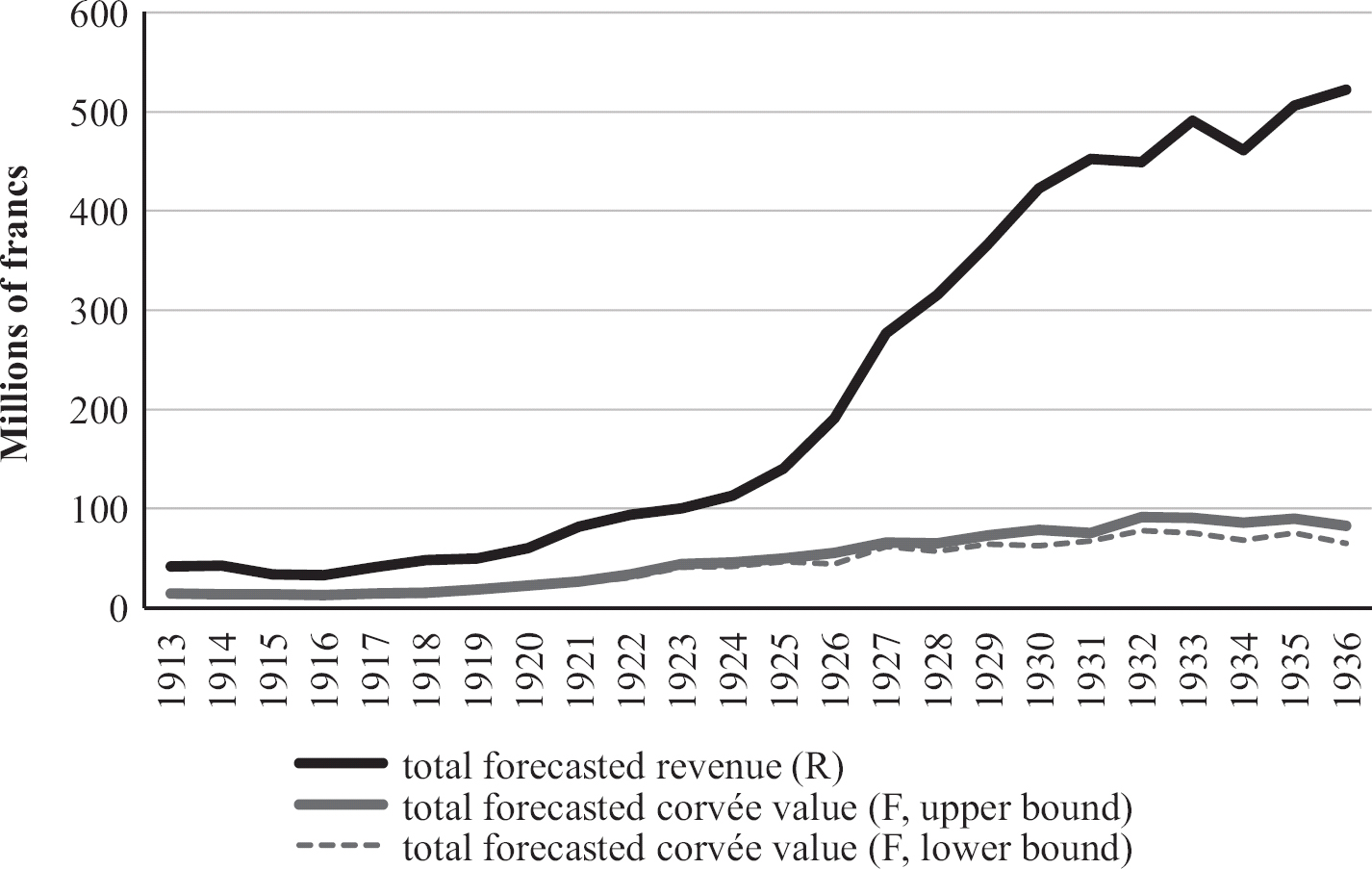
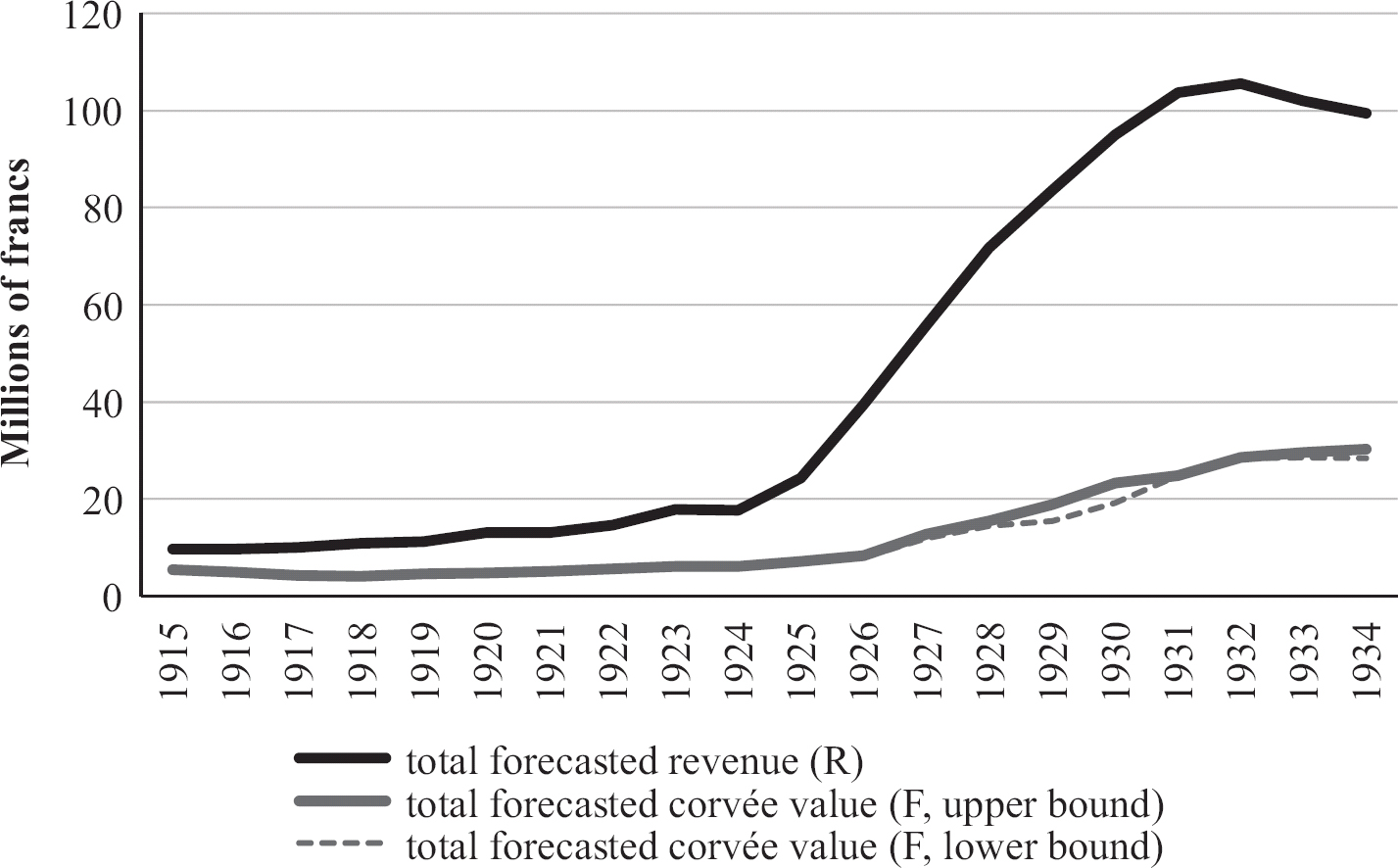
Three observations stand out. First, the population weighted averages for the first two benchmark years reveal an overall high additional percentage of expected labor tax revenue, f ct, in French Africa until well into the colonial era. The averages for 1913/1915 and 1920 indicate that the additional revenue colonial governments expected to derive from prestatory labor, F ct, was nearly half the size of the total forecasted cash component of the revenue base, R ct. Second, the temporal trend points to a decline in the relative importance of labor tax revenue. By the 1930s, the amount of additional revenue that was derived from corvée labor was only about a quarter the size of the “regular” revenue. As illustrated in Figures 3A and 3B, this trend was mostly driven by a rapid expansion in the denominators, R ct. The spike of f ct in 1934 is at least in part the result of a contracting real revenue base in the 1930s, which was caused by the Great Depression. In places where this effect is particularly pronounced, such as in Dahomey, Oubangui-Chari, and Tchad, the near doubling of f ct should also be attributed to an increase in the number of corvée days.
TOTAL FORECASTED REVENUE AND TOTAL EXPECTED REVENUE FROM PRESTATIONS IN THE AOF

TOTAL FORECASTED REVENUE AND TOTAL EXPECTED REVENUE FROM PRESTATIONS IN THE AEF

Third, there was marked variation in the relative importance of labor tax revenue between the French African colonies. Whereas in some colonies the earliest benchmark years reveal a share of additional revenue that was almost as large as, if not larger than, the entire monetary budget, in other territories the projected share was much closer to the orders of magnitude documented in the 1930s. Such discrepancies at least partly reflect that some colonies had existed longer than others. Thus, we catch some of the “high corvée value” colonies at a much earlier stage in their fiscal capacity building efforts. In these places, f ct of course takes on such large proportions in the mid-1910s, or even in 1920, because of the relatively small value of the denominator (R ct). But it is precisely the interaction between these two changing components that helps us better understand how colonial governments responded to the enormous challenges of securing a revenue base, challenges that were largest in the embryonic stages of colonial rule.
To have a more complete sketch of the relative importance of labor taxes, it would thus be valuable to have a better sense of f ct for the earlier stages of European rule in those territories that were colonized and “pacified” well before 1913. Although no systematic data on the prestations exist for such calculations, it is possible to do a thought experiment based on the method I used for Table 1 that can give us some sense of this. We could start from the assumption that the number of corvée days of the first benchmark year is a reasonable approximation of the corvée incidence before 1913. After all, the systematic way in which such labor duties came to be organized under the prestations, was at least in part intended to better regulate pre-existing practices (Fall Reference Fall1993, p. 201). If we then take the population estimates, wage rates, and revenue for the pre-1913 years (for which annual data are available), we could apply similar calculations for the early 1900s.
Lacking data on the number of corvée days, this approach remains necessarily crude, and the presented results should be interpreted with two important caveats in mind. First, assuming comparable levels of corvée incidence may inflate the results if colonial governments had less capacity to enforce compliance in earlier years. Lower levels of head tax coverage in early colonial period have been well documented, but the curve of increased coverage was likely less steep for labor taxes (Baker Reference Baker1975, p. 44; Coquery-Vidrovitch Reference Coquery-Vidrovitch and Roberts1986, p. 336). To minimize the bias from this effect, I will narrow the exercise to two territories that had been fully “pacified” since the late 1890s: Côte d'Ivoire and Soudan (Frankema Reference Frankema and Jerven2014).
There are also reasons to believe that the total number of days was larger in the earliest stages of full colonial control. With even less revenue available to hire labor for competitive wages, with a more pressing need for labor to build infrastructure, with less accountability on labor requisitioning, and with a larger domestic slave population that could be supplied by local leaders against relatively low enforcement costs, forced labor incidence may have been well above that in 1913. Many French African railways, for example, were built in the first decade of the twentieth century and mostly with unpaid or underpaid forced labor (Fall Reference Fall2002, p. 8). Moreover, conscription for unpaid or underpaid porterage was rampant in an era with virtually no alternative transportation options (Fall Reference Fall1993; Young Reference Young1994, pp. 129–30).
All in all, maintaining the average number of corvée days that were imposed in 1913 for the years preceding it is a defendable approach for the purpose of this exercise. Figure 4 shows what this trend would have looked like under this assumption. For Côte d'Ivoire, the computation reaches a figure of 115 percent for the early 1900s, as compared to about 50 percent for the earliest benchmark. For Soudan it generates similar growth in the orders of magnitude, with f ct rising from 41–44 percent in 1913 to more than 70 percent eight years earlier. Again, these figures are potentially subject to significant biases, but the conjectures lend further support for the idea that many colonial governments in French Africa derived the bulk of their revenue from labor taxes in the earliest years of their existence. Excluding them, even just conceptually, from analyses of colonial fiscal capacity building strategies would thus be missing an important part of the story.
ESTIMATED IMPLIED ADDITIONAL INCOME COLONIAL STATE FROM PRESTATIONS (PERCENT) IN CÔTE D'IVOIRE AND SOUDAN, 1903–1937 RELATIVE TO THE SIZE OF THE BUDGET

FRENCH LABOR TAXES IN COMPARATIVE PERSPECTIVE
It is of course fair to ask to what extent the patterns for French Africa are representative for colonial Africa as a whole. Although this question cannot be fully and satisfactorily answered, it warrants some discussion. For the sake of comparability, I will narrow my focus in this section to the forced labor practices that were, like the French prestations system, mostly “communal” in nature. Corvée practices existed in virtually all of the other African territories, but were organized in different ways. Despite being less systematically documented, some scattered information does exist that can shed light on questions of broader applicability. Given space constraints, I will keep this discussion confined to the main European powers on the continent, but similar forced labor systems existed in parts of the Italian and Spanish colonies, and in Liberia.
Let me start with the two colonial powers that are infamous for their flagrant use and abuse of unpaid African labor: the Belgians and the Portuguese. The severe atrocities committed under the Congo Free State's system of “labor taxes” are well known. Framed as a way to meet their tax obligation, the native population officially owed 40 hours of labor per month, which were largely to be paid in the form of rubber gathering for the state or private companies (Northrup Reference Northrup1988, p. 55). Taking five workdays as the daily equivalent of the 40 hours, the annual labor tax burden that was placed on the Congolese population was thus, at least in principle, 60 days per year.Footnote 25 When the sovereignty of Leopold's privately ruled colony was transferred to Belgium in 1908, attempts were made to reign in some of the worst abuses that had taken place in the previous decades (Houben and Seibert Reference Houben, Seibert, Frankema and Buelens2013, p. 183). Nevertheless, the previous level of 60 days in annual labor tax duties remained the quantitative blueprint for corvée until the late colonial period, albeit this becoming the legal maximum over time. And, in line with ILO stipulations, the application of this labor tax was also increasingly restricted to local work projects (Goudal Reference Goudal1929).
Forced labor in Portuguese Africa, including corvée duties, was based around the principle that all native inhabitants had a “moral” obligation to work, and which was, between 1914 and 1928, backed by legal sanctions. Those who failed to voluntarily seek employment were first subject to “compulsory labor,” in which work was “offered” by the state. If the native continued to remain “idle,” he could be charged with “vagrancy” and be sentenced to up to 300 days of unpaid “correctional labor.”Footnote 26 Although wages were to be paid for both voluntary and compulsory labor, most of which was carried out for private employers, many Africans received little more than a few escudos and a receipt from the government that they had fulfilled their annual tax obligation in exchange for the several months of work (Ball Reference Ball2005).
In addition to enforcing natives' obligation to work, chiefs were also to supply the government with labor for “works of public utility”— mostly the construction of a road network—which later became a commutable variant of prestatory labor (Hailey Reference Hailey1939, pp. 623–24). By the time of the ILO Convention, the Portuguese came to officially subscribe to a 60-day maximum, but few such restrictions seem to have been in place before. Unpaid roadwork was conducted by rotating “gangs” of workers to ensure year-round progress. Although I was unable to trace any statistics on the official number of individual corvée days that were to be supplied before the labor reforms of 1928, a critical enquiry into native labor employment from 1925 suggests that the coercive nature of Portuguese colonial labor policies and their ambitious road-building program translated into several weeks if not months of unpaid labor for both men and women (Ross Reference Ross1925).Footnote 27
Last, but not least, the British acquired a reputation of being more benign and progressive when it came to restricting forced labor practices. This more “benevolent” image owed much to their rapid ratification and adoption of the ILO regulations. Corvée, however, existed in the British colonies too until well into the twentieth century, but it was organized in a less systematic and “top-down” manner. British preference for indirect rule meant that indigenous rulers in many parts of British Africa had greater degrees of fiscal autonomy in the form of Native Treasuries. “Communal labor services” were one of the taxes that placed under the responsibilities of these local treasuries, but they were to comply with general imperial standards, including a stipulated maximum of 30–60 days.
In some places, the British could directly build on pre-existing labor duty systems, such as the luwalo in Buganda—an indigenous corvée system that stipulated a month of unpaid labor to the local authorities—and which was subsequently expanded to the rest of the Uganda (Hailey Reference Hailey1939, pp. 575–76, 619). In other places, such as the Gold Coast, various road ordinances made a distinction between the “trade” roads that fell under the responsibility of the Public Works Department and that were to be constructed with paid labor, and the “political” roads for which workers received no remuneration, but local rulers did.Footnote 28 The maximum allowed number of such communal corvée was not to exceed 24–30 days per year in most British territories (Goudal Reference Goudal1929, p. 626).
Corvée labor was not an exclusively African phenomenon. As mentioned, the French had copied part of the prestations template from a similar system that existed in the Dutch East Indies (the heerendiensten). In the late 1920s, two to three million men were still liable each year to perform or buy out between 17 to 26 days of corvée. A little less than half of them converted the labor tax in a cash payment, a number that was substantially higher than in most parts of Africa.Footnote 29 In the same period, a maximum of 16 days of prestatory labor also still applied in French Indochina (Goudal Reference Goudal1929, p. 627). In a similar vein, corvée was common in parts of the Middle East and the West Indies as well. Building on an Ottoman system of road maintenance services that had existed since 1869, requiring 20 days of unpaid labor each five years, the French imposed 30 days of corvée labor per five years in their mandate of Syria and Lebanon.Footnote 30 In some of the islands in the West Indies, the British made use of road ordinances to recruit unremunerated workers until the late 1920s.Footnote 31 Although many other examples can undoubtedly be mentioned here, what matters is that in-kind labor taxes were a common practice. They deserve greater scrutiny in narratives of colonial fiscal capacity building efforts.
CONCLUSION
State formation processes go hand in hand with fiscal capacity building, and economists and economic historians have increasingly come to study this relationship. The growing body of scholarship on colonial public finance and the improved empirical foundations that underpin these studies have deepened our understanding of African colonial revenue raising strategies. However, a central element in this story—the role of taxes in the form of labor services—has yet to feature in this expanding wave of studies. In this article, I have provided some first empirical foundations for doing so.
It is unfortunately impossible to give precise estimates of how much labor taxes implicitly augmented colonial states' revenue base, as data tend to be scarce, biased, and incomplete. However, there are ways to tease valuable information out of the sources that are available. I have argued that, as a starting point, we should get a sense the orders of magnitude of the amounts involved, which we can do by estimating a conservative lower bound. By exploiting a unique set of quantitative and qualitative sources on corvée labor in French Africa, I have revealed the large implied monetary value of such in-kind labor taxes relative to the reported state cash-revenues. Especially in the early colonial period, the invisible value of unpaid labor obligations often may have well exceeded the total size of French African budgets. My findings make clear that we should make a greater effort to integrate the contributions of labor taxes into historical accounts of fiscal and state capacity building efforts.