Significant outcomes
• Anxiety behaviours of animals are controlled by the γ-aminobutyric acid (GABA)ergic system of the medial prefrontal cortex (mPFC).
• GABAA receptors of the mPFC modulate the effects of GABA on anxiety-related behaviour.
Limitations
• In the present study the role of GABA receptors has been evaluated only in the medial area of the prefrontal cortex. The role of these receptors in other areas of the PFC and possible interaction between these areas need to be evaluated to understand the role of GABAergic neurotransmission in the PFC in anxiety.
Introduction
PFC is a collection of cortical areas in the most anterior portion of the frontal lobes. The anatomical organisation of the PFC could be divided into three major sub-regions including the medial PFC, the lateral PFC and the ventral PFC (Reference George and Koob1). Several studies have focussed on understanding the role of different PFC sub-regions in the modulation of emotional behaviours (Reference Yan2,Reference Jinks and McGregor3).
GABA is the main inhibitory neurotransmitter of the brain acting through different receptor sites called GABAA, GABAB and GABAC (Reference Monk, Nelson and McClure4). GABAergic neurons are one of the most important components prevalent in all areas of the brain and its neurotransmission is vital for brain function (Reference Tsutsui, Ukena, Usui, Sakamoto and Takase5). Although GABA plays a major role in the modulation of virtually all cognitive and behavioural processes, several basic and clinical studies have particularly highlighted the role of this neurotransmitter in the central modulation of anxiety and stress responses (Reference Hasler, van der Veen, Grillon, Drevets and Shen6–Reference Zarrindast, Solati, Oryan and Parivar9).
The GABAergic connection between PFC and other brain structures has been reported in previous studies. The entire PFC is highly innervated by projections from different brain nuclei that are involved in the modulation of anxiety and stress. GABAergic innervation of the PFC has an important role in the modulation of cognitive and emotional behaviours (Reference Yan2). GABA-containing neurons in the rat ventral tegmental area project to the PFC (Reference Carr and Sesack10). Further, GABAergic projections from the PFC also innervate different brain regions such as the nucleus accumbens (Reference Torregrossa, Tang and Kalivas11).
In recent times, several studies have demonstrated that the mPFC has an important role in the modulation of behaviours such as learning, memory and anxiety (Reference Yan2,Reference Simpson, Drevets, Snyder, Gusnard and Raichle12,Reference Lacroix, White and Feldon13). However, mechanisms underlying the regulation of behaviours through mPFC and the role of different neural systems are not yet clear.
The present study aimed to examine whether the involvement of GABAA and GABAB receptors of the mPFC in the regulation of behaviours is associated with anxiety.
Materials and methods
Animals
The animals used in this study were male Wistar rats obtained from the Pasteur Institute of Iran (Tehran, Iran), weighing 200–250 g at the time of surgery. Animals were housed four per cage in a room under a 12 : 12 h light/dark cycle (lights on at 07:00 h) and controlled temperature. They had access to food and water ad libitum and were allowed to adapt to the laboratory conditions for at least 1 week before surgery. Rats were handled about 5 min each day before the behavioural testing. All experiments were conducted between 12:00 and 18:00 h, and each rat was tested only once. Seven animals were used in each experiment. All efforts were made to minimise animal suffering and reduce the number of animals used.
Stereotaxic surgery and microinjections
To implant the cannula, rats were anaesthetised intraperitoneally with ketamine hydrochloride (50 mg/kg; Alfasan, Woerden, The Netherlands) plus xylazine (4 mg/kg; Alfasan) and placed in a Stoelting stereotaxic instrument. The stainless steel guide cannulae (21 G) were implanted into the right and left mPFC regions according to the atlas of Paxinos and Watson (Reference Paxinos and Watson14). Stereotaxic coordinates for the mPFC regions were AP: +3.5 mm from the bregma, L: ±0.8 mm from the midline and V: −3.3 mm from the skull surface. The cannulae were fixed to the skull with acrylic dental cement. The animals were allowed to recover from the surgery for a period of 7 days before the experiments. The left and right mPFCs were infused with an internal cannula (27 G) apparatus, terminating 1 mm below the tip of the guides, connected by polyethylene tubing to a 1-μl Hamilton syringe. On each side, 0.5 μl solution was injected (1 μl/rat) for 60 s. The inner cannula was left in place for an additional 60 s to allow adequate diffusion of the solution and to reduce the possibility of reflux. Intra-mPFC injections were performed 5 min before testing. All subjects were allowed to recover for a period of 5–7 days after the surgery before the start of behavioural procedures (Reference Solati, Salari and Bakhtiari15,Reference Solati16).
Elevated plus maze
The elevated plus maze (EPM) is a plus-shaped wooden apparatus elevated 50 cm above the floor. The EPM consists of a central platform (10 cm ×10 cm), two open arms (50 cm × 10 cm) and two equalised closed arms (50 cm × 10 cm × 50 cm) opposite each other with an open roof. The EPM was placed at the centre of a quiet and dimly lit room. Behavioural data were recorded by a “blind” observer who sat quietly 1 m behind one of the closed arms of the EPM, using a chronometer. Five minutes following their respective drug treatments, rats were placed individually at the centre of the EPM, facing one of the closed arms. The observer measured (1) the time spent in the open arms, (2) the time spent in the closed arms, (3) the number of entries into the open arms and (4) the number of entries into the closed arms during the 5-min test period. Open-arm activity was quantified as the amount of time that the rat spent in the open arms relative to the total amount of time spent in any arm (open/total × 100), and the number of entries into the open arms was quantified relative to the total number of entries into any arm (open/total × 100). The total number of open-arm and closed-arm entries was used as indices of general locomotor activity (Reference Solati, Zarrindast and Salari17,Reference Solati and Salari18).
Drugs
The drugs used in the present study were (8)-baclofen, CGP35348, (+)-bicuculline and muscimol (Sigma Chemical Co., St Louis, MO, USA). Baclofen, CGP35348 and muscimol were dissolved in sterile 0.9% saline; bicuculline was dissolved in one drop of glacial acetic acid and made up to a volume of 5 ml with sterile 0.9% saline.
Experiment design
Effects of GABAA receptor agonists and antagonists on anxiety-like behaviours
To evaluate the effects of activation or inhibition of GABAA receptors in the MDPC on anxiety, three groups of rats were infused with muscimol, a selective GABAA agonist (0.25, 0.5 and 1 μg/rat), three other groups received bicuculline, a GABAA antagonist (0.25, 0.5 and 1 μg/rat), and their behaviour was compared with that of the saline control group.
Effects of GABAB receptor agonists and antagonists on anxiety-like behaviours
Three groups of rats received three different doses of the GABAB receptor agonist baclofen (0.05, 0.1 and 0.2 μg/rat) and three other groups received the GABAB receptor antagonist CGP35348 (5, 10 and 15 μg/rat) and their behaviours were compared with that of the saline control group.
Histology assessment
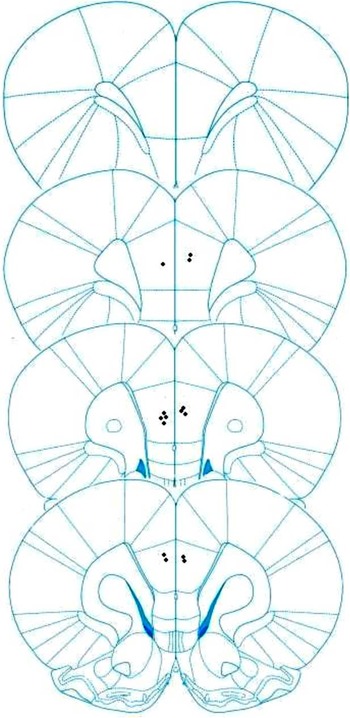
After behavioural tests, 1% methylene-blue solution (1 μl/rat, 0.5 μl/side) was bilaterally injected into the mPFC as a marker of the injection sites. Thereafter, each rat was killed using an overdose of chloroform. Brains were removed after decapitation and fixed in a 10% formalin solution. The brains were sliced and the sites of injection were verified using the atlas of Paxinos and Watson (Reference Paxinos and Watson14). Data from animals with injection sites located outside the mPFC region were not used in the analysis (Fig. 5).
Data analysis
One-way ANOVA was used for comparison of the effects of different doses of drugs and saline (control). In the case of significant differences, the post hoc analysis (Tukey) was performed to evaluate the comparisons of specific groups. Differences with p < 0.05 between experimental groups at each point were considered statistically significant. The statistical package of SPSS (version 16) was used for statistical analysis, and Microsoft Office Excel 2010 was used for drawing graphs.
Results
Effects of GABAA receptor agonist and antagonist on anxiety
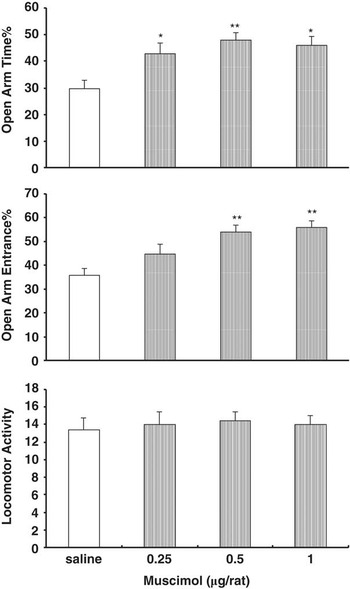
Figure 1 shows the effect of intra-mPFC injection of muscimol (0.25, 0.5 and 1 μg/rat) in the EPM. One-way ANOVA revealed that muscimol (0.25, 0.5 and 1 μg/rat) increased open-arm time (OAT)% [F(3, 24) = 6.61, p < 0.01] and open-arm entries (OAE)% [F(3, 24) = 6.16, p < 0.01]. No significant change in locomotor activity was observed [F(3,24) = 1. 829, p > 0.05], indicating an anxiolytic-like response.
Effects of bilateral intra-medial prefrontal cortex injection of muscimol as seen in the elevated plus maze test. Rats were treated either with saline (1 μl/rat) or with muscimol (0.25, 0.5 and 1 μg/rat). Each bar represents mean ± SEM. %Open arm time, %open arm entries or locomotor activity. n = 7; *p < 0.05 and **p < 0.01.

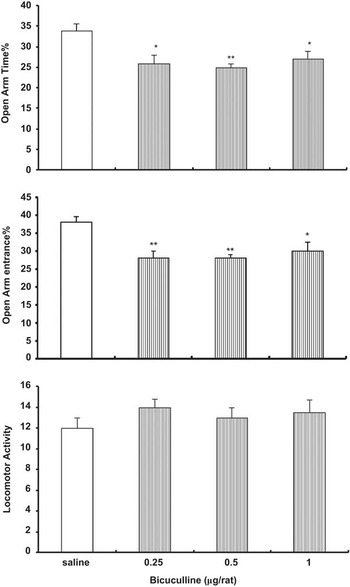
However, rats infused intra-mPFC with bicuculline (0.25, 0.5 and 1 μg/rat) showed significant decrease in OAT% [F(3, 24) = 5.524, p < 0.01] and OAE% [F(3, 24) = 5.081, p < 0.01]. No significant change in locomotor activity was observed [F(3, 24) = 1.231, p > 0.05], indicating an anxiogenic-like response (Fig. 2).
Effects of bilateral intra-medial prefrontal cortex injection of bicuculline as seen in the elevated plus maze test. Rats were treated either with saline (1 μl/rat) or with bicuculline (0.25, 0.5 and 1 μg/rat). Each bar represents mean ± SEM. %Open arm time, %open arm entries or locomotor activity. n = 7; *p < 0.05 and **p < 0.01.

Effects of GABAB receptor agonist and antagonist on anxiety
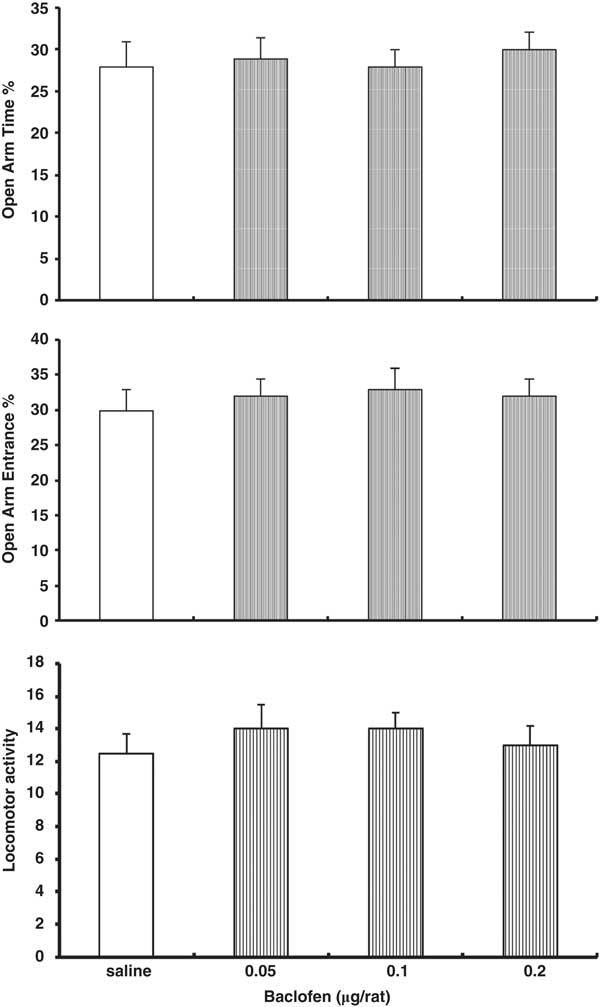
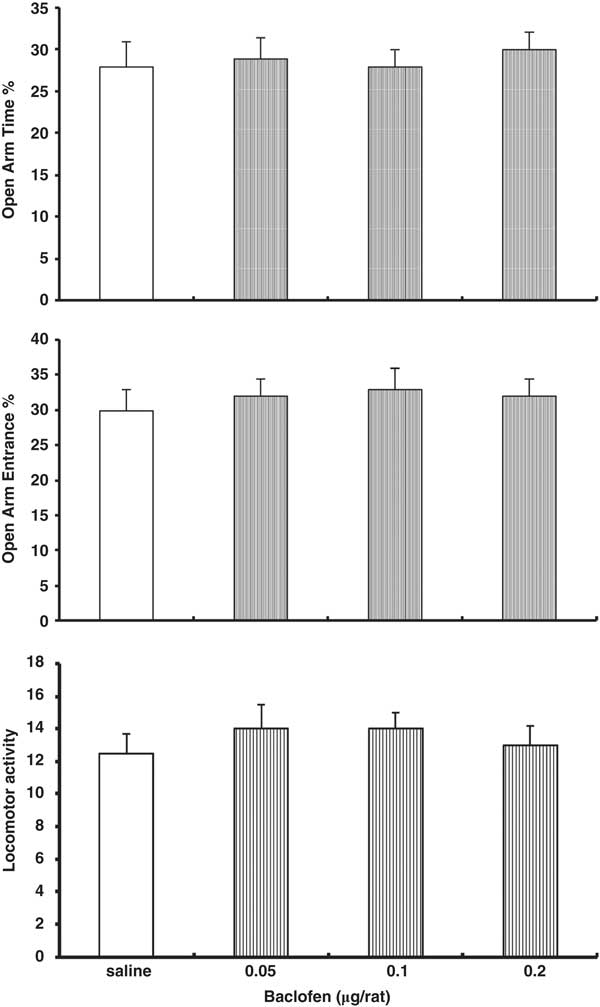
One-way ANOVA shows that intra-mPFC injection of GABAB receptor agonist baclofen (0.05, 0.1 and 0.2 μg/rat) did not alter OAT% [F(3, 24) = 2.011, p > 0.05], OAE% [F(3, 24) = 1.199, p > 0.05] and locomotor activity [F(3, 24) = 1.21, p > 0.05] significantly (Fig. 3).
Effects of bilateral intra-medial prefrontal cortex injection of baclofen as seen in the elevated plus maze test. Rats were treated either with saline (1 μl/rat) or with baclofen (0.05, 0.1 and 0.2 μg/rat). Each bar represents mean ± SEM. %Open arm time, %open arm entries or locomotor activity; n = 7.
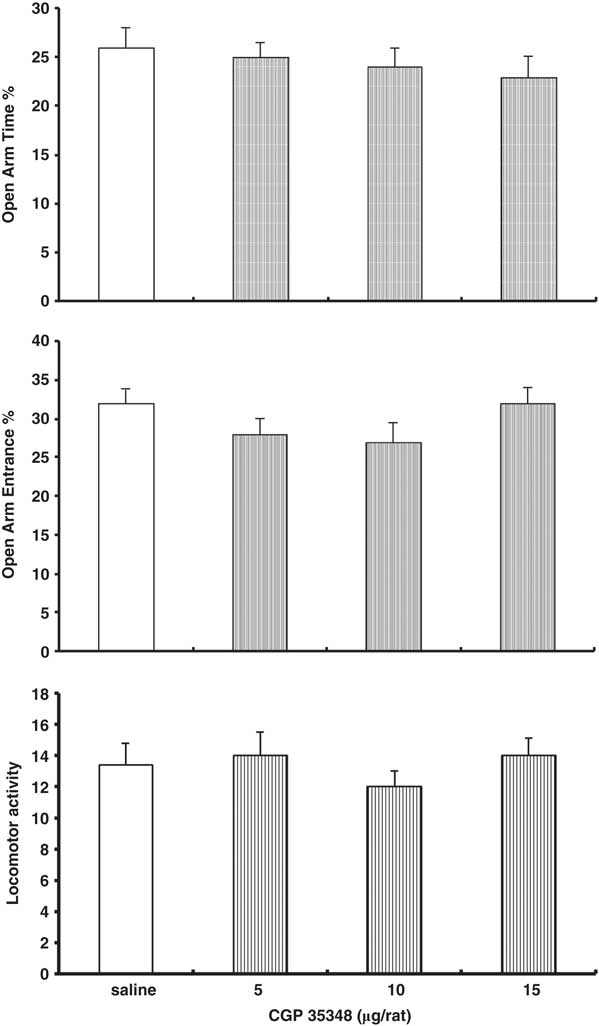
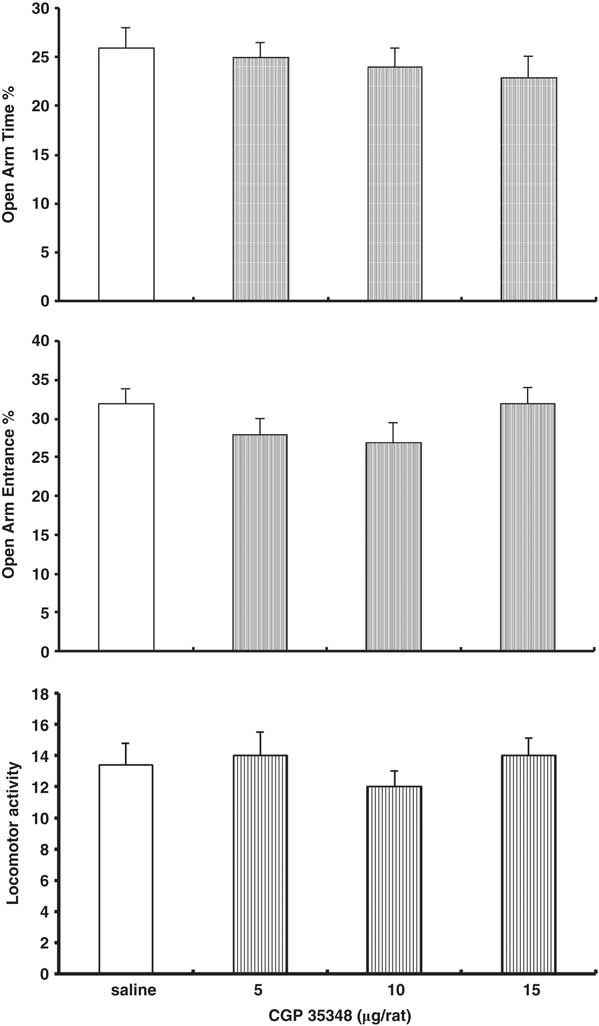
Intra-mPFC infusion with GABAB receptor antagonist CGP (5, 10 and 15 μg/rat) also had no significant effects on OAT% [F(3, 24) = 2.011, p > 0.05], OAE% [F(3, 24) = 1.199, p > 0.05] and locomotor activity (Fig. 4).
Effects of bilateral intra-medial prefrontal cortex injection of CGP as seen in the elevated plus maze test. Rats were treated either with saline (1 μl/rat) or with bicuculline (5, 10 and 15 μg/rat). Each bar represents mean ± SEM. %Open arm time, %open arm entries or locomotor activity.
The approximate placements of the injection cannula within the mPFC are indicated by circles. Representative sections of the mPFC were taken from the rat brain atlas of Paxinos and Watson (Reference Paxinos and Watson14).

Discussion
Results of the present study show that intra-mPFC administration of GABAA receptor agonist muscimol increases OAT% and OAE%, without significant effects on locomotor activity, indicating the reduced anxiety by activation of GABAA receptors. However, intra-mPFC microinjection of bicuculline decreases OAT% and OAE%, indicating the induction of anxiogenic-like response. Activation of the GABAB receptors of mPFC by baclofen or inhibition of them by CGP has no significant effect on anxiety-related behaviours. Our result demonstrates that the GABAergic system of mPFC modulates anxiety-related behaviours via GABAA receptors, and activation of GABAA receptors in this area attenuates anxiety-related behaviours in adult male Wistar rats, whereas inhibition of these receptors by bicuculline produces an anxiogenic profile.
The GABAergic system and GABA receptors are the most important neural systems involved in the modulation and control of anxiety. The important role of GABAA receptors in the modulation of different forms of anxiety, fear and stress depression has been reported in several studies (Reference Kalueff and Nutt19,Reference Tasan, Bukovac and Peterschmitt20). A functional association between the increased GABAergic neurotransmission and reduced emotional responses such as anxiety and fearfulness following aversive stimulation has been frequently proposed (Reference Matsumoto, Togashi, Kaku, Kanno, Tahara and Yoshioka21,Reference Depino, Tsetsenis and Gross22).
Pharmacological studies showed that GABAA receptor activation increases chloride conductance and inhibits neuronal activity by hyperpolarisation or depolarisation block and attenuates anxiety- and stress-related behavioural aberrations, whereas antagonists of this receptor usually enhance the behavioural sequelae generated by stressors and administration of these agents could induce behavioural disturbances and physiological changes comparable to those observed in stressed and anxious animals (Reference Matsumoto, Togashi, Kaku, Kanno, Tahara and Yoshioka21,Reference Kalueff and Nutt23). Although some studies have reported that bicuculline generally has no specific effects on animal models of anxiety (Reference Ågmo, Pruneda, Guzmán and Gutiérrez24,Reference Dalvi and Rodgers25) and it has been suggested that anxiogenesis observed after bicuculline administration may be attributed to behavioural suppression rather than to any effect on anxiety (Reference Ågmo, Pruneda, Guzmán and Gutiérrez24), several studies have shown the anxiogenic effects of bicuculline when injected into different brain areas (Reference Zarrindast, Solati, Oryan and Parivar9,Reference Hodge, Raber and McMahon26,Reference Sanders and Shekhar27).
The GABAergic connection between PFC and other brain structures is probably also involved in modulation of anxiety-related behaviours (Reference Lewis28,Reference Hashimoto, Arion and Unger29). Previous studies have reported that GABA-containing neurons in the rat ventral tegmental area project to the PFC and GABAergic projections from PFC also innervate different brain regions such as the nucleus accumbens (Reference Torregrossa, Tang and Kalivas11,Reference Nair-Roberts, Chatelain-Badie, Benson, White-Cooper, Bolam and Ungless30). Anxiety disorders may relate to perturbations in this ventral PFC-amygdala circuit. A study on anxious youth using selective imaging of the amygdala showed that patients showed greater response to threat-related facial expressions and increased amygdala activation and abnormal ventral PFC responses. These neural abnormalities may be responsible for regulatory processes of anxiety-related behaviours (Reference Monk, Nelson and McClure4,Reference Monk, Telzer and Mogg31).
Only the role of GABA receptors in the mPFC has been evaluated in the present study. Further studies are required on the role of these receptors in other areas of PFC, as well as on the possible interaction between these areas for a full understanding of the role of GABAergic neurotransmission in the PFC on modulation of anxiety-related behaviour.
Acknowledgement
This work was supported by research deputy of Islamic Azad University-Karaj branch.