





Introduction
Civic engagement is widely regarded as essential to democratic vitality, social cohesion, and effective governance (Putnam, Reference Putnam2000). By channeling public concerns into formal and informal arenas, cultivating social capital and civic skills, and forging meaningful horizontal ties, engaged citizens influence policy agendas, strengthen institutions, and address community issues (Coleman, Reference Coleman1988; Dacombe, Reference Dacombe2018; Putnam, Reference Putnam2000; Verba et al., Reference Verba, Schlozman and Brady1995). Empirical studies further link diverse modes of participation (volunteering, grassroots mobilization, electoral activity, mutual-aid networks, etc.) to stronger democracies, resilient communities, and greater collective well-being (Cnaan & Park, Reference Cnaan and Park2016; Norris, Reference Norris2002).
Civic engagement has been approached from multiple disciplinary perspectives. Broadly, the term covers a variety of activities performed individually or collectively, beyond immediate family obligations, with the goal of addressing community needs, shaping public life, or influencing government actions (Cnaan & Park, Reference Cnaan and Park2016; Verba et al., Reference Verba, Schlozman and Brady1995). The complexity of civic engagement has led scholars to distinguish between various types of engagement. Berger (Reference Berger2011) differentiates between political, social (or associational), and moral engagement. Here, we focus on political and associational engagement. Political engagement generally refers to efforts to influence political processes and decisions, whether through conventional participation or more contentious collective action (Berger, Reference Berger2011; Tarrow, Reference Tarrow2012; Verba et al., Reference Verba, Schlozman and Brady1995), while associational engagement is usually understood as nonpolitical and oriented toward addressing community needs through activities such as philanthropic giving and volunteering (Cnaan & Amrofell, Reference Cnaan and Amrofell1994; Payton & Moody, Reference Payton and Moody2008). However, this distinction has increasingly been questioned, particularly in contexts of weak democracies, where the boundary between altruistic and political forms of engagement is often less clear-cut (Glasius & Ishkanian, Reference Glasius and Ishkanian2015; Henriksen & Svedberg, Reference Henriksen and Svedberg2010).
Central and Eastern Europe has long been portrayed as a region marked by low citizen engagement and limited institutional trust, despite the presence of a relatively robust civic sector (Baća, Reference Baća2022; Marková, Reference Marková2004; Mishler & Rose, Reference Mishler and Rose2001). In the postsocialist period, this sector expanded rapidly through professionalized, donor-driven NGOs often oriented toward policy implementation rather than grassroots mobilization (Bilić & Stubbs, Reference Bilić, Stubbs and Jacobsson2015; Petrova & Tarrow, Reference Petrova and Tarrow2007). Yet, recent scholarship on Serbia and the wider region points to a more complex picture. On the one hand, findings indicate that citizens are largely distrustful of both governmental and nongovernmental institutions and have limited faith in their own political efficacy (Fiket et al., Reference Fiket, Pavlović and Pudar Draško2017, Reference Fiket, Ilić and Pudar Draško2022; Radovanović & Vasiljević, Reference Radovanović and Vasiljević2022). On the other hand, the region has witnessed an expansion of diverse forms of bottom-up civic engagement, ranging from self-organized local initiatives to large-scale protests, often in response to the growing encroachment of political power—with the recent student-led protests in Serbia standing out as a particularly striking example (Bieber & Brentin, Reference Bieber and Brentin2018; Delibašić et al., Reference Delibašić, Nikolić and Vasiljević2019; Džihić et al., Reference Džihić, Djolai, Vasiljević and Vračić2022; Fagan & Sircar, Reference Fagan and Sircar2017; Pešić & Vukelić, Reference Pešić and Vukelić2022; Pudar Draško et al., Reference Pudar Draško, Fiket and Vasiljević2020; Radovanović & Vasiljević, Reference Radovanović and Vasiljević2022; Vasiljević, Reference Vasiljević2021, Reference Vasiljević2023). In a context of increasing autocratization and both institutional and societal capture (Bieber, Reference Bieber2018; Castaldo, Reference Castaldo2020; Cvetičanin et al., Reference Cvetičanin, Bliznakovski and Krstić202 Reference Berger4; Lemstra, Reference Lemstra2020), these developments make it ever more difficult to disentangle associational engagement, oriented toward improving everyday life, from political engagement aimed at broader social change.
Based on an analysis of qualitative data on emerging forms of civic engagement in Serbia, this article questions the sustainability of the distinction between political and associational engagement. The article therefore asks: how and under what conditions do civic actors in Serbia combine associational and political repertoires, and what does this reveal about the analytical distinction between political and associational civic engagement?
Our analysis shows how civic actors in Serbia combine associational and political tactics and repertoires in ways that generate permeable political–associational engagement, challenging the conventional distinction between the two forms of participation. Drawing on empirical research conducted in 2021 and 2024 among community foundations, grassroots organizations, and smaller advocacy-oriented civil society organizations, we show that, in a context marked by institutional capture, distrust, and political stigma, civic actors strategically draw on both domains. The article introduces the concept and typology of permeable political–associational engagement, proposing a framework with relevance beyond the “postsocialist civil society.”
The article is organized into four sections. The following section surveys the varied expressions of civic engagement and revisits the conventional division between political and associational participation. The section entitled “Civic engagement in Serbia: a brief overview” places civic engagement in Serbia within its historical context. The section “Patterns of Local Civic Engagement in Serbia” presents original findings from the 2021 and 2024 fieldwork. Building on this evidence, the section “Blurring boundaries: toward permeable political–associational engagement” introduces and elaborates a new concept and typology of permeable political–associational engagement, where tactics from both spheres coexist and actively interweave and inform one another.
Diverse expressions of civic engagement
Civic engagement (civic participation, civic involvement) is defined as acting toward the amelioration of community concerns, from a felt civic duty, responsibility, or obligation (Smith et al., Reference Smith, Stebbins and Dover2006). Broadly, the term covers a variety of activities performed individually or collectively, beyond immediate family obligations, with the goal of addressing community needs, shaping public life, or influencing government actions (Cnaan & Park, Reference Cnaan and Park2016; Verba et al., Reference Verba, Schlozman and Brady1995).
The complexity and multidimensionality of civic engagement have prompted scholars to classify it into two broad categories: political and associational (or social) (Berger, Reference Berger2011), with some scholars even using the term “private” engagement to refer to the latter (Dacombe, Reference Dacombe, Anheier and Toepler2010). Political engagement includes, on one hand, activities directly related to the formal political system, power structures, or governance processes, such as voting, joining a political party, or campaigning for a candidate (Verba et al., Reference Verba, Schlozman and Brady1995). On the other hand, it encompasses activities associated with “contentious politics,” such as protests challenging elites and authorities (Tarrow, Reference Tarrow2012). Citizens are more likely to engage when they perceive their voice as meaningful, trust organizations and institutions, and view political institutions as responsive and transparent (Craig et al., Reference Craig, Niemi and Silver1990; Norris, Reference Norris2002). Thus, political efficacy—the belief that one’s actions can influence political outcomes—is a key driver of participation (Verba et al., Reference Verba, Schlozman and Brady1995).
In contrast, associational engagement refers to participation in community and civic life primarily through nonpolitical (in stricto sensu) associations and foundations (Berger, Reference Berger2011). This form of engagement is close to the concept of philanthropy (Payton & Moody, Reference Payton and Moody2008; Phillips & Jung, Reference Phillips, Jung, Jung, Phillips and Harrow2016; Schuyt, Reference Schuyt2016). It thus includes donating money and goods and dedicating time to nonprofit organizations, community self-help initiatives, mutual-aid networks, engagement with cultural or faith-based associations, neighborhood projects, and other nongovernmental collective endeavors. This form of engagement seeks to address community needs and improve local conditions, without necessarily engaging in political processes understood in the narrow sense of relating to government or acting against it. Associational engagement is instrumental in cultivating social capital by creating networks of trust and reciprocity (Putnam, Reference Putnam2000). Altruism, a sense of belonging, shared values and goals, moral responsibility and duty, as well as pursuing personal goals, such as gaining skills, recognition, or psychological benefits, drive people to engage in various forms of philanthropy (Bekkers & Wiepking, Reference Bekkers and Wiepking2011; Musick & Wilson, Reference Musick and Wilson2008).
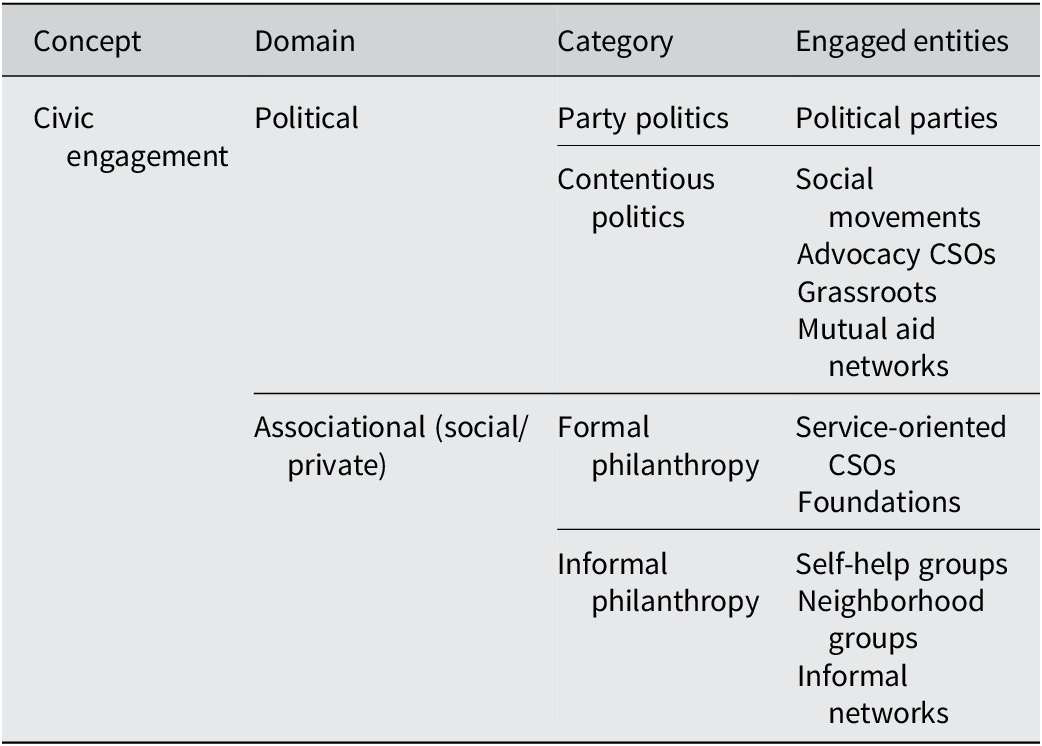
The typology summarized in Table 1 indicates that to effectively address community needs, citizens dedicate their time, energy, skills, and material resources within political and associational domains. The political side spans both institutional channels, such as party membership, campaigning, or voting, and extra-institutional or contentious action, such as social movements, advocacy CSOs, grassroots coalitions, and mutual-aid collectives that seek to influence or confront governing authorities. Associational engagement, by contrast, revolves around philanthropic and community vehicles. It subdivides into formal philanthropy (service-oriented nonprofits, foundations) and informal philanthropy (self-help circles, neighborhood associations, volunteer networks). The distinction between the two subconcepts of civic engagement highlights different arenas and methods of participation, as well as potentially different driving forces. These domains are also studied by different academic fields: philanthropic and third sector studies focus on associational engagement, while political science and social movement studies analyze political engagement—fields that rarely intersect.
Forms of Civic Engagement

Table 1. Long description
The table classifies civic engagement into political and associational domains. Political engagement comprises party politics, involving political parties, and contentious politics, involving social movements, advocacy civil society organisations, grassroots groups, and mutual aid networks. Associational engagement comprises formal philanthropy, involving service-oriented civil society organisations and foundations, and informal philanthropy, involving self-help groups, neighbourhood groups, and informal networks. The table presents the authors’ own classification.
Source: Authors’ own.
Party politics differs clearly from other forms of engagement, but distinguishing contentious politics from associational engagement is less straightforward. Some research suggests that individuals often identify with either activist or volunteer engagement, embracing one while rejecting the other (Musick & Wilson, Reference Musick and Wilson2008). However, recent scholarship shows that the traditional divide between “altruistic volunteering” and “political activism” is rapidly eroding. Mounting evidence reveals extensive overlap: philanthropic work often carries political intent, and activist campaigns routinely rely on volunteer energies (Henriksen & Svedberg, Reference Henriksen and Svedberg2010; Payton & Moody, Reference Payton and Moody2008).
Civil society literature likewise distinguishes between political and socioeconomic or “developmental” roles (Mati, Reference Mati2020), which broadly align with what we describe as political and associational engagement. Yet, these are not separate spheres: organizations often combine or move between them, a tendency reinforced by digitalization, declining trust in parties and large NGOs, and the rise of hybrid organizational forms (Chadwick, Reference Chadwick2007; Feenstra, Reference Feenstra2018; Hasenfeld & Gidron, Reference Hasenfeld and Gidron200 Reference Bieber5; Mair, Reference Mair2006). Studies across different contexts similarly question rigid distinctions between associational and political action and show how civil society adapts to changing political pressures (Dekker, Reference Dekker2009; Glasius & Ishkanian, Reference Glasius and Ishkanian2015; Toepler et al., Reference Toepler, Zimmer, Fröhlich and Obuch2020). This article contributes to such discussions by examining the permeability of that boundary in the Serbian context.
Civic engagement in Serbia: A brief overview
Civil society in Serbia evolved under difficult conditions during the 1990s. Although the formal political pluralization that followed the collapse of the socialist regime created some momentum for civic initiatives, the regime of Slobodan Milošević adopted a hostile stance toward organizations that challenged its politics (Spasic, Reference Spasic2003). In response, numerous citizen groups and associations emerged to oppose the war and hate speech, advocating for human and social rights (Bieber, Reference Bieber2003; Milivojević, Reference Milivojević2006). Their combined efforts notably advanced civic engagement and contributed to the eventual collapse of Milošević’s regime.
After the democratic changes in 2000, the government introduced reforms aimed at strengthening civil society and civic engagement (Kolin, Reference Kolin2009). Between 2001 and 2012, legislation aligned with European standards helped solidify the nonprofit sector (Popović et al., Reference Popović, Stojanović and Selaković2018). However, scholars observed that European and international assistance primarily prioritized partnerships between the state and civil society organizations for policy implementation, rather than promoting grassroots mobilization or broader citizens’ engagement (Fagan & Ostojic, Reference Fagan and Ostojic2008). The NGO-centered model of civil society in Serbia, heavily shaped by international donors, produced professionalized organizations that often operate as interlocutors between donors, government, and citizens, rather than as membership-based representatives rooted in particular social groups (Vuković, Reference Vuković2018). This emphasis contributed to a “depoliticization” of the sector (Vuković, Reference Vuković2015).
Since 2012, following the political takeover by Serbian Progressive Party (SNS), which marked the beginning of an authoritarian turn in the country, conditions for civil society have deteriorated again. Authorities have proposed measures limiting the work of civil society organizations, and government responsiveness to civic initiatives has diminished (Popović et al., Reference Popović, Stojanović and Selaković2018). The Global Alliance of Civil Society Organisations added Serbia to its watch list in response to growing constraints on civic freedoms, downgrading the country’s status from “shrinking” to “obstructed” (CIVICUS, 2019). While certain organizations remain active in areas such as human rights and social inclusion, the contemporary political climate continues to challenge their independence and effectiveness. This trajectory reflects a broader pattern in authoritarian and hybrid regimes in which claims-making (advocacy) NGOs are simultaneously stigmatized and constrained, while more “apolitical” service-oriented nonprofits and regime-loyal organizations are encouraged or even subsidized through social-service contracts and other partnership schemes (Toepler et al., Reference Toepler, Zimmer, Fröhlich and Obuch2020). Additionally, official campaigns portraying NGOs as “foreign mercenaries,” along with allegations of financial misconduct, have further eroded already low levels of public trust in the third sector. While many organizations resist becoming merely donor-driven bureaucracies and continue to attract committed individuals (Herrold, Reference Herrold2025), scepticism persists regarding their ability to respond effectively to citizens’ needs, as empirical studies confirm (ACT, 2019; Radovanović & Vasiljević, Reference Radovanović and Vasiljević2022).
However, the conditions of creeping authoritarianism and growing distrust in institutions, including civil society organizations, have not extinguished citizens’ appetite for civic engagement. Instead, civic participation has diversified, increasingly taking the form of grassroots mobilizations operating outside the framework of professionalized, donor-driven NGOs. Amid a broader wave of democratic and protest movements across the Balkans over the past decade (Bieber & Brentin, Reference Bieber and Brentin2018; Pudar Draško et al., Reference Pudar Draško, Fiket and Vasiljević2020), Serbia, too, has witnessed a significant surge in social movements and citizen-led local initiatives. Several waves of mass street protests, organized outside formal institutional structures, most notably One of Five Million in 2018 and Serbia Against Violence in 2023, brought tens of thousands of citizens into the streets (Spasojević & Lončar, Reference Spasojević and Lončar2023; Vukelić & Pešić, Reference Vukelić and Pešić2023). Remarkable environmental mobilizations, initially against small hydropower plants and later against plans to develop what would be Europe’s largest lithium mine in the Jadar River valley of western Serbia, have given rise to numerous smaller civil society groups that are locally rooted and often informal in legal terms (Vukelić et al., Reference Vukelić, Petrović and Kukuridi2020). In some cases, leading figures of these emerging civic initiatives came from established NGOs and, dissatisfied with donor-imposed agendas, turned to grassroots mobilization to align civic engagement more closely with citizens’ tangible needs (Radovanović, Reference Radovanović, Wiepking and Handy2021; Radovanović & Vasiljević, Reference Radovanović and Vasiljević2022; Vasiljević, Reference Vasiljević, Ivković and Prodanović2019). These initiatives continue to enjoy broad popular support, gradually reshaping both the landscape of civil society in Serbia and prevailing patterns of trust and distrust (Bieber & Brentin, Reference Bieber and Brentin2018; Delibašić et al., Reference Delibašić, Nikolić and Vasiljević2019; Džihić et al., Reference Džihić, Djolai, Vasiljević and Vračić2022; Fagan & Sircar, Reference Fagan and Sircar2017; Iguman et al., Reference Iguman, Mijatović and Nikolić2022; Pešić & Vukelić, Reference Pešić and Vukelić2022; Pudar Draško et al., Reference Pudar Draško, Fiket and Vasiljević2020; Radovanović & Vasiljević, Reference Radovanović and Vasiljević2022).
The most recent and perhaps most striking example of large-scale bottom-up citizen mobilization is the impressive wave of student-led protests and blockades that followed the tragic collapse of the Novi Sad railway station canopy in November 2024. The movement drew its broader force from accumulated frustration over weak political accountability, as well as institutional and societal capture. In this sense, it crystallized grievances that had already been building through earlier mobilizations. Over more than a year, citizens from across Serbia and the diaspora joined the movement through intercity marches, blockades, and mass protest gatherings. Alongside street mobilization, citizens also organized ad hoc ridesharing when public transport was suspended, prepared meals for students and protest participants, donated essential supplies, and provided legal, financial, and medical assistance on a voluntary, unpaid basis. These direct support actions, developed largely outside formal civil society organizations, were more than auxiliary to protest. They helped sustain it over time and lowered the threshold for participation, drawing in citizens beyond established activist circles, many motivated by a desire to “help our children” (Nikolić et al., Reference Nikolić, Radovanović, Radovanović, Bieber, Draško and Išpanović2026). Within this mobilization, care work became politicized: cooking, provisioning, and logistical coordination were experienced as assistance and as forms of political action (ibid.). The student mobilizations, therefore, show how political and associational engagement can become closely intertwined in practice.
Patterns of local civic engagement in Serbia
The empirical evidence presented in this paper draws on two research projects: one focused on community foundations and the other on constituency building among advocacy-oriented CSOs. Community foundations (A community foundation is an independent legal entity that supports local community development by providing financial and other support to citizen-led initiatives. Community foundations usually operate within a specific area, such as a city, a part of a city, a district, or a region, but they are not solely defined by geographic boundaries; they can also serve specific groups that share common goals, interests, or values.) are situated primarily within the domain of associational engagement, whereas the organizations examined in the second project are more closely aligned with political engagement insofar as they engage in public advocacy. Across the two studies, we examined how representatives of these different types of civic actors understand their organizations’ roles in the community, build relationships with citizens, and foster civic engagement.
The first project, Community Foundations in Serbia, was conducted between June and November 2021. It examined the missions and functions of both emerging and established community foundations in Serbia, their capacity to balance multiple roles, and their readiness to promote civic engagement and social change within their local communities. To explore these issues in greater depth and capture the perspectives of those most directly involved in the work of community foundations, we conducted semi-structured group interviews with twelve representatives from six foundations: three participants each from Obrenovac and Stara Pazova, two each from Pančevo and Niš, and one each from Šabac and Novi Pazar. The interviewees were individuals who had played an important role in establishing these foundations and who remained actively involved in shaping their programs. Owing to the epidemiological situation, all interviews were conducted online via Zoom and lasted between 60 and 90 minutes.
The second project, Constituency Building for Civil Society Organizations in Serbia, was conducted between March and May 2024. Its aim was to deepen understanding of how CSOs in Serbia build and sustain constituencies, what barriers they encounter in doing so, whether they have formal mechanisms for constituency building, and to what extent they regard it as an integral part of their mission. The study was based on six focus groups, two conducted in person and four online, with adults employed by or volunteering in civil society organizations in Serbia. The sample included 25 organizations: 22 formally registered citizens’ associations and 3 informal groups of self-organized citizens working on highly localized issues. The main selection criterion was that organizations devote a substantial part of their work to public advocacy, while geographic spread and organizational diversity were also taken into account. In total, 26 individuals participated in the focus groups, including 12 women and 14 men. One organization was represented by two participants. Geographically, the sample included 12 organizations from Belgrade (including 2 informal groups), two each from Novi Sad and Užice, and one each from Niš, Bor, Raška, Kraljevo, Loznica, Novi Pazar, and Pančevo. Each discussion lasted approximately 90 minutes.
The sampling strategy across the two studies was purposive and qualitative, designed to capture a diverse range of perspectives from key actors within Serbia’s civil society landscape rather than to achieve statistical representativeness. For the first study on community foundations, the sample was purposive and expert-based. It included individuals who had played a central role in establishing community foundations and who remained actively involved in their work. This ensured that participants possessed in-depth knowledge of their organizations’ missions, challenges, and community roles. The inclusion of six foundations from different parts of Serbia, varying in age and level of development, also provided valuable geographical and organizational diversity. The second study employed a purposive convenience sampling strategy. Organizations were selected primarily based on their engagement in public advocacy, making them particularly relevant for examining constituency building in advocacy-oriented civil society. At the same time, the sample was designed to reflect diversity in terms of geography, organizational type, and degree of formalization, including both registered associations and informal citizen groups. Taken together, the two samples are theoretically and strategically constructed to enable comparisons.
The transcripts from both studies were analyzed using thematic analysis, combining inductive coding with cross-dataset comparison. We first identified recurrent topics and patterns in how participants spoke about their organizations’ roles, their relationships with citizens and institutions, and the factors that enabled or hindered civic participation. We then compared these patterns across the two research projects and grouped them into broader thematic categories. Three themes emerged as particularly important in both datasets: community, trust and credibility, and apathy and mobilization. These themes are central to our analysis because they illuminate how civic actors in Serbia define the publics they seek to engage, build legitimacy in a context marked by institutional distrust and political polarization, and attempt to encourage participation despite widespread scepticism and weak beliefs in the possibility of change. They also revealed a broader pattern: in practice, associational and political forms of engagement are often closely intertwined.
Community
Across both datasets, respondents defined community primarily in local and relational terms, emphasizing proximity, shared experiences, and a commitment to resolving common problems. Community foundations particularly highlight their role in empowering informal, neighborhood initiatives, stressing a strong local orientation rooted in shared values and prior collaborative experiences. As one respondent noted, community initiatives began with “people who feel the local level as their own, who are local patriots, those who have the feeling that something needs to be given back to the community” (Community Foundations study).
Advocacy-oriented CSOs also framed community in relation to concrete local problems, thus encompassing not only residents directly affected by particular issues but also activists, like-minded organizations, and expert groups. One participant described this as an effort to “activate the dormant expert community” as part of the broader public they sought to engage (Constituency Building study). Advocacy organizations thus more often assemble problem-centered publics around shared concerns.
Community is, therefore, not a given social unit but something actively produced through organizational practice. While community foundations build from territorial embeddedness, advocacy organizations more often assemble publics around shared problems. In both cases, community is shaped through efforts to establish legitimacy, mobilize participation, and build constituencies. In the Serbian context, this helps explain why local embeddedness matters so strongly: amid institutional distrust, political polarization, and scepticism toward professionalized NGOs, rootedness in place and familiarity with concrete local problems become important sources of legitimacy.
Building trust and credibility
A consistent theme emerging from both community foundations and advocacy-oriented CSOs is the challenge of overcoming widespread distrust and deep divisions within local communities. The lack of trust, frequently cited by participants in both studies, often stems from prolonged negative experiences with local institutions (perceived as captured by the ruling regime), a polarized political environment, and the perceived inefficiency or irrelevance of NGOs. According to respondents, this distrust poses a significant barrier to civic engagement and collective action.
Across both studies, especially among actors involved in grassroots and community-driven initiatives, respondents also expressed a critical stance toward traditional, professionalized NGOs, often seen as bureaucratic, donor-driven, and disconnected from local needs. As one community foundation representative put it, “a lot of money is flowing through the civil sector, without ordinary citizens actually seeing results. You know, they don’t get much out of all our trainings, travels, campaigns… I worked in organizations providing support to the civil society … and got sick and tired of it at some point” (Community Foundations study). Such organizations are perceived not only as distant but as constrained by donor agendas and strategic caution in avoiding political involvement. Another respondent captured this frustration more sharply: “I’m sick and tired of those NGO worn-out things. This [community foundation] is about solving concrete problems, and the results are achieved quickly” (Community Foundations study).
In response, both community foundations and advocacy-oriented CSOs sought to build legitimacy through direct, persistent engagement, visibly grounded in local realities. Community foundations, in particular, emphasized neutrality, proximity, local fundraising, and small but visible projects as ways of demonstrating accountability to fellow citizens rather than to external actors. As one participant noted, citizens responded especially positively when they recognized that support was locally generated: “this is literally money raised from their fellow citizens” (Community Foundations study). Another stressed that, in politically polarized local settings, their key strength lay in having “managed to stay neutral for years” while bringing different sides together around the common good (Community Foundations study). Advocacy-oriented organizations similarly stressed sustained presence in the community, face-to-face engagement, consistent transparency, and the achievement of concrete results as ways to counter stigma and persuade citizens that collective action could be meaningful. As one participant noted, “citizens often see CSOs as ‘foreign agents’, and this can only be overcome through persistent work in the community” (Constituency Building study).
The capacity to sustain trust and credibility itself is constrained by organizational fragility. Across both studies, respondents cited time pressures, financial instability, and limited personnel as factors hindering continuous community engagement and consistent public visibility. These findings suggest that trust-building is not merely a relational or communicative effort but also an organizational and structural one: overcoming local mistrust and sustaining engagement requires stable resources, continuity, and institutional capacity. In this sense, both community foundations and advocacy-oriented CSOs must balance grassroots credibility with organizational robustness to mobilize citizens effectively and sustain civic engagement over time.
Apathy and mobilization
Perceptions of citizen apathy and the potential for mobilization emerged as prominent themes in both research studies. Representatives of both community foundations and advocacy CSOs widely agree that civic engagement in Serbia remains limited. Several representatives of advocacy CSOs attributed this to citizens’ precarious socioeconomic circumstances: the struggle to “make ends meet” leaves little time, energy, or other resources for public engagement. When mobilization does occur, it is typically reactive; it is “a defense against something negative” (Constituency Building study) rather than proactive.
Others emphasized that even where initial interest exists, it is frequently undermined by the belief that authorities will ignore citizens’ demands. As one respondent noted regarding local budget hearings, people may initially become involved, but later withdraw because they feel that “their actions can’t change anything” (Constituency Building study). Community foundations voiced a similar diagnosis, linking apathy to atomization and mistrust: “People have become quite apathetic (…) society is totally atomized; they have no trust … they don’t really trust anything” (Community Foundations study).
However, both types of organizations also described ways of counteracting apathy through tangible achievements and sustained, visible action. Community foundations, in particular, stressed that small-scale local initiatives can generate a “snowball effect” when citizens are able to see concrete improvements in their immediate surroundings. As one respondent noted, “When citizens received grants and started working, around forty additional people joined spontaneously … people want to participate when they see tangible results” (Community Foundations study).
Advocacy-oriented CSOs made a similar point regarding campaigning: mobilization tended to expand when prolonged collective effort produced concrete, publicly visible outcomes that were clearly attributable to citizen action. One participant recalled that, after 3 years of sustained pressure, “citizens saw concrete results. A new bus line was introduced, and this mobilized even more people” (Constituency Building study). In both datasets, then, participation was most effectively activated not through abstract appeals to civic duty but through practical experiences showing that collective action can make a difference.
This finding aligns with scholarship on political efficacy (Norris, Reference Norris2002; Verba et al., Reference Verba, Schlozman and Brady1995). In the Serbian context, where distrust and scepticism toward formal politics remain widespread, such efficacy is often generated through concrete successes that make participation feel worthwhile. This also helps explain why associational and political engagement are often intertwined in practice: local problem-solving, service-oriented initiatives, and issue-based advocacy can all serve as entry points into broader civic and political participation. A similar dynamic is visible in the most recent student-led mobilization, where acts of support and care work drew in citizens who might otherwise have remained politically inactive, thereby turning everyday forms of assistance into participation in a broader movement.
Blurring boundaries: Toward permeable political–associational engagement
Empirical synthesis: Why the boundary becomes porous in practice
The preceding themes point to a broader empirical pattern: in contemporary Serbia, political and associational forms of civic engagement are not easily separable in practice. The ways in which organizations define community, build trust, and mobilize participation are shaped by institutional distrust, political polarization, and weak confidence in formal channels of influence. Under these conditions, civic actors combine elements of both spheres, adapting their repertoires to citizens’ scepticism toward politics, the limited responsiveness of institutions, and the need to demonstrate tangible relevance in everyday life.
Advocacy-oriented CSOs described participatory mechanisms as weak and politically captured. Even when civil society actors are formally included in advisory processes, such participation is often experienced as tokenistic “box-ticking,” with little scope for substantive influence: “We are invited as the ‘selected representatives’ of civil society only so officials can claim they consulted us; likewise, we attend merely to avoid being accused of ignoring the invitation” (Constituency Building study). Institutional channels that once enabled more meaningful participation, such as local community councils, have effectively withered or been placed under political control, further reinforcing distrust in formal politics.
At the same time, several respondents stressed that citizens often avoid anything perceived as “political,” understood narrowly in partisan terms: “Fear of being branded politically active … deters engagement” (Constituency Building study). Only after citizens are convinced that CSO initiatives are not “political” in this partisan sense do they express a willingness to participate more fully. This reluctance aligns with scholarly observations regarding political engagement in Serbia, which note citizens’ widespread avoidance of formal political arenas due to perceived corruption and persistent party-based conflict (Fiket et al., Reference Fiket, Pavlović and Pudar Draško2017).
To activate citizen involvement, advocacy-oriented CSOs increasingly rely on associational tactics that foreground immediate, concrete gains for local communities. In one illustrative case, persistent lobbying that secured a commitment for a new bus route prompted residents to “leap out of their cars asking what needed to be signed” (Constituency Building study). By focusing on visible, practical outcomes rather than abstract policy debates, local advocacy CSOs succeed in building public trust and civic mobilization. Yet, this service-delivery focus may leave them better equipped to meet short-term needs than to advance deeper, long-term social transformation.
A similar dynamic is visible among community foundations. Although they present themselves as neutral and nonpolitical, their activities often extend beyond service provision or local philanthropy in a narrow sense. By encouraging citizens to solve problems collectively, mobilize local resources, and act without waiting for state authorities, they foster local autonomy, accountability, and collective efficacy. As one respondent put it, “We want people to realize they can change things by themselves … not to wait for someone else to solve their problems” (Community Foundations study). In this sense, practices framed as associational may already carry clear political implications.
This becomes even more evident in community foundations’ aspiration to become “the first place citizens would think of to resolve a problem… the first institution, first channel citizens would turn to when they realize ‘I have an idea for the local community development, for the city development, let’s see how we can do it together’” (Community Foundations study). Such ambitions point not only to community self-reliance but also to the construction of alternative channels of coordination in contexts where formal institutions are perceived as unresponsive. By building trust, responsiveness, and proactive civic action, community foundations thus begin to assume roles commonly associated with local governance.
The data from the two studies indicate that drawing a strict line between political and associational forms of civic engagement is not always helpful when analyzing activities related to the most vibrant segment of the third sector in Serbia today, particularly its recently revitalized local civic engagement. To both sustain themselves and mobilize disengaged, apathetic, and distrustful citizens, local organizations, whether rooted in philanthropic traditions or more advocacy-oriented, tend to prioritize initiatives that produce concrete, tangible outcomes and directly affect citizens’ everyday lives. While this approach proves effective in encouraging participation, it may also lead to unintended consequences, such as shifting attention away from institutional accountability and long-term structural change. Yet, the reverse dynamic is also visible in the contemporary student-led movement, where forms of engagement usually treated as associational, such as care, provisioning, and logistical support, became politically meaningful forms of action. Read alongside our findings, these mobilizations further reinforce the point that, in contemporary Serbia, the boundary between associational and political engagement is often difficult to sustain analytically.
A typology of permeable political–associational engagement
The empirical findings presented in this paper reveal the emergence of a permeable political–associational engagement in Serbia, challenging conventional academic distinctions between political and associational forms of participation. Permeability can be understood as a form of adaptive civic behavior. Faced with hostile or indifferent state structures, as well as widespread citizen disillusionment with politics, organizations often adopt associational rhetoric and tactics to pursue political ends. For example, a community foundation might frame its mission as “supporting local initiatives” rather than “challenging the local government,” while an advocacy group might campaign for environmental justice by organizing volunteer-led clean-ups.
The student-led movement shows a comparable process, where citizens often described their material and nonmaterial support to students as “helping our children,” although these acts simultaneously sustained a broader mobilization centered on political accountability (Nikolić et al., Reference Nikolić, Radovanović, Radovanović, Bieber, Draško and Išpanović2026). However, it should be stressed that for some citizens, particularly those with prior activist experience, acts of direct support to students were explicitly understood as political (ibid.). This indicates that citizens are drawn into engagement through different pathways: some participate because they seek political change as such, while many others enter collective action only when activities are framed in ostensibly nonpolitical terms, which is in line with our empirical findings from the two studies.
Although these findings are rooted in the specific sociopolitical context of present-day Serbia, they should not be regarded solely as a case of East European, postsocialist civil society. In the context of growing authoritarianism and increasing pressures on civil society worldwide (Chimiak et al., Reference Chimiak, Kravchenko and Pape2024; Toepler et al., Reference Toepler, Zimmer, Fröhlich and Obuch2020), Serbia exemplifies civil society adaptation to challenges.
What characterizes permeable political–associational engagement is not simply the coexistence of different tactics but their dynamic interplay. Community foundations, while self-identifying as neutral and nonpolitical, pursue goals that are deeply political, namely, constructing alternative channels of problem-solving in lieu of ineffective or captured local institutions. Likewise, advocacy CSOs, even when aiming to influence policy or expose institutional wrongdoing, often adopt associational forms to build trust, reduce stigma, and demonstrate tangible benefits. In both cases, pragmatic considerations drive this convergence, as civic actors seek to mobilize disengaged citizens by first engaging them around issues close to everyday life.
Across the two datasets and recent civic mobilizations, civic actors varied most consistently along two dimensions: the primary orientation of action, from immediate problem-solving to institutional accountability and structural change; and political visibility, from deliberate avoidance of political labeling to explicit forms of contestation. Together, these dimensions form a typology of permeable political–associational engagement, capturing how actors combine practices conventionally associated with political and associational domains. This framework yields four ideal-typical positions, each representing a distinct combination of action orientation and political visibility, presented in Figure 1.
Typology of permeable political–associational engagement.

Fig. 1 Long description
The figure presents a two-by-two typology of permeable political–associational engagement. The vertical axis represents political visibility, ranging from low political visibility at the bottom to high political visibility at the top. The horizontal axis represents the primary orientation of civic action, ranging from problem-solving on the left to structural change on the right. The upper-left quadrant is Tactical advocates: actors that prioritise concrete problem-solving while using visible advocacy when necessary. The upper-right quadrant is Transformative mobilisers: actors that combine high political visibility with mobilisation for broader structural change. The lower-left quadrant is Civic problem-solvers: actors that address immediate community needs while deliberately avoiding political labelling. The lower-right quadrant is Strategic bridge-builders: actors that work quietly to link communities, institutions, and longer-term change. Arrows in the centre indicate that real civic actors may move between types over time, depending on political context, issue salience, and available resources.
Tactical advocates prioritize problem-solving and seek high political visibility. While they may initially engage in service delivery or organize community events, they shift to more visible advocacy when necessary. Civic problem-solvers maintain low political visibility and focus on addressing specific local issues, deliberately avoiding political labels, and aim to empower citizens through small grants, volunteer initiatives, and local partnerships. Strategic bridge-builders concentrate on structural change while keeping low political visibility, acting as intermediaries between citizens and institutions and establishing alternative civic infrastructures, all while avoiding direct political confrontation. Transformative mobilizers, by contrast, pursue both high political visibility and structural change, openly supporting political objectives, such as environmental justice, through methods like petitions and community clean-ups to mobilize participants and gain legitimacy.
The four categories should be read as ideal-typical combinations of the two empirically derived dimensions rather than as fixed organizational identities. In practice, real-life civic actors often move fluidly along the spectrum, combining elements from multiple types depending on issue salience, political opportunity, and resource availability. For instance, a community foundation might initially act as a civic problem-solver but adopt tactical advocate strategies when facing institutional resistance. Similarly, advocacy groups may oscillate between low and high political visibility to balance mobilization potential with perceived legitimacy in their communities.
Rather than focusing on “organizational hybridity” (Feenstra, Reference Feenstra2018), permeability captures what actors do over time, which allows us to explain when and how associational tactics convert into political action, and vice versa. These types can also be read alongside broader repertoires of civil society responses to authoritarian pressures, including compliance, withdrawal, and resistance (Chimiak et al., Reference Chimiak, Kravchenko and Pape2024).
Our argument also speaks to the three perspectives on civil society distinguished by Toepler et al. (Reference Toepler, Zimmer, Fröhlich and Obuch2020): a liberal perspective that emphasizes civic associations as schools of democracy and partners in welfare provision; a radical perspective that foregrounds contentious, rights-based claims-making; and a status-quo perspective that views civil society primarily as a mechanism for stabilizing existing power relations. Rather than neatly assigning organizations to one category, our cases show how the same actors can move between liberal, radical, and system-maintenance roles, often within a single campaign or over the course of an organization’s development.
However, such fluidity is both a site of potential and of limitation. On the one hand, permeable political–associational engagement strategies have proven effective in building trust, activating participation, and re-legitimizing civic life in disillusioned communities. On the other, they may risk depoliticizing structural problems by translating them into manageable community projects, thereby diverting energy from broader systemic critique or transformation.
Conclusion
Based on fresh empirical evidence from Serbia confirming the rising appetite for civic engagement, particularly at the local level, the paper develops the concept of permeable political–associational engagement, outlining four ideal types defined along two key axes: the primary orientation of civic action (from immediate, practical concerns to broader structural change) and the extent of political visibility (from discreet approaches to overt activism). The inherent fluidity of permeable political–associational engagement highlights the strategic and context-driven character of civic participation, which exceeds the traditional scholarly division between political and associational engagement.
Growing illiberalism and targeted restrictions on civil society heighten polarization and erode deliberative spaces—a pattern evident not only in weak democracies, including those in the Western Balkans, but increasingly elsewhere as well. Our fieldwork shows how actors mitigate stigma and broaden coalitions by foregrounding immediate communal benefits (clean-ups, micro-grants, new bus lines) while keeping political leverage in reserve. The same logic helps explain why groups in liberal democracies increasingly adopt “service-first, politics-later” tactics to protect civic space, build trust, and convert sceptics. The student-led mobilizations of 2024–2025 in Serbia further illustrate this dynamic: care work, logistical support, and everyday assistance became part of a broader repertoire of political contestation, showing how associational practices can sustain and expand overtly political mobilization.
Our contribution is conceptual rather than simply a contextual correction. We contend that the political/associational divide should no longer serve as the ontological basis for classifying civic action. Instead, we suggest a two-axis framework operationalized through four ideal types. This reframing can support comparative third-sector research by identifying how civic actors preserve agency under different forms of political pressure. In hybrid regimes, this reframing is essential to avoid misclassifying much of the activity as apolitical charity, while in liberal democracies, it clarifies why groups employ various tactics to preserve their maneuvering space amid polarization and populist counter-mobilization.
Funding statement
This paper was realized with the support of the Ministry of Science, Technological Development and Innovation of the Republic of Serbia, according to the Agreement on the realization and financing of scientific research 451-03-136/2026-03/200025. Two research studies referred to in the paper were supported by Trag Foundation and HELVETAS Swiss Intercooperation and Civic Initiatives. Financial sponsors did not play any role in the design, execution, analysis and interpretation of data, or writing of the study. The authors’ views presented in this article do not necessarily reflect those of the funding bodies.
Competing interests
The authors declare none.
Ethical standards
The two studies whose data were used in this article received ethical approval from the Ethics Committee of the Institute for Philosophy and Social Theory, University of Belgrade. Both studies were conducted in accordance with the applicable institutional, national, and international ethical standards for research involving human participants. Informed consent was obtained from all participants prior to their participation in the respective studies.
Use of artificial intelligence (AI) tools
During manuscript preparation, we used two AI-assisted tools: ChatGPT (OpenAI; accessed via the web app at chat.openai.com) and Microsoft Copilot in Word (Microsoft 365; desktop app). These tools were used for language editing, exploratory surfacing of themes from our own data analyses, drafting headings, and developing and refining the visual representation of the typology of permeable political–associational engagement. The tools were not used to search for or collect data, generate citations, perform analyses, or formulate the article’s substantive arguments. No custom model training, fine-tuning, plug-ins, or additions to any public corpus were performed. All prompts consisted of our own text, including draft paragraphs, notes, results of our own data analysis, and author-developed descriptions of the typology. All outputs were reviewed, verified, and, where used, substantively edited by the authors, who take full responsibility for the content. No competing interests or tool-related biases are declared. These tools were used for the purposes described between August 24 and September 15, 2025, and again in April and May 2026 for preparing the figure.


 Open access

