1. Introduction
In social relationships amongst individuals, that is, at the micro-level, TFT has been a well-established means to elicit cooperation. Theoretical and experimental work by Rapoport and Chammah (Reference Rapoport and Chammah1965) and Axelrod and Hamilton (Reference Axelrod and Hamilton1981) substantiated its crucial role in governing the life of individuals in communities.
Clearly, subsequent research has criticized those studies on a number of accounts. Boyd et al. (Reference Boyd, Schonmann and Vicente2014), for instance, recently revisited the issue of community size; Zaggl (Reference Zaggl2014), in a meta-study on alternative mechanisms, alludes to the fact that, under particular circumstances, TFT may be outcompeted by other strategies. Accordingly, a sequential strategy of TFT is a narrow form of reciprocity in that it starts with cooperation and continues to cooperate unless the opposite party defects, in case of which it also defects. Although sharing characteristics with the idea of reciprocity, such as contingency and equivalence, Keohane (Reference Keohane1986: 4–6) thus refers to TFT as a ‘specific’ form of reciprocity as it features a strict quid-pro-quo among a well-defined set of individuals in a particular order of moves. However, more ‘diffuse’ forms of reciprocity may, as well, be capable of sustaining cooperation.Footnote 1
Nevertheless, TFT strategies also found their way into international relations and (economic) policy in general, that is, so to say, at the macro-level. Axelrod and Keohane (Reference Axelrod and Keohane1985), by presenting a case collection, show how wide a range of applications TFT had in the history of international politics. Trade policy is a case in point. Here, TFT clashes gain momentum whenever the world economy is stricken by economic crises and political dissent. Trade conflicts between the US and China are one example among many: for instance, in September 2009, the US imposed an import duty of 35% on Chinese made tires; two days thereafter, China accused the US of ‘dumping’ chicken products on the Chinese market, signaling that it might impose duties in response. A month later, China eventually answered by levying a duty of 36% on some nylon products from the United States. The same year, in November, the focus of US import restrictions shifted to Chinese-made steel pipe, glossy, magazine-quality paper and several types of salts while, a couple of days later, the trade dispute triggered Chinese import restrictions on US auto parts (The Washington Post, 2010).
Most interestingly, TFT in trade policies not only serves as an informal instrument to induce a particular behavior of the opposite party, it also forms an important constitutional element in the dispute settlement understanding (DSU) of the World Trade Organization (WTO). There, it serves to enforce compliance with (once agreed upon) international rules. With Article 22.4 of the DSU, it is even formally institutionalized in international economic policy (see Bown and Pauwelyn, Reference Bown and Pauwelyn2010 and Dluhosch and Horgos, Reference Dluhosch and Horgos2013 for a discussion). The embodiment in the governance of international trade comes on top of the fact that the whole General Agreement on Tariffs and Trade (GATT) to which the DSU is an annex is build around the principle of reciprocity, although in a wider form than TFT (and with the exception of developing countries and certain kinds of preferential trade agreements).
However, as has been pointed out inter alia by Lawrence (Reference Lawrence2003) and Kim and Kim (Reference Kim and Kim2013), TFT may also carry the potential to actually undermine multilateral trade integration. A particular concern is that it might be exploited by special interests. A wide range of authors from various theoretical schools and different backgrounds are thus reluctant to embrace TFT on the account that it might provide special interests with a new and effective springboard to advance (their own) interests. Milner (Reference Milner1992: 492) notes that, with vested interests, outcomes might be very different from those predicted by the rational-actors hypothesis implicitly underlying TFT strategies in many theoretical settings, to the effect that, in reality, TFT may either not be within the set of available strategies or fail to sustain cooperation. Guzman (Reference Guzman2004: 320) warns that, in order to please domestic political constituents, retaliation might be too strong or even based on the mere claim of a violation of the rules of the game in order to ‘legitimize’ protectionist policies. Boudreaux (Reference Boudreaux2011: 5) sees a serious downside in the possible encouragement of rent-seeking behavior.
This paper explores how domestic interest groups might influence TFT and thus the set of possible outcomes with a particular focus on the emergence and the evolution of rules and institutions in trade policy. By parameterizing the leverage of special interests and by tracking their international effects, the paper provides a novel perspective on the relationship between special interests and international economic institutions. It turns out, that, in evolutionary perspective, TFT actually tends to widen the set of parameters that sustain a more open trade regime, even in a special interest-ridden world. In emphasizing the role of domestic interest groups the paper shares in the view of the political-economy literature on two-level games in shaping international economic policy (see Putnam, Reference Putnam1988, and, with reference to trade, da Conceição-Heldt, Reference da Conceição-Heldt2013; Gawande et al., Reference Gawande, Krishna and Olarreaga2009; Mansfield and Milner, Reference Mansfield and Milner2012). Here, however, we explicitly trail the trade-mediated repercussions of a wide range of possible political-economy constellations in evolutionary perspective.
From a strictly welfare-theoretical point of view advantageous effects of unilateral trade liberalization may challenge the need for international cooperation in trade policy (Bhagwati and Panagariya, Reference Bhagwati and Panagariya2002). However, political-economy issues raised by domestic interest groups are known to be quite a game changer, thus illuminating the value added of international institutions, formal and informal, in this field. For political-economy reasons, all of the trade policies carry a strong element of reciprocity, possibly augmented by terms-of-trade issues (Bagwell and Staiger, Reference Bagwell and Staiger2010, Reference Bagwell and Staiger2011; Grossman and Helpman, Reference Grossman and Helpman1995; Keohane, Reference Keohane1986; Rhodes, Reference Rhodes1989).Footnote 2 When examining the role of interest groups in the emergence of rules and institutions related to trade, it is important though to dissect two aspects, namely (i) the stakes interest groups have in certain kinds of policy regimes and (ii) the political leverage of those groups. Research in the tradition of Olson (Reference Olson1968) in particular has shown that, when it comes to actual politics, these are two very distinct issues (see also Immergut, Reference Immergut1990 for examples). In following this distinction, we depart from the protection-for-sale literature as initiated by Grossman and Helpman (Reference Grossman and Helpman1994), which presupposes that the leverage of interest groups primarily depends on the stake of those groups in protection and, via campaign contributions, directly feeds into politics.Footnote 3 Chaudoin and Urpelainen (forthcoming), although also stressing the ambiguous role of interest groups in either strengthening or dampening international cooperation, base their analysis on the assumption of a single interest group in each country and without tracking trade flows and rents, as we do. Same applies to Rönnbäck (Reference Rönnbäck2015), who presents case-study evidence according to which the role of interest groups might differ from what their stakes suggest. Having said that, these studies provide an additional argument backing our introduction of a leverage parameter – apart from the stakes interest groups might have. On this account, it is worth noting that the wider perspective of a parameterization of the leverage of interest groups also takes account of the fact that preference aggregation by political regimes may vary and that neither interest groups nor politicians acting on their behalf may be completely rational or have perfect knowledge as regards the implications of policies or even that preferences are invariant. Besides other differences, in particular with respect to the specific question we are examining here, our basic setup differs also from Baldwin (Reference Baldwin1987), Beshkar (Reference Beshkar2010) and Horn et al. (Reference Horn, Maggi and Staiger2010) by augmenting the analytical trade-governance framework by two parameters, stake and leverage, while in several other respects we want to derive results from minimal assumptions. Notably, by focusing on interest-group issues, we intend a positive and not a normative analysis, in contrast to Martin and Vergote (Reference Martin and Vergote2008), who look at retaliation as a first- or second-best policy from a welfare-theoretic perspective. Hence, identifying whether there are strategies that are superior to TFT in attaining and sustaining cooperation in trade liberalization is beyond the scope of this paper.
With reference to institutional economics, the paper thus offers insights on two accounts: first, it sheds new light on the TFT controversy in trade policy and the dispute settlement within the WTO, which includes the threat of TFT in particular. In this perspective, TFT, rather than raising the specter of a ‘trade war’, serves to enforce a previously agreed upon set of rules and thus constitutes a central pillar of international economic institutions. However, the problem of enforcement also appears in bi- and pluri-lateral relations. It particularly arises in the governance of international relations because national sovereignty largely excludes external, that is, third-party enforcement, thus raising the question, how, then, rules nevertheless emerge, how they are sustained, and, how they eventually gain wider acceptance. Even the WTO is not armed with any power (separate from those of nation states) to enforce the rules of the game, but rather provides a transaction-cost saving platform for the settlement of disputes via the threat of retaliation in case of conflict. In so far, trade policy provides for a case study, however, certainly with the aim of also gaining insights with respect to the problem at large and international (economic) cooperation in general. We thus follow Hodgson (Reference Hodgson2006) and Kasper et al. (Reference Kasper, Streit and Boettke2012: 35) by employing a wide definition of economic institutions in the sense of rules, which includes their enforcement for securing longer-term productivity gains of rules-based behavior. This wide a definition comprises internal as well as external institutions and takes account of the fact that TFT is part of codified as well as non-codified rules governing trade.
Second, and on a more general account, the paper sharpens the argument on the prospects of an evolutionary emergence of institutions (or rules for that matter), as has been sparked by the Hayekian vision of spontaneous order extending from the market to the political level (Hayek, Reference Hayek1966: 126, Reference Hayek1973). Notwithstanding the critique of the Hayekian concept when considered in the abstract (e.g. Hodgson, Reference Hodgson1991; Skarbek, Reference Skarbek, Peart and Levy2013; and Stringham, Reference Stringham2014; Vanberg, Reference Vanberg1986), our work suggests that examining applications in addition to the abstract theoretical notion as formulated by Hayek may provide value added in the discussion on the prospects of an evolutionary approach to institutions.
The paper proceeds in three steps. The next step, Section 2, outlines the basics of supply and demand in two countries and sketches out international interdependence via trade flows. Section 3 displays the rationale for protection as perceived by politicians in a special interest-ridden world with different domestic groups having different stakes in policy regimes. In this section, we focus on two issues in particular: we examine how (i) the leverage of domestic interests and (ii) the degree of lack in competitiveness of the import-substitution industry may possibly affect strategies in trade policy regimes in a one-shot situation. This section on the leverage versus stakes of interest groups serves to identify when a prisoner's dilemma in the rules governing trade arises. Section 4 then takes a closer look at reciprocating trade policies by tracking how the choice of regimes abroad may trigger particular regimes at home and vice versa. Here, we explicitly adopt an evolutionary perspective in the sense of tracing the broader implications beyond the ‘one-shot perspective’. By drawing on the concept of evolutionary stable strategies as introduced by Maynard Smith (Reference Maynard Smith1976), we identify the sub-set of parameters that sustain trade liberalization even in a special interest-driven world and in face of TFT threats. The section closes with a discussion on how TFT fares in a world that is populated by countries that follow a generally protectionist strategy. Apart from the more realistic assumption concerning the number of countries, this scenario gives an indication of the prospects of effective multilateralization of institutions when starting from a more club-like approach. Summarizing, we take stock of insights with respect to the institutional economics.
2. Stakes and leverage of interest groups in trade policy regimes
Assume, just for the moment, that there are two economies, Home and Foreign, with population in both of them normalized to unity. We will discuss an upscaled version featuring a mass of countries in Section 4. Assume furthermore that, in this world economy of two, there are two goods (good 1 and 2) that are potentially subject to trade restrictions, whereas a third good that serves as numéraire is freely traded. The latter assumption follows the tradition in trade analysis by primarily ensuring that international trade flows are balanced. As such, it will not be considered in more detail. Both goods whose trade is potentially restricted are produced in both of the countries with supply, however, inelastic in order to simplify the analysis. Notice that the kind of trade restriction that is imposed on these goods is of secondary importance. Countries may impose duties on imports, but since other trade restrictions carry a tariff equivalent, it is not necessary to be more specific at this point.
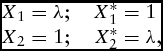
As for trade, we will assume without loss of generality that Home enjoys a comparative advantage in the production of good 2 while Foreign has an advantage in good 1, with supply of both of these export goods inelastic at unity. Simplifying again, the competitive disadvantage in good 1 (Home) and good 2 (Foreign) can be expressed by parameter λ with 0 < λ < 1 and with the disadvantage decreasing as the parameter approaches unity. Measuring the lack in competitiveness, λ is thus also an index of the stake import-competing interest groups have in protection. This supply side ensures that, given the same downward sloping demand curve in Home and Foreign, prices of these goods in autarky are higher, the smaller λ and, naturally, also higher than abroad (and so are local rents). Supply (X) in Home and Foreign is thus
 \begin{equation}
\begin{array}{l}
X_1 = \lambda ;\quad X_1^* = 1 \\
X_2 = 1;\quad X_2^* = \lambda , \\
\end{array}\end{equation}
with subscripts 1 and 2 for goods 1 and 2 respectively. We follow common practice in that variables with an asterisk refer to Foreign. With λ < 1, Home (Foreign) is thus a natural importer of good 1 (2). Because of the inelastic supply and the rents associated therewith, Home's import substitution industry (good 1) has a vested interest in protection while its export industry (good 2) would benefit from free access to markets abroad. The same applies with respect to Foreign, there, however, with the sign reversed.
Suppose furthermore that demand (D) is in any case a simple downward sloping curve of domestic prices p, that is, prices including tariffs or tariff equivalents of other import restrictions:
 \begin{equation}
\begin{array}{l}
D_1 \left( {p_1 } \right) = 1 - p_1 ;\quad D_1^* \left( {p_1^* } \right) = 1 - p_1^* \\
D_2 \left( {p_2 } \right) = 1 - p_2 ;\quad D_2^* \left( {p_2^* } \right) = 1 - p_2^* . \\\end{array}\end{equation}
With trade, albeit restricted, arbitrage conditions are thus p 1 = p*1 + τ and p*2 = p 2 + τ*, with τ, τ* nominal protection (tariff equivalent) rates in Home and Foreign, respectively. Markets for both goods are cleared via trade, implying that supply equals demand for each of them:
 \begin{equation}
X_1 \left( \lambda \right) + X_1^* = D_1 \left( {p_1 } \right) + D_1^* \left( {p_1^* } \right);\quad X_2 + X_2^* \left( \lambda \right) = D_2 \left( {p_2 } \right) + D_2^* \left( {p_2^* } \right).\end{equation}
Market-clearing prices depend inter alia on the competitiveness of the import-substitution industry as measured by parameter λ, as does the import-substitution industries’ stake in protection. The natural coalition partner in the quest for protection is either the government (when collecting tariff revenue) or all those political groups that receive the equivalence of the tariff revenue in the form of rents. The potential opposition is, as usually, formed by the export industry and the consumers whose real income would be higher because of cheaper imports, in case tariffs were removed.
It might be clear who is the potential winner and who is the potential loser when markets are opened up. Yet, it is much less clear how preferences are aggregated in the political process. We will thus distinguish between stakes of vested interests in a particular political regime and their political leverage: as for a general approach, and for reasons mentioned in the introduction, we will assume that preferences are amalgamated into political objective functions V (V* for Foreign) by means of parameter μ with 0 < μ < 1. Hence, parameter μ is a measure of the leverage of protectionist interests versus free-trade interests (that is, the import-substitution industry and recipients of tariff revenue versus the consumers and export industry) – which may well differ from their stake in protection as parameterized by λ. However, notwithstanding problems of aggregation, the respective stakes continue to be measured by consumer (CS) and producer surpluses (PS) as they depend on λ. Consumer surplus is the difference between the maximum willingness to pay and the actual market price. In our case of linear demand and prices as previously outlined, CS, for example, in the consumption of good 1 in Home is the triangle c 1(1 − p 1)/2, with c 1 actual consumption according to equation (2), p 1 market price of good 1 and unity the maximum willingness to pay. Because of the assumptions concerning supply, producer surplus PS can be simply proxied by sales revenue, that is X 1p 1. Finally, with imports M 1 ≡ D 1 − X 1, government collects tariff revenue τM 1 (similar in Foreign).Footnote 4
 \begin{equation}
\begin{array}{l}
V = \left( {1 - \mu } \right)\left( {CS_1 + CS_2 + PS_2 } \right) + \mu \left( {PS_1 + \tau M_1 } \right) \\
V^* = \left( {1 - \mu } \right)\left( {CS_1^* + CS_2^* + PS_1^* } \right) + \mu \left( {PS_2^* + \tau ^* M_2^* } \right). \\
\end{array}\end{equation}
Note that this does not imply that politicians act on behalf of their constituents with complete knowledge of their preferences and foresight as regards the implications of policies. The contrary might be the case: the parameterization with respect to the stakes and the leverage not only covers a wide range of possible ways as to how special interests feed into the political will, it can also be interpreted as a fuzziness with respect to perceptions. With these quite general assumptions concerning the aggregation of interests, we can take a closer look at the incentives (and thus the chances) for sustaining a particular trade regime in the presence of interest groups with stakes λ and political leverage μ.
3. When does a prisoner's dilemma arise?
We will start out with the main argument that is often advanced in support of formal international institutions such as the WTO, namely that otherwise countries would wind up in a prisoner's dilemma from which they cannot free themselves as no country (or policy maker) is ready to make a first move. As alluded to in the introduction, removing barriers to trade while others keep their markets protected, so the argument, would imply a worsening of the terms-of-trade respectively a loss of political support. Given a situation like this, countries are thus stuck with protectionist regimes, and, one might add, with world output smaller than otherwise.
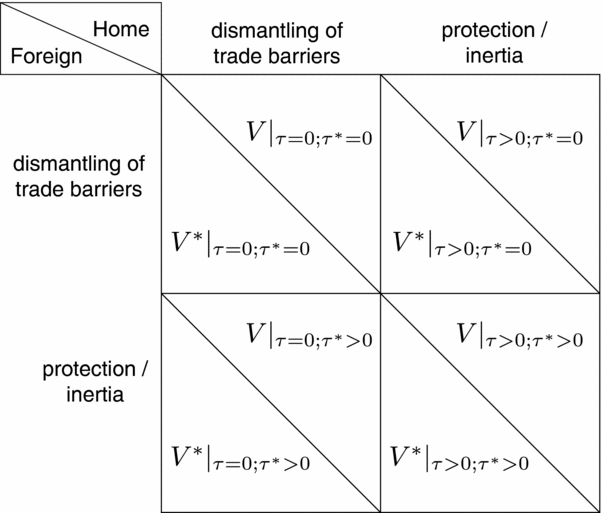
However, a scenario thus bleak need not materialize. Consider the ranking of strategies in a ‘one-shot game’ of two policy makers (from Home and Foreign) with preferences V, V* driven by domestic political support. This is the typical setting under which a prisoners’ dilemma in the governance of trade is said to loom large. Figure 1 displays the basic scenario with politically perceived pay offs conditional on policies as indicated by subscripts, that is, for example, .V|τ > 0; τ* = 0 in case of an asymmetric protection of Home's import-substitution industry.
Pay offs: ‘one-shot trade policies’

Whether protectionism really prevails depends on the two aforementioned parameters in particular: (i) the international competitiveness of the local industry (as measured by parameter λ) and (ii) the leverage of domestic interests seeking protection (as measured by parameter μ). They are both crucial to the ranking and sustainability of policy regimes. Although domestic interests seeking protection have a saying in policy formation and although the chance that Foreign's policy makers might reciprocate does not have a bearing on Home's policy makers’ strategy, protectionism need not obtain. Hence, on a conceptual basis, the prisoner's dilemma does not always reflect governance issues in trade. Note though, that this conjecture is not based on a welfare-theoretic account but on pay offs as politically perceived; those pay offs need by no means coincide with the underlying welfare-theoretic account.
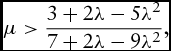
In order for protection to be politically perceived superior despite both parties being better off in case of mutual trade liberalization, the leverage μ of vested interests must fall within a certain range, with the range in turn conditional on the stake λ those interests may have in a protectionist regime. Under Nash assumptions, protectionism is perceived a strictly dominant strategy iff .V|τ > 0; τ* = 0 > .V|τ = 0; τ* = 0 and .V|τ > 0; τ* > 0 > .V|τ = 0; τ* > 0. This condition implies a lower bound on the leverage of vested interests μ: inserting the respective values of consumer and producer surplus, and, if applicable, tariff revenues or related rents into the objective function of policy makers, according to equation (4) shows that outcomes .V|τ > 0; τ* = 0 and .V|τ = 0; τ* = 0 as perceived by policy makers depend on interest-group parameters μ and λ. Solving the inequality for political weights μ then yields pivotal values μ for protection to outperform trade liberalization, even if subjective. Hence, defection (protection) politically outperforms cooperation (trade liberalization) iff
 \begin{equation}
\mu > \frac{{3 + 2\lambda - 5\lambda ^2 }}{{7 + 2\lambda - 9\lambda ^2 }},\end{equation}
thus implying a lower bound on the leverage μ. The pivotal leverage increases in the competitiveness λ of the import-substitution industry: the more competitive the industry, the higher must be the leverage in order to overcome the smaller stakes of their clientele in a protectionist regime (with ∂μ/∂λ = 8/(9λ + 7)2 > 0 for all values of 0 < λ < 1). The same applies with respect to the ranking of outcomes .V|τ > 0; τ* > 0 and .V|τ = 0; τ* > 0.
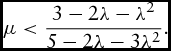
The nexus between both of the parameters, however, is much richer than the focus on dominant strategies suggests. This is because for a ‘pure’ prisoner's dilemma (Kuhn and Moresi, Reference Kuhn and Moresi1995: 335; Rapoport and Chammah, Reference Rapoport and Chammah1965: 34) to obtain, expected outcomes in case of mutual cooperation (here: in trade liberalization) must be considered even better, thus reflecting the ‘true dilemma’. Henceforth, the situation is perceived as a ‘pure’ prisoner's dilemma when the following ranking obtains: .V|τ > 0; τ* = 0 > .V|τ = 0; τ* = 0 > .V|τ > 0; τ* > 0 > .V|τ = 0; τ* > 0 and 2.V|τ = 0; τ* = 0 > (.V|τ > 0; τ* = 0 + .V|τ = 0; τ* > 0). Both of these conditions yield an upper bound on the political leverage μ of domestic interest groups: inserting again values of consumer and producer surpluses, and, if applicable, tariff revenues into equation (4) yields politically expected outcomes of the respective strategies. Solving for the critical μ for which inequalities hold then requires μ not to be too large:
 \begin{equation}
\mu < \frac{{3 - 2\lambda - \lambda ^2 }}{{5 - 2\lambda - 3\lambda ^2 }}.\end{equation}
Here, the condition on the leverage μ is decreasing in the stake λ: the higher the competitiveness of the import-substitution industry, the smaller must be the leverage of protectionist interests in order for the strategic interaction to give rise to a ‘true dilemma’ in the sense that mutual liberalization would have been better (that is ∂μ/∂λ = −4/(3λ + 5)2 < 0 for all values of 0 < λ < 1).
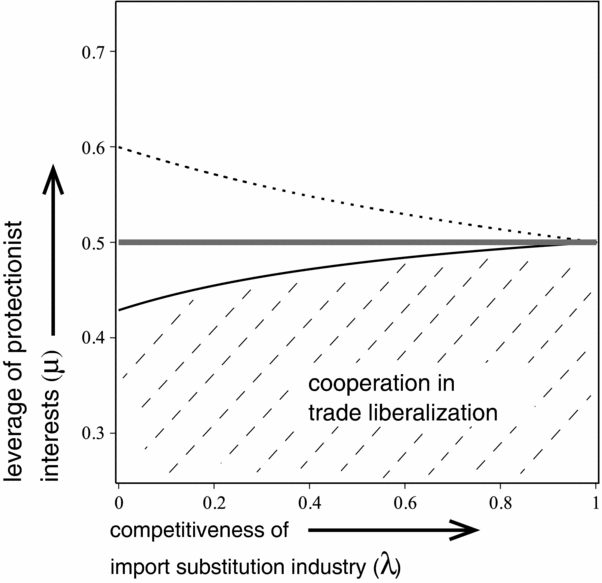
Figure 2 displays pivotal values of interest-group parameters according to equations (5) and (6). The perception of protectionism to pay off politically (that is equation (5)) corresponds to the upward sloping curve, with all combinations (λ, μ) above implying that protection is politically preferred over liberalization (and for all values below the reverse). The upper bound on the leverage μ (that is equation (6)) corresponds to the downward sloping curve, with all combinations (λ, μ) below reflecting that mutual trade liberalization would have been considered even better an outcome.
Strategy space with leverage factor μ
The hatched area indicates the parameter combinations for which cooperation in trade liberalization obtains despite the presence of groups sharing an interest in protectionism; the area between the upward and the downward sloping boundary shows the range for which the situation is perceived as in a ‘pure dilemma’. The range shows the value of a rigorous formal analysis, as does the fact that the parameters have somewhat of a different impact, which also comes out of the analysis.
4. Evolutionary stable strategies in reciprocating trade policies: what are the chances for the emergence of cooperation in trade liberalization?
However, in evolutionary perspective, outcomes also depend on the expected pay off from a continuing trade relationship. This raises the bars for protectionism because in case of TFT trade relationships are at risk. The risk of a protectionist regime facing retaliation is to be included as a cost in any comparison of strategies. In line with repeated interaction models let parameter q thus denote the expected frequency of trade in the future.
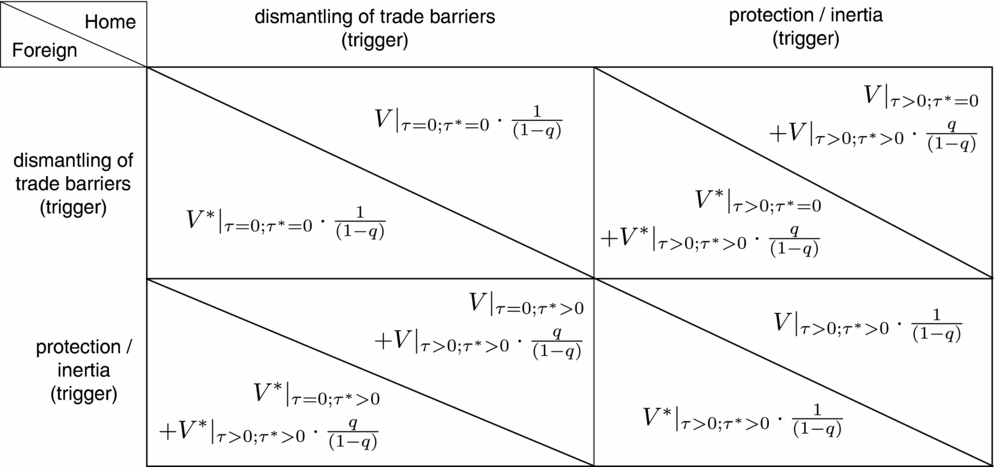
Parameter q may include a discount rate or not. Adding another, explicit, time-specific element, however, does not change the calculus in any substantial way. Therefore, we will leave open what kind of information or characteristics of preferences enter q and instead interpret q as an amalgamation of (eventually) highly subjective considerations. Presumably, initial behavior triggers either cooperation in trade liberalization or retaliation of protectionist strategies along TFT lines. Figure 3 has the expected pay offs in repeated interaction, with .V|τ = 0; τ* = 0, .V|τ > 0; τ* = 0, .V|τ = 0; τ* > 0, .V|τ > 0; τ* > 0, as previously noted (see equations (8) in the Appendix).
Pay offs: ‘trigger strategies in trade policies’
Trigger strategies then imply a lower bound on the (subjective) frequency parameter q for reciprocating trade liberalization to obtain. According to Axelrod and Hamilton (Reference Axelrod and Hamilton1981: 1393), TFT must outperform three alternative strategies, namely
- a strategy of always cooperating (liberalizing),
- a strategy of defection (protection) despite cooperation of the opposite party, which eventually triggers protection, and
- a strategy of alternating between defection (in this case: protection), and cooperation (liberalization).
Since, in effect, the first strategy can be expected to yield the same outcome as TFT, Axelrod and Hamilton (Reference Axelrod and Hamilton1981: 1393) assume that it does not crowd out an established TFT. They thus consider only two strategies potentially threatening TFT, namely those listed second and third. Accordingly, evolutionary stability requires that TFT does better than those. Maynard Smith (Reference Maynard Smith1976: 42; Reference Maynard Smith1982: 14–24) and Maynard Smith and Price (Reference Maynard Smith and Price1973: 17), by contrast, do not consider doing equally well a sufficient condition for non-invasion, as, for instance, the mutants might do better than the established strategy when facing another mutant. In addition, they account for the possibility of randomly mixed strategies. While these modifications might be important in some circumstances, they are less relevant in a trade-policy nexus. A strategy of ‘always cooperate’ amounts to unilateral trade liberalization. Yet, it is exactly for political-economy reasons why unilateralism is seldom, if ever, observed. Randomness will be an issue when we embed the bilateral perspective into an n-country setting. For the time being, we can thus safely follow Axelrod and Hamilton by considering the two remaining alternatives to carry over to trade policy, however, here, in modified form, so as to reflect international interdependence. That is, pay offs are endogenous (as are trade flows and rents). TFT in trade regimes then outperforms the two alternative trigger strategies iff:
 \begin{equation*}
\left. V \right|_{\tau = 0;\tau ^* = 0} /\left( {1 - q} \right) > \left. V \right|_{\tau > 0;\tau ^* = 0} + \left( {\left. V \right|_{\tau > 0;\tau ^* > 0} } \right)q/\left( {1 - q} \right),\end{equation*}
 \begin{equation*}
\wedge \left. V \right|_{\tau = 0;\tau ^* = 0} /\left( {1 - q} \right) > \left( {\left. V \right|_{\tau > 0;\tau ^* = 0} } \right)/\left( {1 - q^2 } \right) + \left( {\left. V \right|_{\tau = 0;\tau ^* > 0} } \right)q/\left( {1 - q^2 } \right).\end{equation*}
Solving for q yields
 \begin{equation}
\left. {\begin{array}{*{20}c}
{q \ge \frac{{\left. V \right|_{\tau > 0;\tau ^* = 0} - \left. V \right|_{\tau = 0;\tau ^* = 0} }}{{\left. V \right|_{\tau > 0;\tau ^* = 0} - \left. V \right|_{\tau > 0;\tau ^* > 0} }}} \\[7pt]
{ \wedge q \ge \frac{{\left. V \right|_{\tau > 0;\tau ^* = 0} - \left. V \right|_{\tau = 0;\tau ^* = 0} }}{{\left. V \right|_{\tau = 0;\tau ^* = 0} - \left. V \right|_{\tau = 0;\tau ^* > 0} }}} \\
\end{array}} \right\} = \frac{{\left( {5\lambda ^2 - 2\lambda - 3} \right) + \mu \left( {7 + 2\lambda - 9\lambda ^2 } \right)}}{{\left( {1 - \mu } \right)3\left( {1 - \lambda } \right)^2 }}.\end{equation}
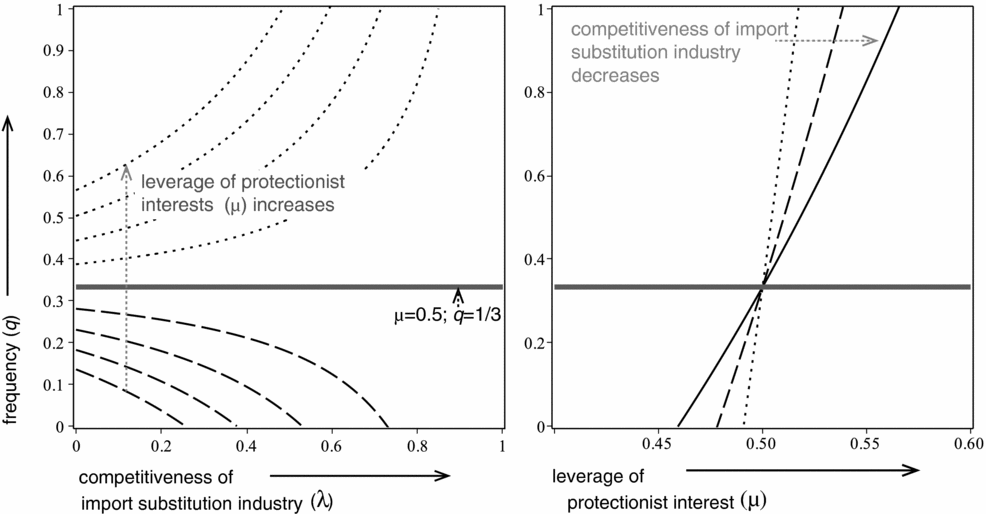
Figure 4 displays pivotal values for q. The LHS panel of Figure 4 shows the nexus between the competitiveness of the import-competing industry and the threshold level of q that must be attained for mutual trade liberalization to be considered politically superior to protection. Parameter combinations above a particular curve (with each curve corresponding to a particular leverage μ of protectionist interests and with μ increasing from the bottommost to the topmost curve) sustain cooperation in trade liberalization with the trade regime evolutionary stable while those below do not. At the horizontal line, i.e. at μ = 0.5, q is independent of the interest groups’ stakes as measured by λ, with protectionism prevailing for all q below one third and trade liberalization above.
Evolutionary stable strategies with leverage factor μ
For values of μ below 0.5 (dashed lines), the lower bound on q for trade liberalization being evolutionary stable decreases in λ for any given leverage μ (i.e. along a particular dashed line); for all values of μ above 0.5 (dotted lines), it increases in λ. The former result obtains because of dead-weight losses weighing more heavily in case of μ < 0.5 while increasing in λ whereas in case of the latter the opposite holds. In any case, the lower bound on q increases in μ for any given λ. However, the shadow of the future as represented by the frequency q continues to play an important role, even with the political weight of special interests μ and the stake parameter λ as intervening parameters. While the pattern is much richer when special interest driven it is still very much in line with the Axelrod-literature on cooperation. There is thus more to TFT than just a fest for vested interests.
The RHS panel of Figure 4 switches perspective by displaying the nexus in μ–q-space. Curves rotate clockwise around the point (q = 1/3; μ = 0.5) as competitiveness decreases, with λ = 0.75 (dotted line), λ = 0.5 (dashed line), λ = 0.25 (solid line). Hence, for any given subjective frequency parameter q, the range of μ, for which TFT is evolutionary stable, is larger the lower λ, provided q is larger than one third; with q smaller, the reverse applies. Note the difference that shows up in formal analysis as regards both of the interest-group parameters, which turns out to be conditional on the actual value of q.
However, environments may be more hostile than previously assumed, hosting outright protectionist countries. How, then, do vested interests influence TFT? Answering this question requires to embed trade regimes and resulting trade flows into the ‘fitness of groups’ as outlined by Maynard Smith (Reference Maynard Smith1976: 42). Suppose, therefore, that, at most, a fraction Q follows TFT whereas the complementary set, (1 – Q), does not.
In this world, it must be that TFT fares better in the eyes of the policy maker whomever he faces. Hence,
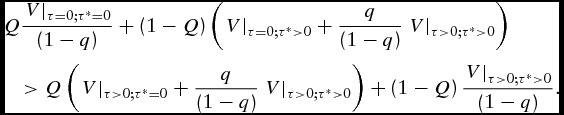 \begin{eqnarray*}
Q\frac{{\left. V \right|_{\tau = 0;\tau ^* = 0} }}{{\left( {1 - q} \right)}} + \left( {1 - Q} \right)\left( {\left. V \right|_{\tau = 0;\tau ^* > 0} + \frac{q}{{\left( {1 - q} \right)}}\left. V \right|_{\tau > 0;\tau ^* > 0} } \right)\nonumber\\
\quad > Q\left( {\left. V \right|_{\tau > 0;\tau ^* = 0} + \frac{q}{{\left( {1 - q} \right)}}\left. V \right|_{\tau > 0;\tau ^* > 0} } \right) + \left( {1 - Q} \right)\frac{{\left. V \right|_{\tau > 0;\tau ^* > 0} }}{{\left( {1 - q} \right)}}.\end{eqnarray*}
Inserting .V|τ = 0; τ* = 0, .V|τ > 0; τ* = 0, .V|τ = 0; τ* > 0, .V|τ > 0; τ* > 0 as previously and solving for Q yields
 \begin{equation*}
Q > \frac{1}{2}\frac{{\left[ {5\lambda ^2 - 2\lambda - 3 + \mu \left( {7 + 2\lambda - 9\lambda ^2 } \right)} \right]}}{{\left[ {3 - 2\lambda - \lambda ^2 + \mu \left( {3\lambda ^2 + 2\lambda - 5} \right)} \right]}}\frac{{\left( {1 - q} \right)}}{q}.\end{equation*}
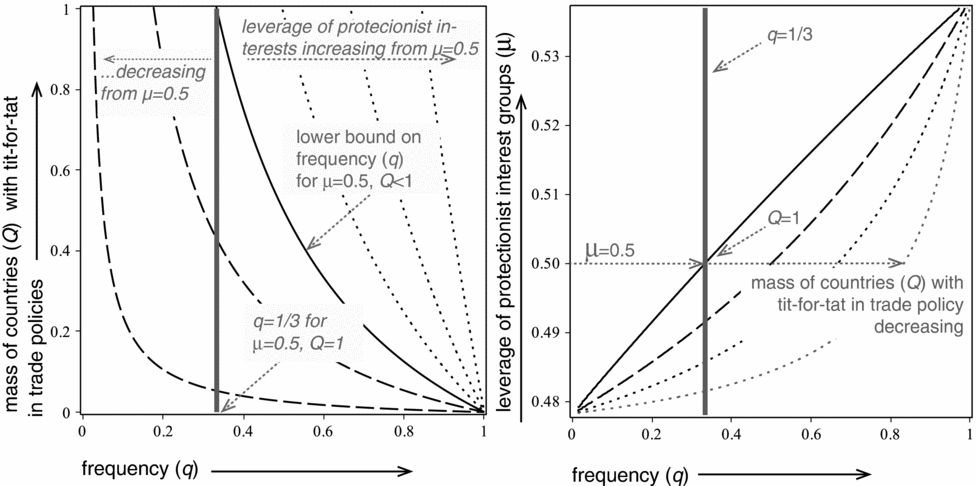
Figure 5 displays results. To display results in two dimensions, we assume without loss of generality that λ = 0.5. The vertical line in the LHS panel shows results for Q = 1, μ = 0.5, with q > 1/3 the pivotal value for trade liberalization to be evolutionary stable. This corresponds with a world of TFT-players as previously outlined. The solid downward sloping line displays the lower bound on q for values of Q < 1, that is, in a more hostile world, with the lower bound on q higher the smaller the probability Q, provided μ = 0.5. The nexus Q, q thus reflects a trade off between the mass of countries with TFT strategies and subjective frequency q in trade. Starting from a situation in which μ = 0.5, it rotates clockwise around the point (Q = 0; q = 1) for values of μ > 0.5 and increasing (dotted lines) and counterclockwise for values of μ < 0.5 and decreasing (dashed lines).
Lower bounds on q, Q with leverage factor μ parameterized
The RHS panel of Figure 5 shows the nexus between the leverage of protectionist groups μ and frequency parameter q. The upward sloping solid line displays pivotal combinations (q, μ) in a world of TFT as previously outlined (i.e. Q = 1). A lower fraction Q, i.e. moving horizontally from left to right, is more demanding on the pivotal value q for catering to a regime of free trade. Hence, TFT tends to unfold a disciplining force with respect to cooperation in trade liberalization, and establishes a trajectory towards effective multilateralization of trade regimes – even in a world populated by special interests and (some) generally protectionist countries.
Hence, this paper takes a different tack on protection than much of (normative) welfare economics. There are certainly also a number of normative reasons put forward as to why the verdict on protection might differ from its traditional welfare-theoretic account according to which it is costly for those imposing as well as those facing restrictions (on this see, for instance, Gomory and Baumol, Reference Gomory and Baumol2001 and the discussion following Chang, Reference Chang2011). Notwithstanding the arguments pro and con in this strand of the literature, we have presented another, political-economy cum institutional-economics perspective, on protection. In this perspective, protection serves to enforce compliance with a set of rules. In a world of sovereign states, where there is no external power, enforcement must come from within. TFT is one such strategy that is, in principle, capable of sustaining institutions.
From this perspective, WTO membership is a signal to employ a strategy of TFT for enforcing rules-based behavior (thus effectively increasing Q). However, TFT is equally widespread in bi- and pluri-lateral conflicts. And, as shown, it is fairly robust vis-à-vis the political economy of domestic interests, which might try to capture trade policy to serve their special interests rather than the common good. This property, in addition to the strategy being fairly simple to understand, caters to its frequent use, with the threat of retaliation often sufficient to ensure compliance. Notably, this is not an excuse for any kind of protection in any kind of situation. Far from it. However, the fact that conflicts usually do not escalate and degenerate into trade wars is in line with our perspective on TFT. Whether the time of the great depression is an exception to the rule is fiercely debated (Irwin, Reference Irwin1998; Kindleberger, Reference Kindleberger1986: Ch.10). Notably, empirical work by Dluhosch and Horgos (Reference Dluhosch and Horgos2013) based on the WTO's dispute settlement process suggests that, on average, countries, which are more often involved in the WTO's dispute settlement's threat of TFT are eventually more open to trade than other countries. This is broadly consistent with the political-economy approach to institutions as presented here.
Because strategies affect trade flows and specialization, effects are far from straightforward. Rents of vested interests are subject to change, as are politically perceived payoffs. While TFT in this analysis shares some results known from self-enforcing institutional economics, there are also some twists and qualifications that emerge from our analysis: e.g., a higher political leverage does not necessarily cater to a ‘pure prisoner's dilemma’ – as one might think prima facie; and the stakes have quite different implications, depending on whether other parameters are above or below a particular threshold value (see Figure 4). These are just two examples among a set of results, which emerge from a more rigorous theoretic analysis of the evolution of institutions in trade, which stretch beyond the traditional abstract iterative reasoning.
Naturally, a free trade regime does not emerge under each and every constellation of domestic interest groups. As such, TFT is no panacea. Nor do the results imply that TFT is in any case considered a superior strategy over any other strategy that might be available, including possibly the linking of trade issues with other policies, side payments or other forms of implicit or explicit compensation that effectively ‘bribe’ protectionist interest groups or else tame their appetite and their vigorous effect. A complementary comparative institutional analysis might thus be an interesting extension.
5. Conclusions
Although criticized on a number of accounts, TFT is a well-known strategy in supporting social cooperation. However, its applications extend well beyond the (small-) group setting into the field of international politics and international political economy in particular. For instance, in trade policy, TFT is considered a strategy for enforcing more open trade regimes. As such, TFT is even formally institutionalized in case of trade conflicts within the DSU under the roof of the WTO. However, there, as elsewhere, TFT is not embraced without qualification. Reservations are brought forward irrespective of whether it is employed as an informal or a formal institution in all issues relating to trade policy regimes. In particular domestic interest groups are considered as possibly detrimental to its working because TFT might hold out the prospect of protection and the legitimization for protectionist measures. If so, TFT would provide a fest for vested interests thus undermining rather than strengthening cooperation in trade liberalization.
As has been convincingly pointed out by Milner (Reference Milner1992: 493), domestic interest groups do play an important role in (framing) international cooperation. Trade policy is an example par excellence of the relevance that both of the levels, the domestic and the international, are intertwined via political-economy issues pertaining to special interests. However, rather than TFT in trade policy being the result of the rent seeking of interest groups, TFT serves as an institutional arrangement for keeping vested interests in check. Hence, as has been shown in this study, the causality runs the other way round. Insofar, the ‘TFT-controversy’ misses somewhat the point. TFT is supposed to remedy the deficiencies and the problems of trade policy in an environment in which politics is spoiled by special interests.
By embedding domestic interest groups in a trade policy cum TFT framework along Axelrod–Rapoport lines, we show that TFT actually tends to widen the constellations that support more open trade regimes. The paper provides a novel approach in that it covers a wide range of possible constellations by parameterizing the political leverage interest groups might have in addition to their stake in protectionism. It explores the circumstances under which TFT proves evolutionary stable even in a world, in which some countries are outright protectionist. Notably, what matters for a more open trade regime to emerge and to be sustained is the threat and the capacity to retaliate, no matter whether formally institutionalized or not. The concern that domestic interest groups might interfere with TFT as an informal or formal institution for cooperation in trade liberalization is thus less severe than it might seem at first sight.
Clearly, there is no such thing as a perfect institutional arrangement and TFT is no exception to that. There are constellations in which vested interests, either because of their heavy stakes in protection or their political power (with both of them affecting policy somewhat differently) cater to the political perception that protection pays off, even when this comes at the expense of the society at large and even when facing the threat of retaliation. Hence, TFT is not a cure all. And there is no doubt that retaliation in trade policy is subject to some caveats. One such caveat is that there must not be an overdose. The notion of ‘equivalence’ is implicitly underlying TFT, and, as such, serves as sort of a focal point in the Schelling-sense (Schelling, Reference Schelling1960: 57). Although itself not precisely definable and subject to (possibly different) interpretations, the general idea might be one of the reasons as to why TFT is so popular and obviously fairly well understood. This underlying principle ensures that TFT in trade policies is less prone to asymmetric ‘hawkish behavior’ as, for instance, feared by Kim and Kim (Reference Kim and Kim2013) or, as alluded to in the introduction, to being ill-used. In fact, the risk that TFT in trade policies runs the danger of triggering a trade war is limited from two sides: first of all, the threat of retaliation possibly echoing another round of retaliation (of nearly equal damage) acts as an implicit, that is, built-in, brake on policy falling victim to false claims by vested interests; secondly, as for instance, established explicitly within the DSU of the WTO, retaliation has to be commensurate to the nature of the violation and the damage related therewith. Despite its vagueness as to what is commensurate, the explicit reference serves as another safeguard and thus as a second line of defense for making TFT less vulnerable to being ill-used. Hence, as far as trade policy is concerned, actual practice is consistent with the theoretical underpinning as presented here.
In a great many instances, policy has to overcome vested interests. Institutional arrangements – in the sense of rules governing behavior – are supposed to limit the leverage of special interests on politics. Insofar, all institutional arrangements have to cope with special interests. However, at the international level, and unlike at the national level, there is no truly external power that can solve conflicts of interpretation and that can enforce the rule of law, including the compliance with treaties governing international trade policy. The very nature of international matters implies a shift toward institutional arrangements such as TFT. Hence, TFT has to be seen in this light and not to be judged against a virtual alternative in some variant of the ‘nirwana approach’ (Demsetz, Reference Demsetz1969: 1). Institutional arrangements are imperfect. And while unilateral trade liberalization might be the preferred alternative in the abstract, special interests are a matter of life and in fact the very problem as to why international politics takes resort to institutions such as TFT.
Acknowledgements
The author wishes to thank the anonymous reviewers of this journal for valuable comments and suggestions.
Appendix
Market clearing according to equation (4) yields prices as depending on competitiveness λ and tariff distortion τ, τ* in Home's respectively Foreign's import substitution and export industries
 \begin{equation*}
p_1 = \frac{{\left( {1 - \lambda } \right) + \tau }}{2};\quad p_1^* = \frac{{\left( {1 - \lambda } \right) - \tau }}{2},\end{equation*}
 \begin{equation*}
p_2 = \frac{{\left( {1 - \lambda } \right) - \tau ^* }}{2};\quad p_2^* = \frac{{\left( {1 - \lambda } \right) + \tau ^* }}{2}.\end{equation*}
Inserting prices in the demand function yields aggregate demand in Home and Foreign
 \begin{equation*}
D_1 \left( {p_1 } \right) = \frac{{\left( {1 + \lambda } \right) - \tau }}{2};\quad D_1^* \left( {p_1^* } \right) = \frac{{\left( {1 + \lambda } \right) + \tau }}{2},\end{equation*}
 \begin{equation*}
D_2 \left( {p_2 } \right) = \frac{{\left( {1 + \lambda } \right) + \tau ^* }}{2};\quad D_2^* \left( {p_2^* } \right) = \frac{{\left( {1 + \lambda } \right) - \tau }}{2}^* .\end{equation*}
Consumer surplus in Home is CSi = Di(pmax − pi)(1/2) with pmax = 1 according to equation (2) and i = 1, 2 (correspondingly in Foreign). Inserting demand and prices yields
 \begin{equation*}
CS_1 = \frac{{\left( {1 - p_1 } \right)^2 }}{2} = \frac{{\left[ {\left( {1 + \lambda } \right) - \tau } \right]^2 }}{8};\quad CS_1^* = \frac{{\left( {1 - p_1^* } \right)^2 }}{2} = \frac{{\left[ {\left( {1 + \lambda } \right) + \tau } \right]^2 }}{8},\end{equation*}
 \begin{equation*}
CS_2 = \frac{{\left( {1 - p_2 } \right)^2 }}{2} = \frac{{\left[ {\left( {1 + \lambda } \right) + \tau ^* } \right]^2 }}{8};\quad CS_2^* = \frac{{\left( {1 - p_2^* } \right)^2 }}{2} = \frac{{\left[ {\left( {1 + \lambda } \right) - \tau ^* } \right]^2 }}{8}.\end{equation*}
Neglecting costs in order to facilitate the analysis, producer surplus PS equals sales revenue
 \begin{equation*}
PS_1 = X_1 p_1 = \lambda p_1 = \lambda \frac{{\left( {1 - \lambda } \right) + \tau }}{2};\quad PS_1^* = X_1^* p_1^* = p_1^* = \frac{{\left( {1 - \lambda } \right) - \tau }}{2},\end{equation*}
 \begin{equation*}
PS_2 = X_2 p_2 = p_2 = \frac{{\left( {1 - \lambda } \right) - \tau ^* }}{2};\quad PS_2^* = X_2^* p_2^* = \lambda p_2^* = \lambda \frac{{\left( {1 - \lambda } \right) + \tau ^* }}{2},\end{equation*}
with imports the difference between local demand and supply
 \begin{equation*}
M_1 = D_1 \left( {p_1 } \right) - X_1 = \frac{{\left( {1 - \lambda } \right) - \tau }}{2};\quad M_2^* = D_2^* \left( {p_2^* } \right) - X_2^* = \frac{{\left( {1 - \lambda } \right) - \tau ^* }}{2}.\end{equation*}
Assuming a myopic government that squeezes out the max in tariff revenue respectively rents, i.e. ∂(τM 1)/∂τ = 0, tariffs are τ = (1 − λ)/2 (in Foreign: τ* = (1 − λ)/2). Inserting this policy into all relevant functions yields the following set of intermediate results, with results corresponding to particular policies as indicated by a vertical bar.
 \begin{equation*}
\left. {p_1 } \right|_{\tau = 0} = \frac{{\left( {1 - \lambda } \right)}}{2};\quad \left. {p_2 } \right|_{\tau ^* = 0} = \frac{{\left( {1 - \lambda } \right)}}{2};\quad \left. {p_1^* } \right|_{\tau = 0} = \frac{{\left( {1 - \lambda } \right)}}{2};\quad \left. {p_2^* } \right|_{\tau ^* = 0} = \frac{{\left( {1 - \lambda } \right)}}{2},\end{equation*}
 \begin{equation*}
\left. {p_1 } \right|_{\tau > 0} = \frac{{3\left( {1 - \lambda } \right)}}{4};\hspace*{5pt} \left. {p_2 } \right|_{\tau ^* > 0} = \frac{{\left( {1 - \lambda } \right)}}{4};\hspace*{5pt} \left. {p_1^* } \right|_{\tau > 0} = \frac{{\left( {1 - \lambda } \right)}}{4};\hspace*{5pt} \left. {p_2^* } \right|_{\tau ^* > 0} = \frac{{3\left( {1 - \lambda } \right)}}{4},\end{equation*}
 \begin{equation*}
\left. {D_1 } \right|_{\tau = 0} = \frac{{\left( {1 + \lambda } \right)}}{2};\quad \left. {D_2 } \right|_{\tau ^* = 0} = \frac{{\left( {1 + \lambda } \right)}}{2};\quad \left. {D_1^* } \right|_{\tau = 0} = \frac{{\left( {1 + \lambda } \right)}}{2};\quad \left. {D_2^* } \right|_{\tau ^* = 0} = \frac{{\left( {1 + \lambda } \right)}}{2},\end{equation*}
 \begin{equation*}
\left. {D_1 } \right|_{\tau > 0} = \frac{{\left( {1 + 3\lambda } \right)}}{4};\hspace*{5pt} \left. {D_2 } \right|_{\tau ^* > 0} = \frac{{\left( {3 + \lambda } \right)}}{4};\hspace*{5pt} \left. {D_1^* } \right|_{\tau > 0} = \frac{{\left( {3 + \lambda } \right)}}{4};\hspace*{5pt} \left. {D_2^* } \right|_{\tau ^* > 0} = \frac{{\left( {1 + 3\lambda } \right)}}{4},\end{equation*}
 \begin{equation*}
\left. {CS_1 } \right|_{\tau = 0} = \frac{{\left( {1 + \lambda } \right)^2 }}{8};\quad \left. {CS_1^* } \right|_{\tau = 0} = \frac{{\left( {1 + \lambda } \right)^2 }}{8},\end{equation*}
 \begin{equation*}
\left. {CS_2 } \right|_{\tau ^* = 0} = \frac{{\left( {1 + \lambda } \right)^2 }}{8};\quad \left. {CS_2^* } \right|_{\tau ^* = 0} = \frac{{\left( {1 + \lambda } \right)^2 }}{8},\end{equation*}
 \begin{equation*}
\left. {CS_1 } \right|_{\tau > 0} = \frac{{\left( {1 + 3\lambda } \right)^2 }}{{32}};\quad \left. {CS_1^* } \right|_{\tau > 0} = \frac{{\left( {3 + \lambda } \right)^2 }}{{32}},
\end{equation*}
 \begin{equation*}
\left. {CS_2 } \right|_{\tau ^* > 0} = \frac{{\left( {3 + \lambda } \right)^2 }}{{32}};\quad \left. {CS_2^* } \right|_{\tau ^* > 0} = \frac{{\left( {1 + 3\lambda } \right)^2 }}{{32}},\end{equation*}
 \begin{equation*}
\left. {PS_1 } \right|_{\tau = 0} {=} \frac{{\lambda \left( {1 - \lambda } \right)}}{2};\hspace*{5pt} \left. {PS_2 } \right|_{\tau ^* = 0} {=} \frac{{\left( {1 - \lambda } \right)}}{2};\hspace*{5pt} \left. {PS_1^* } \right|_{\tau = 0} {=} \frac{{\left( {1 - \lambda } \right)}}{2};\hspace*{5pt} \left. {PS_2^* } \right|_{\tau ^* = 0} {=} \frac{{\lambda \left( {1 - \lambda } \right)}}{2},\end{equation*}
 \begin{equation*}
\left. {PS_1 } \right|_{\tau > 0} = \frac{{3\lambda \left( {1 - \lambda } \right)}}{4};\quad \left. {PS_1^* } \right|_{\tau > 0} = \frac{{\left( {1 - \lambda } \right)}}{4},\end{equation*}
 \begin{equation*}
\left. {PS_2 } \right|_{\tau ^* > 0} = \frac{{\left( {1 - \lambda } \right)}}{4};\quad \left. {PS_2^* } \right|_{\tau ^* > 0} = \frac{{3\lambda \left( {1 - \lambda } \right)}}{4},\end{equation*}
 \begin{equation*}
\tau M_1 = \frac{{\left( {1 - \lambda } \right)^2 }}{8};\quad \tau ^* M_2^* = \frac{{\left( {1 - \lambda } \right)^2 }}{8}.\end{equation*}
A ‘one-shot game’ yields expected pay-offs in strategies as follows:
 \begin{equation*}
\left. V \right|_{\tau = 0;\quad \tau ^* = 0} = \left( {1 - \mu } \right)\left[ {\frac{{\left( {1 + \lambda } \right)^2 }}{8} + \frac{{\left( {1 + \lambda } \right)^2 }}{8} + \frac{{\left( {1 - \lambda } \right)}}{2}} \right] + \mu \frac{{\lambda \left( {1 - \lambda } \right)}}{2},\end{equation*}
 \begin{equation*}
\left. V \right|_{\tau > 0;\hspace*{5pt} \tau ^* = 0} = \left( {1 - \mu } \right)\left[ {\frac{{\left( {1 + \lambda } \right)^2 }}{8} {+} \frac{{\left( {1 + 3\lambda } \right)^2 }}{{32}} {+} \frac{{\left( {1 - \lambda } \right)}}{2}} \right] + \mu \left[ {\frac{{3\lambda \left( {1 - \lambda } \right)}}{4} {+} \frac{{\left( {1 - \lambda } \right)^2 }}{8}} \right],\end{equation*}
 \begin{equation*}
\left. V \right|_{\tau = 0;\quad \tau ^* > 0} = \left( {1 - \mu } \right)\left[ {\frac{{\left( {1 + \lambda } \right)^2 }}{8} + \frac{{\left( {3 + \lambda } \right)^2 }}{{32}} + \frac{{\left( {1 - \lambda } \right)}}{4}} \right] + \mu \frac{{\lambda \left( {1 - \lambda } \right)}}{2},\end{equation*}
 \begin{eqnarray}
\left. V \right|_{\tau > 0;\hspace*{5pt} \tau ^* > 0} = \left( {1 - \mu } \right)\left[ {\frac{{\left( {1 + 3\lambda } \right)^2 }}{{32}} {+} \frac{{\left( {3 + \lambda } \right)^2 }}{{32}} {+} \frac{{\left( {1 - \lambda } \right)}}{4}} \right] + \mu \left[ {\frac{{3\lambda \left( {1 - \lambda } \right)}}{4} {+} \frac{{\left( {1 - \lambda } \right)^2 }}{8}} \right]\!,\!\!\!\!\!\nonumber\\
\end{eqnarray}
with .V|τ = 0; τ* = 0, .V|τ > 0; τ* = 0, .V|τ = 0; τ* > 0, .V|τ > 0; τ* > 0 corresponding to Figure 1 and to respective trigger entries in Figure 3.