

1. Introduction
Government spending in the United Kingdom has soared as a result of the COVID-19 crisis. There has been a sudden and large rise in the ratio of the national debt to national income, which has catalysed an ongoing UK debate about debt sustainability and prospects of austerity. This paper proposes a fiscal framework for the future, outlines the role the UK’s fiscal institutions should play in maintaining that framework and examines historical case studies to support this proposal.
In part 1 of this paper, we propose a new fiscal rule that allows the considerably expanded UK government debt to be handled responsibly yet sustainably for future generations. Our fiscal rule is based on the recognition that, in nominal terms, the cost of government debt is unlikely to exceed growth in the economy for many years to come. Our findings show that even when using highly conservative estimates of future growth, the stock of debt will be eroded. Moreover, the decline in debt stock is likely even if the country runs modest deficits for some years. It may be wise to plan to increase the stock of index-linked government bonds to ensure inflation discipline and further reassure domestic and foreign investors that the UK remains committed to its historic leadership in fiscal probity and investor protection.
It should be noted too that excessive intervention into the economy by government will impede this goal. But we note that intervention operates in two directions: excessive economic intervention by a government usually leads to misallocation of capital and an unfortunate tendency for the state to end up ‘picking losers’. On the other hand, excessive tightening, when such tightening is obviously not needed, unnecessarily undermines economic and political capital at a time when it is most needed. Government restraint (in this case, restraint from premature withdrawal of fiscal support) can be just as important as prudent long-term fiscal management in the long path to economic renewal. There is a fine balance between prudential consolidation and prudential support, but it is a balance that is worth pursuing.
History can be a guide here. In the second part of our paper, we examine historical case studies where the UK faced seemingly insurmountable debt burdens. A large spike in the stock of government debt has occurred several times in UK history. This paper draws on modern economics and Britain’s financial history and suggests a practical fiscal rule appropriate to current and future economic conditions. The rule would establish a sound basis for government finances and for debt sustainability without rushing unthinkingly to fiscal tightening.
Since the inflation of the 1970s, debt sustainability calculations have been based on assumptions of high inflation and positive real interest rates. However, in response to a one-off spike in debt, such as archetypically produced by war, such calculations can often mislead. This approach is no longer appropriate and needs revision. Rather, we argue that debt is sustainable if nominal growth is greater than the nominal interest rate, provided the government’s non-interest deficit remains contained.
The fiscal rule we propose forecasts the average nominal interest on government debt over the decade ahead, given borrowing costs signalled by financial markets today, and compares them with projected nominal GDP growth. Only if the nominal interest rate is expected to increase above the nominal growth rate will adjustment to future primary surpluses be triggered today. Otherwise, modest primary deficits can be tolerated. We propose that the Office for Budget Responsibility (OBR) provides the analysis to underpin this rule and to monitor compliance.
Nominal growth at a higher level than nominal interest rates is highly likely for the foreseeable future, meaning there is no immediate need for austerity post-COVID-19. But if private activity rebounds and nominal interest rates increase, fiscal adjustment will become necessary—though this will be largely automatic as tax revenues increase.
A sensible parallel policy to further alleviate uncertainty about future government policy would be to issue larger quantities of inflation-linked bonds. This would reassure investors as these bonds act as a self-regulating guard against unorthodox monetary behaviour, safeguarding the high reputation of UK debt management.
Although government debt may safely remain at an elevated level for a considerable time, it is important the state does not use interventions stemming from COVID-19 to interfere over the longer term with private capital-allocation decisions, even if there are imperfections as these require consideration of regulation. Elevated public debt levels would inevitably distort economic decisions and reduce long-term growth potential, which in turn would damage debt sustainability and the goal to invest in and level up every part of the country.
1.1. A sustainable fiscal framework for the future
‘It was in truth a gigantic, a fabulous debt; and we can hardly wonder that the cry of despair should have been louder than ever. But again that cry was found to have been as unreasonable as ever. After a few years of exhaustion, England recovered herself. Yet, like Addison’s valetudinarian, who continued to whimper that he was dying of consumption till he became so fat that he was shamed into silence, she went on complaining that she was sunk in poverty till her wealth showed itself by tokens which made her complaints ridiculous. The beggared, the bankrupt society not only proved able to meet all its obligations, but, while meeting those obligations, grew richer and richer so fast that the growth could almost be discerned by the eye.’
Macaulay (Reference Macaulay1848).
1.2. Part 1: Post-COVID-19, a large stock of UK government debt is sustainable
Standard public debt sustainability analysis (DSA) relies on the assumption that the nominal interest rate on government debt is higher than the nominal growth rate of the economy (i > g). Let us suppose for a moment that this is true. If so, then standard DSA notes a government primary surplus is needed to achieve ‘sustainability’—the government’s primary balance being the difference between taxes and non-interest expenditure. Primary surpluses represent the current resources generated by the government to service or pay down the stock of debt. Formally, DSA requires the net present value (NPV) of future primary surpluses to equal the debt stock today, all measured relative to GDP, to ensure sustainability.
Let us consider an example of this ‘standard’ DSA world, where i > g, with a primary surplus of 1½% of GDP and nominal GDP growth equal to 5%—composed of 3% real growth and 2% inflation. And imagine the average nominal interest on government debt is 7½%—so about 5½% real. Then it is straightforward to show that a debt-to-GDP ratio of 63% is sustainable, equal to the NPV of future primary surpluses. If the debt stock were higher than this, debt would not be sustainable and fiscal adjustment needed.
Such numbers today seem outlandish. But they were not unreasonable in the late 1980s, when the global economy was still adjusting to restrictive monetary policy measures needed to tame the Great Inflation of the 1970s. It was against the backdrop of such a disinflationary environment that current DSA was inserted into the policy narrative, and when analysts and politicians first became accustomed to metrics such as the 60% public debt target. In the context of the Maastricht Treaty negotiations, the 60% figure was rationalised thus: ‘The debt reference value is very close to the average value of this indicator for the EC [European Community] in 1991’ (Buiter et al., Reference Buiter, Giancarlo and Nouriel1993). And 60% happened to conform at that time with what was needed for sustainability considering average primary surpluses and interest and growth rates for such countries.
But the UK (and global) economy is no longer in such an environment, nor are there high nominal and real interest rates. The discussion needs to go beyond the DSA of the 1980s. The observation by Olivier Blanchard in his American Economic Association (AEA) Presidential Address that ‘not only are today’s (nominal) interest rates low, they are lower than (nominal) growth rates’ fundamentally overturns one of the cornerstones of the theory of public DSA sketched above. Indeed, in an earlier period working with the OECD in the early 1990s, Blanchard acknowledged the possibility that the nominal interest rate on public debt could fall below the nominal growth rate of the economy, in which case ‘the government could run permanent primary deficits… and these would eventually lead to a positive but constant debt level’. However, while flirting with this possibility, in this earlier paper Blanchard still fell back on the general presumption that the interest rate on government debt exceeds the growth rate—that it prevails generally’.
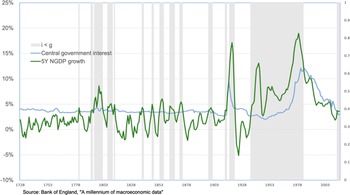
However, it might be that the 1980s and 1990s are an historical aberration—when the nominal interest rate indeed exceeded the nominal growth rate. Indeed, during the post-war period the nominal growth rate of the UK economy was consistently above the average interest rate on government debt—that is, until the 1980s. See figure 1. Taking a longer view, during the 1700s and most of the 1800s, the nominal interest rate on government debt was higher than the nominal growth rate. Yet this period was constrained by the effects of the gold standard which constrained inflation. Outside the closing decades of the last century, when current DSA frameworks were forged, it might be argued that the average nominal interest payments on government debt generally fall below the nominal growth rate, and that we have returned once more to such a situation. This has important implications for periods when public debt is driven sharply higher, as at present.
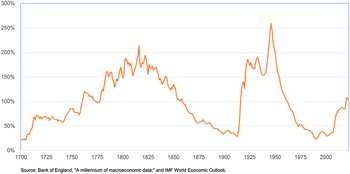
United Kingdom Debt-to-GDP, 1700 to 2022 (%). Source: Bank of England and International Monetary Fund.

First, the presumption that debt-to-GDP must be immediately reduced post-COVID-19 is not (necessarily) supported by economic theory, so the justification for a fiscal retrenchment to achieve some target debt stock needs to be carefully made. Even if i > g then there would be no theoretical presumption that public debt should be driven lower—as noted above, it would only be necessary to achieve a primary surplus sufficient to service the debt at a higher level. But when i < g even such imperative for primary balance consolidation is not clear; indeed, there is no guide from economic theory as to the necessary primary balance for given debt stock. It is conceivable that primary deficits can continue for some time without sustainability being compromised despite a sharply higher stock of public debt.
To be sure, there are some who argue that a lower public debt stock should be sought to provide ‘insurance’ in case another shock emerges. However, experience in lowering or even stabilising public debt stocks in recent decades illustrates problems with this view. But it should not be forgotten that the Nobel Prize winner James Buchanan, among many others, argued that raising taxes to pay interest on debt acted as a disincentive to work and to private sector investment.
1.3. Fiscal policy after the Brexit shock
The Brexit result was a political shock—or at the least, it was not predicted by the opinion polls. It was also an economic shock, with long-term effects that may well be still uncertain.
The NIESR considered the possible implications of the Brexit shock for fiscal policy, in a most careful paper that combined economic analysis with history (see Chadha, Reference Chadha2019).
In the conclusion we find an admirable statement of the National Institute’s position.
‘The government may be tempted to use fiscal policy to offset the slowdown, but caution must be exercised. Public debt levels are already high and risk premia have been far from eradicated. The Bank of England is the largest single holder of UK debt and that starts to erode the distinction between monetary and fiscal policy to the point where it is hard to see much of a difference. We need to think about a fiscal framework that explains “misses” from previously announced plans but promotes a sense of “timeless” fiscal sustainability. The fiscal framework needs attention before policy can be asked to allow debt to deviate for long periods from what we may think is normal.’
That last point bears on the present paper.
1.4. The government’s current fiscal rules
It is useful before turning to the details of our argument and suggestions to summarise very briefly the current set of fiscal rules in the UK. A good summary was produced by the House of Commons Library (see Keep, Reference Keep2023).
We note first in this section that we refer deliberately to the ‘current’ set of fiscal rules in the UK. As the admirable House of Commons report observes, these rules have changed with some frequency.
Some quotations from that report form a helpful background.
In the Charter for Budget Responsibility, the Government sets out how it manages the public finances. This ‘fiscal framework’ includes:
-
• The Government’s approach and objective for managing the public finances and its targets for meeting the objective. The targets are often referred to as the fiscal targets.
-
• The frequency of Budget Reports, their broad contents and how Parliament shall scrutinise them.
-
• The role and remit of the Office for Budget Responsibility (OBR).
-
• The Government’s objective for managing government debt.
-
• How government debt is managed in the UK.
-
• Since its introduction in 2011, the Charter has been revised on several occasions. The current Charter was approved by the House of Commons in February 2023 after it was proposed in the 2022 Autumn Statement. (p 5)
In this paper we focus on the ‘fiscal targets’. These are:
-
• For public sector net debt (excluding the Bank of England) as a % of GDP to be falling by the fifth year of the OBR’s forecast
-
• For public sector net borrowing to not exceed 3% of GDP by the fifth year of the OBR’s forecast
-
• To ensure that spending on welfare is contained within a predetermined cap set by the Treasury. (p 8)
The Treasury’s objective for fiscal policy is:
-
• To ensure sustainable public finances, economic growth and stability, value for money for the taxpayer, a strong balance sheet,
-
• And intergenerational fairness.
-
• The fiscal targets set out how the Government plans to meet the objective. (p8)
There have been numerous criticisms of this approach. The House of Commons Library Report (op. cit.) quotes three, after noting that the current targets are looser than what they replaced, in the sense that they focus on the fifth, rather than the third, year of the target period. (The wisdom of basing policy on such forecasts is not justified or discussed in that report.)
The report considers three criticisms in a little detail. The most interesting is that of the NIESR, which rejects such rules on the very reasonable grounds that they
‘……have limited use, both over time and across space, given the difficulties in setting rules that give enough flexibility to respond to unforeseen circumstances and given the difficulties in meeting the pre-set targets due to uncertainties about the state of the economy.’ (p20).
As will emerge, this paper is very sympathetic to that view. The other views the House of Commons study surveys, those of the OBR and the Resolution Foundation, make changes, in some ways quite substantial, to the framework, but retain the notion of a framework.
1.5. The challenge; fiscal dominance and government interference
Public debt consolidation is often accompanied by the private sector assuming greater risk—which itself results in further macroeconomic instability ahead. During the resulting slowdown, the central bank often eases monetary policy, contributing to asset price bubbles and risk taking. This can therefore create private sector sustainability challenges.
Second, should nominal interest rates move higher, it would imply fiscal adjustment is required. For example, it is sometimes argued that the nominal interest on government debt will increase for demographic reasons in the medium run. To be sure, the experience in Japan suggests this will not be the case. Indeed, beyond property and land, government debt provides a key vehicle in Japan for passing wealth between generations, implying demographic considerations support higher public debt. Still, suppose the average interest on government debt indeed increases. Policy need not react immediately except to acknowledge that if interest rates permanently increase then fiscal policy will adjust accordingly. Indeed, since the average maturity of public debt in the UK is 14.8 years, it will take some time for higher interest rates today to have a significant effect on the average interest paid on debt. During this time, it may be necessary to affect fiscal adjustment. However, it seems likely in such a case that fiscal policy will in any case adjust automatically—as private spending accelerates, competing for resources and causing the interest rate to rise, tax revenues will accrue at a faster rate, causing the primary fiscal balance to adjust accordingly. In this case, all that is required is that the fiscal steward collect the taxes that emerge to service or even repay debt.
Against the arguments in favour of a large fiscal intervention now and the slow withdrawal of fiscal support later, there remain legitimate concerns that continued state involvement in the economy will result in growing political pressure to attempt to ‘pick winners’ along with the misallocation of resources. This would be the case if otherwise unprofitable activities are not allowed to slide into obsolescence but instead are underpinned by state intervention. In fact, this would be equivalent to government intervention ‘picking losers’. Protracted government involvement distorts the distribution of resources, prevents the unleashing of private enterprise and the process of innovation and progress, and hampers the necessary post-COVID-19 and post-Brexit adjustment to changing tastes and technologies. Such intervention would in fact imply slower growth in the real economy and higher inflation. As such, it would underpin lower real incomes in the future and undermine public debt sustainability. This implies public interventions should be generous, but targeted and short term. It should be acknowledged that there are inevitable limits to knowledge about the future and that even well-run firms can fail through imperfect foresight. One persuasive means of showing commitment to the existing policy framework—including a new fiscal rule which might tolerate a higher debt stock—would be to increase issuance of index-linked bonds above historical levels.
All the above considerations suggest a new fiscal rule is appropriate. It would be one that takes a longer horizon than existing approaches and links fiscal adjustment to the projected difference between the average nominal interest on outstanding government debt and the nominal growth rate of the economy. The yield curve facing the government at the time of the sustainability assessment would determine the interest rate assumptions, to avoid inevitable optimism. The rule would distinguish explicitly between a jump in the stock of debt with no associated increase in long-term spending commitments, and debt-financed run-of-the-mill expenditure. The former could be permitted under the rule; the latter would not. An illustrative example of how to articulate this rule is as follows:
-
• If the average nominal interest rate is projected to remain 25 bps below nominal GDP growth, then no automatic adjustment towards primary surplus is required except that the primary balance deficit at the end of the 5-year horizon should be no more than [2%] of GDP. This would mean that debt-to-GDP is roughly stabilised by mid-decade.
-
• If the interest rate is projected within 25 bps of the nominal growth rate at some point over the next decade, then a primary balance of 0% of GDP should be attained within five years.
-
• Finally, if the projected nominal interest rate is expected to exceed 25 bps above the nominal growth rate at any point over the next decade, then a primary balance adjustment into surplus would be required over a five-year horizon. And this adjustment should be sufficient to ensure sustainability given by the interest-growth differential and the existing debt-to-GDP.
The shorter horizon for adjustment compared with the decade forecast acknowledges lags between asset prices and the average interest rate while preventing governments from delaying fiscal adjustment to the next parliament—accepting responsibility immediately.
To ensure the credibility of this rule, the OBR would be charged with providing the analysis and projections as well as ex post monitoring of necessary fiscal adjustment.
2. Part 2: The British historical experience dealing with a large government debt stock
There have been three similar, but far from identical, experiences for Britain when vast new spending needs arose. All were during and immediately after major wars, when British government spending surged. The first occasion was the Revolutionary/Napoleonic Wars of the late eighteenth/early nineteenth centuries, when spending resulted in the accumulation of a huge debt and a debt-to-income ratio close to 200%. See figure 2. There was a similar expansion in WWI when spending again surged, and again during WWII when the need for spending rose dramatically once more. Debt followed and a debt-to-income ratio again reached about 250% at its peak in 1947.
United Kingdom: General government debt and central government interest payments (%). Source: Bank of England and International Monetary Fund.

A good summary of Britain’s historic experience of managing high debt levels can be found in Allen (Reference Allen2012b).
In contrast to other historical episodes when countries faced large debt overhangs as a result of wars, Britain was rarely divided. There was no loss of tax revenues. Tax revenues increased. While there was a clear enemy to be defeated, the tax revenues flowed and on a bigger scale than previously. But taxation alone could not produce sufficient sums. Borrowing had to be relied on. Britain had certain advantages here. It had been at war most of the time between the 1680s and the late eighteenth century. In that period, it built a reputation for probity in peacetime and the repayment of debt acquired in wartime. When it came to these three major wars, it had no difficulty borrowing either domestically or abroad.
Nevertheless, the burden of the debt after all these wars was extremely heavy. How could it be managed? There were only two viable ways. One was from economic growth, and the other was from inflating the debt away. Strictly speaking, there were two additional options. One was simply to default. But that was anathema to the governments of the time and in any case would have damaged or even ruined future possible borrowing requirements. A fourth option would have been strict spending rules and the further raising of taxes. In the climate of the times neither was acceptable. Following the Napoleonic Wars, there were demands for smaller government. After WWI, the pressure was for spending, particularly on housing, for returning servicemen. And after WWII, a newly elected Labour Government came to power on the promise of big spending that included extensive nationalisation.
Thus, the two options were growth or inflation. After the Napoleonic Wars, there were also demands for greater probity in the affairs of the state and a return to the gold standard that had been abandoned in the early years of the war. As that was aimed for and achieved, inflation was ruled out leaving only growth alongside modest primary surpluses. Similarly, after WWI the gold standard that had been suspended on the outbreak of war in 1914 had to be restored and was in 1925 albeit in slightly different form. Again, there was no inflation. Following WWII, there were the large spending plans of the new Labour Government. There was also a much looser association with a metallic base for the currency and the possibility for inflation certainly existed and some inflation duly appeared.
Interestingly, in all three cases the rate of economic growth following the peak point in the debt-to-income ratio was strong and the ratio slowly declined. Only in the last of the three did inflation play some part, as did an increasingly heavy tax burden to pay for an increasing role of the state, a tax burden that continued for many years.
Approaches to reducing the debt-to-income ratio have differed substantially from episode to episode. However, typically managing the debt overhang has been constrained by the overall policy framework—in particular, the money supply regime and the nature of the state.
The importance of the money supply regime has already been implied. With a fractional reserve banking system, the money supply can change according to the reserve-holding behaviour of banks. But the only source of sustained money supply change is a sustained change in the liquid reserves of banks—the monetary base, as it is known in many countries. The major study of this was Phillip Cagan’s for the United States, but similar results appear for other countries. Hence, so long as the growth of the monetary base was constrained, the growth of broader measures of the money supply was constrained, and so too was inflation. If the monetary base comprised gold (the gold standard) or some other metal (silver for example, or even a bimetallic standard), then the base could grow only to the extent that the supply of the metal or metals did.
Of course, the question of what kept countries on that gold standard must arise, but it is useful also to consider—for the underlying questions are the same—what keeps countries to any low inflation commitment.
Britain could have left the gold standard after the Napoleonic Wars, but instead of perpetuating the wartime suspension, the standard was restored (in 1821). And again, Britain could have perpetuated the suspension of the First World War, but instead resumed gold, and at the pre-war parity, until finally forced off in the turmoil of the years leading to the Great Depression in the United States. What kept Britain on gold?
Partly there was simply a feeling that being on the gold standard was natural, that there was nothing else that could be done. But also, it was well established that stable prices were desirable, morally and good for prosperity and growth. Then, too, it was well established that if a country in effect repudiated its debts by debasing the currency, then it would be unable, or at the least experience great difficulty, in borrowing again at times of stress. This was, indeed, an argument Alexander Hamilton used when urging the revolutionary Congress to honour the debts of the previous (colonial) administration of what became the United States of America. (Montagu Norman made this point, among other arguments, when he urged Britain to not only return to gold after WWI, but do so at the old parity.)
Thus, governments are reluctant to use rapid inflation to reduce the debt-to-income ratio. It makes future borrowing more difficult. Today’s monetary framework—including Sterling’s quasi-reserve currency and a clear inflation target—provides additional policy freedom not previously available. But it does not allow an excessive reliance on inflation and does imply a commitment to avoid deflation. Such a credible monetary framework will likewise help contain future borrowing costs.
There are, it should be remarked, many other factors aside from the level of debt that can lead to or allow inflation. Important among them is, quite simply, the ability to make mistakes. Britain during the Heath-Barber administration is an example and inflation started to soar. That was not, though, an attempt to reduce the burden of debt. It was simply a complete misunderstanding of the cause and cure of inflation. There can also be one-off shocks to the price level that are allowed to turn into inflation through a reluctance temporarily to squeeze the economy—that might be a mistake, or a conscious and well-informed decision about trade-offs.
In other words, many things can lead to governments allowing inflation. But choosing to inflate deliberately, to reduce the debt-to-income ratio, involves a neglect of the future. This is what Pigou (Reference Pigou1928), the early-twentieth-century British economist, referred to as a ‘defective telescopic faculty’.
That applies whether keeping to a metallic standard or adhering to a rule or to an inflation target. All are self-imposed constraints. There are exceptions to that. An example is the cabinet minister who, when he heard that Britain had left the gold standard, exclaimed in surprise, ‘No-one told us we could do that.’ But, unfortunately, ignorance so benign appears to be rare.
Accordingly, then, without exception such deliberate inflation is avoided only by states which are secure, with a rule of law and the expectation of a basic level of political stability. In contrast, kleptocracies, unless they are stupid as well as corrupt, must always have an eye on the exit.
Systematic debasement to reduce the burden of debt does not happen in well-ordered societies. When the Governor of the Bank of England, Andrew Bailey, was asked about the possibility that inflation would surge in Britain as a response to the sharp increase in the debt, he responded that Britain was not Venezuela. That is as neat a summary of the above argument as one can imagine.
But though neat and to the point, it is incomplete. It does not rule out the possibility of a few years of modest inflation. Suppose inflation averaged 5% per annum for ten years. That does not appear intolerable. But compound 5% for ten years, and the price level has gone from 100 to around 170 (the figure depends on details of the calculation). Such a price level rise would have a substantial effect on the debt-to-income ratio, so long, of course, as the debt was not primarily index linked.
And here we have a fortunate accident. Index-linked debt was intended to be a way of protecting savers from inflation, so long as they held such debt. As noted above, it turns out also to be a way of constraining governments that were minded to use inflation to solve a problem. If enough debt is indexed, inflation can still happen, through accident or error, but it does remove at least to some extent the incentive to inflate to reduce the burden of debt. We would note, inter alia, that from 2030 index-linked bonds will be CPI linked. This change will alleviate the cost to the government of index-linked issuance a little, but not so much as to dissuade the government (and Bank of England) from seeking to keep inflation low.
2.1. Fiscal room under the proposed rule
If anyone is to ask, ‘How much more could the Chancellor of the Exchequer spend now if our rule had been adopted last year?’, our answer would be the rule is intended for medium-term to long-term fiscal stabilisation. As the charts shown at the beginning of the paper show, our aim is for containment of government debt as a percentage of GDP over many years. Our recommendation would be to ensure several years of policy are clearly within the guideline of ‘i < g’ before experimenting. This is especially true given the very volatile recent history of both debt, inflation and interest rates.
3. Conclusion
This short paper makes two closely related points: one primarily relevant to the future, and the other addressed to the always pressing question, ‘What should we do now?’
A fiscal rule is proposed that henceforth would promote fiscal sustainability, would avoid the explosions of debt to finance long-term spending commitments. This rule differs from existing ones in that it builds in a mechanism to adjust for the possibly changing relationship between interest rates and economic growth. There need be no ad hoc and therefore inevitably distrusted changes.
Turning to the second question, it is shown that there have been episodes in the past where Britain experienced sudden jumps in the stock of debt. Analysis of these episodes shows that they cause no problems if they do not lead into sustained increases in the growth of debt-financed spending.
All that is needed to implement both recommendations is clarity and maturity in political discourse.
This is an endeavour in which all the British public should become engaged.
Disclaimer
The views expressed in this paper may not reflect the views of the institutions to which the authors are affiliated.