Introduction
Head and neck squamous cell carcinoma (SCC) is the sixth commonest cancer in terms of incidence, with 640 000 new diagnoses per year worldwide.Reference Mehanna, Jones, Gregoire and Ang 1 Over the last 30 years, the overall incidence of head and neck SCC has fallen; however, the incidence of tumours arising in the oropharynx has increased significantly.Reference Mehanna, Jones, Gregoire and Ang 1 – Reference Howlader, Noone, Krapcho, Garshell, Neyman and Altekruse 5 Infection with human papilloma virus (HPV) was identified as a risk factor for the development of oropharyngeal SCC in 1992, and since then increasing evidence has emerged to indicate that HPV-positive oropharyngeal SCC represents a biologically distinct subgroup of head and neck SCC.Reference Adelstein and Rodriguez 4 , Reference Rieckmann, Tribius, Grob, Meyer, Busch and Petersen 6 – Reference Snijders, Cromme, van den Brule, Schrijnemakers, Snow and Meijer 8 These studies indicate that HPV-positive oropharyngeal SCC is associated with increased chemo-radiosensitivity and improved overall survival when compared to HPV-negative disease.
The main treatment modalities employed in the management of oropharyngeal SCC are either surgery (with or without adjuvant radiotherapy) or primary chemoradiotherapy, but there is clinical equipoise as to which offers the best oncological and functional outcomes. As a result, there is considerable national and international variation in the management of oropharyngeal SCC.Reference Chen, Zhu and Fedewa 9 , 10
Some large prospective multicentre trials currently underway in the UK (e.g. the Determination of Epidermal growth factor receptor inhibitor (cetuximab) versus Standard Chemotherapy (cisplatin) early And Late Toxicity Events in Human Papillomavirus positive oropharyngeal squamous cell carcinoma (‘De-ESCALaTE HPV’) trial and Post-operative Adjuvant Treatment for HPV-positive Tumours (‘PATHOS’) trial), will more accurately define the functional and survival outcomes in oropharyngeal SCC; however, these trials will not report long-term results for several years. Survival figures in oropharyngeal cancer are therefore based largely upon retrospective studies. Despite the prognostic significance of HPV status, few retrospective studies report these data alongside survival outcomes in surgically treated oropharyngeal SCC patients.
This study therefore aimed to identify long-term survival outcomes in surgically treated patients with oropharyngeal SCC and known HPV status, and compare these data to the published literature.
Materials and methods
The Oxford Head and Neck Cancer database was scrutinised to identify all patients undergoing primary surgery for biopsy-proven SCC of the oropharynx (tonsil, tongue base, soft palate and posterior pharyngeal wall) at the John Radcliffe Hospital in Oxford, between 1 January 2000 and 31 December 2010. Patients undergoing primary chemoradiotherapy, patients treated with palliative intent, and patients with a previous diagnosis of head and neck cancer were excluded from the study. A clinical record review was conducted to identify demographic, oncological, treatment and outcome data. Follow up was undertaken in joint head and neck cancer clinics for five years, after which time patients were discharged. For patients who were no longer in routine follow up, telephone interviews were conducted.
Three representative tumour cores from each primary oropharyngeal SCC specimen were embedded in paraffin blocks to create a tissue microarray. The HPV status was determined using p16 immunohistochemistry (p16INK 4 a monoclonal antibody MTM-E6H4; MTM Laboratories, Heidelberg, Germany) and in situ hybridisation for HPV DNA (Ventana Inform HPV probes; Ventana Medical Systems, Tucson, Arizona, USA). Tumours were considered to be positive for HPV if both p16 and in situ hybridisation showed positive staining.
Survival estimates were obtained using Kaplan–Meier analysis, and associations between clinical variables and survival outcomes were determined by a log-rank test. All statistics were performed using Prism software, version 6 (GraphPad, La Jolla, California, USA), and Stata statistics package, version 11.2 (StataCorp, College Station, Texas, USA).
Results
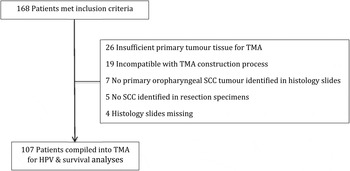
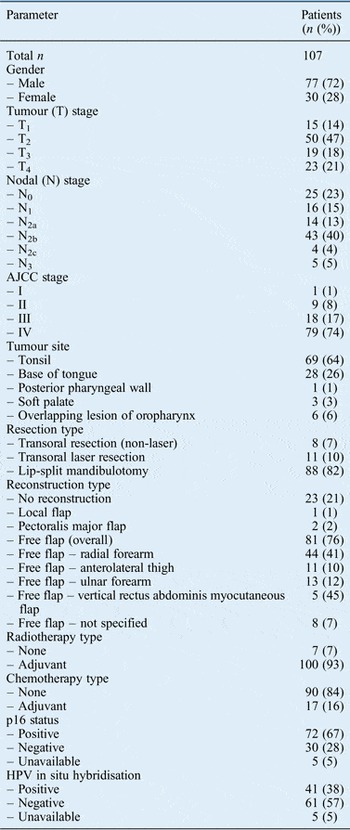
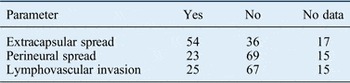
Inspection of the Oxford Head and Neck Cancer database identified 168 patients eligible for inclusion in the study. Of these, 107 were suitable for compilation into the tissue microarray (Figure 1). Patients’ demographic and treatment details and pathological data are shown in Tables I and II.
Flowchart showing the selection of cases for inclusion in the study. TMA = tissue microarray; SCC = squamous cell carcinoma; HPV = human papilloma virus

Patients’ demographic and treatment details*

* For those with surgically treated oropharyngeal cancer. AJCC = American Joint Committee on Cancer; HPV = human papilloma virus
Pathological data from primary oropharyngeal cancer resection specimens*

Data represent numbers of patients. Data were not available for all patients: information on extracapsular spread was only available for patients undergoing neck dissection.
* For patients treated in Oxford between 2000 and 2010.
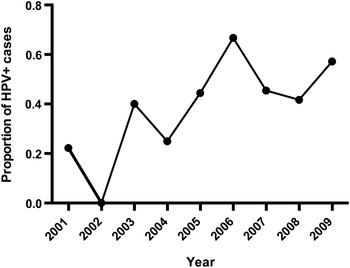
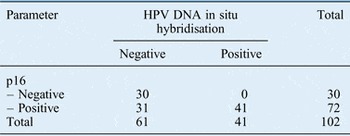
Following p16 immunohistochemistry and in situ hybridisation for HPV DNA, 40 per cent of tumours were considered to be HPV-positive (Table III). Although 71 per cent of cases (n = 72) had positive p16 immunostaining, only 40 per cent (n = 41) were positive for HPV DNA following in situ hybridisation. No cases showed positive HPV DNA in situ hybridisation and negative staining for p16. The positive and negative predictive values of p16 immunohistochemistry for the determination of in situ hybridisation status were 0.57 and 1 respectively. Over the course of the study period, the proportion of patients with HPV-positive oropharyngeal SCC increased from 22 per cent in 2001 to 57 per cent in 2009 (Figure 2).
Proportion of human papilloma virus (HPV) positive cases per year over the study period.

P16 Immunostaining and hpv dna in situ hybridisation results*

Data represent numbers of patients.
* In 102 patients with oropharyngeal squamous cell carcinoma treated with primary surgery; human papilloma virus data were not available in 5 cases. HPV = human papilloma virus
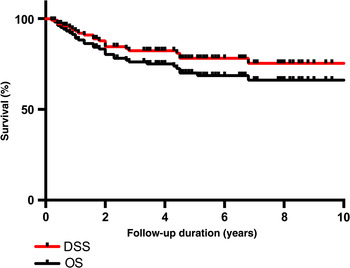
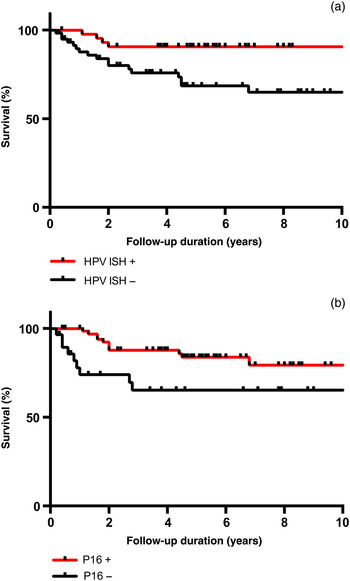
The mean follow-up duration in this study was 59.5 months (range, 0–168 months). Kaplan–Meier survival analysis revealed that overall and disease-specific five-year survival estimates were 78 per cent and 69 per cent, respectively (Figure 3). For HPV-positive disease cases, five-year overall survival was 85 per cent and disease-specific survival was 91 per cent. For HPV-negative disease cases, five-year overall survival was 57 per cent and disease-specific survival was 69 per cent (Figure 4).
Kaplan–Meier analysis of overall survival (OS) and disease-specific survival (DSS) in patients with surgically treated oropharyngeal squamous cell carcinoma.

Kaplan–Meier analysis of disease-specific survival in patients with oropharyngeal squamous cell carcinoma, stratified by (a) human papilloma virus (HPV) DNA in situ hybridisation results and (b) p16 status. Patients with HPV in situ hybridisation positive tumours had significantly higher survival at 10 years compared to those with HPV in situ hybridisation negative tumours (p = 0.012). Patients with p16-positive tumours had significantly higher survival at 10 years compared to those with p16-negative tumours (p = 0.026). ISH = in situ hybridisation

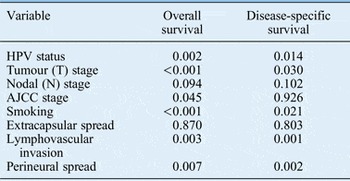
Significant associations were also identified between other clinical variables and survival outcomes. High tumour (T) stage was associated with reduced overall survival (p < 0.001) and disease-specific survival (p = 0.03). Being a current or previous smoker was associated with reduced overall survival and disease-specific survival (p < 0.001 and p = 0.021 respectively). Both lymphovascular invasion (overall survival p = 0.003, disease-specific survival p < 0.001) and perineural spread (overall survival p = 0.007, disease-specific survival p = 0.002) within the primary tumour were associated with reduced overall survival and disease-specific survival (Table IV).
Significance of associations between clinical and pathological variables and survival outcome*

Data represent p values.
* Identified using log-rank testing. HPV = human papilloma virus; AJCC = American Joint Committee on Cancer
In this series, nodal (N) stage and the presence of extracapsular spread were not significantly associated with survival outcomes. Patients treated with transoral surgery (n = 19, 17 per cent) had a significantly lower mean T stage (mean T stage = 1.94 ± 0.2) than those treated with open surgery (n = 88, 82 per cent) (mean T stage = 2.57 ± 0.1, p = 0.014). There was no significant difference in overall survival or disease-specific survival in patients treated with transoral surgery compared to those treated with open surgery (overall survival p = 0.62, disease-specific survival p = 0.85).
Discussion
This study aimed to identify long-term survival outcomes in a series of patients with oropharyngeal SCC treated with primary surgery. Survival outcomes in this group of patients have been reported previously; however, few studies have included data on HPV status, which is a major prognostic indicator in head and neck SCC.Reference Ang, Harris, Wheeler, Weber, Rosenthal and Nguyen-Tan 11
The proportion of patients with HPV-positive disease in this study was 40 per cent, which is similar to other published data from a similar time period in the UK.Reference Evans, Newcombe, Fiander, Powell, Rolles and Thavaraj 12 The proportion of patients with HPV-positive disease increased from 22 per cent in 2001 to 57 per cent in 2009, mirroring national data from the UK and elsewhere in the world (Figure 2).Reference Mehanna, Jones, Gregoire and Ang 1
In this study, HPV status was determined by dual modality testing, as previously described.Reference Westra 13 The positive predictive value of p16 immunohistochemistry was low (57 per cent), although its negative predictive value was 100 per cent. One explanation for the low concordance between p16 staining and HPV DNA in situ hybridisation seen in this study is that HPV DNA integration may occur in a non-uniform manner.Reference Schlecht, Brandwein-Gensler, Nuovo, Li, Dunne and Kawachi 14 This heterogeneity of expression in 0.6–1 mm cores of tissue may contribute to the discrepancy between the two detection methods. In clinical practice, p16 immunohistochemistry is more widely employed than in situ hybridisation for HPV DNA because of its ease of use and low cost. The results from this study indicate that p16 status is of prognostic significance in surgically treated oropharyngeal SCC, and support its continued use in this setting (Figure 4b).
The five-year overall and disease-specific survival estimates of 78 per cent and 69 per cent seen in this study are in line with previous series of surgically treated oropharyngeal SCC patients, which report five-year overall survival rates of 47–88 per cent.Reference Chen, Zhu and Fedewa 9 , Reference Parsons, Mendenhall, Stringer, Amdur, Hinerman and Villaret 15 – Reference Zhen, Karnell, Hoffman, Funk, Buatti and Menck 17 The wide variation in survival outcomes reported in other studies may relate to several factors, including recent treatment advances, the increasing incidence of HPV-positive disease and the heterogeneity of the patient groups examined. Variations in these key variables make it difficult to directly compare survival outcomes from different retrospective studies. The survival outcomes observed in this study are, however, similar to those from a similar UK-based study, which had an equivalent proportion of HPV-positive patients and comparable patient group.Reference Evans, Newcombe, Fiander, Powell, Rolles and Thavaraj 12
There is widespread variation in the treatment of oropharyngeal cancer. In a study of 43 983 patients with oropharyngeal cancer from the USA, Chen et al. demonstrated that the proportion of patients receiving primary chemoradiotherapy increased from 22 per cent in 1998 to 61 per cent in 2009.Reference Chen, Zhu and Fedewa 9 UK data from 2012 indicated that 53 per cent of patients with oropharyngeal cancer received non-surgical treatment as first-line therapy over the preceding year. 10 Despite this, the popularity of primary surgery for oropharyngeal cancer is increasing with the advent of novel transoral techniques including transoral robotic surgery.Reference Chen, Roman, Kraus, Sosa and Judson 18 Although transoral robotic surgery appears to offer excellent local control and disease-specific survival at two years, long-term outcome data are not yet available.Reference de Almeida, Li, Magnuson, Smith, Moore and Lawson 19
In this study, the majority of patients (82 per cent) underwent open surgery. These patients had a higher mean T stage than those treated with a transoral approach. As a significant prognostic indicator in oropharyngeal SCC, T stage is a confounding variable when comparing survival outcomes between transoral and open surgery. Despite this, there was no significant difference in survival between the two groups, which may reflect the small number of patients in the transoral surgery group. An association between open surgery and adverse survival was, however, identified by Bastos de Souza et al.Reference Bastos de Souza, Pinto, da Cunha Mercante, Nishimoto, Brasilino de Carvalho and Kowalski 20 In a series of 256 patients with oropharyngeal SCC, these authors showed that patients undergoing mandibulectomy had a significantly lower 5-year disease-free survival rate than those having transoral surgery. Again, this is likely to relate to the higher proportion of advanced tumours in the mandibulectomy group.
-
• Five-year overall and disease-specific survival for oropharyngeal cancer patients treated with primary surgery were 78 and 69 per cent, respectively
-
• Dual modality testing revealed that 40 per cent of patients had human papilloma virus (HPV) positive tumours
-
• Patients with HPV-positive tumours had significantly higher disease-specific survival than those with HPV-negative tumours (p = 0.012)
-
• High tumour stage, smoking, lymphovascular invasion and perineural spread were associated with adverse survival outcomes
The results from this study highlight known prognostic factors in oropharyngeal SCC, including HPV, smoking status and T stage.Reference Ang, Harris, Wheeler, Weber, Rosenthal and Nguyen-Tan 11 , Reference Haughey and Sinha 21 Although known to be of prognostic significance in head and neck SCC in general, the presence of extracapsular spread and N stage were non-prognostic in this study. This replicates the findings of previous studies on oropharyngeal SCC, and may relate to the high proportion of patients with HPV-positive disease in this group. In HPV-positive disease, nodal status, extracapsular spread and the presence of positive resection margins are not associated with survival outcome; this underlines the importance of publishing data on HPV status alongside survival outcomes in oropharyngeal SCC.Reference Haughey and Sinha 21 , Reference Maxwell, Ferris, Gooding, Cunningham, Mehta and Kim 22
Conclusion
This study reports long-term survival outcomes in patients with surgically treated oropharyngeal SCC and defined HPV status. The five-year overall and disease-specific survival estimates in this study are comparable to previously published data, suggesting that surgery remains an acceptable treatment modality in this group of patients. The significant associations between survival and other clinicopathological variables including HPV status highlight the importance of publishing these data alongside survival rates in head and neck SCC.
Acknowledgement
This study was funded by ‘Heads Up’, a registered charity (number 1057295) (fund number 2119).