Implications
Little is known about how maternal feed level and body condition during pregnancy influence offspring growth. Current findings show that body condition of gilts at insemination had a greater influence on offspring growth than feed level during gestation. Pigs born from Fat gilts (19±0.6 mm P2 backfat depth) had greater feed intakes, were heavier, had greater backfat depths at slaughter and had lower carcass lean meat yield than pigs born from Thin gilts (12±0.6 mm P2 backfat depth).
Introduction
Inadequate prenatal nutrition can negatively influence both the birth weight and subsequent development of offspring (Barker, Reference Barker1998). Altering feeding levels at different time points during the gestation period of the sow can influence piglet growth rates (Bee, Reference Bee2004; McNamara et al., Reference McNamara, Giblin, Markham, Stickland, Berry, O'Reilly, Lynch, Kerry and Lawlor2011) and subsequent sow reproduction (Lawlor and Lynch, Reference Lawlor and Lynch2007), both of which are key factors for efficient and profitable pig production. As a commercial pig spends nearly half its life in utero, optimum nutrition and environmental conditions during this time are essential to maximise pig productivity. Body composition of the mother during gestation may affect offspring development. In humans, babies born from obese mothers have increased body fat percentage, higher rates of diabetes and higher rates of insulin resistance (Hull et al., Reference Hull, Dinger, Knehans, Thompson and Fields2008; Catalano et al., Reference Catalano, Presley, Minium and Hauguel-de Mouzon2009). However, little is known about maternal feed level and body condition interactions during pregnancy and how they influence offspring growth and development.
Undernutrition in pregnancy can affect the development and physiology of the offspring. First, birth weights can be lower due to a reduced supply of essential nutrients to the developing foetus (Dwyer et al., Reference Dwyer, Madgwick, Ward and Stickland1995). Organ weights can also be reduced (Kind et al., Reference Kind, Roberts, Sohlstrom, Katsman, Clifton, Robinson and Owens2005). In addition, increased nutrition during pregnancy influences the ratio of secondary to primary muscle fibres in the offspring. Dwyer et al. (Reference Dwyer, Stickland and Fletcher1994) observed that sows whose daily feed allowance was doubled to 5 kg/day from days 25 to 50 of gestation gave birth to offspring with an 8% increase in secondary muscle fibres, a factor likely to increase the lifetime growth potential of the pig (Dwyer et al., Reference Dwyer, Stickland and Fletcher1994). The IGF axis, one of the major regulators of growth, both pre- and postnatally (Randhawa and Cohen, Reference Randhawa and Cohen2005), can be profoundly altered by malnutrition in utero (Estívariz and Ziegler, Reference Estívariz and Ziegler1997). This can reduce concentrations of both circulating IGF-1 and growth hormone (Oster et al., Reference Oster, Fielder, Levin and Cronin1995). Finally, elevated stress levels during pregnancy may cause growth retardation in the foetus (Liu et al., Reference Liu, Baker, Perkins, Robertson and Efstratiadis1993; Kranendonk et al., Reference Kranendonk, Hopster, Fillerup, Ekkel, Mulder, Wiegant and Taverne2006; Diego et al., Reference Diego, Field, Hernandez-Reif, Schanberg, Kuhn and Gonzalez-Quintero2009). Cortisol, an indicator of stress, is an inhibitor of IGF-1 (Clemmons, Reference Clemmons2007) and excess concentrations of cortisol were shown to suppress IGF-1 gene expression in skeletal ovine muscle (Li et al., Reference Li, Forhead, Dauncey, Gilmour and Fowden2002). Therefore, it is possible that cortisol is a compounding factor in maternal undernutrition, which could significantly affect growth rates in the offspring.
We hypothesised that postnatal growth is increased in pigs raised by sows with a high backfat depth and/or high level of energy intake during gestation compared with sows with a low backfat depth and/or low level of energy intake during gestation. Our main objectives were to determine the effect of backfat depth (Thin, 12±0.6 mm P2 backfat and Fat, 19±0.6 mm P2 backfat) at insemination and feed allowance (1.8, 2.5 and 3.5 kg/day) between days 25 and 90 of gestation in gilts on the lifetime growth and carcass quality of offspring at 158 days of age. To achieve these objectives pig weight, feed intake, serum IGF-1 levels and carcass quality were recorded for offspring born from Thin and Fat gilts provided with different feed allowances during gestation. In addition, we also aimed to determine the effect of sows’ backfat depth and feed allowance during gestation on the stress response of their progeny when subjected to a handling stress. This was achieved by recording serum cortisol levels in progeny by jugular venipuncture at day 49 post-weaning.
Material and methods
This experiment complied with the EU Council Directive 91/630/EEC, which lays down minimum standards for the protection of pigs (Department of Agriculture and Food (Ireland), 2008). It also complied with the EU Council Directive 98/58/EC, concerning the protection of animals kept for farming purposes (Department of Agriculture and Food (Ireland), 2008). The experiment was approved and licensed by the Irish Department of Health and Children under the Cruelty to Animals Act, 1876.
Animals and design – gilts
Gilts (Large White×Landrace) were selected as replacement breeding stock at birth on a commercial breeding company’s (Hermitage AI, Sion Road, Kilkenny, Ireland) multiplier farm and were exposed to the same housing and feeding regime up to 22 weeks of age. At this time backfat depth of gilts was measured at the last rib and 65 mm from the back bone using an ultrasound scanner (Lean-meater, Renco Corporation, Minneapolis, Minnesota, USA) on both the left and right side and the mean value was recorded.
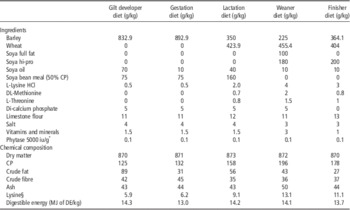
One hundred and forty gilts were selected based on their backfat depth at 22 weeks of age and Thin (n=68; P2 backfat ~8 mm) and Fat (n=72; P2 backfat ~12 mm) groups were formed. The difference in backfat depth between groups was accentuated by feeding different diets up to service at 32 weeks. The Thin gilts were restricted to 1.8kg/day of gestation diet (Table 1) and the Fat gilts were provided with ad libitum access to a gilt developer diet (Table 1) up to 2 weeks before service. All gilts were provided with ad libitum access to a lactation diet (Table 1) for flushing for 2 weeks before insemination (30 to 32 weeks). To allow each gilt to exhibit at least one standing oestrus before insemination, they were provided with constant boar contact from an adjoining pen for 4 weeks before planned mating. Nine mililitres of Regumate Equine (altrenogest, 2.2 μg/ml; Intervet Productions S.A., France), was added to the diet of each gilt on each day for 6 days before planned insemination to synchronise oestrus. Gilts were artificially inseminated at onset of standing oestrus and again 24 h later using semen pooled from eight closely related Hylean Large White boars (Hermitage AI, Sion Road, Kilkenny). At Insemination, backfat depth was 12±0.6 mm and 19±0.6 mm for the Thin and Fat gilts, respectively.
The composition and chemical analysis of experimental diets (on air dry basis g/kg as fed)

Gilt developer, gestation diet and lactation diet provided (mg/kg completed diet): Cu, 38; Fe, 70; Mn, 62; Zn, 80; I, 0.6; Se, 0.2; vitamin A, 10 000 IU; vitamin D3, 1000 IU; vitamin E, 100 IU; vitamin K, 2 mg; vitamin B12, 15 µg; riboflavin, 5 mg; nicotinic acid, 12 mg; pantothenic acid, 10 mg; choline chloride, 500 mg; Vitamin B1, 2 mg, Biotin, 200 µg; Folic acid, 5 mg; thiamin, 2 mg and pyridoxine, 3 mg.
Weaner diet provided (mg/kg completed diet): Cu, 155; Fe, 90; Mn, 47; Zn, 120; I, 0.6; Se, 0.3; vitamin A, 6,000 IU; vitamin D3, 1000 IU; vitamin E, 100 IU; vitamin K, 4 mg; vitamin B12, 15 µg; riboflavin, 2 mg; nicotinic acid, 12 mg; pantothenic acid, 10 mg; choline chloride, 250 mg; vitamin B1, 2 mg; vitamin B6, 3 mg; and endox, 60 mg.
Finisher diet provided (mg/kg completed diet): Cu, 40; Fe, 40; Mn, 31; Zn, 80; iodine, 0.3; Se, 0.2; vitamin A, 2,000 IU; vitamin D3, 500 IU; vitamin E, 40 IU; vitamin K, 4 mg; vitamin B12, 15 µg; riboflavin, 2 mg; nicotinic acid, 12 mg; pantothenic acid, 10 mg; vitamin B1, 2 mg; vitamin B6, 3 mg.
* Sow diets contained 500 FTU phytase per kg finished feed from Natuphos 5000 (BASF, Ludwigshafen, Germany).
Immediately after insemination, pregnant gilts were moved to individual gestation pens (2.4 m × 0.6 m; O’Donovan Engineering, Coachford, Ireland) and fed once per day 1.8 kg/day (23.4 MJ DE/day) of a gestation diet (Table 1) until day 25 of gestation. Gilts that repeated to first service were removed from the experiment. On day 25 of gestation, pregnant gilts from each body condition group (Thin or Fat) were blocked according to weight and expected farrowing date and allocated at random to one of three feeding allowances of the gestation diet: (a) Restricted (1.8 kg/day), (b) Control (2.5 kg/day) or (c) High feed level (3.5 kg/day), until day 90 of gestation. The experiment was a 2×3 factorial design with 2 factors for gilt backfat and 3 factors for gestation feed allowance giving a total of six treatment groups; Thin Restricted, Thin Control, Thin High feed level, Fat Restricted, Fat Control and Fat High feed level. From days 90 to 110 of gestation, all gilts were fed 2.5 kg/day of the gestation diet.
At day 110 of gestation, gilts were moved to individual farrowing pens and were liquid-fed (Big Dutchman, Vechta, Germany) 2.03 kg/day of a lactation diet (28.8 MJ DE/day) in three daily meals (morning, noon and evening). The backfat depth at farrowing was 14.4±0.34 mm for Thin gilts and 19.0±0.34 mm for Fat gilts (Amdi et al., Reference Amdi, Giblin, Hennessy, Ryan, Stanton, Stickland and Lawlor2013). Gilts were housed individually in national pig development company type farrowing crates (O’Donovan Engineering) with hinged bottom bars in farrowing rooms with 10 gilts per room. After farrowing, gilts were fed the lactation diet according to a feeding curve, which provided 28.8 MJ DE/day (2.03 kg/day) at day 0 of lactation increasing to 112.7 MJ DE/day (7.94 kg/day) on day 28 of lactation. Access to water was available on an ad libitum basis throughout the experiment and temperature was maintained at 20oC, except for 48 h after farrowing when temperature was increased to 24oC.
Litter information
At farrowing, litter weights, total born, born alive, stillbirths, mummified pigs and individual birth weights of all piglets were recorded. Piglets were tagged at birth for identification purposes. Litter size was standardised to 12±2 pigs per litter by cross-fostering within treatment groups within 24 h of birth. Creep feed (16.5 MJ/DE, lysine 1.6%, Startrite 88; Nutec, Monread Road, Naas, Co Kildare, Ireland) was fed to all litters from day 12 postpartum until weaning at day 28 postpartum. Pre-weaning mortality and the number of pigs weaned per litter were recorded.
Piglets were categorised on birth weight as low (LBW; <1.2 kg), medium (MBW; ~1.5 kg) and heavy (HBW; >1.7 kg). All pigs were weighed at weaning on day 28 of lactation. One hundred and fifty-five pigs were sacrificed at weaning and their organs weighed. The m. semitendinosus was fully removed from the right side of the piglet and weighed, as were the liver, the kidneys and the heart. All organs were trimmed of excess fat, cut open, rinsed and blotted dry before weighing.
Three same gender pigs (LBW, MBW and HBW) were selected within litter at weaning, with litter representation balanced for the six gestation treatments so that in total 270 pigs were allocated to individual pens to be followed through to slaughter at day 130 post-weaning. From weaning, these pigs were individually fed 2 kg of commercial starter diet (16.25 MJ DE/kg; lysine 1.6%; Easistart, Devensh, NI), followed by 5 kg of a commercial link diet (15.4 MJ DE/ kg; lysine 1.5%; Vital, Devenish, NI) after which a weaner diet (Table 1) was fed to day 49 post-weaning. A finisher diet was fed from day 49 post-weaning to slaughter (Table 1). At all times feed was available on an ad libitum basis. Pig weights were recorded at birth, weaning, days 14, 28, 49, 91 post-weaning and at slaughter. Feed disappearance was measured between days 0 (weaning) and 14, 14 and 28, 28 and 49, 49 and 91 and between 91 and 130 post-weaning. Average daily gain (ADG) and average daily feed intake (ADFI) were calculated for each of the growth stages above and feed conversion efficiency (FCE) was calculated as ADFI/ADG. Weighing took place between 1000 and 1300 h and feed was available right up to weighing except in the case of day 130 post-weaning when pigs were fasted for 12 h before weighing.
Diets and feed analyses
The ingredient content and chemical composition of the gilt developer, gestation, lactation, weaner and finisher diets are shown in Table 1. Representative samples of each diet type were collected and stored at −21°C until analysis. Dry matter, crude ash, CP, crude fat and crude fibre were analysed by the methods described previously (Lawlor et al., Reference Lawlor, Lynch, Caffrey and OD2002).
Housing
During the weaner stage (days 0 to 49 post-weaning), pigs were housed individually in fully slatted pens (1.2 m × 0.9 m). Slats were moulded plastic (Faroex, Manitoba, Canada), and pen divisions were of plastic panelling. Each pen had a single stainless steel feeder 30 cm wide and water was available ad libitum from bowls (BALP, Charleville-Mezieres, Cedex, France). Temperatures were maintained at 28°C to 30°C in the 1st week and reduced by 2°C per week to 22°C in the 4th week post-weaning.
During the finisher stage (days 49 to 130 post-weaning), pigs were individually housed in fully slatted pens (concrete slats, 75 mm solid width 20 mm slots), 1.81 m × 1.18 m with plastic partitions. Air temperature was maintained at 20°C to 22°C. Feeders were stainless steel dry feed hoppers 30 cm in width (O’Donovan Engineering, Coachford, Co. Cork, Ireland). Water was available ad libitum from one drinking bowl (BALP, Charleville-Mezieres, Cedex, France) per pen.
Blood sampling
For all blood sampling, pigs were restrained appropriately and blood was collected by jugular venipuncture into BD Vacutainer® serum (BD, Franklin Lakes, NJ, USA). At day 80 of gestation, gilts were blood sampled before feeding for IGF-1 measurements. At weaning, piglets were also blood sampled for IGF-1 measurements and pigs that were followed through to slaughter at 158 days of age were blood sampled (before feeding) at day 49 post-weaning for cortisol measurements and at slaughter (during exsanguination after CO2 stunning) for IGF-1 measurements. Blood was allowed to clot for 1 h at room temperature and serum was separated by centrifugation at 2500 × g for 20 min at 15°C. All samples were then stored at −20°C until analysed. Serum IGF-1 concentrations were measured using a human IGF-I ELISA kit (BioVendor R&D, Brno, Czech Republic) which was IGFBP blocked. Samples were performed in duplicate and intra-assay variation was 2.5%. Inter-assay variation was 9.4% and was calculated using standards, and high and low controls from each plate. Serum cortisol concentrations were outsourced and quantified, in duplicate, by Core Biochemical Assay Laboratory at the Clinical Biochemistry Department at Cambridge Biomedical Campus after validation of method (linearity of dilution and spike-recovery). The average intra-assay coefficient of variability (CV) for the cortisol was 5.6% and inter-assay CV was 6.9%.
Carcass composition
Pigs were fasted for 12 to 16 h before slaughter. On the day of slaughter, pigs were mixed, transported 90 km and slaughtered by exsanguination after CO2 stunning. Following evisceration, muscle depth and backfat thickness were measured using a Hennessy grading Probe (Hennessy and Chong, Auckland, New Zealand) 6 cm from the edge of the split back at the level of the third and fourth last rib. Lean content was estimated according to the following formula (Department of Agriculture and Food (Ireland), 2001): Estimated lean meat content (%)=60.30–0.847x+0.147y, where x=backfat depth (mm); y=muscle depth (mm). Carcass weight (cold) was estimated as the weight of the hot eviscerated carcass (minus tongue, bristles, genital organs, kidneys, flare fat and diaphragm) 45 mins after harvest×0.98. Dressing percentage was calculated as (carcass weight/live weight prior to slaughter)×100.
Statistical analyses
Data were analysed using the mixed models procedures of SAS (SAS Inc., Cary, NC, USA). The model used to examine the effect of body condition and feed allowance of gilts during gestation was as follows:
 $$\eqalign{Y_{{ijklm}} \,=\,\mu \,{\plus}\,\alpha _{i} {\plus}\beta _{j} {\plus}\left( {\alpha \beta } \right)_{{ij}} {\plus}\gamma_{k} {\plus}\delta _{{\rm l}} {\plus}\zeta _{m} {\plus}\eta _{n} {\plus}\theta _{{isj}} \cr \quad{\plus}\lambda _{{psj}} {\plus}{\varepsilon}_{{ijklm}} $$
where Y ijklm is the dependent variable measured on the pig (weight, ADG, ADFI, FCE, carcass composition, organs, IGF-1, cortisol), μ denotes the overall mean, α i denotes the effect of body condition (i=Thin, Fat), β j is the effect of feed level (j=Restricted, Control, High feed allowance), γ k is the effect of gender of piglet (k=male, female), δ l is the effect of birth weight (l=LBW, MBW, HBW), ζ m is the effect of block (m=1,2, ..., 17), covariate η n is the effect of the litter size (n=6,7, ..., 18), (αβ) ij is the interaction effect between body condition and feed level, θ isj is the random effect of sow and λ psj is the random effect of piglet and ε ijklm describes the error term. If the interaction was non-significant it was removed from the model. The number of piglets born alive and block were included in the model as covariates for the analysis of production data, but not for analyses of IGF-1 concentrations or cortisol concentrations in piglets. Random effects included gilt nested within treatment (feed level). For the analysis of the organ weights at weaning, weaning weights were included in the model as a covariate. Where variables of interest were recorded at multiple time points, day of sampling was regarded as the repeated variable in the analysis.
To analyse maternal IGF-1 concentrations at day 80, the following model was used:
 $$Y_{{ij}} =\mu {\plus}\alpha _{i} {\plus}\beta _{j} {\plus}(\alpha \beta )_{{ij}} {\plus}{\varepsilon}_{{ij}} $$
where Y ij is the dependent variable measured on the gilt (IGF-1), μ denotes the overall mean, α i denotes the effect of body condition (i=Thin, Fat), β j is the effect of feed level (j=Restricted, Control, High feed allowance), (αβ) ij is the interaction effect between body condition and feed allowance, and ε ij describes the random error.
The Bonferroni correction was used to adjust for pairwise comparison of means. For all data, results were considered statistically significant when P<0.05 and as trends when 0.05<P⩽0.10. Values above P>0.10 were reported as non-significant. The results were reported as the least square means (LSMeans) with standard errors of the means (s.e.m.).
Results
Diet composition and analysis
The ingredient composition and nutrient content of the experimental diets are presented in Table 1.
Production data
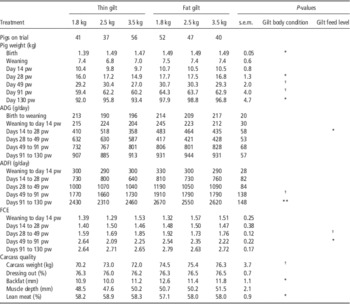
Sixteen gilts did not conceive and two died during the experiment so that the final number of gilts included in the analysis was 68 Thin and 72 Fat. A total of 272 piglets were followed through to slaughter age (158 days). Weights of the pigs from weaning to slaughter (days 28 to 130 post-weaning), ADG, ADFI, FCE and carcass quality variables are presented as LSMeans±s.e.m. for Thin Restricted, Thin Control, Thin High feed level, Fat Restricted, Fat Control and Fat High feed level gilts in Table 2.
Effect of maternal body condition at insemination (Thin; 12±0.6) or Fat; 19±0.6) and gestation feed level (Restricted; 1.8 kg/day, Control; 2.5 kg/day or High Feed level; 3.5 kg/day) on offspring weight, ADG, ADFI, FCE from birth to slaughter and carcass quality at slaughter (day 130 pw)Footnote *

ADG=average daily gain; ADFI=average daily feed intake; FCE=feed conversion efficiency; PW=post-weaning.
Mean values with their pooled standard errors (Bonferroni adjusted).
Symbol indicates level of significance: *<0.05, **<0.01, and ***<0.001, †<0.10.
* There were no significant body condition×feed level interaction effects on pig weight, ADG or ADFI. The results presented are means of low, medium and heavy birth-weight piglets.
Effect of treatment on pig weights
Pigs born from Thin gilts were lighter at birth (1.44 v. 1.49 kg, ±0.02 kg; P<0.05), day 28 post-weaning (16.0 v. 17.4 kg; ±0.6; P<0.05) and at day 130 post-weaning (93.7 v. 97.8 kg; ±2.0 kg; P<0.05). They tended to be lighter than pigs born from Fat gilts at day 49 post-weaning (28.8 v. 30.1 kg; ±0.8 kg; P=0.06), and at day 91 post-weaning (60.6 v. 63.6 kg; ±1.7 kg; P=0.09). HBW offspring were heavier throughout the trial than MBW and LBW offspring (P<0.05).
Effect of treatment on ADG, ADFI and FCE of offspring
From days 14 to 28 post-weaning, pigs born from Control fed gilts (486 g/day) had higher ADG than piglets born from Restricted (453 g/day) and High feed level gilts (397 g/day) (±32 g/day; P<0.05). Pigs born from Thin gilts tended to have lower ADFI than pigs born from Fat gilts (1775 v. 1845 g/day; ±58 g/day; P=0.10) from days 49 to 91 post-weaning. Pigs born from Thin gilts had lower ADFI than pigs born from Fat gilts from day 91 post-weaning to slaughter (2400 v. 2590 g/day; ±69 g/day; P<0.01). From days 49 to 91 post-weaning, pigs from Restricted gilts had poorer FCE than pigs from Control and High feed level gilts (2.55 v. 2.22 v. 2.21; ±0.13; P<0.05).
Effect of treatment on offspring carcass quality at slaughter
Pigs born from Thin gilts tended to have a lower carcass weight at slaughter than pigs born from Fat gilts (71.7 v. 74.8 kg; ±1.6 kg; P=0.09) and had lower backfat depths (10.4 v. 11.7 mm; ±0.4 mm; P<0.05). Pigs born from Thin gilts had a higher lean meat percentage than pigs born from Fat gilts (58.7% v. 57.6%; ±0.3; P<0.05). Gilt gestation feed allocation did not influence progeny carcass weight (P>0.05), carcass backfat depth (P>0.05) or lean meat percentages (P>0.05).
Effect of treatment on organ weights at weaning
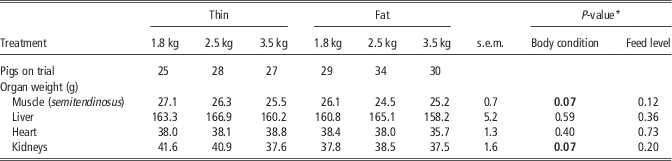
The effect of maternal body condition and feed level during gestation on piglet organ weights at weaning is shown in Table 3. Pigs born from Thin gilts tended to have a heavier m. semitendinosus (P=0.07) and heavier kidneys (P=0.07) at weaning, than piglets born from Fat gilts.
Effect of maternal body condition at service (Thin; 12±0.6) or Fat; 19±0.6) and gestation feed level (Restricted; 1.8 kg/day, Control; 2.5 kg/day or High Feed level; 3.5 kg/day) on the organ weights of offspring at weaning (day 28)

Mean values with their pooled standard errors (Bonferroni adjusted).
* There was no body condition×feed allowance interaction effect.
Effect of treatment on maternal serum IGF-1 concentrations at day 80 of pregnancy
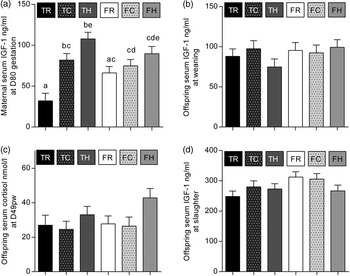
Effects of maternal body condition and feed level during pregnancy on serum IGF-1 concentrations in fasted gilts at day 80 of gestation are presented in Figure 1a. The concentrations of serum IGF-1 were 49.2, 78.4 and 98.8 ng/ml (±6.0 ng/ml, P<0.001) for Restricted, Control and High fed gilts, respectively. Thin Restricted gilts had lower fasting IGF-1 concentrations in serum at day 80 than Thin Control, Thin High feed level, Fat Control and Fat High feed levels gilts. Fat Restricted gilts had lower levels than Thin High feed level gilts (P<0.05). There was no effect of body condition on serum IGF-1 concentrations for Thin and Fat gilts (74.0 v. 76.9 ng/ml; ±4.9 ng/ml, P>0.05), respectively.
(a) Maternal serum IGF-1 concentrations at day 80 of pregnancy in Thin Restricted (TR, 1.8 kg/day, n=10), Thin Control (TC, 2.5 kg/day, n=14), Thin High feed level (TH, 3.5 kg/day, n=13), Fat Restricted (FR, 1.8 kg/day, n=14), Fat Control (FC, 2.5 kg/day, n=14) and Fat High feed level (FH, 3.5 kg/day, n=11) gilts; (b) serum IGF-1 concentrations at weaning (day 28) in pigs born from TR (n=41), TC (n=38), TH (n=37), FR (n=40), FC (n=40) and FH (n=39) sows (total n=235); (c) serum cortisol concentrations at day 49 post-weaning in pigs born from TR (n=16), TC (n=25), TH (n=25), FR (n=32), FC (n=20) and FH (n=17) sows (total n=135); D: serum IGF-1 concentrations at slaughter (total n=182) in pigs born from TR, TC, TH, FR, FC and FH sows (n=23).

Effect of treatment on offspring serum IGF-1 concentrations at weaning (day 28)
The serum IGF-1 concentrations in piglets at weaning are presented in Figure 1b. The concentrations of serum IGF-1 were 92.0, 94.4 and 87.4 ng/ml (±6.9 ng/ml; P>0.05) for pigs born from Restricted, Control and High fed gilts, respectively. Serum IGF-1 concentrations for pigs born from Thin or Fat gilts were similar (86.7 v. 95.8 ng/ml; ±5.6; P>0.05).
Effect of treatment on offspring serum cortisol concentrations at day 49 post-weaning
Serum cortisol values from the offspring at day 49 post-weaning are presented in Figure 1c. These were affected by gilt feed levels during pregnancy. Pigs born from gilts fed a High feed level during pregnancy had greater concentrations of cortisol compared with piglets born from Restricted or Control fed gilts during pregnancy (37.6 v. 27.0 v. 25.6; ±3.6 ng/ml; P<0.05). There was no effect of gilt body condition during pregnancy on the offspring cortisol concentrations at day 49 post-weaning (P>0.05).
Effect of treatment on offspring serum IGF-1 concentrations at slaughter age (day 130 post-weaning)
Offspring serum IGF-1 concentrations at slaughter are presented in Figure 1d. Pigs born from Thin gilts tended to have lower concentrations of serum IGF-1 at slaughter than pigs born from Fat gilts (268.0 v. 294.7 ng/ml; ±11.0 ng/ml; P=0.09). There was no effect of gilt feed level during pregnancy (P>0.05) or pig birth weight (P>0.05) on serum IGF-1 concentrations at slaughter.
Discussion
The aim of this study was to investigate the effect of maternal body composition and maternal feed allowance during pregnancy on growth of the offspring. Pigs born from Fat gilts grew faster until slaughter and tended to have greater IGF-1 concentrations at slaughter than pigs born from Thin gilts. Under the experimental conditions tested here, the gilt’s body condition had a greater influence on offspring growth than the maternal feed level during gestation. Very few interactions between gilt body condition and gestation feed level were observed. Low birth weight piglets did not appear to experience catch up growth when mothers were fat at service or when mothers received higher than normal feed allowance during gestation.
The effect of the gilt body condition during pregnancy on offspring growth and physiological parameters
Pigs born from Fat gilts were heavier at slaughter, they had a higher ADFI from day 91 to slaughter, greater backfat depths and tended to have increased fasting IGF-1 concentrations at slaughter than pigs born from Thin gilts. Positive correlations between sow body weight and piglet birth weight have recently been observed by Lewis and Bunter (Reference Lewis and Bunter2011). Interestingly, in the current study Fat gilts had a 25% increase in milk fat at day 21 of lactation than Thin gilts (Amdi et al., Reference Amdi, Giblin, Hennessy, Ryan, Stanton, Stickland and Lawlor2013), which may have contributed to the increased piglet weight gain. In agreement with our results, Long et al. (Reference Long, George, Uthlaut, Smith, Nijland, Nathanielsz and Ford2010), found that offspring born from obese ewes, consumed 10% more feed than offspring born from control ewes when the offspring where ad libitum fed over a 12-week period from 19.5±0.5 months of age. Recent studies have addressed the issue that perhaps maternal body composition by itself is a programming agent for growth of the offspring. Shankar et al. (Reference Shankar, Harrell, Liu, Gilchrist, Ronis and Badger2008) demonstrated an effect of maternal obesity, independent of nutrition, on disease risk in rat offspring. Although the offspring from obese rats were cross-fostered to lean dams at birth, they still exhibited increased adiposity (1.6-fold) and insulin resistance later in life compared with offspring from lean dams (Shankar et al., Reference Shankar, Harrell, Liu, Gilchrist, Ronis and Badger2008). Others have also demonstrated the effect of maternal body condition in rats on placental and fetal growth (Akyol et al., Reference Akyol, McMullen and Langley-Evans2012; Amdi et al., Reference Amdi, Giblin, Hennessy, Ryan, Stanton, Stickland and Lawlor2013), and studies in humans show that babies born from obese women are more likely to be obese in childhood and adulthood (Whitaker, Reference Whitaker2004; Koupil and Toivanen, Reference Koupil and Toivanen2007). However, it has also been argued that maternal nutrition has a greater effect than maternal obesity. For example, Howie et al. (Reference Howie, Sloboda, Kamal and Vickers2009), found that rat offspring born from dams that had been fed a chow diet up to mating and then switched to a high fat diet during pregnancy were more obese than offspring born from control dams fed chow before and throughout pregnancy. They postulated that the maternal diet is more important than maternal obesity and that the fetal response is driven by dietary aspects (i.e. lower protein or higher fat content) (Howie et al., Reference Howie, Sloboda, Kamal and Vickers2009). In contrast, in our study, body condition during gestation had a greater influence on ADFI and weight in offspring than gestation feed allocation. However, because of our experimental design we cannot rule out the possibility that genetic predisposition of the offspring towards obesity may have influenced the outcome. Closely related F1 gilts were selected to minimise the genetic variation within the trial, and indeed the backfat differences used for selection purposes at 22 weeks were minimal despite our attempt to stratify gilts on backfat differences at this time. However, information on the gilts birth weight, the proportion of gilts born from primiparous sows, the parental nutrient intake, the IGF-1 and cortisol concentrations of parents and grandparents of the gilts was not considered.
The effect of the gilt feed level during pregnancy on offspring growth and physiological parameters
Gilts fed Restricted feed levels during gestation gave birth to lighter piglets (Amdi et al., Reference Amdi, Giblin, Hennessy, Ryan, Stanton, Stickland and Lawlor2013), most likely due to inadequate nutrition in utero, as previously seen in sheep (Redmer et al., Reference Redmer, Wallace and Reynolds2004). Restricted gilts had lower concentrations of IGF-1 than Control and High feed level gilts. In agreement, Nissen et al. (Reference Nissen, Sørensen, Vestergaard and Oksbjerg2005) increased feed allocation from days 25 to 50 or days 25 to 70 of gestation with resultant increases in maternal IGF-1 concentrations. IGF-1 does not cross the placental barrier (Davenport et al., Reference Davenport, Clemmons, Miles, Camacho-Hubner, D'Ercole and Underwood1990; Holmes et al., Reference Holmes, Porter, Newcomb, Holly and Soothill1999). The lower maternal IGF-1 observed in restricted gilts in the current study did not result in subsequently lower IGF-1 concentrations in offspring. Nissen et al. (Reference Nissen, Sørensen, Vestergaard and Oksbjerg2005) also observed no alteration in foetal serum IGF-1 concentrations or glucose concentrations, an indicator of nutrient supply, with different feed allocations in gestation. In contrast, studies in guinea pigs (Dwyer and Stickland, Reference Dwyer and Stickland1992) and sheep (Gallaher et al., Reference Gallaher, Breier, Keven, Harding and Gluckman1998) reported decreased foetal IGF-1 concentrations when maternal feed intake during pregnancy was restricted. IGF-1 can induce nitric oxide production in endothelial cells. Nitric oxide functions as an endogenous vasodilator (Tsukahara et al., Reference Tsukahara, Gordienko, Tonshoff, Gelato and Goligorsky1994) resulting in higher blood flow to the placenta, thereby increasing nutrient availability to the foetus (Reynolds et al., Reference Reynolds, Borowicz, Caton, Vonnahme, Luther, Buchanan, Hafez, Grazul-Bilska and Redmer2010). Therefore, the fact that Restricted gilts with low IGF-1 concentrations gave birth to the lightest piglets (Amdi et al., Reference Amdi, Giblin, Hennessy, Ryan, Stanton, Stickland and Lawlor2013), may not simply be a result of restricted nutrient supply but also due to decreased blood flow across the placenta.
Piglets born from gilts fed a Restricted or Control feed level during gestation had the lowest cortisol response to a handling stress on day 49 post-weaning. In contrast, we have previously shown that their mothers had higher concentrations of salivary cortisol during gestation than mothers on a high feed level (Amdi et al., Reference Amdi, Giblin, Hennessy, Ryan, Stanton, Stickland and Lawlor2013). The latter is in accordance with findings by Kranendonk et al. (Reference Kranendonk, Hopster, Fillerup, Ekkel, Mulder, Wiegant and Taverne2006), who found that piglets born from cortisol-treated sows had a lower peak cortisol response compared with piglets born from non-cortisol-treated sows. In addition, piglets born from sows exposed to elevated cortisol concentrations during pregnancy had altered brain neurotransmitter profiles, such as an increased noradrenergic activity in the locus coeruleus region of the hypothalamus, and tended to have reduced glucocorticoid receptor binding (Kanitz et al., Reference Kanitz, Otten and Tuchscherer2006).
In conclusion, gilts with a backfat depth of ~19 mm at insemination, which is close to current recommendations, gave birth to pigs that were heavier and fatter at ~158 days of age than those born from gilts with ~12 mm backfat depth at insemination. Only transitory effects of gestation feed allowance were observed for offspring ADG and FCE. Therefore, increasing the feed allowance above the current recommendations of 2.5kg/day (the control feed allowance in our study) provides no real benefit to the offspring. Manipulating maternal backfat levels and feed allowance during gestation did not eliminate the poor growth performance associated with low birth weight piglets.
Acknowledgements
The authors would like to acknowledge the assistance of students, technical and farm staff at Teagasc, Pig Development Department, in particular Henry Allen, Pat Magnier, John Walsh, John Heffernan and Dan O’Donovan. The authors also thank Keith Burling for analysis of serum cortisol, Vincent Rafter and the staff at Dawn Pork and Bacon in Waterford for help with blood sampling at the factory. The authors would like to express thanks to Andrew Williams for manuscript discussions and Donagh Berry for statistical advice. They gratefully acknowledge funding provided by Teagasc under the National Development Plan. Charlotte Amdi’s PhD was funded by the Teagasc Walsh Fellowship scheme.