1. Introduction
Heritage speakers are bilinguals with limited first/heritage language (L1) abilities resulting from the simultaneous or sequential acquisition of a second, typically more dominant language (L2). Although heritage grammars are not homogenous, the ultimate attainment of heritage language acquisition (HLA) has been characterized in the literature as incomplete because they often fail to reach age-appropriate linguistic competence in the L1 in comparison to monolingual L1 speakers (Montrul, Reference Montrul2008; Polinsky, Reference Polinsky2008). The various aspects and varying degrees of “incompleteness” in heritage grammars emerging in the literature have generated a number of controversies concerning HLA and its resemblances to and differences from L1 and L2 acquisition.
One of these controversies concerns the specific areas that are vulnerable to language attrition or loss and their theoretical underpinnings and implications for L1 and L2 acquisition and linguistic theory in general. For example, while the attrition or loss of such areas as the lexicon and inflectional morphology has been documented cross-linguistically (Albirini, Benmamoun & Saadah, Reference Albirini and Benmamoun2011; Anderson, Reference Anderson1999, Reference Anderson2001; Bolonyai, Reference Bolonyai2002; Fenyvesi, Reference Fenyvesi, Fenyvesi and Sándor2000; Håkansson, Reference Håkansson1995; Montrul, Reference Montrul2002, Reference Montrul2004; Montrul, Foote & Perpiñan, Reference Montrul2008; Montrul & Potowski, Reference Montrul and Potowski2007; Polinsky, Reference Polinsky1997, Reference Polinsky2006, Reference Polinsky2008; Rothman, Reference Rothman2007; Silva-Corvalán Reference Silva-Corvalán1994; Toribio, Reference Toribio, Do, Domínguez and Johansen2001), other areas, such as subject–verb agreement, tense, and word order, have been found to be less vulnerable to language loss and attrition, possibly because they are thought to be easier or earlier to acquire than other linguistic forms (Benmamoun, Montrul & Polinsky, Reference Benmamoun, Montrul and Polinsky2010; Bolonyai, Reference Bolonyai2007; Fenyvesi, Reference Fenyvesi, Fenyvesi and Sándor2000; Sorace, Reference Sorace, Howell, Fish and Keith-Lucas2000; Tsimpli & Sorace, Reference Tsimpli, Sorace, Bamman, Magnitskaia and Zaller2006; Tsimpli, Sorace, Heycock & Filiaci, Reference Tsimpli, Sorace, Heycock and Filiaci2004).Footnote 1
Another asymmetry involves the predominant use of specific categories within a single linguistic area. For example, heritage speakers have been reported to over-generalize what has been termed the “default” and “unmarked” forms across such linguistic phenomena as aspect, gender, number, and word order (e.g., Albirini et al., Reference Albirini, Benmamoun and Saadah2011; Cornips & Hulk, Reference Cornips, Hulk, Lefebvre, White and Jourdan2006; Laleko, Reference Laleko2010; Montrul et al., Reference Montrul, Foote and Perpiñán2008; Polinsky, Reference Polinsky1997; Suh, Reference Suh, Bowles, Foote, Perpiñán and Bhatt2008).Footnote 2 In most cases, this tendency is manifested through over-regularizing fossilized forms learned in early childhood or simplifying forms that diverge from dominant L2 forms. For example, Cornips and Hulk (Reference Cornips, Hulk, Lefebvre, White and Jourdan2006) found that heritage speakers over-extend the unspecified, default value of non-neuter for the Dutch definite determiner, which is acquired early by monolingual children. Albirini et al. (Reference Albirini, Benmamoun and Saadah2011) found that Egyptian heritage speakers overuse the SVO word order even in contexts where VSO is preferred, possibly because the latter form does not exist in English (transfer) and/or is syntactically more complex (avoidance).
To what extent these asymmetries are reconcilable is an empirical question that can reveal new insights into HLA and its resemblances to L1 and L2 acquisition. It should be noted, however, that these asymmetries, despite their importance, are relevant to the debates on HLA and acquisition theory in general only to the extent that their existence can be ascertained empirically and cross-linguistically. This study seeks to contribute to these debates by examining Arabic heritage speakers’ knowledge of gender and number agreement and concord morphology in two syntactic contexts, namely, subject–verb agreement and noun–adjective agreement. In both contexts, there seems to be an asymmetry in the relation between the two agreeing elements in that the noun seems to be controlling the agreement relation with the verb and the adjective depending on it for their agreement features. This is articulated in different ways within the Principles and Parameters framework either by specifying agreement features only on the noun and devising ways for the verb or adjective to acquire them in the course of the derivation or within the representation or by specifying features on both but privileging the features on the noun (for example, designating them as interpretable and/or inherent features that check the features on the verb and adjectives).
Most generative approaches to these two types of agreement assume that they may be governed by different principles. Subject–verb agreement may be governed in part by principles that govern other syntactic dependencies such as Agree and c-command within a well-defined domain (clause or phase, Chomsky (Reference Chomsky1995) and subsequent work). Noun–adjective agreement may be governed by matching or percolation rules that ensure that the features of the head spread to the eligible members of the noun phrase. However, Baker (Reference Baker2008) advances a proposal whereby the two types of agreement are accounted for by the same mechanisms that exploit the syntactic configuration, hierarchical relations such as c-command, and functional categories that enter into the agreement relation. According to Baker's account, the main difference between verb–subject agreement and (attributive) adjective–noun agreement is that the former involves a relation between a head and its specifier while the latter involves a relation between a head and an adjunct.
The paper seeks to investigate whether heritage speakers of Arabic display differential competencies with regard to these two types of agreement. In addition, it explores the theoretical reasons behind the (a)symmetric competencies of the two forms of agreement. Moreover, the study investigates whether the notion of default-form over-generalization is at play in heritage acquisition of Arabic agreement morphology. The Arabic morphological system is rich in its nominal and verbal domains. Hence, it may offer important insights into the asymmetries discussed above.
The study involves heritage speakers of the Egyptian and Palestinian dialects of Arabic – two varieties that display similar gender and number agreement paradigms. Heritage speakers of Arabic are mostly exposed to their parents’ variety of colloquial Arabic in the home. Some may have been exposed to the Standard variety of Arabic, which is not typically used in the home or in casual daily interactions, at some point in their education or through other communication channels. Since dialectal Arabic is generally neither written nor used in major media channels, heritage speakers have limited access to the variety with which they are familiar and therefore have little chance to practice it outside their homes. This is coupled with the fact that their strong command of English places no pressure on them to use their heritage dialects in the public sphere (Shiri, Reference Shiri and Potowski2010). This situation has direct impact on their L1 competencies in a number of areas, including their command of agreement morphology (Albirini et al., Reference Albirini, Benmamoun and Saadah2011).
Generally speaking, heritage speakers are different from monolingual L1 speakers in that they acquired their heritage language, i.e., Arabic, under reduced input conditions (Montrul, Reference Montrul2002; Polinsky, Reference Polinsky1997). Their heritage language development is typically interrupted after they shift to the second and dominant language (i.e., English), and some aspects of their acquired knowledge may undergo attrition as they progress in age and rely more and more on their L2. Moreover, because they have another competing linguistic system that they use for everyday communication, there is often a chance for transfer from this dominant system (Albirini & Benmamoun, in press).
2. Grammatical gender and number in Arabic
The Egyptian and Palestinian varieties of Arabic, like Standard Arabic, distinguish between nouns based on quantity. Thus, nouns can be singular if they refer to one, dual if they refer to two, and plural if they refer to three or more. Nouns can be further grouped based on whether the noun is human or non-human (animal, object, etc.). This distinction is important because plural non-human nouns may be treated as a mass entity and therefore be considered grammatically as singular feminine. Thus, they may be substituted by singular feminine pronouns and be treated grammatically as singular feminine in every other respect. On the other hand, singular non-human nouns are grammatically indistinguishable from their human counterparts.
In terms of gender, the two varieties distinguish between two genders: masculine and feminine. For human beings and most animals, the distinction is based on sex or biological gender. For the rest of the common nouns, gender is largely determined by convention and sometimes by form. Typically, feminine nouns are marked with -a if they are singular and with -aat if plural. However, some feminine nouns lack the feminine markers and some masculine nouns may have them.
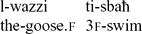
In terms of agreement, nouns require verb agreement at the IP level and adjectival agreement at the NP level. The agreement paradigm on the so-called imperfective verb, which is the subject of the current study, is realized by both prefixes and suffixes, as illustrated in (1)–(8) from the Palestinian dialect:
Singular
(1)

(2)
(3)
(4)
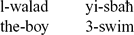
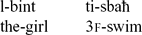
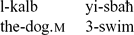
Plural
(5)
(6)
(7)
(8)
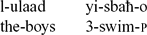
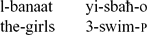


All of these sentences consist of a subject NP and the root sbħ “swim” which is marked for gender and number by different prefixes and suffixes depending on the gender and number of the subject. Particularly interesting are examples (7) and (8), which contain plural masculine non-human and plural feminine non-human NPs, respectively, and yet they can be matched to a verb marked as singular feminine or as plural.
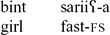
Adjectival agreement with nouns follows a similar pattern insofar as number and gender markings are concerned. Let us consider the following examples of agreement between NPs and attributive APs in the Palestinian dialect:
Singular
(9)
(10)
(11)
(12)


Plural
(13)
(14)
(15)
(16)
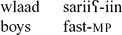

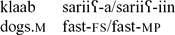

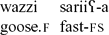
In (9), the AP lacks overt gender and number markers, which is a characteristic of singular masculine nouns and adjectives. In (10), the adjective is marked as singular feminine by the suffix -a. Likewise, it is marked by the suffix -iin as masculine plural feminine in (13) and by -aat as feminine plural in (14). Examples (11) and (12) follow the same agreement patterns of (9) and (11), respectively, even though their subject NPs are non-human. On the other hand, the plural masculine non-human and plural feminine non-human NPs in examples (15) and (16), respectively, can be matched to adjectives that are marked as singular feminine or as plural. This is because plural non-human nouns may have the option to behave grammatically as singular feminine.
These examples show that gender and number agreement patterns between NPs and attributive APs are similar to those found between the subject NP and the verb. The only difference is that, in the case of (13) and (14), two separate suffixes may be used to mark the adjectives as either plural feminine or plural masculine. That is, the plural suffix varies according to gender in the context of agreement with the adjective but not in the context of agreement with the verb. In this respect and if we only count the number of cells in the paradigms, the adjective agreement paradigm seems to be more complex than the verb agreement paradigm. However, this is a misleading picture because the verb agreement paradigm is certainly larger when we include person agreement, which in these two varieties of Arabic varies according to first, second and third. The full paradigms for the above verbs and adjectives are provided in (17) and (18):
(17)
(18)


The paradigms for the Egyptian verbs and adjectives are provided in (19) and (20):
(19)
(20)

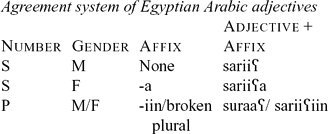
As can be seen from the above matrices, there are at least nine/eight cells in the verbal paradigm compared to four/three cells in the adjectival paradigm.
3. Number and gender morphology among L1, L2, and heritage speakers
From a generative linguistic perspective, grammatical gender and number are relational categories that reflect dependencies between predicates and their arguments. L1 learners may not always be able to overtly realize these forms in their oral production (Hoekstra & Hyams, Reference Hoekstra and Hyams1998a, Reference Hoekstra, Hyams, Greenhill, Hughes, Littlefield and Walshb; Ionin & Wexler, Reference Ionin and Wexler2002). Researchers have suggested that these are performance or processing errors because they are few, unsystematic, and often restricted to online production tasks (for example, L1 learners can recognize and correct their own errors).
Unlike L1 learners, L2 and heritage learners often have relatively greater difficulty with gender and number morphology than L1 learners, and they produce systematic errors that may be due to loss or fossilization (Bolonyai, Reference Bolonyai2007; Choi, Reference Choi2003; Håkansson, Reference Håkansson1995; Ionin & Wexler, Reference Ionin and Wexler2002; Lardiere, Reference Lardiere1998; Pak, Reference Pak1987; Polinsky, Reference Polinsky2006, Reference Polinsky2008; Rothman, Reference Rothman2007; Shin & Milroy, Reference Shin and Milroy1999). A number of studies have shown that heritage speakers do not deploy gender and number morphology with the same accuracy as do monolingual speakers. For example, Anderson (Reference Anderson1999, Reference Anderson2001) reports the gradual weakening of verb and gender agreement in the oral production of child Spanish-L1 immigrants in the United States. Montrul and Potowski (Reference Montrul and Potowski2007) found that Spanish heritage speakers produced significantly more gender agreement errors than native monolingual speakers and significantly fewer errors than L2 learners. Similar results were reported for speakers of heritage Russian (Polinsky, Reference Polinsky2006, Reference Polinsky2008), Hungarian (Bolonyai, Reference Bolonyai2007), Brazilian Portuguese (Rothman, Reference Rothman2007), Swedish (Håkansson, Reference Håkansson1995), and Korean (Choi, Reference Choi2003), among others.
Signs of non-native knowledge of agreement seem to appear particularly in cases where L1 and L2 have divergent agreement paradigms. For example, Fairclough (Reference Fairclough2006) reports that the areas of greatest verbal morphology loss for Spanish heritage speakers are those in which Spanish diverges considerably from English, such as subjunctive and compound tenses, whereas simple tenses and copula are the least affected areas. Moreover, at least one study shows that speakers may have better command of verbal morphology than nominal morphology. Bolonyai (Reference Bolonyai2007) found that while Hungarian heritage speakers show significant attrition of nominal morphology (omission of case affixes and the possessive suffix; over-extension of definite forms), their command of verbal morphology, including agreement marking on the verbs, is not significantly different from monolinguals. As noted above, this asymmetry between the nominal and verbal morphology may be attributed to differences in the nature of these two morphologies and possibly the configurations that they rely on to establish the agreement relation.
Turning to Arabic L1 acquisition, previous studies have shown that Arabic speakers typically acquire number/gender morphology by around the age of three, although errors continue to appear at a later age. For example, Omar (Reference Omar2007) investigated the language development of thirty-one Egyptian children ranging in age from six month to fifteen years. The analysis of her data, collected from conversations and elicitation tasks, shows that verbal agreement morphology starts to emerge around the age of 2;3 mostly through the generic use of uninflected or singular masculine verbs, whereas adjective morphology appears at around the age of three but again through singular forms. Although Omar does not report of data elicitation procedures designed to check the difference in children's knowledge of verb and adjective agreement, she observes that, in her naturalistic data, the overuse of the default singular masculine form continues to appear in the children output even after they had completed their fourth year of age. Similarly, Aljenaie (Reference Aljenaie2001) examined the development of tense and verb agreement in the language of four Kuwaiti children, using recording sessions, imitations, elicitation, and parental interaction techniques. Her findings indicate that Kuwaiti children use tense and agreement suffixes between the ages of 2 and 2;6, starting with those marking singular and masculine. Both studies suggest that agreement morphology, particularly verbal agreement, emerges early in the grammars of Arabic-speaking children.
A number of Arabic L2 studies have examined English-, French-, Spanish-, Japanese-, and Danish-speaking learners’ knowledge of subject–verb and noun–adjective morphosyntax (Alhawary, Reference Alhawary2003, Reference Alhawary2009; Mansouri, Reference Mansouri2000, Reference Mansouri and Pienemann2005; Nielsen, Reference Nielsen1997, among others). For example, in a series of studies examining the influence of processing prerequisites and L1 transfer on the learning of these two forms of agreement, Alhawary (Reference Alhawary2003, Reference Alhawary2009) found that learners of Arabic as an L2 mastered subject–verb agreement before noun–adjective agreement. Moreover, the latter form of agreement seemed to pose greater difficulty for the Arabic L2 learners than the former. In addition, speakers did relatively better on the sound masculine category, possibly because it is morphologically the simpler form. As Alhawary observes, these patterns are expected because noun–adjective agreement in Arabic are completely different from those present in the L1 of the learners and transfer effects may play a role. However, as far as we know, most of the experimental Arabic L2 studies have focused mainly on non-heritage learners of Standard Arabic. The present study seeks to examine these linguistic phenomena but in the speech of Arabic heritage speakers who have acquired their colloquial varieties as children in the home.Footnote 4
With regard to Arabic as a heritage language, Albirini et al. (Reference Albirini, Benmamoun and Saadah2011) examined a number of syntactic and morphological features in oral narratives collected from heritage Egyptian and Palestinian speakers. The researchers found that both groups displayed signs of attrition in agreement morphology in the verbal and nominal domains. Due to its exploratory nature and its reliance on naturalistic data, however, the study did not report whether agreement domain had an effect on the subjects’ performance. The current study uses experimental measures to test heritage speakers’ knowledge of number and gender morphology in the verbal and nominal domains. The study seeks to answer the following research questions:
1. What are the general features of the heritage speakers’ knowledge of gender and number agreement in comparison to that of the native speakers?
2. Is there a difference in the heritage speakers’ patterns of agreement morphology use in terms of gender (masculine, feminine), number (singular, plural), and type of agreement (sentential, phrasal)?
Based on previous studies, we expect that the heritage speakers have incomplete knowledge of verbal and nominal agreement compared to their monolingual counterparts. We also expect that heritage speakers will have less trouble with singular and masculine morphology because these are “simpler” in terms of affixation. For example, plural involves the addition of -u and -iin/aat in the verbal and adjectival domains, respectively. However, the simplicity of masculine may apply only to the phrasal domain, where feminine adjectives are derived from masculine ones by adding the feminine suffix -a. Moreover, studies focusing on the acquisition of agreement morphology by Arabic speaking children have shown that the masculine and singular categories are learned earlier and used more as the default forms by Arab children (Omar, Reference Omar2007).
4. Experiment 1
4.1 Participants
The first experiment involved 40 heritage speakers, 26 of whom were of Palestinian descent and fourteen were of Egyptian origin. The heritage group consisted of seventeen males and 23 females. Thirty-five of them were born in the United States to at least one Arab parent. Five subjects were born to Arab parents, but in Kuwait (1), Qatar (1), Egypt (2), and France (1). They moved with their parents to the U.S. at the ages of one (1), two (2), three (1), and seven (1). The two parents of 35 of the heritage groups were Palestinians/Egyptians, whereas only the fathers of five subjects (two Palestinians and three Egyptians) were native speakers of Arabic and the mothers were not speakers of Arabic.
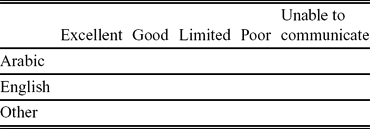
According to self-report, 32 of the heritage speakers were exposed to their Arabic dialects and English from birth, and eight remained monolingual in their dialects until the ages of three (2), four (1), five (4), and seven (1). All of the participants had completed high school in the U.S. at the time of the experiment. The heritage speakers ranged in age between 19 and 33 years (average age = 22.9 years). All of the participants in the current study indicated that English was their dominant language at the time of the experiment; even though some learned Arabic before or as they learned English. In terms of self-reported level of proficiency in their dialects, only four heritage speakers reported to have an “excellent” proficiency, seventeen “good” proficiency, twelve “limited” proficiency, three “poor” proficiency, and four “unable to communicate”. All of the participants could read Arabic script (which is possibly learned from Sunday school and in college Standard Arabic courses).
Thirty-three of the heritage participants still spoke Arabic at home, while seven spoke English predominantly. All of these 33 participants indicated that they spoke Arabic with their parents, and 27 reported that they sometimes interacted with their siblings using their Arabic dialects. Other sources of exposure to Arabic included Arabic TV (20 participants) and Arabic books, magazines, newspapers, or stories (36 participants). Lastly, thirty of the participants were exposed to Arabic through visits to their parents’ home countries, which ranged in frequency from yearly visits to once in a lifetime and in length from two weeks to three months.
The comparison group in this study included 24 Arabic native-speaker subjects, divided equally between Palestinian speakers and Egyptian speakers. The control group consisted of seventeen males and seven females. The average age of the control group was 29.7 years, ranging in age from 23 to 44 years. All of the native speakers spent at least the first 22 years of their lives in an Arab country. Eighteen of the native speakers were completing their graduate education at the time of the experiment and six had settled in the U.S. after completing their graduate education. They all completed high school in an Arab country (Egypt, Jordan, Palestine, or Saudi Arabia) and were residing in the U.S. at the time of the experiment.
4.2 Tasks
The subjects had to complete two elicited oral-production tasks. The first task involved the description of 40 pictures, presented in random order via PowerPoint presentation. The purpose of this task was to elicit instances of subject–verb agreement. The participants were presented with single pictures on individual slides, each involving an action. The pictures were matched to nouns (i.e., sentence subjects) that were distributed as follows: human singular masculine (N = 5), human singular feminine (N = 5), non-human singular masculine (N = 5), non-human singular feminine (N = 5), human plural masculine (N = 5), human plural feminine (N = 5), non-human plural masculine (N = 5), and non-human plural feminine (N = 5). The following action verbs were included: eat, read, watch, pray, play, laugh, cook, write, call, cry, listen, wear, drink, fly, jump, run, swim, walk, carry, and cut. Each of these verbs was used twice, once with a singular subject NP and once with a plural subject NP. After looking at the pictures, the subjects were asked in English to respond in their own dialects to the generative question, “What is/are the (sentence subject) doing?” The participants were instructed to complete the task at their own pace, using the up and down buttons on the computer keyboard to move between slides.
The second task also involved the description of forty picture pairs presented in a random order via a PowerPoint presentation. The purpose of this task was to elicit noun phrases containing adjectives. The picture pairs were matched to nouns that are distributed as follows: human singular masculine (N = 10), human singular feminine (N = 10), non-human singular masculine (N = 10), non-human singular feminine (N = 10), human plural masculine (N = 10), human plural feminine (N = 10), non-human plural masculine (N = 10), and non-human plural feminine (N = 10). Subjects were presented with picture pairs on individual slides, and these pictures involved the following contrasts: happy/sad, beautiful/ugly, fat/thin, tall/short, black/white, clean/dirty, fast/slow, Arabic/American, strong/weak, big/small, new/old, green/yellow, expensive/cheap, heavy/light, narrow/wide, tight/baggy, high/low, and full/empty. Each of these adjective pairs was used twice, once with a singular noun and another time with a plural noun. The subjects were instructed to respond to the questions “What do you see on the left?”/“What do you see on the right?” by creating phrases that demonstrated the contrast. They completed the task at their own pace, using the up and down buttons on the computer keyboard to move between slides. In addition to these two tasks, the subjects completed a questionnaire about their demographics and language background (see Appendix).
4.3 Data collection and coding
The data were collected from three states, Illinois, Michigan, and Utah, over the period of almost a year and a half. The subjects were tested individually. The subjects completed the two tasks and the questionnaire in a single session. The subjects’ responses to both tasks were recorded on a digital audio recorder. Prior to the experiments, the subjects were given four practice test trials: two for the Adjective Agreement Task (using pictures of the contrasting adjective pairs: “rich”/“poor” and “hot”/“cold”) and two for the Verb Agreement Task (using pictures involving the verbs “raise” and “talk”). The stimuli used for the training trials did not occur in the experimental trials. As noted above, the subjects’ responses were recorded with a digital audio recorder.
The recorded material was transcribed verbatim on paper and then typed as an Excel document. Following data collection and coding, the number of target and non-target responses was counted in the two tasks. If the verb or the adjective agreed in gender/number with the noun, gender/number on the verb or the adjective was considered correct and was assigned a 1; otherwise it was considered incorrect and was assigned 0. Items that did not receive a response and non-target responses that were of forms other than verbs or adjectives (i.e., that showed neither correct nor incorrect agreement) were given the value of “9” and coded as “missing”. In addition to counting the correct and incorrect instances, we also coded the patterns of errors across tokens and types. The data of the four subjects with “unable to communicate” proficiency were excluded from the analysis because they used random non-target words across the board. The data were analyzed using SPSS statistical software.
4.4 Findings
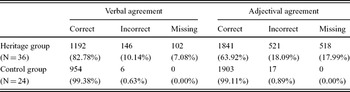
Table 1 provides a summary of the percentage of correct, incorrect, and missing responses in the data obtained from the Verb and Adjective Agreement tasks.
Distribution of correct, incorrect, and missing responses in the two tasks.

As Table 1 demonstrates, 82.78% of the heritage speakers’ responses on the Verb Agreement Task were correct, compared to an incorrect response rate of 10.14%. The heritage speakers’ performance on the Verb Agreement Task diverges from their performance on the Adjective Agreement Task, which yielded a correct response rate of 63.92% and an error rate of 18.09%. Moreover, whereas only in 7.08% of the cases did the heritage speakers fail to provide a response to the verbal stimuli, they failed so do so in 17.99% of the adjectival cases.
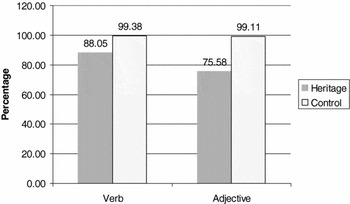
The heritage speakers’ performance on the Verb and Adjective Agreement tasks was dissimilar to that of the native speakers, who performed almost at ceiling on both tasks. The disparity is reflected in their differential accuracy rates (counted based on actual responses, i.e., after removing the “missing” items), which was 88.05% on the Verb Agreement Task and 75.58% on the Adjective Agreement Task for the heritage group and 99.38% and 99.11%, respectively, for the control group (Figure 1).
Comparison of the groups’ mean accuracy percentages on the two tasks.

Two independent-sample t-tests were carried out to compare the mean percentage accuracy of the heritage and control groups on the two tasks. The results of the two tests show that, not assuming equal variance, the two groups differed significantly in terms of their performance on the Verb Agreement Task, t(37.516) = –6.152, p < .001, and the Adjective Agreement Task, t(35.912) = –6.743, p < .001. A paired sample t-test was done to compare the heritage speakers’ accuracy rates on the Verb Agreement Task versus the Adjective Agreement Task. The outcome of the test showed a significant difference in how heritage speakers performed on these two tasks, t(35) = 4.892, p < .001; they performed significantly better on the Verb Agreement Task than on the Adjective Agreement Task.
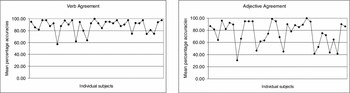
A close examination of the performance of the individual participants on the two tasks, using scatter plots (Figure 2), points to a remarkable convergence in the accuracy rates of the participants on the Verb Agreement Task; the majority of the points were concentrated in the range between 100.00% and 75.00%. On the other hand, the participants varied considerably in terms of their performance on the Adjective Agreement Task, with mean accuracy percentages ranging from 100% to 30.51%. These differences, along with the results of the paired-sample t-test discussed above, indicate that agreement morphology is significantly more maintained in the sentential domain than in the phrasal domain, which may in turn suggest that subject–verb agreement morphology is less liable to input and interaction effects than is noun–adjective morphology.
Comparison of mean accuracy percentages of individual participants on the two tasks.

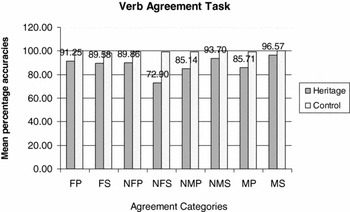
One of the notable differences in the performance of heritage speakers on the Verb Agreement Task versus the Adjective Agreement Task concerns their accuracy on the eight agreement categories specified above, namely, Human Masculine Singular (MS), Human Feminine Singular (FS), Non-human Masculine Singular (NMS), Non-human Feminine Singular (NFS), Human Masculine Plural (MP), Human Feminine Plural (FP), Non-human Masculine Plural (NMP), and Non-human Feminine Plural (NFP). Figure 3 compares the mean percentage accuracies of heritage and native speakers on the Verb Agreement Task.
Mean accuracy percentages on the verb agreement categories.

As Figure 3 demonstrates, the accuracy rates of the subjects seem to be consistent across the different verb agreement categories. The mean percentage accuracies ranged between 85.14% (Non-human Masculine Plural) and 96.57% (Human Masculine Singular), with the only exception being the non-human feminine singular category (72.90%).
A repeated-measures analysis of variance (ANOVA) was carried out to determine whether the gender (masculine, feminine), number (singular, plural), and human-ness (human, non-human) of the sentence subject had an effect on the speakers’ accuracy in deploying matching agreement paradigms. The results showed a significant main effect of human-ness, F(1,58) = 13.170, p < .01; heritage speakers were more accurate in deploying the correct agreement morphology when the subject of the sentence was human than non-human. However, there was no significant effects of gender, F(1,58) = 3.273, p = .67, or number, F(1,58) = .32, p = .859. This means that the heritage speakers’ performance was consistent irrespective the gender and number of the sentence subject. Post-hoc analyses show significant interactions between animacy and gender (p < .01); participants had difficulty with establishing the gender of non-human objects possibly because it is not based on biological gender and therefore they produce more agreement errors with non-human singular nouns. There was also a significant interaction between human-ness and number (p < .05); the number of non-human objects was not clear to the participants because non-human plural subjects can be considered grammatically feminine singular. A significant interaction was also found between number and gender (p < .001); singular masculine forms (both human and non-human) were more preserved than the other forms possibly because singular masculine is the default category.
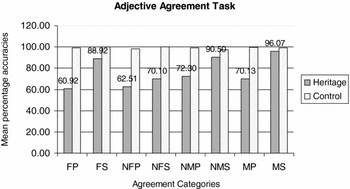
While the heritage speakers showed a considerable consistency in deploying verbal agreement morphology across different categories, they showed a notable variance in deploying adjectival agreement morphology. As Figure 4 shows, the subjects were more accurate on the categories of Human Masculine Singular (96.07%), Non-human Masculine Singular (90.50%), and Human Feminine Singular (88.92%) than on the other categories (which ranged from an accuracy rate of 60.92% (Human Feminine Plural) to 70.13% (Human Masculine Plural).
Mean accuracy percentages on the adjective agreement categories.

A repeated-measures ANOVA was carried out to analyze the effects of the animacy, number and animacy of the qualified noun on the participants’ accuracy in using matching morphology on the qualifying adjective. The results of the test showed a significant main effect of gender, F(1,59) = 10.576, p < .01, number, F(1,59) = 35.006, p < .001, and human-ness, F(1,59) = 4.893, p < .05. The participants’ accuracy rate on the Adjective Agreement Task was higher when the modified nouns were first singular, then masculine, and then human. This again suggests that the singular masculine category, as the default form, is more preserved than the other categories. Post-hoc analyses showed a significant interaction between number and human-ness (p < .01); the number of non-human objects may be vague to heritage speakers because non-human plural subjects can behave grammatically like feminine singular.
To summarize, the data analysis shows that the heritage groups are statistically less accurate in deploying the correct forms of agreement morphology than the control group. The difference between the heritage group and the native group appears in both the sentential and phrasal domains. However, verbal morphology seems to be significantly more maintained by heritage speakers than adjectival morphology. Moreover, while the individual subjects’ accuracy rates seem to be convergent on the Verb Agreement Task, a notable inconsistency is the mark of their performance on the different adjectival agreement categories. This is explained by the fact that the accuracy of the subjects on the Adjective Agreement Task is influenced by whether the qualified noun is masculine/feminine, singular/plural, and human/non-human. Lastly, the data show that the default agreement form (i.e., singular masculine) seems to be more preserved than the other forms in both the sentential and phrasal domains.
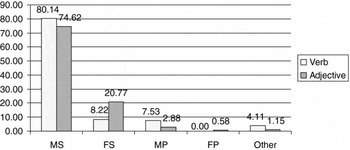
Not only are the default verbal and adjectival inflections more maintained than the other forms, but they are also over-generalized to other categories. Figure 5 outlines the types and percentages of errors in the sentential and adjectival domains.
Heritage speakers’ error types and percentages in the verbal and adjectival domains.

The singular masculine forms are over-extended to 80.14% of the cases of incorrect verbal agreement morphology and to 74.62% of the cases of incorrect nominal agreement morphology. In fact, masculine and singular forms seem to predominate over plural and feminine forms in the two domains. The fact that heritage speakers over-generalize the masculine singular category is consistent with data from other heritage populations suggesting that masculine and singular are less marked in the acquisition of inflectional morphology (Albirini et al., Reference Albirini, Benmamoun and Saadah2011; Cornips & Hulk, Reference Cornips, Hulk, Lefebvre, White and Jourdan2006; Laleko, Reference Laleko2010; Montrul, Reference Montrul2008; Montrul et al., Reference Montrul, Foote and Perpiñán2008; Polinsky, Reference Polinsky1997; Suh, Reference Suh, Bowles, Foote, Perpiñán and Bhatt2008). This is most likely because the third masculine form is the simplest form within the paradigms in that it does not carry any phonologically overt agreement marker. It does not require retrieving any morpheme or specific cell within the paradigm and essentially only involves deploying the bare form of the adjective or verb.
5. Experiment 2
5.1 Participants
The second experiment included 20 heritage speakers, 18 of whom were Palestinian and two were Egyptian. With the exception of two, all of them participated in the first experiment. The heritage group consisted of ten males and ten females. Seventeen of the heritage speakers were born in the U.S. to Palestinian/Egyptian parents and three were born in Qatar, Kuwait, and Egypt. The last three moved with their families to the United States at the ages of one (1) and two (2). The ages of the heritage speakers ranged between 19 and 26 years (average age = 20.5 years). According to self-report, 16 of them were exposed to their Arabic dialects and English from birth, and four remained monolingual in Arabic till the age of five (kindergarten). All of the heritage participants had completed high school in the U.S. at the time of the experiment. All of them could read Arabic script. Fourteen of them reported having a “good” competence in speaking and understanding Arabic and the remaining six reported having a “limited” competence. Four of them spoke English predominantly at home, whereas the other sixteen used English and Arabic with their family members.
The comparison group in this study included 20 native speakers, 12 of whom were Palestinian and eight were Egyptian. The control group consisted of 13 males and seven females, ranging in age from 23 to 44 years (average age = 29.3 years). All of the native speakers spent at least the first 22 years of their lives in an Arab country. All finished high school in an Arab country and were residing in the U.S. at the time of the experiment as either graduate students or university graduates living and working in the U.S.
5.2 Task
The task involved an elicited narrative, based on the Frog Story (Mayer, Reference Mayer1969). The purpose of this task was to elicit subject–verb and noun–adjective constructions in connected discourse. This story has been widely used in a number of studies for cross-linguistic comparison (Albirini et al., Reference Albirini, Benmamoun and Saadah2011; Berman & Slobin, Reference Berman and Slobin1994; Polinsky, Reference Polinsky2008). The participants were shown a picture book containing 24 pictures of a boy, his dog, and his lost pet frog. The speakers had to describe what is happening in each picture until they reach the end, where the boy finds his lost frog. Subjects were given the following instructions: “In this book, you will see a set of pictures that tell a story about a boy, his dog, and his lost frog. Please look at the pictures and then describe what you see in each picture in as much detail as you can.” The subjects were given five minutes to explore the pictures before the elicitation of the data.
5.3 Data collection and coding
Again, the data were collected from three states, Utah, Michigan, and Illinois. The subjects were tested individually in quiet rooms. The subjects were audio recorded with a digital recorder as they completed the task. The audio narratives were transcribed verbatim on paper and those of the heritage group were then typed as Word documents to facilitate error analysis. Every verb and attributive adjective was counted (tokens and types). In each case, if the verb or the attributive adjective agreed in gender/number with the noun, gender/number on the verb or the adjective was considered correct and was assigned a 1; otherwise, it was considered incorrect and assigned 0. Although attributive (and predictive) adjectives follow the noun in Arabic, we did not count adjectives that precede their nouns as incorrect because adjective position is not literally “agreement errors” in the sense used in this paper. In addition to counting the correct and incorrect instances, we also coded the patterns of errors across tokens and types.
5.4 Findings
The data obtained from the narrative (Table 2) demonstrate that the heritage and control speakers were comparable in terms of the number of the words produced. However, the control participants were able to perform the same task in less time than their heritage counterparts did. Thus, the average word production time per minute was about 94.75 for the control group, compared to 56.05 for the heritage speakers. The heritage group produced fewer verbs and more adjectives than did the control group (1164 compared to 1482 verbs and 54 compared to 46 adjectives).Footnote 5
Narrative summary data.

In L1 research, it has been observed that verbs tend to occur less frequently in the speech of young children than in the speech of older children and adults (Pye, Loeb, Redmond & Richardson, Reference Pye, Loeb, Redmond, Richardson and Clark1995; Sandhofer, Smith & Luo, Reference Sandhofer, Smith and Luo2000). This tendency may be explained by the simplicity of verbless clauses possibly because they lack such features as agreement, aspect, and tense, which are usually associated with verbs. The same explanation may be extended to heritage speakers, although in some cases this may be due to lexical retrieval problems.Footnote 6 Consider the following examples:
(21)
(22)
(23)


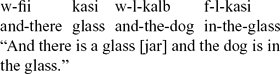
In all of these examples, the speakers produce verbless clauses either for simplification reasons or because they are unable to retrieve the appropriate verb (even though the syntax of these verbless sentences is native-like, particularly word order and the choice of grammatical categories). In (21), for example, the speaker generates an otherwise complex sentence (i.e., one involving a number of subordinate clauses) by using a number of prepositional phrases, maʕ DifDaʕ “with a frog” w maʕ kalb-u “and with his dog” žanb taxt-u “beside his bed” and fi l-leil “at night”. Likewise, the speakers replace the contextually appropriate clauses “the frog fled” and “the dog is searching in the jar” in (22) and (23) by “the frog is not in the house” and “the dog is in the glass”, respectively.
The use of adjectives and other modifiers may be seen as an “augmentative” strategy used to continue the communicative activity and avoid communicative breakdown, which characterizes the speech of heritage speakers and lower proficiency speakers (Jiménez Jiménez, Reference Jiménez Jiménez, Schmid, Köpke, Keijzer and Weilemar2004; Murphy, Reference Murphy1997).
(24)
(25)

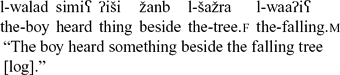
In example (24), the speaker uses of the two nouns “family” and “children” in reference to the same object and then modifies the latter with the word “little” to make sure that her reference to the non-adult frogs is understood. Likewise, in example (25), the speaker uses the term “falling tree” instead of “log”, where the adjective does not agree with the noun. In general, adjectives tend to be used to clarify what heritage speakers consider ambiguous words or concepts. The difference between the heritage and native speakers in terms of word production per minute and the number of verbs and adjectives highlights their divergent overall proficiency levels.
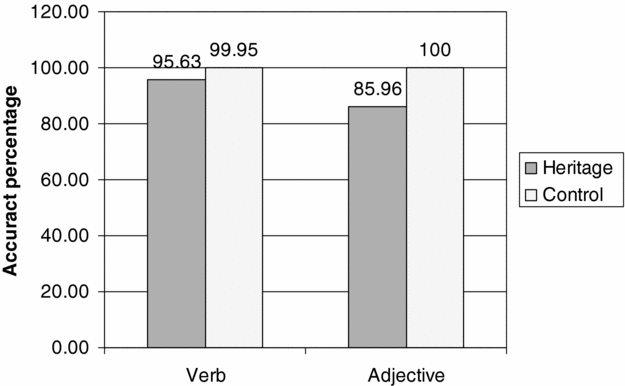
The two groups were also dissimilar in terms of their overall accuracy in realizing verbal and adjectival agreement. As Figure 6 shows, the heritage speakers were less accurate in using the correct verbal and adjectival morphemes (95.63% and 85.96%, respectively) than the native speakers, who performed almost at ceiling (with 99.95% and 100% accuracy rates).
Comparison of the groups’ mean accuracy percentages on verbal and nominal agreement.
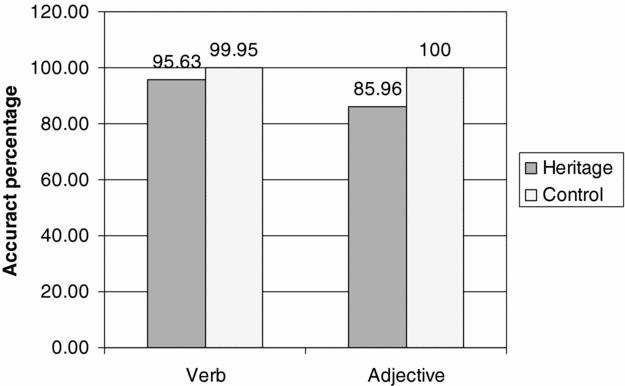
We performed two independent-sample t-tests to compare the mean percentage accuracies of the heritage and control groups on verbal and adjectival agreement. The outcomes of the two tests show that, not assuming equal variance, the two groups differed significantly in terms of their performance on verbal agreement, t(19.057) = –3.021, p < .05, and adjectival agreement, t(18.00) = –3.053, p < .05. We also performed a paired sample t-test to compare the heritage speakers’ accuracy rates on verbal versus adjectival agreement. The results of the test point to a significant difference in how heritage speakers performed in these two types of agreement, t(18) = 2.186, p < .05; they performed significantly better on verbal agreement than on adjectival agreement.
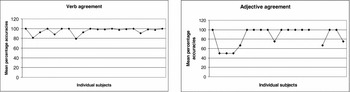
The mean accuracy percentages of the individual heritage speakers in terms of verbal agreement ranged between 79.31% and 100.00%, thus showing a notable convergence in their performance (Figure 7). On the other hand, diverging patterns appeared in their performance on adjectival agreement, with their percentages ranging between 50.00% and 100.00%. The relatively small number of adjectives produced by the heritage speakers in the narrative may not allow us to make generalization concerning their knowledge of adjectival agreement. However, the diverging patterns of the individual heritage speakers reveal general tendencies of adjectival agreement, especially in view of their similarity to the patterns emerging from Experiment 1. These disparities, when combined with the outcome of the paired-sample t-test, indicate that verbal agreement morphology is a significantly more robust area for heritage speakers than adjectival morphology.
Comparison of mean accuracy percentages of individual participants on verbal versus adjectival agreement.

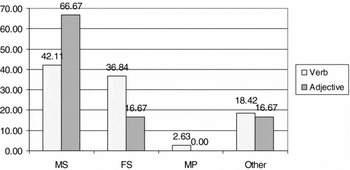
As was the case in Experiment 1, the heritage speakers over-generalized masculine singular forms to other categories. Figure 8 outlines the types and percentages of errors in the verbal and nominal domains.
Heritage speakers’ error types and percentages in the verbal and adjectival domains.

The singular masculine forms are over-extended to 42.11% of the cases of incorrect verbal agreement morphology and to 66.67% of the cases of incorrect adjectival agreement morphology. The overuse of the masculine and singular forms supports previous findings concerning the over-generalization of default inflectional morphology forms (McCarthy, Reference McCarthy2007, Reference McCarthy2008).
In summary, the results of Experiment 2 replicate those of Experiment 1 in terms of the significant difference between heritage speakers and native speakers in the use of gender and number agreement morphology in the verbal and adjectival domains. The narrative data also show that the performance of the heritage speakers was significantly better on verbal morphology than on adjectival morphology. Lastly, the over-generalization of the default singular masculine form is attested in both experiments.
6. Discussion
The agreement patterns in the speech of heritage speakers of Arabic leaves us with intriguing findings. The results show that both subject–verb and noun–adjective agreement morphologies are affected by language attrition, which may very well be caused by interruptions of input in the heritage language and a subsequent decline in use at or before school age. A number of studies have shown the critical impact of input and interaction on morphological accuracy (e.g., Huttenlocher, Vasilyeva, Cymerman & Levine, Reference Huttenlocher, Vasilyeva, Cymerman and Levine2002; Mackey, Reference Mackey1999). At the same time, however, the data reveal that subject–verb agreement morphology is less vulnerable than noun–adjective morphology, which suggests that other factors may be involved in the differential attrition of these two forms of agreement.
The verbal paradigms are larger than the adjectival paradigm as is evident from the matrices in (17), (18), (19), and (20). There are at least nine/eight cells in the verbal paradigm compared to four/three cells in the adjectival paradigm. Moreover, the verbal forms are more complex morphologically because the agreement morphemes can be discontinuous with both prefixes and suffixes. Thus, the third person plural is realized by both a prefix, which usually carries person, and a suffix, which usually carries number and gender (Benmamoun, Reference Benmamoun2000; Noyer, Reference Noyer1992). By contrast, adjectival agreement is realized by a single suffix that carries only the features gender and number but not person. Thus, from a morphological perspective, the verbal paradigm is more complex given that it is larger and can be discontinuous while the adjectival paradigm is relatively simpler. Yet, heritage speakers do better on verbal agreement than on adjectival agreement. This certainly rules out paradigm size and how it is spelled-out (as a single morpheme on one side of the stem or a discontinuous morpheme on both sides of the stem) as an explanation for the heritage speakers’ performance on verbal and adjectival agreement.
The data show that the participants were most accurate when matching a verb or adjective to a singular masculine noun. Moreover, en examination of the types of errors found in the responses of the heritage speakers points to a predominant use of the singular masculine in the Verb Agreement Task, Adjective Agreement Task, and the narrative task. This is not surprising, given the fact that the third singular masculine is the default category in Arabic. It is the simplest form, the first to emerge in L1 acquisition among children, and the most widely used among less proficient speakers of Arabic (Omar, Reference Omar2007). This may explain its prevalent and relatively accurate use by the heritage Arabic speakers. In this respect, heritage speakers are similar to both early monolingual Arabic L1 learners and L2 learners (Alhaway, Reference Alhawary2009; Aljenaie, Reference Aljenaie2001; Omar, Reference Omar2007)
According to McCarthy's Morphological Underspecification Hypothesis (McCarthy Reference McCarthy2007, Reference McCarthy2008), morphological variation results from representational errors; morphological errors involve the systematic replacement of marked, representationally-complex forms by unmarked, representationally-simpler ones. For example, L2 learners tend to substitute the masculine gender for the feminine, which has a more complex morphological representation, at the early stages of L2 acquisition. Likewise, early on in their language acquisition, speakers over-extend the singular number to the plural because the former has a simpler morphological representation than the latter. As we noted above, the third masculine form in Arabic is the simplest form within the paradigms in that it involves deploying the bare form of the adjective or verb. The over-generalization of default form shows that the relationship between L2 and L1 in L2 acquisition may have some resemblances to its counterpart in HLA, as has also been attested in a number of studies (e.g., Albirini et al., Reference Albirini, Benmamoun and Saadah2011; Alhawary, Reference Alhawary2009; Cornips & Hulk, Reference Cornips, Hulk, Lefebvre, White and Jourdan2006; Laleko, Reference Laleko2010; Montrul et al., Reference Montrul, Foote and Perpiñán2008; Polinsky, Reference Polinsky1997; Suh, Reference Suh, Bowles, Foote, Perpiñán and Bhatt2008). However, we believe that an independent study involving more than morphological area and perhaps multiple languages may be needed to ascertain the nature of these resemblances.
The issue of default-form generalization as a simplification strategy may be considered from a different and possibly a complementary view. According to some accounts (e.g., Hyams, Reference Hyams, Roeper and Williams1987), young children produce “inflectionless” verbs early in their language acquisition in languages in which bare verbs constitute whole words. In Arabic, the default category of the verb and adjective is in fact the bare form. It is therefore possible that heritage speakers display child-like performance with respect to the use of agreement morphology, which may be due to fossilization or attrition effects. It may be helpful to conceptualize the process of language attrition as the reverse of language acquisition (e.g., Hansen, Reference Hansen and Hansen1999; Keijzer, Reference Keijzer2010).Footnote 7
However, a purely morphological explanation may not be sufficient, especially if we consider the data from Experiment 2, where many errors are not the result of default-form over-generalization. For example, heritage speakers were least accurate when matching adjectives and verbs to non-human nouns. Non-human singular nouns may be problematic because gender is not always based on biological gender. Moreover, non-human plural nouns can behave grammatically as singular feminine, which is clearly a marked pattern. Therefore, establishing agreement here is not a straightforward number-and-gender-match between the two agreeing elements, but also involves recognizing a separate rule that designates these elements to singular feminine markings. Instead of applying this rule, heritage speakers often used regular plural gender and number agreement markings.Footnote 8 The fact that heritage speakers were often unable to observe this rule points to the possibility of L2 transfer, given the lack of this rule in their dominant L2 (Albirini & Benmamoun, in press; Alhawary, Reference Albirini and Benmamoun2009).
Another factor that may account for the heritage speakers’ differential performance on subject–verb versus noun–adjective agreement is frequency and age of acquisition. Studies in a number of languages have shown that verbs are generally more frequent than adjectives in children's output at the early stages of their language development (e.g., Berman, Reference Berman, Levy, Schlesinger and Braine1988; Choi & Gopnik, Reference Choi and Gopnik1995; Maratsos, Reference Maratsos, Wanner and Gleitman1982; Slobin, Reference Slobin, Smith and Miller1966; Tardif, Gelman & Xu, Reference Tardif, Gelman and Xu1999). In fact, it has been found that heritage children in particular have a better knowledge of verbs than adjectives (Polinsky, Reference Polinsky and Ravid2004), which Polinsky attributes to the optionality of adjectives as a lexical category, their status between nouns and verbs, and their marginal role in grammatical structure. Boerma (Reference Boerma2005) found that Moroccan–Dutch bilingual children (aged between 18 and 34 months) produce more Moroccan-Arabic verbs than nouns or adjectives once their vocabulary grew beyond 125 words. Moreover, Arabic L1 studies seem to indicate the verbal morphology emerges before adjectival morphology (Omar, Reference Omar2007). In addition, the narratives in the current study show that verbs are more frequent than adjectives, which also suggests that the morphosyntactic properties associated with the verb as a word category are expected to be more maintained (especially if we consider the notion of the morphological unity of verbs; see Maratsos, Reference Maratsos, Krasnegor and Rumbaugh1991). Frequency and age of acquisition may therefore partly explain the heritage speakers’ differential performance on subject–verb agreement versus noun–adjective agreement.
Moreover, the varied rates of attrition in the sentential and phrasal domains may be, from a generative syntactic perspective, due to syntactic relations. From a syntactic perspective, agreement morphology is tied to tense which is usually not as vulnerable in heritage speech (Fenyvesi, Reference Fenyvesi, Fenyvesi and Sándor2000). There are two agreement paradigms in Arabic whose distribution generally varies according to whether the verb is in the past or not (past vs. non-past).Footnote 9 The so-called imperfective paradigm, which we tested in this study, occurs in non-past tense and the perfective paradigm occurs in past tense contexts (Benmamoun, Reference Benmamoun2000). While there is no explicit evidence that can be given to argue that agreement morphemes also carry tense, they do co-vary with tense (past vs. non-past). In fact, according to Benmamoun (Reference Benmamoun2000), there are no overt tense morphemes in Arabic, particularly in the past and present tenses. Tense seems to be a property of the clause (an abstract feature of the temporal head) and agreement is at best an indirect reflection of the type of tense that the clause carries. In this respect, agreement seems be relevant to (indirectly) indexing the temporal reference of the clause which could explain why it is less vulnerable than adjectival agreement which is clearly not related to tense at all and does not co-vary with it.
Secondly, agreement on verbs has more semantic import than agreement on adjectives. In particular, agreement on verbs licenses pro-drop/null subjects in Arabic but agreement on adjectives does not (Kenstowicz, Reference Kenstowicz, Jaeggli and Safir1989). The agreement on the verb thus is critical to thematic role assignment, satisfying the requirement that sentences have subjects, and entering into co-reference, binding relations, and control relations. In this respect, it is more semantically grounded and carries a bigger functional load, which could explain why it is less vulnerable. Thirdly, verbal agreement is typically between a subject that is an agent, experiencer, or theme and a head that is the nucleus of the clause, namely the verb. By contrast, the adjective is an adjunct which is not as well integrated into clause structure as the verb's arguments and in fact can be optional when it is used as modifier. Structurally, adjuncts occupy peripheral positions and are not as easy to extract (in relativization and question contexts, for example) as arguments. Thus, the dependency between the verb and its subject is not the same as the dependency between the adjective and the noun it modifies. The subject is selected by the verb and depends on it for its thematic role which is not the case of the adjectival adjunct. Since the adjectival modifier is in a looser relation with the noun, the agreement relation may be more vulnerable since it does not reflect a selectional or thematic dependency.
The three syntax-based accounts imply that agreement is less vulnerable when the two players have a tighter semantic and syntactic relations based on selection and thematic role assignment, which is the case in the context of the verb and its subject. On the other hand, agreement is more vulnerable when the relation between the players in the agreement relation is less tight and based mostly on modification. The strength of the relation is a factor of the semantic and syntactic dependencies and functions at work. Verb agreement involves more of those dependencies and functions, which could be the reason why it is less vulnerable.
Overall, the data provide yet another indication that subject–verb agreement morphology is more maintained in heritage languages than noun–adjective agreement, which is consistent with previous findings on this topic (Bolonyai, Reference Bolonyai2007). At the same time, this asymmetry shows that various linguistic areas may not be equally affected by language attrition or fossilization (Montrul, Reference Montrul2008; Tsimpli & Sorace, Reference Tsimpli, Sorace, Bamman, Magnitskaia and Zaller2006). We believe that no single factor may explain such asymmetries; the data indicate that factors such as morphological representations, frequency, syntactic relations, L2 transfer effects, and maybe semantic issues may be responsible for producing the differential rates of attrition of subject–verb versus adjective–noun agreement morphology.
We conclude this paper by pointing to an important point about research methodology. Although the patterns of attrition were consistent in the tasks used in this study, the results show that the heritage speakers were more accurate on the narrative task than on the experimental tasks. It is also in the narrative that heritage speakers sometimes used avoidance strategies (e.g., using verbless sentences when they had to use forms other than the default form of the verb). These avoidance strategies reduce the gender and number agreement error rate and help heritage speakers maintain the follow of their narratives. As Jiménez Jiménez (Reference Jiménez Jiménez, Schmid, Köpke, Keijzer and Weilemar2004) notes, heritage speakers may perform differently on different tasks. Jiménez Jiménez (Reference Jiménez Jiménez, Schmid, Köpke, Keijzer and Weilemar2004, p. 72) observes that, depending on the type of task, heritage speakers may engage in metacognitive and self-regularatory strategies, such as “self-corrections”, “self-recast”, and “self-retrieval”, to solve communicative problems. The use of these strategies often increase processing time and brings down the speech rate, which is attested in our study. The narrative data show that the word production per minute was 56.05 for the heritage group, compared to 94.75 for the control speakers. Hence, elicitation tasks should be designed in such a way that the participants produce all the target structures. This will give a better and complete picture of the phenomenon under question.
Appendix. Heritage Speakers’ Questionnaire
I. Personal Information
1. Name: . . .. . .. . .. . .. . .. . .. . .. . .. . .. . .. . ..
2. Gender: . . .. . .. . .. . .. . .. . .. . .. . .. . .. . .. . ..
3. Country of birth: . . .. . .. . .. . .. . .. . .. . .. . ..
4. Year of birth: . . .. . .. . .. . .. . .. . .. . .. . .. . .. . ..
5. If not born in the U.S., year arrived: . . .. . .. . .. . .. . .. . .. . .. . .. . .. . .. . ..
6. Education: □ Elementary school □ High school □ College □ Other (specify). . .. . .. . .. . .
7. Parents’ country of origin: Father: . . .. . .. . .. . .. . .. . .. . .. . .. . .. . .. . . Mother: . . .. . .. . .. . .. . .. . .. . .. . .. . .. . ..
II. Language History
1. Languages (including dialects) spoken by parents Father: . . .. . .. . .. . .. . .. . .. . .. . .. . .. . .. . .. Mother: . . .. . .. . .. . .. . .. . .. . .. . .. . .. . .. . ..
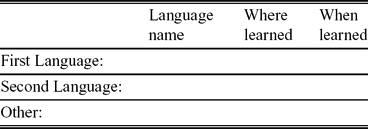
2. List of languages that you have used in the past and that you use now.
III. Current Language Use
1. Do you still speak Arabic at home? . . . Yes . . . No
2. If yes,
a. Do you speak Arabic with your parent(s)? . . . Yes . . . No
b. Do you speak Arabic with your siblings? . . . Yes . . . No
3. When did you start speaking English? . . .. . .. . ..
4. When did you stop speaking Arabic? . . .. . .. . ..
5. In general, what language do you speak predominantly in society? . . .. . .. . .. . .. . .. . .. . .. . .. . ..
6. How often do you visit your parents’ country of origin and how long are your visits? . . .. . .. . .. . .. . .. . .
7. Do you watch Arabic TV? . . . Yes . . . No
8. Do you read Arabic books, magazines, newspapers, stories (circle as necessary)?
9. Did you read Arabic as a child? . . .. . .. . .. . .. . .
10. Are you able to read Arabic script now? . . . Yes . . . No
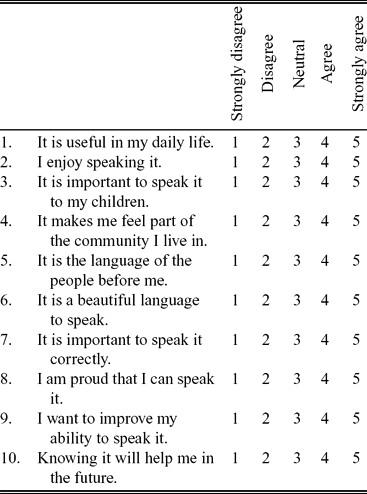
11. For each of the languages you know, put an X on the line that you think most closely describes your ability to converse in that language.
V. Is there anything else you would like to add?
. . .. . .. . .. . .. . .. . .. . .. . .. . .. . .. . .. . .
. . .. . .. . .. . .. . .. . .. . .. . .. . .. . .. . .. . .
. . .. . .. . .. . .. . .. . .. . .. . .. . .. . .. . .. . .
***Thank you very much for your help***