1 Introduction
The most typologically common vowel system is one with the five vowels [i e a o u] (Maddieson Reference Maddieson1984). These five vowels frequently form the core of a larger inventory, with properties such as nasality, length and breathiness used to augment the core system (Ladefoged & Maddieson Reference Ladefoged and Maddieson1996). In some languages, the features that augment such a five-vowel core are clear and unambiguous, whereas in other languages there is considerable potential ambiguity. Standard Yoruba, a Niger-Congo language of Nigeria, is an example of the latter type. Standard Yoruba supplements the typical five-vowel system as in (1a); certain dialects of Yoruba (e.g. Ijeṣa and Ekiti; see Fresco Reference Fresco1970, Akinkugbe Reference Akinkugbe1978 and Orie Reference Orie2003) have an inventory like (1b).
(1)


Such systems are ambiguous in terms of the precise nature of the feature involved in expanding beyond the five-vowel core.
There are two basic possibilities for analysing such inventories. On the one hand, languages with inventories like those in (1) could involve a more fine-grained expansion of the same features involved in the basic five-vowel inventory. That is, such systems could involve features along the vowel-height dimension as required for a five-vowel system, but with a greater number of levels. Alternatively, languages with such inventories could involve the addition of features that play no role in a basic five-vowel system. As an example of the latter type, consider the inventory of !Xũ (Maddieson Reference Maddieson1984), which has a basic five-vowel system cross-cut by additional distinct features, as in (2).
(2)
!Xũ is a language which adds dimensions of length, nasality and pharyngealisation to generate 24 monophthongs and 22 diphthongs. This is a clear example of the unambiguous vowel systems mentioned earlier. While the !Xũ vowel inventory is complex in terms of its overall contrasts, it is organisationally simple.
In this article we argue that the analysis of the Yoruba vowel system should be along the lines of !Xũ, in that it can be best characterised as a simple five-vowel inventory cross-cut by an additional feature, specifically tongue-root retraction. To this end, we present the results of an experimental investigation of vowels in Yoruba. As outlined in the next section, the case of Yoruba is highly relevant for this discussion, since there are arguments in the literature that harmonic vowel classes in Yoruba are distinguished by height features, as well as conflicting arguments that they involve a tongue-root feature. Our analysis of Yoruba ultrasound recordings demonstrates the significance of tongue-root position, not tongue height, in articulatorily distinguishing the two harmonic vowel classes. We use this evidence to argue that the phonological feature which distinguishes the vowels [∊ ɔ] from [e o] is [±ATR], not a height feature.
We also take this opportunity to use our Yoruba production data and methodology for testing a related hypothesis from Hudu (Reference Hudu2010): the Direct Mapping Hypothesis. Phonological evidence indicates that the phonologically active value of [ATR] in Yoruba is [—ATR], and hence the Direct Mapping Hypothesis predicts that the [—ATR] articulation position will be significantly retracted from the ‘neutral’ tongue position (the inter-speech posture) of Yoruba speakers. In exploring the implications of our finding that the Yoruba vowel system maintains a phonological contrast between [—ATR] and [+ATR] vowels, we test Yoruba vowel positions against ultrasound measurements of this inter-speech posture. We obtain a mixed result, but one still partially consistent with the Direct Mapping Hypothesis, especially if stated as a cross-linguistic tendency rather than an inviolable universal.
2 Background to Yoruba vowels
Standard Yoruba, the variety of Yoruba considered here, has seven oral vowels and three nasal vowels, as seen in (3).Footnote 1
(3)
Vowel harmony in Yoruba divides these vowels into two classes, as shown in (4).
(4)
To illustrate harmony, consider the way mid vowels surface in the agentive forms in (5) (Archangeli & Pulleyblank Reference Archangeli and Pulleyblank1989), where Class 1 [o] occurs before Class 1 vowels and Class 2 [ɔ] occurs before Class 2 vowels.
(5)
At issue here is how to characterise these classes. Within the literature on Yoruba vowel harmony, there are essentially three types of proposals. According to one view, the featural difference between Class 1 and Class 2 is one of vowel height: Class 1 vowels are non-low, while Class 2 vowels are low (Oyelaran Reference Oyelaran1971, Reference Oyelaran1973, Goad Reference Goad1993). A second view attributes the harmonic distinction to tenseness, with Class 1 vowels being tense and Class 2 vowels being lax (Courtenay Reference Courtenay1968, Fresco Reference Fresco1970, George Reference George1973). A third class of proposals is related to the second, in that the harmonic feature is considered to supplement the basic height distinctions, differing from the tenseness hypothesis in that the harmonic feature is considered to be specifically a feature of tongue-root advancement/retraction (Akinkugbe Reference Akinkugbe1978, Capo Reference Capo1985, Fọlarin 1987, Archangeli & Pulleyblank Reference Archangeli and Pulleyblank1989, Przezdziecki Reference Przezdziecki2005). Note that these proposals for a tongue-root feature appear to be compatible both with the proposal of Lindau (Reference Lindau1979) that the feature is properly understood as pharyngeal expansion rather than one specifically of tongue-root movement and with that of Edmondson et al. (Reference Edmondson, Padayodi, Hassan, Esling, Trouvain and Barry2007) that the feature is properly understood as involving stricture of a laryngeal articulator.
More is at stake than simply establishing the nature of the feature distinguishing Class 1 from Class 2. There have been various attempts in the phonological literature to predict properties of a language's feature system from properties of the language's segment inventory (Archangeli Reference Archangeli1984, Avery & Rice Reference Avery and Rice1989, Goad Reference Goad1993, Calabrese Reference Calabrese1995, Rose Reference Rose1996, Casali Reference Casali2003, etc.). Of specific relevance to the issue of tongue-root features and vowel height, Goad (Reference Goad1993) proposes a theory of vowel height where monovalent [low] and monovalent [ATR] are in complementary distribution. This has various effects. The complementarity of [low] and [ATR] means that low vowels in such a framework cannot exhibit tongue-root contrasts, since such contrasts would require both monovalent features. Expanding a basic five-vowel system with ‘retraction’, that is with [low], allows systems like (6a), but not systems like (6b) or (6c). Such a ‘retraction’-based system cannot have a contrast in high vowels, since the assignment of [low] to a ‘high’ vowel would cause it to be non-high.
(6)
Expanding a basic five vowel system with advancement (i.e. with [ATR]) allows systems like Types B and C, since [ATR] is compatible with high vowels.
Overall, active ‘retraction’ is only possible in a system like (1a) (the inventory of Standard Yoruba) where [low] can be a property of the vowels [∊ a ɔ].Footnote 2 It would also be possible to have such an inventory with [ATR], but this would mean phonological advancement, not retraction. Overall, Goad's prediction is that advancement (phonological use of [ATR]) is possible with non-low vowels but never with low vowels; retraction (phonological use of [low]) is possible only with non-high vowels.
There are various problems with these inventory-based predictions. For example, languages like Degema (Elugbe Reference Elugbe1984, Reference Elugbe1989, Archangeli & Pulleyblank Reference Archangeli and Pulleyblank1994, Kari Reference Kari1995, Reference Kari1997) have low advanced vowels, inconsistent with the claim that [low] and [ATR] are in complementary distribution. Concerning Yoruba, various dialects have nine-vowel inventories phonetically (Type C), with retraction, not advancement, being the active feature phonologically, just as in Standard Yoruba (Fresco Reference Fresco1970, Akinkugbe Reference Akinkugbe1978).
This paper addresses a distinct, though related, issue. Proposals of the type made in Goad (Reference Goad1993) depend crucially on the assumption that languages' phonologies are largely determined by properties of Universal Grammar. If, in contrast, phonological features emerge from experience (Mielke Reference Mielke2005, Reference Mielke2008, Pulleyblank Reference Pulleyblank2006, Mohanan et al. Reference Mohanan, Archangeli, Pulleyblank, Uyechi and Wee2010), then there would be no reason a priori for features being monovalent, for retraction being an impossible feature, and so on. It would be expected that phonological features would be quite concrete, motivated by phonological patterning but shaped by properties of speech production and perception.
In this paper, we address the articulatory nature of the harmonic feature in Yoruba, in particular whether harmony is best characterised in terms of tongue-root movement or whether it is best understood in terms of tongue-body raising/lowering. It is noteworthy that our knowledge of the articulatory properties of ‘tongue-root harmony’ systems is still quite limited. Since Stewart (Reference Stewart1967), there has been wide acceptance in the phonological literature that West African phonological systems frequently involve division of vowels into classes based on their tongue-root positions. Akan (the language considered by Stewart Reference Stewart1967) is the most widely studied language (Painter Reference Painter1971, Lindau Reference Lindau1979, Hess Reference Hess1992, Tiede Reference Tiede1993, Edmondson et al. Reference Edmondson, Padayodi, Hassan, Esling, Trouvain and Barry2007). Other West African languages for which there are articulatory data include Igbo (Ladefoged Reference Ladefoged1968), Dagbani (Hudu Reference Hudu2010) and Kabiye (Edmondson et al. Reference Edmondson, Padayodi, Hassan, Esling, Trouvain and Barry2007), as well as languages from elsewhere in Africa, such as Kinande (Gick et al. Reference Gick, Pulleyblank, Campbell and Mutaka2006), Maa (Guion et al. Reference Guion, Post and Payne2004) and Somali (Edmondson et al. Reference Edmondson, Padayodi, Hassan, Esling, Trouvain and Barry2007). Interestingly, all of these languages appear to be compatible with the postulation of phonologically active advancement, not retraction. In cases like Akan and Dagbani, the postulation of phonologically active advancement is necessary, while in a case like Somali, either active advancement or active retraction would appear compatible with observed patterns. Yoruba is therefore an interesting case, since it exhibits harmony, has a seven-vowel system and shows evidence of phonologically active retraction.
The evidence that Yoruba involves active retraction can be briefly summarised as follows; for detailed arguments, see Archangeli & Pulleyblank (Reference Archangeli and Pulleyblank1989). In word-internal sequences of mid vowels (except across compound boundaries), all vowels must exhibit the same value for the harmonic feature: [ rέ]
 r
 ‘friend’, [ɔw] ọw ‘broom’, [
 rɔ]
 rọ ‘machine’, [ekpo] epo ‘oil’, [olè] olè ‘thief’, [owó] owó ‘money’, and so on. Such cases do not argue for either harmonic value as active or passive. With respect to high vowels, we can see that within morphemes, the harmonic feature of a mid vowel is independent of the value of an adjacent high vowel.Footnote 3 That is, both before and after high vowels within a morpheme, mid vowels may belong to either Class 1 or Class 2.
(7)
Such examples show that the harmonic value of a mid vowel does not interact with an adjacent high vowel – there is no evidence for the harmonic ‘Class 1’ feature of a high vowel being active.
With low vowels, however, the situation is different. Although both Class 1 and Class 2 mid vowels may follow a low vowel, only Class 2 mid vowels may occur to the left of a low vowel.
(8)
The most plausible account for this is that the Class 2 value of a low vowel forces an immediately preceding mid vowel to belong to Class 2 as well. That is, the ‘retraction’ value of a low vowel actively causes a preceding mid vowel to assimilate to it.
Assuming that the articulatory implementation of distinctive features is non-arbitrary, we chose to address this question of the phonological status of Class 1 and Class 2 vowels in Yoruba by means of an ultrasound experiment. As the next section describes, ultrasound investigation allows us to determine which articulatory features correspond to the harmonic phonological classes in Yoruba – tongue-height features, as in Goad's (Reference Goad1993) proposal, or tongue-root features, as in Archangeli & Pulleyblank (Reference Archangeli and Pulleyblank1989) . We also take advantage of this opportunity to collect ultrasound information on Yoruba vowels to test a more general hypothesis about the mapping between phonology and articulation: Hudu's (Reference Hudu2010) Direct Mapping Hypothesis. Yoruba constitutes the ideal test case for this hypothesis, for reasons to be covered in §4.
3 The articulation of harmonic classes
Building on research by Davidson (Reference Davidson2005), Gick et al. (Reference Gick, Bird and Wilson2005) and Hudu (Reference Hudu2010), we collected tongue-position measurements using ultrasound imaging. In addition to its relative ease of deployment for both researcher and subject, modern ultrasound probes output high-resolution video amenable to analysis using smoothing spline ANOVA models (Davidson Reference Davidson2006).
Our null hypothesis states that, in both the tongue-root position and the tongue-height dimensions, no significant difference will be found between the averaged contour of Class 1 vowels and that of Class 2 vowels. Alternatively, a significant difference in only one of the two dimensions would speak to that dimension's articulatory and phonological relevance in distinguishing the two classes.
3.1 Methodology
Ultrasound data were collected from six native speakers of Standard Yoruba, all of whom were raised in Yoruba-speaking households in areas of Nigeria where the Ekiti, Oyo or Onko dialect is predominant. Each had been living in Vancouver for between one and five years and had maintained frequent Yoruba use during this period. Ages ranged from 25 to 42; three were male and three were female.
Rather than deploy additional sensors and machinery to track and subsequently correct for head movement (as in Whalen et al. Reference Whalen, Iskarous, Tiede, Ostry, Lehnert-LeHouillier, Vatikiotis-Bateson and Hailey2005), we adopted the motion-minimising techniques advocated by Gick et al. (Reference Gick, Bird and Wilson2005): use of a chair with attached motion-restricting headrest, combined with a head-mounted laser pointer shining onto a small square on the wall facing the subject. Tokens during which the laser point moved outside the square were re-recorded. After training, each subject held the ultrasound transducer against his or her neck above the larynx, enabling the transducer to render a midsagittal image. Recordings were made with an Aloka SSD-900 ultrasound machine and a 3·5 MHz electronic convex intercostals probe UST9012, which produced a 90° spread which included the tongue root and tongue blade. The ultrasound equipment recorded video to a standard digital video recorder, and sound was recorded simultaneously with an external microphone.
Target vowels were elicited as nuclei of monosyllabic verbs, mostly real verbs, but also novel verbs to cover lexical gaps, each embedded in the carrier phrase K  mọláf [verb] l méjì ‘Komolafe [verb] twice’. Approximately ten to twenty tokens of each vowel were recorded from each subject, with count variability arising from exclusion of tokens of low recording quality. To control for the consonantal context, the consonants preceding the target vowel were primarily [d]. The choice of [d] was for two principal reasons. First, in preliminary examination, it did not appear that coronal consonants had an effect on the tongue position at the midpoint of the following vowel. Note in this regard that the consonant following the target vowel was always coronal [l], because of the carrier phrase. Second, [d] occurs with high frequency in Yoruba, making it possible to find verbs of the shape [dV]. In total, 192 tokens were elicited from each subject for the purposes of this research. We did not control for tone, since pilot work did not show an effect of tone on tongue position.
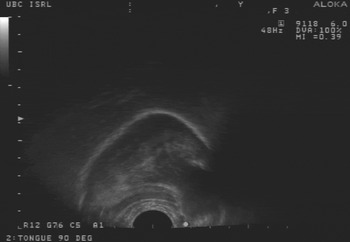
Target verbs in their carrier phrases were produced in hard copy and given to subjects, who read the list of sentences one by one, each following a signal by the researcher. The token order was randomly generated in order to prevent priming and other undesirable psychological and articulatory effects. After ultrasound video collection, still frames were extracted from the midpoint of each vowel, specifically halfway between the cessation of spectrographically noticeable onset consonant articulation and the beginning of the following [l] or pause; see Fig. 1 for an example. This extraction was performed by first labelling midpoints in a Praat TextGrid (Boersma Reference Boersma2001) and then writing to JPEG files via a command line interface for the FFmpeg multimedia framework.Footnote 4
These JPEGs were imported into EdgeTrak (Li et al. Reference Li, Kambhamettu and Stone2003), which enables conversion of images into contour data. An implementation in R (R Development Core Team 2012) of a smoothing spline ANOVA algorithm produced graphs of pairs of these data, including visual indications of Bayesian confidence intervals (Davidson Reference Davidson2006). Confidence intervals were calculated at p<0·05; non-overlapping confidence interval spreads for the two contours at a given angle indicated that the contours were significantly different at that angle. We compared confidence-interval spreads at 45° leftward of centre as indications of tongue-root position, and confidence-interval spreads at approximately 25° rightward of centre as indications of tongue-body height. These seemingly arbitrary measurement locations are as deemed appropriate in Gick et al. (Reference Gick, Pulleyblank, Campbell and Mutaka2006) and Namdaran (Reference Namdaran2006), based on average vocal tract shapes and the slight tilt of the ultrasound image relative to standing position; we visually checked these default positions for each subject and ensured that they were not noticeably inappropriate for any of them.
Rather than compare individual vowels, we grouped multiple vowels into categories informed by our preliminary featural analysis of Yoruba – all Class 1 vowels, all Class 2 vowels, all non-high Class 1 vowels, etc. – and plotted those groups against each other. These groupings served to abstract away from articulatory properties of individual vowels, allowing us to focus on the contrasts at play in the Yoruba vowel-harmony system. We were careful to use the same number of data points from each vowel within a group, preventing vowels that were more common in the test stimuli from unfairly influencing the average position. This number varied from group to group, depending on the number of tokens with each included vowel, but averaged around twelve per vowel.
3.2 Results
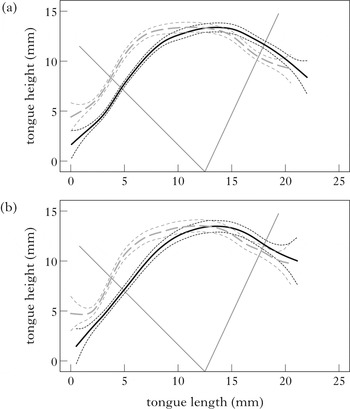
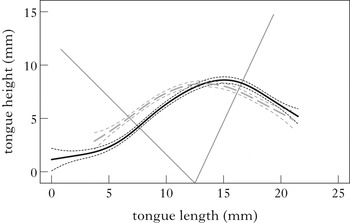
Because we were primarily interested in whether the two harmonic classes of Yoruba vowels are articulatorily distinguished in terms of tongue-root position, tongue height or both, our primary groupings correspond to those two classes. We considered two ways of grouping the test vowels potentially appropriate: groups containing all of the vowels in the two harmony-based classes ([i u e o ĩ ũ] vs. [a ∊ ɔ ã]), and groups containing only the relevant mid vowels ([e o] vs. [∊ ɔ]). To illustrate, consider the results for subject KA. Figure 2a compares the complete set of vowels (Classes 1 and 2), while Fig. 2b includes only the mid vowels (Classes 1′ and 2′). These graphs provide the results of a smoothing spline ANOVA analysis, and so are comprised of mean tongue positions (the thicker lines) and their confidence intervals (the thinner lines). The x-axis displays horizontal tongue displacement and the y-axis vertical displacement; the tongue root is at the left. Grey lines indicating both measurement angles have been added for clarity.
Note that tongue height is significant in the all-vowels condition in subject KA's vowels, but not significant in the only-mid-vowels condition. Tongue-root distinctions are significant in both conditions.
We discuss the results of both types of comparison below, and conclude that comparison of the only-mid-vowels groupings is more insightful.
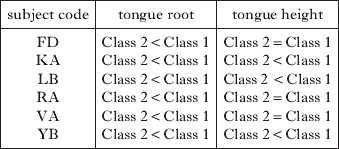
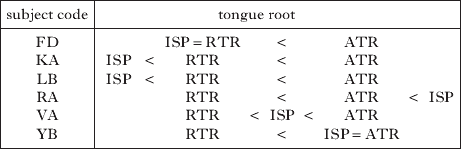
In Table I and similar tables below demonstrating the groupings based on harmony class, Class 1 represents the vowels [i u e o ĩ ũ] and Class 2 represents the vowels [a ∊ ɔ ã]. y<x indicates that x is significantly advanced compared to y (in the case of tongue-root position) or significantly higher than y (in the case of tongue height), while y=x indicates that no significant difference in position was found. To be consistent with our ultrasound figure (Fig. 1), we indicate ‘retraction’ to the left and ‘advancement’ to the right.
An ultrasound image of subject FD producing the vowel /e/. The tongue root is at the bottom left, and the front of the tongue extends to the right.

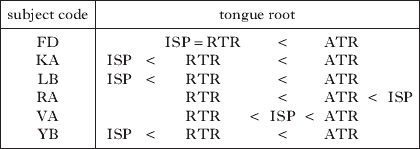
Relative tongue positions of Class 1 and Class 2 vowels. y<x indicates that x is significantly advanced (for the tongue root) or raised (for tongue height), compared to y. y = x indicates that no significant difference in position was found.
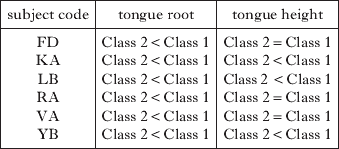
While tongue-root position differed significantly between the two classes for all six subjects, distinct positions in the tongue-height dimension were found for only three subjects. That a secondary height distinction accompanies a primary tongue-root distinction is unsurprising, given that movements of a muscular hydrostat – such as a human tongue – in one dimension will inevitably cause some change in position in another dimension, if not always a significant one. This trait of hydrostats is due to their incompressibility. Additionally, Class 1 includes all high vowels, while Class 2 includes all low vowels, although those height distinctions are not themselves relevant for harmony processes. Pairwise comparisons between groups based on vowel height, [i u] vs. [e ∊ o ɔ] vs. [a], did exhibit the expected significant differences in tongue height; these differences therefore likely affected measurements between Class 1 and 2, and, moreover, it is not merely the case that the ultrasound transducer is somehow more efficient at detecting tongue-root differences. Tests for differences between nasal and oral vowels, however, showed no appreciable difference in tongue-root position or tongue height.
Considering that the central question of featural difference is most relevant for distinctions among mid vowels, we tested the tongue positions for groups comprised of only these, as already seen in Fig. 2b. Specifically, we created a condition grouping only the alternating vowels [e o] and [∊ ɔ] as Class 1′ and Class 2′ respectively. Since any putative tongue-root distinction only plays a contrastive role for this subset of the overall vowel system, we might expect the magnitude of such a distinction to be the highest in these vowels.
(a) All vowels; (b) mid vowels: ATR (black solid line) vs. RTR (grey dashed line). Subject KA. Here and below, the tongue root is on the left, and the tongue tip on the right. The grey solid lines indicate tongue-root (left) and tongue-height (right) measurement angles.

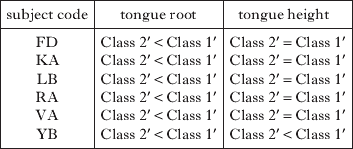
In the comparison in Table II, all tongue-root differences are significant – just as in the all-vowels condition – but of the six subjects, only YB shows a significant difference in the tongue-height dimension. The mid-vowel comparisons for FD, LB, RA and VA exhibit the same types of confidence-interval overlap as seen in the graph of KA's mid vowels (Fig. 2b).
Relative tongue positions of Class 1′ and Class 2′ vowels (the mid vowels).
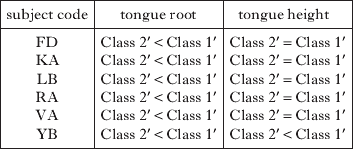
For purposes of comparison with the majority result (as exemplified by Fig. 2b), Fig. 3 presents YB's contour comparisons in the only-mid-vowel condition, showing both tongue-root and tongue-height distinctions.
Mid vowels: ATR (black solid line) vs. RTR (grey dashed line). Subject YB.

3.3 Discussion
Our results indicate a significant difference in tongue-root position between the Yoruba vowel classes examined. The vowels [e o] are significantly advanced relative to [∊ ɔ]; the vowels [i u e o ĩ ũ] are significantly advanced relative to [a ∊ ɔ ã]. For the vowels [e o] and [∊ ɔ], there is a slight but significant difference in tongue height for only one out of the six subjects; for [i u e o ĩ ũ] and [a ∊ ɔ ã], three of the speakers exhibits a significant height distinction, while the other three do not. We interpret this result as indicating an overall lack of a distinctive height contrast between class 1 and class 2 vowels, especially considering the narrowness of the difference in tongue height for the one outlier, YB. Given that the set [i u e o ĩ ũ] includes four high vowels (and two mid vowels) while the set [a ∊ ɔ ã] includes two low vowels (and two mid vowels), and that vowel height will have some effect on the positions of other areas of the tongue-as-hydrostat, it is unsurprising that some speakers' values indicate an overall height distinction between the two classes. What is remarkable is that even these classes fail to exhibit a significant height distinction for half of the speakers. Ultimately, therefore, our results corroborate a featural analysis that includes a tongue-root feature rather than one that relies only on iterative distinctions in the tongue-height dimension.
The findings here are incompatible with Goad's (Reference Goad1993) proposal that seven-vowel systems of the Yoruba type must involve tongue-height distinctions rather than tongue-root distinctions. The findings do not, however, address the question of whether an appropriate feature would be [ATR], as opposed to, for example, [expanded pharynx] or a laryngeal sphincter feature. Detailed information about the pharynx is not available from ultrasound imaging as deployed in this study. Regardless, we can conclude that the articulatory dimension contrasting the two vowel classes lies somewhere in the tongue-root or pharynx region, not the tongue body.
Note also that these results contrast sharply with articulatory patterns found by Dalton (Reference Dalton2011) in an ultrasound investigation of Canadian French. Canadian French exhibits a phonological distinction between ‘tense’ and ‘lax’ high vowels: [i y u] vs. [ɪ ʏ ʊ]. Dalton determined that the difference between the tense and lax members of each pair in Canadian French was articulated with a significant difference in tongue height, but no difference in tongue-root position. This result helps to validate our findings about Yoruba by establishing not only that there exists cross-linguistic variation in the types of articulation characterising such pairs of vowels, but also that such variation can be and has been detected using ultrasound imaging.
4 Inter-speech posture and direct mapping
In the first part of this paper, we examined two featural approaches to vowel harmony in Yoruba, arguing that our ultrasound data support an analysis formulated in terms of tongue-root advancement/retraction. In the remainder of this paper, we focus on related insights, gleaned from comparisons of segmental articulation postures to a language-specific (or speaker-specific) ‘default’ articulator position. It has long been suspected (Honikman Reference Honikman, Abercrombie, Fry, MacCarthy, Scott and Trim1964, Laver Reference Laver1978, Jenner Reference Jenner2001) that such default positions exist. Gick et al. (Reference Gick, Wilson, Koch and Cook2004) and Wilson (Reference Wilson2006) provide empirical support for this hypothesis, linking a language's default position to the inter-speech posture (ISP) to which a speaker's articulators return between utterances.
Inter-speech posture measurements may be directly related to a language's phonological organisation. Consider recent ultrasound imaging studies on tongue-root movement by Namdaran (Reference Namdaran2006) and Hudu (Reference Hudu2010), which examine segmental articulation and ISP in Dagbani and St'át'imcets respectively. Of particular importance, Hudu (Reference Hudu2010) proposes a phonologically motivated cross-linguistic typology of relationships between ISP and the articulation of phonological classes. His proposal, the Direct Mapping Hypothesis, states that phonetic displacement from ISP corresponds to phonological feature specification (see also Hudu et al. Reference Hudu, Miller, Pulleyblank, Austin, Bond, Charette, Nathan and Sells2009). That is, if the phonetic implementation of a feature involves displacement in a particular direction, then there should be a phonological counterpart where a feature value [+F] corresponds to such a displacement, and vice versa.Footnote 5 For example, if a vowel involves phonetic advancement of the tongue root from the ISP, then the phonology should involve an active [+ATR] feature. The Direct Mapping Hypothesis makes no predictions about articulation of non-active feature values, and so a language only with active advancement may or may not have an ISP that overlaps with the phonologically retracted tongue position. The predictions made by this typology motivate the experiment described in this section. In brief, given that Hudu found compelling trends in ISP relative to advanced vowels (Dagbani) and Namdaran found compelling trends in ISP relative to retracted consonants (St'át'imcets) – both in accordance with Hudu's Direct Mapping Hypothesis – we chose to fill out the relevant typology by examining ISP in Yoruba, where retracted vowels form the relevant class.
4.1 ISP in Dagbani
Building on previous accounts of Dagbani vowels (Abu-Bakari Reference Abu-Bakari1977, Dakubu Reference Dakubu1997, Olawsky Reference Olawsky1999), Hudu (Reference Hudu2010) argues that Dagbani has a highly asymmetric vowel system underlyingly. Although exhibiting a fairly typical phonetic vowel system for a language with tongue-root harmony, [i ɨ e ∊ ə a ɔ o ʊ u], Dagbani has, according to Hudu, only one advanced vowel underlyingly, [i]. Two basic factors determine the appearance of advanced vowels on the surface. First, a set of phonotactic conditions involving syllable structure and word minimality determines the appearance of advanced and retracted variants of vowels. Second, conditions governing vowel harmony require the appearance of advanced vowels when in proximity either to the underlyingly advanced vowel [i] or to vowels that are advanced because of the phonotactic conditions just mentioned. Hudu clearly establishes two important points. Phonetically, the harmonic classes of Dagbani are based on tongue-root advancement/retraction; phonologically, an adequate account of Dagbani vowels requires reference specifically to tongue-root advancement.
Hudu (Reference Hudu2010) goes on to discuss ISP, using ultrasound imaging for his investigation. Developing a strong version of the Direct Mapping Hypothesis, Hudu proposes a set of three predictions about the locations of advanced and retracted tongue-root positions relative to a language's ISP: one each regarding languages in which [+ATR] or [—ATR] is the phonologically active value of the tongue-root feature, and one regarding languages in which both values of the tongue-root feature are active. Together, these three predictions comprise a strict hypothesis about the relationship between positions of phonologically active and passive features and the ISP more generally. We present a version of Hudu's predictions – modified only for typological clarity and economy – in (9).
(9)
Using methods similar to those described in §3.1 above, Hudu first demonstrated that tongue-root advancement and retraction are the primary articulatory correlates of the vowel classes [i u e o ə] and [ɨ ʊ ∊ ɔ a] – a result parallel to our conclusions about Yoruba. By further comparing these vowel tongue-root measurements to measurements of tongue-root postures between utterances (the ISP), Hudu then confirmed his hypothesis about the relationship between ISP and phonologically active tongue-root features in Dagbani, as shown in Table III.
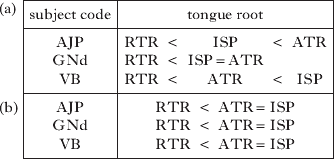
Dagbani: ISP relative to grouped vowel classes.
Tongue-root locations for vowels bearing the phonologically active tongue-root feature [+ATR] were significantly advanced compared to the ISP, and the [—ATR] position was either in an intermediate position significantly distinct from the ISP and [+ATR] position (for four subjects) or significantly posterior to the ISP (for one subject).
4.2 ISP in St'át'imcets
St'át'imcets, also referred to as Lillooet, is an Interior Salish language of the southern British Columbia region in Canada. Its phonological inventory includes a large set of consonants articulated with a retracted tongue root, including uvulars, retracted coronals and possibly pharyngeals, depending on the analysis (Remnant Reference Remnant1990, van Eijk Reference Eijk1997, Shahin Reference Shahin2002). Moreover, St'át'imcets retracted consonants, like those in all Interior Salish languages, can trigger assimilation of vowel quality.
Under an analysis of St'át'imcets phonology that makes reference to a single tongue-root feature, then, it is trivial to determine that [—ATR] is the phonologically active value: vowels adjacent only to vowels and/or word edges are articulatorily comparable to those adjacent to [+ATR] consonants, while the same vowels adjacent to [—ATR] consonants surface as significantly retracted, presumably due to feature spreading (Namdaran Reference Namdaran2006). The Direct Mapping Hypothesis therefore predicts that in St'át'imcets (a Type B language) the retracted tongue position will be reliably posterior to the tongue-root ISP, while the non-retracted tongue-root position may overlap with the ISP.
In addition to using ultrasound imaging to compare retracted and advanced vowels in St'át'imcets, Namdaran (Reference Namdaran2006) also recorded each subject's ISP and plotted it against his or her consonant-position traces. Finding no a priori reason that the Direct Mapping Hypothesis should apply only to vowel positions relative to the ISP and not also to consonant positions, we used Namdaran's data to test these predictions over the domain of St'át'imcets consonant tongue-root positions.
Tracings of tongue positions for the relevant St'át'imcets consonants and the inter-utterance ISP revealed that while tongue-root positions for all of the retracted consonants were significantly retracted from the ISP, non-retracted vowels as a class were not found to exhibit significant anteriority or posteriority to the ISP (see Table IV). Assuming that the predicted correlation between tongue-root ISP and vowel positions also holds for consonant positions, Namdaran's findings categorically corroborate Hudu's hypothesis.
St'át'imcets: ISP relative to (a) /s/ (advanced) and /s/ (retracted); (b) /k/ (advanced) and /q/ (retracted).
4.3 ISP in Yoruba
Hudu's results from Dagbani and Namdaran's from St'át'imcets provide tentative validation of the first two parts of Hudu's ISP hypothesis. However, such a strong claim about the relationship between inter-utterance tongue positions and phonological markedness cannot be firmly supported by just these two studies, especially given the discrepancy between grouped vowel-ISP measurements in Hudu's paper and individual consonant-ISP measurements in Namdaran's. To contribute towards a more robust typology, we chose to compare Yoruba tongue-root ISP to vowel positions: Yoruba, like Dagbani, contrasts vowels that articulatorily involve tongue-root advancement with vowels that involve tongue-root retraction; Yoruba, like St'át'imcets, demonstrates phonologically active retraction (Akinkugbe Reference Akinkugbe1978, Archangeli & Pulleyblank Reference Archangeli and Pulleyblank1989, Reference Archangeli and Pulleyblank1994, Przezdziecki Reference Przezdziecki2005). This combination of properties makes Yoruba fully amenable to examination by a methodology similar to that of Hudu (Reference Hudu2010).
4.3.1 Methodology
We revisited the Yoruba ultrasound data described in the previous section in order to determine whether Yoruba also exhibits the tongue-root positions predicted by the Direct Mapping Hypothesis. In order to determine the inter-speech postures of the six Yoruba-speaking subjects, additional frames were extracted from the ultrasound videos of their speech production, the collection of which was described in §3.1. These recordings were made in large sections, such that each recording was comprised of approximately twelve utterances. Between each of these utterances was a roughly one-second silence; ISP frames were taken from the midpoints of these silences. In total we extracted 48 ISP tokens per subject, an arbitrary number chosen for its similar size to the total number of ATR or RTR vowel tokens for each subject. The contours of these inter-speech posture images were processed and analysed in the same way as the vowel data.
4.3.2 Results
Within the speech of each subject, inter-speech postures were consistent across the duration of the recording session, producing confidence levels on the scale of those for vowels. As in our original test for differences in tongue-root position vs. tongue height, we tested both groupings of all ATR vs. RTR vowels (as in Hudu Reference Hudu2010), as well as groupings of only the mid vowels.
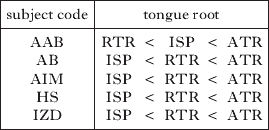
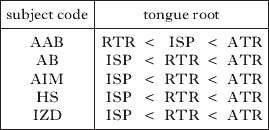
Table V describes the tongue-root ISP location for each subject relative to his or her retracted and advanced tongue-root positions for groupings including all ten vowels: y<x indicates that x is significantly advanced compared to y, while y=x indicates that no significant difference in position was found. All subjects' ATR and RTR positions are aligned with each other for improved readability.
Yoruba: ISP relative to grouped vowel classes (Class 1 and Class 2). y<x indicates that x is significantly advanced compared to y. y=x indicates that no significant difference in position was found.
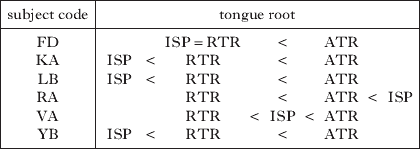
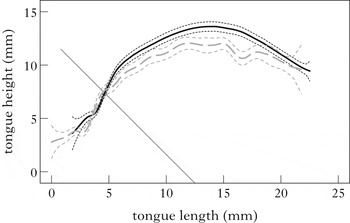
To summarise the critical comparisons between ISP and RTR: only two subjects (RA and VA) exhibit an ISP significantly advanced from the RTR position as predicted by the Direct Mapping Hypothesis, whereas three subjects (KA, LB and YB) have an ISP significantly retracted from the RTR position. FD presents a borderline case that fails to reach significance, although this may be due to irregularities in FD's tongue contours (see Fig. 6 below).
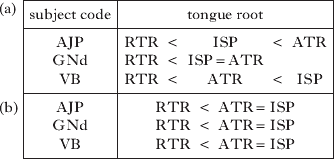
In the condition that limits membership in phonological class averages to those phonemes forming an advanced and retracted pair (e.g. those in Table II), most ISP locations were identical to those in the condition that included all vowels. The one difference is that YB's ISP is now significantly advanced from the RTR position, as shown in Table VI.
Yoruba: TR ISP relative to grouped vowel classes' TR, excluding [i u a ĩ ũ ã] (Class 1′ and Class 2′).
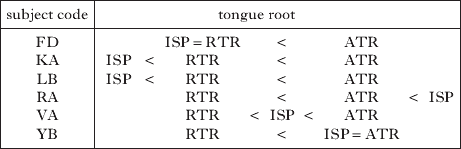
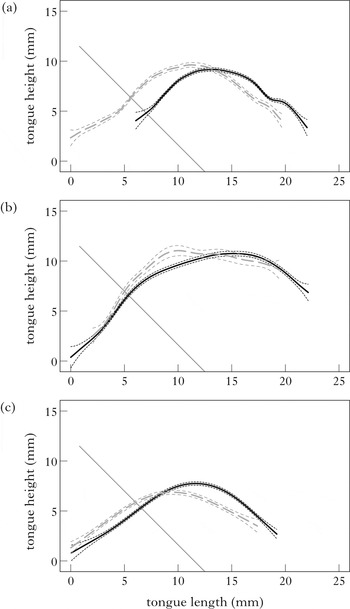
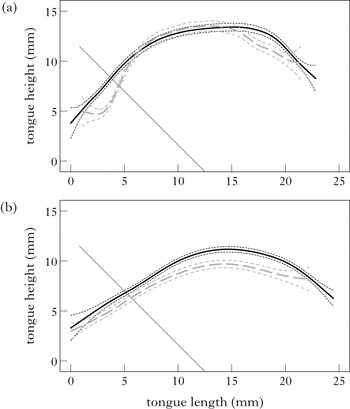
Our subjects therefore fall into two distinct groups in terms of relative ISP and RTR positions. We continue to adopt the stance that, as in §3, the mid-vowel comparisons are better representatives of the target patterns than the comparisons of all vowels (see §4.4). Therefore the largest group of subjects (RA, VA and YB) exhibits an RTR position retracted from ISP, as shown in Fig. 4. Conversely, KA and LB both show evidence of an RTR position that is advanced compared to ISP, as seen in Fig. 5. Finally (Fig. 6), FD failed to show a significant difference between ISP and RTR, although FD's contour data show irregularities of unknown origin which may be responsible for a lack of difference between contour means.
Mid vowels: ISP (black solid line) vs. RTR (grey dashed line). (a) subject RA; (b) subject VA; (c) subject YB.

Mid vowels: ISP (black solid line) vs. RTR (grey dashed line). (a) subject KA; (b) subject LB.

Mid vowels: ISP (black solid line) vs. RTR (grey dashed line). Subject FD.

4.4 Discussion
In §3.2, we demonstrated that altering vowel groups such that they include only the vowels with both advanced and retracted forms, rather than including all ten vowels, causes a weak pattern of significance to become extremely strong. In brief review: with all vowels included in the compared groupings, tongue-root position is always significantly different between vowel classes, while height is also significantly different in half of the subjects; but with only the mid vowels included, tongue height ceases to be significantly different for all but one of the subjects, while tongue-root position remains significant for all of them. We tentatively take this result to indicate that comparisons involving groups of only the lexically contrastive vowels (the mid vowels in this case) are more accurate metrics of actual patterns of articulatory significance and non-significance than groups under the less strict criterion.
A parallel relationship exists between the two grouping criteria among comparisons with the ISP. The relative positions of the ISP and two vowel classes change with the removal of non-mid vowels only for a subject whose results in the all-vowels condition indicated an ISP significantly retracted compared to both the advanced and retracted positions. If removing non-alternating vowels from the comparison groups can root out ‘false positives’ produced by compensatory hydrostatic motion of the tongue root corresponding to differences in vowel height, then we must conclude once again that the comparisons of Class 1′ and Class 2′ provide more accurate insights than comparisons involving all ten vowels. Additionally, although no such domain restrictions were required to produce conclusive results in Dagbani, in Yoruba the vowels forming advanced and retracted pairs comprise a smaller proportion of the vowel inventory than in Dagbani; comparison of all ten vowels in Yoruba (counting both oral and nasal vowels) would, then, be more dissimilar to the methodology used for Dagbani, since the compared groups would be comprised mostly of non-alternating vowels. We therefore propose that the Class 1′ and Class 2′ comparisons best represent the locations of [+ATR] and [—ATR] vowels respectively.
These vowel-group and ISP-comparison analyses indicate a minor trend toward the directionality predicted by Hudu's hypothesis, but are better characterised as indicating that (at least) two subgroups exist within speakers of Yoruba in terms of their ISP compared to the RTR position. Three of the six speakers exhibit an RTR position significantly retracted from ISP in the tongue-root dimension, as Hudu predicts, but FD's RTR position is undifferentiated from ISP, while KA's and LB's RTR positions are advanced compared to ISP. The only methodological difference of note between this study of Dagbani and ours of Yoruba is that Hudu (Reference Hudu2010) relied on Student's t-tests to check for significance levels rather than smoothing spline ANOVA. Although we know of no reason to expect that one test would produce more Type I or Type II errors than the other, this discrepancy in analysis techniques could be responsible for some of the difference between the Dagbani and Yoruba patterns.
It is conceivable to run statistical tests of significance to determine whether, at least, there is a greater-than-expected tendency toward the RTR position being retracted from ISP. With only six subjects, however, any such test in this case would be guaranteed to yield negative results; were the number of subjects greater, it would be possible that we would find a significant result. Unfortunately, the collection and processing of ultrasound data is much less straightforward than that of, for example, acoustic data, and so we had no choice but to limit ourselves to six subjects. We hope that advances in ultrasound and available data processing technologies will enable larger-scale studies in the near future.
There are various interpretations of this mixed result. One obvious interpretation is that the Direct Mapping Hypothesis is too strong, as at least some speakers (KA, LB and possibly FD) appear to violate it. Another possibility is that speakers such as KA and LB have somewhat different phonologies from RA, VA and YB, perhaps differing in terms of the phonological activity of retraction. A couple of points are worth noting in this regard. First, Standard Yoruba is the language of education, broadcasting, and so on, and differs in significant ways from non-standard dialects. There has been relatively little work on dialectal differences in Yoruba harmony (but see Akinkugbe Reference Akinkugbe1978, Orie Reference Orie2001, Reference Orie2003). The impact of dialects on results such as those reported here must be left for future investigation.Footnote 7 Second, and related to the first point, one of the strongest pieces of evidence in favour of phonologically active retraction is provided by forms such as bi ‘guilt’ and bùrú ‘shortcut’. Such lexical items show that lexically specified retraction values survive even when in positions that are disharmonic in that they precede high advanced vowels. Dialects differ, however, as to whether such forms are allowed. For example, Orie (Reference Orie2001) shows that Ifẹ disallows such sequences. Where such forms are disallowed, the evidence for phonologically active retraction is weakened. We might expect that speakers of relevant dialects would exhibit different active feature values, the predictions about relation to the ISP therefore being different.
Finally, we note that the ISP may tend to occur in a particular part of the vocal tract independent of whether a language has tongue-root harmony, and independent of any specific phonological value for a harmonic feature if present. Imagine that, all else being equal, the ISP tended to be closer to a retracted position than an advanced position. That such might be the case is suggested by an observation by Dakubu (Reference Dakubu1997) and Casali (Reference Casali2002, Reference Casali2003, Reference Casali2008) that retracted vowels tend to occur much more frequently than advanced vowels in many tongue-root harmony languages. This is the case in Dagbani, for example. If the ISP is closer in general to a retracted position, then we might expect languages with phonological advancement to more strikingly exhibit advanced vowels as displaced from the ISP than languages with phonological retraction. To establish the plausibility or implausibility of such a hypothesis, we clearly need more ISP data both from languages with advancement and from languages with retraction. While considering other potential physiological factors, we also scrutinised our results for evidence of a gender-based difference in articulatory positions, but found no particular trends.
In conclusion, data from three of our six subjects are consistent with the Direct Mapping Hypothesis. Data from two subjects are opposite to its predictions, and we have speculated on various possible explanations for the results seen in those two speakers; one speaker's data are inconclusive. Certainly our Yoruba results indicate some sort of principled difference from the Dagbani patterns: the majority case in both languages is the one predicted by the Direct Mapping Hypothesis, and for one reason or another there is significantly more variability in Yoruba.
5 Conclusion
This paper supports an analysis of Yoruba vowels wherein a basic five-vowel system [i ∊ a ɔ u] is augmented by nasality [ĩ ã ũ], by tongue-root advancement/retraction [e o] and by tone [H M L]. That a feature of tongue-root advancement/retraction is attested rather than an augmented vowel-height system is supported by an ultrasound investigation into the articulation of Yoruba vowels. The result is a theory which does not impose different types of features on seven-vowel, nine-vowel or ten-vowel inventories. Just as nine-vowel ([i ɪ e ∊ a ɔ o ʊ u]) and ten-vowel ([i ɪ e ∊ ə a ɔ o ʊ u]) inventories involve five basic vowels cross-cut by a tongue-root feature, so does the seven-vowel system of Standard Yoruba ([i e ∊ a ɔ o u]). The essential difference lies not in a seven-vowel inventory's featural make-up, but in its imposing particular redundancies: low vowels have a retracted tongue root and high vowels have an advanced tongue root (Archangeli & Pulleyblank Reference Archangeli and Pulleyblank1994). It is of course possible that inventories of different sizes exhibit different tendencies in terms of featural activity. Casali (Reference Casali2003), for example, argues that nine-vowel and ten-vowel systems tend to exhibit active advancement, while seven-vowel systems tend to exhibit active retraction. We have not addressed this issue here, noting only that it must be considered a (strong) tendency, not a definitional requirement.
We have also found a degree of support for the Direct Mapping Hypothesis of Hudu (Reference Hudu2010) as a cross-linguistic tendency, if not as a strict universal. Data from three of the six speakers we tested were fully consistent with the Direct Mapping Hypothesis, while data from two speakers were not; this result is primarily interesting insofar as it contrasts with the strongly categorical result of Hudu's (Reference Hudu2010) study of Dagbani, suggesting some sort of asymmetry in ISP between active ATR and active RTR systems. Further investigation is needed to determine if there is an explanation for the patterns observed in the two or three speakers apparently at odds with the hypothesis. While our data do not conclusively disprove the Direct Mapping Hypothesis, they do speak to a general correlation between phonological activity and directed divergence from ISP, and indicate a need for further experiments.
Nonetheless, it is by no means to be taken for granted that phonological activity – or any other single factor – can have exclusive influence over the ISP in a given language. It is likely that ISP is affected by a number of variables, such as the relative frequencies of members of relevant segment classes. In such a case, it would follow that in languages with uniform ISPs across the population, all or most of these variables exert pulls on the ISP in the same direction, whereas in languages with mixed ISPs, the effects of these different factors interact with each other in a less straightforward manner.
We close with speculation on the acquisition of phonological features as motivated by the Direct Mapping Hypothesis. In an effort to form a testable hypothesis, we have followed Hudu (Reference Hudu2010) and Hudu et al. (Reference Hudu, Miller, Pulleyblank, Austin, Bond, Charette, Nathan and Sells2009) in assuming that phonological activity involves significant displacement from ISP. Phrased less formally, this hypothesis states that active values will tend to be produced with more extreme or peripheral values than inactive values. This means that if a learner discovers that to imitate sounds that she is encountering requires a relatively ‘extreme’ or ‘peripheral’ articulation, Direct Mapping would suggest to the learner that the relevant feature value plays a role in the expression of phonological regularities. If, for example, the imitation of a set of vowels seemed to require considerable tongue-root advancement, then the learner would expect that the phonological system would require reference to tongue-root advancement – and vice versa for tongue-root retraction. Without foreknowledge of a principle such as Direct Mapping, the problem of learning to accurately produce a language's consonants and vowels would be largely independent of learning the language's phonological patterning. The validity of Direct Mapping is therefore of direct relevance to a determination of how phonological categories and phonological activity levels are acquired.
 ] occurs in a few lexical items (e.g. ì
 ‘that’) and in certain dialects [
 ] occurs as an allophonic variant of the low nasalised vowel [ã].