1. Introduction
Interaction plays an essential role in teaching and learning, whether in face-to-face, online, or blended-hybrid settings (Anderson, Reference Anderson2003; Smith & Kurthen, Reference Smith and Kurthen2007). While hybrid learning has gained in popularity since the COVID emergency, the discourse nature of hybrid classrooms remains less explored. Current literature mainly focuses on the discourse analysis of hybrid interactions in higher education. However, there is limited research in the context of synchronous hybrid instruction for young English language learners (Lin et al., Reference Lin, Zheng and Zhang2017).
In China, hybrid learning programs built by non-profit organizations have increased in order to address the scarcity of English instruction for rural young learners. Under-resourced rural schools, especially those in ethnic minority regions of western China, lack qualified English language teachers and an adequate curriculum. Despite English classes being compulsory for all Chinese elementary students, they are not offered in many rural schools due to the shortage of teachers. Research shows that English is the subject with the largest achievement gap between urban and rural students (Hao, Reference Hao2015). Apart from limited access to quality English education at school, over 60 million rural Chinese children (the so called ‘left-behind children’) also have minimal home learning support resulting from the large migration of rural adult labors to cities in recent years (UNICEF, 2018). Studies have found that these children tend to have less self-confidence and motivation to learn, important characteristics for second language (L2) learners (Zhao et al., Reference Zhao, Yu, Wang and Glauben2014). Therefore, it is particularly challenging for many rural Chinese children to learn English as a new language both cognitively and social-emotionally (Li & Yang, Reference Li and Yang2015). This study examines a leading non-profit hybrid English learning program in an ethnically mixed, rural village school in southwestern China, where over 70% of the students’ both parents have migrated to cities.
2. Research questions
The study explored the following research questions:
1. What are the discourse patterns of synchronous hybrid interactions in a hybrid English as a foreign language (EFL) class for rural Chinese elementary school students?
2. How do the teachers and students perceive their synchronous hybrid interactions?
3. Literature review
Anderson (Reference Anderson2003) and Martin et al. (Reference Martin, Parker and Deale2012) propose that the study of online and hybrid interactions should focus on different forms of online dialogues (e.g., text and video chat) between students and instructors. Previous studies have examined the instructional discourse in asynchronous online language classes (for instance, Heo et al. Reference Heo, Lim and Kim2010; Mazzolini & Maddison, Reference Mazzolini and Maddison2003) and hybrid language instruction that combines online discussion forum interactions and face-to-face classroom interactions (e.g., Meskill & Anthony, Reference Meskill and Anthony2005, Reference Meskill and Anthony2018; Xu, Reference Xu2012, Reference Xu2014). These studies have largely focused on computer mediated text communications rather than video communications.
IRF (initiation-response-feedback) is the talk pattern often used in classes in which teachers present more dominance. Despite its prevalence and efficiency, it is not the only interactional pattern in classrooms (Cazden, Reference Cazden2001); neither is it the single sequence type applicable to classroom teaching and learning. Student-initiated interactions have attracted increasing attention from scholars who advocate for learner voice in classroom discourse research (e.g., Aukerman, Reference Aukerman2007; Waring et al., Reference Waring, Reddington and Tadic2016). Studies have shown its success in increasing student participation, encouraging student agency, and democratizing the classroom (Dolce & van Compernolle, Reference Dolce and van Compernolle2020; Waring Reference Waring2009). However, there is still limited empirical research on younger EFL students’ initiation in classroom settings.
Therefore, this research addresses the existing gaps in three ways. First, it examines the classroom discourse patterns in a synchronous hybrid language class, an emergent form of instruction during the global pandemic. Second, it focuses on underserved young Chinese EFL learners, a population less examined in the current academic literature on classroom discourse. Third, it investigates patterns where students agentively initiate and follow up. Specifically, by exploring the classroom discourse patterns and the underserved EFL children's perceptions in a fifth-grade synchronous hybrid English class in a Chinese rural village, this research echoes the call of increasing student initiatives and engagement in classroom practices (Sert, Reference Sert2017; Waring et al., Reference Waring, Reddington and Tadic2016).
4. Methods
The participants in this study are an online English teacher (OT), a local classroom teacher (CT), and 19 students (S) in the fifth-grade hybrid English class. The class adopted a dual-teacher model in which the videoconferencing tool was used to connect the online English teacher and the rural class, with the facilitation of a local classroom teacher. In each class, the students participated altogether, at the same time in the computer lab of the village school.
The classes were observed and video recorded for eight weeks, for a total of 320 minutes. Half of the classes were observed online and half onsite. The video recordings were transcribed and analyzed using classroom discourse analysis (Cazden, Reference Cazden2001). Semi-structured interviews with the teachers and students were conducted, transcribed, and analyzed using thematic analysis (Braun & Clarke, Reference Braun and Clarke2006).
5. Results
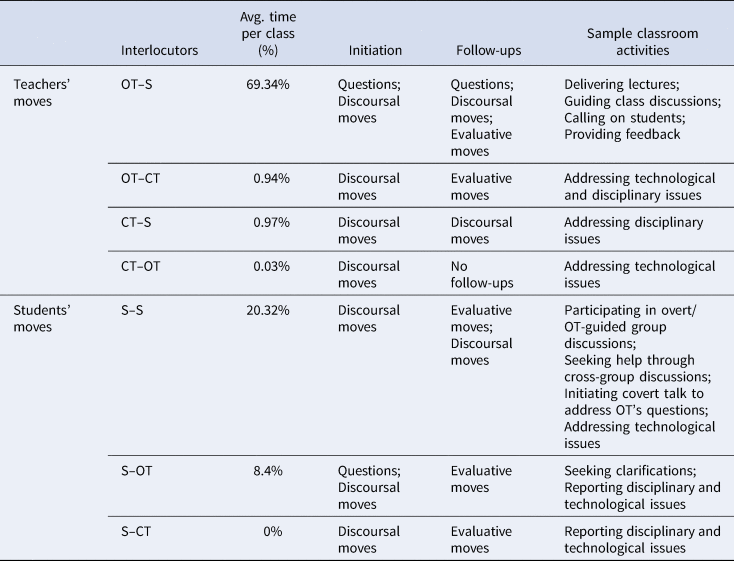
Although the traditional teacher-initiated and teacher-dominant IRF turns were adopted in this hybrid English class during most of the time, we also found new patterns of interactions initiated by the students (as shown in Table 1). The student-initiations took the form of spontaneous and self-directed collaboration amongst the students themselves, always stimulated by the technological affordances.
Teachers’ and students’ interactional patterns in the synchronous hybrid English class

It is important to note that the student interaction and collaboration were found to be very dynamic and fluid, in that there were not only group discussions but also cross-group interactions. For instance, instead of being confined to the online teacher's group assignments, the students also attempted to seek help from other groups when problems could not be solved within their original groups. Moreover, when one student was called upon by the online teacher, others would actively provide help if they noticed that the student was having difficulties either technologically or intellectually. These kinds of student-initiated interactions were often covert and involved private talks that could not be observed from the online teacher's perspective. The students took advantage of their distance from the online teacher to take more self-directed activities and become more autonomous in their learning in the hybrid English class.
Our interview data showed that the students felt more motivated and relaxed participating in hybrid classroom learning activities than in their regular face-to-face classes, because the technological affordances provided them the flexibility to initiate interactions that could benefit them for their own learning purposes. The students also expressed that the synchronous hybrid English class allowed them to ‘communicate and collaborate with peers’ in ways that they felt more comfortable with. Similarly, the teachers recognized the benefits of hybrid language instruction in promoting young learners’ participation and motivation in English language learning. However, they also highlighted the challenge of maintaining control and managing the class.
6. Discussion
From a sociocultural perspective (Vygotsky, Reference Vygotsky, Gauvain and Cola1978), students learn through participation in social interactions and activities (Mercer, Reference Mercer2007). In this study, the students in the synchronous hybrid class learned L2 English through various online and face-to-face interactions, including raising questions, negotiating, co-constructing knowledge with teachers and peers. Apart from the common teacher-controlled IRF sequences of classroom discourse, we found that new patterns emerged in the hybrid classroom talks in which students take active roles. The students initiated many in-group and cross-group discussions among classmates and actively interacted with the online English teacher. These student-initiated new patterns of interaction allowed them to feel motivated and empowered in participating in language learning and discussions. The findings suggested that the ‘democratization effects’ (Thompson & Nutta, Reference Thompson and Nutta2015; Waring et al., Reference Waring, Reddington and Tadic2016) of hybrid instruction for adult language learners also adapt to young, beginning level EFL learners.
7. Conclusion and implications
The ‘voices of children’ are particularly important when teaching traditionally marginalized groups, and in this context, the rural children who do not have access to English education in remote Chinese villages (Alldred, Reference Alldred, Ribbens and Edwards1998). Hybrid instruction provides the rural children the autonomy and flexibility to create a dynamic and collaborative learning environment that promoted the young underserved EFL learners’ language development as well as their confidence towards language learning. However, despite these affordances of hybrid language instruction, challenges may also rise for teachers who are concerned about effective classroom management and young learners who have not developed self-regulation skills for distance learning. Therefore, online language instructors should provide necessary guidance and nurture students’ self-directed learning dispositions to help them succeed in hybrid language classes.
Supplementary material
To view supplementary material for this article, please visit https://doi.org/10.1017/S026144482100029X
Acknowledgement
We would like to thank The International Research Foundation for English Language Education (TIRF) for their grant support.
Chaoran Wang earned her Ph.D. in Literacy, Culture, and Language Education from Indiana University. Her current research examines technology-enhanced language learning through the intersecting perspectives of language studies, sociocultural theories, and educational technologies. She is a Multilingual Writing Specialist and an Assistant Professor of Writing at Colby College, Maine.
Ying Luo is a Ph.D. candidate in Language, Culture, and Society at the Pennsylvania State University. She currently facilitates research on English language learner's (ELL) learning and teaching in STEM. Her research interests includes classroom interactions and multimodal analysis.