

Introduction
Whether or not legislators are judged on what has happened in the past has significant implications for democratic accountability. In this regard, electoral accountability is said to exist when citizens can retrospectively hold politicians to account, and accordingly reward or punish them with their vote. It is no wonder, then, that political scientists have spent considerable time investigating the extent to which voters engage in retrospective voting (e.g. Anderson, Reference Anderson2000; Lewis-Beck and Stegmaier, 2007; Duch and Stevenson, Reference Duch and Stevenson2008).
Almost without exception, the literature has focussed on voters facing a binary choice between either supporting the incumbent or not (e.g. Fiorina, Reference Fiorina1977; Johnston and Pattie, Reference Johnston and Pattie2001; Berry and Howell, Reference Berry and Howell2007), mostly based on the economic performance of the government (e.g. Paldam, Reference Paldam1991; Powell and Whitten, Reference Powell and Whitten1993; Anderson, Reference Anderson2007; Duch and Stevenson, Reference Duch and Stevenson2008: 235; Tilley et al., Reference Tilley, Garry and Bold2008). The binary approach – that is, to support or not support the government – works well under single-party governments; its application, however, is problematic where more than one party composes the cabinet, as is the case in most modern democracies (Williams et al., Reference Williams, Stegmaier and Debus2015). In fact, the application of a binary approach in the context of coalition governments assumes that retrospective evaluations exercise an identical influence for the prime minister’s (PM) party and the other coalition parties. A recent line of literature demonstrates that this assumption is unrealistic. The literature shows that economic evaluations are much more strongly connected with vote choice for the PM’s party compared with smaller coalition partners (Van der Brug et al., Reference Van der Brug, Van der Eijk and Franklin2007; Fisher and Hobolt, Reference Fisher and Hobolt2010; Debus et al., Reference Debus, Stegmaier and Tosun2014; Plescia and Kritzinger, Reference Plescia and Kritzinger2017). Expanding on this, Duch et al. (Reference Duch, Przepiorka and Stevenson2015) in an experimental study, and then Angelova et al. (Reference Angelova, König and Proksch2016) with survey data from Germany, have confirmed that both prime ministerial dominance and ministerial proposal power are essential for policy responsibility attribution.
This article contributes to this recent line of literature by studying how voters attribute responsibility for government outcomes when they are the result of a collective decision taken by multiple parties within a governing coalition. In particular, we are interested in identifying those coalition decision-making features that affect how voters attribute responsibility to the individual parties in the coalition. The argument to be tested is that in a multiparty coalition system, the electoral fate of individual parties varies according to the quantity and quality of the ministerial portfolios they control. To test this argument, this article investigates data from Italy, a country with a long tradition of coalition governments. Italy is a good testing ground for multiple reasons. First, Italian governments are usually formed by more than two parties. As coalition partners vary by size and control over specific ministerial positions, we are able to specify the retrospective voting mechanism at the party level, differentiating among prime ministerial prerogatives, ministerial proposal power, and party size in the cabinet. Second, the possibility of testing the theoretical expectations over several elections – featuring different government coalition arrangements – allow us to assess the extent to which our conclusions hold under different circumstances, albeit differences in the data quality does not allow for an identical analysis across all these elections. The article moves beyond the economy and a general government performance evaluation and it studies retrospective accountability across an array of policy areas.
The results confirm the importance of studying the impact of retrospective voting on support for specific parties rather than for the government coalition as a whole (Debus et al., Reference Debus, Stegmaier and Tosun2014; Williams et al., Reference Williams, Stegmaier and Debus2015). In addition, we find that while voters do blame the largest party in control the most, they recognize that parties play different roles within a governing coalition and clearly differentiate between ministerial responsibilities when attributing responsibility for policy outputs. Given that the comparative literature has usually classified Italy as an extreme case of ‘coalitional complexity’ (Lewis-Beck, Reference Lewis-Beck1988; Bellucci, Reference Bellucci1991) and low party cohesion (Giannetti and Laver, Reference Giannetti and Laver2009), which should in fact highly moderate retrospective voting obfuscating the ‘clarity of responsibility’ (Powell and Whitten, Reference Powell and Whitten1993); the basic fact that our hypotheses hold in Italy enhances the chances that they will be true elsewhere, where the institutional set-up is less complex, that is, fewer parties form the government and parties are more cohesive, and it is easier for voters to assign responsibility to the government for past performance (Anderson, Reference Anderson2000).
In what follows, we first review the existing literature and derive the hypotheses to be tested. We then present the data, the methods, and the findings. We conclude by discussing the implications of our findings in a comparative perspective.
Retrospective voting in the context of coalition governments
A consolidated tradition of research on economic voting, moving from Lewis-Beck’s (Reference Lewis-Beck1988) seminal study, has showed the impact of the economic cycle, unemployment, and different issues related to the economy on voters’ choices, both at aggregate and individual level (e.g. Fiorina, Reference Fiorina1977; Powell and Whitten, Reference Powell and Whitten1993; Duch and Stevenson, Reference Duch and Stevenson2008; Dassonneville and Lewis-Beck, Reference Dassonneville and Lewis-Beck2013). The basic assumption of economic voting is simple: people tend to reward the incumbent if economic conditions are good and punish them if the economy performs badly (Lewis-Beck and Stegmaier, Reference Lewis-Beck and Stegmaier2000). While past empirical assessments of performance voting have focussed almost exclusively on the economy, more recent literature have demonstrated that the economy is not the only aspect of policy performance that voters care about (e.g. Fisher and Hobolt, Reference Fisher and Hobolt2010; Singer, Reference Singer2011; Vries and Giger, Reference Vries and Giger2014). In particular, as explained in Hobolt et al. (Reference Hobolt, Tilley and Banducci2013), the focus on economic voting for assessing electoral accountability may also be problematic in an increasingly globalized world where government control over the economy is constrained by exogenous factors to varying degrees (Hellwig, Reference Hellwig2010).
Existing studies also show that performance voting is weaker in complex institutional settings with blurred lines of responsibility (Lewis-Beck, Reference Lewis-Beck1990; Bellucci, Reference Bellucci1991; Powell and Whitten, Reference Powell and Whitten1993; Anderson, Reference Anderson1995, Reference Anderson2000; Whitten and Palmer, Reference Whitten and Palmer1999; Nadeau et al., Reference Nadeau, Niemi and Yoshinaka2002; Hobolt et al., Reference Hobolt, Tilley and Banducci2013). The basic argument in the literature on democratic choice has been that a coalition government obscures accountability, thereby reducing the ability of the electorate to assign blame (Laver and Shepsle, Reference Laver and Shepsle1990). Yet, how do voters cope with this institutional complexity?
Who gets punished: hypotheses
It is well known that voters are largely uninformed about political matters, either because they are inattentive or because of the enormous complexity of the political world (Zaller, Reference Zaller1992). While voters may often realize that coalition governments include many parties, they may lack any further information about how the government is organized and therefore lack the ability to discriminate between government parties when assessing their performance (Downs, Reference Downs1957). Even highly sophisticated voters may have little incentive to invest (so) much effort in forming accurate judgements about government performance and the intricacies of coalition policy. Starting with one of the simplest heuristics imaginable, voters can then be expected to hold all coalition parties equally responsible irrespective of the number of seats in cabinet and their ministerial prerogatives. Our first hypothesis is therefore:
Hypothesis 1 Retrospective evaluations have the same effect on support for all coalition partners irrespective of the quantity and quality of cabinet portfolios they control.
Although all parties in a ruling coalition have some responsibility for formulating policy in all areas (Müller and Strøm, Reference Müller and Strøm2000; Martin and Vanberg, Reference Martin and Vanberg2011, Reference Martin and Vanberg2014), some parties, by virtue of the quantity and quality of cabinet portfolios they control, have greater responsibility than do other parties. The distribution of that responsibility, measured in terms of payoff received by a party in a coalition government, is likely to influence the electoral fate of the coalition partners. In fact, coalition membership not only guarantees a political party the right to participate in the policy-making process, but also the opportunity to increase its visibility among portions of the electorate (De Mesquita, Reference De Mesquita1979). Albeit, the constitutionally provided power of the head of the cabinet do vary across modern democracies (e.g. O’Malley, Reference O’Malley2007; Strøm et al., Reference Strøm, Müller and Bergman2008), the PM is without a doubt the most visible member of the government and the one with the strongest institutional position in terms of deciding on future policies. Several works identify the head of the cabinet and his or her party as the key ‘agent’ that is held accountable for a country’s record (Müller, Reference Müller2000; Carey, Reference Carey2009). Recent experimental evidence suggests that agenda-setting power represents one of the heuristics voters are likely to employ for attributing responsibility for collective decisions (Duch et al., Reference Duch, Przepiorka and Stevenson2015). Evidence from economic voting suggests that voters often identify the largest party as the leading party within the coalition, and thus the party most in charge of decisionmaking (Anderson, Reference Anderson2000; Duch and Stevenson, Reference Duch and Stevenson2008, 2013; Debus et al., Reference Debus, Stegmaier and Tosun2014). Beyond the economy, in Germany, where PMs have strong agenda setting and cabinet decision-making powers, there is evidence that voters use the PM heuristic to assign responsibility for policy outputs (Angelova et al., Reference Angelova, König and Proksch2016). Hence a second hypothesis reads as follows:
Hypothesis 2 Retrospective evaluations have a stronger effect on support for the PM’s party compared with the other coalition partners.
While the PM’s party is expected to suffer the most, responsibility attribution might not work equally for all the remaining coalition partners. In several countries like Italy, the Netherlands, Belgium, Finland, New Zealand, and so forth, the government usually comprises more than two parties, where the power of each over government outcomes varies in terms of the quantity and quality of portfolios the party controls. Quantity refers to the distribution of the responsibility within the coalition government measured in terms of the proportion of cabinet portfolios controlled by a political party (Browne and Franklin, Reference Browne and Franklin1973). Larger parties tend to have a bigger say over the final compromises negotiated in government (Martin and Vanberg, Reference Martin and Vanberg2011, Reference Martin and Vanberg2014), as most legislative prerogatives are allocated proportional to parliamentary party size. Party size determines the share of ministerial portfolios each coalition partner receives when the government forms (Gamson, Reference Gamson1961; Browne and Franklin, Reference Browne and Franklin1973; Morelli, Reference Morelli1999; Warwick and Druckman, Reference Warwick and Druckman2001, Reference Warwick and Druckman2005; Bäck et al., Reference Bäck, Meier and Persson2009; Carroll and Cox, Reference Carroll and Cox2012), the number of junior minister positions (Thies, Reference Thies2001), and committee chairmanship in parliament (Kim and Loewenberg, Reference Kim and Loewenberg2005). All of these privileges provide large coalition parties with more proposal power, more resources to exercise ministerial control, and more bargaining power to get their proposals accepted in government and parliament (e.g. McDonald et al., Reference McDonald, Mendes and Budge2004; Powell, Reference Powell2006). The more ministries a party controls the greater the opportunities to capture the attention of the electorate and to be more visible among portions of the electorate, but also the greater the risks when the party’s performance is judged negatively by the electorate. Fortunato et al. (Reference Fortunato, Lin and Stevenson2014) demonstrate empirically that a high proportion of voters in Western democracies are able to identify the party of the PM and have substantial knowledge about the relative size of parties. If voters understand that party size in the cabinet plays a relevant role in determining the distribution of power within the coalition, then when it comes to performance voting, perhaps they will rely on this heuristic when assigning responsibilities for policy outputs. Hence in terms of the quantity of portfolios we hypothesize:
Hypothesis 3 Retrospective evaluations of government performance have a stronger effect on support for the junior parties controlling more cabinet portfolios than for those controlling fewer posts.
While the previous hypothesis takes into account the overall weight of the coalition partner in the government negotiation, specific responsibility in terms of which ministries the party controls can also make a difference when parties are judged retrospectively. Drafting legislation requires policy-specific expertise, as well as detailed technical knowledge about the status quo, costs, and the implementation feasibility of alternative policies. Accordingly, policy specialization is inevitable and the actual authority to draft and ultimately propose legislation in parliamentary systems is delegated to the ministry specialized in this portfolio (Laver and Shepsle, Reference Laver and Shepsle1990). Hence while it is true that coalition partners govern jointly and that the cabinet is characterized by intra-party bargaining and coordination (Müller and Strøm, Reference Müller and Strøm2000; Thies, Reference Thies2001; Kim and Loewenberg, Reference Kim and Loewenberg2005; Martin and Vanberg, Reference Martin and Vanberg2011, Reference Martin and Vanberg2014), the access to policy-specific expertise grants ministers considerable policy prerogatives. Given the central role of ministerial portfolios, if voters understand specific party responsibilities within the coalition, then when it comes to the performance vote, perhaps they will hone in on the party in control of specific ministries (Duch and Falcó-Gimeno, Reference Duch and Falcó-Gimeno2015). If so, when it comes to specific issues, voters are expected to reward or punish not the party of the head of the cabinet or simply the party that controls more ministerial posts, but rather the party in charge of the ministries that deal with those specific issues (Narud and Valen, Reference Narud and Valen2008). Hence a fourth hypothesis reads as follows:
Hypothesis 4 Retrospective evaluations on a specific issue have a stronger effect on support for the coalition partner which has the ministerial control of that issue compared with the other coalition partners that do not control that issue.
Ministerial portfolios differ in value or salience – often referred to as the ‘qualitative’ strand of portfolio allocation – which is likely to change over time and be country-specific (Laver and Schofield, Reference Laver and Schofield1998; Druckman and Warwick, Reference Druckman and Warwick2005). As Browne and Franklin (Reference Browne and Franklin1973) put it: ‘[I]t will certainly make a difference to [a] party whether the ministries it receives are, say, the Prime Ministership and the Ministry of Finance, or if they are Sport and Tourism. In addition to a quantitative dimension operating in the bargaining context, then, we may reasonably expect that a qualitative one operates as well’ (Browne and Franklin, Reference Browne and Franklin1973: 458). De Mesquita (Reference De Mesquita1979: 62–63; see also Browne and Frendreis, Reference Browne and Frendreis1980) calls these portfolios ‘re-distributive’, as their possession can induce electoral changes that cause parliamentary seats to be re-distributed among parties, and he argues that they are especially prized because of that property. After all, the more redistributive portfolios a party controls, the greater its opportunities to capture parliamentary attention, media publicity, and hence the attention of the electorate (Druckman and Warwick, Reference Druckman and Warwick2005; Verzichelli, Reference Verzichelli2008). When it comes to retrospective voting, controlling a redistributive portfolio is a double-edged sword that works to a party’s disadvantage when the evaluations of the work during the legislative term are negative, leading to a greater loss of electoral support than parties in the government that do not obtain redistributive portfolios. Hence our final hypothesis reads as follows:
Hypothesis 5 Retrospective evaluations have a stronger effect on party support as the saliency of the ministry controlled by that party increases.
Data and methods
We test the hypotheses listed above using data collected by the Italian National Election Study (ITANES) research group in 2004 covering the inter-election between the 2001 and 2006 elections. We then use ITANES data from the 2006 and 2008 elections as well as the inter-election period 2008–11 to confirm some of our findings, as explained below.Footnote 1 Note that, for the 2004 and 2011 only, we focus on vote choice outside an election context with the potential limitation that several respondents may have not thought through their choices. We chose Italy for several reasons. First, Italy has a long tradition of coalition government, usually formed by more than two parties. The bipolar competition that characterized Italian politics up until 2013 has generally seen a pattern of alternation between ideologically homogeneous left- and right-wing governments (Bartolini et al., Reference Bartolini, Chiaramonte and D’alimonte2004; Chiaramonte and Emanuele, Reference Chiaramonte and Emanuele2013; Vegetti et al., Reference Vegetti, Poletti and Segatti2013). Hence, voters are familiar with the coalition context. Second, the Italian constitution explicitly specifies the formal powers and responsibilities of the individual ministers, the PM, and the government, which comprise all the central aspects of coalition governance (Verzichelli and Cotta, Reference Verzichelli and Cotta2000). Empirical analyses of the Italian case describe a system in which every minister has a different set of resources and confronts a different set of opposing powers depending on the nature of the department and his or her political ‘mandate’ at a specific point in time (Verzichelli, Reference Verzichelli2006). Some ministers are asked to make policy decisions (often related to the economy). Others, the more generalist politicians, control important areas of policy implementation – for example, interior, justice and foreign policy – in addition to operating as ‘watch dogs’ with regard to the PM’s political programme. A third type of cabinet figure is the ‘specialized’ minister who works in a specific policy area with limited political autonomy (Fabbrini, Reference Fabbrini2001). Third, the Italian case allows us to distinguish the effect of prime ministerial prerogatives from that of the quantity and quality of portfolio allocation on retrospective voting because the government is formed by more than two parties, which differ in terms of cabinet seats as well as the saliency of the portfolios they control. So, to separate the effect of Hypothesis 2 and Hypothesis 3 we need the government to be formed by several junior coalition partners that differ in terms of cabinet seats as well as the saliency of the portfolios they control. In addition, to separate Hypothesis 4 and Hypothesis 5 we need a situation in which the PM’s party does not control all the salient ministries, but where those are distributed across the different coalition partners. Last, as explained next, the survey data contain useful questions to measure retrospective voting generally and by issue which are not normally available in election studies.
The 2004 survey we use represents the second wave of a panel study which started in 2001 (first wave) and concluded in 2006 (third wave). The 2004 survey was conducted between April and June 2004 with Computer-Assisted Personal Interviews (CAPI) and it includes 1882 participants representative of the adult Italian population. The survey covers the first 3 years in government of the centre-right Berlusconi II government (11 June 2001–23 April 2005). The timing of the survey was chosen to ensure that considerable time had passed since the beginning of the legislative term and voters had had enough time to observe policy-making in the coalition government.
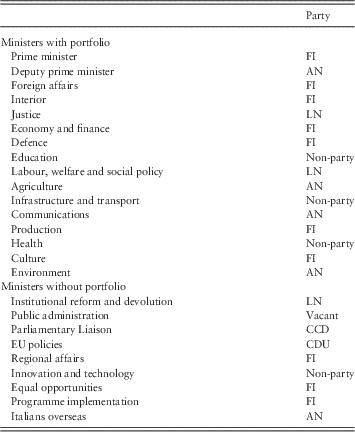
The coalition government was formed at that time by the centre-right’s prime ministerial party, Forza Italia (FI); the autonomist Northern League (LN); heirs to the far-right Italian Social Movement, the National Alliance (AN), and the Christian Democrat heirs, the Christian Democratic Centre–Christian Democratic Union (CDU) (from 2002 onwards called UDC). In terms of vote share in the 2001 elections, FI received 29.4% of the vote, AN about 12%, UDC about 3.2%, and LN about 3.9%. The distribution of ministers across the different parties is presented in Table 1, in which ministerial offices are listed in order of importance – that is, redistributive capacity, as per Verzichelli and Cotta (Reference Verzichelli and Cotta2000), initially derived from Laver and Hunt (Reference Laver and Hunt1992). Besides the premiership, FI controlled the foreign affairs, interior, economy, and defence ministers. The LN was over-represented in the cabinet compared with the share of the majority’s national vote that it had obtained, while the AN and the UDC were under-represented (Donovan, Reference Donovan2004: 82).Footnote 2 The LN controlled two salient portfolios, the justice and the labour, welfare, and social policy ministers; also the LN’s leader, Umberto Bossi, was minister for institutional reform. The AN held four ministries, all minor figures except for the communications ministry. Its leader, Gianfranco Fini, held the post of deputy PM which gave him high media visibility but little power in terms of policy output. The UDC had only two posts, both without a portfolio; but its leaders, Pier Ferdinando Casini, held the post of the speaker of the Chamber of Deputies – again, a post with no real policy power but nonetheless high media visibility.Footnote 3
Berlusconi II cabinet (11 June 2001–23 April 2005)

The ministerial offices are listed in order of importance as per Verzichelli and Cotta, as derived from Laver and Hunt (Reference Lewis-Beck1992).
Verzichelli and Cotta (Reference Verzichelli2000) and Donovan (Reference Donovan2004).
FI=Forza Italia; AN=National Alliance; LN=Northern League; CCD=Christian Democratic Centre; CDU=Christian Democratic Union.
The bad performance during the 2005 local elections of the FI led to the formation of the Berlusconi III government (23 April 2005–17 May 2006) which lasted until new elections were called in 2006 and which saw, among minor changes to undersecretaries, the passage of the minister for foreign affairs from FI to AN. The 2006 elections saw the victory of the centre-left coalition. The government coalition that formed after the 2006 elections included the Ulivo party led by the PM, Romano Prodi (from 2008 onwards called PD), the Party of Italian Communist, and Communist Refoundation Party (RIF), as well as the UDEUR Populars of Mastella and Italia dei Valori (IDV). During its brief existence the Prodi government was characterized by a fractious governing coalition and unpopular government policies due mainly to the very heterogeneous composition of the coalition (Newell, Reference Newell2006; Chiaramonte, Reference Chiaramonte2010). The 2008 elections won by the centre-right coalition lead to the creation of Berlusconi IV government formed by the PM party, The People of Freedom (PDL), the LN, and the Movements for the Autonomies (MPA). Albeit limited in terms of the survey questions we need to examine our hypotheses, we can use the 2006, 2008, and the 2011 ITANES surveys to test some of the results obtained using the 2004 survey.
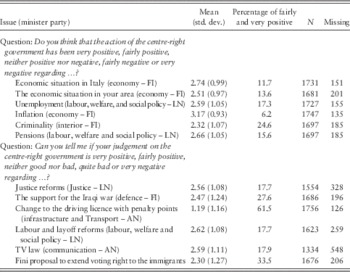
The goal of this study is to uncover the effect of retrospective policy evaluations on the vote choice with respect to government parties, in general, and across several policy areas. With respect to the first, in 2004, voters were asked: ‘In general, your judgement on the current centre-right government is very positive, fairly positive, neither positive nor negative, fairly negative or very negative?’ The second set of questions asked voters to evaluate the government’s performance in specific policy areas using the same five-point scale as for the general evaluation question.Footnote 4 Table 2 presents these questions, the issues, and descriptive statistics of the answers. The available questions span the following ministerial responsibilities: the economy, interior, and defence ministers controlled by the FI; justice, unemployment, labour, and pensions controlled by the LN, and the posts and telecommunication controlled by AN. We also have available a question asking voters to evaluate the government’s work on an issue, that is, driving license reform, linked to the infrastructure minister, an area controlled by a non-partisan minister (see Table 1). Finally, respondents have been asked to evaluate the government parties in opposing one reform proposed by the deputy PM, Gianfranco Fini, concerning the right to vote for immigrants. The reform was opposed by all the coalition allies, including part of AN, but more fiercely by the LN, and never became law. Note that while such questions are informationally demanding, survey respondents were given the option to choose that they do not know how to evaluate the government. Table 2 shows that, with the exception of the TV law, for which 71% of the participants indicated an evaluation, for all the other issues at least 83% indicated a government evaluation.
Policy evaluations by issue

FI=Forza Italia; LN=Northern League; AN=National Alliance.
We use the probability of voting for a specific party as dependent variable (van der Eijk and Franklin, Reference van der Eijk and Franklin1996; van der Eijk et al., Reference van der Eijk, Van der Brug, Kroh and Franklin2006). For this purpose the respondents were asked to indicate on a 10-point scale how likely they were to vote for party X.Footnote 5 We expect negative retrospective evaluations to be linked to lower probabilities to endorse that specific party, with differences according to our hypotheses. Our models also control for several variables that have the potential to influence the probability of voting for a specific party. Following most of the existing literature on retrospective voting we have included several individual socio-economic characteristics such as age, gender, education, religiosity, and political predisposition captured by (actual) vote choice in the previous parliamentary elections held in Italy in 2001.Footnote 6 Our empirical models also control for interest in politics using a question asking respondents, on a four-point scale from ‘none’ to ‘very’, their interest in what the government says and does.Footnote 7
Results
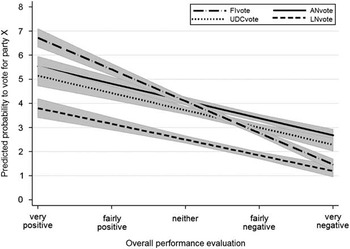
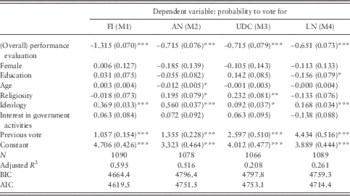
Table 3 presents the results of four linear regression models where the dependent variables are the probabilities of voting for the different parties in government in 2004. The key independent variable in Models 1–4 is the overall evaluation of the government’s performance: we expect to see a negative coefficient, implying that voters are less likely to vote for a coalition party as the policy evaluations decrease. The significant negative effect of the overall policy evaluations constitutes strong evidence that voters are less likely to vote for a party when they are dissatisfied with the government’s performance. Yet there are important differences in both the impact of the key independent variable on party vote as well as with regard to the overall performance of the models. With respect to the latter, a model of retrospective voting appears to work much better for the PM’s party (Model 1) – with an adjusted R 2 of 0.595 – compared with all other parties. The variance explained is much lower for the LN and the UDC parties but not so much for the AN party, the party of the deputy PM. We provide a substantive interpretation of the main results in Figure 1 where we plot the predicted values of party vote for varying levels of overall government performance. These figures also allow assessing the differences across parties albeit, given that the estimates come from different models, we cannot assess directly whether or not they are statistically different.
The impact of retrospective evaluations on party support. Figure based on M1, M2, M3, and M4 in Table 3. FI=Forza Italia; UDC=Christian Democratic Union; AN=National Alliance; LN=Northern League.

The impact of retrospective evaluations on party support: ordinary least squares models

Standard errors in parentheses.
The sample is restricted to those respondents who have answered all the evaluation questions.
FI=Forza Italia; AN=National Alliance; UDC=Christian Democratic Union; LN=Northern League; BIC=Bayesian Information Criterion; AIC=Akaike Information Criterion.
*P<0.05, **P<0.01, ***P<0.001.
Figure 1 provides support for the prime ministerial dominance conjecture (Hypothesis 2). The FI loses probability of voting notably faster than the other coalition members as voters’ overall policy evaluation decreases. This finding is in contrast to the equal responsibility conjecture (Hypothesis 1) and thus we do not find any evidence that coalition partners are held equally responsible. Regarding Hypothesis 3, Figure 1 shows that the effect of the overall performance decreases in line with the number of seats the party has in the parliament, for the AN party, for the UDC, and then for the LN. Hence, albeit the LN controls more ministries than the UDC and ministries that are more salient than the AN, it appears to suffer less from retrospective evaluations. The posts of deputy PM and of speaker of the Chamber of Deputies controlled by the AN and UDC, respectively, lead to substantial media visibility, which seems to cause these parties to lose more votes than the LN in the case of negative performance evaluations. The apparently counterintuitive result of LN may be also due to its specific party nature substantially different from the mainstream parties (Diamanti, Reference Diamanti2009; Passarelli and Tuorto, Reference Passarelli and Tuorto2012). It is indeed an ethno-regionalist party (Tronconi, Reference Tronconi2009) rooted in its specific territory with a strong identification with its voters. For these reasons, it is likely that voters do not simply reward or punish LN for its political behaviour, but other factors are at stake.
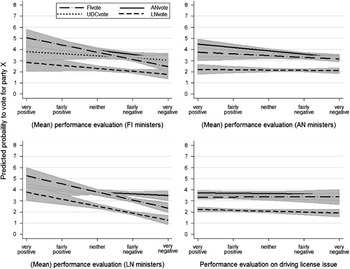
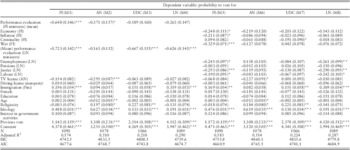
The results for the effect of specific policy evaluations on the support for the different coalition parties are presented in Table 4. With these second set of models we test directly Hypothesis 4 and Hypothesis 5: to find support for Hypothesis 4, we should see that the effect of specific policy evaluations should apply mostly to the party controlling that issue; hence, this implies an inter-party comparison by issue. Support for Hypothesis 5 would be found if retrospective voting applies more strongly to the party controlling the issue and according to the issue saliency of that ministry; hence it implies an inter-party and intra-party comparison. We run two sets of models: first, we use the mean evaluation across all issues controlled by a specific party as listed in Table 2, then we run models using evaluations by issue separately. The results are presented in Table 4 and in substantive terms in Figure 2.
The impact of specific retrospective evaluations on party support. Figure based on M1, M2, M3, and M4 in Table 4. FI=Forza Italia; UDC=Christian Democratic Union; AN=National Alliance; LN=Northern League.

The impact of specific retrospective evaluations on party support: ordinary least squares models

Standard errors in parentheses.
The sample is restricted to those respondents who have answered all the evaluation questions.
FI=Forza Italia; AN=National Alliance; UDC=Christian Democratic Union; LN=Northern League; BIC=Bayesian Information Criterion; AIC=Akaike Information Criterion.
*P<0.05, **P<0.01, ***P<0.001.
Starting with the mean evaluation across all issues controlled by the FI, the effect of retrospective evaluations is negative across all parties but significant only on vote choice for FI. In fact, the top-left plot in Figure 2 shows almost flat lines for all parties except for the FI. Moving to the mean evaluation across all issues controlled by the LN, the effect of retrospective evaluations is negative and significant across all parties – except for the AN – but with a larger effect on the LN. Moving to the only issue controlled by the AN, the effect is negative and significant for AN and FI albeit the effect is stronger on the AN. Finally, with regard to the driving license reform, controlled by a non-partisan minister, there is no effect across all parties as seen by almost flat lines in the bottom right plot in Figure 2. Moving to the deputy PM’s proposal to extend voting rights to immigrants which was opposed by all coalition allies, Table 4 shows a positive effect for all parties except for the AN. But across parties, the strongest significant effect is on the LN, the party that most fiercely opposed the proposal that ultimately failed to pass. How about saliency?
The second set of models presented in Table 4 considers each issue evaluation separately.Footnote 8 Starting with the PM’s party, we see a negative and statistically significant impact on FI (almost) regardless of whether or not the PM controlled that issue: the effect of retrospective evaluations is found on economy, inflation, and war, controlled by the FI and unemployment, justice, and labour, controlled by the LN. Moving to the AN party, the only effect on the party comes from the TV law, the only ministry among the ones analysed that were under the control of the AN party. The UDC controlled no ministries, yet we find a negative effect on vote choice for retrospective evaluations on criminality. With respect to LN, the party suffered only on the issues it controlled, unemployment, justice, and labour.
To sum up, we again find strong support for the PM dominance hypothesis as retrospective evaluations have a negative effect on FI almost regardless of whether or not the FI controlled the issue. This is also shown by the much higher overall explained variance of Models 1 and 5 compared with all the other models. We also seem to find support for Hypothesis 4, because the retrospective evaluations have a stronger impact for the party that controls the issue: the AN and the LN only suffered on the issues they controlled. Some support is found for Hypothesis 5 as the FI and LN parties suffered more on the issues that were salient at that time, the Iraq war and unemployment, justice, and labour reforms.
With regard to the other core variables, the effect of voters’ ideological position on a left-right scale is very strong across all models: the more people position themselves on the right, the more likely they are to vote for one of the parties in the centre-right government; the effect is stronger for the FI party, but positive and significant across all parties. Voters’ predispositions, captured by previous vote choice, has the expected positive effect, which indicates that party supporters are more likely to endorse their own party in the elections: the effect is strong and consistent across all models. The other control variables – age, gender, education, religiosity, and interest in government activities – have only scattered effects across parties and models.
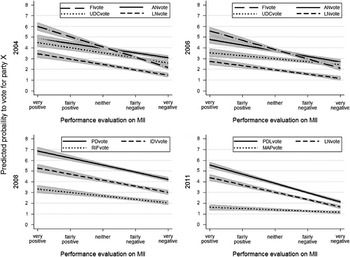
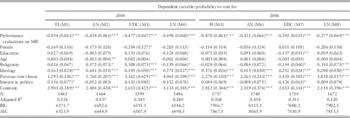
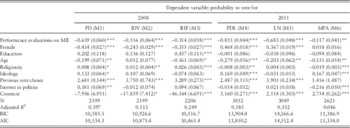
Do these patterns hold in other elections? Unfortunately, other ITANES surveys do not contain specific issue evaluations that allow us to test our hypotheses, as was the case in the 2004 survey. Yet, the 2004, the 2006, 2008, and 2011 studies all contained a question asking respondents what was the most important problem facing the country at that moment and to evaluate the government’s performance on that specific issue using the same general question we used for the previous analysis. We can use this question to test Hypothesis 1–Hypothesis 3 across different elections. Due to space limitation, we only present the results in substantive terms in Figure 3 (full results are presented in Tables A1 and A2 in the Appendix). Figure 3 indicates that the PM’s party – that is, the FI in 2004 and 2006, the PD in 2008, and the PDL in 2011 – is the party that suffers the most. The effect of the retrospective evaluation appears to diminish with party size in the parliament rather than in terms of the quantity of portfolios the party controlled: the AN and the UDC in 2004 and 2006 suffer more than the LN, being larger than the LN in terms of seats in the parliament; the same holds true for the LN in 2011 which suffers more than the MPA being the latter much smaller in terms of seats in the parliament. This confirms the previous findings that party size in the parliament rather than in the government is the heuristic that voters appear to rely on the most when blaming the government for policy outputs. The same conclusion does not hold true in 2006 in which we see the IDV suffering more than RIF albeit the latter was larger in terms of seats than the IDV party. This result may have been driven by the fact that RIF was no longer part of the centre-left coalition in 2008 (unlike IDV) and this may have led voters to exclude the party from the accountability mechanism concerning the incumbent government.
The impact of retrospective evaluations, by year and by party. FI=Forza Italia; UDC=Christian Democratic Union; AN=National Alliance; LN=Northern League; RIF=Communist Refoundation Party; IDV=Italia dei Valori; PDL=The People of Freedom; PD=Partito Democratico; MPA=Movements for the Autonomies.

Conclusions
How do voters attribute responsibility for government outcomes when they are the result of a collective decision taken by multiple parties within a coalition government? This article tested the argument that in a multiparty coalition system, the electoral fate of individual parties should vary in terms of the quantity and quality of portfolios that the party controls. The findings indicate that all parties in government suffer from negative evaluations, but the results are stronger if we are able to trace back exactly who held responsibility for policy-making in the coalition. Voters recognize that parties play different roles within a governing coalition, with the PM’s party being the clear target of blame but not the only party that suffers from negative performance evaluations. We find that larger parties, in terms of seats in the parliament, mostly because of their media visibility, tend to suffer more than smaller parties. Also, parties seem to suffer in line with ministerial responsibilities, albeit mostly for salient issues.
While the negative effect of poor performance evaluations on the chances of a voter voting for government parties is in line with a theoretical argument that sees elections as a mechanism to hold the government in check, the strong negative bias for two parties – AN and UDC – shed a negative light on the overall accountability process. The two parties in fact had relatively little policy power over government outcomes, at least compared with the LN, yet they suffered a larger punishment than the LN. This suggests that the mass media as well as the specific nature of the party may play a fundamental role in the working of the retrospective voting mechanism and that of elections more generally, two issues we leave open for future research. In addition, future studies should examine how the transformation of the Italian party system after the 2013 elections from a bipolar to a clear three-party competition (Chiaramonte, Reference Chiaramonte2010; Chiaramonte and Emanuele, Reference Chiaramonte and Emanuele2013) may impact the working of the accountability mechanism and the clarity of responsibility (Vegetti et al., Reference Vegetti, Poletti and Segatti2013) and the continuing validity of this article’s findings.
The comparative literature has usually classified Italy as an extreme case of ‘coalitional complexity’ (Lewis-Beck, Reference Lewis-Beck1988: 105) and as a case of (very) low party cohesion (Giannetti and Laver, Reference Giannetti and Laver2009), which, together, should in fact highly moderate retrospective voting obfuscating the ‘clarity of responsibility’ (Powell and Whitten, Reference Powell and Whitten1993). The basic fact that our hypotheses hold in Italy enhances the chances that they will be true elsewhere, where the institutional set-up is less complex and it is easier for voters to assign responsibility to the government for its performance (Anderson, Reference Anderson2000; Debus et al., Reference Debus, Stegmaier and Tosun2014). This is not to say however that comparative studies will not be useful – in fact future research should focus in testing whether the results hold in other countries and what specific features of coalition governments over time can impact voters’ capacity to hold government parties responsible. This is especially true given the saliency dynamics of certain cabinet posts. Future studies should also examine how the features of the political culture at the elite level moderate the attribution of responsibility for the different coalition partners.
Acknowledgements
The author thanks Paolo Bellucci, Sylvia Kritzinger, Konstantin Glinitzer, and the participants at the 2016 SISP General Conference for feedback on earlier versions of this manuscript. The author also thanks the anonymous reviewers for their critical comments and suggestions, which have greatly improved this article.
Financial Support
This research received no grants from public, commercial, or non-profit funding agency.
Data
The replication data set is available at http://thedata.harvard.edu/dvn/dv/ipsr-risp
Supplementary Material
To view supplementary material for this article, please visit https://doi.org/10.1017/ipo.2017.11
Appendix
The impact of retrospective evaluations on party support (across 2004 and 2006)

The impact of retrospective evaluations on party support (across 2008 and 2011)