




No CrossRef data available.
Exceeding and Falling Short: Elliptical and Hyperbolical Application of Areas
Published online by Cambridge University Press: 01 September 2003
Abstract
Argument
My purpose in this paper is to venture an explanation for how the peculiar Greek idiom “application of area” came into being, and why Greek mathematicians preferred this idiom to one which seems more straightforward and is undoubtedly older. To those conversant with the Greek theory of  , especially Elements VI.28–29, there is little new in my exposition, and they may want to skip sections 1 and 2. I present them nevertheless, partly to initiate newcomers, partly in order to show that Elements II.5 works as a maximum condition (analogous to VI.27) besides being, like II.6, a useful lemma in the solution of the problem. My main point is the shifting of focus from one rectangle to another in problems 3a and 4a, which may have given rise to the esoteric – and more general – wording of problems 3b and 4b.
Information
- Type
- Articles
- Information
- Copyright
- 2003 Cambridge University Press
0.1 Two plus two equivalent problems
In Book X of the Elements Euclid teaches us (lemma 16/17) that
If a parallelogram is applied to some straight line and is deficient by a square figure, the applied parallelogram is equal to the rectangle contained by the segments of the straight line produced by the application.
- 1a) To construct a rectangle if the sum of its adjacent sides is a given line segment, and [the area of] the rectangle is equal to a given area.
- 1b) To apply a given area to a given line segment as a rectangle deficient by a square [figure].
“To apply an area to a (straight) line” always means “to construct a parallelogram along that line.” The parallelogram may have the line segment as one of its sides, known as “the parabolic application” of area (Elements I.44), or it may exceed the segment – “the hyperbolical application” (VI.29), or fall short of it – “the elliptical application” (VI.28).
Analogous problems involving difference are
- 2a) To construct a rectangle if the difference of its adjacent sides is a given line segment, and [the area of] the rectangle is equal to a given area.
- 2b) To apply a given area to a given line segment as a rectangle exceeding by a square [figure].
Those two plus two problems are special cases of more general ones,
- 3b) To apply a given area to a given line segment as a rectangle deficient by a rectangular figure similar to a given one.
- 4b) To apply a given area to a given line segment as a rectangle exceeding by a rectangular figure similar to a given one.
The question to be answered in this paper is the following: What would be the wording of the corresponding problems 3a and 4a, that is: “To construct a rectangle if the sum or difference of its adjacent sides is a given line segment, and the area of the rectangle is … what?”
The reason why I wrote this paper is, first that I am not at all sure that the answer is evident, secondly that I do know that an answer can be given, the analysis of which leads immediately to the formulation of the b-types. Here is my answer:
- 3a) To construct a rectangle if the sum of its adjacent sides is a given line segment, and the area of the rectangle has a given ratio to a given area.
- 4a) To construct a rectangle if the difference of its adjacent sides is a given line segment, and the area of the rectangle has a given ratio to a given area.
Beware! This is a reconstruction; no propositions of the a-type occur in Euclid’s Elements or Data, where only b-formulations are admitted (therefore creating the need of the lemma X.16/17 mentioned above). Problems 3b and 4b are solved in Elements VI.28 and 29; problem 1 is presupposed in X.17 and 18; and analysis of the four will involve II.5 and 6 plus some vital propositions from Book I and VI, as will emerge from section 3.2, Gnomonic Situations.
In Elements VI.28 and 29 and in the Data, the figure in request is not a rectangle but a parallelogram in a given angle, but that is purely ornamental. The given area may be any rectilineal figure; but as any such figure can be transformed into a square by methods known to the Elements, we may without loss of generality let it be a square.
1.0 Analysis of problem 1
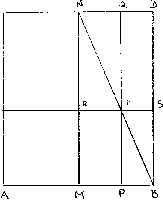
Let the given line segment be AB, and the given square □C. Suppose that the problem is solved (fig. 1). Then AB is divided at the point P into two parts AP and PB so that [sqsub ][sqsup ]AP,PB = □C.

If AP = PB then P coincides with the middle point M, and [sqsub ][sqsup ]AP, PB = □AM = □AB/2 = □C.
But if not, then let AP > PB; thus P is between M and B, and [sqsub ][sqsup ]AP,PB < □AB/2, according to
Elements II.5: If a straight line be cut into equal and unequal segments, the rectangle contained by the unequal segments of the whole together with the square on the straight line between the points of section is equal to the square on the half.
[sqsub ][sqsup ]AP,PB + □MP = □MB.
Since AM = MB, we have
AP = MB + MP and PB = MB − MP
, so that II.5 can be restated in well-known words:
The difference of the squares on two straight lines is equal to the rectangle contained by the sum and the difference of the lines.
Since by hypothesis [sqsub ][sqsup ]AP,PB = □C, equality [1] becomes
□C + □MP = □MB
.
Since C and MB (= AB/2) are given, MP is given by way of Elements I.47, (the “Pythagorean Theorem”), and then AP and PB are given from [2].
End of analysis of problem 1
1.1 Construction of problem 1
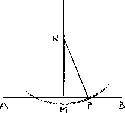
Let the given line AB (fig. 2) be bisected at the point M, AM = MB = AB/2.
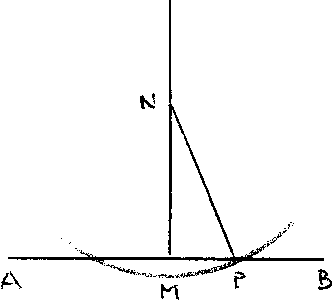
From M draw the perpendicular and cut off MN equal to the side C of the given square. With N as center and AM or MB as radius let a circle be described, which (if possible) will cut MB in P, rendering the situation of II.5, AB bisected at M and cut unequally at P:
[sqsub ][sqsup ]AP,PB. + □MP = □MB.
In the right triangle NMP
□NM + □MP = □NP
;
since MN = C and NP = MB, this means □C + □MP = □MB,
whence [sqsub ][sqsup ]AP,PB = □C. Which was to be done.
1.2 Conditions of possibility
If C > AB/2, the circle does not reach AB, and there is no solution to the problem.
If C = AB/2, the circle touches AB at the point M, and the problem has one solution, [sqsub ][sqsup ]AM,MB = □AM = □C.
If C < AB/2, the circle cuts AB in two points, and the problem has two symmetric solutions; we follow the analysis and choose the point P between M and B.
Those conditions have counterparts in the cases of discriminants in quadratic equations, cf. section 2.3 Algebraic interpretation.
1.3 Elliptical application of areas
When the construction is done (fig. 1), the rectangle [sqsub ][sqsup ]AP,PB is placed along AB in such a way that there is still room for a square, □PB, “in front of” the rectangle. The Greeks (the Pythagoreans? – they liked to invent esoteric jargon) spoke of this construction as

, “to a given line to apply a given [area as a rectangle] deficient by [a figure in] the form of a square.” “Defect” is elleipsis in Greek, whence the problem came to be known to historians as “Elliptical Application of Areas.”
As mentioned in section 0.1, the lemma X.16/17 in Book X of the Elements identifies this application with our problem 1a, and in X.17 and 18 Euclid analyzes elliptical applications of areas to determine which conditions will render commensurable parts (Taisbak 1982, 41f).
2.0 Analysis of problem 2
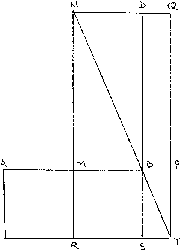
Let the given line segment be AB, and the given square □C. Suppose that the problem is solved (fig. 3). Then AB is divided externally at the point P into AP and BP so that [sqsub ][sqsup ]AP,PB = □C.
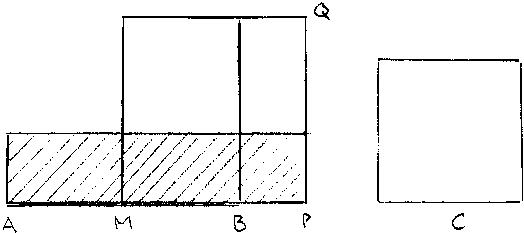
Let AB be bisected at M, so that AM = MB = AB/2 and
AP = MP + MB and BP = MP − MB.
We recognize the configuration from
Elements II.6. If a straight line be bisected and a straight line be added to it in a straight line, the rectangle contained by the whole with the added straight line and the added straight line, together with the square on the half, is equal to the square on the straight line made up of the half and the added straight line.
[sqsub ][sqsup ]AP,PB + □MB = □MP.
Since by hypothesis [sqsub ][sqsup ]AP,PB = □C, [4] becomes
□C + □MB = □MP.
Since C and MB (= AB/2) are given, MP is given by I.47, and then AP and BP are given from [3]. End of analysis of problem 2
2.1 Construction of problem 2
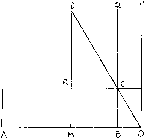
Let the given line segment AB (fig. 4) be bisected at the point M; from B draw the perpendicular and cut off BN equal to the side C of the given square.
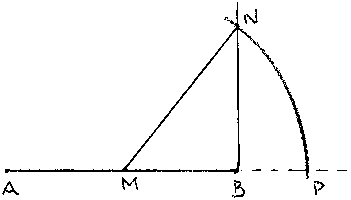
With M as center and MN as radius let a circle be described, which will cut AB produced in P, rendering the situation of II.6, AB bisected at M and cut externally at P:
[sqsub ][sqsup ]AP,PB. + □MB = □MP.
In the right triangle NMB □NB + □MB = □MN, that is,
□C + □MB = □MP,
whence [sqsub ][sqsup ]AP,PB = □C. Which was to be done.
2.2 Hyperbolical application of Areas
When the construction is done (fig. 3), the rectangle [sqsub ][sqsup ]AP,PB is placed along AB in such a way that a square, □BP, exceeds the line. The Greeks spoke of the construction as

, “to a given line to apply a given [area as a rectangle] exceeding by [a figure in] the form of a square.” “Excess” is hyperbole in Greek, whence the problem came to be known as “Hyperbolical Application of Areas.”
The Elements show only one instance of this problem, VI.30 (duplicated in II.11): To divide a given line segment in extreme and mean ratio, “The Golden Section.” That instance is a very special case, as the side C of the given square equals the given difference AB (= AP−PB). You may read all about its history in Hertz-Fischler 1987.
2.3 Algebraic interpretation
If we allow ourselves (with H. G. Zeuthen and his followers) to put lengths to line segments and to treat rectangles as products of lengths, which Euclid never did, problem 1 can be interpreted as follows, b, c, s, d, x, and y being real numbers: If the given length of AB is b, of C is c, the lengths to be determined are AP = x, PB = y, and the problem is equivalent to finding x and y from the equations
x + y = b and xy = c2.
The analysis (fig. 1) shows that x is b/2 plus MP, y is b/2 minus MP, so we put MB = s = b/2, MP = d, whence
x = s + d, y = s − d.
Now II.5 says
xy + d2 = s2.
Since by hypothesis xy = c2, [1] is a Pythagorean equation
c2 + d2 = s2
where d is given because c and s (= b/2) are given, and therefore, by [6], x and y are given.
[5] can be rewritten as x = b−y and (b−y)y = c2, and therefore (fig. 1) x = b−y and by−y2 = c2, (deficient by a square) that is, on normal form,
y2 − by + c2 = 0.
Equation [7] has solutions if and only if the discriminant b2/4−c2 is nonnegative, i.e. if c[gel ]b/2, cf. the conditions of possibility above (section 1.2).
Problem 2 is analogous, subtraction replacing addition. With the same names the problem is equivalent to finding x and y from the equations
x − y = b and xy = c2.
The analysis (fig. 3) shows that x is MP plus b/2, y is MP minus b/2, so this time we put MP = s, MB = d = b/2, whence
x = s + d, y = s − d.
Now II.6 says
xy + d2 = s2.
Since by hypothesis xy = c2, [4] is a Pythagorean equation
c2 + d2 = s2
where s is given because c and d (= b/2) are given, and therefore, by [9], x and y are given.
[8] can be rewritten as
x = b + y and (b+y)y = c2,
and therefore (fig. 3)
x = b + y and by + y2 = c2,
(exceeding by a square) that is
y2 + by − c2 = 0.
Algebraically [1] and [4] say the same thing. Why, then, are there two propositions? Because II.5 analyzes the problem with s given, that is: when the given line segment is a sum of two segments x and y to be found; whereas II.6 analyzes the problem with d given, that is: when the given line segment is a difference between two segments x and y to be found. Geometry differs from algebra in many respects.
We have no good reason to believe that the Greeks were thinking of quadratic equations on any form when working with the different types of application of areas. If, however, we were to follow Zeuthen’s remarks (in his treatment of Geometrical Algebra in Die Lehre von den Kegelschnitten im Altertum) about “what quadratic equations would look like in the language of Geometrical Algebra,” we inevitably end up with equations [5] and [8] on the forms
by − y2 = c2 and by + y2 = c2.
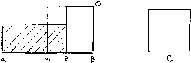
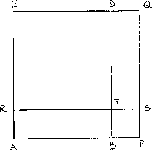
That only those two are relevant is due to the fact that no geometrical meaning could be given to the equation x2 + bx + c2 = 0, because the sum of three rectangular figures cannot be nothing. And the equation x2 − bx = c2 is easily shown to be geometrically equivalent with [10] and thus, in a sense, superfluous: In fig. 5 (AQ)−(AD) = (BQ) = (AS) = (BS)+(AT); so, if we put AP = AE = x, AB = b, BP = PS = y, then, since (AS) is equal to sqr(C), we can write these equalities as x2 − bx = c2 = y2 + by.
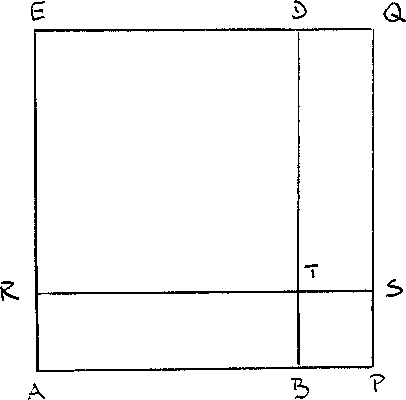
Zeuthen’s quadratic equations on the general form can be connected with problems 3 and 4 (sections 4.2). The analysis will lead to that specific Greek way of thinking which I will call “Gnomonic Situations.”
3.0 Analysis of problem 3, first part
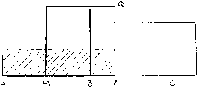
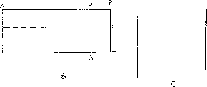
Let the given line segment be AB, the given square □C, and let the ratio be h:v, given e.g. by the sides of a rectangle [sqsub ][sqsup ]HKL, in the following called “the Form” (fig. 6).
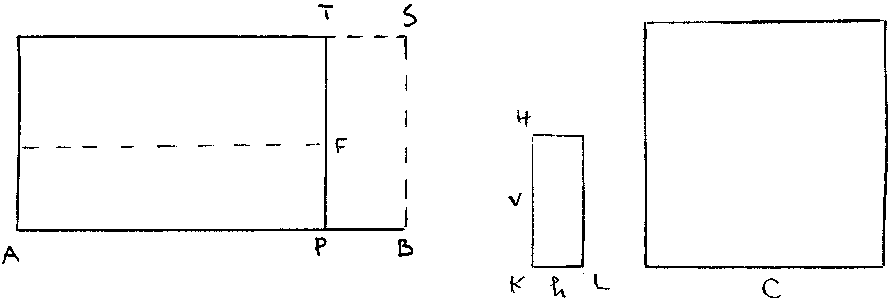
Suppose that the problem is solved. Then AB is divided at the point P into two parts AP and PB so that [sqsub ][sqsup ]AP,PB:□C :: h:v. Let [sqsub ][sqsup ]AP,PB be (AF), with PF = PB.
To visualize the given ratio, let □C have been applied parabolically (Elements I.44) to AP as the rectangle (AT) with AF:AT :: h:v (Elements VI.12).
End of first part of analysis of problem 3
The analysis shifts the focus from the primary rectangle (AF) (having the given ratio to the given square and being contained by AP and BP whose sum is AB) to a secondary one (AT), which is equal to the given square.
How do we construct (AT), i.e. how do we find the point T, if AB, □C, and “the Form” are given?
3.1 Analysis of problem 3, second part
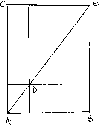
If AP = PB, P coincides with the middle point M (fig. 7); and (AT), equal to □C, coincides with the rectangle (AN), similar to the Form and drawn on half the given segment AB; and the deficient rectangle (PS) coincides with (MD), congruent with (AN).
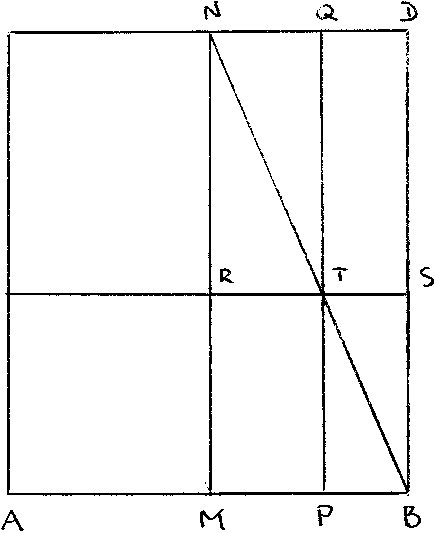
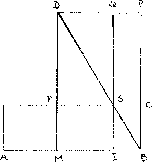
But if not, let AP > PB; then P will fall between M and B; we find ourselves in a typical gnomonic situation, with MD constituting a schema, in which the diagonal BN plays an essential part. End of second part of analysis of problem 3
3.2 Gnomonic Situations
Let me explain by inserting a few definitions and propositions, beginning with a decisive one, the importance of which is quite obliterated in modern mathematical thought:
3.2.1 Definition A: Eidos, Form, and Similarity
Any rectilineal figure is a Form (in Greek eidos).
Rectilineal figures are the same Form, if and only if they are similar.
We may confine ourselves in this context to defining similar parallelograms with an eye to Elements VI.def 1:
Parallelograms are similar that have an angle equal to an angle and the sides about the equal angles proportional when taken in the same order (the greater to the greater and the less to the less).
3.2.2 Definition B: Schema
If a parallelogram is cut into four parallelograms by two straight lines parallel to its adjacent sides and intersecting on a diagonal of the parallelogram, let the whole configuration be called a schema.
In the parallelogram MBDN (fig. 7) PQ and RS, parallel to MN, MB respectively, intersect at T; since (PS) is similar to (NB), T is on the diagonal NB (VI.26, see below), and the configuration is a schema. Let T be called The diagonal point of the schema. It appears that the word schema – which means “something held together,” i.e. “figure” — is used idiomatically in this special sense as a kind of password to gnomonic situations.
3.2.3 Definition C: Parallelograms about the diagonal
(RQ) and (PS) are called The parallelograms about the diagonal. (Elements I.43)
VI.24 The parallelograms about the diagonal of any parallelogram are similar to the whole and to one another.
VI.26 If from a parallelogram a parallelogram similar to the whole, similarly situated and having a common angle with it, is subtracted, it is about the same diagonal as the whole.
The three similar parallelograms (of proposition VI.24) in fig. 7, (RQ), (PS), and (MD), represent the eidos or form of the schema.
3.2.4 Definition D: Parapleromata, Complements
(MT) and (TD) in fig. 7 are called the complements, parapleromata, of the parallelograms (RQ) and (PS).
I.43 The complements of the parallelograms about the diagonal of any parallelogram are equal.
3.2.5 Definition E: Gnomon
Let any one of the parallelograms about the diagonal of any parallelogram together with the two complements be called a gnomon (II.def 2).
In fig. 7, MBDQTR[M] is a gnomon. The parallelogram (RQ) “contained by” the gnomon we will call the “form in the gnomon.” An important observation, which must have been present to any Greek geometer (although not transmitted to us), is the following:
Any parallelogram can be transformed in two ways into congruent gnomons containing a given form.
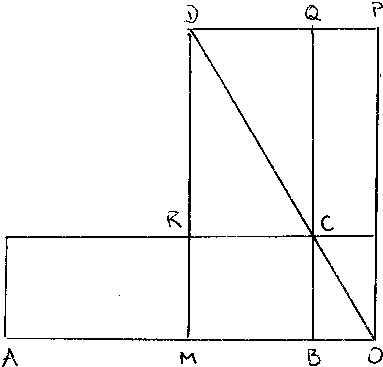
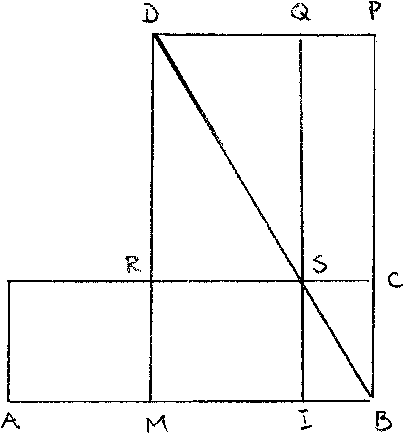
Second transformation (fig. 11): Let a parallelogram (CI) of the given form be placed inside (AC) on AB; let AI be bisected at M, and on MB about the diagonal BD let the schema be described, making the gnomon MBPQSR, equal to (AC). The two gnomons are congruent, holding the form (RQ) similar to the given form. They show that any parallelogram is the difference between two similar forms; particularly, any rectangle is the difference between two squares.
3.3 Analysis of problem 3, third part
In fig. 7, since (PS) is similar to “the Form,” and so to (MD), T is on the diagonal (Elements VI.26); since M is the middle point of AB, (AT) is equal to gnomon MBDQTR, because (MT) = (TD) (parapleromata, section 3.24, cf. VI.27 for details) and (MS) = (AR); that is, (AT) is the difference between two rectangles similar to “the Form,” namely (MD) and (RQ).
End of (third part of) analysis of problem 3
The problem is reduced to (a) drawing on half of the given segment equal rectangles (AN) and (MD) similar to and situated as the Form, and (b) if necessary constructing (NT) similar to the Form and equal to a certain difference, namely (MD) minus the given area □C.
Problem (a) is solved by constructing MN as the fourth proportional to h, v, and AB/2 (Elements VI.12). Problem (b) is cognate to the one we are analysing, namely: to construct a rectangle, similar to a given form and equal to a given area. That problem is solved in the VI.25. The analysis points to the construction known from VI.28, which we will imitate below; Euclid for unknown reasons states VI.28 more generally in terms of parallelograms; I know of no application that is not a rectangular case, like e.g. Apollonius’ in his Conica.
3.4 Construction of problem 3
Let the given line segment AB (fig. 7) be bisected at the point M and let (MD) be applied parabolically (I.44) to MB such that MB:MN :: h:v, and let the rectangle (AN) be completed.
If (AN) = □C, the problem is solved, the deficient rectangle being (MD).
If (AN) < □C, the problem has no solution (VI.27, an analogue to II.5, compare problem 1, section 1.2).
If (AN) > □C, the difference (AN) − □C can be found (I.44 & 45) and the rectangle (NT) is constructed about the diagonal NB, equal to the difference and similar to the Form (VI.25); since the point T is now given, let the rectangle (AT) be drawn, leaving PS as deficient. Now, as T is on the diagonal, the gnomon MBDQTR equals (AT) and by construction □C, and it holds (NT) similar to the Form. Thus (AT) is the rectangle of our analysis, equal to □C and applied to AB such that a rectangle (PS) is deficient, similar to the Form.
The primary rectangle (AF), which we requested (fig. 6), is contained by AP and PB, but not seen in fig. 7, since the Greeks (this is my conjecture) reformulated the problem in the idiom of elliptical application of areas (respecting the conditions of possibility) as
VI.28 To apply to a given straight line a parallelogram equal to a given rectilineal (figure) and deficient by a parallelogrammic form similar to a given one; thus it is necessary that the (first) given rectilineal (figure) be not greater than the (parallelogram) described on the half and similar to the defect.
4.0 Analysis of problem 4
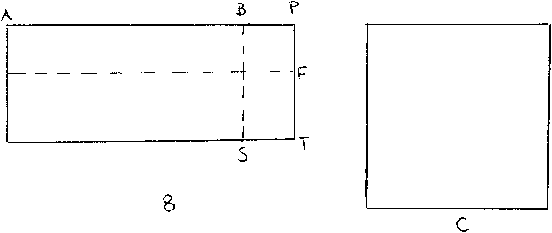
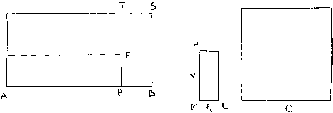
Let the given line segment be AB, the given square □C, and let the ratio be h:v, given e.g. by the sides of a rectangle [sqsub ][sqsup ]HKL, called the Form. Suppose that the problem is solved (fig. 8). Then AB is divided externally at the point P into two parts AP and PB so that [sqsub ][sqsup ]AP.PB: □C :: h:v. Let [sqsub ][sqsup ]AP.PB be (AF), with PF = PB.
To visualize the given ratio, let □C be applied parabolically (I.44) to AP as the rectangle (AT) with PF:PT :: h:v. (VI.12).
End of analysis of problem 4
Again the analysis shifts the focus from the primary rectangle (AF) (having a given ratio to the given square and contained by AP and BP whose difference is AB) to a secondary one (AT) equal to the given square.
Obviously we get (AF) gratis if it is possible to construct (AT) equal to □C and exceeding AB by a rectangle (PS) similar to the Form. Again, care must be taken that the Form is correctly situated, with the h-side on AB produced; else, we shall be solving the wrong problem, where the given ratio is h:v, cf. definition A (section 3.21).
How do we construct (AT), i.e. how do we find the point T, if AB, □C, and the Form are given?
4.1 Construction of problem 4
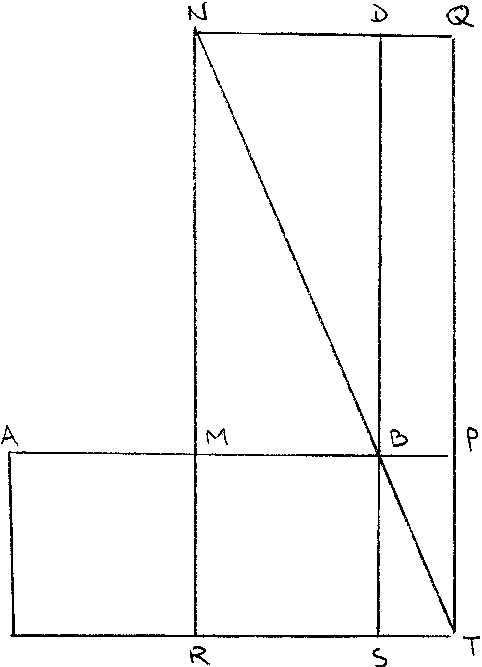
Let the given line segment AB be bisected at the point M and let (MD) be applied parabolically (I.44) to MB such that MB:MN :: h:v (fig. 9).
Construct a rectangle (somewhere), equal to (MD) plus the given □C and similar to the Form (VI.25), and duplicate it in about the diagonal NB as (NT); then (AT) is described (below AB), exceeding AB by (PS). Now, as B is on the diagonal (VI.26), the gnomon RTQDBM equals (AT), and by construction □C, and it holds (MD) similar to the Form. Thus (AT) is the rectangle of our analysis, equal to □C and applied to AB such that a rectangle (PS) exceeds, similar to the Form.
The primary rectangle (AF), which we requested, is contained by AP and PB, but not seen in fig. 9, since the Greeks (my conjecture) reformulated the problem in the idiom of hyperbolical application of areas as
VI.29 To apply to a given straight line a parallelogram equal to a given rectilineal figure and exceeding by a parallelogrammic form similar to a given one.
4.2 Algebraic interpretation
If again we allow ourselves to put lengths to line segments and to treat rectangles as products of lengths, which Euclid never did, problem 3 can be interpreted as follows: If the given length of AB is b, of C is c, and the given ratio is h:v, and if the lengths to be determined are AP = x, PB = y, then the problem is equivalent to finding x and y from the equations
x + y = b and xy:c2 :: h:v,
which can be rewritten as
x = b − y and y(b−y):c2 :: h:v,
and therefore
x = b − y and bvy−vy2 = hc2.
Putting A = v, B = bv, and C = hc2 makes a quadratic equation on the general form
Ay2 − By + C = 0
Thus, dividing the given segment b internally into x and y by the elliptical application of area may be interpreted as solving a general quadratic equation of type [11].
Under the same allowances, problem 4 can be interpreted as determining x and y from the equations
x = b + y and xy:c2 :: h:v,
which can be rewritten as
x = b + y and (b+y)y:c2 :: h:v,
and therefore
x = b + y and bvy + vy2 = hc2.
Again A = v, B = bv, and C = hc2 makes a quadratic equation on the general form
Ay2 + By − C = 0
Thus, dividing the given segment b externally into x and y by the hyperbolical application of area may be interpreted as solving a general quadratic equation of type [12].
But do not forget that this is a modern interpretation; to the Greeks it was probably always a question of plane figures interacting with one another by rules of similarity and equality, by Form and Magnitude, the predominant items in the Data.
5.0 Symptomata of conic sections
My conjecture is based on the following considerations about the Greek treatment of conic sections.
The “ancient” (i.e. pre-Apollonian) version of the symptomata of the ellipse and hyperbola was “the two abscissa form,” also called “the constant ratio form”: The square on the ordinate has a given ratio to the abscissas’ rectangle.
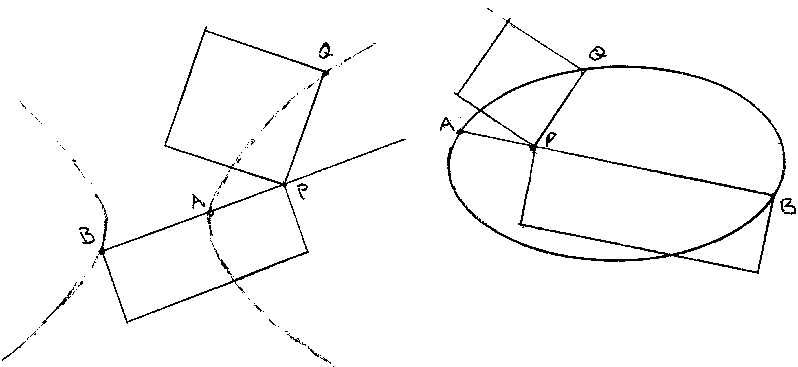
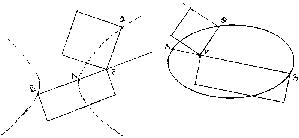
Let Q be an arbitrary point of an ellipse or a hyperbola with diameter AB, PQ the ordinate, AP the first abscissa, BP the second abscissa (fig. 12). The symptoma, then, says that □PQ: [sqsub ][sqsup ]AP,PB :: v:h, a constant (or in the ancient idiom: “given”) ratio. We shall speak of the given ratio v:h as “The symptomatic ratio.”
5.1 Equivalent constructions
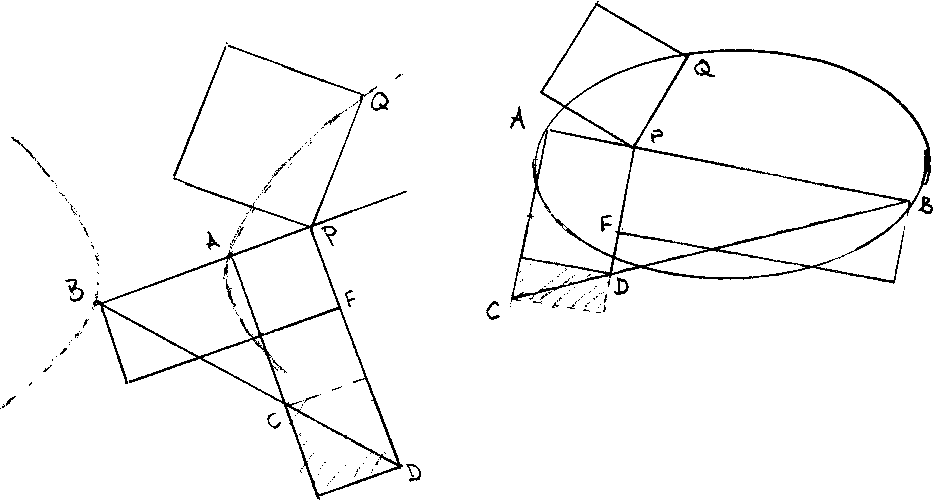
One way to represent the symptomatic ratio for a given conic would be (as in section 3.0) to construct the abscissas’s rectangle [sqsub ][sqsup ]BP,PC (with PC = PA) and apply the square on the ordinate, □PQ, to the greater abscissa BP, to make [sqsub ][sqsup ]BP,PD, producing the width PD (figs. 13 & 14). The symptomatic ratio stands out as PD:PC, that is h:v (Elements VI.1).
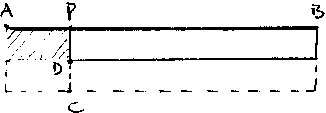
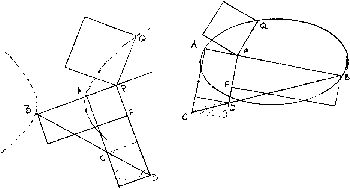
To a Greek mathematician, trained in application of areas, the said application of the ordinate’s square □PQ would be recognized as elliptic (fig. 13) or hyperbolic (fig. 14) application of area, the rectangle (AD) being in either case the given form (whose sides are in the symptomatic ratio) by which the applied square falls short or exceeds the diameter AB.
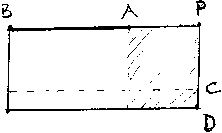
What the Greek mathetician would observe (cf. section 3.0 and 4.0 about “shift of focus”) is the equivalence: To construct a rectangle equal to an area (in casu the square on the ordinate) which has a given ratio to a given rectangle, is eqvivalent with applying the area to the sum or difference of the sides of the rectangle with a defect or excess of the form defined by the give ratio.
Therefore, to represent the symptomata of the ellipse and hyperbola, the straightforward way would be to apply the square on the ordinate
- of an ellipse to the sum of the abscissas (i.e. the diameter AB, fig. 13) by an elliptical application with rectangular defect (AD) in the symptomatic ratio, — and
- of a hyperbola to the difference between the abscissas (i.e. the transverse diameter AB, fig. 14) by a hyperbolical application with rectangular excess (AD) in the symptomatic ratio.
5.2 Apollonius and the Upright Line
However, Apollonius does not do so: instead, he constructs at one end of the diameter a line segment (AC, the orth

a, “ upright”) which has the symptomatic ratio to the diameter (AB, the plagia, the “horizontal” — named as the bars, the mullions and transoms, in a window). And then he applies the square on the ordinate elliptically (or hyperbolically) to the orthia AC with defect (or excess) of the form “turned over,” that is F(v:h).
We can guess how he hit on that idea by looking at his symptomata for the ellipse and hyperbola, fig. 15: That the square on the ordinate PQ has a given ratio to the rectangle contained by the abscissas (BF) may be illustrated by applying the square to the lesser abscissa AP as a standing rectangle (AD), producing a certain width PD.
Since □PQ = [sqsub ][sqsup ]AP,PD, RPQ: [sqsub ][sqsup ]AP,PB :: [sqsub ][sqsup ]AP,PD: [sqsub ][sqsup ]AP,PB
and by Elements VI.1 (equal heights) :: PD:PB; by drawing the diagonal BD :: AC:AB, that is the ratio of the orthia to the (transverse) diameter.
Thus, for a given ellipse or hyperbola, the ratio AC:AB is given; and as the (transverse) diameter is given, the orthia will also be given. And therefore the eidos, that is the shape or form of the rectangle [sqsub ][sqsup ]CAB (half of which is seen as a triangle on fig. 15) is characteristic of the actual conic section, very properly called its symptoma, “what befalls it.”
Figure 15 also shows the square □PQ applied to the orthia as a rectangle with a rectangular defect or excess (CD), (in Greek elleipsis or hyperbolē), which is similar to the eidos. We understand why Apollonius was inspired to give the names ellipse and hyperbola to these conic sections.
5.3 Conjugate application of areas
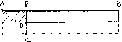
The fact that applying the ordinate’s square to the diameter by elliptical (or hyperbolical) application – as we expected – is equivalent with applying it to the orthia – which he does –, can be formulated as a Theorem of conjugate applications of area (fig. 16).
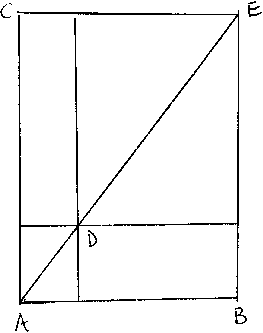
If h:v is a given ratio, and if AB and AC are orthogonal line segments in the ratio h:v, and if a square is applied elliptically (or hyperbolically) to AB with a rectangular defect (or excess) of the form F(h:v),
then the same square can be applied elliptically (or hyperbolically) to AC with the same defect (or excess), now differently positioned, that is to say: a form F(v:h).
Proof of the elliptical case:
Let the given square have been applied elliptically to the diameter AB with a defect (AD) of the given form, the symptomatic ratio. I say that the same square can also be applied elliptically to AC, the orthia, which by construction is at right angles to AB, with the same defect (DA) differently situated from (AD).
Proof: Let the rectangle ABEC be completed by producing the diagonal ADE, thus making (AE) similar to (AD).
And (CD) is equal to (BD), because they are complements, parapleromata. Thus (CD) is equal to the given square and applied elliptically to AC with the defect (DA). But since AC is the line to which the area is applied, the defect is of the form F(v:h), that is differently situated from (AD).
Epilogue
We cannot know whether or not the “shift of focus” led to the idiom of “application of area,” and if it did, when it happened. I suggest the Pythagoreans, who invented so many other esoteric mathematical terms. I am convinced that the absence of problem 3a and 4a in the literature and Apollonius’ treatment of the given ratio between the ordinate’s square and the abscissas’ rectangle renders my story plausible. I, for one, understand the gnomonic situations better that way.
References
Hertz-Fischler, Roger.1987. A Mathematical History of Division in Extreme and Mean Ratio. Waterloo, Ontario, Canada: Wilfred Laurier University Press.
Taisbak, Chr. Marinus.1982. Coloured Quadrangles. A Guide to the Tenth Book of Euclid’s Elements. Copenhagen: Museum Tusculanum Press.
Taisbak, Chr. Marinus.1993. “A Tale of Half Sums and Differences. Ancient Tricks with Numbers.” Centaurus 36.Google Scholar
Zeuthen, H. G.[1886]1966. Die Lehre von den Kegelschnitten im Altertum. Kopenhagen(reprint: Hildesheim, Georg Olms Verlagsbuchhandlung).

 You have
Access
- 1
- Cited by