INTRODUCTION: THE CDD-ELITE CAPTURE PROBLEM
Community-driven development (CDD) is an approach to the decentralised management of anti-poverty interventions that aims to increase local control over externally provided goods and services. In recent years, CDD has received considerable support from international donors. This has occurred, however, despite a range of empirical studies demonstrating CDD to be vulnerable to a range of conceptual and practical problems (for a review, see Mansuri & Rao Reference Mansuri and Rao2004). The best known of these is the phenomenon of ‘elite capture’. Elites are groups of persons or a member of such a group with superior political and economic status relative to others in their social cluster. In CDD projects, the term ‘elite’ usually refers to traditional or kin-based authorities operating at the village level where their power is understood to arise from the logic of patrimonialism that exists within a structure of ‘community imperfections’ (Platteau & Abraham Reference Platteau and Abraham2002: 111). However, the term potentially applies to a wide range of actors, including government-based personnel, urban elites and agricultural extension officers. Elite capture of CDD is said to occur when advantaged groups succeed in altering projects for their own benefit, usually at the expense of other people, particularly the poor (Araujo et al. Reference Araujo, Ferreira, Lanjouw and Ozler2008).
In spite of these concerns, questions regarding how particular kinds of elite structures develop in different social contexts, their roles and functions in implementing development projects, as well as their relationships with the ‘ordinary people’, or ‘non-elites’, that they govern, have not been seen as a priority area of investigation in studies of CDD. As recent reviews conducted by deGrassi (Reference DeGrassi2008) and Pitcher et al. (Reference Pitcher, Moran and Johnston2009) suggest, however, this might prove fertile ground in trying to understand how development agencies can work more effectively with local leaders to produce more progressive development outcomes. This is because, as deGrassi and Pitcher argue, much of the literature on the problems of African social and economic development assumes a priori the existence and important influence of patrimonialism and neopatrimonialism without first empirically demonstrating or analysing the historical development of the concept, its significance, and previous critiques.
This paper considers the implications of these insights on the CDD-elite capture problem in Mozambique, drawing upon two case studies of non-governmental organisation (NGO) intervention. The politics of international development aid in sub-Saharan Africa (SSA) have come under increasing scrutiny by scholars in recent years (Craig & Porter Reference Craig and Porter2006). In Mozambique, most critical enquiry has fallen upon the relationships between western donors, national political elites and the ruling Frelimo Party (Frente de Libertação de Moçambique; Mozambique Liberation Front) (Sumich Reference Sumich2008; Hanlon & Mosse Reference Hanlon and Mosse2010). Relatively less consideration, however, has been directed towards the sharp rise in numbers of international and national NGOs across SSA since the commencement of IMF-induced economic reforms in the mid 1980s. In Mozambique, NGOs are primarily seen as service-deliverers, mainly to remote rural areas where state institutions have little reach. Many have also adopted an advocacy role, one that aims to reconfigure local power relationships to provide marginalised groups, such as women, with the opportunity to hold local leaders to account. However, concerns have been raised over the use of NGOs as ‘legitimising tools’ in the ‘New Policy Agenda’ being pursued by international financial institutions (IFIs) (Cunguara & Hanlon Reference Cunguara and Hanlon2010). These fears have led to claims that NGOs have fuelled growing inequality in rural areas of Mozambique by channelling resources to local elites (cf. Pfeiffer Reference Pfeiffer2004). Such concerns mean that the country provides particularly rich case study context in which to explore the CDD-elite capture problem.
The next section introduces the concept of elite capture as it has been applied to studies of CDD to date, before outlining a number of recent theoretical and empirical challenges to the notion of patrimonialism that underlies much of this work. Drawing on literature examining state-led interventions in rural Mozambique, as well as interviews conducted with NGOs and communities in two case study locations in the south of the country, the remainder of the article attempts to bring these insights to bear on the CDD-elite capture problem. It explores how elites and the non-elites with whom they interact are embedded in local communities in different ways, and how these dynamics influence whether and in what ways benevolent and malevolent elite capture of NGO projects takes place. In the final section, the wider implications of these findings for neopatrimonial interpretations of CDD are considered.
PATRIMONIALISM, ELITE CAPTURE AND CDD IN MOZAMBIQUE: A CRITICAL REVIEW
The theories most commonly used to explain the occurrence and effects of elite capture in CDD are those of patrimonialism or neopatrimonialism. These ideas – which refer to governance systems in which political relations are based on personalised relationships between leaders and subjects, or patrons and clients – have become closely associated with lawlessness, inequality and economic stagnation in developing countries in recent years (Craig & Porter Reference Craig and Porter2006). Many scholars writing on SSA understand patrimonialism to be rooted in pre-colonial regimes or the coercive, distortionary and exclusionary practices of colonial governments, and neopatrimonialism as the behaviours and patterns of authority established by leaders and their followers following independence (deGrassi Reference DeGrassi2008). Most recently, these ideas have been carried over into the present period of democratisation in Africa to create newer forms of neopatrimonialism. Although patrimonialism and neopatrimonialism are conceptually distinct, in the discussion that follows, the former term refers to both.
The best-known application of patrimonial theory to elite capture in CDD is the work of Platteau & Abraham (Reference Platteau and Abraham2002: 111), who describe how the ‘personalised character of human interactions’ found in the context of small, traditional societies leads to ‘community imperfections’ characterised by high levels of inequality between local leaders and their subjects. The authors describe how externally induced modernisation of this system requires no less than its ‘complete transformation’ from a society characterised by ‘mutual control, respect of ranks, and strictly enforced codes of generosity to a society where free entry and exit [and] democratic governance… are used as guiding principles or expressly allowed to operate’ (Platteau & Abraham, Reference Platteau and Abraham2002: 119). Problems arise, however, when an NGO, under pressure to demonstrate results to its ‘partner’ organisations, begins to rapidly disperse large quantities of resources into this system but not necessarily alongside the equivalent levels of investment required to develop new institutional arrangements. The end result is increased investment through a small number of community elites who are reinforced in the process, often transformed into ‘greedy individuals who show all the less restraint in enriching themselves at the expense of their community as they are actually legitimated by outside actors’ (Platteau & Abraham Reference Platteau and Abraham2002: 122).
Platteau and Abraham's (Reference Platteau and Abraham2002) work is important as it helps provide counterweight to studies of CDD that overly focus on technical and economic solutions to problems of local-level development. In recent years, their ideas have been further explored by researchers via a wide range of empirical studies. As a result, understanding of the CDD-elite capture problem has been advanced in three important ways. First, although Platteau & Abraham (Reference Platteau and Abraham2002) provide examples to illustrate their arguments, these are largely anecdotal and mainly confined to kin-based or hereditary governance arrangements. Subsequent research, however, has explored a much wider range of scenarios involving actors such as CBOs (Adhikari & Goldey Reference Adhikari and Goldey2010), forest user groups (Iverson et al. Reference Iverson, Chhetry, Francis, Gurung, Kafle, Pain and Seeley2005) and community-based conservation groups (Tai Reference Tai2007). The overriding conclusion from these studies is that elite capture of externally initiated community-based projects is a common occurrence.
Second, empirical research has demonstrated that elite capture of project decision-making does not necessarily result in misappropriation of project benefits. In some cases, this might simply be due to ‘trickle-down’ effects when, for example, elites capture projects that best suit their interests, but the goods are still of benefit to the wider community (e.g. see Araujo et al. Reference Araujo, Ferreira, Lanjouw and Ozler2008). In other cases, a distinction has been drawn between what has been called ‘benevolent’ and ‘malevolent’ capture (Rao & Ibanez Reference Rao and Ibanez2005; Dasgupta & Beard Reference Dasgupta and Beard2007). Benevolent capture arises because elites might genuinely be motivated by communitarian interests that have a generally positive impact (Rao & Ibanez Reference Rao and Ibanez2005) or their interests might be found to align with the poor's (Veron et al. Reference Veron, Williams, Corbridge and Srivastava2006). These findings have resulted in calls for a need to better understand what ‘mechanisms’ or ‘checks and balances’ result in greater likelihood that elites will behave benignly within CDD projects.
Third, it has been argued that the specific design features of CDD projects might have limited effect on the likelihood that such interventions will result in progressive development outcomes. Such features might be ‘top-down’, meaning that they are imposed in a hierarchical manner by an outside entity (Larson & Ribot Reference Larson and Ribot2004); ‘horizontal’, indicating that elites are being held to account by their peers (i.e. other elites) (Tendler Reference Tendler1997); or bottom-up, referring to pressure from ordinary, non-elite community members (Thorp et al. Reference Thorp, Stewart and Heyer2005). However, local contextual factors can overwhelm externally introduced parameters (Fritzen Reference Fritzen2007). More work is therefore necessary ‘to clarify the interconnections between local context, the wider socioeconomic reform process and the impact of specific design features’ in CDD projects (Fritzen Reference Fritzen2007: 1373).
These insights have helped move the CDD-elite capture debate forward in important ways. Less attention, however, has been directed towards the theory of patrimonialism itself as the underlying basis for such studies. This is in spite of the fact that the application of patrimonial theory to problems of African economic and political development has been increasingly scrutinised on two main fronts in recent years (cf. deGrassi Reference DeGrassi2008; Pitcher et al. Reference Pitcher, Moran and Johnston2009). First, it is often assumed that, rather than being the consequences of certain stages of economic development, third world elites are, in fact, causes of economic stagnation, and primarily act as barriers to more inclusive, modernistic forms of human development. Based on this logic, the unchecked distortion of CDD projects in favour of malevolent elites can be seen as the inevitable consequence of systems of personalised rule. However, according to deGrassi, there are numerous different trajectories of personalised systems of governance in Africa and elsewhere, each varying in origins and affects.
These ideas can be applied to SSA where it is increasingly recognised that ‘local authority’ is a historically situated construct subject to continuous reworking (Berman Reference Berman1998). Much of this reworking has been due to attempts by the state to extend its influence into rural areas, often during periods of major political and socioeconomic transition characterised by colonialism, independence and the formation of post-colonial regimes, as well as more recent transitions to multi-party democracy. In Mozambique, the colonial state adopted a system of indirect rule, co-opting traditional chiefs, renamed as regulos, who were used to extract labour and taxes, and maintain law and order (Hedges & Chilundo Reference Hedges, Chilundo and Rocha1993). Following independence in 1975, the newly installed socialist Frelimo Party attempted to eliminate this system by, amongst other actions, replacing it at the village level with party secretários (secretaries) (Kyed & Buur Reference Kyed and Buur2006). This was a policy, however, that ultimately failed in many parts of the country due to poor centralised planning and civil war in the 1980s. Since this period, political and economic liberalisation in Mozambique has resulted in limited recognition of traditional authority by government (Ministério da Administração Estatal 1995). However, Frelimo has overall been hesitant to hand over any significant power. Today, although the government officially separates the Frelimo Party from the Mozambican state, in reality there continues to be considerable overlap between the two systems at multiple levels, and, in some areas, Frelimo officials wield considerable influence over local administrational affairs.
Second, much of the literature on African patrimonialism views ordinary people as passive and accepting of autocratic behaviour in the name of ‘traditional’ relations. In CDD, these arrangements inevitably result in unchecked elites being given free rein to do as they please, wilfully and openly enriching themselves with externally provided resources at the expense of non-elites who continue to offer political support. This contrasts with deGrassi and Pitcher's argument that much of the scholarship on patrimonialism to date overlooks notions of mutual respect, reciprocity and voluntary compliance between rulers and the ruled, and the fact that non-elites are often capable of holding their leaders to account through withdrawal of support or via the exercise of resistance, a phenomenon which Scott (Reference Scott1985) refers to as ‘weapons of the weak’.
The insights provided by deGrassi and Pitcher are applicable to Mozambique where uncertainties created by shifting power bases over the last 100 years have created ‘an ambivalent attitude towards power’ amongst rural populations in which local authority figures are ‘simultaneously respected and suspected’ (West & Kloeck-Jenson, Reference West and Kloeck-Jenson1999: 476). Moreover, Pitcher (Reference Pitcher1998: 117), in her exploration of agrarian livelihoods in northern Mozambique, argued that rural populations managed to ‘individually and collectively reconstitute and renegotiate those policies with which they disagreed, or mitigate the effects of those in which they were involved’. These processes have been documented in detail (cf. Alexander Reference Alexander1997; Kyed & Buur Reference Kyed and Buur2006) showing how village secretaries implementing unpopular socialist policies were often forced to compromise with local populations, including unofficial collaboration with former regulos. These studies paint a picture of local, rural authorities engaged in a complex balancing act between the requirements of the state on the one hand, and the need to secure cooperation and support from below on the other hand. In recent years, the Mozambican government has introduced a number of decentralisation initiatives, such as the 2003 Law for Local State Bodies (Lei dos Órgãos Locais do Estado; LOLE), designed to increase local community say in district affairs (Barnes Reference Barnes2005). However, the government faces considerable challenges in their implementation and their impact at the local community level remains minimal to date (Barnes Reference Barnes2005).
These two central critiques of patrimonialism, and their applicability to the Mozambican context, highlight two important considerations for the CDD-elite capture debate in this county and beyond. First, relatively little attention has been paid to what the varied and complex contributions of local elites to CDD are in different locations; second, detailed exploration of the roles that non-elites play in monitoring and controlling leader activities has been underplayed. This paper helps to bridge these knowledge gaps by showing that elite capture is occurring, but in a variety of ways that cannot be reduced to ‘traditional’ or kin-based patron-client relations. Instead, there are a number of different sources of legitimacy at play, which are also influenced by the post-colonial party-state and regional socio-economic differences. Moreover, the article challenges the view of African citizens as passive ‘clients’ and argues that locally based ‘check and balance’ mechanisms on authority are in fact more efficient than externally imposed ones. In doing so, it is hoped that the article will contribute to the development of a more nuanced, contextually grounded response to the CDD-elite capture problem in rural societies of developing countries.
ELITE CONTROL AND RESISTANCE IN CDD: PERSPECTIVES IN THE FIELD
The state–society dynamics referred to in the previous section have spawned a complex mosaic of local political power in rural Mozambique. This means that any discussion on local development in this country must be conducted with relatively high historical and geographical precision (West & Myers Reference West and Myers1996). This makes a contextually grounded, case study-based approach to understanding the roles of elites in CDD interventions imperative.
The selection of NGOs for the case studies was purposeful and designed to emphasise differing approaches and stances toward local leadership. The first case study focused on a food security programme implemented by a UK-based international NGO, GlobalAid, which operated a national organisation in Mozambique, GlobalAid-Mozambique (GA-Moz).Footnote 1 The second case study concerned a Mozambique-based national NGO, CDG (Grupo de Desenvolvimento da Comunidade; Community Development Group), which had developed close links with key figures in the Mozambican government. Although GA-Moz had wider global reach than CDG, both NGOs were largely funded through a combination of international aid grants and domestic fundraising.
Both NGOs attempted to establish new forms of community-based governance to run in parallel with more locally defined forms of authority. A key component of GA-Moz's programme was the formation of ‘commissions’, small community groups focused on a particular task or issue, in this case the management of cattle and water pumps received from the NGO. GA-Moz therefore emphasised the introduction of ‘modern’ governance in line with its ‘Western’ democratic values. In contrast, CDG preferred to provide credit and agricultural inputs to target communities via the establishment of Cooperatives of Agricultural Producers (hereafter referred to as ‘cooperatives’). CDG had its roots in Mozambique's independence movement, and was essentially attempting to resurrect the earlier system of socialist ‘modernisation’ first witnessed in the region in the mid-1970s when the Frelimo government collectivised rural inhabitants into communal villages for cooperative agriculture (Wardman Reference Wardman1985).
Both case studies were located in Maputo and Gaza provinces in southern Mozambique, which are recognised as Frelimo strongholds. In these areas, traditional leaders were used by the colonial state to recruit forced labour for deployment in South Africa's rapidly growing mining industry, a role which significantly undermined their legitimacy following independence (van den Berg Reference Van den Berg1987). As a result, local leaders associated with Frelimo experience high levels of legitimacy relative to traditional leaders in these areas. This situation contrasts with central and northern regions of the country where traditional authority has much greater influence over local community politics relative to Frelimo, and where a more diverse power-base could have produced different research results.
The analysis that follows further explores these southern dynamics. It draws on data collected during field visits to two communities in which the NGO projects were running over a two-year period (June–October 2006 and July–November 2007). In each community, a total of 40 individual and group-based semi-structured interviews were conducted with community and NGO members. Respondents were selected using a purposeful sampling approach, which stresses the search for information-rich cases or ‘key informants’, defined as people with a particular knowledge of a subject being addressed (Denscombe Reference Denscombe2003). However, interviewees were also controlled for age, gender and community position or ‘status’ to ensure that a cross-section of opinion was being sampled. Discussions with respondents sought to elicit perspectives on local institutions, and development activities and priorities. The idea was to bring local perspectives and voices to the debate so that a contextual understanding of the CDD-elite capture problem could be developed through the eyes of those experiencing it first-hand. Participatory farm-visits, attendance at local NGO meetings and time spent living in both communities allowed triangulation of primary data to take place.
In the analysis that follows, the various ideas established above are investigated through presentation and discussion of the empirical findings. These ideas have been organised into the following three research themes: (1) the roles of elites and their relationships with non-elites within the contexts of their particular historical and socioeconomic circumstances; (2) the extent to which project capture occurred as a result of the introduction of the NGO projects and the reasons for this; and (3) whether these forms of project capture led to capture of project benefits. Each is examined in succession.
Elites’ roles and community relations
Although both case study locations were subject to colonial, Frelimo and NGO-led interventions, they differ significantly in terms of their historical development trajectories. The first case study, where GA-Moz worked, was the Locality of Chicomo, which was located in Manhiça District in Maputo Province, and consisted of five bairros.Footnote 2 In the early days of colonial rule, Manhiça's residents mainly lived in dispersed homesteads alongside the floodplain of the Incomati River under a system of hereditary leadership. Although quite close to the capital city and accessible from the national road, there was little major external investment in the area, although the creation of the nearby Maragra sugar plantation resulted in the installation of a regulo by the Portuguese authorities in the late 1930s. The settlement as it is recognised today was formed as a communal village following the Incomati River floods in 1978, when the government permanently resettled some 800 households from the low-lying floodplain to areas of higher ground (Republic Popular de Moçambique 1983; van den Berg Reference Van den Berg1987). At the same time, due to its status as one of the first communal villages, Frelimo's district leaders took a direct interest in the settlement, and moved in one of its respected party leaders to take control of local affairs. At the time of the case study, this individual, who was known as the ‘president’, was supported by the party secretaries, each of whom was responsible for leading one bairro. Each secretary was, in turn, supported by a small group of ‘problem-solvers’, who represented the remnants of the old system of traditional leadership in the area. Even though these two systems of authority worked together in small groups, day-to-day tasks were still split along official ‘executive’ and informal ‘traditional’ lines, with secretaries acting as local government representatives, and traditional leaders being called upon to resolve domestic conflicts, and perform rituals and ceremonies for the local population.
The president held considerable influence within this system, and a notable social and material gap divided him from the political non-elite. His appointment, officially by election, occurred across the locality once every four years, although it was considered highly unlikely that local residents would vote against a representative associated with the Frelimo party. Much of the president's authority stemmed from his image as the settlement's local ‘protector’ or ‘provider’, a representation created during the community resettlement process when he played a pivotal role in diverting government resources to the local population. This role was extended during the civil war when Manhiça came under sustained threat from opposition Renamo forces with the result that the district was cut off from national Frelimo control for extended periods of time. The president's role was also consistent with that of the national Frelimo Party's generally ‘paternalistic’ attitude towards its rural subjects in which the party took on the job of ‘modernising’ poor people (Hanlon & Mosse Reference Hanlon and Mosse2010). The president's status thus transcended that of day-to-day politics within locality-life. Like Chicomo's president, bairro secretaries were also selected by vote once every four years, although there was a greater likelihood of these authority figures being deposed, suggesting that the secretary's power relative to non-elites was smaller. Respondents during interviews were more willing to criticise the performance of village secretaries, mainly because they were lower in rank and therefore ‘closer’ to the people. These dynamics were observable on a number of occasions during village meetings when non-elites would directly question local leaders on service provision, including water pumps and cattle.
In contrast to Chicomo Locality, the second study site – Jofane Town, located in Chokwé District, Gaza Province, where CDG worked – experienced high levels of agricultural and infrastructural investment during the colonial and socialist periods. Following independence, the national Frelimo authorities transformed the former Portuguese plantation and settlement scheme in the region, the Colonato do Limpopo, into a huge agro-industrial complex, the Complexo Agro-Industrial do Limpopo (CAIL), the largest in the country at the time (Bowen Reference Bowen1989). Chokwé District was also the birthplace of the Frelimo cooperative movement, at the height of which there were 12 cooperatives locally active, with a combined membership of over 3,000 farmers (Ministério da Agricultura 1982). Following Frelimo's Fourth Party Congress in 1983, and in the context of ongoing South African destabilisation of the country, the government began a Priority Districts Programme, channelling scarce resource to regions, including Chokwé, where economic, military and climatic conditions presented the best chance of positive results (Bowen Reference Bowen1989). These economic and technological investments targeted at the agricultural sector resulted in a relatively well-developed government administration as local secretaries were often called upon to organise labour and direct resources (Hermele Reference Hermele1992). The leadership system also benefited from relatively low levels of disruption due to civil war as Frelimo's Maputo-based government invested heavily in the defence of the district due to its strategic importance as the ‘granary of Mozambique’ (Wardman Reference Wardman1985).
This legacy of external investment was still evident at the time of the case study, as governance arrangements within Jofane's bairros were found to be dominated by the secretary system. Unlike in Chicomo, arrangements also included ‘vice-secretaries’ to assist with the day-to-running of community affairs. Secretaries in Jofane were relatively well-educated, as shown by their higher literacy rates than their Chicomo-based counterparts (90% compared with 55%) (CDG 2005). In addition, traditional leaders in Jofane were more marginalised within the bairro structure compared with Chicomo, as they were consistently ranked as having lower status by community-based respondents. This difference was explained by some key informants as due to the relatively high levels of forced resettlement and labour that occurred in the region under Portuguese rule, and the unpopular roles that former regulos took within this system of oppression. As in Chicomo, selection of bairro secretaries occurred once every four years by general election. In general, secretaries were well-respected by the local populations that they governed, and community meetings mainly revolved around the transfer of information from district government ‘downwards’, as well as the collection of ‘complaints’ from the local population to pass on ‘upwards’ to district-level authority. These meetings appeared to be mainly technical, planning exercises, and there was little direct questioning of secretary authority.
In sum, the two case studies illustrate variations in elite structures, and show how these differences are linked to the particular histories of socioeconomic development found in their respective localities. Because of these differences, the basis of local elite legitimacy also varied between localities. In the first study, the president's authority derived from his association with the Frelimo Party, and from his status as a figure of ‘stability’ during the community's turbulent history. In the second study, local secretaries derived legitimacy from their long history of involvement in the provision of external inputs for economic growth. Both of these examples of legitimacy are recently constructed and differ from the ‘timeless’ logic of ‘traditional’ relations that dominate the patrimonial literature (Pitcher et al. Reference Pitcher, Moran and Johnston2009). This is not to suggest, however, that kin-based authorities were completely excluded from local affairs. The case studies also show that dominant government structures existed alongside and worked with ‘traditional’ authorities. This likely reflects the many compromises that secretaries were forced to make as the civil war progressed and the Maputo-based Frelimo Party's grip on the countryside weakened. Although the two governance systems are widely considered in Mozambique to be distinct and parallel, and therefore cannot be viewed as ‘hybrid’, these findings add weight to recent scholarship which suggests that ‘selected’ and ‘elected’ forms of governance can exist alongside one another and work together (Logan Reference Logan2009).
Project capture by elites
This section considers whether and how community-based projects were captured by local elites following their introduction to the case study areas by the intervening NGOs, GA-Moz and CDG. ‘Capture’ in this instance is considered to occur when established local elites dominate project decision-making, whether those elites take key positions within organisations themselves or affect their activities from outside. Both NGOs tried to influence this process by attempting to control the positions that local leaders took vis-à-vis newly introduced organisations. Following the civil war, the perceived ‘neutrality’ of international NGOs by the donor community provided foreign agencies with the necessary legitimacy to enter conflict-affected areas (Costy 1996). This historical role was reflected by GA-Moz's approach to community interventions as commissions were designed along a technical rationale intended to ensure their independence from local community affairs. As one Maputo-based GA-Moz food security manager explained: ‘The commissions are separated from other groups. They are linked to the outside world by their results … For example, water is useful for the whole village, and the people in commissions are accountable to the community in this way.’
Commissions were therefore designed on a ‘counter-elite’ logic (Wong Reference Wong2010) in which legitimacy stemmed from the technical performance of trained commission personnel rather than the political power of local leaders. This, it was conjectured, would spread decision-making and financial management across a greater number of people, thus allowing for monitoring of each others’ work and greater transparency (cf. Thorp et al. Reference Thorp, Stewart and Heyer2005). The strategy is consistent with the idea that the interests of poor people can be protected when the representation of elites is sufficiently diversified for a division of opinions to develop among them (Gow & Vansant Reference Gow and Vansant1983). It was also hoped that commissions would provide marginalised community groups, such as women, with the opportunity to improve their social status by becoming more involved in community affairs.3 GA-Moz's fieldworkers, for example, encouraged the nomination of certain non- and low-ranking elites to run commissions by creating pools of candidates from which community members could select. These positions were then consolidated through the provision of management training and reinforced annually by externally organised ‘participatory assessment exercise’ meetings.
In contrast to GA-Moz, CDG's preference was for community authorities to run local, externally introduced organisations. This approach is referred to by Wong (Reference Wong2010) as a ‘co-opt’ elite strategy, in which elite structures are deliberately ‘absorbed’ into externally facilitated organisations. This is because CDG believed that cooperatives would function more effectively with community elites at the helm due to their greater management and problem-solving capabilities. It is consistent with the idea that if the more powerful have similar interests to the less powerful, then the former might greatly enhance the probability of successful organisation through investment of their resources in group management (Ostrom Reference Ostrom1999). The co-opt approach was also ideologically motivated, as CDG viewed cooperative leadership positions as the ‘proper place’ for secretary leaders. As one CDG food security manager explained: ‘Secretaries have always looked after this area and run local affairs. It is what the people expect. This place was the birthplace of … the Party. [Frelimo] has been able to change a lot of things on the ground as a result.’ In this quotation, the NGO manager is linking effective local leadership with the governing national party, effectively associating secretary leadership with ‘benevolence’. This ‘co-opt’ approach, however, can also be viewed as a form of control as CDG aimed to draw local leaders into an externally initiated governance structure designed to manage a cooperative agricultural system.
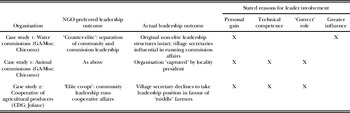
In sum, elite domination of project decision-making was actively discouraged by GA-Moz but generally favoured by CDG. The positions taken by the case study NGOs, as well as the leadership outcomes for the organisations that they introduced, are summarised in Table 1.
Leadership outcomes for newly introduced organisations

Table 1 shows that all newly introduced organisations were ‘captured’ by community leaders in ways that were not intended by the NGOs. In the case of water commissions in case study 1, respondents reported that the original leadership structures were still intact within the majority of organisations. However, commission members struggled to maintain water pumps and had increasingly sought out bairro secretaries to help resolve water management disputes between themselves and community members that resulted. It was widely believed by respondents that this was the correct role for a secretary as water was something that was available for everyone and this was analogous to the secretary's function of being ‘one of the people’. It was also suggested that the presence of problem-solvers within the secretary's group would increase the ability of community-based authorities to settle water-related disputes.
In the case of animal commissions in case study 1, the system of decentralised, non-elite management intended by the NGO had been replaced by a centralised animal management group run by the locality's president. According to GA-Moz's fieldworkers, the president's interest in the commission stemmed from the high economic value of the good being managed, and the prestige associated with cattle-ownership in southern Mozambique in general (cf. van den Berg Reference Van den Berg1987). The NGO attempted therefore to establish a link between elite interest in commissions and personal gain. The president, however, rebuffed this claim, stating that it was his ‘duty’ to take charge of the commission, a belief consistent with his historical role as the main ‘provider’ to the local population. This position was reinforced by the majority of community-based respondents who stated that the president had assumed this role due to his ‘expertise’ in animal husbandry. The overall message here was that, given the high value of the good under management, it was only fitting that an individual who commanded high levels of respect should be assigned the task. In the first case study, therefore, an association was created between the nature of the good being managed and local leaders’ status in community affairs.
In the second case study, a bairro secretary and vice-secretary were initially elected by the local population to run the cooperative as CDG intended. However, contrary to expectations, the community-based leaders declined to take up the positions. Publicly, they stated that they were ‘too busy’ running bairro affairs to take on any extra responsibility but, in later interviews, expressed doubts about the viability of cooperative forms of agriculture, citing past limitations and mistakes made by Frelimo in the region in the 1980s (cf. Coelho Reference Coelho1998). The secretary explained: ‘In the past under Frelimo we had large state farms and these provided the people with all that they required. I was often involved in informing the people about these activities, and organising them [for work]. But the cooperatives in this region were not so successful … I learned the hard way that they do not deliver and now I don't involve myself in them.’ The careful consideration shown in this quotation by the secretary about which types of external investment to support reflects the important role they can play in building the legitimacy and reputation of a local leader. In this case, the secretary backed an alternative group of cooperative leaders who represented ‘middle farmers’. The parents of these individuals had been part of the registo dos agricultores Africanos (Register of African Farmers) established by the Portuguese authorities in the region in the 1950s in an attempt to create a class of peasants who would produce for the market (van den Berg Reference Van den Berg1987). Middle farmers were not officially recognised by the socialist Frelimo administration but captured many government-mandated collective forms of production in the late 1970s and 1980s nonetheless as a route to capital accumulation (Harris Reference Harris1980; Dinerman Reference Dinerman2001). This was found in Jofane where, according to CDG interviewees, ‘capture’ by middle farmers occurred as they sought out personal gain. In this region, therefore, CDG essentially found itself organisationally allied to middle-income farmers. However, most non-elite cooperative members disagreed with this analysis, stating that former privadores were well-placed to run the cooperative due to their experiences of ‘modern’, irrigated agriculture.
In sum, elite capture of NGO projects was commonplace, although the variety of explanations offered for its occurrence were far more diverse than those suggested by the CDD-elite capture literature. NGO personnel often described a ‘push’ from elites to gain political and material benefits from newly established organisations, but many community members offered an alternative view, explaining how elites were ‘pulled’ into such organisations by newly elected leaders. This suggests that elite involvement in projects can represent a logical response to the complex demands placed on organisations during CDD, in addition to a bid to gain materially and politically from externally initiated programmes.
Project benefits capture by elites
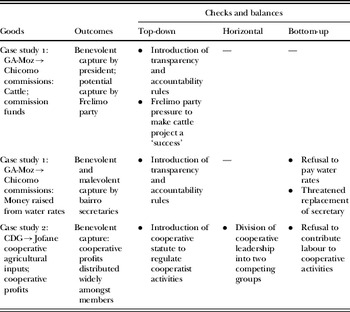
The previous section demonstrated that project capture occurred widely in the two NGO-initiated CDD projects. This section examines whether NGO-provided goods continued to flow to ordinary communities under these regimes, indicating that benevolent capture was taking place, or were seized by elite groups, implying malevolent capture. Table 2 summarises the elite capture outcomes in both case studies, and main checks and balances on elite activity that were found. As set out in the second section, checks and balances are classified as either ‘top-down’, ‘horizontal’ or ‘bottom-up’.
Elite capture outcomes, and checks and balances on elite behaviour

Table 2 shows the presence of both benevolent and malevolent capture in the case studies, as well as a variety of checks and balances in operation. In the case of the animal commission in case study 1, no evidence of malevolent capture of cattle or commission funds by the president was found in either NGO documentation or key informant interviews. GA-Moz reported, however, that cattle were being distributed by the president to Chicomo's better-off households and that this was evidence that the local representatives of the Frelimo party had captured the distribution programme. Indeed, the national Frelimo Party has a history of rewarding people who were loyal to it during the war (West & Myers Reference West and Myers1996). This finding reflects fears that community-based economic and political decentralisation is being used by Frelimo's national political elites as an inexpensive way of extending the state's reach into rural areas, thus helping to undermine Renamo political influence which is traditionally based in the countryside (Alexander Reference Alexander1997; Kyed & Buur Reference Kyed and Buur2006).
Because of these concerns, GA-Moz's fieldworkers attempted to retain partial control of the cattle allocation system via the introduction of ‘transparency and accountability’ rules aimed at ‘ensuring distribution…to a wide range of families, including more vulnerable female-headed households’ (GlobalAid 2006). This was important because, as one GA-Moz fieldworker explained, ‘cattle ownership helps to raise the status of women in the community relative to men’. However, the president was able to resist these attempts, arguing that better-off families should be prioritised as they were more capable of taking care of animals. Interviews with local Frelimo representatives revealed that the party was likely to be having a positive effect on keeping the president's activities in check. This is because ‘number of cattle distributed’ was a key indicator of local development success in the District Development Plan (Ministério da Administração Estatal 2005). As a local party representative, the president was more likely to be responding to these internal forms of checks and balances than external ‘accountability measures’ imposed by the NGO.
Although top-down accountability measures exerted by GA-Moz appeared to be relatively ineffective, there was more success in the case of CDG's cooperative in the second case study where no evidence of elite capture of project benefits could be found. This is partly because cooperative forms of organisation were relatively familiar to cooperatists, and this allowed group norms of behaviour to be relatively quickly established by the intervening NGO. However, evidence from across SSA shows that even well-organised cooperatives have been prone to elite ‘takeover’ (Bingen et al. Reference Bingen, Serrano and Howard2003), and the presence of a statute by itself cannot explain the absence of malevolent elite capture. In this case, uncertainty over cooperative leadership following the secretary's resignation created the necessary space for a competitive political system to emerge. This consisted of cooperative leaders, which, as described in the previous section, consisted of ‘middle’ farmers, and a small group of former community secretaries that had banded together in response to the NGO intervention. This split reflects old divides that were observed within the 1980s within cooperatives between party and state officials on the one hand and cooperative leaders on the other hand (Coelho Reference Coelho1998). The group of former secretaries regularly attended Union meetings and challenged the organisation's leaders on a range of issues varying from the reporting of cooperative accounts to use of the tractor. This split was possible as there was greater overall capacity amongst local leaders in Jofane compared with Chicomo due to the history of investment in the region.
These arrangements were reinforced by ordinary cooperatists who were able to maintain a degree of control over elite activities through the withdrawal of cooperative behaviour. This was possible because, according to Dinerman (Reference Dinerman2001), the main reason ordinary people have historically engaged in cooperatives in Mozambique is to spread income risk. This suggests that farmers position themselves relative to cooperatives depending on what they can gain from their participation, not according to the dominion of their leaders. For this reason, mobilising people for important work on collectively managed land such as irrigation or application of pesticide can prove difficult. This was observed by Wardman (Reference Wardman1985) and Bowen (Reference Bowen1989), and also reflected present-day attitudes amongst cooperatists in the second case study who viewed their participation in group-based work as conditional upon an ongoing flow of monetary benefits towards them. Withdrawal of labour from the cooperative was therefore an effective way for people to exert control over the Union leadership. It reflects the argument advanced by Pitcher et al. (Reference Pitcher, Moran and Johnston2009) who stated that the act of ‘buying’ support from clients by patrons is more difficult than often presumed.
Although elite capture of projects was observed as relatively benign in the cases of the animal commission and the cooperative, respondent attitudes towards water commissions in case study 1 were found to be more mixed. According to GA-Moz, commission positions were strictly ‘voluntary’, and use of water funds by commission members for personal gain was referred to by agency personnel as ‘eating’. This reflects Berman's (Reference Berman1998) reference to Africa's politics as focused on ‘devouring’, or getting one's share of resources, or Bayart's (Reference Bayart1993) ‘politics of the belly’. Some commission personnel acknowledged that funds had been removed from their organisations’ coffers in this manner, but justified this as payment for their work. Community members, on the other hand, held mixed views about the use of commission funds in this way, with some interviewees condemning leaders’ activities, and others offering their leaders support in spite of on-going elite misappropriation. This latter example illustrates how ‘benevolent’ and ‘malevolent’ can mean different things to different people, and draws attention to the need to understand who is defining such terms in studies of elite capture.
Some commentators have observed in southern Africa that accountability to the local community by user committees is often lacking or weak (Matose 2009). This appeared to be the case in the first case study where NGO-introduced rules around recording and reporting funds were largely ignored by commission members. One NGO member explained how local elites were able to manipulate such arrangements: ‘The people who work in the water commissions hide the registration of the money to take advantage. When you ask for the accounts, they say: ‘we lost them’, or ‘the money is with this or that person’. If you have everything registered then the loss of money will be easier to find. When the money is passed from one person to another, a quantity is always taken out.’ This does not mean, however, that ordinary community members were powerless in the face of such problems. Over half of respondents interviewed acknowledged that commission members were struggling to maintain water services under difficult circumstances and that leaders deserved some form of financial compensation for their efforts. Others, however, reported that they had ceased paying their water rates in protest, with the result that the organisation was chronically underfunded. This form of ‘passive’ resistance to elite domination was similar to that which was occurring in the case of the cooperative. In addition, a smaller number of respondents stated that there was a need to ‘remove’ their secretary as a consequence of these failings. Although this threat had yet to be carried out, key informants reported that some community members had begun a campaign to remove their bairro leader on the basis of ongoing water management problems.
In these cases, the ability of NGOs to impose externally devised checks and balances onto communities was mixed. In the first case study, they were found to be relatively ineffective as user-based commissions represented relatively unfamiliar ways of working to the communities involved. The tendency, therefore, was for these NGO-initiated groups to be drawn into local governance arrangements relatively quickly where externally introduced ‘transparency’ procedures could be easily manipulated. In this way, commissions appeared to replicate social relations that were already present in the community, acting as an extension of the local-level politics rather than as arenas in which new arrangements of actors could be realised (cf. Coelho & Favareto Reference Coelho and Favareto2008). In the second case study, the union statute drawn up by CDG proved more effective in regulating elite activities, although cooperatists had an historical template on which to work, and this led to the replication of old elite–non elite relations that had played out in the Chokwé region in the past. However, these externally introduced accountability arrangements are only a part of the picture. As Table 2 shows, there were a range of alternative checks and balances in place, some of which proved relatively effective in regulating elite activities, but which were rarely taken into account or encouraged by the intervening NGOs.
CONCLUSION
This paper has made two main contributions to the literature on elite capture and CDD in rural SSA. First, it has provided yet another illustrative example of the ubiquity of elite control within community-based development projects. In doing so, the paper concurs with previous research which showed that the effects of elite control can be both benevolent and malevolent. Moreover, it supports Fritzen's (Reference Fritzen2007: 1373) argument concerning the limitations of ‘CDD design features’. In both cases examined here, NGO ambition to control elite activities to bring about preferred development outcomes was not matched by the reality on the ground where local institutional arrangements and power configurations quickly overwhelmed the prescriptive practices of the intervening agencies. Such ‘reality gaps’ between NGO aspiration and real-life complexity have been explored elsewhere (Hulme Reference Hulme and Booth1994; Marriage Reference Marriage2006). Their presence adds weight to the suggestion that the ‘if-then’ propositions of ‘new institutionalists’ concerning design of effective decentralised community-based governance structures are limited in their applicability on the ground (Ribot & Oyono Reference Ribot, Oyono, Wisner, Toulmin and Chitiga2005).
Second, through detailed empirical research, the paper has critically examined the theory of patrimonialism itself as the underlying basis for studies of elite capture in CDD projects. The findings show that community-based elites contextualised within their specific historical trajectories have varied and complex motivations that cannot be reduced to the ‘timeless’, static image created by Platteau and Abraham (Reference Platteau and Abraham2002). In Mozambique, concerns expressed about Frelimo's domination of national politics (Carbone Reference Carbone2005) have been qualified recently by the suggestion that party leaders operating in elite business networks might in fact offer the best chance for significant future economic growth (Hanlon & Mosse Reference Hanlon and Mosse2010). Similarly, this research found little evidence that local Frelimo Party representatives within communities were acting as an impediment to rural development through neopatrimonial self-interest. This was due to both a paternalistic attitude towards non-elites and pressure from higher up the Party hierarchy to be seen to be ‘delivering’ development. These findings are aligned with Bernard et al. (Reference Bernard, Collion, De Janvry, Rondot and Sadoulet2008) who argued that elite capture in West African village societies was unlikely due to a predominant cultural concern with egalitarianism in benefit sharing.
The findings also show that community leaders rely upon the acceptance of the communities that they govern. These more passive, bottom-up forms of control might be some way off from the local democratic procedures of local leadership elections and claims groups desired by NGOs (Thorp et al. Reference Thorp, Stewart and Heyer2005). However, when combined with other horizontal and top-down indigenous control measures, they can exert significant influence on the activities of local elites. Again, this contrasts to Platteau & Abraham (Reference Platteau and Abraham2002: 122), who portray non-elites as relatively powerless as their leaders are transformed into ‘all-powerful patrons’ by external NGOs. In both case studies, non-elites were found to be challenging individuals in authority structures rather than the dominant structures themselves. As one anonymous reviewer of this paper suggested, this conclusion has consequences for how we understand politics in Mozambique where oppositional forces that question Frelimo dominance appear to have weakened alongside a strengthening of the spaces for critique of individual office-holders due to, for instance, programmes of decentralisation and community consultation (Sumich Reference Sumich2010). There is a need for more research into where the limitations of poor people's ‘weapons of the weak’ lie, and the extent to which they can transform local systems of elite control.
What does this research tell us about the emerging theoretical literature on patrimonialism? The Mozambican case suggests that the patron–client relationship is too often understood in an overly clear-cut manner. This is for two reasons. First, explanations for the failures of CDD interventions cannot be reduced to the rational self-interest of patrons stemming from vague sets of notions around ‘traditional relations’ in African rural society. Instead, there is a need to look more broadly at other structural influences on the nature of village-based relations of reciprocity and mutualism, for example the role of state formation (MacLean Reference Maclean2010) or regional economic transformation (Lange Reference Lange2010). Second, studies of African rural development interventions need to more rigorously take on board processes of negotiation between actors operating within networks of dispersed power (Long & Long Reference Long and Long1992). Such elite networks can be constituted both horizontally and vertically, as explored for example by Veron et al. (Reference Veron, Williams, Corbridge and Srivastava2006) in the case of community monitoring of poverty-alleviation schemes in eastern India. An actor-oriented analytical lens provides greater scope for the critical scrutiny of the capacity of patrons to ‘buy clients’. Future empirical work in this area could explore further the extent of patron power over clients, and the ways in which these processes are mediated by the ‘specific histories of debate and interaction among farmers, traders, headmen, officials and their relatives and associates’ (Berry Reference Berry1993: 65).
This research also has implications for development agencies conducting CDD interventions. As deGrassi (Reference DeGrassi2008: 118) argues, in SSA ‘many texts on neopatrimonialism discount rural and local politics of resistance’. The case studies suggest, however, that development agencies should be cautious about automatically assuming the prevalence of malevolent elite capture and its ill-effects. This is because relatively effective institutional structures might already exist – structures that endure due to their historical legacy – with which external interveners can work. Perhaps, therefore, the answer lies in following Bebbington et al.'s (2004) example of investing more upfront in extended qualitative research to investigate local power relations and dynamics prior to intervention. In Mozambique, this could involve controlling for different socioeconomic variables and development agency approaches in other regions of the country where Frelimo is less dominant and ethnic differences more apparent. In light of limited resources and competing priorities in CDD, NGOs could replace Platteau & Abraham's (Reference Platteau and Abraham2002) ‘institutional organisers’ for the ‘complete transformation of society’ with ‘institutional investigators’ to make the most of what is already present.